11
Benchmarking Space Usage in Higher Education Institutes: Attaining Efficient Use
Shahabudin Abdullah1, Hishamuddin Mohd Ali2 & Ibrahim Sipan3
Universiti Teknologi Malaysia
Abstract
This paper proposes to benchmark the performance of space management in Universiti Teknologi Malaysia (UTM). The main objective of this paper is to measure the efficiency of space management for Higher Educations Institutes (HEIs) through benchmarking the space utilization for teaching and learning rooms. The data was collected through interview, questionnaire, as well as secondary sources such as books, journal, article, and previous research. This research is analyzed by using both qualitative and quantitative technique. Results from analysis show that faculties in UTM vary from 11.34% to 98.16. Furthermore, some effective space management method was listed out through analyzing space management system of these faculties and interview with the officer in-charge for each faculty. Few methods were suggested for improving space management performance in UTM, including review and evaluation on space management system; development of better space management system and staff training; lease out teaching space, and establish centralized computer rooms to replace current computer rooms.
12 INTRODUCTION
In any institution of higher education, space within its organization is the most expensive assets owned for it is essential to the performance of almost all of their activities. With escalating construction cost, bad economic circumstance and increased enrolments, there is ever rising pressure on higher education institutions to manage the usage of existing space more effectively before constructing new, costly buildings.
An efficient facility management system is not only able to utilize the use of the facilities but also can help to manage the resources needed in the management process. Space management is an essential strategic and operational activity that delivers vital function in building a balanced, competitive and sustainable business. However, quality academic facilities should accompany with efficient facility management system. Many universities have started to use advanced facility management software in managing space to optimize its utilization and improve existing management system Gabriel (2003).
Ramachandran (2002), states that as an infrastructure, which support individual in an organization to achieve their vision, academic facilities play a vital role in Universiti Teknologi Malaysia (UTM) whole envision is to become a world-class university. In order to achieve its vision to become a world-class university, one of the conditions that need to be fulfilled by UTM is that they need to have quality academic facilities. In order to become a quality university, UTM also needs to improve the upkeep of buildings by having an efficient facility management system. This will not only improve the quality of the academic facilities, but it can make the management process becomes more cost effectiveness as well.
Nutt (2002), states that the primary function of facility management is resource management, at strategic and operational level of support. Facilities management can be further divided into different field such as security management, maintenance and operational, emergency management, space management and so on (Downie, 2005). The main objective of this study is to measure the efficiency of space management for Higher Education Institutions (HEIs) through benchmarking their room utilization. Apart from that, the aim of this paper also to identify the criteria of an effective space management is from management point of view.
THEORETICAL BACKGROUND
Space management can be described as the capability to allocate space to a specific user and / or for a specific usage (Newcastle University, 2007). Facilities Management (FM) may also refer to the ability to suggest renovations and alterations to the space that may improve it; change its use, and / or change its assignment criteria. The scope of space management includes facility or master planning, space planning, space configuration and reconfiguration, space allocation, utilization and relocation, as well as space use audit and monitoring.
Space management is more than evaluation of space needs. It relates to space planning, management process and space utilization in determining exactly how many people will the facilities adequately support. The primary aim of space management is to make the most efficient and effective use of space, equipment and furniture, during the present time as well as in the future. According to Rourke and Brooks (1999), the allocation of space is a matter of distributing scarce or limited resources and it involves decisions about programs and priorities. Space management also provides is an environment for which enable the biggest cost and most important asset of the organization, and its people to operate (Abdul Rahman, 1999).
13
With efficient space management, HEIs can plan, configure and reconfigure, allocate and reallocate, audit and monitor the use of space more effectively. However, poor space management will bring negative impacts to both the end-user of the space in HEI as well as the administrative of the HEI. Many HEIs are facing common space management problem such as low utilization rate for teaching space and usage of space mismatch with its design. Space management problems exist because HEIs do not know; yet does not treasure the essentials of space management. TEFMA (2009), states that space management is about using standards and benchmarks and planning models to measure how well space is being used and to plan for future needs. According to Minior, Hanafin, & Bringhurst, (2001), the space management process relies on both qualitative and quantitative analyses to provide widespread information on all research groups.
Space Management in University
In order to ensure cost effective and reliable delivery of services in the university environment, the adoption of the best practice of space management is very important, covering the planning, acquisition, operation, maintenance and disposal in the asset’s whole life cycle. The university's objective is to maximize all useable space while providing an environment, which supports its activities and creativity.
Increasingly the teaching and learning spaces need to be responsive to the changing demands of a leading university, and so space should be designed to be flexible and planned on the basis of functional in order to encourage effective utilization. The key aim of space management is to effectively manage a dynamic and limited resource in order to support academic activity, minimize cost and achieve maximum and efficient design, planning and use of the institution’s space.
In managing the use of space in physical buildings, three concepts are essential. The concepts of space inventory, measuring utilization, and future space needs must be understood first before further analysis is being carried out. Space inventory deals with knowing how much space is available. Measuring utilization on the other hand, is regarding knowing how to use space effectively by looking at frequency and occupancy rates. Space management is also concerned how with we can estimate how much space of what types will be needed at some point in the future.
According to Space Management in Higher Education Report (2002), two prerequisites for increased efficiency are sophisticated data analysis and space usage planning and analysis. With increasing demand on existing available space in university, space management has to look into the area of space utilization. Essentially, the administration of space utilization falls into the following categories: Space Analysis and Planning, Assignment and Scheduling of Facilities for Academic Classes, Assignment and Coordination of Facilities for Purposes of Office, Research and Storage Space, and Administration of facility utilization for purposes other than regular credit classes. A second criterion is looking on space usage planning through addressing types of space for HEIs. There are academic space, public use space, and administrative space. This research will address on academic space only. For academic space, there are several types of spaces. Among them are lecture halls, classrooms, tutorial rooms, seminar rooms, computer laboratories, workshop and general laboratories, and studios.
Space Management Standard and Practice
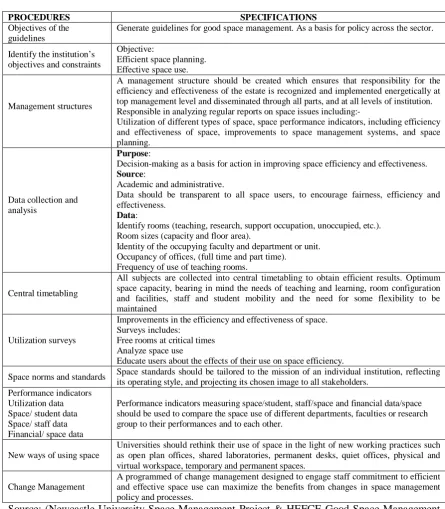
Space management is about using standards, benchmarks and planning models to measure how well space is being used and to plan for future needs. Standards are a ‘bottom up’ approach and define the area required to perform a particular function or activity. Table 1 shows procedures of a good space management being used in UK universities.
14
benchmarking has become commonplace it remains a relatively recent phenomenon (Ahmad & Rafiq, 1998).
Table 1: Procedures of Good Space Management Practice in University
PROCEDURES SPECIFICATIONS
Objectives of the guidelines
Generate guidelines for good space management. As a basis for policy across the sector.
Identify the institution’s objectives and constraints
Objective:
Efficient space planning. Effective space use.
Management structures
A management structure should be created which ensures that responsibility for the efficiency and effectiveness of the estate is recognized and implemented energetically at top management level and disseminated through all parts, and at all levels of institution. Responsible in analyzing regular reports on space issues including:-
Utilization of different types of space, space performance indicators, including efficiency and effectiveness of space, improvements to space management systems, and space planning.
Data collection and analysis
Purpose:
Decision-making as a basis for action in improving space efficiency and effectiveness. Source:
Academic and administrative.
Data should be transparent to all space users, to encourage fairness, efficiency and effectiveness.
Data:
Identify rooms (teaching, research, support occupation, unoccupied, etc.). Room sizes (capacity and floor area).
Identity of the occupying faculty and department or unit. Occupancy of offices, (full time and part time).
Frequency of use of teaching rooms.
Central timetabling
All subjects are collected into central timetabling to obtain efficient results. Optimum space capacity, bearing in mind the needs of teaching and learning, room configuration and facilities, staff and student mobility and the need for some flexibility to be maintained
Utilization surveys
Improvements in the efficiency and effectiveness of space. Surveys includes:
Free rooms at critical times Analyze space use
Educate users about the effects of their use on space efficiency.
Space norms and standards Space standards should be tailored to the mission of an individual institution, reflecting its operating style, and projecting its chosen image to all stakeholders.
Performance indicators Utilization data Space/ student data Space/ staff data Financial/ space data
Performance indicators measuring space/student, staff/space and financial data/space should be used to compare the space use of different departments, faculties or research group to their performances and to each other.
New ways of using space
Universities should rethink their use of space in the light of new working practices such as open plan offices, shared laboratories, permanent desks, quiet offices, physical and virtual workspace, temporary and permanent spaces.
Change Management
A programmed of change management designed to engage staff commitment to efficient and effective space use can maximize the benefits from changes in space management policy and processes.
Source: (Newcastle University Space Management Project & HEFCE Good Space Management Practice Programme (2002)
15
Benchmarking involve continuous process of comparisons with other organizations to learn the lessons that those comparisons throw up. Benchmarking has an internal and external dimension, whereby for internal dimension the organization critically examines itself in search of best practices. The external dimension of benchmarking is where the organization searches its industry and other domains in an attempt to identify external competitive benchmark that may then be implemented it its operating environment.
RESEARCH METHODOLOGY
Basically, this research will be conducted by using a benchmarking methodology. Apart from that, data will be gathered using questionnaires and interviews.
Data Collection
In this study, both primary and secondary data are collected. The primary data is collected trough gathering planned timetabling, room capacity, and student enrolment for all the faculties in UTM. The opinion and suggestion from property managers are collected through open ended and structured interview. The secondary data is all the theories that relate to space management reviewed through journal and past report.
Techniques of Analysis
Descriptive analyses were used for quantitative analysis while content analysis will use for qualitative analysis. For descriptive analysis (quantitative analysis), mean score will be used as an analysis tool. Content analysis is a research tool used to determine the presence of certain words or concepts within texts or sets of texts. According to Harrington (1996), the benchmarking process should be well planned to ensure that the study is feasible and can be conducted smoothly. Table 2 shows benchmarking methodology adopted for this research.
Table 2: Benchmarking methodology adopted for this study
Phase 1: Identify
Identify functions to be benchmark
Identify key performance variables to measure Determine whom to compare against
Establish data collection
Phase 2: Data Collection Preparation for site visit Develop a questionnaire survey
Phase 3: Analyzing Data
Measure current performance
Measure performance of competitors, determine gaps and reasoning.
Phase 4: Adapting and Improving
Develop action plans
Implement actions and monitor progress Recalibrate benchmarks over time Set goals to close, meet and exceed gap Source of data: Fieldwork
RESEARCH FINDING AND DISCUSSIONS
This section will discuss and elaborate on research findings. The discussion is based on the objectives for this paper. For the first objective, this paper tries to measure the efficiency of space management by using benchmarking technique and analysis. As for second objective, it will explore the views of administrator regarding managing space management effectively.
16
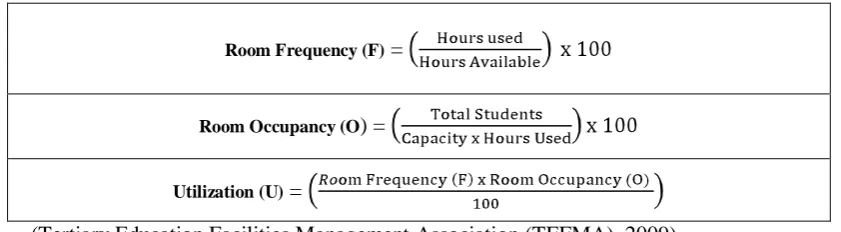
Table 3 elaborates further on UFO’s terminologies and Table 4 shows an example of how to calculate UFO’s for a room.
Table 3: Space Utilization Rate Formula
Room Frequency (F) =
Room Occupancy (O) =
Utilization (U)=
(Tertiary Education Facilities Management Association (TEFMA), 2009)
Table 4: An Example of UFO calculation
UFO calculation for Room A
Room capacity: 80 Hours used: 22 hours Total students: 1102
Time/Day
1 2 3 4 5 6 7 8 9 10
7.00 8.00 9.00 10.00 11.00 12.00 13.00 14.00 15.00 16.00
Monday 1(50) 2(50) 3(52) 4(52) 5(51) 6(51) 7 8
Tuesday 9 10 10 12(42) 13(44) 14(44) 15(43) 16(43)
Wednesday 17 18 18 20(40) 21(38)
Thursday 22 23(50) 23(50) 25(55) 26(55) 27(45) 28(45) 29
Friday 30(80) 31(80) 31(80) 33 34 35
Table 4 gives an example of calculating UFO for a room with the capacity of 80 students per hour. From the table, out of the possible 35 hours meeting per week (room usage from 8.00am until 5.00pm.), the room is only being used for 22 hours per week. Given that information, we can derive the frequency rate by using the formula as in table 3 (F = 22/35 x 100 = 62.86%). Based on Table 3, we can also derive the occupancy rate and utilization as well. From this example the occupancy rate is 39.357% (O = 1102 / (80 x 35) x 100). Figure 1102 is derived from the number of students using the rooms for 22 meeting hours (adding all the numbers in the parenthesis). The utilization rate is 24.739% (62.86% x 39.375 / 100). The calculation of UFO is then being calculated for all rooms for 12 faculties in UTM.
RESEARCH ANALYSIS
Based on benchmarking methodology above, after identifying UFO as performance function that need to be benchmarked, next step is to identify benchmarking partner. This paper examines the use of internal benchmarking, whereby the partners for UFO’s performance will be the faculties in UTM. Table 5 shows the UFO’s rate for all the faculties/department in UTM for semester two (2) 2008/2009.
17
Table 5 also shows that the frequency rate for Faculties A, J, and K is above 100% (109.14%, 131.11%, and 108.91% respectively). Faculty A, having the number of teaching and learning rooms of 15 units with total available contact hours of 525 hours per week (15 rooms x 35 contact hours per room), but for total hours used is 573. This is due the space usage outside the designated 35 hours as illustrated in table 4. The same applies for Faculty J and K. Faculty J, the weekly space usage is 413 hours as compared to 315 hours of available contact hours (9 rooms x 35 contact hours per room). While for faculty K, the weekly space usage is 648 as compared to 595 hours (17 rooms x 35 contact hours per room). The great variations in utilization rates (the lowest of 11.34%, to the highest of 98.16%) making comparing or benchmarking between faculties becoming more subjective.
Table 5: UFO’s rate for respective faculties
UFO rates for perspective faculties for session 2008/2009 - December Facult y No. of room s Hour s used Hours availabl e Room occupie d Rooms capacit y Utilizatio n rate Frequenc y rate Occupanc y rate
A 15 573 525 42637 108500 42.89% 109.14% 39.30% B 16 391 560 16584 36400 31.81% 69.82% 45.56%
C 3 86 105 3838 10500 29.94% 81.90% 36.55%
D 31 705 1085 30764 86800 23.03% 64.98% 35.44% E 25 699 875 30212 74200 32.53% 79.89% 40.72% F 19 521 665 21475 65100 25.84% 78.35% 32.99% G 31 856 1085 30781 61950 39.20% 78.89% 46.69% H 24 474 840 18142 50925 20.10% 56.43% 35.62% I 32 497 1120 17484 68425 11.34% 44.38% 25.55% J 9 413 315 18605 24850 98.16% 131.11% 74.87% K 17 648 595 27001 48650 60.44% 108.91% 55.50% L 26 646 910 22709 67200 23.99% 70.99% 33.79% UTM 248 6509 8680 280232 703500 29.87% 74.99% 39.83%
To further elaborate the differences in UFO’s rate, the faculties will be divided into three different fields of study. These fields are engineering, science and technology and social science. These fields are based on departmental based space ownership (decentralized space usage). In order to benchmark between centralized and decentralized space, another field is put in place. This field is centralized rooms.
Table 6 shows the UFO’s rate for faculties that are grouped into three fields of study. Based on Table 6, centralized lecture halls having the highest utilization rate (42.89%) while the lowest utilization rate is in the field of social science (24.54%). The variations of these figures are due to the variation in frequency and occupancy rate for the space usage.
Table 6: UFO’s based on field of study and centralized space
UFO Rates for respective fields of study for session 2008/2009 - December Fields of study/Centralized rooms No. of rooms Hours used Hours available Rooms occupied Rooms capacity Utilization Rate Frequency rate Occupancy rate
Centralized rooms 15 573 525 42637 108500 42.89% 109.14% 39.30%
Engineering 106 2781 3710 113232 288050 29.47% 74.96% 39.31%
Science and
Technology 86 2245 3010 88274 213675 30.81% 74.58% 41.31%
Social science 41 910 1435 36089 93275 24.54% 63.41% 38.69%
UTM 248 6509 8680 280232 703500 29.7% 74.99% 39.83%
18
While for occupancy rate show the variation of 38.69% up to 41.31%. Based on TEFMA (2009), the target room frequency and occupancy of 75% respectively. This will give the target utilization of 56% (75% x 75%). Based on space planning guideline TEFMA (2009), and compared with Table 6, utilization rate for UTM (29.87%) is well behind anticipated 56%. This is due to the occupancy rate 0f 39.83% as oppose to frequency rate of 74.99%. In order to increase utilization rate, UTM should think of increasing the occupancy rate from 39.83% to at least 75% as suggested by TEFMA. In order to do so, UTM must increase the occupancy of 280232 to 527625 out of possible 703500 room capacity.
Second objective of this paper is to identify and examine at the criteria of an effective space management. Based on the survey results from management officers, the criteria of effective space management has been made and represented in the table 7.
Table 7: Criteria of effective space management
Item Method for effective space management
Staff involvement and competency
Depends on the size of the faculty.
Staff or officer involved in space management should have relevant knowledge on space management
Classroom arrangement Consider the ratio between classroom capacity and number of student.
Traveling time between two rooms should be minimized
Use of software If software were used, it is necessary to have at least a staff that can master the use of software to make sure that the software can play its role.
Managing space during break
Rent out the space in order to increase room frequency and generate income for faculty.
Cooperate with other organizations that need venue for organizing events.
Space management evaluation
Current space management system must be reviewed and evaluated regularly.
The frequency of review should base on the ability of the faculties.
The table shows five (5) criteria of having an effective space management. These criteria of staff involvement and competencies, classroom arrangement, the use of software, managing space during break, and space management evaluation. Based on interviews, the space management evaluation must be addressed properly in order to increase the utilization rate. Apart from that, classroom arrangement plays a vital role in determining the room’s capacity.
DISCUSSION
Based on benchmarking process as outlined in Table 1, UFOs has been identified as the performance that needs to be benchmarked. This paper used internal benchmarking in order to understand the performance of space utilization internally. Twelve (12) faculties have been chosen as benchmarking partner. However, due to a large variation of utilization rate for those faculties, the data then is grouped based on their fields of study.
Table 5 and 6 discussed the benchmarking of UFO’s for those faculties and fields of study. Table 6 clearly shows that utilization rate for engineering, science and technology, and social science are below the UTM average utilization rate. Based on Table 5, the UFO rate for UTM is 29.87%, 74.99% and 39.83% respectively.
The low utilization rate is due to lower occupancy rate as opposed to frequency rate. In order to increase the utilization rate, UTM needs to look at the strategy on how to increase occupancy rate for the faculties. Based on Table 6, in order to increase the occupancy rate, UTM can centralize room usage. By doing so, the frequency rate will also be increased as the room/space will be used by all of the students rather than by their respective faculties only.
19
• Top management strategy
• Space management guideline in early stage to develop and apply
• Current vision and mission increase the utilization rate
• Intention to apply sustainable management approach
• Faculties and departmental factors
• No control on student intakes
• Syllabus contents (second semester for each study session is the time for industrial training for some faculties. This is strongly contribute to the drop number of occupants)
• Incomplete of T&L database
• Unstandardised centralized timetabling system
• Person who in charges in space management in Faculties/ department have no background of this field
• Low understanding of space utilization
• It is difficult to share other rooms in other faculties/ department because of limited rooms
• Lectures/ students factors
• Like to use certain rooms
• Limited information of faculties/ department T&L rooms
• The space itself
• Some space have not meet the T&L requirements
• Space with high capacity but filled with small number of occupants contributes to the low UR
• A limited number of T&L rooms in such faculties encourage the maximum usage of the space
CONCLUSIONS AND RECOMMENDATION
Space utilization survey can be used as a study to examine UFO’s rate for building space. In this research, UTM Skudai has achieved above fair rate for the whole components of UFO’s rate. Occupancy rate (O) contributes as the main factor influencing the utilization rate. Further research need to be carried out in term of benchmarking among HEIs. Another suggestion is to broaden the scope of study to examine offices space. Also, it is suggested to vary the ways or survey based on type of space usage such as labs, lecture halls and so on. A real time survey is one of the ways to enhance the quality of data.
As a conclusion, existing space resources must be utilized. Effective and efficient management of this resource not only can reduce operating cost, but also can sustain the physical and the function of the spaces. Therefore, all related units should play their roles lies in meeting the needs of currents way of life, to sustain our resources, include existing building spaces.
REFERENCES
Abdul Rahman, F. (1999). Space Management. Kursus Pengurusan Hartanah dan Fasiliti, 20 – 23 September INSPEN, Malaysia. Unpublished lecture notes.
Ahmad and Rafiq (1998) Ahmed, P. K., & Rafiq, M. (1998). Integrated Benchmarking: A Holistic Examination of Select Techniques for Benchmarking Analysis. Benchmarking for Quality Management & Technology, 5(3), 225-242.
Downie, M. L. (2005). Efficiency Outcomes from Space Charging in UK Higher Education Estates. Property Management, 23 (1), pp. 33-42.
Gabriel, G. C. (2003). Decentralizing Asset Management in a University Environment Using Web Enabled Technology. Facilities. Vol. 21(10), pp. 233-243.
20
Minior, Hanafin and Bringhurst (2001) Minior, S., Hanafin, N., & Bringhurst, F. R. (2001). Research Space Management- A Dynamic Process for Optimal Space Utilization and Strategic Planning. Massachusetts General Hospital, Boston.
Newcastle University Space Management Project & HEFCE Good Space Management Practice Programme. (2002). Space Management in Higher Education.
Newcastle University. (2007). Report of Space Management in Higher Education. Newcastle University. Newcastle Upon Tyne: Newcastle University.
Nutt (2000) Nutt, B. (2000). Four Competing Future for Facilities Management. Facilities, 18 (3/4), pp. 124-132.
Parker, C. (2000) Performance measurement-Work Study, Vol. 49 (2), pp.63 - 66
Ramachandran (2002). Faciliti Akademik bagi Organisasi Pendidikan Bertaraf Dunia. Universiti Teknologi Malaysia. Johor Bahru: Unpublished.
Rourke, F. & Brooks, G. (1966). The Managerial Revolution in Higher Education. Baltimore: The Johns Hopkins Press, pp. 87.