Secure Communication in VANET Broadcasting
Muhammad Jafer, M. Arif Khan, Sabih ur Rehman and Tanveer A. Zia
School of Computing and Mathematics Charles Sturt University, Australia
[email protected],{mkhan, sarehman, tzia}@csu.edu.au,
Abstract
Broadcasting is a communication mechanism utilized in VANET architecture that facilitates in disseminated of public information to help reduce traffic jams/congestions. The authentic and genuine nature of public information is required to be maintained to avoid broadcasting of false information causing mass panic and hysteria. Therefore, it is of utmost importance to secure the broadcasting information so that an intruder is unable to alter any information without compromising public nature of the information. In this paper, we have proposed a secure broadcasting architecture consisting of different layers stacked together in different formation according to operating modes. A real-time simulation model is developed in Python, while simulations are run on a supercomputer for the purpose of gathering results for highway environments. We compare the results of the proposed secure highway architecture with unsecure architecture. Overall, the results show delayed propagation time due to the availability of multiple information packets as well as prioritization of these information packets. However, there was no significant difference in retransmission of different information packets when compared with either different broadcasting probability or unsecure highway scenario, which indicates an effective as well as efficient, secure broadcasting architecture.
Receivedon15 November 2018;acceptedon11 December 2018;publishedon21 December 2018
Keywords: VANETs,SecureBroadcasting,NetworkCoverage,InformationRetransmission,PublicInformation Copyright © 2018 Muhammad Jafer et al., licensed to EAI. This is anopen access article distributed under the terms of theCreative CommonsAttribution license (http://creativecommons.org/licenses/by/3.0/), which permits unlimiteduse,distributionandreproductioninanymediumsolongastheoriginalworkisproperlycited.
doi:10.4108/eai.10-1-2019.156243
1. Introduction
The revolutionary concept of connecting physical devices to the internet is a step towards increasing better services and products for end-user satisfaction. Among these devices, such as refrigerators, televisions, smart washing machines and many more, vehicles are one of the most important devices for modern-day commuters. Therefore, vehicles are at the forefront of new research capable of solving challenges related to traffic safety, congestion, accidents, and pollution [1–3]. The most important concept introduced in recent times is to establish a new type of mobile ad-hoc network for vehicles known as Vehicular Ad-hoc Network (VANET) [4]. In VANETs, the communication link between vehi-cles change frequently making the topology dynamic
∗
Correspondingauthor.Email: [email protected]
and vulnerable to security risks, which are the primary focus of our research.
Moreover, there are two main types of communica-tion supported in VANETS namely:Vehicle-to-Vehicle (V2V) and Vehicle-to-Infrastructure (V2I) communi-cation. In general, V2V communication is established among vehicles, whereas in the V2I scenario com-munication link is established between a vehicle and any roadside infrastructure, commonly known as Road Side Units (RSUs). In addition to this, communication scenarios in VANET can also be categorised as Point-to-Point (P2P) and broadcasting (BC) [5]. P2P com-munication can be defined as sharing the information between two vehicles. In this scenario, one vehicle acts as a source and the second vehicle acts as a destination. In BC scenario, a vehicle transmits information to all vehicles within a certain geographical area. The BC sce-nario used in this paper is different than the commonly used BC scenario in mobile wireless communication where a transmitter broadcasts different information for different users. In this paper, we use BC as a source
vehicle broadcasting the same information for multiple other vehicles.
We also classify the information to be transmitted into two categoriesprivateand publicinformation as explained below.
Private Information:- We consider information as pri-vate, transmitted using P2P communication system, if it is intended only for one single vehicle or it requires certain decryption process to extract the information from the transmitted signal. For the sake of simplicity, we assume that private information is intended only between two vehicles that resemble the P2P communi-cation scenario defined above.
Public Information:- On the other hand, public infor-mation is defined as the inforinfor-mation available for any vehicle within the network and it does not require any decryption process to extract the information from the transmitted signal. This scenario resembles BC commu-nication in VANETs as defined above.
It is of great importance to transmitting authentic infor-mation whether public or private, therefore it is crucial to secure the information. Unsecured information espe-cially public information can be misused causing mass hysteria and traffic jams. Whereas, when information is secured, it is difficult for intruders to alter the original message and hence lowering the risk of creating public panic(s).
The focus of this paper is to investigate and propose a secure broadcasting architecture for VANETs. The proposed secure broadcasting architecture facilitates in the implementation of strategies that avoid tempering of information during transmission. To the best of our knowledge, there currently exists no publications related to research studies proposing secure broadcast-ing systems or architectures. However, there is sig-nification research studies as well as publications in secure P2P communication. This paper builds on the lessons learned from secure P2P communication archi-tectures by applying them to secure public information in VANET broadcasting.
Following list consists of three main contributions put forward in this paper:
• Identification and categorization of security challenges related to broadcasting in VANETs.
• Proposing of a layer based secure broadcasting architecture to counter alteration in information during broadcasting.
• Implementation of the proposed secure broad-casting architecture and collecting results related to credibility index with respect to propagation time required by an information packet, Pinf o to achieve network coverage.
The rest of the paper is organized as follows. Section2 contains literature review of previous research, whereas
Section 3 describes the system model that is used in this study. A discussion regarding proposed secure broadcasting architecture is contained in Section 4, while operational flow of the architecture is presented in Section 5. In section 6, the numerical results are presented in detail. Finally, Section 7 concludes the paper.
2. Related Work
The main focus of this paper is to extend the security principles and techniques available in P2P communication to VANETs BC. Some of the major security challenges in VANET are bogus information, ID disclosure, and Sybil attacks. There are a number of solutions available for these security threats in the literature such as [6–13]. However, one common challenge in the literature is that it is mainly focused on P2P mobile ad-hoc networks. In order to integrate these security features in VANET BC, we have classify these feature into three groups: Authentication, Anonymity
andAvailability of resources, which is inspired by work put forward in [4,14–16].
Authentication is a process of validating both sender and associated message by receiving vehicle [14]. The validation process requires sender identification, which is defined by different properties such as location, direction, speed, and owner of the vehicle. The authentication mechanism helps to establish the reliability of the sender’s information, which ultimately provides the mechanism facilitating prevention of Sybil attacks in VANETs. In addition to this, the process of
anonymitydictates hiding sender information as well as encrypting this information to make it unreadable for unintended users. Sender vehicles that are either source or relay vehicles may be willing to share information provided a mechanism to avoid tracking of vehicles or sharing actual vehicle information. On the other hand, a secure system is also required to incorporate fault-tolerant design, resilient to attacks as well as survival protocols so for the purpose of remaining available and operational in the presence of faults or malicious attacks [14,17]. These three distinct groups of security threats are further explored with respect to P2P and BC systems in the following sections:
location authentication. ID authentication uses unique IDs, which are either license number or chaises number of a vehicle, for identification of a vehicle. The property authentication facilitates in identifying the type of sources, such as a vehicle or a traffic signal, on the other hand, location authentication identifies the location of a source allowing receiving vehicles to validate received information. Authentication is an effective process of identifying the source as well as validating transmitted information. However, this would compromise the anonymity of a source vehicle providing a convenient way of tracking as well as identifying the vehicle and its passengers.
In [19], a centralized system is implemented with the help of RSUs providing encryption mechanism for all the vehicles that are registered with the system. An authentication process is employed by the centralized system for the purpose of validating as well as issuing certificates to registered vehicles. Source vehicles are issued encrypted certificates during the transmission of information, while, these certificates are decrypted by providing a public key to destination vehicles. In addition to this, unique encrypted digital signature generated by the source vehicle and attached to a Pinf o facilitates in identifying changes in the original Pinf o by a destination or relay vehicles. Any change in the original Pinf o causes the centralized system to either not issue or validate attached encrypted certificate. The process introduced in this study establish an authentication process without compromising anonymity. However, the process is not applicable in environments lacking RSUs as it is heavily dependent on a centralized system implemented through RSUs. Moreover, public nature of information in broadcasting would increase the complexity of the overall system due to repeated requests for issuing or validation of certification for authentication.
In [6], authentication process based on encrypted vehicle signature is used to establish authentication between a vehicle and an RSU. After successful authentication, RSU issue a short-lived anonymous certificate to the vehicle. This certificated as well as public key and signature are broadcasted by the vehicle to all the neighboring vehicles. The broadcastedPinf ois verified by all the neighboring vehicles with the RSU. Source vehicle in this scenario transmits encrypted
Pinf o, which is decrypted using public key provided by vehicle to its neighbor. This secure system prevents external attacks by employing encrypting transmitting
Pinf o as well as registration of vehicles with RSU. However, the system is dependent on the availability of RSU and lack a mechanism to identify internal attacks. Encryption mechanisms used for vehicle authentication as well as encryption purposes play a vital role in creating secure P2P systems. Both these mechanisms help to establish P2P systems that are robust enough
such that they are available to the users even under malicious attacks. For interested readers, a detailed list of literature describing such secure and robust systems based on encryption mechanisms is available at [7–10, 20]. In addition to this, anonymity in P2P communication facilitates in securing confidential information of vehicles such as speed, identity, and location of vehicles. The methodologies used for anonymizing vehicle information in literature of P2P VANETs are based on either pseudonyms of k-anonymity principles [6–13]. In the pseudonym approach, a vehicle is allotted an alias from a pool of pseudonyms by using a different algorithm to achieve vehicle anonymity. On the other hand in k-anonymity approach, vehicle information attributes are either suppressed or generalized to avoid identification and tracking of a vehicle and its passengers.
2.2. Security in Broadcasting (BC) Communication
In the BC, the information is shared among all vehicles in the network, therefore this information is classified as public. Security aspects are relatively new in the VANET broadcasting, consequently the research paper [21] is the only research paper we were able to find. In [21], a detail and analytical discussion related to security perspective of the multi-hop broadcasting mes-sage is discussed. The paper identifies and provides possible solutions based on the previous research stud-ies in other wireless networks. A novel methodology or technique has not been proposed in this paper. To the best of our knowledge, there has been no other novel methodology or technique being proposed during the writing process of this paper. On the other hand, the three distinct security parameters of authentication, anonymity, and availability of resource remain equally important for the security of broadcasting. Therefore, we can extend the strategies available in P2P VANET to the security applications in BC.The concepts and associated principles required for the authentication mechanisms explored in P2P commu-nication are implementable for BC as well. Whereas, anonymity techniques based on either pseudonyms or k-anonymity principles are also effective in case of BC. However, due to public nature of information in BC, encryption and cryptographic techniques used for encryption of the original Pinf o cannot be applied in their current form.
3. Generalized VANET System Model
Figure 1. Layered architecture of the proposed secure broadcasting in the VANETs
Figure 2. Operating modes of the proposed secure broadcasting architecture
vehicles are able to run left or right depending on the availability of the road. Moreover, the vehicles are ran-domly distributed capable of communicating with each other using the IEEE 802.11p communication protocol. The IEEE 802.11p belongs to the family of the IEEE
Multiple Access with Collision Avoidance (CSMA/CA) and beaconing system are the two vital features that play important part in our research [25].
The CSMA/CA is a packet collision avoidance pro-cess that facilitates in the seamless transmission of information in a network. In this process, a vehicle, which has a desire to transmit, is required to sense the network for the purpose of establishing network usage. An immediate transmission will proceed when there is no other transmission by any other vehicle in the network. However, a random wait time, formally known as contention window, is assigned to the vehicle if the network is busy. After expiry of this wait time, the vehicle will check the network again and depending on the status of the network, the vehicle will either transmit or assign another wait time. The process of assigning wait time will continue until information is transmitted. Presence of the CSMA/CA helps to avoid implementation of complex collision avoidance and detection system, which would have increased the complexity of our system many folds.
Beaconing system is another feature of the IEEE 802.11p that helps a vehicle to maintain an up to date information regarding their neighborhood This infor-mation facilitates accurate calculation of the probability of neighborhood,Pnc, which is vital in calculating wait time, W T, of an Pinf o. Pnc, W T and other variables of the retransmission system are further discussed in Section4.
4. Proposed Secure Broadcasting Architecture
A layer based secure broadcasting architecture has been proposed in this Section. The purpose of this proposed architecture is to identify any type of alteration in pub-lic information during BC. The proposed architecture consists of five different layers, namely anonymity, cred-ibility, encryption/decryption, relay vehicle selection method, and transmission layer as shown in figure1. In addition to this, these layers support different operating mode discussed in Section 5. A detailed discussion related to functionalities associated with these layers is explained in the following subsections:
4.1. Anonymity Layer (AL)
Anonymity layer (AL) facilitates in anonymizing information for the purpose of hiding identifiable information of a vehicle. Techniques, such as shared pseudonym pool, put forward in Section2for P2P can be introduced in anonymity layer to anonymize vehicle information. In this technique, each network in VANETs has a shared pseudonym pool consisting of unique alias that can be chosen by a vehicle to shield its identity.
4.2. Encryption/Decryption Layer (EDL)
Encryption is one of the most effective and efficient systems to secure information. Therefore, we propose an encryption/decryption layer (EDL) to achieve this functionality in our model. This layer can be used to encryption actual information as well as the signature of vehicles to preserve the authenticity of aPinf o. Due to public nature of Pinf o, the encryption strategies available in P2P discussed in Section2, such as [8–10], are not directly applicable in BC.
4.3. Relay Vehicle Selection Method (RVSM) Layer
RVSM layer is required during the transmission phase for the purpose of avoiding the broadcasting storm. The broadcasting storm is caused by blind retransmissions to achieve network coverage, which is a process of achieving propagation of Pinf o, to all the vehicles in a network. The RVSM layer consists of a technique, put forward in previous research [24], that assigns a wait time, W T, based on the probability of neighborhood coverage,Pnc, to avoid the broadcasting storm. A Pinf o is broadcasted after the assigned W T has expired. The probability of neighborhood coverage,
Pnc, is determined by all the vehicles, Nnp, that have received this information, and all the vehicles in the neighborhood database, Nvh, of that vehicle. Mathematically,Pnccan be defined as follows:
Pnc=
0, ifNnp= 0 1, ifNvh= 0
Nnp
Nvh, otherwise.
(1)
4.4. Creditability Layer (CL)
Credibility layer establishes the authenticity of an infor-mation packet, Pinf o, which facilitates in the process of prioritization during transmission. The process of establishing authenticity for a vehicle consists of com-puting and storing historical information related to credibility index, ∝, broadcasting probability, PBC, as
well as authenticated packet score, Pscore, of all the vehicles in its neighborhood. The credibility of a vehicle is defined by∝using historical data consisting ofPBCof
all the previous retransmissions. Mathematically, ∝ is
defined as follows:
∝:=
1, ifBn= 0
1 Bn
PBn
i=1(PBC)i), otherwise,
(2)
whereBn is the total number of historical retransmis-sions. In addition to this, a priority value is assigned to the Pinf o using PBC using Algorithm 1. The PBC relies on a combination of∝and Pscore, which consists of an
Source Vehicle
Transmission mode
Anonymity Layer
Encryption / Decription Layer
Neighbouring Vehicle Recieving mode
Encryption /
Decription Layer Credibility Layer
Retransmission mode
Anonymity Layer
Encryption / Decription Layer Transmit
RVSM Calculate Credability Index
Brodcasting Probability Historical Data
Storing Credability Index
Credibility Index Historical Data
Calculation Wait Time
Has Wait Time Expire?
Credibility Layer Yes
Calculate Broadcasting
Probability Packet Authentication Historical Data
Credibility Index Historical Data No
Storing Broadcasting
Probability
Brodcasting Probability Historical Data Assign
Broadcasting Probabaility as
Priority Index
Is there no higher
priority packet?
Yes
No RVSM
Calculation Wait Time
Has Wait Time Expire?
Yes
Figure 3. Detail explanation of different layers and transmission modes of the proposed secure broadcasting architecture
source vehicle. Formally,PBCis defined as follows:
PBC:=
∝
Pn Pn
X
i=1 (Pscore)i
!
, (3)
where Pscore ranges between 1 and 0, while Pn are the total number of packets received from the source vehicle. It is important to note that PBC of Pinf o may
increase or decrease if another vehicle in the same vicinity either confirms or contradicts the original
Algorithm 1Pseudocode of CreditGetPriority function of Credibility Layer
1: functionCL_GetPriority(Vid,Pid
inf o,Pscore,isStore) 2: ifisStorethen
3: UpdateVehicleHistoricalData(Vid, Pscore)
4: end if
5: Array_Pscore←GetVehicleHistoricalData(Vid)
6: PN ←Length_of_Array_Pscore 7: T otal_Pscore←0
8: fori←0to PN do
9: T otal_Pscore←T otal_Pscore+Array_Pscore[i]
10: end for
11: PBC←random(T otal_Pscore/PN,2)
12: ifisStorethen
13: UpdateBCHistoricalData(Vid, Pid
inf o, PBC)
14: end if
15: Array_PBC←GetBCHistoricalData(Vid, Pid
inf o) 16: BN ←Length_of_Array_PBC
17: ifBN = 0then
18: return[1,1]
19: end if
20: T otal_PBC ←0 21: fori←0to BN do
22: T otal_PBC←T otal_PBC+Array_PBC[i]
23: end for
24: ∝←random(T otal_PBC/BN,2)
25: return[∝ ×10, total_Pscore]
26: end function
4.5. Transmission Layer (TL)
Transmission layer facilitates in the propagation of
Pinf o in a communication network. The IEEE 802.11p protocol governs the transmission of Pinf o over a wireless medium, however, the transmission can also use other established protocols such as Wireless Access in Vehicular Environment (WAVE). We assume that a vehicle,v, transmits its information as a vector~xsuch that:
~
x= [x1, x2, ...., xn]1×N, (4)
wherex1, x2, ...., xnare the coded information alphabets. The transmission vector, ~x, is affected by the wireless
channel fluctuations, modeled by the channel matrix, H, and the noise vector, n~. The information signal received on a vehicle,v, can be represented byy~v and is given as:
~ yv=Hx~
>
+~n, (5)
such that [y~v]N×1, [H]N×N, [~n]N×1 and ~x> represents transpose of ~x. We further assume that each element of H~ is modeled as a Gaussian random variable and the noise ~n is also modeled as uniformly distributed Additive White Gaussian Noise, AW GN, with zero
mean and unit variance. Such a model is used in most of the VANET communication scenarios such as [26–28]. Furthermore, the data rate at which each vehicle can transmit the packets is denoted byrv and can be given as:
rv=ηlog2 1 +
Pt|HH ∗|2
|n~|2
!
bps, (6)
wherePt is the transmitted power, η is the bandwidth inHzand (.)∗ denotes the complex conjugate transpose of a matrix.
5. Secure Broadcasting Operating Modes
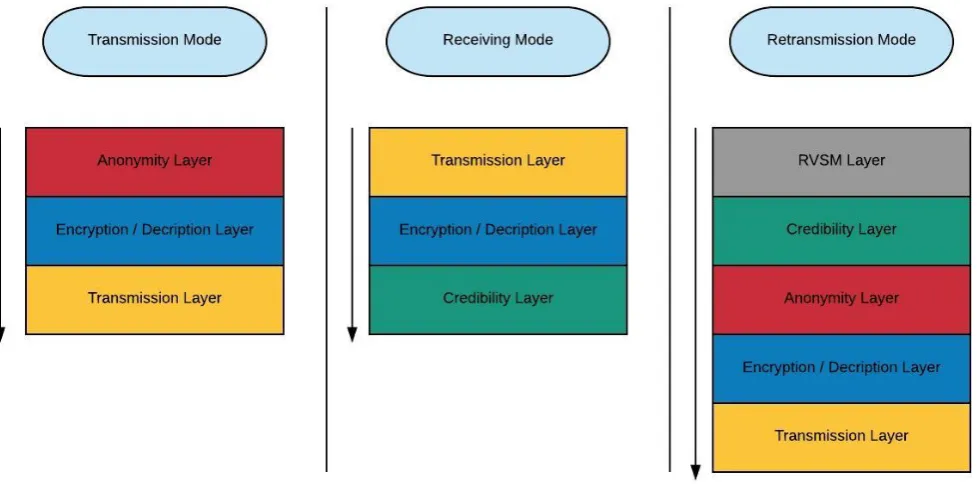
The proposed secure broadcasting architecture consists of three different operating modes, known as transmis-sion, receiving and retransmission modes. These modes operate by utilizing secure broadcasting layers, which are stacked together in different formation according to operating modes shown in figure 2. These modes are further discussed in the following sections:
5.1. Transmission Mode
Algorithm 2Pseudocode of Transmission Mode
1: functionTransmissionMode(Data,Vinf o)
2: W T ←0
3: isT ransmit←False
4: Data[Pscore]←1
5: whileisT ransmit=Falsedo
6: ifW T = 0then
7: isT ransmit←Check_CSMA_CS(Vinf o)
8: W T ←RSVM()
9: end if
10: W T ←W T −1
11: end while
12: VAD ←AL(Vinf o) 13: Pinf o←EDL(VAD, Data) 14: Transmit(Pinf o)
15: end function
A vehicle, known as source vehicle, is in transmission mode during the process of transmitting an original
Algorithm 3Pseudocode of Receiving Mode
1: functionReceivingMode(Pinf o)
2: [Vinf o, Data]←EDL(Pinf o)
3: CL_GetPriority(Vid
Inf o, Data[id], Data[Pscore], T rue) 4: end function
5.2. Receiving Mode
In receiving mode, a vehicle receives an original or retransmittedPinf o. This mode consists of EDL and CL. The decryption part of EDL is used to decrypt received
Pinf o. The part of the message that is of public nature can be decrypted by this layer. In addition to this, the CL comes after EDL. During receiving mode, the CL computes and updates credibility index of transmitting vehicle based on Eq.2. The Pseudocode of receiving mode is put forward in Algorithm3.
5.3. Retransmission Mode
Algorithm 4Pseudocode of Retransmission Mode
1: functionRetransmissionMode(Data,Vinf o)
2: [P riority, Data[Pscore]]←
CL_GetPriority(VI
Inf o, Data[I], Data[Pscore], False)
3: W T ←0
4: isT ransmit←False
5: whileisT ransmit=Falsedo
6: ifW T = 0then 7: isT ransmit←
Check_CSMA_CS(Vinf o, P riority)
8: W T ←RSVM()
9: end if
10: W T ←W T −1
11: end while
12: VAD ←AL(Vinf o)
13: Pinf o←EDL(VAD, Data)
14: Transmit(Pinf o)
15: end function
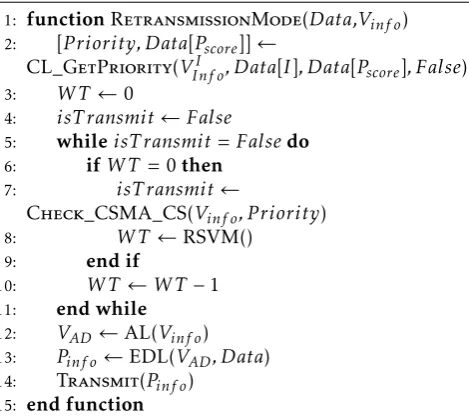
A vehicle is in retransmission mode when it decides to retransmit an original or retransmitted Pinf o. However, before a vehicle decides to retransmit, it has to go through an independent method run by all the vehicles in a network to establish their suitability to retransmit a message using RVSM layer. The RVSM layer provides a W T to all the Pinf o that needs to be transmitted. The transmission of a Pinf o proceeds whenW T assigned to it is expired. The CL is involved after the RVSM layer for the purpose of computing
PBC. This probability facilitates in prioritizing all the information packets for the purpose of broadcasting. ThePinf owith the highestPBC is then forwarded to the transmission layer for broadcasting over the wireless
Table 1. Simulation parameters
Parameters Values
Simulation Area Variable
Frequency 5.9 GHz
Type of Road Highway with multiple lanes Vehicle Densities 5, 10, 20, 40, 50,
100, 150, 200, 250,
300, 350, 400, 450, 500 vehicles
s Between 60 and 100 km/h
Protocol IEEE 802.11p
Transmission Range 1000m [29]
Table 2. Symbols and notations
Symbol Description
Pinf o Information Packet
NR Number of Retransmissions
W T Wait Time
T T L Time To Live
PN C Probability of Neighborhood Coverage
NN P Number of vehicles that have received the transmitted packet
NV H Number of neighboring vehicles in the neighborhood.
V Total Number of vehicles
s Speed of vehicles
Pscore PacketScore
PN Total Number of Packet recieved
PBC Probability of Broadcast Communication
BN Total Number ofBN
Vinf o Vehicle Information Dataset
Vid Vehicle Identity
Vinf oid Vehicle Identity Property from Vehicle Information Dataset
Pinf oid Information Identity Property from
Pinf oDataset
∝ Credibility Index
medium. The Pseudocode of receiving mode is put forward in Algorithm4.
6. Results and Analysis
100 200 300 400 500 0
2,000 4,000 6,000 8,000
Vehicles
A
v
er
ag
e
netw
or
k
cov
er
ag
e
time
(ms) Non-secure Highway
PBC = 1
PBC= 0.8
PBC= 0.6
PBC= 0.4
PBC= 0.2
PBC = 0
Figure 4. Average network coverage time for different PBC
scenarios in vehicular mobile environments for various vehicle densities.
100 200 300 400 500
200 400 600
Vehicles
av
er
ag
e
n
umber
of
retr
ansmissions
Non-secure Highway
PBC = 1
PBC = 0.8
PBC = 0.6
PBC = 0.4
PBC = 0.2
PBC = 0
Figure 5. Average number of retransmission in for differentPBC
scenarios in vehicular mobile environments for varied densities.
supercomputer, which is based on Unix system. Moreover, prioritization of Pinf o in the priority queue is based on Time-To-Live (TTL) and PBC. A Pinf o with a higher value of TTL decreases its priority of retransmission as compared to the lower value of TTL, on the other hand, higher values of PBC increases transmission priority of the Pinf o. The results related to the effect ofPBC on network coverage time and the number of transmissions is compared with an unsecure highway and urban environments. The highway and urban scenarios categorized as unsecure lack PBC to establish priority of the Pinf o. In addition to this, the simulation parameters are put forward in Table1, while Table 2 contains symbols and notations used in this paper.
100 200 300 400 500
0 2,000 4,000 6,000
Vehicles
A
v
er
ag
e
netw
or
k
cov
er
ag
e
time
(ms) Non-secure Urban
PBC= 1
PBC = 0.8
PBC = 0.6
PBC = 0.4
PBC = 0.2
PBC= 0
Figure 6. Average network coverage time for different PBC
scenarios in vehicular mobile environments for various vehicle densities.
100 200 300 400 500
200 400 600
Vehicles
av
er
ag
e
n
umber
of
retr
ansmissions
Non-secure Highway
PBC = 1
PBC= 0.8
PBC= 0.6
PBC= 0.4
PBC= 0.2
PBC = 0
Figure 7. Average number of retransmission in for differentPBC
scenarios in vehicular mobile environments for varied densities.
0 0.2 0.4 0.6 0.8 1 200
400 600 800 1,000
1,200 Point A
(0.20,1058)
Point B (0.90,220)
Broadcasting probability (PBC)
Netw
or
k
C
ov
er
ag
e
T
ime
(ms)
Propagation Time (ms)
Figure 8. Average number of retransmissions in for different broadcasting probability ,PBC, scenarios in vehicular mobile
environments for varied densities.
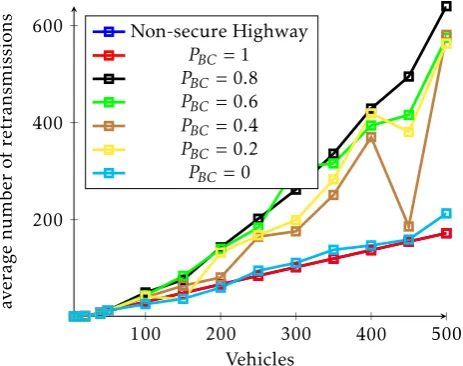
available for broadcasting at a certain time. In our simulations, the results indicated no significant effect on the experiments for less than 50Pinof in the network. In addition to this, the result show very closely numbers for non-secure and PBC score of 0, therefore the non-secure highway as well as urban scenarios are hidden behind PBC results of 0. The experiments are further discussed in following two subsections:
6.1. Network Coverage Time
In the first experiment, we investigate network coverage time, which is defined as a time required for propagation of aPinf oto all the vehicles in the network. The Pinf o that consists of lower values of the PBC are transmitted after thosePinf o with higher values ofPBC are transmitted. Therefore, network coverage time of a PBC is directly proportional to the number of Pinf o with higher PBC and vehicle density. The effects of change in network coverage time with respect to the number ofPinf o with differentPBC can be observed in figures4and 6for both highway and urban scenarios respectively. ThePinf o network coverage time increases with the decrease of PBC, whereas, an increase in vehicle density also increases network coverage time. In addition to this, an increase in network coverage time due to vehicle density is caused by the increase in the number of vehicles needed to receivePinf o in a network. On the other hand, network coverage time is quite consistent for the non-secure highway as well as urban environment.
Table 3. Transmission information and broadcasting over time
T ime Vidr Vidt Pinf oid ∝ Pnc
t40
V22 VV18 2 0.3 0.3
20 1 1 0.3
V23 VV19 5 0.9 0.3
14 6 0.6 0.3
V24 VV17 8 0.1 0.3
16 9 0.2 0.3
t41
V22 V18 2 0.3 0.3
V23
V22 1 1 0.7
V19 5 0.9 0.3
V14 6 0.6 0.3
V24
V22 1 1 1
V17 8 0.1 0.3
V16 9 0.2 0.3
6.2. Number of Retransmission
In the second experiment, we explore the number of retransmissions exhibited by the secure broadcasting architecture for both highway and urban scenarios. The experiments for each vehicle density are repeated at least ten times. The number of retransmissions, NR, is directly proportional to the distribution of vehicles rather than delay in transmission. Therefore,NRshould exhibit nearly the same values irrespective of the PBC. However, delay in transmission may cause changes in the distribution of vehicles due to the movement of vehicles over time. That is one of the reasons for the different number of average retransmissions observed in figure5and7for differentPinf oirrespective of their
PBC.
6.3. Network Coverage Over Time
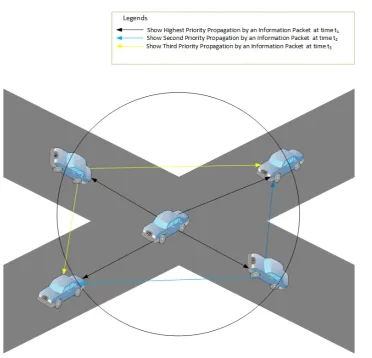
Figure 9. Broadcasting of different packets with different priorities in a network
6.4. Simulation Analysis
In Table 3, a simulation snapshot is present to provide analyses related to the impact of∝in the transmission
process. At the beginning of the simulation, the vehicle in the network does not have enough number of the
Pinf o so that the decision of transmitting thePinf o can be made. In order to present the explanatory numerical results, we start from the vehicle Vidr =V22. However, the starting vehicle can be any other vehicle in the network. The neighborhood of the V22 is depicted in the table, which consists of vehicle 23 and 24. At a time interval t40, the table shows each vehicle containing different Pinf o identified by their identity property,
Pinf oid . Each of the Pinf o have different ∝ and during transmission, the broadcasting system assigns lower
W T to highest∝in the neighborhood. Att40, thePid
inf o1 of vehicle 22 is allowed to be broadcasting since its∝is
highest in the neighborhood. On the other hand, Att41, thePinf oid 1 of vehicle 23 is allowed to be broadcasting, and the same Pinf o is not allowed to broadcast for vehicle 24 due to fact Pnc is 1. The 1 value of Pnc is achieved when all the neighbors of the vehicle received aPinf o, therefore there is no need to broadcast thisPinf o.
A similar scenario related to prioritized transmissions ofPinf oin a system is show in figure9.
7. Conclusion
References
[1] Kumar N, Misra S, Rodrigues J, Obaidat M. Coalition games for spatio-temporal big data in internet of vehicles environment: a comparative analysis. 2015;.
[2] Alam KM, Saini M, El Saddik A. Toward Social Internet of Vehicles: Concept, Architecture, and Applications. Access, IEEE. 2015;3:343–357.
[3] Gerla M, Lee EK, Pau G, Lee U. Internet of vehicles: From intelligent grid to autonomous cars and vehicular clouds. IEEE World Forum on Internet of Things (WF-IoT). 2014 March;p. 241–246.
[4] ur Rehman S, Khan MA, Zia TA, Zheng L. Vehicular Ad-Hoc Networks (VANETs)-An Overview and Challenges. Journal of Wireless Networking and Communications. 2013;3(3):29–38.
[5] Forouzan AB. Data Communications & Networking (sie). Tata McGraw-Hill Education; 2006.
[6] Choi HK, Kim IH, Yoo JC. Secure and efficient protocol for vehicular ad hoc network with privacy preservation. Journal on Wireless Communications and Networking (EURASIP). 2011;2011:11.
[7] Armknecht F, Festag A, Westhoff D, Zeng K; VDE. Cross-layer privacy enhancement and non-repudiation in vehicular communication. ITG-GI Conference on Communication in Distributed Systems (KiVS). 2007;p. 1–12.
[8] Hesham A, Abdel-Hamid A, El-Nasr MA. A dynamic key distribution protocol for PKI-based VANETs. In: IEEE IFIP Wireless Days (WD). IEEE; 2011. p. 1–3.
[9] Al Falasi H, Barka E. Revocation in VANETs: A survey. In: IEEE International Conference on Innovations in Information Technology (IIT); 2011. p. 214–219. [10] Al-Kahtani MS. Survey on security attacks in Vehicular
Ad hoc Networks (VANETs). In: 6th IEEE International Conference on Signal Processing and Communication Systems (ICSPCS); 2012. p. 1–9.
[11] Rivas DA, Barceló-Ordinas JM, Zapata MG, Morillo-Pozo JD. Security on VANETs: Privacy, misbehaving nodes, false information and secure data aggregation. Journal of Network and Computer Applications. 2011;34(6):1942 – 1955. Control and Optimization over Wireless Networks.
[12] Djamaludin C, Foo E, Camtepe S, Corke P. Revocation and update of trust in autonomous delay tolerant networks. Computers & Security. 2016;60:15–36. [13] Caballero-Gil C, Molina-Gil J, Hernández-Serrano J,
León O, Soriano-Ibanez M. Providing k-anonymity and revocation in ubiquitous VANETs. Ad Hoc Networks. 2016;36:482–494.
[14] Engoulou RG, Bellaïche M, Pierre S, Quintero A. VANET security surveys. Computer Communications. 2014;44:1–13.
[15] Yadav V, Misra S, Afaque M. Security in vehicular ad hoc networks. Security of Self-Organizing Networks: MANET, WSN, WMN, VANET. 2010;p. 227.
[16] Stampoulis A, Chai Z. A survey of security in vehicular networks. Project CPSC. 2007;534.
[17] Qian Y, Moayeri N. Design of secure and application-oriented VANETs. IEEE Vehicular Technology Confer-ence (VTC) Spring. 2008;p. 2794–2799.
[18] Kargl F, Ma Z, Schoch E. Security engineering for VANETs. Proc 4th Wksp Embedded Sec in Cars. 2006;p. 15–22.
[19] Papadimitratos P, Buttyan L, Holczer T, Schoch E, Freudiger J, Raya M, et al. Secure vehicular communication systems: design and architecture. IEEE Communications Magazine. 2008;46(11):100–109. [20] Isaac JT, Zeadally S, Camara JS. Security attacks
and solutions for vehicular ad hoc networks. IET communications. 2010;4(7):894–903.
[21] Galaviz-Mosqueda A, Morales-Sandoval M, Villarreal-Reyes S, Galeana-Zapién H, Rivera-Rodríguez R, Alonso-Arévalo MÁ. Multi-hop broadcast message dissemina-tion in vehicular ad hoc networks: A security perspective review. International Journal of Distributed Sensor Networks. 2017;13(11):1550147717741263.
[22] ur Rehman S, Khan MA, Zia TA, Khokhar RH. A synopsis of simulation and mobility modeling in vehicular ad-hoc networks (VANETs). Journal of Computer Engineering (IOSR-JCE), e-ISSN. 2013;p. 2278–0661.
[23] Jiang D, Delgrossi L; IEEE. IEEE 802.11 p: Towards an international standard for wireless access in vehicular environments. IEEE Vehicular Technology Conference (VTC) Spring. 2008;p. 2036–2040.
[24] Jafer M, Khan MA, Rehman SU, Zia TA. Evolutionary Algorithm based Optimized Relay Vehicle Selection in Vehicular Communication. IEEE Access. 2018;.
[25] Saeed RA, Naemat A, Bin Aris A, Bin Awang MK. Design and evaluation of lightweight IEEE 802.11p-based TDMA MAC method for road side -to-vehicle communications. The 12th International Conference on Advanced Communication Technology (ICACT). 2010 Feb;2:1483–1488.
[26] Goldsmith A. Wireless communications. Cambridge University Press; 2005.
[27] Hussain M, Rasheed H, Ali N, Saqib N. Roadside infrastructure transmission of VANET using Power Line Communication. In: International Conference on Communication, Computing and Digital Systems (C-CODE); 2017. p. 139–143.
[28] Lazaropoulos AG. Deployment concepts for overhead high voltage broadband over power lines connections with two-hop repeater system: Capacity countermea-sures against aggravated topologies and high noise environments. Progress in Electromagnetics Research. 2012;p. 283–307.
[29] Saini M, Alelaiwi A, Saddik AE. How Close are We to Realizing a Pragmatic VANET Solution? A Meta-Survey. ACM Computing Surveys (CSUR). 2015;48(2):29. [30] Intersect Australia Limited; 2017. (Accessed on