BASED MANAGEMENT AND
ACCOUNTING: WITH REFERENCE TO
JAPANESE PRACTICES
Akira Nishimura Beppu University, Japan
Abstract
The aim of this paper is to outline and discuss the framework of contemporary management accounting known as ‘value-based management accounting’. At present, under the severe competition in the international markets, short-lived consumer sentiment and rapid change in technology, management should enhance not only the effective and efficient value of product but also enterprise value for competitive advantage. This value management should look so forward and be so proactive as to be not swung around risk and uncertainty, while management accounting should also serve the management as a supplier of useful information on risk and opportunity.
Therefore, this paper focuses on profit opportunities and risks, or what lies behind profits and losses, and tries to build models which are suitable for applying variance analysis, and to do so with specific reference to Japanese management practice in order to clarify the characteristics of value-based management accounting (VBMA). At the same time, these analytical models are also based on the integration of quick feedback and reliable feed forward controls and support the visual and virtual management system.
This paper begins by conceptually examining the relationship between value and a company, clarifies the structures and features of value-based management (VBM) and tries to establish a theoretical model of proactive variance analysis, which would go forward to the formation of a practically analytical model, although the model analysis and the transformation of risks into opportunities should be further supplemented by empirical study.
Keywords: value-based management accounting (VBMA); value-based leadership; quick feedback; reliable feed forward; value analytic models
Introduction
financial goods may have been developed through fabricated accounting techniques that promote financial activities which prevent investors from realizing the concealment of their unfair and dishonest transactions: accounting for derivatives. On the other hand, however, accounting manipulation has actually been enhanced in order to conceal earnings connected with financial goods. Thus, financial businesses have become vast not only through complex financial transactions but also via the repeated purchase and absorption of other operating businesses: takeover bid or merger. At the same time, all operating businesses are facing keen competition in the international markets under the rapid development of information and transportation technologies. Everyday they should compete with their rivals in the development of new types of product.
Under such an extremely financially structured economy, the severe competition in the international markets forces all operating enterprises to continually improve the quality of their products while at the same time endeavour to minimize their costs in order to gain competitive advantages. This is because the enterprises that fail to do so would be taken over and merged by worldwide financial firms. Consequently, all enterprises expose themselves to the risk of being purchased or forsaken by financial firms and shareholders whenever they cannot create better and higher value-added products relative to their rivals. Given such a situation, they should also recognize themselves not just as going concerns, but as commodities which are unstably traded in the markets, just like their products. Therefore, each enterprise has a double character: it is a manufacturer, selling a product, hence has a product value (i.e. generates sales revenue); and it is an entity, exchangeable as a commodity, hence has a commodity value (i.e. the value of what is worth). It is more difficult to survive perpetually as a going concern in the competitive markets even if the enterprise exerted its utmost.
Presently, no firm can survive without withstanding risks und uncertainty under severe competition. Such a stern reality prescribes the functions and roles of contemporary management accounting. This paper aims to examine the relationships between VBM and accounting in Japan and clarify the basic framework of VBMA. Therefore, the paper begins by investigating the relationship between value and management, but before doing so, provides existing literature on VBMA to clarify its subject of controversy. It then goes on to clarify the basic characteristics of contemporary, or VBM with reference to Japanese practices. Finally, the paper attempts to construct variance-analytic models for VBMA, utilizing Demski’s model and Cost Design (Nishimura, 2003).
Existing Literature and Accounting Cognition
Business enterprises have been assessed from the viewpoint of the capital markets, since they have been perceived in terms of their value as exchangeable properties. In the earlier stages, the concept of value was symbolized as shareholder value in management (Malmi and Ikäheimo, 2003). Financial accounting first restructured its valuation and measurement methods in accordance with this concept and this had an effect on management accounting. As a result, EVATM, residual profit,
and cash flow discount have also been discussed in management accounting. Recently, however, with the growth of the knowledge economy and economic networks, management should be paying more attention to these, especially where their social and synergic ability can result in higher value relative to the total for each factor of production. Thus, a great deal of thought has been exerted on the relationship between value creation and cultural and communal communication (Cant, 2006). Consequently, management researchers and accountants have begun to examine the management process from the perspective of knowledge, human resources, business networks, and value chain, or value added. Their perspective has shifted away from the short-term shareholder towards the long-term shareholder value management, and the stakeholder value management as well as sustainable growth (Rappaport, 2006; Porter and Kramer, 2006; Cant, 2006). Actually some companies in Japan and Germany reconsider ‘Anglo-Saxon capitalism’ which has caused investment funds exhaustively crossed over border, the intensification of jungle M&A, and the stronger voice of stockholders and grope for the ‘Third Way’ differently from the Rhine- or Japanese one based on social joint decision (Ishiyama, et al. 2006; Geissler, et al. 2006).
Möller and Svahm (2006) depict three stages in the development process of business networks: the current business nets; the business renewal nets; and the emerging new business nets. They also clarify today’s characteristics of value creation management, particularly pointing out that for them it is important to stress the complex collaborative learning models and the uncertainty and ambiguity related to value activities as a result of radical changes in old value activities.
Hilton (2005) discussed management accounting from the angle of value creation at an early time. He is interested in ‘value to [the enterprises’] shareholders by leveraging the strength of [the enterprises’] brand’. Therefore, ABC related to activities and value added, and value chain became his subject of discussion. With regard to the Japanese literature, Japanese scholars have energetically studied cost management with relation to value (function) in terms of cost design, and here Tanaka (1995; 2002) is the most enthusiastic; he has recently studied management accounting from the viewpoint of value concepts. Tanaka et al. (2006) characterize contemporary management accounting as multi-value management, and point out that since the activities of the enterprises should be various, they need to be evaluated likewise, with aspects tackling environmental value; economic value (fair market value, investment value, stock value, etc.); social value; and brand value. Basically, they emphasize that there exist plural values in business management and these should be harmonized at the core of stockholder value (Tanaka et al., 2006). Monden (2006) barely examines accounting issues in VBM, although he describes the functions of human assets from the viewpoint of shareholder value. Ueno (2007) rightly describes management accounting in the development process from cost- through profit- to VBMA. Although these researchers have made some important contributions to the development of management accounting, it is however yet to be made clear how management accounting is related to the value concepts and how accounting measures and controls these values.
Value and Management
Basic Concepts
Profits and costs have for a long time been mainly used as fundamental concepts in management accounting, since they could monetarily and directly measure and evaluate the planning process and performance and hence help managers plan and control the business process. Why do accounting students, who, as Bell (1925) formerly averted the usage of value, conceive of measurement as the most important function of accounting, keep on debating the concept of value in management accounting in the face of its inability to directly measure economic activities? Before elucidating the[0] reasons for this, we should clarify the relationship between value and management.
Generally speaking, value is an extremely abstract and general concept related to human judgment or utility, but it needs to take a concrete form for measurement and evaluation in accounting. Therefore, when we examine the relationship between value and management, we should study more deeply the contradiction between the abstract and concrete, or the general and individual.
be measured in terms of money. Smith (1776) pointed out two different meanings for the word value: the utility of some particular object (value in use) and the power of purchasing other goods (value in exchange).(1) Marx (1867) also
elucidated the relationship between abstraction and concreteness of value, according to whose theory the individual and concrete value of usefulness takes the most abstract form of exchangeable value in its exchange process and gradually develops towards such more concrete concepts as goods, money, price, and capital, although the concrete concept of working hour is common to all value concepts. Anyway, value is surely contradictory in terms of utility and exchangeability and takes various different forms in different stages of exchange process.
It must be confirmed that the double aspect of utility and exchangeability for a product to take as value also applies to a company. A company has also the double aspect of value in use and value in exchange. It is utility for a company to create profit through product (value) production: to efficiently and effectively produce products of high quality and at lower cost for competitive advantage. However, assets value to guarantee the value production is not always consistent with the whole value of a company (enterprise value), since the financial markets would evaluate it from the viewpoint of exchangeability and future ability for profitability. It is of importance to clarify that value in production differs from value in the market, which reflects future profitability and exchangeability. Therefore, a company should integrate value management in production with value management in the market. Management must not only control the production process based on market demand, but also enhance the market value of the company by strengthening brand value or social reliability. Incidentally, this paper also regards ‘value’ as ‘functions divided by cost’ as well as ‘exchangeable enterprise value’.
As the double aspect of a company as a value producer and an exchangeable value in market regulates the characteristics of VBM, management must proactively and preventively control value production in step with enterprise value due to risky and uncertain environment, while management accounting must provide synthetic and proactive information and analytical results to management, which deals with risks and uncertainty. Today, therefore, management accounting must basically focus on value production from the wider aspect of organization and culture (Olsen, 2002).
Double Aspect of Management
In today’s world, senior managers should assess and control the value production processes within the context of their relation to the market value of enterprise. In other words, they should develop competitive products of high value, concurrently enhancing the social value of their enterprise through offering attractive brands with high reliability. Contemporary management and accounting would not argue against each other without the recognition of common value concepts.
value production in the company, while the whole value of the company is created with the strong cooperation of the employees under value-based leadership, i.e. value formation inside the markets. Thus, because value creation consists of value production and value formation, managers should pay attention not only to efficient and effective production, but also to the social responsibility and to the reliability of their company.
However, value production does not easily translate into value formation and neither always leads to value creation. At present, business enterprises would not succeed in VBM without the strategic integration of these two aspects. Acquisition as tool for simple business expansion (value formation), if it proves to be in conflict with ‘a new growth platform’ (Laurie, et al. 2006), would lead in the long run to value destruction, not value creation. Sometimes, the short-term view of market share (short-term request for dividends by shareholders) often means the sacrifice of the long-term nature of value production, since senior managers operate earnings in accounting and undermine value creation (Rappaport, 2006). Even a minor defect in these aspects of management may lead to a complete ruin of the business enterprise, so the balance between the production and formation of value is of critical importance to good value creation. Indeed, we have a typical example where the fiendish leadership for value resulted in hollowed value creation. This occurred during the 1990s when Kenneth Lay and three other top executives, namely Fastow, Skilling, and Causey, orchestrated ‘one of the largest cases of corporate fraud in the United States history’, making Enron ‘Houston’s most benevolent financial donor’ and the company that ‘actively encouraged employees to embrace these professed values by involving themselves with local charities.’(Glynn and Jamerson, 2006) Thus, value creative management must keep in step with the long-term strategy and enterprise governance (Nishimura, 2006).
Structure of VBM
Leadership and Uncertainty
help organizational units return to health by being attuned to and concerned for the social relationships of their organizations.” (p. 197)
Value-based leadership and cooperation for value creation become more important in the contemporary world of high risk and strong strategic competition, because risk must be preventively and proactively managed and changed into opportunity in order to enhance the prospects for profitability. Weick (2006) also states that the “role of values in high risk organizations is to provide a direction for people who are thrown into the middle of unknowable, unpredictable events that don’t play by the rules” (p. 65). According to him, high risk organizations must devalue misspecification, wrong estimation, and misunderstanding, while they must be careful of people who pay too much attention to success, simplicity, strategy, and anticipation. Today’s operational and financial risks would not be lessened without the proactive cooperation of all members of an organization.
Visible and Virtual Management
VBM is value-creative management built on the value-based leadership and cooperation: for value creation risk and strategy management within the context of social reliability. It must be both preventive and proactive in order to avoid decisive failure, since financial markets and value formation regulate value production and value creation is both very unstable and subject to uncertainty. Under these circumstances, senior managers must perceive risks and try to transform them into profit opportunities. For this purpose, therefore, quick feedback and reliable feed forward controls assume vital importance. The former quickly enables revision of errors, hence the avoidance of critical defects and failures, while the latter facilitates the prediction of outbreaks of errors, and the exercise of preventive and proactive risks control. Thus, contemporary management needs to integrate visual management with virtual management: quick feedback with reliable feed forward control (Nishimura, 2005).
The integration of virtual and visual management plays an important role in minimizing opportunity cost and maximizing profit opportunities. In order to establish an effective VBM system, control should be visual in relation to quick feedback control and concurrently virtual in relation to reliable feed forward control. Therefore, with the strong cooperation of and harmony with all employees, sensitive monitors, precise observers, and mobile controllers should be prepared for the fulfillment of quick feedback and reliable feed forward controls. When these control systems fulfill their functions perfectly, the enterprise would be able to gain a competitive advantage in the value creation.
Visualized management has been adopted by the Japanese enterprises in the form of the Kanban and Andon(2) systems where all employees at the workshops can
loose and slow feedback control systems. Recently, the Kanban system has become electronic in some Japanese enterprises, called Kanban system with UHFand RFID. When materials move from storage to a factory, electronic Kanbans with RFID give the control center information on the changed amount of material inventory and the flow of each material, and each worker operates his/her job according to the Kanban. Some Japanese companies that have adopted the
Kanban system have set many cameras and sensors at the ceiling of the shop to concentrically and individually monitor the flow of work and control stoppage or problematic places in the production process (see optical transmission equipment in Fujitsu(4)). This is an example of quick feedback management.
Virtual management has also been introduced in some Japanese companies for preventive and proactive management. Shiseido, a cosmetics company, uses computer and picture technologies to help customers buy the most suitable goods, since before purchase they can visually make up their faces on the computer display by freely arranging the imitative cosmetics, which simulate the actual goods of the company (see Virtual Real-time Make-Up system(5)). Once, Nissan Motor
Company also planned to design order-made cars together with the customers on computer displays before production when agreement is reached between the two (Tanaka, 1991). These are examples of reliable feed forward management.
These quick feedback and reliable feed forward management systems would create the opportunities for cost minimization and profit maximization through interviews between the suppliers and demanders. The organic connection between quick feedback and reliable feed forward controls, and visual and virtual management systems play more important roles in actualizing value creation than in the past (reduction of opportunity cost related to sales and inventory risk). The more important the maximization of opportunity and the minimization of risk are, the quicker feedback control and the more reliable feed forward control must be.
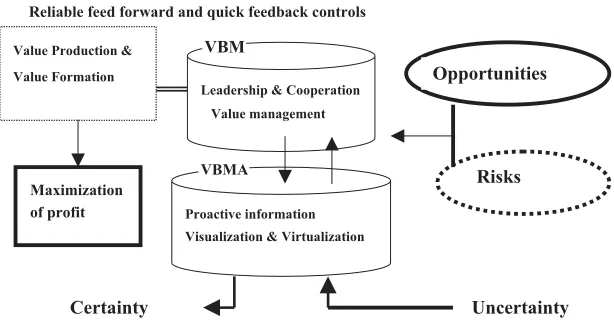
According to the above content, we can picture the framework of VBM in Figure 1. Fundamentally VBM consists of reliable feed forward and quick feedback controls. The former aims at estimating reliable and realizable target and certainly transforming risks into profit opportunities before performance. The latter quickly uses some new methods to amend wrong performance and change profit opportunities into profits and actualize its maximum. Eventually VBM is a management system to try to change uncertainty (opportunities and risks) into certainty (profits). At the same time, as shown in Figure 2, through VBM, big risk is reduced to small losse and transformed into opportunity which then is turned to big profit.
Some Practices of VBM in Japan
Figure 1: Framework of VBM
Figure 2: the Structure of VBM and VBMA
At the same time, Canon Electronics Inc. stresses leadership with value, which fully taps every employee’s talents for the development of new technology and products (Sakamaki, 2007).
10% increase in productivity. The whole process (from assembly and inspection to packaging and shipment) is unified in terms of management through this visible system. RFID enables the company to avoid waste in the assembling process and improve quality through the standardization of the working process. An example of this is the reduction of 100,000 bar cord reading works, due to replacing the manual bar cord reading with RFID automation which results in the standardization of operations based on on-line monitor. This real time management makes it possible to connect every workshop directly with the nerve center of decision-making. Futaba Industrial Company, which produces automobile components, has also aimed at becoming the ‘No. One Factory’ in the world through global production and management: facilities and production systems which anybody can use to produce the same product at the same input and quality in any of the company’s factories anywhere in the world. The company has tried to fundamentally realize this goal by means of a visual, recognizable, and usable system.
Some Japanese companies have adopted virtual and visual management to visualize opportunities and risks and proactively and quickly reactively used various methods to transform risks into opportunities. Accordingly management accounting must be more visual and virtual than Cost Design, in order to support this management.
VBMA and Analytical Model of Variance
Some Rudimentary Experiences
We have experienced the rudimentary connection of quick feedback control and reliable feed forward control systems in Japanese and American management accounting. Cost design is the earliest experience with VBMA in Japan, relying on value engineering and value analysis, in which the cost of a product is virtually and visually estimated and controlled at the product design stage from the viewpoint of a long-term profit plan and a competitive strategy. The allowable cost is estimated by subtracting the target profit from target sales, while, in accordance with the competitive strategy, estimated cost is calculated through a cost table or reverse engineering, which is more competitive relative to its rivals in terms of price and functions (quality). After these two costs are closely scrutinized together, the target cost is decided upon at the design and development stages for a new product. If the target cost is achieved, the company will be able to acquire a larger market share relative to its rivals. Consequently many Japanese motor companies have enhanced not only their sales revenues value but their own worth.
On the other hand, BSC galvanizes the strategic mission into action. In order for the strategy and mission to penetrate the entire organization, BSC focuses on four stages relating to finance, customers, learning/growth, and the internal business process, even though the financial target is most important. Every member of the company should have a common value for the achievement of the mission (Kaplan and Norton, 1996). Thus, the financial information must be integrated with the non-financial in strategic decision-making (Bhimani and Langfield-Smith, 2007). For management accounting, the realization of its function becomes more distant from the financial measure and much closer to non-financial value (functions and satisfaction).
Despite such progress in management accounting, presently however world class companies should pursue the more organic integrated system of quick feedback and reliable feed forward controls than Cost Design, BSC or ABC.
Structure of Variance Analysis
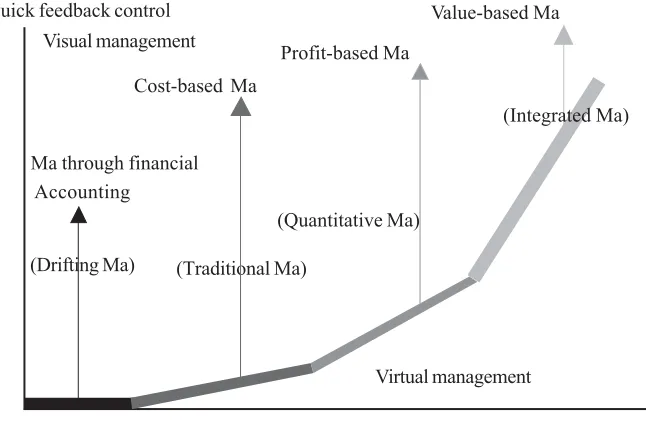
According to changing management viewpoints, as stated about Cost Design, ABC, and BSC, contemporary management accounting has also shifted from the cost- and profit-based management accounting systems to VBMA. We can make a picture of VBMA in Figure 3, in contrast with the cost-and profit-based ones. As I have discussed the characteristics of each process of management accounting
Figure 3: Contemporary Management System
Visual management
Value-based Ma Profit-based Ma
Cost-based Ma
Ma through financial
(Quantitative Ma)
(Drifting Ma)
Virtual management
Reliable feed forward control (Traditional Ma)
Accounting Quick feedback control
(Integrated Ma)
*Ma: Management Accounting; ** Each management accounting development stage (Drifting,
development in other papers (Nishimura, 2003; 2005), traditional management accounting is based on cost-based one, which is distinguished by standard costing related to efficient and waste control and feedback control. The quantitative and mathematical management accounting is mainly connected with profit-based one, of which opportunity costing and the transformation into feed forward control are typical for decision-making.
At present, this focus on value is not only a phenomenon confined to management accounting; but it also applies to financial accounting. Management accounting is much more strongly based on the relationship with stakeholder value (business value) than financial accounting oriented towards shareholders, so let us turn to an examination of why value has become a key concept in management accounting.
Firstly, it is quite obvious that the traditional viewpoints and methods of management accounting, based only on financial information like cost, have not coincided with the recent changing environment due to the development of the financially structured industry and the intensely competitive international markets. We would not be able to recognize and manage the whole value-creation and value chain of companies using the cost or profit concept, since the value of the chain of companies is inconsistent with the total sum of their partial values. The chained value of management resources, social reputation and brand, and the skill of the engineers depicts the whole value of a company. Each company is also always evaluated as an exchangeable commodity in the financial markets. Such partial concepts as cost or profit are not pertinent for measuring and managing the integrated value process.
Secondly, cost or profit cannot directly measure the value creation process, since it is wider and more abstract than them. However, we cannot directly calculate its process by means of value, since, unlike cost or profit, it is not a concept for measurement. Although value is a key concept in contemporary management and accounting, it is not an accounting concept for evaluation and measurement. We should however use accounting concepts such as profit or cost indirectly in order to recognize and measure the value creation process, since the category of value is not instrumental in measuring it although the category plays an important role in grasping and managing the factual structure of the contemporary enterprise. Because the accounting concepts cannot be directly used, they must be metamorphosed in another form.
forward due to the increased uncertainty of value creation caused by radical changes in the value drivers (Möller and Svahn, 2006, p.989; Scapens, 2006).
COSO properly refers to the relationship between uncertainty and value:
‘All entities face uncertainty, and the challenge for management is to determine how much uncertainty the entity is prepared to accept as it strives to grow stakeholder value. Uncertainty presents both risk and opportunity, with the potential to erode or enhance value. Enterprise risk management enables management to efficiently deal with uncertainty and associated risk and opportunity and hereby enhance the entity’s capacity to build value’ (COSO, 2004).
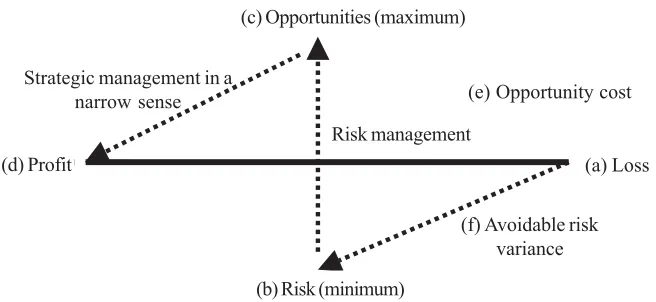
The relationship between how opportunity and risk is managed as depicted in Figure 4. The dotted line in Figure 4 shows how to manage the profit opportunity and risk which hide behind the visible profit and loss; the solid line. In order to support the strategic decision-making of management, management accounting should first collect information on profit opportunity and risk and measure their numerical values. The long-term and strategic amounts of opportunity and risk, measured on the stable growth of business and dividend policy, are compared with the short-term and competitive amount based on competitive advantage.
Figure 4: Strategic and Risk Management
Risk management
Note: Solid line shows traditional management accounting; dotted line shows strategic management in a wide sense including risk management and strategic management in a narrow sense through VBM; (e) and (f) show variance through ex ante and ex post analyses.
(c) Opportunities (maximum)
(e) Opportunity cost
(a) Loss (d) Profit
(f) Avoidable risk variance (b) Risk (minimum)
Strategic management in a narrow sense
As a result of the two numerical comparisons, the target profit and risk are decided. All units and employees should do their best to proactively and preventively diminish these variances and achieve the target of profit opportunity and risk. This calculation is an ex ante process carried out at the decision-making stage. Senior managers use the information (a-b-c-d) to maximize opportunities and minimize risks:
Table 1: The Case of New Investment
Strategic (long-term): Competitive Index for control
Perspective (short-term): perspective
Estimated capital cost Expected cost – Estimated cost = Risk variance
Estimated revenue Expected revenue – Estimated revenue = Opportunity variance
Control method Minimization of variances and transforming risk into opportunity
In order to facilitate easy understanding, we use estimated cost and estimated revenue as a surrogate for opportunity and risk to explain the above equations in the following Table 1(6):
What is most important is to preventively and proactively interweave them with the target values in order to erase these variances by collecting strategic and competitive information and adopting pertinent methods and means. This target calculation is made in order to secure the general strategy for a company, but it also indicates the individual targets for each organization. Thus, reliable feed forward management should be carried out in this process.
Moreover, the two target values should be compared with the actual values (profit and loss) after performance. It is certain that the targets will never be consistent with the actual values. Managers should recognize these variances as opportunity cost variance or avoidable risk variance and utilize them to adopt various methods and minimize variances in the following period. This is quick feedback control. The equations are as follows ((e) and (f) are related to Figure 4):
Target opportunity – actual profit = opportunity cost variance (e) Actual loss – target risk = avoidable risk variance (f)
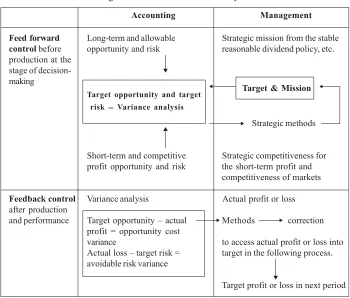
This calculation process is ex post and is feedback control. We summarize the above equations in Figure 5.
These variance analyses can give managers information on opportunities and risks and help them preventively and reflectively to control the production process from the viewpoint of value creation. For the implementation of VBM, ‘a project leader who can measure value creation through accounting and finance, and who has the capacity to change the corporate landscape’ is strongly required in the contemporary business enterprise (Karame, 2004). At the same time, management accountants should use data bases to build models in order to create value (Calderon, et al., 2003).
Conclusion
environment. Under the keen competition in the international market, continuous advance in technology and short-lived consumer sentiment, all enterprises always face risks and uncertainty and try to keep away from crucial risks or take risks for bigger opportunities.
Therefore, from the angle of risk management, management should not only effectively and efficiently control production process but also enhance enterprise value. At the same time, it should also combine the former with the latter for value creation. All members of an enterprise must look more forward and be more proactive and quickly reactive. In addition, the organic cooperation of organizational members must tie up with the leadership with value in order to establish reliable feed forward and quick feedback management system. After all, VBM and VBMA should be virtual and visual, since VBM is proactively and reactively carried out in relation with risks and uncertainty by the proactive and reactive support of accounting information.
This paper has endeavoured to clarify some pertinent aspects of VBM and VBMA by highlighting certain Japanese VBM practices and to examine the framework of VBM and VBMA by means of conceptual approach. This goes a long way towards developing the practically applicable model of VBMA and theoretically
Figure 5: VBM and Variance Analysis
Accounting Management
Feed forward Long-term and allowable Strategic mission from the stable
control before opportunity and risk reasonable dividend policy, etc.
production at the stage of decision-making
Target & Mission Target opportunity and target
risk = Variance analysis
Strategic methods
Short-term and competitive Strategic competitiveness for
profit opportunity and risk the short-term profit and
competitiveness of markets
Feedback control Variance analysis Actual profit or loss
after production
and performance Target opportunity – actual Methods correction
profit = opportunity cost
variance to access actual profit or loss into
Actual loss – target risk = target in the following process.
avoidable risk variance
formulating an outline of management accounting history in connection with the previous researches, since this work may lead to clarifying fundamental factors which have historically accelerated management accounting development.
However, much still remains to be done in this paper. First, by using some empirical evidences, it must be made clear how to concretely transform risks into profit opportunities, since the relationships between risks and opportunities are so intricately bilateral as to be incomprehensible. Secondly, the conceptual framework of VBM and VBMA should be more deeply testified by empirical study in order to be more persuasive. Lastly, because the variance analyses were only theoretically and abstractly inquired in this paper, they should be further expanded into actually applicable models. As a result, these empirical studies would give a power of persuasion to the conceptual approach in this paper, which laid the foundation to the formation of practical and applicable VBM and VBMA. The relationship between VBM and enterprise governance has not touched on in this paper despite its importance, since it was observed in the previous paper (Nishimura, 2006).
(I gratefully acknowledge the thoughtful and helpful comments with the reviewer on several points in this paper.)
Notes
(1) Adam Smith also pointed out that ‘The word VALUE, it is to be observed, has two different meanings, and sometimes expresses the utility of some particular object, and sometimes the power of purchasing other goods which the possession of that object conveys. The one may
be called “value in use”; the other; “value in exchange.”’ (Adam, Smith, An Inquiry into the
Nature and Causes of the Wealth of Nations, 1776 (Modern Library: New York, 1937, p. 28). (2) Andon is a lamp letting other workers know the need for the cooperative resolution of a problem
when it occurs on a line. When a worker at the problematic line draws the switch-cord, Andon
goes on and off, and other workers know the problem and cooperatively resolve it with him. (3) ‘Radio-frequency identification (RFID) is an automatic identification method, relying on
storing and remotely retrieving data using devices called RFID tags or transponders. An RFID tag is an object that can be attached to or incorporated into a product, animal, or person for the purposes of identification using radio waves. All RFID tags contain at least two parts, one is an integrated circuit for storing and processing information, modulating and demodulating a radio frequency (RF) signal and perhaps other specialized functions. The second is an antenna for receiving and transmitting the signal.’(Wikipedia, http://en.wikipedia.org/wiki/RFID) ‘Ultra-High Frequency (UHF) offers a greater communications range than other frequency bands. As a result, the use of the UHF RFID system for full traceability of products has been growing in the retail and logistic industries, ---UHF tags, however, are subject to multi-path interference, an inherent problem for electromagnetic signals, which can make a RFID tag unreadable even if it is within the range of the reader.’ (NE Asia Online2006 march 30, http:/ /neasia.nikkeibp.com/dailynewsdetail/003799?ST=English).
(4) See http://enterprise.watch.impress.co.jp/cda/topic/2005/12/09/6810.html
(5) See Siseido, ‘Development of Virtual Make-up Picture System’: http://www.sankei.co.jp/ enak/2007/jam/kiji/29lifemake.html
References
Bell, H. W. (1925). Accountants’ Report, Second Edition. The Ronald Press.
Bhimani, A. and Langfield-Smith, K. (2007). Structure, Formality and the Importance of Financial and Non-financial Information in Strategy Development and Implementation. Management Accounting Research, Vol. 18, Issue 1, 3-31.
Bouch, W. G. (2006). FedEx Freight-Putting: People First, Edward, H. D. and Cameron, K. K., eds., Leadership with Values: Positivity Virtue, and High Performance, Cambridge University Press, 29-54.
Cant, S. (2006). Value-based Management. Financial Management, April, 33-34. Calderon, G. T., Cheh, J. J. and Kim, I. (2003). How Large Corporations Use Data Mining to Create Value, Management Accounting Quarterly, Wintere 2003, Vol. 4, No. 2, 1-11. Committee of Sponsoring Organizations of the Treadway Commission (COSO)(2004). Enterprise Risk Management: Integrated Framework, COSO, September, 13.
Geissler, C., Ikeda, R. and Cook, A. (2006). Corporate Germany Must Change? Diamond Harvard Business Review (Japanese version), July, 44-56.
Glynn, M. and Jamerson, H. (2006). Principled Leadership: A Framework for Action, Hess, D. E. and Cameron, S. K., eds., Leadership with Values: Positivity, Virtue, and High Performance, Cambridge University Press.
Hilton, W. R. (2005). Managerial Accounting: Creating Value in a Dynamic Business Environment, Sixth Edition, McGraw-Hill, (New York).
Ishiyama, S., Kimura, Y. and Kumagaya, T. (2006). German Business Report. Diamond Harvard Business Review (Japanese version), July, 68-174.
Kaplan, S. R. and Norton, D. P. (1996). Balanced Scorecard, Harvard Business School Press, Boston.
Karame, M. (2004). Leading a Value-Based Management Implementation. The Trusted Professional, May, Vol.7 No. 8. (http://www.nysscpa.org/trustedprof/504/tp15.htm) Kikukawa, T. (2007). Importance of Continual Public Relation Activities. Business Research, 1, 14-8.
Laurie, L. D., Doz, Y. L. and Sheer, C. P. (2006). Creating New Growth Platform. Harvard Business Review, May, 80-90.
Malmi, T. and Ikäheimo, S. (2003). Value Based Management Practices-some Evidence from the Field. Management Accounting Research, Vol.14 Issue 3, 235-254.
Marx, K. (1867). Capital: A Critical Analysis of Capitalist Production, Volume 1, Foreign Language Publishing House, Moscow.
Monden, Y. (2006). Business Value, Human Assets and Organizational Restructuring, Monden, Y., Miyamoto, K., Hamada, K., Lee, G. and Asada, T. eds., Value-Based Management of the Rising Sun, World Scientific Publishing, Singapore, 3-16.
Nishimura, A. (2003). Management Accounting: Feed Forward and Asian Perspectives, Palgrave Macmillan.
Nishimura, A. (2005). Strategic Management and Contemporary Management Accounting, Nishimura, A. and Willlett, R. eds., Management Accounting in Asia, Thomson, Singapore. Nishimura, A. (2006). Enterprise Governance and Management Accounting from the Viewpoint of Feed Forward Control. Asia-Pacific Management Accounting Journal, Vol. 1 No. 1, 1-17.
Olsen, E. (2002). Rethinking Value-Based Management, Handbook of Business Strategy, http://w.w.w.bcg.com/publications/files/Rethinking-Value-Based-Mgmt-Sept-02pdf. Porter, E. M. and Kramer, R. M. (2006). Strategy & Society: the Link Between Competitive Advantage and Corporate Social Responsibility. Harvard Business Review, December, 78-92.
Powely, H. E. and Taylor, N. S. (2006). Values and Leadership in Organizational Crisis, Edward, H. D. and Cameron, K. S. ed., Leading with Values, Cambridge University Press.
Rappaport, A. (2006). Ways to Create Shareholder Value. Harvard Business Review, September, 67-77.
Sakamaki, H. (2007). Digging out Profit through Elimination of Waste. Business Research, 1, 33-40.
Scapens, W. R. (2006). Changing Times: Management Accounting Research and Practices from a UK Perspective. Bhimani, A., ed., Contemporary Issues in Management Accounting, Oxford University Press, 329-354.
Special Issue (2007). Work Visualization and Workshop Improvement. Nikkei Research, 4, 2007, 19-47.
Tanaka, M. (1995). Theory and Practices of Cost Design, Chuo-Keizaisha.
Tanaka, M. (2002). Profit Strategy and Value Engineering, Sangyou Nouritsu University Press.
Tanaka, M., Ishizaki, T. and Harada, N., eds. (2006). Accounting for Performance Evaluation: The Development of Plural and Various Evaluations, Chou-Keizaisha, 22-29.
Tanaka, T. (ed.) (1991). Contemporary Management Accounting System. Chuoukeizaisha, Japan.