Improvement of Ion Confinement in Core Electron-Root
Confinement (CERC) Plasmas in Large Helical Device
Yasuhiko TAKEIRI, Masayuki YOKOYAMA, Kenichi NAGAOKA, Katsumi IDA, Shin KUBO,
Takashi SHIMOZUMA, Hisamichi FUNABA, Masaki OSAKABE, Katsunori IKEDA,
Katsuyoshi TSUMORI, Yashihide OKA, Mikiro YOSHINUMA, Shigeru MORITA,
Motoshi GOTO, Kazumichi NARIHARA, Ichihiro YAMADA, Kenji TANAKA,
Osamu KANEKO, Akio KOMORI and LHD Experimental Group
National Institute for Fusion Science, 322-6 Oroshi-cho, Toki 509-5292, Japan
(Received 25 November 2007/Accepted 7 March 2008)
An increase in ion temperature has been observed with superposition of centrally focused electron cyclotron resonance heating (ECRH) to plasmas heated by high-energy neutral beam injection (NBI) in Large Helical Device. The ion-temperature (Ti) rise is accompanied by the formation of electron internal transport barrier
(ITB). A transport analysis shows that ion transport as well as electron transport is improved with the reduction of anomalous transport. A neoclassical ambipolar flux calculation shows a positive radial-electric field (Er) in
the region of theTi rise, andEr should suppress the enhancement of ripple transport due to theTi-rise. These
analyses indicate the ion transport improvement in the core electron-root confinement plasmas. Toroidal rotation is driven in the co-direction by applying ECRH, and the toroidal rotation velocity is increased with theTirise. A
correlation between theTirise and toroidal rotation is suggested.
c
2008 The Japan Society of Plasma Science and Nuclear Fusion Research
Keywords: core electron-root confinement, neoclassical transport, anomalous transport, radial electric field, ion transport, toroidal rotation, electron internal transport barrier
DOI: 10.1585/pfr.3.S1031
1. Introduction
Helical devices have non-axisymmetric magnetic field configuration, which induces neoclassical ripple transport. Neoclassical ion and electron fluxes are strongly depen-dent on the radial electric field (Er), whose value is
deter-mined by the ambipolarity condition of these fluxes. Er
also has a great influence on the plasma properties related to both ripple and anomalous transport. In major middle-sized helical devices such as CHS, W7-AS, and TJ-II, the improvement of electron transport is commonly observed in core electron-root confinement (CERC) plasmas [1, 2], in which a large positiveEris observed in the core region.
The CERC plasmas are obtained when the central electrons are strongly heated with electron cyclotron resonance heat-ing (ECRH), and they are also observed in Large Helical Device (LHD) [3–5]. In the CERC plasmas, an electron internal transport barrier (electron-ITB) with a steep gradi-ent of the electron-temperature (Te) profile is formed in the
core region, and the core electron transport is improved in the neoclassical electron root with the positiveEr[1, 2, 6].
As a result, highTeis achieved in the CERC plasmas.
The confinement improvement in the neoclassical electron root is specific to helical systems, and ion trans-port should also be improved in the CERC plasmas accord-ing to a theoretical prediction. We have observed an
ion-author’s e-mail: [email protected]
temperature (Ti) rise in the neutral beam injection (NBI)
plasma by applying centrally focused ECRH in LHD, in which theTeprofile shows electron-ITB formation. It is
thought that theTirise is ascribed to the ion transport
im-provement in the CERC plasmas. A transport analysis and a comparison with the neoclassical calculation are carried out, and the results are discussed. The properties of the CERC plasmas, which are realized by applying ECRH to the NBI plasmas, are presented with a view of ion transport improvement.
2. NBI and ECRH Systems
LHD is the world’s largest superconducting helical device [7], and it is equipped with NBI and ECRH sys-tems for plasma heating. The NBI system consists of three high-energy negative-ion-based NB injectors [8, 9] and a low-energy positive-ion-based NB injector [10]. The ar-rangement of the NBI system is illustrated in Fig. 1. The injection direction of the negative-NBI is tangential while that of the positive-NBI is perpendicular to the magnetic axis. The injection energy of the negative-NBI is as high as 180 keV and plasma electrons are dominantly heated. The total injection power achieved is 14 MW in the negative-NBI. To increase the ion heating power effectively with the negative-NBI, high-Z discharges are utilized in high-Tiexperiments with Ar/Ne gas puffing [11]. As a result,
Tiis increased with an increase in ion heating power and
c
2008 The Japan Society of Plasma
Fig. 1 Arrangement of three high-energy tangential NB injec-tors (BL1, BL2, and BL3) and a low-energy perpendicu-lar NB injector (BL4). A toroidal line of sight from the BL3-injection port for the CXS system, which utilizes the BL4 beam, is also indicated.
reached 13.5 keV [12]. For efficient ion heating in hy-drogen plasmas, the positive-NBI has been recently con-structed with an injection energy of 40 keV, which dom-inantly heats plasma ions, and 6 MW of injection power was achieved [10]. The positive-NBI is also utilized for a Ti-profile measurement by charge-exchange spectroscopy
(CXS) along a toroidal line of sight [13,14], which is better for the measurement in the central region than that along a poloidal line of sight. With this arrangement, toroidal rotation is also measured.
The ECRH system employs 168, 84, and 82.7 GHz gyrotrons [15]. Each microwave is injected as a highly focused Gaussian beam using vertical and horizontal an-tenna systems with quasi-optical mirrors. The beam-waist radius at the focal point is 15-30 mm. The focus location is variable at 3.5-3.9 m of the major radius on the equato-rial plane. The total injection power achieved is 2.1 MW. In the experiments, the second-harmonic heating with 84 and 82.7 GHz microwaves is used at around 1.5 T of the magnetic field strength on the axis.
3. Ion Temperature Rise in the CERC
Plasmas
CERC is a specific feature commonly observed in he-lical systems, and no counterpart is observed in tokamaks. In LHD, by applying centrally focused ECRH to the NBI plasma, a strongly peakedTe profile is observed in the
core region. Such a kind of the electron-ITB formation indicates improvement of electron transport, and reduc-tion of electron thermal diffusivities is recognized together with positive radial electric field (Er). This means that the
improvement of electron transport in the core region
oc-Fig. 2 (a) Electron temperature profiles, (b) ion temperature pro-files, and (c) toroidal rotation velocity propro-files, with and without ECRH superposition to the plasmas heated with both the counter-NBI (BL2) and the perpendicular-NBI (BL4). While the electron temperature profiles are poly-nomially fitted, the ion temperature profiles are paraboli-cally extrapolated to the center.
curs in the neoclassical electron root. Ion transport is also expected to be improved in the electron root, and ECRH was applied to plasmas heated by both the negative-NBI and the positive-NBI.
0.4×10¹⁹m−3, and the target plasma is sustained by the counter-NBI (BL2) and the perpendicular-NBI (BL4). The applied ECRH power is 0.68 MW and is focused at about
ρ =0.15. By applying ECRH, theTe profile indicates a
steep gradient insideρ =0.4, which shows improvement of electron confinement in the electron root. Tiis also
in-creased along with theTerise, as shown in Fig. 2 (b). The
ion temperature is measured using the charge exchange emission of CVI, and the carbon impurity profile in the core region is strongly hollowed due to the impurity pump-out effect when ECRH is applied. As a result, the centralTi
profile is not measured. Although it is unknown how much the centralTiis increased by the ECRH superposition, aTi
rise is observed in the mid-radius region. It seems that the Ti-rise location is different from theTe-rise location.
Toroidal rotation is also measured by CXS in a tan-gential line of sight. Figure 2 (c) shows the toroidal rota-tion velocity,Vt, for the plasmas with and without
apply-ing ECRH. It is found that the toroidal rotation is driven in the co-direction at theTi-rise location by applying ECRH.
The increase in the toroidal rotation seems to be correlated with theTirise, and the spontaneous toroidal rotation due
to applying ECRH is suggested to cause the transport im-provement.
A transport analysis based on power balance was per-formed for the plasmas with and without applying ECRH shown in Fig. 2. SinceTidata in the central region is not
available, theTiprofiles are parabolically extrapolated to
the center using the measured data, as shown in Fig. 2 (b). Thus, ion transport in the central region is not discussed here. As for electron transport, since the heat exchange between electrons and ions is almost negligible in such low-density plasmas, the electron thermal diffusivity is ob-tained in the entire region. Zeff is usually 2 to 3 in
hydro-gen plasmas, and the Zeff profile should be changed due
to the impurity pump-out effect in the central region with the ECRH superposition. TheZeff profile change would
influence the injected neutral-beam deposition (ionization) profile. In LHD, the beam deposition power is estimated using a shine-through power measurement on the beam-facing armor plate [16], and no distinct change of the beam deposition power was observed with the ECRH superpo-sition. This is probably becauseZeff in the NBI plasmas
without the ECRH superposition is not high, and the influ-ence of theZeff change due to the ECRH superposition on
the beam deposition is considered to be small. Therefore, the effect of theZeffchange is not taken into consideration
to estimate the beam deposition profile.
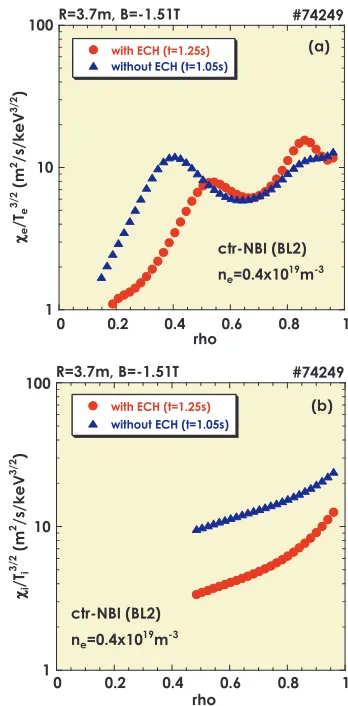
Figures 3 (a) and (b) show the thermal diffusivities for electrons and ions normalized by the gyro-Bohm factor of Te3/2 andT
3/2
i , respectively. χe/T 3/2
e and χi/Ti3/2 are
re-garded as measures of the degree of anomalous transport for electrons and ions, respectively. As shown in Fig. 3, by applying ECRH, the thermal diffusivity normalized by the gyro-Bohm factor for ions is reduced in the region of
ρ >0.5 while that for electrons is not changed in the same
Fig. 3 Profiles of (a) electron thermal diffusivities normalized by Te3/2, χe/Te3/2, and (b) ion thermal diffusivities nor-malized byTi3/2,χi/Ti3/2, for the NBI plasmas with and without the ECRH superposition shown in Fig. 2.
region. In the central region ofρ <0.5,χe/Te3/2is reduced
by applying ECRH, although the change in ion transport in the central region is unknown. These results suggest that the location of the transport improvement by applying ECRH is different between electrons and ions.
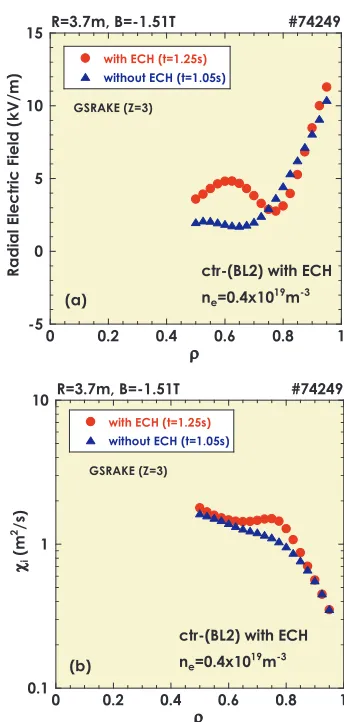
The neoclassical calculation was also performed for the plasmas shown in Fig. 2. The GSRAKE code was used [17], and the calculated ambipolar Er is shown in
Fig. 4 (a). PositiveEr is found at aroundρ =0.6, which
corresponds to theTi-rise location. The value of the
pos-itive Er is not large, and the obtained electron root is a
single solution. The calculated ion thermal diffusivities,
χi, including theEreffect, are shown in Fig. 4 (b), and it is
found that the neoclassicalχi is not increased with theTi
rise. Ripple transport is greatly enhanced withoutEr, and
the positive-Ereffect suppresses the enhancement of ripple
transport due to theTirise. Considering that the
neoclas-sicalχiis not changed much by applying ECRH, theTi
Fig. 4 Results of the neoclassical calculation using the GSRAKE code for the plasmas with and without the ECRH superposition shown in Fig. 2 (a). Radial electric-field profiles and (b) ion thermal-diffusivity profiles.
4. Discussion
In previous investigations on the electron-ITB in LHD, which have been reported in Refs. [3–6], no increase inTiwas observed in the CERC plasmas. In those
exper-iments, only high-energy negative-NBI heating was used in the target plasmas for the ECRH superposition, and the ion heating power ratio was much smaller than the electron heating one. In the present experiments, on the other hand, low-energy positive-NBI heating is used together with the negative-NBI in the target plasmas, and the ion heating power ratio is enhanced compared with the previous ex-periments. As a result, the change inTi would be more
sensitive to the change in ion transport, and thus, aTirise
has been observed in the present experiments. In the pre-vious experiments, theTimeasurement was performed by
CXS in a poloidal line of sight with a high-energy beam with a small cross section for the measurement. In that case, the peripheralTiwould have an influence on the core
Timeasurement under such an experimental condition, as
the ECRH superposition causes the impurity pump-out ef-fect. In the present experiments, CXS in a toroidal line of
sight is employed with a low-energy beam with a larger cross section for the measurement. Thus, the Ti-profile
measurement should be improved for observation of the Ti-change. Another hypothesis considers the density
pro-file. There is a tendency that the density-profile hollowness is suppressed with low-energy NBI heating [13]. Although the increase in theTe/Tiratio in the CERC plasmas could
destabilize the ion temperature gradient (ITG) mode, the destabilization of the ITG mode could be suppressed due to this effect with low-energy NBI heating.
TheTe/Tiratio is one of the important parameters for
ion transport. In tokamaks, it has been reported that in-creasing theTi/Teratio decreases electron and ion
trans-port [18]. This is related to the ITG mode, and it is thought that an increase in theTe/Tiratio leads to lowering the
crit-ical ion temperature gradient for the destabilization of the ITG mode. Considering that the electron confinement is improved in the LHD-CERC plasmas, in which theTe/Ti
ratio increases, the same discussion as that for tokamaks would not be necessarily applied. However, an excess in-crease in theTe/Tiratio would lead to the destabilization of
the ITG mode, which would suppress theTiincrease. On
the other hand, the density gradient would also be related to the ITG mode, and low-energy NBI heating, in which the density hollowness is suppressed, may play a role in stabilization of the ITG mode. In LHD, theTiprofile
mea-surement by CXS is improved with the combination of the injected low-energy neutral beams and the toroidal line of sight for the measurement. The correlation between the Te/Tiratio and ion transport in the CERC plasma is an
im-portant subject to be solved, and its investigation has just started with the results presented in this article with the improved CXS measurement.
Er plays an important role in the confinement
im-provement, and it would also influence the direct loss of energetic ions, especially for the perpendicularly injected particles. It is predicted that the loss of energetic ions with a specific pitch angle is reduced with positiveEr. In LHD,
the behavior of energetic ions in the CERC plasmas is in-vestigated with neutral particle analyzers; however, the re-duction of the direct ion loss with ECRH superposition has not been observed definitely. Thus, although thisEreffect
for energetic ions should be investigated further, enhance-ment of the NBI heating power due to the reduction of the direct ion loss is not considered with ECRH superposition in the present analyses.
As shown in Fig. 2 (c), toroidal rotation driven by ECRH superposition seems to be correlated with the Ti
rise. The neoclassical calculation code for the toroidal vis-cosity is being developed for the LHD high-Ti plasmas;
however, the neoclassical prediction for toroidal rotation is not available currently. In near future, the correlation be-tween toroidal rotation and ion transport would be clarified theoretically, including the effect ofEron the toroidal
5. Summary
An increase in ion temperature has been observed in the NBI-heated plasmas with the superposition of centrally focused ECRH in LHD. The target plasma is produced with a high-energy NBI, and a low-energy NBI is also used for ion heating and aTi-profile measurement by CXS. By
applying ECRH to the NBI plasma, an increase inTe is
observed with a steepTe-gradient. This indicates the
for-mation of the electron-ITB, in which the improvement of electron transport is recognized in CERC. Therefore, it is thought that theTi increase is observed in CERC
condi-tions. The location of the Ti rise seems to be different
from that of theTerise. The transport analysis shows that
the ion transport improvement is ascribed to the reduction of anomalous transport. Neoclassical ambipolar calcula-tion shows thatEr is positive at the location of theTi-rise.
This suggests that ion transport is improved in the CERC plasma. Considering that the neoclassical ion thermal dif-fusivity is not changed much, the experimental ion trans-port is dominated by anomalous transtrans-port. Toroidal rota-tion is measured by CXS in a toroidal line of sight, and a correlation is observed between toroidal rotation and the Ti-rise by applying ECRH.
The improvement of ion transport in CERC is a pos-sible scenario for increasing the ion temperature in helical systems, and this is experimentally demonstrated in LHD.
Acknowledgments
The authors are grateful to the technical staffin LHD for the excellent operation of LHD and the NBI and ECRH systems. This work has been supported by the NIFS under NIFS07ULBB501.
[1] M. Yokoyamaet al., Fusion Sci. Technol.50, 327 (2006). [2] M. Yokoyamaet al., Nucl. Fusion47, 1213 (2007). [3] Y. Takeiriet al., Phys. Plasmas10, 1788 (2003).
[4] T. Shimozuma et al., Plasma Phys. Control. Fusion 45, 1183 (2003).
[5] K. Idaet al., Phy. Rev. Lett.91, 085003 (2003). [6] Y. Takeiriet al., Fusion Sci. Technol.46, 106 (2004). [7] O. Motojimaet al., Nucl. Fusion47, S668 (2007). [8] O. Kanekoet al.,Proc. 16th Int. Conf. on Fusion Energy
1996 (Montreal, 1996)Vol. 3 (Vienna, IAEA) p. 539. [9] Y. Takeiriet al., Nucl. Fusion46, S199 (2006).
[10] M. Osakabe et al., Proc. 17th International Toki Confer-ence, Toki, Japan, 2007, P2-079.
[11] Y. Takeiriet al., Nucl. Fusion45, 565 (2005). [12] Y. Takeiriet al., Nucl. Fusion47, 1078 (2007). [13] K. Nagaokaet al., Plasma Fusion Res.3, S1013 (2008). [14] M. Yoshinumaet al., Plasma Fusion Res.3, S1014 (2008). [15] S. Kubo et al., Plasma Phys. Control. Fusion 47, A81
(2005).
[16] M. Osakabeet al., Rev. Sci. Instrum.72, 586 (2001). [17] C.D. Beidler and W. D. D’haeseleer, Plasma Phys. Control.
Fusion37, 463 (1995).