https://dx.doi.org/10.24001/ijaems.3.7.15 ISSN: 2454-1311
User Friendly Pashto Text Editor
Sarwar Shah Khan
1, Muzammil Khan
21Department of Computer Science City University Peshawar Pakistan 2Department of Computer & Software Technology, University of Swat, Pakistan
Abstract— Thousands of languages are spoken around the world; each language has its own importance in their community. Every community is trying to promote their language via writing books, newspapers, and poetry in their language. Pashto is one of the main languages of Pakistan, Afghanistan and about 60 million of Pashto speakers are dispersed around the world. Even Pashto is national and official language of Afghanistan. The importance of the Pashto language leads to introduce an application for Pashto language, just like a number of applications available for Urdu, English and even for all major languages of the world. In this paper we introduced an offline Pashto Editor “PashApp” for writing Pashto language and provide mark-ups facilities during writings after analyzing the drawbacks or the services not available in online or offline Pashto editors. We developed PashApp in Java. The application is analyzed by comparative analysis using the available Pashto editors and analyzed different features provided by PashApp using task based questionnaire. The study includes 20 Pashto speaking volunteers by simple random sampling technique. The comparative analysis of different available editors lead PashApp which is analyzed using task based questionnaire. The results show high user satisfactions for the features provided in the developed PashApp for Pashto language. The application is an offline editor available for free and covers all basic operations for writings of a language. Kaywords— PashApp, Pashto Text Editor, Script Editors, Comparison.
I. INTRODUCTION
A number of languages are spoken around the world, and every community is trying to promote their language by written scripts that show the culture and civilization of the community. Pashto is a prominent language of Pakistan and Afghanistan and about 60 million people speak Pashto around the world. Historically inhabited in Afghanistan and Khyber PakhtunKhwa, Federally Administered Tribal Areas (FATA), Baluchistan and Iran. The Pashto language is prevailing rapidly because of its rich literature. The first written records of Pashto are believed to date from the sixteenth century and consist of an account of Shekh Mali's conquest of Swat. Pashto has an extensive written tradition. There are a number of classic Pashtun poets, most notably Khushal Khan Khattak (also known as Khushāl Bābā), considered as the national poet of Afghanistan, and a known Pashto language poet in Pakistan. In this century, there has been a rapid expansion of writings in Pashto such as in journalism and other modern artistic work (genres). Pashto writings and writers play vital role in promoting Pashto language [1,2].
In this digital world, every language writings have been facilitating introducing new sophisticated software tools. Similarly, we need to have an application tool that facilitates Pashto writings. In this study we are introducing
a Pashto offline editor “PashApp” the support Pashto
https://dx.doi.org/10.24001/ijaems.3.7.15 ISSN: 2454-1311
II. RELATED WORKS
2.1 InPage
InPage is a word processor and page layout software for languages such as Urdu, Persian, Pashto and Arabic under Windows operating system, which was first developed in 1994 [2]. It is primarily used for creating pages in the
language of Urdu, using the Nasta`līq ('hanging'
calligraphic) style of Arabic scripts. InPage is considered as a de-facto standard tool for publishing Urdu scripts. InPage is widely used on PCs where a user wishes to create their documents in Urdu. The main features are; one can write in many languages, the page border are standard level, the words are written is also counted and many more.
Fig.1: Main interface of InPage
2.1.1 Limitation in Inpage
The use of inpage is very difficult and especially for uneducated people. Inpage need to specialized training to use. inpage is not specific to Pashto language so first you need to toggle the language and toggle the language is difficult, it need five steps to toggle language from Urdu to Pashto. These five steps are not known to everyone. There
are a lot of people they haven’t known can Pashto written
on inpage.
2.2 Online Pashto Editors
We have many online text editors which are specific for Pashto editing [3]. Almost all entire online text editors fail to fulfill the user requirements, provide only writing facilities.
https://dx.doi.org/10.24001/ijaems.3.7.15 ISSN: 2454-1311
2.2.1 Limitation in online Pashto text editor
There are few problems related to online editors, e.g. Most of the Pashto speaking regions are hilly and remote areas
where internet in not available (if available it’s very slow
because of old dial up connections), the online Pashto editors are very simple and not provide some of the main features like text markup etc.
https://dx.doi.org/10.24001/ijaems.3.7.15 ISSN: 2454-1311
IV. COMPARATIVE ANALYSIS OF PROPOSED
AND EXISTING SYSTEM
All those features available in PashApp which is beneficial for different users to write Pashto are comparing with the existing systems like online Pashto text editor which is very simple feature wise. While the other InPage is specific for
Urdu not for Pashto but possible to write Pashto. In analysis its clearly identify our proposed system is much better than other.
In table 1 comparison of existing system and proposed system is given
https://dx.doi.org/10.24001/ijaems.3.7.15 ISSN: 2454-1311
V. ADVANTAGES AND OBJECTIVES OF
PROPOSED MODEL/APPLICATION The application is specific for only Pashto language with special keyboard after the analysis of other Pashto and Urdu keyboard comparison. There is no need for specialized training to learn how to work and user friendly interface (easy to use).the Pashto text editor is almost fulfill the requirement of user. The application is easily available in the market and as will on internet .
The creation of simple and easy application software The creation of easy to use interface
This software will help publishers to publish books, magazines, and newspapers in Pashto language To edit and format text in different markups, i.e.,
colors, fonts etc.
Although default writing style is from right to left but
it will allow user to choose
whether to write Pashto script from left to right (if user comfortable with it)
VI. EXPERIMENTAL SETUP
6. PashApp Evaluation
The worth, reliability and significance of a research study can be analyzed by choosing a suitable evaluation procedure based on some criteria. Evaluation is one of the substantial steps of research process [7]. The selection of evaluation technique depends on the nature of the research study. The study evaluates the Learn ability, Understand ability and Effectiveness of Pashto text editor (PashApp) by categorizing PashApp features, as briefly described in table 2.
Table.2: PashApp Features and its Description
This study is evaluated by using questionnaire based control experiment. In questionnaire based control experiments the participants are asked to execute a number of tasks based experiments on functional prototype of PashApp and fill the feature based questionnaire [4].
6.1 Participant Sampling
Sampling is the process of selecting individuals from the accessible population which are the representatives of entire population and are unbiased. Accessible population means individuals within reach in the existent resources, especially time and cost.
Target Population: The individuals how have Pashto native speakers they are properly Pashto speak and write and they already familiar with different Pashto editor [13].
Accessible Population: The individuals from different educational institutions around the capital and Khyber
Pakhtunkhwa which have speaks and write Pashto it make up our accessible population.
Sampling: The study considers the simple random sampling technique, where each individual of the population have equal chance of being selected as a sample. To evaluate the posted research statement with real users on applying the functional prototype, the study includes 20 volunteer participants. Asking the users to fill the questionnaire using
Pashto editor “PashApp” for the analysis.
6.2 Participants
https://dx.doi.org/10.24001/ijaems.3.7.15 ISSN: 2454-1311 Table.3: Participant’s Demographics
6.3 Survey Design
To evaluate the study we choose the control experiment evaluation technique based on survey or questionnaire. Quantitative research methods are useful to identify relationships among variables, measure and analyze using statistical techniques. After studying numerous systems [6] conclude that 78% of evaluation is based on surveys. In surveys, questionnaire is used to collect the data using functional prototype over sample of real users selected from population and generalize the results to the whole population. Questionnaire used five-point Liker scale which is commonly used in questionnaires, and is the most widely used scale in survey research [5, 4,8,9,10,11].
Five-point Liker Scale
5. Strongly Agree 4. Agree 3. Neutral 2. Disagree 1.
Strongly Disagree
6.4 Result Analysis & Discussion
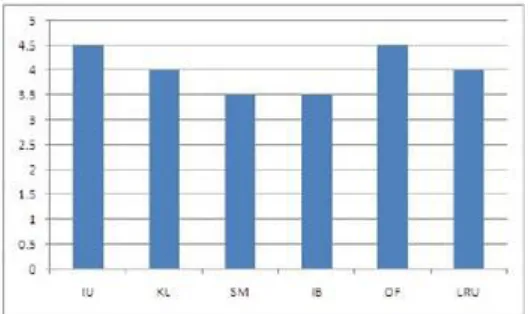
According to the experimental setup, the task based control experimentation is performed on the functional prototype using questionnaire. In this section we analyze different features of Pashto text editor PashApp. Learning and Understanding features are of greatest importance to evaluate how much the PASHAPP present the functionality according to the user's requirement. The user response relatively weak results for Searching Mechanism (SM), Image browsing (IB) while rest of the features represents encouraging results features like Icon understand ability (IU) , Keyboard layout (KL), Overall functionalities (OF) and Label readability and understand ability[12,13,14]. The figure 3 shows the functionalities rate by users.
Fig.1: PASHAPP features (Learning and understanding) evaluation
Rate the features of PashApp are of greatest importance to evaluate how much the PASHAPP present the functionality according to the user's requirement. The user response relatively weak result for Color distinction (CD) while rest
https://dx.doi.org/10.24001/ijaems.3.7.15 ISSN: 2454-1311
Fig.2: Rate the features of PASHAPP
VII. CONCLUSION
This article introduced a new application for Pashto writing which performance and features are evaluated. And also comparative analysis with the existing system. The experimental setup section contains the evaluation technique applied, participant demographics, and questionnaire. The last section discussed the results of
PashApp, include abstract user’s response. The study found
that in column charts showed the promising results for all PashApp features up to user satisfaction level as compare to bar charts. In the article is a comprehensive analysis of different keyboards which provide the easy keyboard to user to remember the key and easily used.
VIII. FUTURE WORK
The study can be extended in different dimensions as briefly discussed below;
8.1 Localization: Localization is first important feature of PashApp to enhance in future. PashApp is software which specific for Pashto text editing so everything is written in Pashto is called localization. For example, the name of menu, menu items etc are written in Pashto. It is very important because in Pakistan Khyber PakhtunKhwa (KPK), Federally Administered Tribal Areas (FATA), and Baluchistan and in Afghanistan the literacy Level is very low. Less number of people understands English so PashApp is less useful for them, if localization is not done.
8.2 Multilanguage: Multilanguage is Second important Feature of PashApp. We want to interact the simplicity and user friendliness while enhancing its capabilities like InPage. PashApp is Specific for Pashto but we want to embed many languages like:
Urdu
Sindhi Arabic Persian Kashmiri English
Because generic use for everyone
8.3 Keyboard layout setting: In PashApp keyboard layout setting is another future enhancement.
In which user set keyboard layout and keys setting according to their own preferences and choice.
And Mobile Interface [11]
8.4 Different fonts styles: In PoshApp font’s style is an important future enhancement. In future we embed fonts in different styles (different Pashto characters) like.
LateefiPashtoLSU KitabiPashtoLSU NargisiPashtoLSU SarmastPashtoLSU
These are all different font styles in Pashto which may feature in future enhancements.
REFERENCES
[1] Ethnic Groups: BBC News. Retrieved 7 June 2013. Pashtun: Estimated to be in excess of 45% of the population, the Pashtuns have been the most dominant ethnic group in Afghanistan.
http://news.bbc.co.uk/hi/english/static/in_depth/world/ 2001/war_on_terror/key_maps/ethnic_pashtun.stm [2] InPage Official Website: http://www.inpage.com/ [3] Easiest Way to Write Pashto:
https://dx.doi.org/10.24001/ijaems.3.7.15 ISSN: 2454-1311
[4] Muzammil Khan, Sarwar Shah Khan, and M. Daud
Awan. "Comparative Exploration of Features for Data Mining Results by Legend Navigation Interactive Technique." International Journal of Database Theory and Application 9.9 (2016): 49-58.
[5] J.A. Gliem, and R.R. Gliem, “Calculating,
interpreting, and reporting Cronbachs alpha reliability coefficient for Likert-type scales”, Midwest Research -to-Practice Conference in Adult, Continuing, and Community Education, The Ohio State University, Columbus, OH, 2003
[6] L.V. Velsen, T.V. Der Geest, R. Klaassen and M.E.L
Steehouder, ”User-centered evaluation of adaptive and
adaptable systems: a literature review”, Knowledge
Engineering Review, Cambridge Univ Press, vol 23, pp. 261, 2008
[7] Trochim, M.K. William and J. P. Donnelly. “Research methods: The concise knowledge base”. Atomic Dog Publisher, 2005.
[8] Khan, M. Interactive Data Mining Results Visualization on Mobile Devices. ISBN 978-3-659-46354-9, LAP Publisher USA, 2013.
[9] Khan, Muzammil, Ali Shah, and Israr Ahmad. "Framework for Interactive Data Mining Results Visualization on Mobile Devices." International Journal of Database Theory and Application 7.4 (2014): 23-36.
[10]Khan, Muzammil, and Sarwar Shah Khan. "Data and information visualization methods, and interactive mechanisms: A survey." International Journal of Computer Applications 34.1 (2011): 1-14.
[11]Khan, Muzammil, Fida Hussain, and Imran Khan. "Single Level Drill Down Interactive Visualization Technique for Descriptive Data Mining Results."International Journal of Grid and Distributed Computing 7.4 (2014): 33-40.
[12] Khan, Muzammil, and Mushtaq Raza. "Suitable Length of Text Line on the Bases of Eye Blink for Reducing Maximum Focus Losses." International Journal of Computer Applications (IJCA) 30.8 (2012): 7.
[13]Khan, Muzammil, et al. "Time & Cost Effective Information Management Framework for Secure Learning Environment in Educational Institutions."International Journal of Computer Science and Information Security 15.1 (2017): 26. [14] Khan, Muzammil. "Comprehensive Study on the Basis
of Eye Blink, Suggesting Length of Text Line, Considering Typographical Variables the Way How to