Original Research Article
Unmet need for family planning among women in rural Egypt
Ragaa El-Masry*, Noha Essam, Magda Ghoneim
INTRODUCTION
At any given time, more than half of women in reproductive age don’t want to get pregnant and want to use any family planning (FP) method.1 FP enables women and their partners to achieve their desired number of children and to space their births. It has many benefits to women’s health, child health and economic development.2
The percentage of married women who don’t want to get pregnant but are not using any form of contraception are
considered to be women with unmet need for FP.3 Globally, about 40% of all pregnancies were unintended where 81% of them were attributed to unmet needs for FP.5,6 In 2015, 12% of married or in-union women globally were estimated to have an unmet need for FP; that is they wanted to stop or delay childbearing but were not using any method of contraception.7
Although Egypt has a strong FP program and lower rates of unmet need than other countries in the region, the downward trend in the unmet need and upward trend in the contraceptive prevalence rate (CPR) in the least two
ABSTRACT
Background: Although Egypt has a strong family planning program; the downward trend in the unmet need has been reversed recently. Thus the present study aimed to assess the magnitude of unmet need for family planning, its common reasons and the associated factors among women of reproductive age group.
Methods: this is a community-based cross sectional household survey study conducted in Awish El-Hagar village, Mansoura, Egypt during the year 2015-2016. Using an interviewer questionnaire; 394 rural women in childbearing period were surveyed via a systematic random sampling technique with the help of the outreach community health workers affiliated to Awish El-Hagar family medicine center.
Results: The overall prevalence rates of unmet need for family planning and contraceptive use were 11.2% and 69.5% respectively, while the total demand for family planning was 80.7%. Infrequent sex (27.3%), fear from the side effects (25%) and husband opposition (15.9%) were the most frequent reasons for non-use of family planning methods among unmet need women. Logistic regressions explored that risk factors for unmet need women were having husband disapproved family planning, having only girls, perception that having >3 children to be ideal, working, having husband with the main family planning decision maker, with no past history of unintended pregnancy and having only boys.
Conclusions: A considerable proportion of Egyptian women still have an unmet need for family planning that need to be addressed by more effective family planning and health education programs together with improving counseling strategies and enforcing the role of outreach workers.
Keywords: Unmet need, Family planning, Rural Egypt, Reproductive age, Household survey Department ofCommunity Medicine, Mansoura Faculty of Medicine, Mansoura, Egypt
Received: 15 January 2018
Revised: 12 February 2018
Accepted: 13 February 2018
*Correspondence:
Dr. Ragaa El-Masry,
E-mail: [email protected]
Copyright: © the author(s), publisher and licensee Medip Academy. This is an open-access article distributed under the terms of the Creative Commons Attribution Non-Commercial License, which permits unrestricted non-commercial use, distribution, and reproduction in any medium, provided the original work is properly cited.
decades has been reversed. According to the latest Egypt Demographic and Health Survey (EDHS) 2014, unmet need for FP has increased from 11.6% in 2008 to be 12.6% in 2014. Similarly, CPR has decreased from 60% in 2008 to 59% in 2014.8
Overpopulation is one of the major challenges facing Egypt in the way to achieve the proposed sustainable development.9 However, future projections estimated that if the CPR among Egyptian women could rise to be 74.4% in 2030, the TFR would decline to be 2.1 births/woman in 2030.10
Knowing the direct reasons for non-use of contraceptive methods can help the FP program planners to find areas for interventions in order to facilitate use of contraceptive methods.8
Socio-demographic and socio-economic factors were found to affect unmet need across different regions of the world, or even within the same country.11 Moreover, many studies assumed that the total demand for FP and unmet need levels were influenced by socio-cultural values.12
Fulfilling the unmet needs for FP means enabling women to have the desired number of children, when they want and enabling them to space births safely.13 Satisfying women unmet need would be also accompanied by striking enhancements of women’s health falls in maternal mortality and savings from reduced expenditures for maternal and newborn healthcare.14 As having updated estimates of the unmet need for FP together with CPR is vital for monitoring success in FP programs and assessing where there is need for corrective actions which could accelerate the Egyptian achievement of sustainable developmental goals and reduction of maternal mortality. Thus this study was conducted to investigate the problem of unmet need for FP (magnitude, common reasons and associated factors) among married women in an Egyptian rural village.
METHODS
Study locality
The study was conducted in Awish El-Hagar village being the largest and most populated village among 39 villages in Mansoura district, Dakahlia Governorate, Egypt. Awish El-Hagar also has an accredited family medicine center that provides integrated primary healthcare services including FP ones. The center provides outreach health services through the outreach healthcare workers (Raedat Refiat). In 2014, the estimated total population of Awish El-Hagar was 30222 with 5037 women of childbearing age while the number of houses in the village was 4769 houses.
Study design
A community-based cross sectional household survey was conducted during the year 2015-2016 starting from the 1st of November 2015. The response to the study was voluntary and the participants were briefed about the study and its objectives.
Study tool
A semi-structured interviewer administered questionnaire was developed to collect data via reviewing the literatures. The content validity of the questionnaire was insured by consulting subject experts, where the questionnaire was amended according to their comments and suggestions. The questionnaire was developed first in English version and was translated into Arabic by a bilingual Egyptian researcher. Then it was back-translated into English by another translator who has no knowledge about the English version whereas similar translation was obtained. Finally the Arabic version of the questionnaire was pilot tested on a group of married women in their childbearing period attending the family medicine center (they were excluded from the full-scale study) in order to check the clarity and validity of the questionnaire. The estimated Cronbach's alpha of the tool was 0.78 which is scientifically accepted.
The constructed questionnaire was composed of 4 parts;
Part 1 included data for determining the women need status for FP according to the latest used EDHS questionnaire8 and the size of unmet need for FP was determined according to the revised definition of unmet need.15Part 2 elicited socio-demographic characteristics of the studied group whereas the socioeconomic score was calculated according to the updated scale of El-Gilany et al.16Part 3 inquired reproductive history of the respondents while Part 4 assessed knowledge and attitude of the studied women toward FP including their exposure to the formal FP message.
Study population
The target population was the married women in their childbearing age. The eligible participants were all married sexually active women, aged 15-49 years and living in Awish El-Hagar village during the period of the study. All women of childbearing age who were not yet sexually active and those who were mentally incapacitated as well as visitors to Awish El-Hagar village were excluded from the study. The response rate among women was 98.5% and the questionnaire was completed by only 394 for whom analysis of data was done.
Sampling and Sample size calculation
The calculated sample size of the study was at least 323 female, using Daniel formula19:
Where: Z =1.96 for 95% confidence interval. P =expected prevalence (30%). d =precision (margin of error) =0.05
The sample size was increased to be 400 women to overcome the non-responders and drop outs.
A systematic random sampling technique was used to cover the desired sample size. The houses number in the village (4769 houses) was used as a sample frame. A simple random technique was used to select the first house from the first 11 houses in the frame, and then a systematic technique was followed to involve every 11th house until the required number was satisfied. A door-to-door survey was done searching for eligible women in the sampled houses. Help was obtained from the community health workers (Raidat Rifyat) affiliated to Awish El-Hagar family medicine center to facilitate outreaching the participants and to build a rapport with the local people. During data collection, if there were more than one eligible woman in the sampled house, one woman was selected randomly. If there was no eligible woman in the sampled house, the next one was visited and a revisit was done if the sampled house was closed.
Data management phase
The collected data were coded, processed and analyzed using SPSS program for windows (version 16). Quantitative data were presented in mean and Standard Deviation. Qualitative data were presented as number and percent. Chi square and Fisher’s Exact were used to test significance of categorical data. Student t-test was used to test significance of quantitative data. P≤0.05 was considered to be significant. Odds Ratio (OR) was used for comparison between groups with a Confidence Interval (CI) of 95%. Significant predictors in univariate analysis were entered into logistic regression model using Forward Wald method and adjusted odds ratio (AOR) was calculated to predict the independent predictors of unmet need for FP.
On scaling the socioeconomic status of the women, scores from 45-49 were considered low social standard. Scores from 50-56 were considered middle social standard while scores ≥57 were considered high social standard.16
Women were classified astotal unmet need for FP, unmet need for spacing, unmet need for limiting, using contraception, have no unmet need for FP and infecund as well as the total demand for FP was calculated according to Brdley et al.15,20
RESULTS
The present work estimated that women with met need for FP (current contraceptive use) were 274 with 69.5% overall CPR whereas 73% of them used contraception for limiting their childbearing while 27% used for spacing births. Women with unmet need for FP were estimated to be 44 women with 11.2% total unmet need for FP whereas 52% of them had unmet need for limiting their childbearing and 48% have unmet need for spacing births. Furthermore, the result found that 27% of women with unmet need for FP were currently pregnant or PPA. The total demand for FP was found to be 80.7%. Infecund women and women with no unmet need for FP represented 5.3% and 14% of the studied women respectively (Data is not shown in table).
Reasons for non-use of FP methods among the unmet need women were investigated in this study. The most frequent were infrequent sex (27.3%) and fear from the side effects (25%) followed by husband opposition (15.9%) and perception of sub-fecundity (11.4%) (Data is not shown in Table).
It was found that unmet need group had significantly higher percent of younger age <30 years and working women compared to those with met need group (p=0.02). The reproductive characteristics of studied women revealed that having only girls or having only boys were significantly higher among women with unmet need compared to those with met need (p<0.001 and p=0.02 respectively). Also, the youngest child aged <2 years old was significantly more belonging to women with unmet need (p=0.002). Furthermore, having no past history of unintended pregnancy and no past history of FP method use were significantly more prevalent among women with unmet need compared to those with met need (Table 1).
The result shows that unmet need women were significantly less knowledgeable about right concept of FP with significant higher percentage that having >3 children to be ideal, having husband with the main FP decision maker, having husband disapproval of FP and having husband desire for more children (Table 2).
Logistic regression analysis shows that women having only girls (OR=5.07), working women (OR=3.83), women with no past history of unintended pregnancy (OR=2.93) and women having only boys (OR=2.60) were significant risk factors for unmet need for FP while having the youngest child aged ≥2 years old was a significant protective factor against unmet need for FP (OR=0.39) (Table 3).
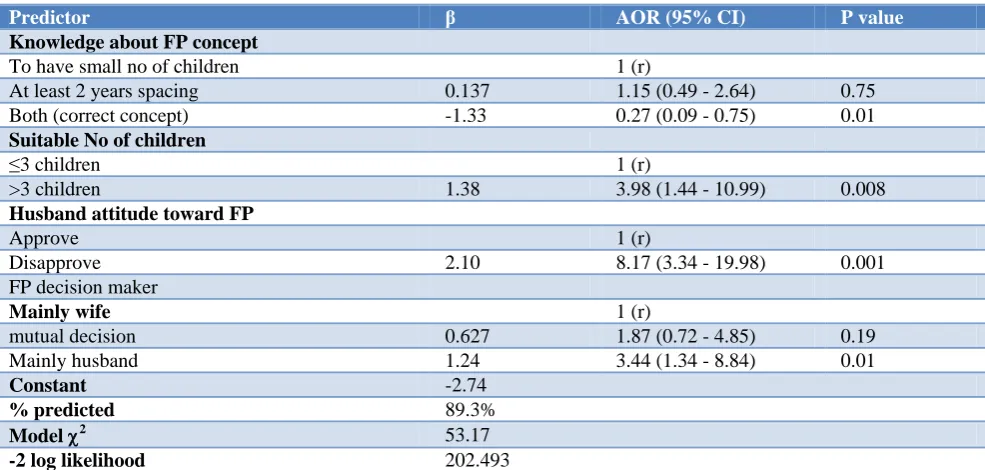
decision maker (OR=3.44) were significant risk factors for unmet need for FP (Table 4).
Table 1: Socio-demographic and reproductive characteristics of studied women with met need versus women with unmet need.
Women characteristics Met need (n=274)
No (%)
Unmet need (n=44)
No (%) OR (95% CI) P value
Woman age
<30 years 100 (36.5) 24 (54.5) 1 (r)
≥30 years 174 (63.5) 20 (45.5) 0.48 (0.25 - 0.91) 0.02
Woman education
≤Secondary 167(60.9) 26 (59.1) 1(r)
˃Secondary 107(39.1) 18 (40.9) 1.08 (0.57 - 2.07) 0.82
Woman working status
House wife 217 (79.2) 28 (63.6) 1 (r)
working 57 (20.8) 16 (36.4) 2.18 (1.1 - 4.29) 0.02
Husband education
≤Secondary 169 (61.7) 26 (59.1) 1(r)
˃Secondary 105 (38.3) 18 (40.9) 1.11 (0.58 - 2.13) 0.74
Husband working status
Non-working 2 (0.7) 1 (2.3) 1(r)
Working 272 (99.3) 43 (97.7) 0.32 (0.02 - 9.01) 0.36
Socio-economic level
Very low 66 (24.1) 12 (27.3) 1(r)
Low 62 (22.6) 8 (18.2) 0.71 (0.27 - 1.85) 0.48 Middle 72 (26.3) 10 (22.7) 0.76 (0.31 - 1.89) 0.56 High 74 (27) 14 (31.8) 1.04 (0.45 - 2.41) 0.93
Watch TV at least once/week
Yes 247 (90.1) 43 (97.7) 1 (r)
No 27 (9.9) 1 (2.3) 0.21 (0.03 - 1.61) 0.15
Read newspaper once/weak
Yes 10 (3.6) 3 (6.8) 1 (r)
No 264 (96.4) 41 (93.2) 0.52 (0.14 - 1.96) 0.40
No of living children
<3 children 106 (38.7) 22 (50) 1 (r)
≥3 children 168 (61.3) 22 (50) 0.63 (0.33-1.20) 0.16
Gender composition of living children
Girls and boys 193 (70.4) 16 (36.4) 1(r)
Only girls 36 (13.1) 18 (40.9) 6.03 (2.82-12.92) 0.001 Only boys 43 (15.7) 10 (22.7) 2.81 (1.19-6.61)
No living children 2 (0.8) 0 0.02
Age of the youngest childa
<2 years 94 (34.6) 26 (59.1) 1 (r)
≥2 years 178 (65.4) 18 (40.9) 0.37 (0.19-0.70) 0.002
Type of the last delivery
Normal 142(52.2) 20(45.5) 1(r)
Caesarian 130(47.8) 24(54.5) 1.31(0.69-2.48) 0.41
Past history of abortion
Yes 83(30.3) 16(36.4) 1(r)
No 191(69.7) 28(63.6) 0.76(0.39-1.48) 0.42
Past history of unintended pregnancy
Yes 140 (51.5) 11 (25) 1 (r)
No 132 (48.5) 33 (75) 3.18 (1.54-6.56) 0.001
Past history of FP method use
Yes 237 (86.5) 32 (72.7) 1 (r)
No 37 (13.5) 12 (27.3) 2.4 (1.14-5.08) 0.02
Table 2: Knowledge and attitude of studied women with met need versus women with unmet need about some items related to FP.
Items Met need (n=274)
No (%)
Unmet need (n=44)
No (%) OR (95% CI) P value
Knowledge Concept of FP
To have small no of children 112 (40.9) 25 (56.8) 1 (r)
At least 2 years spacing 49 (17.9) 14 (31.8) 1.28 (0.61 - 2.67) 0.51 Both (correct concept) 113 (41.2) 5 (11.4) 0.198 (0.07 - 0.54) 0.001
Main source of knowledge about FP
Radio/TV 44 (16) 4 (9) 1 (r)
Medical staff 80 (29.2) 9 (20.5) 1.24 (0.36 - 4.25) 1.00 Mother/friends/relatives 138 (50.4) 30 (68.2) 2.39 (0.80 - 7.16) 0.12 Others 12 (4.4) 1 (2.3) 0.92 (0.09 - 8.98) 1.00
Proper time to start using a method after labor
The end of puerperium 245 (89.4) 38 (86.4) 1 (r)
Other time 29 (10.6) 6 (13.6) 1.33 (0.52 - 3.43) 0.60
Attitude
Suitable spacing period
<2 years 4 (1.5) 2 (4.5) 1 (r)
≥2 years 270 (98.5) 42 (95.5) 0.31 (0.06 - 1.75) 0.195
Suitable No of children
≤3 children 253 (92.3) 36 (81.8) 1 (r)
>3 children 21 (7.7) 8 (18.2) 2.68 (1.10-6.49) 0.04
FP decision maker
Mainly wife 111 (40.5) 10 (22.7) 1 (r)
mutual decision 115 (42) 16 (36.4) 1.5 (0.67-3.55) 0.3 Mainly husband 48 (17.5) 18 (40.9) 4.2 (1.79-9.68) 0.001
Husband attitude regarding FP
Approve 254 (92.7) 27 (61.4) 1 (r)
Disapprove 20 (7.3) 17 (38.6) 7.9 (3.71 - 17.07) 0.001
Husband desire for children
Same as wife’s 180 (65.7) 25 (56.8) 1 (r)
More than wife’s 66 (24.1) 18 (40.9) 1.96 (1.01 - 3.83) 0.05 Fewer than wife’s 28 (10.2) 1 (2.3) 0.26 (0.03 - 1.97) 0.22
Religious approval of FP
Approve 180 (65.7) 26 (59.1) 1 (r)
Disapprove 57 (20.8) 16 (36.4) 1.94 (0.97 - 3.88) 0.06 Don’t know 37 (13.5) 2 (4.5) 0.37 (0.09 - 1.65) 0.27
Health effects of FP methods
Harmful 170 (62.1) 24 (54.6) 1 (r)
Not harmful 76 (27.7) 14 (31.8) 1.3 (0.64 - 2.67) 0.46 Don’t know 28 (10.2) 6 (13.6) 1.5 (0.57 - 4.04) 0.41
The cost of FP methods
Expensive 9 (3.2) 2 (4.5) 1 (r)
Not expensive 261 (95.3) 41 (93.2) 0.71 (0.15 - 3.39) 0.65 Don’t know 4 (1.5) 1 (2.3) 1.13 (0.08 - 16.3) 1.00
Table 3: Socio-demographic and reproductive predictors of unmet need for FP by logistic regression analysis.
Predictor β AOR (95% CI) P value
Woman working status
House wife 1 (r)
Working 1.34 3.83 (1.69-8.67) 0.001
Gender composition of living children
Girls and boys 1 (r)
Only girls 1.62 5.07 (2.23 - 11.47) 0.001 Only boys 0.96 2.60 (1.04 - 6.54) 0.04
Age of the youngest child
<2 years 1 (r)
≥2 years -0.95 0.39 (0.18 - 0.84) 0.02
Past history of unintended pregnancy
Yes 1.08 1 (r)
No 2.93 (1.35 - 6.38) 0.01
Constant -2.98
% predicted 86.6%
Model 2 44.28
-2 log likelihood 210.186
β: regression coefficient, r: reference group; CI: confidence interval, AOR: adjusted odds ratio; 2
: Chi-square, *Significant level: p≤0.05
Table 4: Knowledge and attitude predictors of unmet need for FP by logistic regression analysis.
Predictor β AOR (95% CI) P value
Knowledge about FP concept
To have small no of children 1 (r)
At least 2 years spacing 0.137 1.15 (0.49 - 2.64) 0.75 Both (correct concept) -1.33 0.27 (0.09 - 0.75) 0.01
Suitable No of children
≤3 children 1 (r)
>3 children 1.38 3.98 (1.44 - 10.99) 0.008
Husband attitude toward FP
Approve 1 (r)
Disapprove 2.10 8.17 (3.34 - 19.98) 0.001 FP decision maker
Mainly wife 1 (r)
mutual decision 0.627 1.87 (0.72 - 4.85) 0.19 Mainly husband 1.24 3.44 (1.34 - 8.84) 0.01
Constant -2.74
% predicted 89.3%
Model 2 53.17
-2 log likelihood 202.493
β: regression coefficient, r: reference group; CI: confidence interval, AOR: adjusted odds ratio; 2
: Chi-square, *Significant level: p≤0.05.
DISCUSSION
The present study, calculated the overall unmet need for FP as 11.2% in a sample of married sexually active women in their childbearing age living in Awish El-Hagar village. The current rate was near to those reported in other studies including the latest EDHS8 and the Morocco Demographic Health Surveys.21 In comparison, the present result was higher than the overall rate of unmet need reported in Cairo, Egypt and In Botswana
44.8%, 15.6%, 23.5%, 21.4% and 20.4% respectively).17,18,21,24-30 Different sample size, study design and locality, reproductive and social characteristics of studied women could explain the higher rates of these studies in comparison to our rate. Furthermore, the perception, attitudes and accessibility towards contraception and methods are likely to be more positive in Egypt compared to these other settings leading to lower levels of unmet need in Egypt.
The current study revealed that CPR was 69.5% among the studied women including both modern and traditional methods. This rate was in accordance with that of previous Egyptian rural study (69.7%).24 However, the present CPR was lower than rate found in study conducted in Cairo, Egypt (81.8%).22 Difference could be due to the rural culture of the present work where contraceptive use is expected to be lower than urban areas. On the other hand, the current CPR was higher than those reported in the latest EDHS including both national and regional level in rural Lower Egypt (CPR was 59% and 64% respectively).8 The different rates were indicating disparities across different regions of Egypt. On reviewing CPR in other countries, similar findings were found in Morocco, in Botswana and in Cameroon while lower rate was reported in Eastern Sudan due to inadequate access to FP health services in these regions.21,23,26,30
The total demand for FP was calculated to be 80.7% among the studied women which was higher than the national and regional estimates reported in the latest EDHS.8 Other Egyptian studies were in contrary to the present study with higher FP demand in rural Ismailia and lower demand in Upper Egypt.24,25 It was not surprising as Upper Egypt is characterized by higher rates of fertility, lower levels of desire to stop childbearing and lower CPR.
Regarding fertility preferences of women with met need for FP, it was found that 73% used contraception for limiting their childbearing while 27% used contraception for spacing births and these findings were near to that reported in the latest EDHS, in Cairo and in Ismailia.8,22,24 While the fertility preferences of women with unmet need for FP showed that 52% had unmet need for limiting while 48% had unmet need for spacing. This finding was in line with study conducted in Cairo, Egypt.22 Other studies stated that unmet need was either greater for limiting than for spacing or was divided between the two types.8,17,24 On the other hand, unmet need for spacing was found to be about two third of the total unmet need in Ethiopia, in Eastern Sudan and in Cameroon and this was a common observation in low income countries with high fertility rates.26,29,30
The current study found that pregnant and PPA women represented 27% of total unmet need for FP indicating that unneglectable percent of women with unmet need actually had gained the unfavorable outcome of
non-using contraception and developed unintended pregnancy (either unwanted or mistimed). This result was consistent with findings of other previous Egyptian studies in Cairo, Banha and Ismailia.17,22,24
The main reasons for non-use of FP methods are very important to the program planners as they help to discover areas for potential interventions in order to improve practicing FP among women with unmet need. In this study, more than half (52.3%) of women with unmet need perceived that they are not at risk of pregnancy either due to infrequent sex (27.3%), sub-fecundity (11.4%) and older age (6.8%) or up to God/fatalistic (6.8%) while quarter of them (25%) reported their fear of side effects, 15.9% mentioned husband opposition and religious prohibition was believed by only 6.8%. This means that women with unmet need should be targeted by appropriate FP counseling to address the false perception of low risk of pregnancy and unnecessary fear of side effects. The current reported reasons of unmet need for FP were consistent with findings of other studies.8,24 However the present reasons showed discrepancy in distribution compared to other studies in Upper Egypt and in Cameroon.25,30 In comparison to our result, the cost of FP methods was the most common reason for unmet need in upper Egypt study as it is conducted in a very poor rural area (Bani Talb village, Assuit) where the financial element, even when so small, is so critical for such deprived population. Also, the cultural and social variation of different societies could explain the discrepancy in distribution of reasons for non-use of contraceptive methods.
the majority of our working unmet need women were either workers or work in trade and the increased familial responsibilities both socially as well as financially could lead to unintended laxity regarding using FP methods.
Univariate analysis of reproductive characteristics of the studied women showed that regarding gender composition of living children, women with only girls and those with only boys were more significantly associated with unmet need although having only girls was found to be associated with more risk for unmet need than having only boys. Previous Egyptian studies conducted in Cairo and Ismailia revealed that women with unmet need significantly were having larger number of girls than met need group.22,24 Regarding age of the youngest child, the current study revealed that the age of the last child was significantly associated with unmet need whereas 59% of unmet need women had their youngest child <2 years old compared to 35% of the met need women (p=0.002). This is due to fear from the side effects of contraceptive methods especially hormonal methods on breast milk secretion during the period of breast feeding. However, a study in Cairo, Egypt found that age of the last child was not associated with unmet need where there was higher awareness and better postpartum FP counseling services in urban than rural settings.22 Women without past history of unintended pregnancy were significantly at higher risk of unmet need for FP than women with past experience of unintended pregnancy (OR=3.18) indicating that women who experienced unintended pregnancies either mistimed or unwanted were more keen to avoid future pregnancy by using contraceptive methods. The current study revealed that women who had never used modern FP before were 2.4 times more likely to have unmet need than those who had ever used. Hence, unmet need for FP showed negative and significant association to past history of using modern contraceptive methods. This finding was in agreement with a study in Pakistan. This could be explained that ever user are more familiar with FP methods and services while never users are exposed to rumors about possible adverse health effects of FP methods.28 Unmet need for FP was found not to be associated with the number of living children in the present study; a finding which was consistent with previous studies and inconsistent with other studies.22,24,25,28,30 Furthermore, the present work revealed no significant association between unmet need and past history of abortion, however abortion was reported more frequently among the unmet need women (36.4%) than the met need women (30.3%). This factor was addressed by other study that found the number of abortions experienced by women is positively and significantly associated with unmet need for FP.22
Assessing knowledge in the present study revealed that unmet need for FP was negatively and significantly associated with knowledge about the correct concept of FP as only 11.4% of unmet need women realized this concept while the main source of knowledge about FP
and knowledge about the proper time to start a method after labor were found not to be associated with unmet need for FP. However, it was observed that most of studied women gained their knowledge about contraception from their mothers, friends and relatives (50% of the met need women vs. 68% of the unmet need women). Unfortunately, this will put an additional burden on the FP program planners in order to consider the possible false concepts and rumors that can be transmitted through these ways.
Addressing attitude by current study also showed that perception to have >3 children was ideal, husband with the main FP decision maker, husband disapproval of FP and high husband desire for children were found to be significantly more frequent among the unmet need group than the met need group. However, women attitude toward suitable birth spacing period, religious approval, health effects and cost of FP methods were found not to be associated with unmet need for FP in the current study. The current husband disapproval of FP was in agreement with previous result.30 On the other hand, some studies concluded that most of women; both with met and unmet need for FP agreed with their husbands regarding the desired number of children.17,24 More than half of studied contraceptive users believed that the methods have harmful health effects and this could be a threat as at any time, those women can give up using FP methods and become unmet need women. So, adequate counseling before use is a must. Also, more than 90% of our participants considered the cost of FP methods to be affordable and not expensive which was an optimistic point in the way to sustain method utilization among the met need women and to facilitate the task of decreasing unmet need.
Logistic regression revealed that the independent risk factors for unmet need were working women, having only girls/only boys, without past history of unintended pregnancy, preferred >3 children, with husband disapproved FP and dominating husband in FP decision. However, knowledge about right concept of FP with youngest child ≥2 years old were found to be significant protective factors against unmet need for FP. Similar result was found in study conducted in Ethiopia and Cameroon.29,30
ACKNOWLEDGEMENTS
We are really so grateful to the outreach workers in Awish El-Hagar family health center, Egypt for their generous help. Also, we are thankful to all women who had willingly shared their precious time in this study.
Funding: No funding sources Conflict of interest: None declared
Ethical approval: The study was approved by the Institutional Research Board (IRB) of Mansoura University Faculty of Medicine, Egypt. Official permissions were also obtained from the director of the essential care sector in Dakahlia Directorate of Health and the authority of Awish El-Hagar family medicine center, Egypt
REFERENCES
1. Darroch JE, Sedgh G, Ball H. Contraceptive technologies: responding to women’s needs. New York: Guttmacher Institute, 2011. Available at: https://live.guttmacher.org. Accessed on 25 January 2017.
2. WHO. Family planning/Contraception fact sheet. Geneva: World Health Organization, 2016, Media Center. Available at: http://www.who.int. Accessed on 23 January 2017.
3. Westoff CF. New estimates of unmet need and the demand for family planning: DHS Comparative Reports 2006: 14. Calverton, Maryland: Macro International.
4. Sedgh G, Singh S, Hussain R. Intended and Unintended Pregnancies Worldwide in 2012 and Recent Trends. Studies in Family Planning. 2014;45(3):301-14.
5. Singh S, Darroch J, Ashford L. Adding It Up: the need for and cost of maternal and newborn care — Estimates for 2012. New York: Guttmacher Institute, 2013. Available at: http://www. guttmacher.org. Accessed on 2 February 2017. 6. Say L, Chou D, Gemmill A, Tunçalp O, Moller A,
Daniels J, et al. Global causes of maternal death: a WHO systematic analysis. The Lancet Global Health. 2014;2(6):323-33.
7. United Nations. Trends in Contraceptive Use Worldwide 2015. New York, USA: United Nations, 2015. Department of Economic and Social Affairs (DESA), Population Division. Available at: www.unpopulation.org. Accessed 20 January 2017. 8. El-Zanaty F, Way A. Egypt Demographic and
Health Survey 2014. Cairo, Egypt: Ministry of Health, El-Zanaty and Associates, and Macro International, 2015. Available at: http://dhsprogram. com. Accessed 25 January 2017.
9. United Nations. Probabilistic Population Projections based on the World Population Prospects: The 2015 Revision. New York, USA: United Nations, 2015. Department of Economic and Social Affairs (DESA), Population Division. Available at:
http://esa.un.org/unpd/ppp/. Accessed 25 January 2017.
10. Nassar H, Fouad J. Family Planning in Egypt is a Financial Investment Benefit- Cost Analysis of Egypt Family Planning Program, 2014- 2050. Cairo: Center for Economic and Financial Research and Studies, Cairo University, 2015.
11. Igwegbe A, Ugboaja J, Monago E. Prevalence and determinants of unmet need for family planning in Nnewi, South-east Nigeria. International Journal of Medicine and Medical Sciences. 2009;1(8):325-9. 12. Ndaruhuye D, Broekhuis A, Hooimeijer P. Demand
and unmet need for means of family limitation in Rwanda. Int Perspectives Sexual Reprod Health. 2009;35(3):122-30.
13. Singh S, Darroch J, Ashford L, Vlassoff M. Adding it Up: The costs and Benefits of Investing in family Planning and maternal and new born health. New York: Guttmacher Institute and United Nations Population Fund, 2009. Available at: http://library. nhrc.org. Accessed on 2 February 2017.
14. Singh S, Darroch JE. Adding It Up: Costs and Benefits of Contraceptive Services—Estimates for 2012. New York: Guttmacher Institute and United Nations Population Fund, 2012. Available at: http://www.guttmacher.org. Accessed on 2 February 2017.
15. Bradley SE, Croft TN, Fishel JD, Westoff CF. Revising unmet need for family planning: DHS Analytical Studies, 2012;25. Calverton, Maryland, USA: ICF International.
16. El-Gilany A, El-Wehady A, El-Wasify M. Updating and validation of the socioeconomic status scale for health research in Egypt. Eastern Mediterranean Health J. 2012;18(9):962-8.
17. El- Gendy SD, Dawah AY, Afify RH, El-Taher Sh, Abd-elmoniem RO. Epidemiological study of the unmet need for contraception in Benha city. J Am Sci. 2012;8(5):125-34.
18. Vohra R, Vohra A, Sharma S, Rathore MS, Sharma BN, Sharma MP. Determinants of the unmet need for family planning among women of Jaipur, Rajasthan. International J Advanced Med Res. 2014;1(1):20-5.
19. Daniel W. Biostatistics: A foundation for Analysis in the Health Sciences, 7thed, 1998. New York: John Wiley and Sons.
20. United Nations. World Contraceptive Use 2014, unmet need for family planning. New York, USA: United Nations, 2014. Department of Economic and Social Affairs (DESA), Population Division. Available at: http://www.un.org. Accessed on 19 November 2016.
21. Roudi-Fahimi F, Abdul Monem A, Ashford L, El Adawy M. Women’s Need for Family Planning in Arab Countries. Washington, USA: Population Reference Bureau and UNFPA, 2012. Available at: www.prb.org. Accessed on 19 November 2016. 22. Sultan MK, Bakr I, Ismail NA, Arafa N. Prevalence
women: a community-based study. J Prevent Med Hygiene. 2010;51(2):62-6.
23. Letamo G, Navaneetham K. Levels, trends and reasons for unmet need for family planning among married women in Botswana: across-sectional study. BMJ. 2015;5(3):12.
24. Mohamed NA. The unmet need for contraception among married women in Nefesha village in Ismailia. Ismailia: Suez Canal University, Faculty of Medicine, Master dissertation, 2013.
25. Braghi I, Gadallah M, Habil I. Prevalence and determinants of unmet need for contraception in a village population in Assiut governorate, Egypt. The Egyptian J Community Med. 2013;31(1):15-25. 26. Ali A, Okud A. Factors affecting unmet need for
family planning in Eastern Sudan. BMC Public Health. 2013;13(1):1-5.
27. PCBS. Monitoring the situation of children and women: Family Health Survey 2010. Ramallah: Palestinian Central Bureau of Statistics, 2013. 28. Hameed W, Azmat SK, Bilgrami M, Ishaqe M.
Determining the factors associated with unmet need for family planning: across-sectional survey in 49
districts of Pakistan. Pakistan J Public Health. 2011;1(1):21-7.
29. Gebre G, Birhan, N, Gebreslasie K. Prevalence and factors associated with unmet need for family planning among the currently married reproductive age women in Shire-Enda-Slassie, Northern West of Tigray, Ethiopia 2015: a community based cross-sectional study. Pan African Med J. 2016;23:165-74.
30. Ajong AB, Njotang PN, Yakum MN, Essi MJ, Essiben F, Eko FE, et al. Determinants of unmet need for family planning among women in Urban Cameroon: a cross sectional survey in the Biyem-Assi Health District, Yaoundé. BMC Women's Health. 2016;16(1):1-8.