http://www.ijcmph.com pISSN 2394-6032 | eISSN 2394-6040
Original Research Article
Risk factors associated with refractive error among medical students
Neelam Kumar
1, Babita Jangra
2*, Mahavir Singh Jangra
3, Neeraj Pawar
1INTRODUCTION
Refractive error may be defined as a state in which the optical system of the non-accommodating eye fills to bring parallel rays of light to focus on the retina. Worldwide, about 12.8 million people in the age group of 5-15 years have visual impairment from uncorrected REs, with a prevalence of 0.97%; about 27.1 million in the age group 16-39 years and the prevalence is 1.11%, about 18.4 million have uncorrected REs in 40-49 years with a prevalence of 2.43%, and 95 million people aged 50 years and older have this problem with a prevalence of
7.83%, and thus, a total 153 million have uncorrected REs from with a prevalence of 2.67%. The corresponding figures in India are 1.61 million (0.63%), 2.69 million (0.63%), 4.04 million (3.39%), 30.97 million (18.70%), a total 39.31 million with prevalence of 4.07%.1
Myopia is the most common type of RE, a complex trait including both environmental and genetic factors. Numerous studies have conducted to elucidate the etiology of myopia. However, the exact etiology is still unclear. Myopia is a public health problem globally which leads to visual impairment and blinding
ABSTRACT
Background: Refractive error may be defined as a state in which the optical system of the non-accommodating eye fills to bring parallel rays of light to focus on the retina. Myopia is the most common type of RE, a complex trait including both environmental and genetic factors. Refractive errors are extremely common in the young academically active population. As for any nation they are the features of hardcore human resource, it has huge economic impact. These are the major cause of mild to moderate visual impairment in young individuals; knowledge of the prevalence of refractive error would be helpful in planning of public health strategy.
Methods: The present study was carried out on MBBS students studying in 2nd year to 4th year at Pt. BDS PGIMS Rohtak, Haryana. The study was a case – control type of study, in which a total of 100 cases and 100 controls were taken by simple random sampling by lottery method. Cases and controls were matched for age with a difference of ±2 years.
Results: Refractive error was found statistically significant among females, students spending more reading hours, watching television, mobile use, inadequate light and family history of refractive error. Means age of refractive error was 14.46±3.4 years.
Conclusions: As most of the risk factors are modifiable, so this data could help health care professionals to develop targeted refractive error control policies for the population of students in medical field & insure the policies are more rational, useful, and effective.
Keywords: Refractive error, Risk factors
1Department ofCommunity Medicine, 3Department of General Surgery, Pandit Bhagwat Dayal Sharma Post Graduate
Institute of Medical Sciences, Rohtak, Haryana, India
2
Department ofCommunity Medicine, BPS Govt. Medical College (W), Khanpur Kalan, Sonepat, Haryana, India
Received: 23 November 2017
Revised: 15 December 2017
Accepted: 16 December 2017
*Correspondence:
Dr. Babita Jangra,
E-mail: [email protected]
Copyright: © the author(s), publisher and licensee Medip Academy. This is an open-access article distributed under the terms of the Creative Commons Attribution Non-Commercial License, which permits unrestricted non-commercial use, distribution, and reproduction in any medium, provided the original work is properly cited.
complications Although, the prevalence of myopia varies by the country, age and by ethnic group it is a major cause of visual impairment in both the developed and the developing world. The prevalence of myopia in India was 7-11% among <15 years of age and 35% among adults in 2013.2 The prevalence of myopia has been reported to be as high as 70-90% in some Asian population with Taiwan reporting a myopic prevalence of 84% among 16 to 18 years old high school students.3 Study conducted in Turkey medical student, the prevalence & ages of onset were determined. Out of 207 student 32.9% was found to be myopic.4 High incidence and progression rates of myopia have been reported in individuals who spend long hours in near work activity, such as carpet weavers, visual display terminal workers & microscopes. Several environmental risk factors for myopia, including higher educational attainment, higher socioeconomic status & increased amount of near work activities are well documented in children.5 However exact mechanism of how these factors induce the development of myopia remains controversial.
There is evidence that lack of normal visual stimuli causes improper development of the eyeball. In this case, ―normal‖ refers to the environmental stimuli that the eyeball evolved for over hundreds of millions of years.6
These stimuli would include diverse natural
environments—the ocean, the jungle, the forest, and the savannah plains, among other dynamic visually exciting environments. Modern humans who spend most of their time indoors, in dimly or fluorescently lit buildings are not giving their eyes the appropriate stimuli to which they had evolved and may contribute to the development of myopia.6 In one study, heredity was an important factor
associated with juvenile myopia, with smaller
contributions from more near work, higher school achievement and less time in sports activity.7 Long hours of exposure to daylight appears to be a protective factor.8,
9 Researchers at the University of Cambridge have found
that a lack of outdoor play could be linked to myopia.10 Refractive error are extremely common in the young academically active population. As for any nation they are the features of hardcore human resource, it has huge economic impact. These are the major cause of mild to moderate visual impairment in young individuals; knowledge of the prevalence of refractive error would be helpful in planning of public health strategy. Not much work is done and very little is known about the prevalence of refractive error in medical students. Thus, the study related to the refractive error in the young population, especially those involved in professional studies should be of prime concern. As it is suggested from the review of literatures, refractive error may be, in young medical students. To evaluate this hypothesis the presence study was aimed to study of prevalence of refractive error in medical students.
Aims and objectives
1. To study the risk factors for refractive error in MBBS medical students
2. To study the socio-demographic profile of study population.
METHODS
Study settings
The present study was carried out on MBBS students studying in 2nd year to 4th year at Pt. BDS PGIMS Rohtak, Haryana. Total duration of the study was 4 months (from February 2017 – June 2017). The study was a case – control type of study, in which a total of 100 cases and 100 controls were taken by simple random sampling by lottery method. Cases and controls were matched for age with a difference of ±2 years. Students wearing glasses, lenses or had taken some surgical intervention for refractive error were taken as cases, while controls were taken as students having normal vision without any refractive disorder
Data regarding socio-demographic profile, age of appearance of refractive error, diopter number, family history of refractive error, hours spent on study, mobile, computer Information about outdoor activity like sport etc. were collected on pre tested semi – structured proforma after taking consent from the study subjects.
Exclusion criteria
Exclusion criteria were study participants refused to give consent; study participants having eye disorder other than refractive error.
The collected data were entered in Microsoft excel and were analyzed using SPSS. Frequency, percentage and mean and SD were calculated. Risk factors associations were calculated by applying Chi- square test and p<0.05 was considered statistically significant.
RESULTS
Data were collected from 100 cases and controls each. Refractive error was more common in females (62.7%) as compared to males; this difference was found statistically significant (p=0.006). More than half of the cases (53.8%) belonged to rural area as compared to urban area (Table 1).
Family history of refractive error was also found statistically significant (Table 1). Refractive error was more common among students when both the parents were having positive history of refractive error, followed by positive history in mother followed by father (Figure 1).
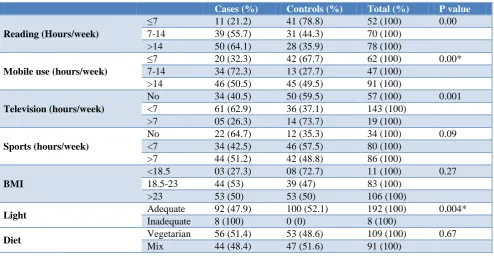
in outdoor sports activities. All the students using inadequate light were having refractive error while none of the student among control group was using inadequate light. The difference in reading hours, watching
television, mobile use, inadequate light were found statistically significant while BMI, diet and participation in sports activities were found statistically insignificant (Table 2).
Table 1: Socio – demographic determinants of study population.
Cases (%) Controls (%) Total (%) P value
Age (years) ≤21 55 (46.2) 64 (53.8) 119 (100) 0.195
>21 45 (55.6) 36 (44.4) 81 (100)
Sex Male 53 (42.4) 72 (57.6) 125 (100) 0.006*
Female 47 (62.7) 28 (37.3) 75 (100)
Residence Urban 23 (40.4) 34 (59.6) 57 (100) 0.085
Rural 77 (53.8) 66 (46.2) 143 (100)
Family h/o refractive error Present 54 (59.3) 37 (40.7) 91 (100) 0.016*
Absent 46 (42.2) 63 (57.8) 109 (100)
*significant.
Table 2: Refractive error and its determinants among study subjects.
Cases (%) Controls (%) Total (%) P value
Reading (Hours/week)
≤7 11 (21.2) 41 (78.8) 52 (100) 0.00
7-14 39 (55.7) 31 (44.3) 70 (100)
>14 50 (64.1) 28 (35.9) 78 (100)
Mobile use (hours/week)
≤7 20 (32.3) 42 (67.7) 62 (100) 0.00*
7-14 34 (72.3) 13 (27.7) 47 (100)
>14 46 (50.5) 45 (49.5) 91 (100)
Television (hours/week)
No 34 (40.5) 50 (59.5) 57 (100) 0.001
<7 61 (62.9) 36 (37.1) 143 (100)
>7 05 (26.3) 14 (73.7) 19 (100)
Sports (hours/week)
No 22 (64.7) 12 (35.3) 34 (100) 0.09
<7 34 (42.5) 46 (57.5) 80 (100)
>7 44 (51.2) 42 (48.8) 86 (100)
BMI
<18.5 03 (27.3) 08 (72.7) 11 (100) 0.27
18.5-23 44 (53) 39 (47) 83 (100)
>23 53 (50) 53 (50) 106 (100)
Light Adequate 92 (47.9) 100 (52.1) 192 (100) 0.004*
Inadequate 8 (100) 0 (0) 8 (100)
Diet Vegetarian 56 (51.4) 53 (48.6) 109 (100) 0.67
Mix 44 (48.4) 47 (51.6) 91 (100)
Table 3: Analysis of risk factors for refractive error.
Cases Controls P value
Age (years) 21.61 21.44 (matched)
Reading (hours/week) 17.37 11.11 <0.001*
Mobile (hours/week) 15.58 14.59 0.52
Fruits (grams/week) 1784.00 1655.50 0.43
Milk (ml/week) 2450.50 2496.40 0.85
Height (cm) 165.35 168.18 0.13
Weight (kg) 62.32 64.95 0.10
BMI 22.52 22.78 0.50
Mean age of refractive error (years) 14.46±3.4 NA
*significant.
The continuous variables were analyzed by applying independent t – test then it was found that cases have more reading hours per week (17.37) as compared to controls (11.11) and this difference in means of reading hours per week was found statistically significant (p<0.001). Although difference was also found in means of mobile use, fruits and milk intake, height, weight, BMI but it was not statistically significant (p>0.05) (Table 3).
Figure 1: Family history of refractive error.
DISCUSSION
The study was a case – control type of study, carried out on MBBS students studying in 2nd year to 4th year. A total of 100 cases of refractory error and 100 controls were taken. The results were compared with many previous studies conducted in different regions of India and abroad.
In the present study, the prevalence of REs was more in females (62.7%) compared to males. And this difference was found statistically significant. This results are comparable with studies done by Fledelius et al at Denmark, Chaudhry et al at Pakistan, Wu et al at China, Lv and Zhang at China Megbelayin et al at Nigeria, Gopalakrishnan et al at Malaysia, and Mavracanas et al at Greece reported that the prevalence of REs including myopia was higher among females as compared to their male counterparts.11-17 On the contrary, a higher rate of myopia in males compared to females was observed at Barodaand Burdwan study though this was found to be of borderline significance and no significant difference between female and male students was observed in our study and Bangalore,Norway,Singapore,Hyderabad,and Turkey study.18-24 It is possible that this slight variation in prevalence rates among medical students across different countries may be attributable to ethnic variations and different genetic predispositions.
The present study and many previous studies supported the observations that ―Refractive errors are multifactorial with genetic and environmental factors and interaction between them, as well as ―parental history of refractory error is an important risk factor for its development such as Chalasani et al, Kathrotia et al, Wakode et al, Chaudhry et al, reported a positive parental history of refractory error. However, Woo et al. study did not
demonstrate any statistically significant correlations between refractory error and the number of parents with refractory error.25-33
In the present study it was found that cases have more reading hours per week (17.37) as compared to controls (11.11) and this difference in means of reading hours per week was found statistically significant (p<0.001). Similar finding was observed by Wakode et al.31
Limitations
The present was an institution-based study. Longitudinal cohort studies or randomized clinical trials of community-based health behavior interventions should be conducted to search further the etiology of refractory errors.
CONCLUSION
Our study revealed the prevalence of refractive error was more common in females (62.7%) as compared to males; this difference was found statistically significant (p=0.006). Similarly inadequate light, long reading hours, watching television and mobile use for long duration were found as statistically significant risk factor for refractive error.
Majority of the parents of medical students having refractive error were also found to be affected by refractive error. Thus genetic factor may play a more substantial role in the development of refractive error.
This data could help health care professionals to develop targeted refractive error control policies for the population of students in medical field and insure the policies are more rational, useful, and effective.
This study produces a small insight of ongoing problem of refractive errors in students. Much work is still needed to assess on a larger scale to enable alterations of the environmental factors responsible for causing refractive errors for the betterment of generations.
Funding: No funding sources Conflict of interest: None declared
Ethical approval: The study was approved by the Institutional Ethics Committee
REFERENCES
1. Resnikoff S, Pascolini D, Mariotti SP, Pokharel GP. Global Magnitude of Visual Impairment Caused by Uncorrected Refractive Errors in 2004. Bulletin of the World Health Organization; 2004: 2. Available
at:
http://www.who.int/bulletin/volumes/86/1/07-041210/en/. Accessed on 4 January 2016.
2. Pan CW, Ramamurthy D, Saw SM. Worldwide
prevalence and risk factors for myopia. Ophthalmic Physiol Opt. 2012;32:3–16.
109
20 13
58
3. Lin LL, Shih YF, Hsiao CK, Chen CJ. Prevalence of myopia in Taiwanese schoolchildren: 1983 to 2000. Ann Acad Med Singapore. 2004;33:27–33.
4. Onal S, Toker E, Akingol Z, Arslan G, Ertan S, Turan C, et al. Refractive errors of medical students in Turkey: One year fallow –up of refraction & biometry. Optomety Vision Sci. 2007;84(3):175-80.
5. Zadnik K, Mutti DO. Refractive error chages in law
students. Am J Optom Phys Opt. 1987;64: 558 561.
6. Lieberman, Daniel E. The Story of the Human
Body: Evolution, Health, and Disease. New York: Pantheon Books. 2013.
7. Mutti DO, Mitchell GL, Moeschberger ML, Jones LA, Zadnik K, Moeschberger M, et al. Parental myopia, near work, school achievement, and children's refractive error. Investigative Ophthalmol Visual Sci. 2002;43(12):3633-40.
8. Elie D. The myopia boom. Short-sightedness is reaching epidemic proportions. Some scientists think they have found a reason why. Nature. 2015;519:276–8.
9. Cui D, Trier K, Ribel-Madsen SM. Effect of Day Length on Eye Growth, Myopia Progression, and Change of Corneal Power in Myopic Children". Ophthalmology. 2013;120(5):1074-9.
10. Sherwin J. Lack of outdoor play linked to short-sighted children". BBC News, 2011.
11. Fledelius HC. Myopia profile in Copenhagen
medical students 1996-98. Refractive stability over a century is suggested. Acta Ophthalmol Scand. 2000;78:501-5.
12. Chaudhry R, Ali H, Sheikh NH. Frequency and underlying factors of myopia among medical students. Biomedica. 2011;27:154-60.
13. Wu Y, Yi H, Liu W, Jia H, Eshita Y, Wang S, et al. Risk factors for myopia in Inner Mongolia medical students in China. Open J Epidemiol. 2012;2:83-9. 14. Lv L, Zhang Z. Pattern of myopia progression in
Chinese medical students: A two-year follow-up study. Graefes Arch Clin Exp Ophthalmol. 2013;251:163-8.
15. Megbelayin EO, Asana UE, Nkanga DG, Duke RE,
Ibanga AA, Etim BA. Refractive errors and spectacle use behavior among medical students in a Nigerian medical school. Br J Med Med Res. 2014;4:2581-9.
16. Gopalakrishnan S, Prakash MV, Jha RK. A study of
refractive errors among medical students in AIMST University, Malaysia. Indian Med J. 2011;105:365-73.
17. Mavracanas TA, Mandalos A, Peios D, Golias V, Megalou K, Gregoriadou A, et al. Prevalence of myopia in a sample of Greek students. Acta Ophthalmol Scand. 2000;78:656-9.
18. Rajdeep P, Patel R. A study of refractive errors on students of Baroda Medical College. Indian J Res Reports Med Sci. 2013;3:18-9.
19. Dey AK, Chaudhuri SK, Jana S, Ganguly P, Ghorai
S, Sarkar A. Prevalence of refractive errors in
medical students. Int J Health Sci Res. 2014;4:98-102.
20. Chalasani S, Jampala VK, Nayak P. Myopia among
medical students - A cross sectional study in a South Indian medical college. Al Ameen J Med Sci. 2012;5:233-42.
21. Midelfart A, Aamo B, Sjøhaug KA, Dysthe BE. Myopia among medical students in Norway. Acta Ophthalmol (Copenh). 1992;70:317-22.
22. Woo WW, Lim KA, Yang H, Lim XY, Liew F, Lee
YS, et al. Refractive errors in medical students in Singapore. Singapore Med J. 2004;45:470-4.
23. Reddy Y, Babu R, Reddy YG, Reddy YM. A study
on prevalence of Myopia among the medicos of Osmania Medical College, Hyderabad. IOSR J Dent Med Sci. 2015;14:112-7.
24. Onal S, Toker E, Akingol Z, Arslan G, Ertan S, Turan C, et al. Refractive errors of medical students in Turkey: one year follow-up of refraction and biometry. Optom Vis Sci. 2007;84:175-80.
25. Morgan A, Young R, Narankhand B, Chen S,
Cottriall C, Hosking S. Prevalence rate of myopia in schoolchildren in rural Mongolia. Optom Vis Sci. 2006;83:53-6.
26. Shi Y, Qu J, Zhang D, Zhao P, Zhang Q, Tam PO,
et al. Genetic variants at 13q12.12 are associated with high myopia in the Han Chinese population. Am J Hum Genet. 2011;88:805-13.
27. Jones-Jordan LA, Sinnott LT, Manny RE, Cotter SA, Kleinstein RN, Mutti DO, et al. Early childhood refractive error and parental history of myopia as predictors of myopia. Invest Ophthalmol Vis Sci. 2010;51:115-21.
28. Jones LA, Sinnott LT, Mutti DO, Mitchell GL, Moeschberger ML, Zadnik K. Parental history of myopia, sports and outdoor activities, and future myopia. Invest Ophthalmol Vis Sci. 2007;48:3524-32.
29. Chalasani S, Jampala VK, Nayak P. Myopia among
medical students – A cross sectional study in a South Indian medical college. Al Ameen J Med Sci. 2012;5:233-42.
30. Kathrotia RG, Dave AG, Dabhoiwala ST, Patel ND,
Rao PV, Oommen ER. Prevalence and progression of refractive errors among medical students. Indian J Physiol Pharmacol. 2012;56:284-7.
31. Wakode NS, Wakode SL, Ksheersagar DD. Risk
factors for myopia in medical students. Int J Recent Trends Sci Technol. 2013;8:09-11.
32. Chaudhry R, Ali H, Sheikh NH. Frequency and underlying factors of myopia among medical students. Biomedica. 2011;27:154-60.
33. Woo WW, Lim KA, Yang H, Lim XY, Liew F, Lee
YS, et al. Refractive errors in medical students in Singapore. Singapore Med J. 2004;45:470-4.