http://www.ijcmph.com pISSN 2394-6032 | eISSN 2394-6040
Original Research Article
Awareness about rabies among general population and treatment
seeking behaviour following dog-bite in rural Puducherry:
a community based cross-sectional study
Yuvaraj Krishnamoorthy*, Vijayageetha M., Sonali Sarkar
INTRODUCTION
Rabies is an acute viral disease that causes fatal encephalomyelitis in virtually all the warm-blooded animals including man. Dog-mediated human rabies kills tens of thousands of people every year worldwide.1 Rabies is 100 per cent fatal but 100 per cent preventable by vaccination in humans and animals. Yet, it remains a
neglected zoonotic disease and endemic in many underdeveloped countries. The World Health Organization states that Rabies claims the lives of an estimated 59,000 people each year globally, out of which 20,000 are in India, accounting for the largest number of rabies deaths globally. Most of these deaths occur primarily among children in rural or marginalized populations.2 In India, dogs are responsible for about 97% of human rabies.3
ABSTRACT
Background: India contributes to one-third of rabies death globally. Despite the efforts taken by government, Rabies incidence in India has been constant for over a decade. Hence, there is need to assess the awareness and treatment-seeking behaviour which will help to plan strategies to prevent rabies related deaths. The objective of the study was to assess the awareness about rabies among general population and to determine the treatment-seeking behaviour and adherence to anti-rabies vaccine among victims of dog-bite in rural Puducherry
Methods: Community based cross-sectional study was conducted during November 2016 in rural Puducherry. 386 individuals were covered in four villages. Information on socio-demographic characteristics and awareness regarding rabies, treatment-seeking behaviour and adherence to anti-rabies vaccine among dog-bite victims was collected using pre-tested questionnaire.
Results: Among 386 participants, 244 (63.2%) were in the age group 31-60 years, 259 (67.1%) were females, 103 (26.7%) had no formal-education. About 68% were found to have adequate knowledge regarding rabies but only 49.5% were aware of local wound-management and 237 (61.4%) showed a positive attitude towards vaccination following scratches/lick over abraded skin. Among 27 (6.9%) with history of dog-bite in last one-year, 17 (62.9%) had taken first-aid measures. All 27 (100%) had visited hospital out of which 24 (88.8%) adhered to vaccination schedule.
Conclusions: Although two-thirds of the study populations were found to have adequate knowledge regarding rabies, half of them had no knowledge regarding first-aid measures. Although all dog bite victims visited hospital, some did not adhere to the schedule mainly due to negligence. Hence, there is need to create awareness regarding wound management and post-exposure immunization.
Keywords: Awareness, Rabies, Treatment-seeking behaviour
Department of Preventive and Social Medicine, JIPMER, Puducherry, India
Received: 31 March 2018 Accepted: 04 May 2018 *Correspondence:
Dr. Yuvaraj Krishnamoorthy, E-mail: [email protected]
Copyright: © the author(s), publisher and licensee Medip Academy. This is an open-access article distributed under the terms of the Creative Commons Attribution Non-Commercial License, which permits unrestricted non-commercial use, distribution, and reproduction in any medium, provided the original work is properly cited.
The high fatality among dog bite cases necessitates it to be treated as a medical emergency. Immediate, thorough wound cleansing with soap and water after contact with a suspect rabid animal is crucial and can save lives. As per National Rabies Control Programme, Anti-Rabies Vaccine should be administered to all Category II and Category III dog bite cases intramuscularly at 0, 3, 7, 14, 28 days following dog bite.3 Vaccines should always be administered and no modification of the recommended number of doses is advisable.4 A lack of adequate awareness and the measures to be taken following dog bite makes the victims more prone for developing rabies. Previous study in Puducherry also showed that even though most of the people knew about the immediate initiation of Anti-Rabies vaccine following animal bite and its free availability in government hospitals, only one-third knew about immediate washing with soap and water following animal bite.5 Awareness about rabies, particularly in rural areas has been documented to be insufficient. Certain misconceptions regarding wound management makes the patient further vulnerable which can be found more among people from rural areas.6–8 Perception of dog-bite victim and their attitude towards treatment are also important for prevention of rabies. Although studies about awareness and treatment seeking behaviour are reported widely very few have been conducted to know the adherence to vaccination schedule among dog-bite cases in rural areas of India/Puducherry.
Aims and objectives
Among the general population residing in the selected villages of rural Puducherry during November 2016 was done with the objective to assess the awareness and knowledge regarding rabies and to assess the treatment-seeking behaviour and adherence to vaccination schedule among the dog-bite victims.
METHODS
Study type: A community based cross sectional study
Study population: Adults belonging to age group of 18 years or more in the study area.
Inclusion criteria
Individuals more than 18 years of age belonging to the rural field practice area of JIPMER were included in the study
Exclusion criteria
Households locked for two consecutive visits were excluded.
Study area
This study was carried out in the rural health centre (RHC) of a tertiary care institute which caters to a
population of around 10000 in the villages of Ramanathapuram, Thondamanatham, Pillaiyarkuppam and Thuthipet during November 2016. RHC provides comprehensive primary health care to the whole population residing in the four wards which are similar in terms of socio-demographic factors and culture.
Study duration: 1 month (November 2016)
Sample size calculation
Sample size was calculated by OpenEpi v3.01 using proportion of individuals having knowledge about first aid measures following dog bite as 52.1% based on a previous study. With an absolute precision of 5% and a Confidence interval of 95%, sample size was estimated to 386.9
Sampling technique
Household was taken as a sampling unit and individual as a study unit. There were totally 2451 households in the area of study. The number of households needed from each of the four villages was calculated proportionate to the population after which, systematic random sampling was employed to select households from the villages. Then the individual to be interviewed from households was selected using a KISH Table.
Data collection tools measurements
A pre-tested structured questionnaire was used for collecting information on socio-demographic variables like age, gender, education, occupation and information regarding knowledge of rabies such as mode of transmission, signs for identification of a rabid dog, wound management and attitude regarding dog bite and immediate measures following dog bite among victims. For Knowledge and Attitude sections, each correct answer was given a score of 1 and every wrong answer was given a score of 0 with maximum score of 15 and minimum of 0. Total knowledge score was calculated for each participant. Median score was calculated among all the individuals and those with score more than or equal to the median score were considered to have adequate knowledge and those less than median score were considered to have inadequate knowledge regarding rabies.
Questionnaire about attitude towards management following dog bite was administered to all 386 participants. Only those who had history of dog bite in last one year were administered questions pertaining to practices.
Statistical analysis
Data was entered into Epidata v3.01 software and analysis was done using SPSS version 19.0 Continuous variables like age were summarized as mean (SD) and categorical variables like gender, education, occupation were summarized as proportions. Chi square test was used to find the association between socio-demographic variables and awareness about rabies.
RESULTS
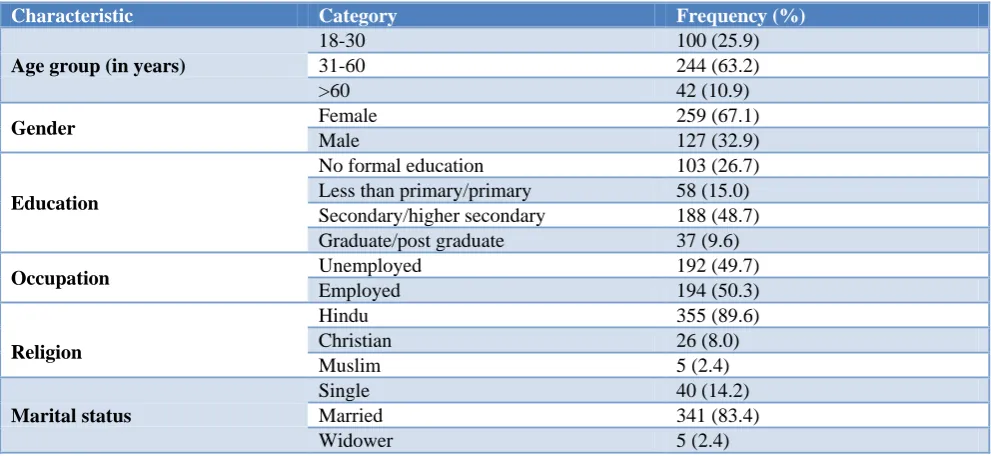
Among 386 individuals interviewed, 259 (67.1%) were females and 127 (32.9%) were males. Study participants age ranged from 18 years to 86 years and the mean age+ Standard Deviation (SD) was 42.87±15.06 years. Majority, 244 (63.2%) of the study participants were in the age group between 31-60 years, 103(26.7%) had no
formal-education, 192 (49.7%) were unemployed, 355 (89.6%) were Hindus, 341 (83.4%) were married (Table 1).
Figure 1: Distribution of study participants based on vaccination status of pet dogs (n=58).
Among 386 participants, 58 (15%) were dog owners. Among these dog owners, 29 (50%) did not vaccinate their dog, five (8.7%) had vaccinated their dogs but not in the last one year, 24 (41.3%) had their dogs vaccinated in the last one year (Figure 1).
Table 1: Distribution of study participants based on socio-demographic characteristics (n=386).
Characteristic Category Frequency (%)
Age group (in years)
18-30 100 (25.9)
31-60 244 (63.2)
>60 42 (10.9)
Gender Female 259 (67.1)
Male 127 (32.9)
Education
No formal education 103 (26.7)
Less than primary/primary 58 (15.0) Secondary/higher secondary 188 (48.7)
Graduate/post graduate 37 (9.6)
Occupation Unemployed 192 (49.7)
Employed 194 (50.3)
Religion
Hindu 355 (89.6)
Christian 26 (8.0)
Muslim 5 (2.4)
Marital status
Single 40 (14.2)
Married 341 (83.4)
Widower 5 (2.4)
Among 386 participants, 17 (4.4%) had not heard about rabies. Only those 369 participants who had heard about rabies were interviewed regarding knowledge about rabies. Among those interviewed, 365 (98.9%) knew that mode of transmission of rabies was through animal bite. When asked about the mode of transmission of rabies other than animal bite, only 121 (33.1%) knew scratch as a mode of transmission and 225 (61.6%) did not know any other modes of transmission other than animal bite. Majority, 360 (97.6%) stated dog as the most common animal whose bite causes rabies and 276 (74.8%) mentioned aggressiveness as the major sign for identification of a rabid dog (Table 2).
Regarding knowledge about severity of rabies based on site of bite, 231 (62.6%) were not aware and only 95 (25.7%) mentioned head and neck correctly. If left untreated, 276 (74.8%) mentioned that there was a 100% chance of death. With regard to local wound management, 191 (49.5%) knew that they have to wash the site of wound immediately with running water, however, 158 (40.9%) were unaware about first aid measures to be taken following dog bite. Majority, 359 (97.2%) were aware about the availability of anti-rabies vaccine in hospitals (Figure 2).
50% (29) 41.30%
(24) 8.70%
(5)
Table 2: Distribution of study participants based on their knowledge regarding rabies (n=369).
Respondent’s knowledge Category Frequency (%)
Mode of transmission
Animal bite 365 (98.9)
Vector borne 3 (0.8)
Does not know 1 (0.3)
Mode of transmission other than animal bite
Scratch 121(32.8)
Close contact with animals 10 (2.7)
Lick on intact skin 9 (2.4)
Eating raw flesh 4 (1.1)
Does not know 225 (61.0)
Signs of identification of a rabid dog
Aggressiveness 276 (74.8)
Sudden behavioural change 49 (13.3)
Hyper-salivation 31 (8.4)
Hydrophobia 3 (0.8)
Does not know 10 (2.7)
Severity based on site of bite
Head and Neck 95 (25.7)
Chest and abdomen 25 (6.8)
Hands 18 (4.8)
Does not know 231 (62.6)
Risk of death in untreated cases
25% 28 (7.6)
50% 35 (9.5)
75% 30 (8.1)
100% 276 (74.8)
Knowledge about availability of ARV
Available 345 (93.4)
Not available 20 (5.4)
Does not know 4(1.2)
Table 3: Distribution of study participants based on their attitude towards dog bite management (n=386).
Attitude Yes (%) No (%) Not sure (%)
Wash the site immediately following dog bite 239 (61.9) 81 (21.0) 66 (17.1)
Visit traditional healer 100 (25.9) 262 (67.9) 24 (6.2)
Visit hospital 363 (94.0) 10 (2.6) 13 (3.4)
Vaccination for scratch/lick on abraded skin 237 (61.4) 88 (22.8) 61 (15.8)
Vaccination following dog bite 365 (94.6) 8 (2.1) 13 (3.4)
Table 4: Distribution of study participants based on their health seeking behaviour following dog bite in last one year (n=27).
Health seeking behaviour Yes (%) No (%)
Taken first aid measures immediately 17 (63.0) 10 (37.0)
Sought Health care services 27 (100) 0 (0)
Completed ARV 24 (88.8) 3 (11.2)
Majority, 239 (61.9%) showed a positive attitude towards washing the site of wound with running water. Nearly 26% (100) of the participants said that they would visit a traditional healer following dog bite. A majority, 363 (94%) had a positive attitude towards visiting hospital following dog bite, irrespective of any other measures taken immediately following dog bite. Most of the participants 365 (94.6%) stated that they would get vaccinated following dog bite whereas only 237 (61.4%) said that they would get vaccinated following scratch by dogs (Table 3).
Figure 2: Distribution of study participants based on knowledge regarding first aid measures following dog
bite (n=369).
The median knowledge score was observed to be 11. Those who had not heard about rabies were given a score of 0 without administering knowledge questionnaire. Those who had a score of 11 or more and those with a score below 11 were classified to have adequate knowledge and inadequate knowledge regarding rabies respectively. Majority, 264 (68.3%) were found to have adequate knowledge regarding rabies.
Proportion with adequate knowledge decreased with increasing age, less in females and in those with lesser education. But none of these associations were found to be statistically significant (Table 5).
Table 5: Distribution of study participants based on knowledge scores and its association with socio-demographic characteristics (n=386).
Variable Inadequate knowledge Score <11 (%)
Adequate knowledge
Score >11 (%) Total P value
Age group
18-30 28 (28) 72 (72) 100 0.22
31-60 76 (31.1) 168 (68.9) 244
>60 18 (42.9) 24 (57.1) 42
Gender
Female 87 (33.6) 172 (66.4) 259 0.22
Male 35 (27.6) 92 (72.4) 127
Education
No formal education 40 (38.8) 63 (61.2) 103 0.12
Less than primary/primary 21 (36.2) 37 (63.8) 58
Secondary/higher secondary 53 (28.1) 135 (71.8) 188
Graduate/post graduate 8 (21.6) 29 (78.3) 37
DISCUSSION
In this study in rural Puducherry, majority of study participants (95.5%) were aware of rabies as a disease and about 99% of them knew how the disease is transmitted and about 94% were aware of the need to seek medical attention following dog bite. But there was a lack of knowledge regarding importance of wound washing, the risk of rabies transmission from species other than dogs and among dog-owners the need to vaccinate their dog against rabies.
Awareness about the severity of bites is very critical as there is a need to be aware about the urgency of initiation of treatment. The present study showed that only 25% of those who had heard of rabies knew head and neck as a severe site of bite which concurred with the findings of a study done in rural Gujarat (25%). In contrast another study done in rural Pune revealed a lower prevalence (less than 10%) of awareness regarding severity of bite.9 This difference in knowledge may be due to the fact that more number of participants had no formal education.
Regarding knowledge about fatal nature of rabies, our study showed that about 75% knew that dog bite is 100% fatal. However, studies done in other rural parts of the country like Pune, Gujarat, New Delhi and a study done in urban Puducherry have revealed that almost 90% had knowledge about the fatality from rabies which is higher than the findings observed in the current study.5,6,8,9 In this study, half of the study participants were unaware of the preventive practices. Similar findings (52.1%) were also found in a study done in rural community of Pune.9 However, studies done in rural part of Gujarat and urban Puducherry observed that only one third knew about immediate wound washing following bite.5,6 In contrast observations from Tanzania revealed that only 5% of respondents expressed the need to apply first aid measure.10 Cultural practices like application of turmeric, chillies, oil over wound were found in addition to lack of awareness regarding proper wound management. Although rabies control programme was implemented, emphasis to create awareness is still lacking in rural parts of the country.
49.5% (191) 40.9%
(158) 7.3%
(28) 2.3% (9)
Wash the wound with running water
Do nothing
Visit Traditional Healer
Knowledge regarding anti rabies vaccine availability was found to be 97% which was analogous to the findings of a study conducted in urban Puducherry.5 Conversely, studies done in rural community of Gujarat (86%) and Bangladesh (70%) showed lesser awareness as compared to this study findings.6,11
In the present study 93% were willing to visit hospital following dog bite, in contrast to studies done in rural areas of Gujarat (75%) and New Delhi (50%) and almost 42% of the study participants preferred to use household treatment of chilly application over wound which is much lower than the observed findings. However, a study in Urban Puducherry has observed that everyone was willing to do so.5,6 Awareness about fatality and severity of rabies may have attributed to willingness to seek health care facility for treatment.
A critical component of PEP is immediate washing of site of bite with soap and water before visiting health care facility. Practice of local wound management was similar between rural and urban Puducherry as almost 65% washed the site of wound with soap and water, which differed from a study done in rural community of Gujarat (11.1%). It may be due to the cultural practices followed in rural communities. Misconceptions about local application of irritants are dangerous which necessitates corrective action by extensive health education.
Among 27 individuals who had a history of dog bite in the last one year, everyone visited health care facility however; three of them did not adhere to the schedule. Reasons for non-adherence were mainly negligence and loss of wages.
Vaccination of pet dog was found to be inadequate as only 41% vaccinated their dog in the past one year which was higher than the findings of a study done in rural areas of Gujarat (20%). Studies done in other countries like Indonesia have showed better results i.e. 74% of dog owners have vaccinated their dog.12
There is knowledge gap in the rural areas about the course of action to be taken after dog bite which needs to be addressed through regular targeted awareness campaigns. The present study findings highlight key factors affecting rabies knowledge, attitudes and practices across rural Puducherry that could be targeted to improve health-seeking behaviour and rabies control practices.
Limitations of our study were unavailability of working population as data collection was done at day-time, which resulted in more number of female participants.
Relevance of our study is that we have assessed the adherence to vaccination schedule among the dog bite cases which was explored by very few studies in India.
CONCLUSION
Although two-thirds of the study population were found to have adequate knowledge regarding rabies, half of them had no knowledge regarding first-aid measures. Even though, all dog bite victims visited the hospital, yet some of them did not adhere to the schedule. Hence, there is a need to create awareness regarding wound management and post-exposure immunization through enhanced IEC activities.
Funding: No funding sources Conflict of interest: None declared Ethical approval: Not required
REFERENCES
1. World Health Organization. Global elimination of dog-mediated human rabies: report of the rabies global conference, 10-11 December 2015, Geneva, Switzerland WHO. Available at: http://apps.who.int/ iris/bitstream/10665/204621/1/WHO_HTM_NTD_ NZD_2016.02_eng.pdf. Accessed on 1 July 2017. 2. Hampson K, Coudeville L, Lembo T, Sambo M,
Kieffer A, Attlan M, et al. Estimating the global burden of endemic canine rabies. PLoS Negl Trop Dis. 2015;9(4):e0003709.
3. National Health Portal of India. National Rabies Control Programme. NHP. Available at: http://117.239.178.13/national-rabies-control-programme. Accessed on 1 July 2017.
4. World Health Organization. WHO Guide for Rabies Pre and Post Exposure Prophylaxis in Humans. WHO. Available at: http://www.who.int/rabies/ PEP_Prophylaxis_guideline_15_12_2014.pdf. Accessed on 1 July 2017.
5. Naik B, Sahu S, Ganesh Kumar S. Wound management and vaccination following animal bite: a study on knowledge and practice among people in an urban area of Pondicherry, India. Int J Community Med Public Health. 2015;2:501–5. 6. Singh US, Choudhary SK. Knowledge, attitude,
behavior and practice study on dog-bites and its management in the context of prevention of rabies in a rural community of Gujarat. Indian J Community Med. 2005;30(3):81.
7. Singh A, Ahluwalia S, Bhardwaj A, Mithra P, Siddiqui A. A cross-sectional study of the knowledge, attitude, and practice of general practitioners regarding dog bite management in nothern India. Med J Dr Patil Univ. 2013;6(2):142. 8. Agarwal N, Reddaiah VP. Knowledge, attitude and
practice following dog bite: a community-based epidemiological study. Health Pop Perspect. 2003;26(4):154–61.
10. Sambo M, Lembo T, Cleaveland S, Ferguson HM, Sikana L, Simon C, et al. Knowledge, Attitudes and Practices (KAP) about Rabies Prevention and Control: A Community Survey in Tanzania. Rupprecht CE, editor. PLoS Negl Trop Dis. 2014;8(12):e3310.
11. Rumana R, Sayeed AA, Basher A, Islam Z, Rahman MR, Faiz MA. Perceptions and treatment seeking behaviour for dog bites in rural Bangladesh. Southeast Asian J Trop Med Public Health. 2013;44(2):244.
12. Widyastuti MDW, Bardosh KL, Sunandar , Basri C, Basuno E, Jatikusumah A, et al. On dogs, people,
and a rabies epidemic: results from a sociocultural study in Bali, Indonesia. Infect Dis Poverty. 2015;4(1):30.