Original Research Article
Health problems and risk factors prevailing among garment
workers in Tirupur, Tamil Nadu
Sreesupria P. Ravichandran
1*, Pankaj B. Shah
2INTRODUCTION
Every occupation has its own ill effects on health. According to ILO estimates, at least 2 million deaths per year are accounted to occupational diseases and injuries.1 One such occupational group, causing a wide range of co –morbid conditions is the garment industry. Workers are denied of their basic rights and less importance is given to their health. Garment workers are susceptible to
various health problems by virtue of their workplace and working conditions. Studying the prevalence of the various health problems demands an observational study of which cross sectional study is one feasible option. Addressing issues among the garment workers, demands a one to one in depth interviewing of the participants which is best achieved by conducting cross sectional studies. Many studies done in the field of garment industry focussed only on few aspects of the health with
ABSTRACT
Background: Garment workers are susceptible to various health problems by virtue of their workplace and working conditions. The present study was conducted to estimate the prevalence of certain health problems and to assess association between socio demographic factors, occupational factors and certain health problems among garment workers.
Methods: A cross sectional study was conducted among garment industry workers, at Tirupur. Interview was conducted using a structured pretested questionnaire including information on visual problems, hypertension, diabetes, gastrointestinal symptom rating scale, American thoracic society, and division of lung disease –78 adult respiratory questionnaires. Clinical examination was done to assess body mass index and blood pressure was recorded. Visual acuity for distant and near vision was tested. Haemoglobin estimation was performed. Data entry and analysis was done using SPSS version 15 software. Chi-square test was used as a test of significance.
Results: In this study, 87.4% of the workers reported any one health problem. The common problems reported were musculoskeletal problems (77.6%) followed by anaemia (57%), visual problems (51.6%), symptoms of respiratory problems (31.3%), hypertension (12.9%), diabetes (6.6%) and obesity (2.1%). 49.7% of the workers had any one symptoms of gastrointestinal problems in the last 7 days. The study has shown a possibility of older age, sewing work, sitting posture, and increased work experience as potential risk factors in the development of various health problems.
Conclusions: Garment workers probably need long term on site awareness programs, continuous motivation and health education to prevent and treat these problems at an earlier stage.
Keywords: Garment workers, Gastrointestinal problems, Respiratory problems, Anaemia, Hypertension, Risk factors Department ofCommunity Medicine, 1Coimbatore Medical College, Coimbatore, 2Sri Ramachandra Medical College and Research Institute, Sri Ramachandra University, Chennai, Tamil Nadu, India
Received: 14 March 2018 Accepted: 04 April 2018
*Correspondence:
Dr. Sreesupria P. Ravichandran, E-mail: [email protected]
Copyright: © the author(s), publisher and licensee Medip Academy. This is an open-access article distributed under the terms of the Creative Commons Attribution Non-Commercial License, which permits unrestricted non-commercial use, distribution, and reproduction in any medium, provided the original work is properly cited.
less emphasis on gastrointestinal problems, visual problems, certain non-communicable diseases like hypertension, diabetes and obesity. Looking for the potential risk factors, may serve as an appropriate base in helping the administrators and other personnel involved, in planning solutions or intervention strategies to improve the workers health by reducing the workplace associated risks. Against this background, the present study was conducted to estimate the prevalence of certain health problems and also to assess the association between socio demographic factors, occupational factors and certain health problems among garment workers.
METHODS
A cross sectional study was conducted among garment industry workers, at Tirupur, during, May and June 2013. With an estimated prevalence of musculoskeletal disorders among garment workers as 22.1%, limit of accuracy as 20%, non-refusal rate of 10% and at 5% level of significance, the sample size calculated was 374.2 Workers ≥18 years of age with a minimum of one year experience were included in the study. After obtaining a written informed consent, interview was conducted using a structured pretested questionnaire. Gastrointestinal symptom rating scale was used to assess the symptoms of gastrointestinal problems.3 The responses are graded on a 7 point Likert scale ranging from no discomfort (score 1) to very severe discomfort (score 7). The higher the score, the more pronounced is the symptom.4 Prevalence of symptoms of respiratory problems was assessed using American thoracic society, division of lung disease – 78 (ATS DLD -78) adult respiratory questionnaire.5 Information on visual problems, hypertension, and diabetes were collected, followed by clinical examination to measure height, weight for assessment of body mass index (BMI). Blood Pressure was recorded and classification was done using JNC – VII criteria.6 Visual acuity for distant and near vision was tested using Snellen’s chart.7
Laboratory investigation for Haemoglobin estimation was performed. Anaemia is considered to exist if the haemoglobin levels are below 13 g/dl in adult males and 12 g/dl in adult non-pregnant females.8 Participants who had been identified with problems were referred for further assessment and treatment to higher centres.
Data entry and analysis was done using SPSS version 15 software. Descriptive statistics were calculated for background variables, details on work. Prevalence was calculated for symptoms of gastrointestinal problems, symptoms of respiratory problems, visual problems, hypertension, diabetes, obesity and anaemia. Odds ratio was calculated with 95% Confidence interval to evaluate the association between socio demographic variables, type of work, posture during work, years of working experience and visual problems symptoms of gastrointestinal problems, and respiratory problems. Chi-square test was used as a test of significance.
RESULTS
Particulars about demographic profile, socio economic status and occupational history were described earlier9. 71.1% of the workers had no history of any tobacco use while 98 (25.7%) workers had a history of current tobacco use. 9.7% and 8.9% workers reported a family history of hypertension and diabetes respectively.
Figure 1: Prevalence of various health problems.
The prevalence of various health problems are given in Figure 1. 87.4% of the workers had any one health problem. Musculoskeletal was commonest problem present among 77.6% of the workers. It was found that over half of the workers (51.6%) had any one visual problem during the last one year. The most common symptom was headache (28.2%), followed by burning sensation (15.3%), watering in eyes (15.3%), irritation (11.85%), pain (11.3%), redness (9.2%), double vision (2.6%) and discolouration of objects (1.1%). 12.4% of the workers were using spectacle for refractive error and 61.3% of the workers had normal visual acuity.
49.7% of the workers had any one symptom of gastrointestinal problem during the last 7 days. Heart burns were noted in 73 workers (19.2%). 15.5% had acid regurgitation, 15.3% had complaints of increased flatus and 13.7% had abdominal pain. The other gastrointestinal symptoms reported were eructation (9.7%), hunger pain (7.4%), nausea and Borborgymus (6.6%) each. 5.8% of the workers had constipation and 4.5% suffered from abdominal distension. Only 8 workers (2.1%) had loose stools, 4 (1%) had a feeling of incomplete evacuation and 2 (0.5%) had urgent need for defecation.
In this study, 31.3% of the worker reported any one symptom of respiratory problem. Phlegm was the most prevalent symptom reported by 65 (17.1%) workers, followed by cough in 60 (15.8%) workers, breathlessness in 44 (11.6%) workers and wheeze in 30 (7.8%) workers. Only 2.1% of the workers had wheeze with breathlessness. Majority of the workers, 40 (66.7%) and 50 (76.9%) had cough and phlegm for four or more days a week respectively. Only 18 (30%) workers reported
0 10 20 30 40 50 60 70 80 90 100
Pe
rc
en
ta
g
e
Any one health problem Musculoskeletal problem (Any one) Anaemia
Visual problem (Any one)
Symptom of respiratory problem (Any one) Hypertension Diabetes (From records) Obesity
87.4% 77.6%
57.1% 51.6%
31.3%
early morning cough. 10 (15.4%) workers had phlegm for three or more months a year.15 (50%) workers had wheezing only during cold. 17 (38.9%) workers complained of walking slower than other people of same age, and one among them stopped for breath after walking a few minutes on the level. 18 (4.7%) workers
reported chest colds and illness. 2 (66.7%) workers had two or more episodes of chest illness with phlegm in the last three years. 5% and 2.4% of the workers had a history of asthma and tuberculosis in the past. None of the workers had a past history of emphysema. Neither of them had any chest injuries nor chest operations done.
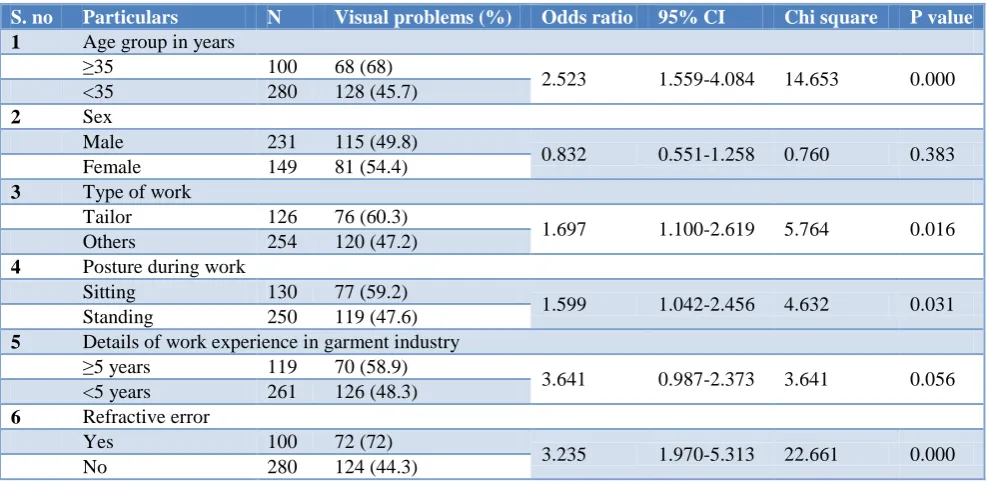
Table 1: Association between various factors and visual problems.
S. no Particulars N Visual problems (%) Odds ratio 95% CI Chi square P value
1 Age group in years
≥35 100 68 (68)
2.523 1.559-4.084 14.653 0.000
<35 280 128 (45.7)
2 Sex
Male 231 115 (49.8)
0.832 0.551-1.258 0.760 0.383
Female 149 81 (54.4)
3 Type of work
Tailor 126 76 (60.3)
1.697 1.100-2.619 5.764 0.016
Others 254 120 (47.2)
4 Posture during work
Sitting 130 77 (59.2)
1.599 1.042-2.456 4.632 0.031
Standing 250 119 (47.6)
5 Details of work experience in garment industry
≥5 years 119 70 (58.9)
3.641 0.987-2.373 3.641 0.056
<5 years 261 126 (48.3) 6 Refractive error
Yes 100 72 (72)
3.235 1.970-5.313 22.661 0.000
No 280 124 (44.3)
Table 2: Association between various factors and symptoms of gastrointestinal problems.
S. no Particulars N
Symptoms of gastrointestinal problems (%)
Odds ratio 95% CI Chi square P value
1 Age group in years
≥35 100 66 (66)
2.478 1.539-3.990 14.358 0.000
<35 280 123 (44)
2 Sex
Male 231 119 (51.6)
1.199 0.794-1.811 0.745 0.388
Female 149 70 (47)
3 Type of work
Tailor 126 66 (52.4)
1.172 0.764-1.797 0.527 0.468
Others 254 123 (48.4)
4 Details of work experience in garment industry
≥5 years 119 68 (57.1)
3.801 0.997-2.338 3.801 0.051
<5 years 261 121 (46.4)
In the current study, 138 (36.3%) workers were found to have normal blood pressure. 193 (50.8%) workers were found to be pre hypertensive. 25 (6.6%) and 24 (6.3%) workers belonged to stage I and stage II hypertension respectively. According to JNC 8 guidelines, 12.9% of the workers needs an initiation of pharmacological treatment to lower the blood pressure to <140/90 mmHg. 25 (6.6%) had a known history of diabetes.10 245 (64.5%) workers had a normal body mass index. 105 (27.6%) workers were overweight and only a very few 8 (2.1%) workers were obese. 217 (57.1%) of workers had
anaemia, out of which 59.9% were females. The other morbidities reported were skin problems (2.63%), epilepsy (0.78%), thyroid disorders (0.78%) and haemorrhoids (0.52%).
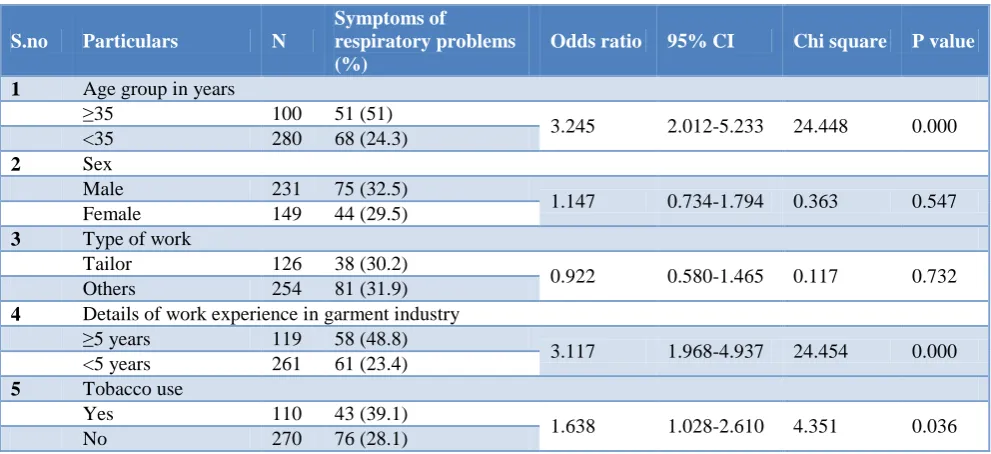
years (66%) were two and half times at risk of developing gastrointestinal problems compared to workers <35 years (44%) with a p<0.001. Symptoms of respiratory problems was more common among workers aged ≥35 years, work experience ≥5 years, in tobacco users and these
differences were statistically significant. Association between various factors and visual problems, symptoms of gastrointestinal problems, symptoms of respiratory problems are shown in Tables 1, 2 and 3 respectively.
Table 3: Association between various factors and symptoms of respiratory problems.
S.no Particulars N
Symptoms of
respiratory problems (%)
Odds ratio 95% CI Chi square P value
1 Age group in years
≥35 100 51 (51)
3.245 2.012-5.233 24.448 0.000
<35 280 68 (24.3)
2 Sex
Male 231 75 (32.5)
1.147 0.734-1.794 0.363 0.547
Female 149 44 (29.5)
3 Type of work
Tailor 126 38 (30.2)
0.922 0.580-1.465 0.117 0.732
Others 254 81 (31.9)
4 Details of work experience in garment industry
≥5 years 119 58 (48.8)
3.117 1.968-4.937 24.454 0.000 <5 years 261 61 (23.4)
5 Tobacco use
Yes 110 43 (39.1)
1.638 1.028-2.610 4.351 0.036
No 270 76 (28.1)
DISCUSSION
Being one of the biggest job creators in India, this sector makes one out of every six households to depend on them either directly or indirectly. The workers are unaware of their basic rights and their health problems are generally left unaddressed. The common problems experienced by the workers during the last one year in the present study were musculoskeletal problems (77.6%), anaemia (57.1%) visual problems (51.6%) followed by symptoms of respiratory problems (31.3%). Saha et al in Kolkata reported that musculoskeletal problems were the commonest health problem (69.64%) followed by sleep disturbances, gastrointestinal problems and malnutrition.11 These variations may be due to difference in the methods used for the assessment of health problems and also variations in the socio demographic characteristics and occupational setting.
In the present study, the visual problem was present among 57.6% of the workers. In a study done by Thomas and Mehta, only 10.47% and 45% of the workers engaged in cutting, stitching and finishing section had any one visual problem respectively.12,13 In our study, problems are comparatively much less than those done by, Begum et al and Mridula.14,15 This variation could be explained by inappropriate work environment like insufficient lighting, uncorrected visual problems or improper viewing distance which needs to be explored. 38% of the workers in our study was diagnosed to have refractive error and were advised to use spectacles. The percentage of workers with gastrointestinal problems was
less compared to most of the studies reviewed.10,14,15 This could be related to the dietary habits persisting in our locality and adequate leisure time available to them in between work.
crowded room. The workers were advised to report to a physician for treatment and were also explained about usage of personal protective measures at work.
Occupational stress resulting from a lack of balance between job demands and job control is one of the risk factor for hypertension. In the current study, 12.9% of the workers were found to have hypertension and were in need to initiate treatment, out of which 65.3% were males. This estimate is higher when compared to a study done by Yerpude et al among cotton mill workers and Joseph et al.17,18 These variations could be due to the difference in the life style practices, dietary habits and socio demographic characteristics. Only 6.6% of the workers, were found to be known cases of diabetes, which is because most of the study population were between 18–33 years, wherein the prevalence will be obviously lesser than the older age groups.
In the present study, 27.6% were overweight and only 2.1% were found to be obese. The results of our study is comparable with a study done by Joseph et al in Karnataka where 11.8% and 2.9% were overweight and obese respectively.18 Workers with overweight and obesity were advised to follow regular exercise and diet modifications. They were also explained about the risk of developing hypertension, diabetes and cardiovascular problems at a later stage. The higher estimate of anaemia among garment workers could be explained by a circle of hard work, irregular food habits, reduced food and water intake, poor socio economic status leading to undernourishment and anaemia.
Increasing prevalence of visual problems among workers aged ≥35 years may be due to the fact that persons with older age generally have age related macular changes, more muscle fatigue and eye strain compared to those in younger age group. A significant increase in the eye problems among sewing machine operators could be explained by higher level of visual attention required for stitching, along with poor illumination at the work place, lack of shades and too much glare. Workers with refractive error and experience >5 years, will suffer more ocular fatigue, because of the effect of focusing on near vision.
Increasing prevalence of gastrointestinal problems with age could be explained by the changes in the gastric mucosal barrier, decrease in the tone of the oesophageal sphincter, delayed absorption and emptying of food materials with increasing age. Excessive consumption of low quality foods from outside and addiction to substances like alcohol by males, compared to females makes them more prone to get gastrointestinal problems. Inadequate food intake and consumption of food at improper timings due to excessive work load was found to be related to occurrence of more symptoms among workers with ≥5 years of experience.
Workers aged ≥35 years and ≥5 years of experience are thrice at risk of developing symptoms of respiratory problems, compared to workers <35 years of age (p <0.01) and <5 years of experience (p<0.001), which is in line with the study done by Ganyarut in Thailand (p<0.001).19 Exposure to cotton dust for long periods coupled with inappropriate use of personal protective devices exacerbates the respiratory symptoms. Contrary to the studies done by Mehta and Ganyarut, the lower estimate for respiratory problems (30.2%) among tailors in our study may be explained by the fact that constant dust exposure prevailing in all sections of work environment.13,19 Significant positive association between symptoms of respiratory problems and tobacco use with an odds ratio of 1.638, emphasizes the known fact that tobacco use in any form potentiates the risk of lung symptoms.
CONCLUSION
Success of the garment industry has been made at the cost of worker’s health. The health problems prevailing among garment workers is quite high with the most common being musculoskeletal problem, anaemia and visual problem. The study has highlighted the possibility of older age, sewing work, sitting posture, and increased work experience as potential risk factors in the development of various health problems with no significant difference between male and female workers. Adequate attention must to be paid to the ergonomics, in the improvement of health and safety conditions at the workplace. Small improvements in the working conditions and tool designs will undoubtedly have large benefits on workers health. Garment workers probably need long term on site awareness programs, continuous motivation and health education to prevent and treat these problems at an earlier stage. Nevertheless, this study design does not provide scope for establishing the causation. Hence, further research is needed to study the possible causal inferences for the risk factors.
ACKNOWLEDGEMENTS
I am thankful to Prof Dr. B.W.C. Sathiyasekaran and Prof Dr. Ramesh Harihara Iyer, Department of Community Medicine, Sri Ramachandra University for their wonderful guidance, support and encouragement.
Funding: No funding sources Conflict of interest: None declared
Ethical approval: The study was approved by the Institutional Ethics Committee
REFERENCES
2. Arumugam B, Kalaichelvi R, Paul CM, Duttagupta KK. Occupational morbidity in a garment manufacturing industry in Chennai. Indian J Public Health. 2009;53(4):268.
3. Svedlund J, Sjodin I, Dotevall G. GSRS - A clinical rating scale for gastrointestinal symptoms in patients with irritable bowel syndrome and peptic ulcer disease. J Digestive Dis Sci. 1988;33(2):129-34. 4. Revicki DA, Wood M, Wiklund I, Crawley J.
Reliability and validity of the gastrointestinal symptom rating scale in patients with gastroesophageal reflux disease. Qual Life Res. 1998;7(1):75-83.
5. Reprinted with permission of American Thoracic Society, Copyright @ 2012, and American Thoracic Society. Cite: Benjamin G. Ferris/1978/ Epidemiology standardization project, Recommended respiratory disease questionnaires for use with adults and children in epidemiological research/ American review of respiratory diseases/118(6)/pt 2: 1-120.
6. The Seventh Report of the Joint National Committee on Prevention, Detection, Evaluation, and Treatment of High Blood Pressure, U.S. Department of Health and Human Services. National Institutes of Health National Heart, Lung, and Blood Institute August 2004. Available at: http://www.nhlbi.nih.gov/guidelines/hypertension/jn c7full.pdf. Accessed on 01 October 2012.
7. Jogi R. Textbook of Basic ophthalmology. 4th edition. New Delhi: Jaypee; 2009: 35-40.
8. Park K. Textbook of Preventive and Social Medicine. 24th edition. Pune: Banarsidas Bhanot; 2013: 661.
9. Sreesupria PR, Pankaj B Shah, Kannan L, Abinayaa PR. Musculoskeletal problems among workers in a garment industry, at Tirupur, Tamil Nadu. Indian J Comm Health. 2016;28(3):269-74.
10. James PA, Oparil S, Carter BL, Cushman WC, Dennison-Himmelfarb C, Handler J, et al. 2014 Evidence-Based Guideline for the Management of High Blood Pressure in Adults Report from the Panel Members Appointed to the Eighth Joint National Committee (JNC 8). J Am Med Association. 2014;311(5):507-20.
11. Saha TK, Dasgupta A, Butt A, et al. Health status of workers engaged in the small scale garment industry: How healthy are they? Indian J Community Med. 2010;35(1):179-82.
12. Thomas S. A Study on the Health Problems of Women Working in a Textile Unit in Coimbatore. Int J Sci Technol. 2011;1(5):200-3.
13. Mehta R. Major Health Risk Factors prevailing in Garment Manufacturing Units of Jaipur. J Ergonomics. 2012;2(2):1–3
14. Begum F, Ali RN, Hossain MA, Shahid SB. Harassment of female garment workers in Bangladesh. J Bangladesh Agricultural University. 2010;8(2):291-6.
15. Mridula SM. A study report on working conditions and reproductive health status of Female garment workers of Bangladesh. Bangladesh Occupational Safety, Health and Environment Foundation (OSHE) 2009. Available at: http://www.amrc. org.hk/system/files/Final%20Garments%20Study% 20Report.pdf. Accessed on 2 February 2018. 16. Altin. R, Ozturk S. Prevalence of byssinosis and
respiratory symptoms among Cotton Mill Workers. Journal of Respiration. 2002;69:52-6.
17. Yerpude PN. Morbidity profile of cotton mill workers. Indian J Occupational Environ Med. 2010;14(3):94-6.
18. Joseph B, Kiran PR. A stitch in time... annual health appraisal of garment industry employees. Pakistan J Med Sci. 2008;24(1):104 -8.
19. Ganyarut MW. Working environment and respiratory problems among employees in 2 garment factories in Ubon Ratchathani province. Chulialongkorn University 2010. Available at: http://cphs.healthrepository.org/bitstream/12345678 9/1516/1/Thesis_2010_Wanliya.pdf. Accessed on 2 February 2018.