Original Research Article
A study of adolescent obesity and hypertension in urban
school in Mumbai
Anita D. Patil
1*, Sonali Shejul
1, Prashant Bhandarkar
2, Ashok Kattimani
1,
Ansari Mudassir
1, Kanchan Bantwal
1INTRODUCTION
Overweight and obesity is a result of accumulation of abnormal and excessive fat, which may lead to health impairment.1 Childhood obesity is increasingly being recognized worldwide as a major public health problem reaching epidemic proportions.1,2 Initially thought to be a disease of the High Income Countries (HIC), this disease is now increasing across Low Middle Income Countries (LMIC).3–5 However, methodological differences are seen while defining obesity among adolescents.6–9 Compared with thinner children, obese children are much more
likely to become obese adults and have adverse levels of insulin, lipids, and blood pressure.10–12
Hypertension is the most common comorbidity among overweight adolescents, which attributes risk of adulthood morbidity.13 Presently world is passing through an epidemic transition, because of changing life style and growing economy. Obesity and high blood pressure is increasingly prevalent, not only in adults but also in children. High BP in Childhood are considered risk factor for hypertension in early adulthood.14 In India, under nutrition attracted the focus of health workers and childhood obesity was rarely observed in the past.15
ABSTRACT
Background: Obesity and high blood pressure is increasingly prevalent, not only in adults but also in children. Initially thought to be disease of high income countries (HIC), this disease is now increasing across low middle income countries (LMIC). This study aims to estimate the prevalence of obesity and hypertension among urban school children in Mumbai.
Methods: Guidelines of Indian Academy of Pediatrics were used to calculate BMI Z Score and identify the overweight and obese adolescents. Children from the age group of 9 to 15 years were selected from schools in Mumbai. Standard guidelines of blood pressure measurement using Sex height specific blood pressure percentile charts were used. Normotensive, pre-hypertensive and hypertensive adolescents were recognized. Associations among both groups were checked using chi-square test of significance and gender wise differences were studied.
Results: Among 1486 adolescents studied prevalence of overweight and obesity was found to be 20.18% and 16.01% respectively. While the prevalence of pre-hypertension and hypertension was found to be 7.5% and 5.4% respectively. Gender wise significant difference was found; boys had blood pressure slightly higher than that of girls.
Conclusions: Study documents scenario of increasing obesity and hypertension among urban school children of India. Strong association exists between both obese/ overweight and hypertensive disorder.
Keywords: Adolescents, Body mass index Z-score, Hypertension, Obesity, Overweight, Prehypertension 1
Deonar West Dispensary, 2Statistics Section, Medical Division, Bhabha Atomic Research Centre, Maharashtra, India
Received: 20 December 2017 Accepted: 10 January 2018
*Correspondence: Dr. Anita D. Patil,
E-mail: [email protected]
Copyright: © the author(s), publisher and licensee Medip Academy. This is an open-access article distributed under the terms of the Creative Commons Attribution Non-Commercial License, which permits unrestricted non-commercial use, distribution, and reproduction in any medium, provided the original work is properly cited.
Childhood Obesity is a growing problem in India.16 Changes in diet habit, consumption of fast foods, sugar additive drinks and shifting to sedentary lifestyle have affected children and made them vulnerable to the risk of chronic diseases among adolescents.17
Obesity and HT in Adolescents was estimated to be 7-15% and 3%-9% respectively in various studies conducted in India.11-13,16 It is essential to know the prevalence of obesity and Hypertension among adolescents so that appropriate preventive measures can be taken.18 Primary HT in adolescents is becoming increasingly common in association with Obesity. Considering this as an important health issue of adolescents we decided to study their prevalence. Our aim is to determine prevalence of obesity among urban school going children using BMI Z –score and also find out the association between BMI and Blood Pressure.
METHODS
Study was conducted in residential township of Department of Atomic Energy (DAE) in Mumbai where approximately 10,000 families reside. Total population of community is 45000 which include 3500 adolescents in age group 9 to 15 years. Study was conducted in five out of six schools of Atomic Energy Central Schools. One division was randomly selected from each standard from fifth to tenth. Data were collected by trained Medical professional from December 2016 to June 2017. All the healthy adolescents from selected standard were interviewed. Adolescents who were known case of heart diseases or hypertension and/or acute illness at the time of an interview were excluded from the study.
Required details of each individual like socio-demographic profile, height, weight and blood pressure were collected. Standard equipment and procedures were followed while collecting the data by trained medical professionals. Weight was measured after calibration to zero and up to the nearest 0.1 kg using digital scale. Height was measured to the nearest 0.1 centimeter using wall mounted stadio meter (Ishnee Stature Meter). We ensured child standing upright, barefoot on the ground with heels, buttocks, upper back and back of head making firm contact with the wall. The chin is tucked in slightly and the head is held erect. This has helped the subject to stretch to his full height.
Three readings of blood pressure (BP) were taken using mercury sphygmomanometer of Diamond Mercurial blood pressure apparatus, regular. We ensured cuff bladder of size width 10 cm and length 24 cm were used for adolescents with arm circumference less than or equal to 26 cm. While, width 13 cm and length 30 cm were used for adolescents with arm circumference more than 26 cm. Care was taken that cuff bladder should cover 80– 100% of arm circumference. BP was measured on right arm with support at heart level, in sitting posture with
back supported chair and foot touching the ground. Average of three readings was considered in to the study. Precautions were taken to eliminate confounding factors like anxiety, fear, laugh etc., which may affect the BP reading.
Based on available data, body mass index (BMI) was considered as a ratio of weight in Kg to square of height in meter. Further, calculated BMI converted into their respective BMI Z score as per the standard guidelines published by Indian Academy of Pediatrics (IAP). Using BMI Z scores, normal weight, overweight and obese adolescents were classified as per gender specific criteria of IAP.8,19 Gender and height specific BP percentile were used to recognize respective systolic as well as diastolic BP percentiles.20 All the adolescents with systolic and/or diastolic BP above 95th percentile were considered as hypertensive. Those with SBP and/or DBP between 90th to 95th percentile were recognized as pre-hypertensive and remaining were normotensive.14,21
Adolescents were classified as normal weight boys and girls when their BMI Z score was found to be less than 0.54 and 0.66 respectively. For overweight, boys and girls their BMI Z score considered to fall in the range from 0.55 to 1.33 and 0.67 to 1.63 respectively. While for obesity BMI Z score considered as greater than or equal to 1.34 for boys and greater than or equal to 1.64 for girls.8 BMI Z score was calculated based on following formula.
Where,
Statistical analysis
Association among BMI Z score and blood pressure percentiles were studied and inferences were drawn for gender as well as age specific groups. Categorical variables were expressed in frequency and percentages of groups, while quantitative variable were expressed as mean±standard deviation. Chi square test was applied to check the association among study variable. P value less than 0.05 was considered to be statistically significant. Data was analyzed using SPSS 21.0 (SPSS Inc., Chicago, IL, USA) for windows and Microsoft Excel Version 2010.
Ethics clearances
RESULTS
There were 1486 participants in the study among which 774 (52.1%) were boys and 712 (47.9%) were girls. Average age of participants was 11.81±1.72, there was no difference in age, among both sex (male: 11.72±1.72, female: 11.9±1.72).
Based on classification using BMI Z score we found, 948 (64%) of participants were normal weight, while 300
(20%) were overweight and remaining 238 (16%) as obese. Similarly, based on BP percentile charts 1295 (87%) were normotensive, 111 (7.5%) were pre hypertensive and 80 (5.4%) were found to be hypertensive. 871 (59%) adolescents were normal weight and normotensive while remaining 615 (41%) were either overweight or obese and pre-hypertensive or hypertensive. Among 1295 (87%) normotensive, 871 (59%) had normal BMI Z score, while remaining 424 (28%) were either overweight or obese (Table 1).
Table 1: Obesity and hypertension wise breakup of study participants.
Blood pressure Body mass index (BMI) Total (%) χ2 P value
Normal (%) Over weight (%) Obese (%)
Normotensive 871 (59) 258 (17) 166 (11) 1295 (87.1) 92.411 0.000 Pre-hypertensive 53 (4) 23 (2) 35 (2) 111 (7.5)
Hypertensive 24 (2) 19 (1) 37 (2) 80 (5.4)
Obesity total 948 (64) 300 (20) 238 (16) 1486
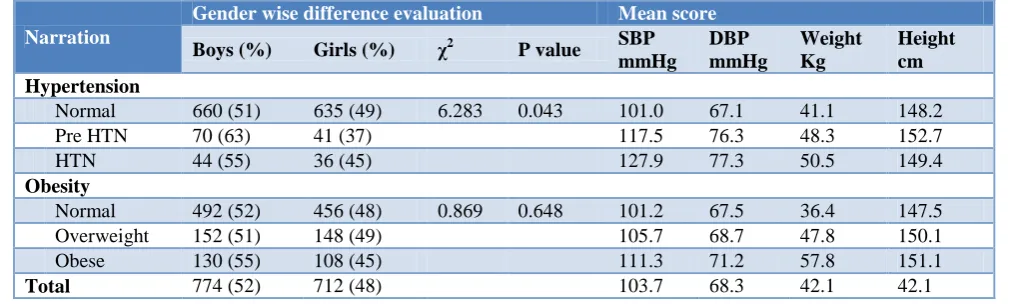
There was no statistically significant difference in obesity among both the genders (p=0.648), while high blood pressure found to be statistically significant among males than females (p=0.043). Boys are seen to be more pre-hypertensive and pre-hypertensive than that of girls. The mean SBP for boys (104.59±11.003) was found to be more than that of girls (102.73±11.98), while for both sex combined was found as 103.70±11.98. Similarly, mean DBP for boys (68.43±6.67) was slightly more than girls (68.16±6.81) and recorded as 68.30±6.73 for overall study participants.
Average SBP, DBP and Weight were found to be increasing among thrice of the subcategories in both obesity and hypertension. Among hypertensive adolescent average height (149.4) was slightly lower than pre hypertensive (152.7) adolescents, but little more than the Normotensive (148.2). Mean weight of hypertensives was found 50.5 kg while, for normotensives it was 41.1 Kg. Similarly, for normal BMI Z score adolescents mean weight was 36.4 which was 57.8 among obese (Table 2).
Table 2: Gender wise breakup of hypertension obesity and mean descriptive variables.
Narration
Gender wise difference evaluation Mean score
Boys (%) Girls (%) χ2 P value SBP mmHg
DBP mmHg
Weight Kg
Height cm Hypertension
Normal 660 (51) 635 (49) 6.283 0.043 101.0 67.1 41.1 148.2
Pre HTN 70 (63) 41 (37) 117.5 76.3 48.3 152.7
HTN 44 (55) 36 (45) 127.9 77.3 50.5 149.4
Obesity
Normal 492 (52) 456 (48) 0.869 0.648 101.2 67.5 36.4 147.5
Overweight 152 (51) 148 (49) 105.7 68.7 47.8 150.1
Obese 130 (55) 108 (45) 111.3 71.2 57.8 151.1
Total 774 (52) 712 (48) 103.7 68.3 42.1 42.1
DISCUSSION
33% of adolescents were either overweight or obese and pre-hypertensive or hypertensive. Obesity is found to have an association with hypertensive disorder among adolescents. 36.2% of overweight/obesity indicates the regional scenario of urban Indian adolescents. This estimate has compliance with Indian Academy of Paediatrics guidelines.8 While 12.9% of pre-hypertensive/hypertensive indicates the severity of issue. As seen towards the urban, educated and economically
stable community, adolescents are found to be at a similar risk as reported in the studies from high income countries.22,23
reported 7.1%.24,25 We reported prevalence of 16% obesity and 20% overweight from urban India in present study. There was no gender wise difference observed among overweight adolescent in present study (19.6% boys and 20.7% girls). Rao et al reported more overweight boys (27.5%) than girls (20.9%) among adolescents (10-18 years).27 In Meerut study, girls reported 5.3% obese and 19.7% overweight whereas boys were slightly higher with 10.82% obese and 18.36% overweight.
Various studies from India reported hypertension among adolescents 3.68% to 9.78%.25,26,28 A study from Shimla reported 12.3% of pre-hypertension prevalence among adolescents.28 Girls reported more hypertensive than boys, while few studies reported more boys than girls.26,27,29 Our study reported high BP more in boys than girls. Mean systolic blood pressure (SBP) of girls was found to be more than that of boys in some studies.30 n present study mean SBP of boys (104.60) were found to be higher than that of girls (102.74), while no difference was observed in mean diastolic blood pressure. Present study reports strong association among BMI and blood pressure. Among adolescents with high BMI, 21.2% (114/538) were found to have high blood pressure. While in adolescents with normal BMI, 8.1% (77/948) were found with high blood pressure.
Adolescent’s obesity has direct relationships with dietary habits, physical exercise, junk food and screen time with electronic gadgets. However, these factors are beyond the scope of this study. As seen towards the changing patterns of lifestyles and other factors obesity and related issues are needs to be addressed not only in adults but in adolescents also. Considering all this aspects, adolescent obesity appears as a crisis for upcoming generation.
CONCLUSION
Study documents the increasing association of obesity and hypertension among urban community adolescents. Obese and overweight adolescents are seen at increased risk of high blood pressure. 36% of overweight/obesity and 13% pre-hypertension/hypertension prevalence indicates the increasing intensity of issue. Effective policy level intervention and community level awareness to address this issues are recommended.
ACKNOWLEDGEMENTS
Authors are thankful to Thursday Research Group, Mumbai for their inputs and guidance. Chairman, Atomic Energy Central School for permission to the study. Priti Patil, Nisha and Rakhi for their support during the study.
Funding: No funding sources Conflict of interest: None declared
Ethical approval: The study was approved by the Institutional Ethics Committee
REFERENCES
1. WHO. Obesity and Overweight - Fact Sheet. March
2013. 2013. Available from:
http://www.who.int/mediacentre/factsheets/fs311/en /index.html. Accessed on 21 June 2017.
2. Strauss RS, Pollack HA. Epidemic Increase in Childhood Overweight, 1986-1998. J Am Med Assoc. 2001;286(22):2845–8.
3. Popkin BM, Gordon-Larsen P. The nutrition transition: worldwide obesity dynamics and their determinants. Int J Obes Relat Metab Disord. England; 2004;28:2-9.
4. Guilbert JJ. The world health report 2002 - reducing risks, promoting healthy life. Education for health (Abingdon, England). India; 2003: 230.
5. Ng M, Fleming T, Robinson M, Thomson B, Graetz N, Margono C, et al. Global, regional, and national prevalence of overweight and obesity in children and adults during 1980-2013: A systematic analysis for the Global Burden of Disease Study 2013. Lancet. 2014;384(9945):766–81.
6. Wang Y. Epidemiology of childhood obesity: methodological aspects and guidelines: what is new? Int J Obes. 2004;28:21–8.
7. Kuczmarski RJ, Flegal KM. Criteria for definition of overweight in transition: Background and recommendations for the United States. Am J Clin Nutr. 2000;72(5):1074–81.
8. Khadilkar VV, Khadilkar AV. Revised Indian Academy of Pediatrics 2015 growth charts for height, weight and body mass index for 5–18-year-old Indian children. Indian J Endocrinol Metab. India: Medknow Publications Media Pvt Ltd. 2015;19(4):470–6.
9. Khadilkar VV, Khadilkar AV, Cole TJ, Sayyad MG. Crosssectional growth curves for height, weight and body mass index for affluent Indian children, 2007. Indian Pediatr. 2009;46(6):477–89.
10. Freedman ADS, Goodman A, Contreras OA, DasMahapatra P, Srinivasan SR, Berenson GS. Secular Trends in BMI and Blood Pressure Among Children and Adolescents : The Bogalusa Heart Study. 2012;130(1):159-66.
11. James PT. Obesity: The worldwide epidemic. Clin Dermatol. 2004;22(4 SPEC. ISS.):276–80.
12. Whitaker RC, Wright JA, Pepe MS, Seidel KD, Dietz WH. Predicting obesity in young adulthood from childhood and prental obesity. N Engl J Med. 1997;337:869–73.
13. Kelly RK, Sabin MA, Cheung M, Juonala M. Development of hypertension in overweight adolescents : a review. 2015;171–87.
14. Heart N. Fourth report on Diagnosis, Evaluation, and Treatment of High Blood Pressure in Children and Adolescents. Pediatrics. 2004;114(2):555-76. 15. Nanaware NL, Gavkare AM, Surdi AD. Study of
16. Hospital L, Hospital A, Mahavidyalaya R. Revised IAP Growth Charts for Height, Weight and Body Mass Index for 5- to 18-year-old Indian Children. 2015.
17. Kulkarni S, Kumavat A, Mane A. Prevalence and determinants of overweight / obesity among affluent school children. 2016;3(1):9–14.
18. Vishnu PR, Bazroy J, Singh Z. Prevalence of overweight and obesity among adolescent students in Pondicherry, South India. Int J Nutr Pharma Neurol Dis. 2016;6(2):72-5.
19. Khadilkar VV, Khadilkar V, Choudhury P, Agarwal KN, Ugra D, Shah NK. IAP growth monitoring guidelines for children from birth to 18 years. Indian Pediatr. 2007;44(3):187–97.
20. Raj M, Kumar RK. Obesity in children & adolescents. Indian J Med Res. India: Medknow Publications; 2010;132(5):598–607.
21. National High Blood Pressure Education Program Working Group on High Blood Pressure in Children and Adolescents. The fourth report on the diagnosis, evaluation, and treatment of high blood pressure in children and adolescents. Pediatrics. 2004;114(2):555–76.
22. Lobstein T, Baur L, Uauy R. Obesity in children and young people: a crisis in public health. Obes Rev. England; 2004;5:4–104.
23. Czyz SH, Toriola AL, Starosciak W, Lewandowski M, Paul Y, Oyeyemi AL. Physical Fitness, Physical Activity, Sedentary Behavior, or Diet-What Are the Correlates of Obesity in Polish School Children? Int
J Environ Res Public Health. Switzerland; 2017;14(6):664.
24. Jain S, Pant B, Chopra H, Tiwari R. Obesity among adolescents of affluent public schools in Meerut. Indian J Public Health. India; 2010;54(3):158–60. 25. Danasekaran R, Vinoth R. A study on relation
between BMI and hypertension among adolescents in Kancheepuram district, Tamil Nadu. 2015;1(2):8–12.
26. Bagudai S, Nanda P, Kodidala SR. Prevalence Of Obesity & Hypertension In Adolescent School Going Children Of Berhampur, Odisha, India. Quick Response code. 2014;2(6):777–80.
27. Rao S, Kanade A, Kelkar R. Blood pressure among overweight adolescents from urban school children in Pune, India. Eur J Clin Nutr. 2007;61:633–41. 28. Sharma A, Grover N, Kaushik S, Bhardwaj R,
Sankhyan N. Prevalence of Hypertension Among School children in Shimla. 2010;8:873-6.
29. Patil RR, Garg BS. Prevalence of Hypertension and Variation in Blood Pressure among School Children in Rural Area of Wardha. 2014;58(2):78-83. 30. Madhusudan S, N BV, K BA, Monika R, Amita K.
A study of blood pressure profile in school (Rajasthan). 2012;3(2):242–6.