Original Research Article
Etiology and prevalence of urinary tract infections among pregnant
women in Kerala
Srinath M. P.
1, Shajina M.
2*, Fasalu Rahiman O. M.
3INTRODUCTION
Urinary Tract Infection (UTI) is the typical type of infectious disease which can occur for all groups of populations. However, some particular groups of people are more prone to UTI than others, such as women are in a higher risk compared to men due to their shorter urethra which is continually contaminated with pathogens from vagina and rectum. UTI’s are more common during
pregnancy because of changes in the urinary tract and has been reported among 20% of the pregnant women with significant reason for hospital admission.1 The uterus sits directly on top of the bladder. As the uterus grows, its increased weight can block the drainage of urine from the bladder, causing an infection. Hormonal and mechanical changes can promote urinary stasis and vesicoureteral reflux. These changes, along with an already short urethra (approximately 3-4 cm in females) and difficulty with
ABSTRACT
Background: Infectious disease such as urinary tract infection was found very commonly during all pregnancies. Chronic renal failure, pyelonephritis, preeclampsia, anemia, fetal mortality and premature delivery are the common complication associated with UTI in pregnancy. Hence the management and prevention of UTI in pregnancy is the crucial factor for the sustained pregnant period. It is more important for a clinician to recognize the pathogenic factor for UTI and its sensitivity profile for planning an effective treatment for infected patients. Hence the present study was designed to identify the pathogenic agents of UTI among pregnant women and to find out the drug susceptibility patterns of the isolated organism against commonly prescribed antibiotics
Methods: A prospective analysis was carried out by collecting urine from the 210 patients, the sample was also processed for antimicrobial drug susceptibility testing.
Results: A positive report was seen in 26 cases with 13.4% of incident rate. Escherichia coli 14 (53.8%), Klebsiella
species 23.07%, Enterococcus species 7.69%, Staphylococcus aureus 3.84%, Proteus 3.84%, Pseudomonas
aeroginosa 3.84%, Streptococcus pyogenes 3.84% were the most common isolate found in the present population. The isolated pathogens were sensitive to Ceftazidime, Cefotaxime, Ciprofloxacin, Gentamicin, and Amikacin.
Conclusions: It is there for recommended that routine microbiological analysis and antibiotic sensitivity test of urine samples of pregnant women must be carried out before the administration of drugs for better treatments and managements of urinary tract infection.
Keywords: Urinary tract infection, Uropathogens, Bacteriuria, Pregnancy, Antimicrobial susceptibility pattern
1Department of Community Medicine, Vydhehi Institute of Medical Sciences and Research Centre, Bangalore,
Karnataka, India
2Department of Medical Laboratory Technology, MIMS College of Allied Health Science, Kozhikode, Kerala, India 3Department of Pharmacology, MES Medical College, Perintalmanna, Kerala, India
Received: 25 June 2018
Revised: 12 July 2018
Accepted: 13 July 2018
*Correspondence:
Dr. Shajina M.,
E-mail: [email protected]
Copyright: © the author(s), publisher and licensee Medip Academy. This is an open-access article distributed under the terms of the Creative Commons Attribution Non-Commercial License, which permits unrestricted non-commercial use, distribution, and reproduction in any medium, provided the original work is properly cited.
hygiene due to a distended pregnant belly, help make UTIs among the most common bacterial infections during pregnancy.
UTIs during pregnancy is associated with risks to both the fetus and the mother, including pyelonephritis, preterm birth, low birth weight, and increased perinatal mortality. In general, pregnant patients are considered immunocompromised UTI hosts because of the physiologic changes associated with pregnancy. These changes increase the risk of serious infectious complications from symptomatic and asymptomatic urinary infections even in healthy pregnant women. Antibiotics are the treatment of choice for cystitis and asymptomatic bacteriuria. The standard course of treatment for pyelonephritis is hospital admission and intravenous antibiotics. Antibiotic prophylaxis is indicated in some cases. Patients treated for symptomatic UTI during pregnancy should be continued on daily prophylactic antibiotics for the duration of their pregnancy. Screening of pregnant lady for urinary tract infection can reduce all UTI associated complications. The pathological agents for UTI and its susceptibility pattern can vary according to the geographical, social and biological settings.2 Therefore; it is necessary to identify the etiological agent and its susceptibility pattern to select appropriate antimicrobial drugs for the management of UTI patients. Hence, this study was conducted to determine the range of bacterial isolates and their antibiotic susceptibility among pregnant women attending the antenatal clinic.
METHODS
Study area and population
A prospective study was conducted in both pregnant outpatient, and pregnant inpatients visited the department of OBG at MIMS Hospital, NABH accredited 650-bed super-speciality hospital at Kozhikode, Kerala during the period of 01-02-2014 to 31-05-2014.
Inclusion and exclusion criteria
Pregnant women ages 18 years to 40 years with varying gravida from all three trimesters were included in this study. All non-pregnant women, individuals suffering from STD’s and the pregnant women who took any antibiotics during the last two weeks were excluded from the study. The sample was not considered as valid if sample collection was improper.
Ethical considerations
The study was started after obtaining ethical approval from the institutional ethics committee. Participants were explained about the study and informed written consent was obtained from each study participants. For all reported confirmed infection case, the responsible
clinicians were informed, and treatments were selected as per the culture result and drug susceptibility pattern.
Bacterial isolation and antimicrobial susceptibility testing
Selected participants were instructed to collect 30 ml of mid stream urine in a sterile bottle. Details regarding patient age, trimester, and parity, history of UTI, history of diabetes, hypertension and other diseases were collected and documented. Urine culture was carried out by platting on Blood agar and Mac-Conkey plates and incubated at 37°C for 24 hours. A significant bacterial count was taken as a count equal to or more than 105 per millilitre. Morphological, cultural and biochemical characters were examined for the identification of isolates. Antibiotic sensitivity testing was performed using the Kirby–Bauer disc diffusion method according to the Clinical and Laboratory Standards Institute Guidelines. Antimicrobial drug susceptibility testing was carried out for Ampicillin, Nitrofurantoin, Amoxicillin-clavulanate, Cotrimoxazole, Gentamicin, Ciprofloxacin, Amikacin, Cefuroxime, Ceftriaxone, Vancomycin, Imipenem against all bacteria isolates. Interpretation of results was done based on the diameter of the zone.
RESULTS
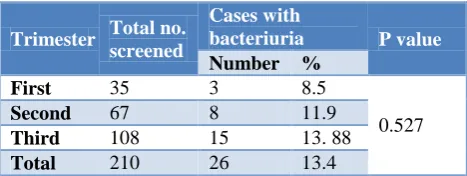
During the period of study total of 210 urine sample were collected and screened for microscopic examination and culture from pregnant women in various trimesters. Out of 210 urine samples analyzed, 26 females (13.4%) show significant bacteriuria. Among this 22 (10.47%) women were asymptomatic patients with a growth rate of 105 organisms/ml and 4 (1.9%) of symptomatic patients with growth less than 103 organisms/ml. Among this 35 sample were collected during first trimester 67 were in the second trimester, and 108 were in the third trimester. Out of this 3 (8.5%) in the first trimester and 8 (11.9%) in the second trimester and 15 (13.88%) in the third trimester showed significant bacteriuria (Table 1).
Table 1: Relationship of duration of pregnancy and bacteriuria.
Trimester Total no. screened
Cases with
bacteriuria P value Number %
First 35 3 8.5
0.527
Second 67 8 11.9
Third 108 15 13. 88
Total 210 26 13.4
to that in the primi gravida. From Table 4 it is clear that the factors like history of surgery, UTI and diabetes mellitus, shows significant bacteriuria compared to others. Personal hygiene was also significantly affecting the incidence of bacteriuria, but the history of contraceptive use does not have a significant role in UTI in pregnancy.
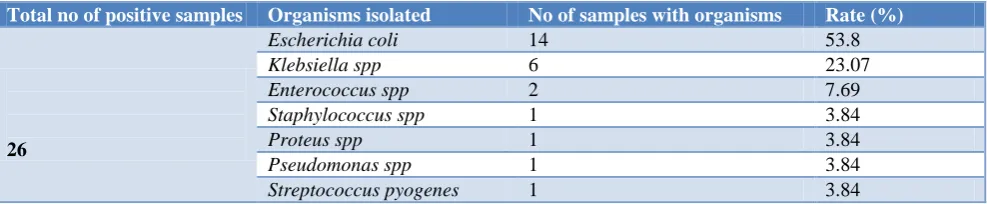
Urine culture is considered the gold standard for detecting bacteriuria in pregnancy. Table 5 shows the frequency of various isolated pathogens during pregnancy. From the present study 26 pathogens were isolated from selected patients. The most predominant pathogen isolated was Escherichia coli which were isolated from 14 samples giving a rate of 53.8%.
Klebsiella species was isolated from 6 samples giving rates of 23.07%. Enterococcus species were isolated from 2 samples giving a rate of 7.69%, Staphylococcus aureus,
Proteus, Pseudomonas aeroginosa, Streptococcus
pyogenes were isolated from one sample giving a rate of
3.84%.
Isolated bacterial uropathogens shows a high level of multiple antimicrobial resistances against commonly prescribed drugs. Among them, the commonest organism
E.coli showed sensitivity to Imipenem, Amikacin,
Gentamicin, Tazobactam + Piperacillin. 11 were sensitive to Ciprofloxacin and Norfloxacin. 9 were sensitive to Cefotaxime, Ceftazidime and Cefepime. E.coli isolated showed 100% resistance of Ampicillin. Klebsiella species
isolated show 100% sensitive to Tazobactam+ Piperacillin, Imipenem, Amikacin, Gentamicin, Cefopime, Ciprofloxacin and nor floxacin. The second most prevalent pathogen Klebsiella shows 100% resistance to Ampicillin. Staphylococcus aureus isolated shows sensitivity towards Cotrimoxazole, Cefoxitin and Tetracycline. Enterococcus species isolated shows sensitivity towards Ciprofloxacin, Gentamycin, Vancomycin and Erythromycin. Proteus species isolated shows sensitivity towards Gentamycin, Ciprofloxacin, Amikacin, Imipenem. S. pyogenes showed sensitivity towards Vancomycin, Ampicillin, Cotrimoxazole, Erythromycin. Pseudomonas species isolated shows sensitivity towards Gentamicin, Ciprofloxacin, Amikacin, Imipenem.
Table 2: Age distribution in pregnant women with bacteriuria.
Age in years Total no. screened Cases with bacteriuria P value
Number %
17-20 45 6 13.3
0.065
21-25 82 8 9.75
26-30 45 5 11.1
31-35 28 4 14.28
Above 35 10 3 30.0
Total 210 26 13.4
Table 3: Relationship of parity and bacteriuria during pregnancy.
Gravida total no. Total no. screened Cases with bacteriuria P value
Number %
First 92 9 9.78
0.184
Second 65 8 12.30
Three or more 53 9 16.98
Total 210 26 13.4
Table 4: Treatment history in bacteriuric Women.
History Total no Cases with
bacteriuria
Cases without
bacteriuria P value
History of diabetic mellitus Yes 12 4 8 0.0132*
No 198 22 176
Surgery Yes 24 8 18 0.0336*
No 186 18 168
History of UTI Yes 32 11 21 0.0423*
No 178 15 163
History of contraceptive use Yes 23 3 20 0.768
No 187 23 164
Satisfactory personal hygiene Yes 170 14 156 0.043*
Table 5: Organisms isolated.
Total no of positive samples Organisms isolated No of samples with organisms Rate (%)
26
Escherichia coli 14 53.8
Klebsiella spp 6 23.07
Enterococcus spp 2 7.69
Staphylococcus spp 1 3.84
Proteus spp 1 3.84
Pseudomonas spp 1 3.84
Streptococcus pyogenes 1 3.84
DISCUSSION
Urinary tract infection is one of the most common medical complications of pregnancy together with anemia and hypertension, and it occurs approximately in 5-10% of pregnancies.3 Urinary tract infections are associated with risks to both the mother and fetus, including pyelonephritis, pre term birth, low birth weight and increased prenatal mortality. The prevalence rates of bacteriuria in pregnant women and non-pregnant women are essentially the same. However, when pregnant women have a urinary tract infection, they have a higher risk of upper urinary tract infection compared to lower urinary tract infections. Research about the pathogens responsible for UTI and their sensitivity profile towards commonly using antibiotics may assist the clinician to select the appropriate and accurate treatment. The present study was focused on the prevalence of urinary tract infection in pregnant women. The overall prevalence of UTI in pregnancy in study region was found as 13.4%. This is comparable to the prevalence of urinary tract infection reported in Kerala (16.88%) and Northern Tanzania (16.4%).4,5 The dissimilarity may be due to the difference in the environmental, geographical and social nature of the population. In the present study, the prevalence of asymptomatic bacteriuria was found to be 10.47% which is in agreement with previous studies done by Aseefa et al, Kuttay et al and Habib et al. reported that symptomatic urinary tract infection occurs in 1-2% of all pregnancies.6-8 The present study showed the prevalence of symptomatic bacteriuria as 1.9%, which is the same as that of previous studies done by levent et al.9
As per the present study, the incidence of urinary tract infection is 8.5% during the first trimester, 11.9% during the second trimester and 13.88% during the third trimester. The highest incidents were found during the third trimester followed by the second and first trimester. Which match with earlier studies conducted by Nath et al, this is due to the increased obstruction of ureters by the enlarging uterus.10 In this study, the relationship between maternal age, gravidity and parity with bacteriuria was found to be nonsignificant. Previous studies conducted in Kerala, Northwest Ethiopia, Sudan and Tanzania was agreed with this study.4,11-13
Prevalence of UTI in a pregnant lady with a prior history of UTI was significantly higher than the one without
previous history UTI (p=0.0423), this was in agreement with previous studies conducted in Pakistan and Northwest Ethiopia.14,11 It may be due to drug-resistant organism from those who had previous history of urinary tract infection. The history of diabetic mellitus in pregnant lady was significantly influenced by the prevalence of UTI among them (p=0.0132), this may be due to their weakened immune systems.
The uropathogens identified in this study is similar to other studies.15-17 The E.coli is the most common pathogen isolated with a rate of 53.8% similar to studies done by Nareesa Esabel C Sescone, Vincent JL, Cura C.18-20 Pregnancy may make difficulty to maintain personal hygiene due to anatomical and functional changes in them; this can increase the chance of E.coli
infection during pregnancy. The other organism isolated include Klebsiella, Enterococcus species, Staph aureus,
Strep pyogenes, Pseudomonas and Proteus with a
percentage of 23.07%, 3.84%, 3.84%, 3.84%, 3.84% respectively. This is comparable to most of the world wide studies.4,5,15
The resistances among uropathogens against the commonly used antibiotics are a serious issue, which limits the drug of choice for the treatment of UTI. Hence it got importance to find the sensitivity pattern of commonly used drugs against the causative pathogen. In this study, the organism investigated was found to be susceptible to Ceftazidime, Cefotaxime, Ciprofloxacin, Amikacin and Gentamicin which are in agreement with previous studies.21,22
CONCLUSION
Staph. aureus. In the current study, most of the isolated uropathogens showed multiple antibiotics resistance against commonly prescribed antibiotics. The isolated pathogens were sensitive to Ceftazidime, Cefotaxime, Ciprofloxacin, Gentamicin, and Amikacin. Given the grave consequences due to asymptomatic urinary tract infection in pregnant women involving not only this woman but also to their newborn babies. There is a need for urgent action to control the situations. It is there for recommended that routine microbiological analysis and antibiotic sensitivity test of midstream urine samples of pregnant women and other patients be carried out so as enhance in the administration of drugs for the treatments and managements of urinary tract infection. There should also be mass education and public awareness programs on environmental sanitation habits mostly during pregnancy. Periodic screening should also be carried out on all pregnant women at the anti-natal clinics for asymptomatic urinary tract infection.
ACKNOWLEDGEMENTS
Authors are thankful to MIMS College of Allied Health Science and Medi research direct for their scientific support during entire project.
Funding: No funding sources Conflict of interest: None declared
Ethical approval: The study was approved by the Institutional Ethics Committee
REFERENCES
1. Schneeberger C, Kazemier BM, Geerlings SE. Asymptomatic bacteriuria and urinary tract infections in special patient groups: women with diabetes mellitus and pregnant women. Current opinion in infectious diseases. 2014;27(1):108-14. 2. Mohammad M, Mahdy ZA, Omar J, Maan N, Jamil
MA. Laboratory aspects of asymptomatic bacteriuria in pregnancy. Southeast Asian J Trop Med Public Health. 2002;33(3):575–80.
3. Nelson-Piercy C. Handbook of obstetric medicine. CRC press; 2015.
4. Fasalu Rahiman OM, Balasubramanian T, Pawan Kumar, Ashif CM, Shejina M. Prevalence of Urinary Tract Infections and Its Etiological Agents among Pregnant Women in Malabar Region of Kerala. Int J Pharm Sci Rev Res. 2015;34(2):202-9. 5. Olsen BE, Hinderaker SG, Lie RT, Gasheka P,
Baerheim A, Bergsjo P, et al. The diagnosis of urinary tract infections among pregnant women in rural Tanzania; Prevalence and correspondence between different diagnostic methods. Acta Obstetrica Gynecol Scandinavia. 2000;79(9):729-36.
6. Assefa A. Asrat N, Woldemanuel Y, G/Hiwot Y, Abdella A, Melesse T. Bacterial profile and drug susceptibility pattern of urinary tract infection in pregnant women at Tikar Anbessa specialized
hospital Addis Ababa, Ethiopia. Ethiop Med J. 2008;46(3):227-35.
7. Kutlay S, Kutlay B, Karrahmetoglu O, AKC, Erkaya S, Prevalence, detection and treatment of asymptomatic bacteuria in a Turkish obstetric population. J Reprod Med. 2003;48(8):627-30. 8. Zeighmani H, Mota A, Rahmati M. Evaluation of
UTI in pregnant women. Res J Biological Sci. 2008,4(3):441-3.
9. Tutuncu L, Ardic N, Ziya Y. Yergot: UTI in pregnancy. Perinatal J. 2005:13(2):114-21.
10. Nath G, Choudary M, Prakash J, Pandey LK, Singh TB, Prakash J. UTI during pregnancy and fetal outcome. Indian J Med Neurobiol. 1996;14(3):158-60.
11. Agersew A, Feleke M, Yitayal S, Ketema T, Afework K, Belay A, et al. Bacterial profile and drug susceptibility pattern of urinary tract infection in pregnant women at University of Gondar Teaching Hospital. Northwest Ethiopia. BMC Research Notes. 2012;5:197.
12. Hamdan Z, Ziad Abdel Haliem M, Ali Salah K, Ishag Adam. Epidemiology of urinary tract infections and antibiotics sensitivity among pregnant women at Khartoum North Hospital. Ann Clin Microbiol Antimicrob. 2011;10(2):1–5. 13. Masinde A, Gumodoka B, Kilonzo A, Mshana SE.
Prevalence of urinary tract infection among pregnant women at Bugando Medical Centre, Mwanza, Tanzania. Tanzan J Health Res. 2009;11:154–9.
14. Sheikh MA, Khan MS, Khatoon A, Arain GM, Incidence of urinary tract infection during pregnancy. East Mediterr Health J. 2000;6(2-3):265–71.
15. Assefa A, Asrat D, Woldeamanuel Y, Hiwot Y, Abdella A, Melesse T. Bacterial profile and drug susceptibility pattern of urinary tract infection in pregnant women at Tikur Anbessa Specialized Hospital Addis Ababa, Ethiopia. Ethiopia Med J. 2008;46(3):227–35.
16. Sescon NIC, Garingalao Molina FD, Ycasiano CEJ, Saniel MC, Manalastas RM. Prevalence of Asymptomatic Bacteriuria and Associated Risk Factors in Pregnant Women. Phil J Microbiol Infect Dis. 2003;32(2):63-9.
17. Tadesse A, Negash M, Ketema LS. Asymptomatic bacteriuria in pregnancy: Assessment of prevalence, microbial agents and their antimicrobial sensitivity pattern in Gondar Teaching Hospital, North West Ethiopia. Ethiop Med J. 2007;45(2):143-9.
18. Nerissa Issabal C, Sces con, Felice D, Guringaluomolin, Curla Elena JY Cassiano. Prevalance of ASB and associated risk facters in pregnant woman. Phyl J Microbiol Infect OIS. 2003;32(2):63-9.
20. Cura C, Ozen M, Kara AA, Alkan G, Cetin ES. Health care–associated infection surveillance in a tertiary neonatal intensive care unit: A prospective clinical study after moving to a new building. Am J Infection Control. 2016;44(1):80-4.
21. Khanday SB, Shah AN, Gani TT, Khanday NB, Khanday AB, Manzoor SV. To Study the Prevalence and Pattern of Resistance and Sensitivity of Commonly Isolated Organisms in Patients Admitted In Surgical Intensive Care. Int J Innovative Res Med Sci. 2017;2(10):1368.
22. Poorabbas B, Mardaneh J, Rezaei Z, Kalani M, Pouladfar G, Alami MH, et al. Nosocomial
Infections: Multicenter surveillance of antimicrobial resistance profile of Staphylococcus aureus and Gram negative rods isolated from blood and other sterile body fluids in Iran. Iranian J Microbiol. 2015;7(3):127.