Original Research Article
Dengue prevention practices among community in dengue hotspot area
Muhammad Faridzuan Faiz Said, Hasmah Abdullah, Noraini Abdul Ghafar*
INTRODUCTION
Dengue fever is one of the most important mosquito-borne diseases. It is an acute infection of Flavivirus
transmitted by the vector, Aedes mosquito. Dengue is the illness that can cause a significant morbidity and mortality and the infection can increase the problem regarding human health around the world.1,2 Globally, around 390 million of dengue infection occurred annually.3 Dengue virus infection has globally become a major concern when dengue fever increases more than 30 folds over several decades ago and the disease is endemic in 128 countries.4 Dengue fever also recognized as the most rapid spread disease in the world.5
Increasing number of dengue hotspot is a serious problem. This is because the control of Aedes and dengue need to cover wider areas. This will increase the economic and resource burden of the government besides more lives are exposed to the risk of contracting dengue. In Malaysia, dengue epidemiology is rapidly evolving, with the increase in frequency of outbreaks and involvement of new area that were previously unaffected are being observed lately. Outbreak in cities and big towns tend to be out of control and has become hotspots.6
Attitude and practices toward dengue prevention especially among the individual or community in high
ABSTRACT
Background: Dengue is one of the most important mosquito-borne diseases which can cause a major problem to
human health. Poor practices in dengue prevention especially in the area where dengue is prevalent is among the factors contributing towards dengue spike. This study was commenced to assess the level of attitude and practice toward dengue prevention among the community residing in a dengue prone area, beside identifying the environmental characteristics surrounding the housing compound.
Methods: A cross-sectional study was conducted among 132 respondents living in a dengue hot spot area. A set of
questionnaire form consisted of four parts; socio-demographic information, environmental characteristics around the house, and attitudes and practices toward dengue prevention were distributed to respondents.
Results: More than half of the respondents possessed good level of attitude, and more than half scored moderately for
practice (57.6% and 56.1% respectively). Data on the environmental characteristics showed that majority of the respondents’ houses have no potential breeding sites for Aedes mosquito. Findings also indicate that there was no significant association between dengue prevention practices and socio-demographic factors such as age, gender, educational level and occupational status.
Conclusions: Level of practice of dengue prevention is still considerably low and could be improved through
educational campaign. Proper knowledge and information regarding dengue practices should be emphasized among the community especially in high risk area to raise up the awareness and cultivate better practices for dengue prevention.
Keywords: Dengue, Prevention, Community, Practices
School of Health Science, University of Science Malaysia, Health Campus, Kubang Kerian Kelantan, Malaysia
Received: 20 August 2018
Accepted: 01 October 2018
*Correspondence:
Dr. Noraini Abdul Ghafar, E-mail: [email protected]
Copyright: © the author(s), publisher and licensee Medip Academy. This is an open-access article distributed under
the terms of the Creative Commons Attribution Non-Commercial License, which permits unrestricted non-commercial use, distribution, and reproduction in any medium, provided the original work is properly cited.
risk setting is important. Theoretically, a favourable attitude will lead to a good practice. On the other hand, negative attitudes towards dengue fever will cause a poor dengue prevention practices.7 Sometimes, the community regard the prevention and control of dengue is the responsibility of the government. However, control of mosquito breeding by means of disposing potential breeding sites should be done by the community themselves. This is because, dengue is very close to the community, and the vector abundance is related to the poor practice in terms of water and environmental management. Therefore, the responsibility to control the breeding of mosquito by means of destroying potential breeding sites should be borne by each house owner.8
Regarding practices of dengue prevention, a few studies found poor practices among the respondents.4,9,10 Practices of dengue prevention is important to avoid breeding of Aedes mosquito and subsequently dengue fever especially in the setting where dengue is high in cases. Abundance of food container and used tires around the housing compound, poor garbage management, uncovered water container and clogged roof or drain could indirectly provide breeding sites for Aedes
mosquito, and disposal and maintenance of these should be practiced regularly. Practices such as clearing the housing compound from receptacle that could possibly collect water, cleaning and rubbing the base of the flower pots, rooftop and bowl of domestic animal that can retain water help in controlling the breeding of dengue vector, meanwhile poor practices in dengue prevention would indirectly provide potential breeding area for them.11,12 Lack of dengue prevention practices is one of the factors associated with worse dengue cases. Sometimes, people knew about dengue disease and the knowledge was not translated into prevention practices.13
Lack of environmental management is another factor associated with high cases of dengue. Improper waste management at the household level such as poor management of plastic food container or used tires would lead to dengue cases indirectly by providing potential breeding sites for Aedes mosquito.14 Besides, poorly maintained small pool usually used to collect water for vegetation could serve as natural habitat for the deadliest mosquito.15
Good environmental management, favourable attitude and practices toward dengue prevention are important in controlling dengue especially in high risk settings. This study was therefore commenced aiming to determine the level of attitude and practices toward dengue prevention among the community residing in a dengue hotspot, beside to assess the environmental characteristics around the housing compound, and to determine the association between dengue prevention practices and socio-demographic factors of community in the village.
METHODS
Study location and design
This cross sectional study involved 132 community members (estimated from the formula of two-proportion by considering the power of study of 80% and the confidence interval of 95%) living in a dengue hotspot area, Tok Kenali village. The village is situated in the north part of Kelantan, one of the states in Malaysia. Convenience sampling was used to recruit the respondents.
Research tool
This study used established questionnaire adopted form the previous studies.16,17 The questionnaire consisted of four sections; sociodemographic background of the respondents, environmental characteristics of the households, attitudes towards dengue prevention, and practices of dengue prevention. Respondents were approached from house to house in Kampung Tok Kenali. Then, a brief explanation on the study purpose was given by the researcher to each respondent involved. The respondents took about 10-15 minutes to complete the questionnaire. Due to time and logistic constraints, only one visit was done to the houses involved. If the house is vacant, it will be replaced with the next house.
Data analysis
The data were analysed using the Statistical Packages for Social Science (SPSS) version 23.0. A few statistical tests were performed; descriptive analysis was performed to obtain the level of attitude and practice as well as for the environmental characteristics of each household, and the association between dengue prevention practices with sociodemographic factors were assessed through Chi square test. Significance of the results are set at alpha of 0.05.
Ethical consideration
The study protocol had been granted ethical clearance from the Human Research Ethics Committee of University of Science Malaysia, USM (HREC) for approval (Code: USM/JEPeM/16120556). The distribution of the questionnaire was only commenced after the subject voluntarily signed the consent form.
RESULTS
Sociodemographic background
ever been infected by dengue fever. Based on the Chi square analysis performed, there were no association between all sociodemographic factors with attitude a well as practices of dengue prevention.
Level of attitude and practices toward dengue prevention
Table 1: Level of attitude and practices toward dengue prevention (N=132).
Component Level N (%)
Attitude
Poor 1 (0.8) Moderate 55 (41.7) Good 76 (57.6)
Practice
Poor 16 (12.1) Moderate 74 (56.1) Good 42 (31.8)
The level of both attitude and practices toward dengue prevention were determined descriptively based on the total score of each component. The total scores were then categorised into three categories; poor, moderate, and good. Table 1 summed up the level for both attitude and practices toward dengue prevention among the respondents. Based on the table, more than half of the
respondents possessed good level of attitude, while more than half scored moderately for practice.
Attitudes toward dengue prevention practices
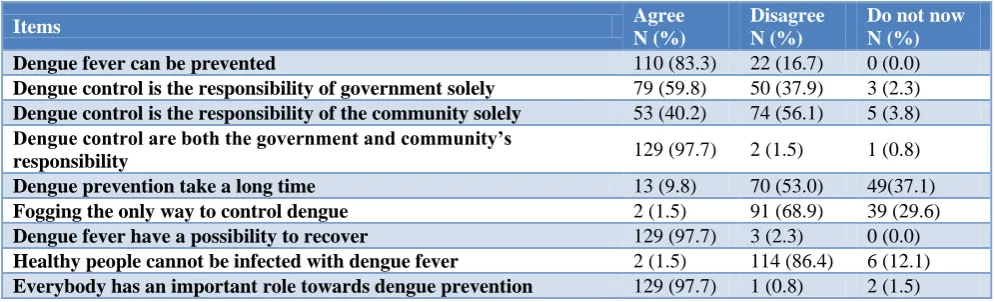
Table 2 summarized the attitudes toward dengue prevention among the respondents. Majority of the respondents agreed that dengue fever could be prevented. Regarding responsibility of dengue control, more than half of the respondents agreed that the control of Aedes
and dengue should be conducted by the government solely, and about 40 percent agreed that the control should be conducted by the community solely. However, majority of them came into agreement that the control should be conducted by both parties. In view of the duration of prevention, more than half of the respondents disagree that prevention of dengue will take a long time. Besides, more than half of the respondents disagree that “fogging” is the only method to control dengue. In terms of recovery from dengue fever, majority of the participants agreed that there is a possibility to recover from dengue fever infection. Besides, another majority recorded disagreement that healthy people cannot be infected with dengue fever. Finally, majority of the respondents agreed that they have an important role towards dengue prevention.
Table 2: Attitudes towards dengue prevention.
Items Agree
N (%)
Disagree N (%)
Do not now N (%)
Dengue fever can be prevented 110 (83.3) 22 (16.7) 0 (0.0)
Dengue control is the responsibility of government solely 79 (59.8) 50 (37.9) 3 (2.3)
Dengue control is the responsibility of the community solely 53 (40.2) 74 (56.1) 5 (3.8)
Dengue control are both the government and community’s
responsibility 129 (97.7) 2 (1.5) 1 (0.8)
Dengue prevention take a long time 13 (9.8) 70 (53.0) 49(37.1)
Fogging the only way to control dengue 2 (1.5) 91 (68.9) 39 (29.6)
Dengue fever have a possibility to recover 129 (97.7) 3 (2.3) 0 (0.0)
Healthy people cannot be infected with dengue fever 2 (1.5) 114 (86.4) 6 (12.1)
Everybody has an important role towards dengue prevention 129 (97.7) 1 (0.8) 2 (1.5)
Table 3: Dengue prevention practices among the respondents (N=132).
Items Never
N (%)
Sometimes N (%)
Always N (%)
Use insecticides spray 6 (4.5) 62 (47.0) 64 (48.5)
Use window screen 72 (54.5) 53 (40.1) 7 (5.3)
Use fan in house 2 (1.52) 16 (12.12) 114 (86.36)
Use a bed net 48 (36.4) 64 (48.4) 20 (15.1)
Use mosquitoes’ coil 9 (6.8) 49 (37.1) 74 (56.0)
Clean the house compound from used food and drink container 1 (0.8) 59 (44.7) 72 (54.5)
Eliminate standing water 4 (3.0) 57 (43.1) 71 (53.8)
Cover water container 4 (3.0) 40 (30.3) 88 (66.7)
Cleaning water container and ditches 2 (1.5) 61 (46.2) 69 (52.3)
Using an abate in storage water 22 (16.7) 96 (72.7) 14 (10.6)
Change water in the water storage 3 (2.3) 58 (43.9) 71 (53.8)
Practices of dengue prevention among respondents
Table 3 shown the prevention practices among the respondents. Based on the table, the proportion of respondents using insecticides spray to prevent from mosquito bites for sometimes and always were in balance. More than half (54.5%) of respondents stated that they had never use window screen in their house. Majority of the respondents always use fans to chase away the mosquito. For controlling the mosquito at night, only 15.1 percent of the respondents always use bed net when sleeping. Apart from that, more than half of the respondents always use mosquito coil.
For the control of mosquito around the housing area, more than half of the respondents always clean their compound from scattered food and drink container. Besides, 53.8 percent of the respondents always eliminate the standing water around their housing area. In addition, majority of the respondent (66.7%) always practice covering the water container. Besides, more than half of the respondents always clean the water container and ditches and only 1.5% respondents never practiced it. Moreover, respondents also show a good dengue prevention practices by always changing the water in their water storage. However, only 7.6 percent of the respondents recorded that they always attend seminar or campaign regarding dengue.
Environmental characteristics of each household
Table 4 summarized the environmental characteristics for each household visited. Based on the table, majority of the households have no unused tires, pool, cans, water container for plantation, and vase with base around their housing compound.
Table 4: Environmental characteristics of each household.
Environmental
household characteristics Frequency
Percentage (%) Have used tires around the house
Yes 18 13.6
No 114 86.4
Have unused pool inside the house
Yes 28 21.2
No 104 78.8
Have used can around the house
Yes 34 25.8
No 98 74.2
Use water container for plantation
Yes 35 26.5
No 97 73.5
Use flower vase with base
Yes 43 32.6
No 89 67.4
DISCUSSION
Attitude and practices toward dengue prevention
According to the findings, 57.6 percent of the respondents posed good attitude toward dengue prevention. For practice, majority (56.1) of the respondents shown moderate level of practice of dengue prevention. These numbers are considered as low based on the fact that the community are living in a dengue hotspot area. In the area where dengue is prevalent, common practices of dengue prevention should be in place regularly to avoid from mosquito bites as well as to prevent Aedes mosquito from breeding. Self-protection measures such as use of mosquito repellent or mosquito coil, use of bed net, and use of window screen should be practiced by the community members since these measures could help prevent them from mosquito bites. Meanwhile, good practices on domestic water like covering the water container and changing the water periodically should be practiced in avoiding mosquito breeding.18
Surprisingly, current finding showed most of the respondents had never used window screen and bed net in their house. Some of the respondents ever mentioned that sleeping with a bed net will cause a discomfort to them. Then, a low rate of abate usage was detected because it was hard to get an abate. This is also mentioned by respondents during the data collection. Besides, lack of knowledge regarding abate may also one of the reasons why the respondents were do not use an abate in their water storage. This finding is in coherent with a study by Al-Dubai et al, which assessed the factor affecting the dengue fever KAP among selected urban, semi-urban and rural communities in Malaysia. In the study, they found that only 18.0% of respondents have used abate.19
shortage urged the community in the area to store water, and the practice of changing the water frequently could avoid possible egg deposition on the wall of the water storage.
In terms of attitude, majority of the respondents agreed that dengue could be prevented. This correct attitude is important to be cultivated among the community so that they become aware of the prevention method. Regarding the responsibility to control dengue, it should be from both parties; the government and the community members. The community should perform the control method such as clearing their housing compound from container or tires that could collect water, beside using personal protective measures to prevent themselves and their family members from mosquito bites. The government on the other hand would play their part accordingly.6,7
Household environmental characteristics
Majority of the respondents reported that they do not have water pond. Findings also showed that most of respondents in Kampung Tok Kenali did not collect used tires, vase with base for potted plant, and cans around their house. Majority of the respondents did not have water container used for plantation since they use water hose directly to water the plant. Environmental management is central in dengue prevention. This is due to the fact that man-made container could serve as potential breeding sites for Aedes mosquito. Elimination of Aedes breeding site therefore is one of the best prevention and control method against dengue fever. Findings from this study showed that, most of the respondents’ houses were free from Aedes potential breeding sites. The current findings regarding availability of potential breeding sites may influence the occurrence of dengue fever. Environmental characteristics such as plastic bag, coconut shell and other disposable items will provide an ideal condition for Aedes mosquitoes breeding. Besides, uncovered water jar may also can contain Aedes larva and may lead to dengue occurrence.22 An almost similar finding was reported by Aung et al whereby majority of their respondents were free from factors of dengue breeding sites. In the study, the respondents always drain water in the flower pots, check the potential breeding sites and destroy larvae found.23
CONCLUSION
More than half of the respondents in this study had a good attitude toward dengue prevention. However, the percentage of those practicing good practices is low. According to the data collected, majority of the respondents’ housing area were free from the environmental characteristics that could influence Aedes
mosquito breeding despite some of them do have them. In addition, the finding showed there was no significant association between dengue prevention practices the sociodemographic factors. In the settings where dengue
cases are high, knowledge regarding dengue practices should be emphasized to cultivate better practices among the community dwellers.
Limitation of study
Our findings must be interpreted in the light of several potential limitations. Firstly, cross sectional design which does not allow causation. However, we carefully use the word association. Next, small sample size may have limited the ability to detect associations that were small and moderate in magnitude. Finally, the study location which only concentrate on one dengue hot spot may limit the findings to be extrapolated to other settings.
ACKNOWLEDGEMENTS
Authors would like to acknowledge the University of Science Malaysia for supporting this study. We would also like to acknowledge all the professionals, health personnel, and all the respondents participated in this study.
Funding: No funding sources Conflict of interest: None declared
Ethical approval: The study was approved by the by the Human Research Ethical Committee of University of Science Malaysia
REFERENCES
1. Qadir S, Ahmad I, Akhtar MN, Naeem H. Knowledge, attitude and practice about dengue fever among local population. Gomal J Med Sc. 2015;13(2):87-90.
2. Syed M, Saleem T, Syeda UR, Habib M, Zahid R, Bashir A, et al. Knowledge, attitudes and practices regarding dengue fever among adults of high and low socioeconomic groups. J Pakistan Med Assoc. 2010;60(3):243-7.
3. Harrington LC, Fleisher A, Moreno DR, Vermeylen F, Chrystal V, Rebecca LP, et al. heterogeneous feeding patterns of the dengue vector, Aedes aegypti, on individual human hosts in rural Thailand. Neglected Trop Dis. 2014;8(8):1-13. 4. Dhimal M, Aryal KK, Dhimal ML. Knowledge,
attitude and practice regarding dengue fever among the healthy population of highland and lowland communities in central Nepal. PLoS One. 2014;9(7):1-15.
5. Nishiura H, Halstead SB. Natural history of dengue virus (DENV)-1 and DENV-4 infections:reanalysis of classic studies. J Infect Dis. 2007;195(7):1007-13.
6. Abdul Kadir AHS, Mohamed MS, Abdul Rahman J. Dengue in Malaysia - A Commentary. Int Med J Malaysia. 2015;14(1):1-2.
international students in Universiti Putra Malaysia, Serdang. Int J Pub Health Clin Sc. 2016;3(5):36-47. 8. Frank AL, Beales ER, Wildt G, Sanchez GM, Laura
L. “We need people to collaborate together against this disease”: A qualitative exploration of perceptions of dengue fever control in caregivers of children under 5 years, in the Peruvian Amazon. PLOS Neg Trop Dis. 2017: 1-19.
9. Manrique C, Gomez FMV, Florez P, Talbot RM. Knowledge, attitudes and practice regarding dengue in two neighbourhoods in Bucaramanga, Colombia. Rev Salud Publica. 2009;11(1):27-38.
10. Santos SL, Cabral AC, Augusto LG. Knowledge, attitude and practice on dengue, the vector and control in an urban community of the Northeast Region, Brazil. Cien Saude Colet. 2011;16(1):1319-30.
11. Kumar K, Singh PK, Tomar J, Baijal S. Dengue: epidemiology, prevention and pressing need for vaccine development. Asian Pacific J Trop Med. 2010;3(12):997-1000.
12. Zahir A, Ullah A, Shah M, Mussawar A. Community participation, dengue fever prevention and control practices in Swat, Pakistan. Int J MCH AIDS. 2016;5(1):39-45.
13. Willoquet JR, Dantes GH. Dengue in the Americas:challenges for prevention and control. Cad Saude Publica. 2009;25(1):19-31.
14. Banerjee S, Aditya G, Saha GK. Household wastes as larval habitats of dengue vectors:comparison between urban and rural areas of Kolkata, India. PLoS One. 2015;10(10):1-21.
15. Roberto TC, Galva JM, Burciaga P. Community participation in the prevention and control of dengue:The Patio Limpio strategy in Mexico. Paed Int Child Health. 2012;32(1):10-3.
16. Binsaeed A, Sahli A, Noureldin E, Mohammed W, Dafalla O, Dahlan A, et al. Knowledge, attitudes and preventive practices of dengue fever among
secondary school students in Jazan, Saudi Arabia. Curr. World Environ. 2015;10(3):747-57.
17. Nur Syakilah M, Rosmawati M, Hamid Jan JM, Norfarhana R. High knowledge on dengue but low preventive practices among residents in a low cost flat in Ampang, Selangor. Malaysian J Nurs. 2016;8(1):39-48.
18. Juni MH, Hayati KS, Chai MC, Gan SP, Samad NH, Zainal Abidin ZS. Risk behaviour associated with dengue fever among rural population in Malaysia. Int J Pub H Clin Sc. 2015;2(1):114-27. 19. Al-Dubai SAR, Ganasegeran K, Alwan MR,
Alshagga MA, Saif-Ali R. Factors affecting dengue fever knowledge, attitudes and practices among selected urban, semi-urban and rural communities in Malaysia. Southeast Asian J Trop Med Pub H. 2013;44(1):37-49.
20. Mariam M, Mohamad IS, Zaliha I. Factors associated with larval control practices in a dengue outbreak prone area. J Env Pub H. 2014:1-6. 21. Yboa BC, Labrague LJ. Dengue knowledge and
preventive practices among rural residents in Samar province, Philippines. Am J Pub H Res. 2013;1(2):47-52.
22. Khun S, Manderson L. Community and school-based health education for dengue control in rural Cambodia:a process evaluation. PLoS Neg Trop Dis. 2007;1(3):143-53.
23. Aung MMT, Hassan AB, Kadarman NB, Hussin TM, Barman A, Ismail SB, et al. Knowledge, attitude, practices related to dengue fever among rural population in Terengganu, Malaysia. Malaysian J Pub H Med. 2016;16(2):15-23.
Cite this article as: Said MFF, Abdullah H, Ghafar