Original Research Article
Quality of life of low back pain patients following
self back care intervention
M. Ashikur Rahman Robin
1*, M. Ziaul Islam
2, Akhiruzzaman
3, M. Shahriar Morshed
4INTRODUCTION
Low back pain (LBP) is a common condition that affects an estimated about 70% to 80% of adults at some points during their lifetimes.1 Back pain also the major cause of suffering and the second most common reason for patients to visit primary health care providers.2 It is particularly common, and the largest single cause of
years lived with disability in England.3 It is almost 5.4 million Americans are disabled by LBP each year and that it is the second most common cause of sick leave.2
The exact cause of low back pain is often uncertain. Most of the time people report that LBP start after heavy physical workload such as lifting heavy weight, awkward posture or fall from height. Many studies shows that
ABSTRACT
Background: Low back pain is the major health problem which is experienced by people at any stage of lifetime. The study was conducted to assess the quality of life (QOL) of low back pain (LBP) patients following self back care intervention.
Methods: A quasi-experimental study was carried out among adult (18-59 years) LBP patients. A self-back care intervention was applied to compare QOL of low back pain patients before and after intervention by using SF-20 scale.
Results: The study showed that mean (±SD) age was 37.41 (±10.63) years and majority (52.7%) of the LBP patients was female. The study revealed that LBP was common among married housewives and mean duration of LBP was 3.59 (±3.52) years. Majority (55.4%) of the patients had poor QOL before intervention but after self back care intervention most (83.9%) of them had average QOL.Mean (±SD) score of QOL after intervention (57.83±8.74) was significantly (t, p˂0.001) higher to before intervention (49.30±11.31). It was also found that mean QOL score with long duration of LBP (50.526±6.844) was significantly (ANOVA, p˂0.001) lower than QOL with short duration of LBP (65.137±9.538). The study also found that when severity of pain increased, mean QOL score significantly (ANOVA, p˂0.001) decreased after intervention. Mean QOL score significantly correlated with duration of LBP (r=-0.382 p˂0.01). Linear regression of mean QOL and duration of LBP before intervention were R2=0.146 and after
intervention were R2=0.214.
Conclusions: Self back care is an effective intervention to improve QOL of LBP patients. So encouraging health education measures regarding self back care.
Keywords: Quality of life, Low back pain, SF-20
1Department of Orthopedics, Bangabandhu Sheikh Mujib Medical University (BSMMU), Dhaka, Bangladesh
Department of Community Medicine, 2National Institute of Preventive and Social Medicine (NIPSOM), Mohakhali, Dhaka, 3Diabetic Association Medical College, Faridpur, 4M. Abdur Rahim Medical College, Dinajpur, Bangladesh
Received: 11 September 2018
Revised: 11 October 2018
Accepted: 12 October 2018
*Correspondence:
M. Ashikur Rahman Robin, E-mail: [email protected]
Copyright: © the author(s), publisher and licensee Medip Academy. This is an open-access article distributed under the terms of the Creative Commons Attribution Non-Commercial License, which permits unrestricted non-commercial use, distribution, and reproduction in any medium, provided the original work is properly cited.
lifestyle is important risk factor of LBP such as smoking, sedentary lifestyle, elevated BMI, diabetes etc. Low back pain is one of the single leading causes of disability worldwide.3 Low back pain may originate from many spinal structures, including ligaments, facet joints, the vertebral periosteum and spinal nerve roots. Mostly age-related degenerative processes in the intervertebral disks found among LBP patients. Other common problems include spinal stenosis and disk herniation.4,5 And back pain is considered one of the most common reasons for missed work. Back pain is the second most common reason for visits to the doctor’s office. 6
LBP affects men and women equally; it is commonly found that LBP occurs between the ages of 30 and 50 years. It is known as work-related disability in people under 45 years of age and most expensive cause of medical care.7 The back pain decreases the quality of life (QOL) of individuals, as well as deterioration in physical activity.8 LBP often affects all life domains from primarily self-care activities to advance and complex social interactions, work, and leisure activities and eventually has a profound impact on quality of life. Health related quality of life (HRQOL) affected in patients with LBP showed in a prospective studies. Clinical trials revealed that Quality of life (QOL)
significantly improved after various modes
of rehabilitation program like back care education and exercise therapy.9
The prevalence increases and peaks between the ages of 35 and 55 years.10 LBP has been referred as a 20th century disaster.11 Now a days it has become an universal problem with the expanding proportion of elderly population the burden of LBP is likely to increase in the causing significant challenges for primary health care service developing countries.12 Self back care is an effective way of preventing or reducing back pain. Regular exercise, body weight control and maintaining correct posture improves the quality of life of LBP patients.13 Self-management programs promote patient responsibility for managing daily health in conjunction with traditional health care self efficacy and self management; these programs may ultimately improve patients’ health status. Interventions seeking to instill behavioral change typically recruit highly motivated subjects.14
METHODS
This study was a Quasi-experimental study (n=112), carried out among the diagnosed low back pain patients who were between 18-59 years old and attending at orthopedic outpatients department (OPD) in BSMMU. The study was conducted from January to December, 2017(1year). Simple random sampling technique was applied to select the diagnosed low back pain patients for assessing quality of life of low back pain patients among.
Inclusion criteria
The participants were included in the study who were, diagnosed low back pain patients (LBP), adult patients (18-59 years) and both male and female were included. The participants who were willing to give informed written consent.
Exclusion criteria
The participant was excluded in the studies who were mentally ill, seriously ill people. Also excluded who were absent after intervention of self back care.
Data collection instruments
Data were collected by interviewer administered, semi structured questionnaire & Checklist. QOL was assessed by SF-20 scale.
Data collection technique
Data were collected through face to face interview, medical record review and anthropometric measurements.
Level of quality of life
QOL was categorized as good, average and poor. Score was ranged from 0-100 according to SF-20 directory.
Good QOL: Total quality of life score between75-100 leveled as good quality of life of low back pain patients.
Average QOL: Average quality of life marked when quality of life score between 50-74 total.
Poor QOL: It may be defined as total quality of life score between 0-49 leveled as poor QOL.
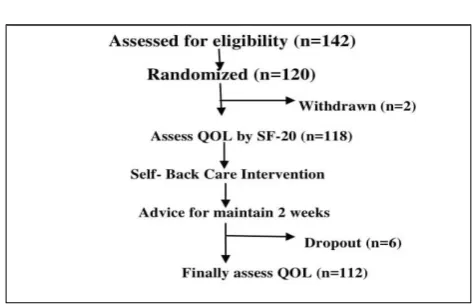
Figure 1: Flow chart of the study.
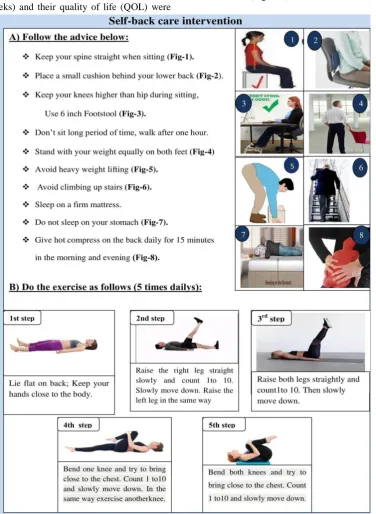
Self-back care intervention
that the participants would be able to perform the exercises by themselves. Self back care was advised for 14 days (2 weeks) and their quality of life (QOL) were
finally assessed and compare before and after intervention (Figure 2).
Figure 2: Self back care instruction for low back pain patients. RESULTS
The study showed that majority (33.0%) of the LBP patients were 30-39 years old and their mean (±SD) age was 37.41 (±10.63) years. Majority (52.7%) of the LBP patients was female and nearly one third (29.5%) had secondary level of education. The study revealed that LBP was common among married housewives and mean duration of LBP was 3.59 (±3.52) years (Figure 3).
Figure 3: Distribution of pain duration by the low
back pain patients. Figure 4: Distribution of the low back pain patients by site of LBP.
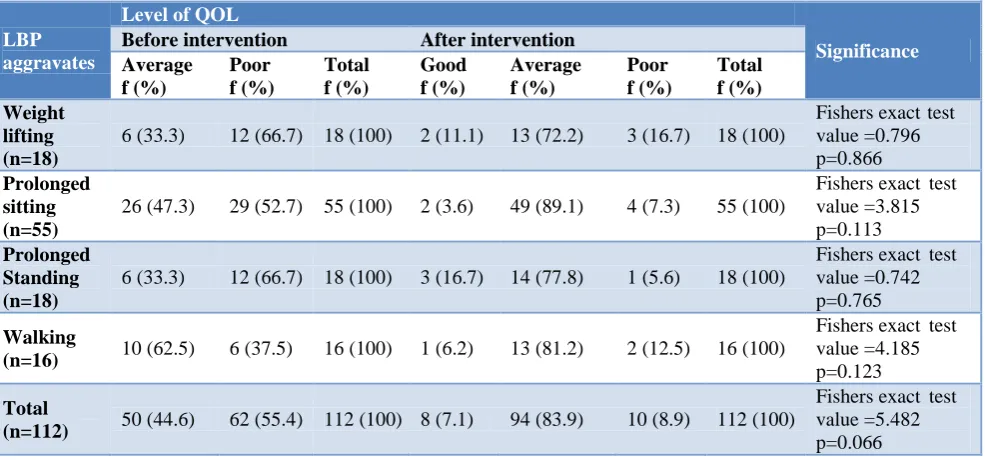
Table 1: Association between QOL of LBP patients before and after self back care intervention by LBP aggravating factors.
LBP aggravates
Level of QOL
Significance Before intervention After intervention
Average f (%)
Poor f (%)
Total f (%)
Good f (%)
Average f (%)
Poor f (%)
Total f (%) Weight
lifting (n=18)
6 (33.3) 12 (66.7) 18 (100) 2 (11.1) 13 (72.2) 3 (16.7) 18 (100)
Fishers exact test value =0.796 p=0.866
Prolonged sitting (n=55)
26 (47.3) 29 (52.7) 55 (100) 2 (3.6) 49 (89.1) 4 (7.3) 55 (100)
Fishers exact test value =3.815 p=0.113
Prolonged Standing (n=18)
6 (33.3) 12 (66.7) 18 (100) 3 (16.7) 14 (77.8) 1 (5.6) 18 (100)
Fishers exact test value =0.742 p=0.765
Walking
(n=16) 10 (62.5) 6 (37.5) 16 (100) 1 (6.2) 13 (81.2) 2 (12.5) 16 (100)
Fishers exact test value =4.185 p=0.123
Total
(n=112) 50 (44.6) 62 (55.4) 112 (100) 8 (7.1) 94 (83.9) 10 (8.9) 112 (100)
Fishers exact test value =5.482 p=0.066
Table 2: Comparison of Mean (±SD score) of different domain of QOL (before & after intervention).
Domain of QOL Before intervention After intervention Significance
(Paired t test)
Mean (±SD) Mean (±SD)
Physical functioning 33.021 (±18.323) 56.235 (±19.981) t=14.835; p=0.000
Role completion 62.277 (±30.201) 76.875 (±25.856) t=5.638; p=0.000
Social functioning 56.429 (±24.782) 68.607 (±20.134) t=6.065; p=0.000
Psychic health 45.616 (±13.886) 54.991 (±12.350) t=8.110; p=0.000
Experienced health 36.018 (±15.084) 52.723 (±13.084) t=15.149; p=0.000
Physical pain 64.063 (±31.261) 39.955 (±25.358) t=7.868; p=0.000
Total QOL score 49.302 (±11.313) 57.835 (±8.749) t=8.466; p=0.000
Table 1 showed that, 12 (66.7%) had poor QOL among whose back pain aggravates through weight lifting before intervention and after self back care intervention 13 (72.2%) had average QOL. But weight lifting were not statistically significant (Fishers Exact test value=0.796, p˃0.05). Long time sitting among LBP patients had poor
(62.5%) had average QOL before intervention and 13 (81.2%) had average QOL after self back care intervention . Before intervention average QOL among prolonged sitting were about 26(47.3%) and 29(52.7%) and after intervention average QOL prolonged sitting 49 (89.1%) and this difference was not significant. It shown in Table 2.
Comparison of quality of life (QOL) scores of different domain (before & after intervention)
The average score of physical functioning among low back pain patients were 33.0210 (±18.3230) before self back care intervention while after self back care intervention were QOL score improved to 56.2350 (±19.98931) and Statistically this mean difference were
significant (t=14.835, p˂0.001). The mean score of social
functioning before intervention were 56.4286
(±24.78219) and this quality of social functioning score 68.6071±20.13439 were improved through self back care intervention and statistically shows significant results (t=6.065, p˂0.001). Psychic health score were 54.9911 (±12.34963) improving after self back care intervention among low back pain patients.
It shows statistically significant result (t=8.110, p˂0.001). Study of quality of life of low back pain patients mean (±SD) score were about 49.3018 (±11.31353) before giving self back care interventions. And this mean (±SD) score were 57.8359(±8.74886) increasing after self back care intervention. The mean score differences were statistically significant (t=8.466, p˂0.001). QOL score showed in Table 2.
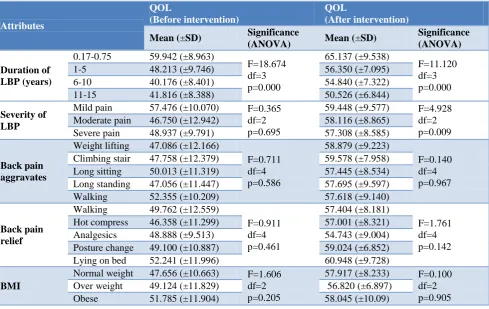
Table 3: Comparison of QOL means (±SD) score by selective LBP related attributes.
Attributes
QOL
(Before intervention)
QOL
(After intervention) Mean (±SD) Significance
(ANOVA) Mean (±SD)
Significance (ANOVA)
Duration of LBP (years)
0.17-0.75 59.942 (±8.963)
F=18.674 df=3 p=0.000 65.137 (±9.538) F=11.120 df=3 p=0.000
1-5 48.213 (±9.746) 56.350 (±7.095)
6-10 40.176 (±8.401) 54.840 (±7.322)
11-15 41.816 (±8.388) 50.526 (±6.844)
Severity of LBP
Mild pain 57.476 (±10.070) F=0.365
df=2 p=0.695
59.448 (±9.577) F=4.928
df=2 p=0.009
Moderate pain 46.750 (±12.942) 58.116 (±8.865)
Severe pain 48.937 (±9.791) 57.308 (±8.585)
Back pain aggravates
Weight lifting 47.086 (±12.166)
F=0.711 df=4 p=0.586 58.879 (±9.223) F=0.140 df=4 p=0.967
Climbing stair 47.758 (±12.379) 59.578 (±7.958)
Long sitting 50.013 (±11.319) 57.445 (±8.534)
Long standing 47.056 (±11.447) 57.695 (±9.597)
Walking 52.355 (±10.209) 57.618 (±9.140)
Back pain relief
Walking 49.762 (±12.559)
F=0.911 df=4 p=0.461 57.404 (±8.181) F=1.761 df=4 p=0.142
Hot compress 46.358 (±11.299) 57.001 (±8.321)
Analgesics 48.888 (±9.513) 54.743 (±9.004)
Posture change 49.100 (±10.887) 59.024 (±6.852)
Lying on bed 52.241 (±11.996) 60.948 (±9.728)
BMI
Normal weight 47.656 (±10.663) F=1.606
df=2 p=0.205
57.917 (±8.233) F=0.100
df=2 p=0.905
Over weight 49.124 (±11.829) 56.820 (±6.897)
Obese 51.785 (±11.904) 58.045 (±10.09)
It was found that, among the low back pain patients those who were suffering from less than one year back pain their mean (±SD) score were highest 59.9427 (±8.9635) which was decreasing from the group of 11-15 years back pain mean (±SD) score were 41.8167 (±8.3881) before intervention. It was also observed that mean (±SD) score of QOL were increasing after self back care intervention. Statistical analysis of Mean comparison of total quality of life with duration of LBP was significant (ANOVA, p˂0.01). Themean (±SD) score of severity of low back pain patients before intervention were deteriorating from mild to moderate back pain after intervention. Statistically severity of back pain and QOL mean score
were significant (ANOVA, p˂0.05). Table-3 depicted the LBP related score.
Figure 5 shows that, QOL score were decreased when duration of LBP increased. And about 21.4% (R2=0.214) cases.
Figure 5: Simple linear regression between duration of LBP and QOL score (before intervention).
Figure 6: Simple linear regression between duration of LBP and QOL score (after intervention).
DISCUSSION
Socio-demographic characteristics
Study revealed that majority 37 (33.0%) of the low back pain patients were 30-39 years old. It also found that mean±SD age of the low back pain patients were about 37.41 (±10.628) years. Another studied clinical profile
mean age of LBP patients were 42.22 (±8.07) years.15 Majority of the low back pain patients were female 59 (52.7%) and 53 (47.3%) were male patients. In 2007,
LBP patients were attending physical medicine
(33.9%) LBP patients were service holder Another study found same results that housewives were mostly affected by low back pain which were around 70% and 6% were unemployed.16 Study also revealed that most 95 (84.8%) of the low back pain patients were married and only 2 (1.8%) of the patients were widowed. The study also showed that 15 (13.4%) back pain patients were unmarried, 3% were single and 3% had other marital status.
Nature of LBP patients
In the study duration of low back pain showed that more than half 62 (55.3%) of the LPB patients had 1-5 years of back pain and few of them 6 (5.4%) had their low back pain for 11-15 years. Mean duration of LBP patients were found 3.59 (SD 3.52) years Lankhorst studied patients with persistent LBP and he found that mean duration of back pain for the group was 5.4 years (SD 3.6).17 This study showed that majority 43.8% of the LBP patients felt pain at the center of the back and 16.1% patients suffering from back pain in both right and left side of the back. Present study found that nearly two-third 62 (55.4%) low back pain patients had severe pain on the back. And one third patients felt moderate pain 36 (32.1%) and few of them 14 (12.5%) felt mild pain on the back. But another study conducted by Nujhat found dissimilar result that among the participants, the severity of pain in VAS scale was in between no pain in 29.6%, medium pain in 58.3% and severe pain in 12.20%.18 The study also revealed that 18 (16.1%) cases long standing and weight lifting aggravated back pain. Montakarn found that there was 62.9% of them reported that LBP was aggravated by sitting during a 6-hour working shift.19 It also found that 91 (81.3%) patients given their opinion that back pain worsening day by day. The study found that that patients feel comfortable to lying on bed during the pain started which were about 27(24.1%). And they 26 (23.2%) also said that hot compress also relief back pain. French found that Application of heat for 15 to 20 minutes at a time relieve back pain. And patients felt comfortable than harsh pain perceptions.20
QOL of LBP patients
In this study regarding level of quality of life (QOL) of low back pain (LBP) patients, before intervention 8 (7.1%) had good QOL and good quality of life were absent before intervention. And average QOL before intervention were 50 (44.6%) improving to 94 (83.9%) in after self back care intervention. It also found that 62 (55.4%) low back pain patients had poor quality of life at The mean(±SD) score of physical function among low back pain patients were 33.0210 (±18.3230) at before self back care intervention. And mean (±SD) score at after self back care intervention were 56.2350 (±19.98931). Statistically physical functioning before and after intervention among LBP patients were significant (t=14.835, p˂0.001). Study of quality of life of low back pain patients mean (±SD) score were about 49.3018 (±11.31353) before giving self back care interventions.
And this mean (±SD) score were 57.8359 (±8.74886) increasing after self back care intervention.
CONCLUSION
Low back pain is one of the common health problems among all age group. Most of the cases LBP start from an early adulthood due to trauma or awkward posture during bending, twisting or lifting any objects. Low back pain were more common among married women specially housewife. Majority of the female had higher BMI than male. Half of the LBP patients had poor QOL before intervention but after self back care intervention were average QOL. The average QOL score were higher among short duration of LBP than higher duration of LBP. Study also found that Severity of pain increases, mean QOL score were decreases. Majority of the LBP patients had radiation of back pain, numbness and weakness to the leg. Study revealed that prolonged sitting aggravates LBP among more than half of the participant. And back pain relieved by Self-back care intervention was an important ways to improving quality of life of low back pain.
Funding: No funding sources Conflict of interest: None declared
Ethical approval: The study was approved by the Institutional Ethics Committee
REFERENCES
1. Tavafian SS, Jamshidi A, Mohammad K, Montazeri
A. Low back pain education and short term quality of life: a randomized trial. BMC Musculoskeletal Disorders. 2007;8(1):21.
2. McBeth J, Jones K. Epidemiology of chronic musculoskeletal pain. Best Pract Res Clin Rheumatol. 2007;21(3):403-25.
3. Hoy D, March L, Brooks P, Blyth F, Woolf A, Bain C, Williams G, Smith E, Vos T, Barendregt J, Murray C. The global burden of low back pain: estimates from the Global Burden of Disease 2010 study. Annals Rheumatic Dis. 2014;73(6):968-74. 4. Hart LG, Deyo RA, Cherkin DC. Physician office
visits for low back pain: frequency, clinical evaluation, and treatment patterns from a U.S. national survey. Spine. 1995;20:11-9.
5. Deyo RA, Diehl AK. Cancer as a cause of back pain: frequency, clinical presentation, and diagnostic strategies. J Gen Intern Med. 1988;3:230-8.
6. Sharma SC, Singh R, Sharma AK, Mittal R. Incidence of low back pain in workage adults in
rural North India. Indian J Med Sci.
2003;57(4):145-7.
7. Andersson GBJ. Epidemiologic features of chronic low-back pain. Lancet. 1999;354:581-5.
Southeast Asian J Trop Med Public Health. 2006;37(5):1040.
9. Montazeri A, Mousavi SJ. Quality of life and low back pain. InHandbook of disease burdens and quality of life measures Springer, New York, NY; 2010: 3979-3994.
10. Serranheira F, Cotrim T, Rodrigues V, Nunes C, Sousa-Uva A. Nurses’ working tasks and MSDs back symptoms: results from a national survey. Work. 2012;41(1):2449-51.
11. Sparkes V. Treatment of low back pain: monitoring clinical practice through audit. Physiotherapy. 2005;91(3):171-7.
12. Billis E, Koutsojannis C, Matzaroglou C, Gliatis J, Fousekis K, Gioftsos G, Papandreou M, McCarthy C, Oldham JA, Tsepis E. Association of low back pain on physical, sociodemographic and lifestyle factors across a general population sample within
Greece. J Back Musculoskeletal Rehab.
2017;30(2):279-90.
13. Claiborne N, Vandenburgh H, Krause TM, Leung P. Measuring quality of life changes in individuals with chronic low back conditions: a back education program evaluation. Evaluation and program planning. 2002;25(1):61-70.
14. Rana AM, Wahlin Å, Lundborg CS, Kabir ZN. Impact of health education on health-related quality of life among elderly persons: A community-based intervention study in rural Bangladesh. Health Promotion Int. 2009;24(1):36-45.
15. Shakoor MA, Islam MA, Ullah MA, Ahmed MM, Al Hasan S. Clinical profile of the patients with
chronic low back pain-A study of 102 cases. Journal
of Chittagong Medical College Teachers'
Association. 2007;18(2):16-20.
16. Khan AA, Uddin MM, Chowdhury AH, Guha RK. Association of low back pain with common risk factors: a community based study. Indian J Med Res. 2014;25:50-5.
17. Lankhorst GJ, de Stadt Van RJ, der Korst Van JK. The natural history of idiopathic low back pain. A three-year follow-up study of spinal motion, pain and functional capacity. Scandinavian J Rehab Med. 1985;17(1):1-4.
18. Nujhat M. Prevalence of low back pain among the people age over forty at a selected village in Nator
(Doctoral dissertation, Department of
Physiotherapy, Bangladesh Health Professions Institute, CRP).
19. Montakarn C, Nuttika N. Physical activity levels and prevalence of low back pain in Thai call-center
operators. Indian J Occup Environ Med.
2016;20(3):125.
20. French SD, Cameron M, Walker BF, Reggars JW, Esterman AJ. Superficial heat or cold for low back pain. Cochrane Database of Systematic Rev. 2006: 1.