Original Research Article
A cross sectional study to assess the functioning of cold chain
in a tribal district of central India
Sanjay K. Chourasiya, Anil S. Baghel*, Arpit Verma, Saket Kale
INTRODUCTION
Routine Immunization is one of the most cost-effective public health interventions and was first introduced in India in 1978. Yet, despite the concerted efforts of the government and other health agencies, a large proportion of vulnerable infants and children in India remain
unimmunized.1 India had started its Universal
Immunization Program (UIP) in 1985 focusing more on infants and pregnant mothers.2 The success of this program depends highly on the level of cold chain
maintenance of the vaccines right from the site of manufacturing up to its administration.
Cold chain maintenance is a continuous and cohesive process of preserving vaccines to ensure their availability and to maintain potency.3 Cold chain maintenance is a term defined as the materials, equipment and procedures used to maintain temperatures between +2°C to +8°C while in transit throughout the distribution and storage process for vaccines from the manufacture point up to the beneficiary; whereas cold chain also includes the people
ABSTRACT
Background: Immunization is one of the best efforts that India is putting forward currently to fight against various vaccine preventable diseases. Cold chain maintenance is always an issue. Therefore, cold chain maintenance is a pre-requisite in the correct delivery of immunization services.
Methods: A cross sectional study was conducted among 18 cold chain points (CCPs) of Jhabua district using standard Government of India (GOI) structured questionnaires.
Results: Out of 18 cold chain points only 5.55% had dry room for the storage of needle, syringes and other clerical material. A separate voltage stabilizer was attached each to deep freezer and ILR at only 22% of the health centers. Only 55.55% CCPs waste disposal pit constructed as per guideline. 94.45% cold chain handlers (CCHs) knew the definition of cold chain and correct temperature range at which vaccines to be stored, whereas only 33.33% CCHs knew about Shake test. 72.23% CCHs knew how to read vaccine vial monitor (VVM) and stages of VVM correctly. Knowledge of the CCHs regarding open vial policy was poor, with only 33.33% knowing exactly, the details of open vial policy.
Conclusions: The quality of immunization programme can be increased by proper maintenance of cold chain and management of vaccine logistics at every designated cold chain point. There is need to improve the knowledge level of CCHs regarding cold chain maintenances and handling practices.
Keywords: Immunization, Cold chain, Cold chain points, Cold chain handler
Department of Community Medicine, Ruxmani Ben Deep Chand Gardi Medical College, Ujjain, Madhya Pradesh, India
Received: 10 August 2018
Revised: 26 September 2018
Accepted: 01 October 2018
*Correspondence:
Dr. Anil S. Baghel,
E-mail: [email protected]
Copyright: © the author(s), publisher and licensee Medip Academy. This is an open-access article distributed under the terms of the Creative Commons Attribution Non-Commercial License, which permits unrestricted non-commercial use, distribution, and reproduction in any medium, provided the original work is properly cited.
i.e. health workers engaged to maintain the equipment and temperature at peripheral levels.4
Keeping vaccines at the right temperature is not an easy task, but the consequences of not doing so can be disastrous. Once vaccine potency is lost, it cannot be regained. Cold chain equipment, both electrical and non-electrical, is used for storing vaccines and/or transporting them at appropriate temperatures, cold chain equipment includes, deep freezer (DF), ice lined refrigerators (ILR), cold box, vaccine carrier, ice packs etc. Immunization Program has undergone a number of significant changes in recent years. These include a new policy environment, the National Rural Health Mission, new vaccines (e.g. hepatitis B and Japanese encephalitis), new procedures to solve old problems (e.g. injection safety) and new technologies for vaccine delivery and cold chain. Such changes underscore the need for constant attention, sharing of experience, creativity, and flexibility in responding to problems.5
Cold chain maintenance is always an issue. Health workers involved in providing immunization services to the beneficiaries are also part of the cold chain system. Therefore, knowledge of these health workers in the cold chain maintenance is a pre-requisite in the correct delivery of immunization services.
METHODS
This was a cross sectional study done in Jhabua district of Madhya Pradesh during time period of one year from January 2017 to December 2017.This study was a part of
project of Strengthening Routine Immunization
programme funded by UNICEF, Madhya Pradesh. Jhabua is a predominantly tribal district in central part of the Madhya Pradesh plain in Indore Division of Madhya Pradesh with an area of 3,600 km2 and population of 1,025,048. Jhabua district has one district hospital, 5 Community health centers and 19 Primary health centers. 6 At the time of study there were 18 functional Cold Chain Points in this district. All of the cold chain points were evaluated by us and physical verification of the available cold chain equipment’s was done using predesigned pretested checklist. Cold storage monitoring was assessed by actual documentation at various levels of cold chain infrastructure and logistics. All vaccines were inspected for expiry date, frozen state and VVM (vaccine vial monitoring) status and open vaccine vial storage policy as per GOI (Government of India) guidelines. Training status and knowledge of the all available cold chain handlers were also checked. Data was collected and compiled using MS Excel and represented in percentage and proportions.
RESULTS
Among all CCPs visited 88.89% (16 out of 18) had cold room and only 5.55% (1 out of 18) had dry room for the storage of needle, syringes and other clerical material.
77.78% of CCPs had table for conditioning of ice packs but none have clean cloth to wipe up the ice packs. None of the visited CCPs had separate internet connection (Table 1).
Table 1: Status of cold chain infrastructure at studied cold chain focal points (N=18).
Cold chain infrastructure Yes N (%)
No N (%) Dedicated rooms available
for cold chain 16 (88.89) 2 (11.11) Dry room 1 (5.55) 17 (94.45)
Table for conditioning of
ice packs 14 (77.78) 4 (22.22) Availability of clean cloth 0 (0) 18 (100)
Availability of water
supply 12 (66.67) 6 (33.33) Availability of continuous
electrical supply 13 (72.23) 5 (27.77) Do all equipment are
backed up by generator support
5 (27.77) 13 (72.23)
Internet connection 0 (0) 18 (100)
Cross ventilation 4 (22.22) 14 (77.78)
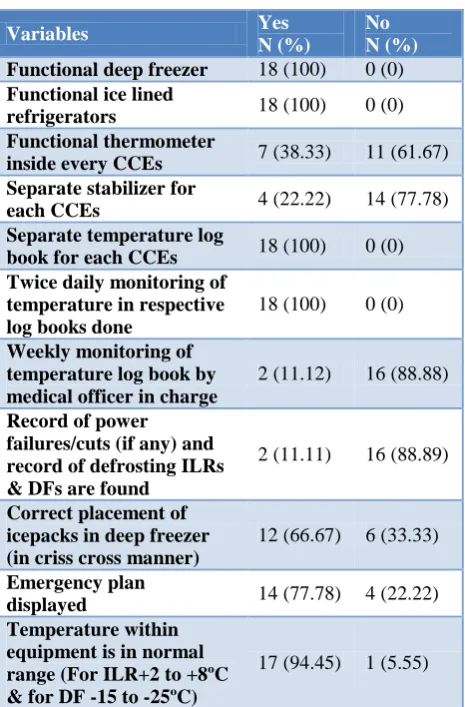
Table 2: Availability of cold chain equipment’s (CCEs) and cold chain practices (N=18).
Variables Yes
N (%)
No N (%) Functional deep freezer 18 (100) 0 (0)
Functional ice lined
refrigerators 18 (100) 0 (0) Functional thermometer
inside every CCEs 7 (38.33) 11 (61.67) Separate stabilizer for
each CCEs 4 (22.22) 14 (77.78) Separate temperature log
book for each CCEs 18 (100) 0 (0) Twice daily monitoring of
temperature in respective log books done
18 (100) 0 (0)
Weekly monitoring of temperature log book by medical officer in charge
2 (11.12) 16 (88.88)
Record of power failures/cuts (if any) and record of defrosting ILRs & DFs are found
2 (11.11) 16 (88.89)
Correct placement of icepacks in deep freezer (in criss cross manner)
12 (66.67) 6 (33.33)
Emergency plan
displayed 14 (77.78) 4 (22.22) Temperature within
equipment is in normal range (For ILR+2 to +8ºC & for DF -15 to -25ºC)
It had observed that only 38.33% of CCPs had functional thermometer inside every CCEs but entry of temperature recording was found in 100% of temperature log book. Record of power failures/cuts (if any) and record of defrosting ILRs & DFs are found only in 11.11%. We also observed that temperature log book was supervised by Medical office in charge at only 2 cold chain points. It was also found that ice packs were arranged in a crisscross manner in only 12 (66.67) health centers. On observing the alternative to the cold chain equipment’s, we found that emergency plan was displayed at 14 (77.78) CCPs (Table 2). In this study we also found that a separate voltage stabilizer was attached each to deep freezer and ILR at only 22% of the health centers.
Table 3: Practice of biomedical waste management at cold chain points (N=18).
Variables Yes
N (%)
No N (%) Biomedical waste
management guidelines followed
3 (16.67) 15 (83.33)
Is color coded bucket
available and used 3 (16.67) 15 (83.33) Does immunization waste
is collected in red and black plastic bags from all sessions
8 (44.45) 10(55.55)
Does immunization waste
chemically disinfected? 0 (0) 18 (100) Is waste disposal pit
constructed as per guideline?
10 (55.55) 8 (44.45)
Table 3 shows biomedical waste management practices at cold chain points, it was very discouraging that only 3 (16.67) CCPs followed biomedical waste management guidelines while at 10 (55.55) CCPs waste disposal pit constructed as per guideline.
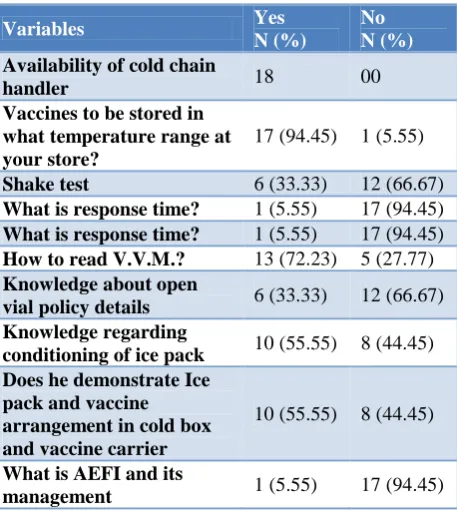
Table 4 shows the knowledge of the Cold chain handlers regarding cold chain. It was good to see that 17(94.45%) CCHs knew the definition of cold chain and correct temperature range at which vaccines to be stored, whereas only 6 (33.33%) CCHs knew about shake test. It was encouraging to see that 13 (72.23%) CCHs knew how to read VVM and stages of VVM correctly but only 10 (55.55%) had knowledge regarding conditioning of ice pack and ice pack and vaccine arrangement in cold box & vaccine carrier. Knowledge of the CCHs regarding open vial policy was poor, with only 6 (33.33%) knowing exactly, the details of open vial policy.
We found that 5 (27.77%) CCPs equipment are backed up by generator support. The present study found water bottles kept inside ice lined refrigerator in 2 (11.11%) CCPs and at 13 (72.22%) CCPs the diluents are stored
inside the ILR from the time of receipt and, at 2 (11.11%) health centers, things other than vaccines/diluents, like empty water bottles, were kept inside the ILR. Vaccines were arranged according to temperature sensitivity in ILR at 14 (70%) health centers (Table 5).
Table 4: Availability of cold chain handler and its knowledge regarding cold chain practices (N=18).
Variables Yes
N (%)
No N (%) Availability of cold chain
handler 18 00
Vaccines to be stored in what temperature range at your store?
17 (94.45) 1 (5.55)
Shake test 6 (33.33) 12 (66.67)
What is response time? 1 (5.55) 17 (94.45)
What is response time? 1 (5.55) 17 (94.45)
How to read V.V.M.? 13 (72.23) 5 (27.77)
Knowledge about open
vial policy details 6 (33.33) 12 (66.67) Knowledge regarding
conditioning of ice pack 10 (55.55) 8 (44.45) Does he demonstrate Ice
pack and vaccine arrangement in cold box and vaccine carrier
10 (55.55) 8 (44.45)
What is AEFI and its
management 1 (5.55) 17 (94.45)
Table 5: Distribution of vaccines and diluents practices in side ILRs at studied cold chain focal
points (N=18).
Variables Yes
N (%)
No N (%) Vaccine stock position 10 8
Do counts of vaccine & diluents of BCG/Measles are matching
12 (66.67) 6 (33.33)
Is any vaccine found to be stock out (0 stock or inadequate buffer stock)?
13 (72.22) 5 (27.78)
Any vaccine found in
frozen condition 5 (27.78) 13 (72.22) All the vaccine with usable
VVM 18 (100) 0 (0)
Only UIP vaccines are
placed inside ILRs? 16 (88.88) 2 (11.12) The diluents are stored
inside the ILR from the time of receipt
13 (72.22) 5 (27.78)
The diluents are stored inside the ILR 24 hrs. before the session
DISCUSSION
Immunization programs are widely recognized as one of the most effective means of health intervention. Cold chain management can enhance the quality, safety and efficacy of an immunization program. Once the potency of a vaccine is lost, it cannot be regained or restored and the vaccine will no longer provide protection against the target disease. Cold chain management includes the storage conditions, refrigerator maintenance and temperature monitoring, and handling of the vaccine during immunization sessions.
There must be a dedicated room for cold chain (cold room) and a dry room for storage of syringes and diluents. Temperature of ILR/DF used for storage of vaccines must be recorded twice daily. The ILR and DF each should have separate thermometer and temperature record book. In our study we found that only 1 cold chain point had dry room, it was also found that only 38.33% of CCPs had functional thermometer inside every CCEs. In contrast to this study done by Biradar et al at Bijapur, Karnataka found that only 76.1% health center, functional thermometer was placed inside every ILRs and DFs.7 A study done by Sinha et al at Durg, Chhattisgarh showed that only 75% CCPs had separate functional thermometer inside every functional equipment’s.8 The present study stated that, all CCPs (100%) had separate temperature log book for ILR and DF in comparison to study done by Sinha et al observed only at 45% centers.8 In similar study done by Rao et al observed at 94.2% centers.9 The findings in our study was more than that what Mallik et al (60%), Samath et al (65%) and Sachdeva et al (71.87%) found in their studies.10-12 It was observed that temperature log book was supervised by Medical office in charge at only 2 cold chain points, in contrast to our study much better result found in other studies done by Gupta et al (100%), Govani et al (89%).13,14 This may be the reason for carelessness showened by cold chain handler in maintaining the cold chain.
A separate voltage stabilizer should be attached each to deep freezer and ILR, except in emergency, when one stabilizer per two small equipment is acceptable. The function of the voltage stabilizer is to monitor the range of fluctuations in the main voltage of 90-280 V and maintain voltage in a required range of 220+10 Volt (1) Stabilizer protects the cold chain equipment against voltage fluctuations and is an essential pre-requisite. 1 The present study claimed that a separate voltage stabilizer was attached each to deep freezer and ILR in only 22% of the health centers. In contrast to our study, Naik et al found that a separate voltage stabilizer was attached to each deep freezer and ILR in 3 (15%) health centers.16 A shortage of voltage stabilizers was also reported in several other studies.10,12
As per the vaccine management guidelines, ice packs need to be stacked in crisscross manner inside deep
freezer which allows space for air circulation to make a frozen ice packs to maintain the recommended level of temperature at point of vaccination.1 We also found that ice packs were arranged in a crisscross manner in only 66.67% health centers, only at 77.78% emergency plan was displayed, as per the guidelines this must be 100%. In contrast to these Naik et al in their study found that ice packs were arranged in a crisscross manner in only 7 (35%) health centers.15 Similarly Sinha et al found that 95% of CCPs had faulty arrangements of ice packs inside deep freeze.8 Ice packs are key components of cold chain, used for inside lining of cold boxes and vaccine carrier at facility and at field respectively for vaccine storage and transport at storage.
The most common cause of exposure to freezing temperatures is the failure to correctly condition ice packs prior to transport. Conditioning prevents freezing of freeze- sensitive vaccines. In the present study, we found that only half of the CCHs knew conditioning of ice pack and ice pack and vaccine arrangement in cold box & vaccine carrier. We observed that 14 (77.78%) CCPs had dedicated space for conditioning of icepack but none of the CCPs had clean cloth for wiping icepacks for the same purpose. In other study done by Sinha et al found that 9 (45%) CCPs had dedicated space for conditioning of icepack and 11 (55%) CCPs had clean cloth for wiping icepacks.8 Shake test, for testing whether a vaccine is frozen or not, should be a matter of common knowledge for the CCH. But, we found in the present study that just one-thirds (33.33%) of the CCHs knew exactly about Shake test. Naik et al in their study found that two-thirds of the vaccinators knew exactly about Shake test.15 Bhatnagar et al found 11.6% in their study 19% by National EVM assessment.17 It was good to see that almost all of the CCHs knew the definition of cold chain and correct temperature range at which vaccines to be stored. It was encouraging to see that 72.23% CCHs knew how to read VVM and stages of VVM correctly. Thakur et al also highlighted similar results with 94.4% staff members being aware that VVM is present on vaccine itself and 71.7% knowing how to read it.18
In our study we found that only 3 (16.67%) CCPs followed biomedical waste management guidelines while at 10 (55.55%) CCPs waste disposal pit constructed as per guideline. In spite of dangers to health and dangers to the environment practice of unsafe disposal of immunization waste is followed.
Knowledge of the CCHs regarding AEFI was very poor which needs improvement. It is imperative that vaccinators are well conversant with the temperature range to be maintained in ILR and deep freezer so that a break in cold chain can be easily detected and reported to the higher authority.
contrast to these Bhatnagar et al found in their study that 100% of CCHs had knowledge regarding open vial policy.
CONCLUSION
Success of immunization programme mainly depends on the management of cold chain and the knowledge, attitude and practices followed by the personals involved in the cold chain maintenance.
Our study reveals that Cold Chain and Logistic Management component were not up to the mark in study area. Persistent gaps included non-availability of cold chain equipment like voltage stabilizers, backup generator services and separate and adequate cold chain room with dry room, which mainly depended on policy makers and funding. All personnel handling vaccines should understand the purpose and function of various cold chain tools in their setting for immunizations. The present study contemplates for periodic refresher training and capacity building for cold chain maintenance of all the cold chain handlers. Medical officers should be actively involved in the monitoring and supervision of the cold chain system.
ACKNOWLEDGEMENTS
Authors express their sincere thanks to UNICEF, Madhya Pradesh for their financial support to carry out this study.
Funding: No funding sources Conflict of interest: None declared Ethical approval: Not required
REFERENCES
1. New Delhi: Ministry of Health and Family Welfare; 2010. Govt. of India. Handbook for vaccine and cold chain handlers. Available at http://www.unicef. org/india/Cold_chain_book_Final. Accessed on 19 July 2017.
2. Park K. Textbook of Preventive and Social
Medicine. 21st ed. Jabalpur: Bhanot Publishers; 2011: 112.
3. Seto J, Marra F. Cold chain management of vaccines. CPD. 2005.
4. Sudarshan MK, Sundar M, Girish N, Patel NG. An
evaluation of cold chain system for vaccines in Bangalore. Indian J Pediatric. 1994;61:173–8. 5. Immunization Handbook for Medical Officers. 6. Official website of District Administration, Jhabua
available at http://www.jhabua.nic.in/. Accessed on 22 February 2018.
7. Biradar SM, Biradar MK. Evaluation of Vaccine Storage Practices in Primary Health Centres of Bijapur District of Karnataka. Int J Pharma Bio Sci. 2013;4(4):1290-3.
8. Sinha AK, Verma AR, Chandraker A, Shanta PK, Dixit S. Evaluation of cold chain and logistics
management practice in Durg district of
Chhattisgarh: pointer from Central India Int J Community Med Public Health. 2017;4(2):390-5. 9. Rao S, Naftar S, Unnikrishnana B. Evaluation,
awareness, practice and management of cold chain at the primary health care centers in coastal South India. J Nepal Paediatric Society. 2012;32(1):19-22. 10. Mallik S, Mandal PK, Chatterjee C, Ghosh P,
Manna N, Chakrabarty D, et al. Assessing cold chain status in a metro city of India: an intervention study. Afr Health Sci. 2011;11(1):128-33.
11. Samant Y, Lanjewar H, Parker D, Block L, Tomar G, Stein B. Evaluation of the Cold-Chain for Oral Polio Vaccine in a Rural District of India. Public Health Rep. 2007;122(1):112-21.
12. Sachdeva S, Datta U. Status of vaccine cold chain maintenance in Delhi, India. Indian J Med Microbiol. 2010;28:184-5.
13. Gupta A, Gupta R. Study of Cold Chain Practices at Community Health Centers of Damoh District of Madhya Pradesh. National J Community Med. 2015;6(4):528-32.
14. Govani KJ, Sheth JK. Evaluation of Temperature Monitoring System of Cold Chain at all Urban Health Centres (UHCs) of Ahmedabad Municipal Corporation (AMC) area. Healthline. J Indian Assoc Prevent Social Med. 2015;6(1):41-5.
15. Naik AK, Mihir PR, Bansal RK. Evaluation of Vaccine Cold Chain in Urban Health Centers of Municipal Corporation of Surat City, Western India Int J Prevent Med. 2013;4(12):1395–401.
16. Sharma DK, Varun A, Patel R, Singh US. Process Evaluation of Immunization Component in Mamta Diwas and Support Services in Kheda District, Gujarat. Natl J Community Med. 2013;4(1):81-5. 17. Government of India. National effective vaccine
Management assessment India (New Delhi:
National Institute of Health and Family Welfare, ministry of health and family welfare, 2013.
18. Thakur JS, Swami HM, Bhatia SP. Staff awareness of oral polio vaccine vial monitor in Chandigarh. Indian J Pediatr. 2000;67:253–4.