Influence of Silver Nanoparticles on the Specific
Properties of Acrylic Resin for Ocular Prosthesis
Maha M. Turki1 and Faiza M. Abdul-Ameer2
1M.Sc. Student, Department of Prosthodontics, College of Dentistry, University of Baghdad. 2Department of Prosthodontics, College of Dentistry, University of Baghdad, Iraq.
*Corresponding author E-mail: [email protected] http://dx.doi.org/10.13005/bpj/1524
(Received: 30 July 2018; accepted: 13 September 2018)
Scleral acrylic resin is widely used to synthesize ocular prosthesis. However, the properties of this material change over time, thus requiring the prosthesis to be refabricated. Many studies were conducted to improve these properties by reinforcing this material with nanoparticles. This study aims to evaluate the effect of silver nanoparticle powder on the mechanical properties (transverse flexural strength, impact strength, shear bond strength, surface microhardness, and surface roughness) of scleral acrylic resin used for ocular prostheses. Two concentrations were selected from the pilot study and evaluated for their effects on scleral acrylic resin properties. According to the pilot study, 0.01 and 0.02wt% AgNPs powder improved the transverse flexural strength, microhardness, and surface roughness compared with other percentages. The specimens in the main study were divided into (3) main groups, (50) specimens without additives (control group A), (50) experimental specimens (with 0.01wt% AgNPs group B), and (50) experimental specimens (with 0.02 wt% AgNPs group C). Each group was subdivided into (5) equal subgroups depending on the tests used. The data were studied using one way ANOVA and post hoc LSD test. At 0.01 wt% AgNPs addition, the mean values of transverse flexural strength insignificantly increased (p> 0.05), and those of impact strength and shear bond strength significantly increased (p< 0.05) compared with those of the control group. At 0.02 wt% AgNPs addition (group C), the mean value of transverse flexural strength significantly increased (p< 0.05), that of impact strength insignificantly increased (p> 0.05), and that of shear bond strength increased with high significance (p< 0.01) compared with those of the control group. Group C showed insignificant increase in the mean values of transverse flexural strength, impact strength, and shear bond strength (p. 0.05) compared with group B. The scleral acrylic resin added with 0.01 and 0.02 wt% AgNPs showed insignificant increase in microhardness and insignificant decrease in surface roughness. The addition of AgNPs powder in both concentrations improved the mechanical properties of scleral acrylic resin used for ocular prostheses.
Keywords: Silver nanoparticles; scleral acrylic resin; modified curing protocol; ocular prosthesis.
Defects of the face result from congenital causes, surgical resection, and trauma and should be corrected surgically to improve the aesthetic and function of the patient. However, the prosthetic rehabilitation is important when the defect cannot
be corrected surgically because of the size and location of the defect, to restore the psychological and physiological health of the patient.1
Ocular prosthesis is one of the maxillofacial prostheses that are used to restore
Published by Oriental Scientific Publishing Company © 2018
(3), 1573-1581 the quality of life and the appearance of the patient
for social and psychological adaptation. 2
Acrylic resin has specific properties, such as low cost, good adaptation, easy fabrication, good biocompatibility, easy coloring, and good esthetic results, which make it the best material for ocular rehabilitation. 3
Despite these advantages, this material undergoes property deterioration, thus requiring refabrication of the prosthesis. Several studies were conducted to improve these properties by reinforcing the polymer with NPs, which provide the former with new properties such as the resistance of NPs and the flexibility of polymer. 4
Silver nanoparticles have antimicrobial activity against (Gram positive and negative bacteria, protozoa, fungi, and viruses) that has been improved for many years. Adding AgNPs into polymer provides the latter with antimicrobial activity for maxillofacial fabrication. 5
This study aims to determine the appropriate percentage of AgNPs and to study the effect of AgNPs powder addition on the transverse flexural strength, impact strength, shear bond strength, surface microhardness, and surface roughness of scleral acrylic resin used for ocular prostheses.
Materials and Methods
Scleral acrylic resin (heat cure scleral polymer (J-510) was mixed with non-crossed linked scleral monomer (J-570)) (Techno vent Ltd., South Wales, UK). Silver nanoparticles (average particles size <20 nm) (MK Nano, Canada) were used for reinforcement. Three various plastic shapes were constructed by cutting plastic plate with shape and dimension according to the required tests by using laser cutting machine for mold preparation (JL-1612, Jinan Link Manufacture and Trading Co., Ltd., China). For the tests on transverse flexural strength, impact strength and microhardness, the dimensions of specimens were 80mm x 10 mm x 4 mm length, width, and thickness, correspondingly.6–8 For the surface
roughness test, the dimensions of specimens were 65 mm x 10 mm x 2.5 ± 0.1 mm length, width, and thickness, correspondingly. 9
For shear bond strength test, a space with dimension of (25 mm x 25 mm x 3 mm length,
width, and depth, correspondingly) was created by making two blocks of scleral acrylic with dimensions of 75 mm x 25 mm x 5 mm, length, width, and depth correspondingly) with stopper of depth of 3 mm 10, 11 and putting one block over the
other for relining materials. 12
Molds for transverse flexural strength, impact strength test, microhardness test and surface roughness were prepared using the conventional technique for complete denture (Figures 1 A and B).13 The scleral acrylic heat cure was blended,
packed, and cured according to manufacturer’s instructions. After curing was completed, the specimens were finished, polished, conditioned in distilled water, and stored in the incubator at 37 °C for 48 h before the test was performed. 9
The mold for shear bond strength was prepared by creating two blocks of scleral acrylic with dimensions 25 mm × 25 mm × 3 mm length, width, and depth, correspondingly, which were placed one over the other. The whole specimen (two blocks) was invested into silicone to create a template for the final specimen. Scleral acrylic resin (before and after the addition of AgNPs) filled the formed space, and curing was then conducted (Figures 2 A, B, and C).
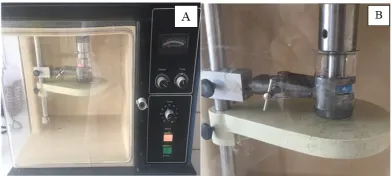
A pilot study was initially conducted with 0.006, 0.01, 0.02, and 0.05 wt% AgNPs added to scleral acrylic resin and compared with 0.00 wt% AgNPs (control group). AgNPs were first weighted with digital electronic balance (Germany, sensitivity 0.0000g), added into the monomer, and broken down into singular nanoparticles using probe sonication apparatus (Soniprep-150, England) for 3 min. The mixture was cooled by putting the container in a vessel with iced water because sonication could excessively heat the liquid and consequently damage the material (Figures 3 A and B). 14
The monomers with AgNPs powder were immediately mixed with acrylic powder (the weight of AgNPs powder must subtracted from the weight of acrylic powder) to reduce the possibility of particle aggregation and phase separation. Mixing was conducted in a clean and dry glass mug using a wax knife for 30 s. The mixture was then enveloped until dough stage was reached.
and surface roughness of the tested scleral acrylic resin specimens.
The mold was brushed with separating medium and left to dry. The dough mix was collected then packed into the mold. The flask were closed and placed under gradual press. Finally, the two halves closed together until metal to metal contact and were left for 2 min under 100 bar before clamping.15 The flask was clamped, left for bench
polymerization for 30 min, and then transferred to the water bath for complete polymerization cycle. A modified curing protocol referred to as reverse curing was followed. In this technique, the flask was placed in boiling water at 95 °C for 20 min, cooled for 20 min, and placed back in water boiling at 100 °C for 20 min.16 The flask was then cooled,
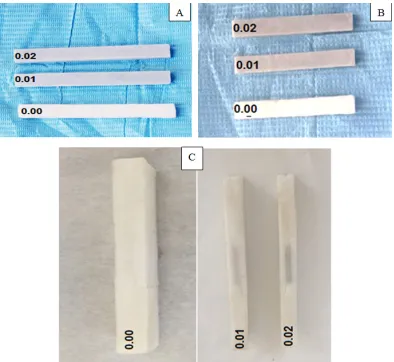
the specimens were removed from the mold, and finishing and polishing were finally conducted (Figures 4 A, B, and C).
A total of 150 specimens of scleral acrylic resin were fabricated and divided into (3) main groups; 50 specimens without additives (control), 50 experimental specimens (with 0.01 wt% AgNPs) and 50 experimental specimens (with 0.02 wt% AgNPs). Each group was subdivided into five equal subgroups depending on the conducted tests (transverse flexural strength, impact strength, shear bond strength test, microhardness, and surface roughness) with 10 specimens for each test.
Transverse flexural strength test: As recommended by (ISO, 2010),[6] a computerized
universal testing machine (WDW-20, Laryee Technology Co., Ltd., China) was used for testing. A 100 Kg load was applied with a cross head speed of 5 mm/min by a bar located in the center between the supports to ensure bending until fracture happened. The strength was measured using formula:
Transverse strength= 3P x l / 2b x d2 N/mm2, 17
Where:
P: Peak load (N) I: Span length (mm) b: Specimen width (mm) d: Specimen thickness (mm)
Impact strength test: As recommended by ISO 179, 2000 7 with impact testing instrument
of Charpy type (INC. USA) used for testing. The specimen was located horizontally at its ends and was hit with a free swinging pendulum. Testing capacity of pendulum 2 joules was used. The scale
reading gave the impact energy (in joules) absorbed to fracture the specimen when hit by a sudden shot.
[18] The strength of the impact was calculated in KJ/
m2 using the following formula:
Impact strength = (E/B x D) x1000KJ /m2, 17
Where:
E: Impact absorbed energy (J) B: Width of the specimens (mm) D: Thickness of the specimens (mm)
Shear bond strength test: Computerized universal testing machine (WDW-20, Laryee Technology Co., Ltd., China) was used to test shear bond strength by using load of 100 Kg and cross head speed of 0.5 mm/min.[19] The shear bond
strength can be calculated by using this formula:-Bond strength (N/mm2) = (Maximum load) / (Cross sectional area).
Microhardness test: As recommended by Standard (2011), 8 Vickers microhardness tester
(HVS-1000, China) was used to test the surface hardness using a micro hardener with a 25 g load for 10 s. Five measurements were collected, and the mean of these five measurements represents the surface hardness. 15
Surface roughness test: A portable digital roughness profilometer tester was used (Time 3200/TR200, China). The diamond stylus of profilometer moves in close with surface of the specimen at three different places to obtain three readings. The mean value of the three readings represents the roughness. 20
Scanning electron microscope (SEM), X-ray diffraction analysis (XRD) and Fourier transform infrared (FTIR) analyses were each performed on three specimens (one specimen before the addition of AgNPs and two specimens after the addition of 0.01 and 0.02 wt% AgNPs).
results
seM, Xrd, and Ftir analyses
The SEM results for the fracture surfaces of specimens for impact strength test before and after the addition of 0.01 and 0.02 wt% AgNPs indicated the thorough dispersion of the AgNPs into the scleral acrylic resin matrix (no agglomeration was observed) (Figures 5 A, B, and C).
(3), 1573-1581
Fig. 1. Mold preparation A, for transverse flexural strength, impact strength and microhardness; B, for surface roughness
Fig. 2. A, The plastic pattern in silicone mold; B, Mold preparation for shear bond strength test; C, Custom fabricated flask with silicone –stone mold for final specimens
Fig. 3. A and B, AgNPs and monomer sonicated using a probe sonication apparatus
amorphous structure, but no diffraction peak was found in the crystal structure of AgNPs (Figure 6).
The average particle size of Ag NPS can be calculated by using XRD results for the well-known Scherrer’s formula established by Paul Scherrer. The result showed that the nanoparticles size is < 20 nm.
D = (L ë) / (â cosè), (Scherrer’s formula) 21
Where:
D: Average particle size
L: Constant related to crystalline shape, normally taken as 0.94
â: Full width half max (FWHM) for peak of XRD ë: Wavelength of the target that use in XRD instrument (1.54056oA)
oA: Interplanar spacing between the atoms The FTIR results revealed shifting in the absorption peaks of tested AgNPs powder, pure PMMA powder, nanocomposite PMMA with 0.01 wt% AgNPs, and nanocomposite PMMA with 0.02 wt% AgNPs. Hence, physical interaction but no chemical reaction occurred between the saturated forms of PMMA and AgNPs.
transverse flexural strength
Descriptive statistics, One-way ANOVA, and LSD analysis are presented in Table 1. Compared with that of the control group, the transverse flexural strength insignificantly increased in the resin added with 0.01 wt% AgNPs (p> 0.05) and significantly increased in the resin added with 0.02 wt% AgNPs (p< 0.05) as shown in Table 1.
impact strength
Descriptive statistics, One-way ANOVA, and LSD analysis are presented in Table 2. Compared with that of the control group, the impact strength of the resin significantly increased after being added with 0.01 wt% AgNPs (p< 0.05) and insignificantly increased after being added with 0.02 wt% AgNPs (p> 0.05) as shown in Table 2. shear bond strength
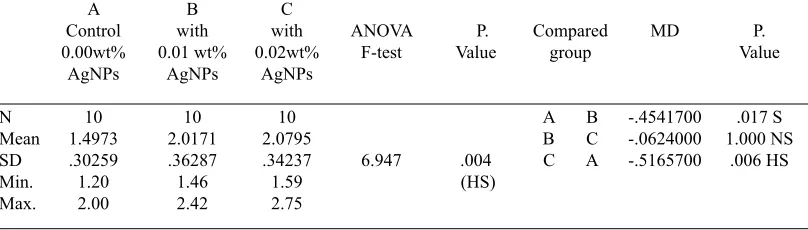
Descriptive statistics, One-way ANOVA, and LSD analysis are presented in Table 3. Compared with that of the control group, the shear bond strength of the resin significantly increased after being added with 0.01 (p< 0.05) and 0.02 wt% AgNPs (p< 0.01) as shown in Table 3.
surface microhardness
Descriptive statistics and one-way ANOVA are presented in Table 4. One-way ANOVA showed insignificant difference among the tested groups as shown in Table 4.
surface roughness
Fig. 4. A, Specimens for transverse flexural strength, impact strength and microhardness test; B, Specimens for surface roughness test; C, Specimens for shear bond strength test
Fig. 5. A, Surface fracture of impact test for pure PMMA; B, Surface fracture of impact test for sample of PMMA with 0.01% AgNPs; C, Surface fracture of impact test for sample of PMMA with 0.02% AgNPs
discussion
Ocular prosthesis is used to increase the confidence of patients and restore their psychological and social health. Losing of the eye, congenitally or acquired, negatively affects the life of patients. Scleral heat cure acrylic resins are widely used to fabricate ocular prosthesis because they have suitable characteristics, such as light in weight, compatible to tissues, aesthetic, durable, non-irritating to the tissues of eye socket,
and has stable dimensions and low cost22 Despite
these advantages of scleral acrylic resin, the ocular prostheses synthesized from this material require refabrication due to the possible changes in the chemical and physical properties. Many studies were conducted to improve the mechanical and physical properties of scleral acrylic resin by reinforcing it with nanoparticles. The properties of this material were improved due to the addition of NPs 23, 24
(3), 1573-1581
table 1. Descriptive statistics, One-way ANOVA and LSD for transverse flexural strength test among groups
A B C
Control with with ANOVA P. Compared MD P.
0.00wt% 0.01 wt% 0.02wt% F-test Value group Value
AgNPs AgNPs AgNPs
N 10 10 10 A B -9.6600 .332 NS
Mean 122.880 132.540 138.060 B C -5.5200 1.000 NS
SD 15.0753 9.8405 13.7883 3.444 .047 C A 15.1800 .046 S
Min. 108.0 121.2 121.2 (S)
Max. 147.6 150.0 156.0
table 2. Descriptive statistics, One-way ANOVA and LSD for impact strength test among groups
A B C
Control with with ANOVA P. Compared MD P.
0.00wt% 0.01 wt% 0.02wt% F-test Value group Value
AgNPs AgNPs AgNPs
N 10 10 10 A B -1.4290 .033 (S)
Mean 8.626 10.055 9.532 B C .5230 .981(NS)
SD 1.2113 1.2954 .9859 3.809 .035 C A .9060 .286(NS)
Min. 6.5 7.3 7.8 (S)
Max. 10.6 12.2 11.2
table 3. Descriptive statistics, One-way ANOVA, and LSD for shear bond strength test among groups
A B C
Control with with ANOVA P. Compared MD P.
0.00wt% 0.01 wt% 0.02wt% F-test Value group Value
AgNPs AgNPs AgNPs
N 10 10 10 A B -.4541700 .017 S
Mean 1.4973 2.0171 2.0795 B C -.0624000 1.000 NS
SD .30259 .36287 .34237 6.947 .004 C A -.5165700 .006 HS
Min. 1.20 1.46 1.59 (HS)
Max. 2.00 2.42 2.75
table 4. Descriptive statistics and One-way ANOVA for microhardness test among groups
A B C Control with with ANOVA P. 0.00wt% 0.01wt% 0.02wt% F-test Value
AgNPs AgNPs AgNPs
10 10 10
Mean 48.555 50.864 48.891
SD 5.2013 3.0772 3.5027 .957 .397
Min. 40.9 47.0 43.2 (NS)
Max. 54.6 55.1 56.0
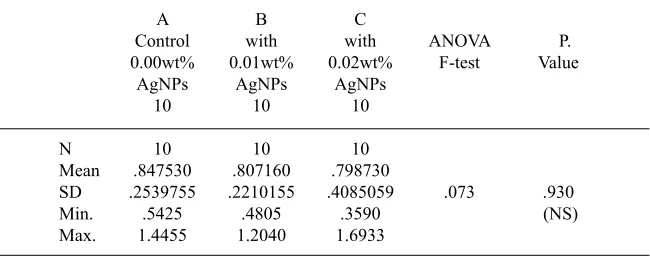
table 5. Descriptive statistics and One-way ANOVA for surface roughness test among groups
A B C Control with with ANOVA P. 0.00wt% 0.01wt% 0.02wt% F-test Value
AgNPs AgNPs AgNPs
10 10 10
N 10 10 10 Mean .847530 .807160 .798730
SD .2539755 .2210155 .4085059 .073 .930
Min. .5425 .4805 .3590 (NS)
Max. 1.4455 1.2040 1.6933
The mean values of transverse flexural strength of scleral acrylic resin increased with the addition of 0.01 and 0.02 wt% AgNPs as compared with that of the control group. This finding may be due to the formation of complicated network chains during the curing process of polymer. In addition, NPs decreased the distance of intermolecular space and free space between polymer chains, thus filling the free spaces between chains and attracting resin molecules 26 When the specimens were subjected to
stress, this stress was transferred from the polymer (more flexible) to the nanoparticles with higher modulus, rigidity, and stiffness than the former 17
The mean values of impact strength of the resin increased after adding 0.01 wt% AgNPs and decreased when adding 0.02 wt% AgNPs; however, the value remained higher than that of the control group. This phenomenon occurred because adding NPs introduced a mechanical restraint of the matrix by restricting the mobility of the chains, which bonded the particles/polymer, and consequently bringing extra forces for these chains 26 The increase
in impact strength is a result of the interfacial bond strength between the matrix and NPs. This result was confirmed by the FTIR findings that indicate a physical interaction between polymer and NPs. The uniform distribution of NPs within the polymer matrix was also confirmed by the SEM results. Meanwhile, the decrease in the mean value at 0.02 wt% AgNPs affected the average distance between single particles (up to 0.5 pm). This distance is important for the stress field around each particle. If the distance surpasses the critical value, then the failure transitions from brittleness to toughness. Therefore, with 0.02 wt% AgNPs, the decrease in inter particles distance lead to the decrease in impact strength27 The reduction in impact strength
when adding 0.02 wt% AgNPs also explained that the continuity of the resin matrix was interrupted when more NPs were added in the polymer matrix after reaching saturation state 28
(3), 1573-1581 between the relined (nanocomposite materials)
and original materials (without addition), thus leading to the entire permeation of the bond29 Visual
examination of fracture site revealed the cohesive and mixed modes of failure, indicating a strong bond between the relined and original materials and making the fracture to passed through the original and relined materials.
The mean microhardness value increased at 0.01 wt% AgNPs addition but decreased at 0.02wt% AgNP addition. This increase may be attributed to the inherent characteristics of NPs as having good interatomic bonding with polymer chains,30 dispersing uniformly within the resin
matrix, being located at and near the surface as characterized to hardness and stiffness31 and having
small size with high microhardness due to their 3D network formation15 The decreased value at 0.02
wt% is because microhardness (wear resistance) is directly related to the impact strength26 and flexural
strength; the material becomes susceptible to fracture when the microhardness increased because of its friability15
The surface roughness value decreased when adding 0.01 and 0.02 wt% AgNPs because this material is small and can be thoroughly dispersed and thus closed the gaps within the resin matrix.32 In addition, surface roughness is
measured from the outer surface and not the inner surface of composite; few particles are involved in the surface of specimens when using small percentages of NPs.14 Surface smoothness also has
a direct relationship with the hydrophobicity of the composite system.33
conclusion
• After the limitations of this study were
considered, the following conclusions were reached:
• The addition of 0.01 wt% AgNPs
increased the transverse flexural strength, impact strength, and surface microhardness of scleral acrylic resin.
• The addition of 0.02 wt% AgNPs
increased the transverse flexural strength and shear bond strength of scleral acrylic resin but reduced its impact strength and surface microhardness, which were still higher than those of the control group.
• The addition of AgNPs in both
concentrations decreased the surface roughness of scleral acrylic resin.
acknowledgeMent
The authors would like to thank the dean and the assistant dean for Scientific Affairs of the College of Dentistry, University of Baghdad for their friendly support and contribution of the available resources and materials to complete this work.
reFerences
1. Goiato MC, dos Santos DM, Haddad MF, Pesqueira AA, de Carvalho Dekon SF, Zavanelli AC. Most frequent tumors in maxillofacial area rehabilitated through surgical reconstruction and prostheses. JCS, 21(2):396-9 (2010).
2. Artopoulou I-I, Montgomery PC, Wesley PJ, Lemon JC. Digital imaging in the fabrication of ocular prostheses. J Prosthet Dent, 95(4):327-30 (2006).
3. Maller US, Karthik K, Maller SV. Maxillofacial prosthetic materials—past and present trends. J Indian Acad Dent Spec, 1(2):42-4 (2010). 4. Khan AA, Alam MM. Synthesis, characterization
and analytical applications of a new and novel ‘organic–inorganic’ composite material as a cation exchanger and Cd (II) ion-selective membrane electrode: polyaniline Sn (IV) tungstoarsenate. Reactive and Functional Polymers. 55(3):277-90 (2003).
5. Atay A, Piskin B, Akin H, Sipahi C, Karakas A, Saracli M. Evaluation of Candida albicans adherence on the surface of various maxillofacial silicone materials. J MYCOL MED, 23(1):27-32 (2013).
6. Iso, E... 178, 2010, “. Plastics–Determination of flexural properties,” European Committee for Standardization (CEN) 2010.
7. ISO 179-1:2000.
8. Standard A. E384, Standard Test Method for Knoop and Vickers Hardness of Materials. West Conshohocken, USA: ASTM International. 2011. 9. American Dental Association Specification
No. 12 1999.for denture base polymer guide to dental materials and devices, 7th edition, Chicago Illiniois.
10. Wang RR, Nguyen T, Boyle AM. The effect of tray material and surface condition on the shear bond strength of impression materials. J Prosthet Dent, 74(5):449-54 (1995).
perforation and adhesive usage on the tensile and shear bond strength using two different elastomeric impression materials, (comparative study). A master thesis, prosthetic department, University of Baghdad. (2006).
12. Al-Azzawi R. Evaluation of Some Properties of Three Types of Denture Reline Materials with Miconazole (Antifungal agent) Preparation. A master thesis, Prosthetic Department, University of Baghdad. (2007).
13. Esmael S. Effect of Zirconium silicate nano-powder reinforcement on some mechanical and physical properties of heat cured polymethylmethacrylate denture base materials: M. Sc. thesis/the college of dentistry/university of Baghdad; 2015.
14. Ihab N. Evaluation the effect of modified nano-fillers addition on some properties of heat cured acrylic denture base material. JBCD, 23(3):23-9 (2011).
15. Andreotti AM, Goiato MC, Moreno A, Nobrega AS, Pesqueira AA, dos Santos DM. Influence of nanoparticles on color stability, microhardness, and flexural strength of acrylic resins specific for ocular prosthesis. Int J Nanomedicine, 9:5779 (2014).
16. Jorge JH, Giampaolo ET, Vergani CE, Machado AL, Pavarina AC, Carlos IZ. Biocompatibility of denture base acrylic resins evaluated in culture of L929 cells. Effect of polymerization cycle and post polymerization treatments. Gerodontology.
24(1):52-7 (2007).
17. Anusavice KJ, Shen C, Rawls HR. Phillips’ science of dental materials: Elsevier Health Sciences; 2013.
18. KÖROÐLU A, ÞAHÝN O, KÜRKÇÜOÐLU I, DEDE DÖ, ÖZDEMÝR T, Hazer B. Silver nanoparticle incorporation effect on mechanical and thermal properties of denture base acrylic resins. J Appl Oral Sci, 24(6):590-6 (2016). 19. Issa MI, Abdul-Fattah N. Evaluating the effect of
silver nanoparticles incorporation on antifungal activity and some properties of soft denture lining material. JBCD, 27(2):17-23 (2015).
20. Goiato MC, Pesqueira AA, da Silva CR, Gennari Filho H, dos Santos DM. Patient satisfaction with maxillofacial prosthesis. Literature review. J Plast Reconstr Aesthet Surg, 62(2):175-80 (2009).
21. Monshi A, Foroughi MR, Monshi MR. Modified Scherrer equation to estimate more accurately nano-crystallite size using XRD. WJNSE, 2(3):154-60 (2012).
22. Al-Shammari FAK. Effect of metal oxides on some mechanical properties of clear acrylic
specific for artificial eye. MDJ, 13(1):77-84 (2018).
23. Alwan SA, Alameer SS. The effect of the addition of silanized Nano titania fillers on some physical and mechanical properties of heat cured acrylic denture base materials. JBCD, 27(1):86-91 (2015).
24. Dahham T. The effects of modified zinc oxide nan fillers addition on some properties of heat cure acrylic resin denture base material. A master thesis, College of Dentistry, University of Baghdad. 2014.
25. Shaikh TN, Agrawal S. Qualitative and Quantitative Characterization of Textile Material by Fourier Transform Infra-Red. IJIRSET. 3(1):8496 (2014).
26. Ke Y, Stroeve P. Polymer-layered silicate and silica nanocomposite: Elsevier; (2005). 27. Wetzel B, Haupert F, Friedrich K, Zhang MQ,
Rong MZ. Impact and wear resistance of polymer nanocomposite at low filler content. Polymer Engineering & Science.; 42(9):1919-27 (2002). 28. Ahmed MA, El-Shennawy M, Althomali YM,
Omar AA. Effect of titanium dioxide nano particles incorporation on mechanical and physical properties on two different types of acrylic resin denture base. WJNSE, 6(03):111 (2016).
29. Hammad SM, El-Wassefy N, Maher A, Fawakerji SM. Effect of nanotechnology in self-etch bonding systems on the shear bond strength of stainless steel orthodontic brackets. Dental Press J Orthod, 22(1):47-56 (2017).
30. Vojdani M, Bagheri R, Khaledi AAR. Effects of aluminum oxide addition on the flexural strength, surface hardness, and roughness of heat-polymerized acrylic resin. JDS, 7(3):238-44 (2012).
31. Sato H, Ogawa H. Review on development of polypropylene manufacturing process. Sumitomo Chemical Co, Ltda Process & Production Technology Center Fecha de consulta.; 12 (2009).
32. Cevik P, Yildirim Bicer AZ. The effect of silica and prepolymer nanoparticles on the mechanical properties of denture base acrylic resin. J Prosthodont, (2016).
33. Bürgers R, Eidt A, Frankenberger R, Rosentritt M, Schweikl H, Handel G, et al. The anti-adherence activity and bactericidal effect of microparticulate silver additives in composite resin materials. Archives of Oral Biology;