* To whom all correspondence should be addressed. Mob.:+989127430839;
E-mail: [email protected]
Analysis of Program Structures, Content and Functional
Roles of Republic Islamic of Iran Broadcast Sport TV Channel
Reza Sadeghi1, Ali Mohammad Safania2 and Hamid Ghasemi3 1Department, Physical Education Faculty, Shomal University, Amol, Mazandaran, Iran
2Department of Sport Management, Islamic Azad University, Science and Research Branch, Tehran, Iran
3Deaprtment of Sport Management, Physical Education Faculty, Payam Noor University, Alborz, Iran.
DOI: http://dx.doi.org/10.13005/bbra/1954
(Received: 19 September 2015; accepted: 03 November 2015)
The aim of this research was the analysis of the structure, content and the functional roles of IRIB sport TV channel. This study was an applied and content analysis research. The tools that data collected by it was a researcher made coding sheet that analyzed contents and structures of sport channels. Its objectivity coefficient confirmed by kappa coefficient 0/89. Statistical population of this study was Iran sport TV. Statistical sample was selected among 13 week. The method of selection was cluster – random and the size of sample considered 14 days since 21 March until 5 April 2015. The descriptive statistics like percentages and charts is used to describe the variables. Also the Xi2 test is used to analyze the hypothesis. The results showed that there was a significant difference in the level of (p<0.01) in the variables of sex, functional roles, four components of sport and the production field of the sport programs but in the production axis of the sport program variable was not observed a significant difference among the programs of sport channel.
Key words: conductor, sport, program, TV, channel.
This present era is the age of communication and information and the world is converting to a global village. Here the role of the mass media especially television is unavoidably in facilitating the transfer of information. The media diversity, be active, selectivity and the entertainment aspect of group media has caused to accept and the increased use of them in the society. Media is the most components of communication. The selection and proper use of the media has an important role in achieving the goals of mass communication. Media are a form of mass communication and usually are included
television, publications, radio and even cinema. Media have the direct effect on the values and norms of society because its domain covers the countless people. McLuhan in the communications system knows the means of communication as the source of changes. Television has specific skill in the performance and value to events.
Today, television is building structure and characteristics of their own as a visual media, the structure which causes finds a certain attention and charm and is raised as pervasive media of technology era.
phenomenon for doing skillfully, appealing and above all leisure and fun activities.
In the most countries people spend their time in a room between 10-25 hours in a week which in it the television is on. The relationship between the sport and broadcasting is a bilateral media coverage. Each of the sport fields and its media player have mutual dependence and interaction on each other. The TV channels is targeted the various sectors of society. They benefit most from the sport as a tool for increasing of audiences. The channels which are targeted higher socioeconomic groups may be turn to the sports peculiar of these classes like rugby, golf and cricket. They know that some special sporting events can draw the large target population to television. The qualitative research of media-sport typically begins of a general question about the relationship between production and consumption of media content. For example, Lowes is began a study on the sport section of a newspaper to see why such publications are allocated most of their space to the sports which have more spectators commercially and less are attended to non-commercial sports. Theberge and Cronk are paid to this issue that why newspapers cover the men’s sport at the expense of virtual exclusion of women’s sport. These general questions led to research foundation of Lowes and Theberge and Cronk. Are adopted the ways of study of the journalistic routine affairs which was used in the previous studies of media with success. Their research questions are found towards the impact of organizational structure on the media content and or reproduction of the dominant social values like the priority of commercial and patriarchal values in the mediated sport. The studies related to the production in sport-media which is done lately has noticed its focus point to the impact of globalization on the difficult process of production an event from the immediate effects of routine and under time pressure affairs.
Considering that nearly all done researches in this field only have sufficed to check the appearance of programs and have been ignored other aspects of channels and sport programs, the researcher in this research tries with review content, the structure of programs and the functional role of sport channel programs and with offering the results to be able is taken a step in order to further
enrich of Iran sport channel and meet the needs of the audience. With all the interpretations and conclusions which was presented from the research was conducted, here this question arises how is the quality content of broadcast programs from the sport channel based on the mentioned variables which will discuss about them in the following and what difference is exist in the pattern broadcast of this channel. This research results can help to official policy of national media and sport channels in addition to costs which do in order to set up dedicated channels including sport channel can achieve the contained objectives in the mission of these channels and this research can be useful along with the other done researches in the development of strategies of internal sport channel.
Methodology
research are included all of the programs of Iran sport channel. Accordingly the research community in this section is included that the total daily conductors of this channel will be during one season, then one month and finally one week. The statistic sample of research was also selected as cluster-random among the 13 weeks. Due to the sensitivity and importance of this issue on one hand and the extent and diversity of sport channel programs, in this research the programs are examined for 15 days (instead of one week) which is examined in the first half of April. The descriptive statistics like percentages, charts, mean and frequencies is used to describe the examined variables of sport channel. Also the statistics tests of Chi-square coefficient (Xi2) is used to analyze the hypothesis. In the data analysis is used SPSS software.
Findings
In this section the collected data after analysis are shown in the form of tables and graphs and findings are provided. In table 1, the frequency of programs is provided in the examined sport channel.
As the results in table 1 shows most of the sport programs of sport channel are composed of non-live programs 75.4% and the live programs assigns 24.6% of programs to itself.
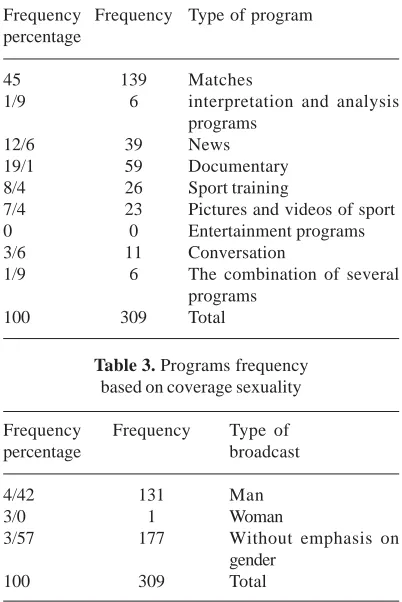
As the results of table 2 shows the most frequency among the sport programs is related to sport competitions of different fields with 45%. Also the lowest level of programs is related to entertainment programs with 0% and interpretation and analysis programs with 1.9%.
The table 3 shows that 42.4% of programs is peculi ar for men’s sport and only 0.3% of programs is assigned to women’s sport. Also 57.3% of programs is without emphasis on gender (like sport news, sport pictures, interpretation and analysis and discussions).
In table 4 is provided the reflected sport fields of the sport channel separately.
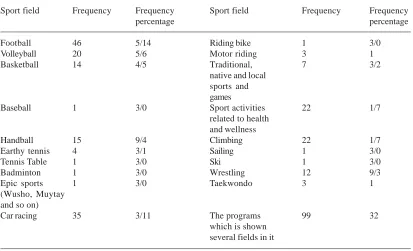
According to the obtained results, football sport field with frequency percentage of 14.9% is assigned the most level of broadcast and theme of programs to itself. After football, the car riding field with 11.3% is placed in second place and then are placed the fields such as climbing, programs with a focus on wellness. Among the broad cast sport fields riding bike, tennis table and
sailing with 0.3% are assigned the lowest level to themselves. Also the programs which their focus is more than one sport field also with 32% are assigned a significant part of daily broadcast tables to themselves and there was no base sport fields like track and field, swim and gymnastic separately in the broadcast tables (in some combined programs was displayed these three sport fields). In table 5 is provided the content analysis of programs based on the functional roles and the covering of four components of sport separately. According to obtained results in the
Table 1. The frequently distribution of programs based on type of broadcast
Frequency Frequency Type of
percentage broadcast
24/6 76 Live
75/7 233 Non-live
100 309 Total
Table 2. the separation of type of broadcasting programs in the sport channel in the examined time limit
Frequency Frequency Type of program percentage
45 139 Matches
1/9 6 interpretation and analysis programs
12/6 39 News
19/1 59 Documentary 8/4 26 Sport training
7/4 23 Pictures and videos of sport 0 0 Entertainment programs 3/6 11 Conversation
1/9 6 The combination of several programs
100 309 Total
Table 3. Programs frequency based on coverage sexuality
Frequency Frequency Type of percentage broadcast
4/42 131 Man
3/0 1 Woman
3/57 177 Without emphasis on gender
Table 4. The frequency of displayed sport fields from the sport channel during search
Sport field Frequency Frequency Sport field Frequency Frequency
percentage percentage
Football 46 5/14 Riding bike 1 3/0
Volleyball 20 5/6 Motor riding 3 1
Basketball 14 4/5 Traditional, 7 3/2
native and local sports and games
Baseball 1 3/0 Sport activities 22 1/7
related to health and wellness
Handball 15 9/4 Climbing 22 1/7
Earthy tennis 4 3/1 Sailing 1 3/0
Tennis Table 1 3/0 Ski 1 3/0
Badminton 1 3/0 Wrestling 12 9/3
Epic sports 1 3/0 Taekwondo 3 1
(Wusho, Muytay and so on)
Car racing 35 3/11 The programs 99 32
which is shown several fields in it
Variable The covering of four components of sport
in the sport programs The functional roles of sport programs
S u b -c at egor ie s In fo rm at iv e E d u cat io n al B u ild cu lt u re So cia l p ar tic ip atio n Th e co m b in at io n o f ro les ch amp io n sh ip Pr of essi o n al Ed u cat iv e Pu b lic T h e co mb in at io n o f co m p o n en ts Frequency 73 11 38 36 151 44 118 2 50 95 Frequency percentage 6 / 23 % 6 / 3 % 3 / 12 % 7 / 11 % 9 / 48 % 2 / 14 % 2 / 38 % 6 / 0 % 3 / 16 % 7 / 30 %
Table 5. The frequency of programs based on the based on the functional roles and the covering of four components of sport
functional roles variable the informative variable with 23.6% is assigned the most level of programs to itself and build culture with 3.6% is assigned the lowest level of programs to itself and programs with the combination of roles is formed 48.9% of programs. In the four components of sport variable, the professional sport with 38.2% of programs is
Table 6. To investigate frequency of variables of production field, the program status according to repeat, geographical coverage, production-oriented programs, the age coverage of programs and the reflection level of team and single sports
Frequency percentage Frequency Sub-categories Variable
3/12 38 Talk-oriented program Production field 7/87 271 Non-talk-oriented program
7/86 268 Non-repetitive Repetition
3/13 41 Repetitive
3/22 69 Asia Geographical coverage
6/1 5 Europe
5/4 14 Africa
14 5.4 America
5/71 221 Programs and events related to around the world
3/46 143 Event-oriented Production axis 7/53 166 Process-oriented
6 2 Childs and adolescents Age coverage of programs
0/6 2 Youth
1/9 28 Adults
0 0 Seniors
6/89 277 All ages
7/31 98 Team
6/34 107 Single The reflection of team and single sports
7/33 104 Both types
Table 7. The comparing of sexuality, functional roles, four components of sport, production axis and production background variables of sport programs
The examined variable The statistics Freedom Sig level of Chi2 degree
Programs gender 78/161 2 0001/0
The functional roles of programs 47/192 4 0001/0 The reflection of four components of sport 18/234 4 0001/0 Production axis (be event-oriented or process-oriented) 1/71 1 191/0 The production background (talk-oriented or non-talk-oriented) 69/175 1 0001/0
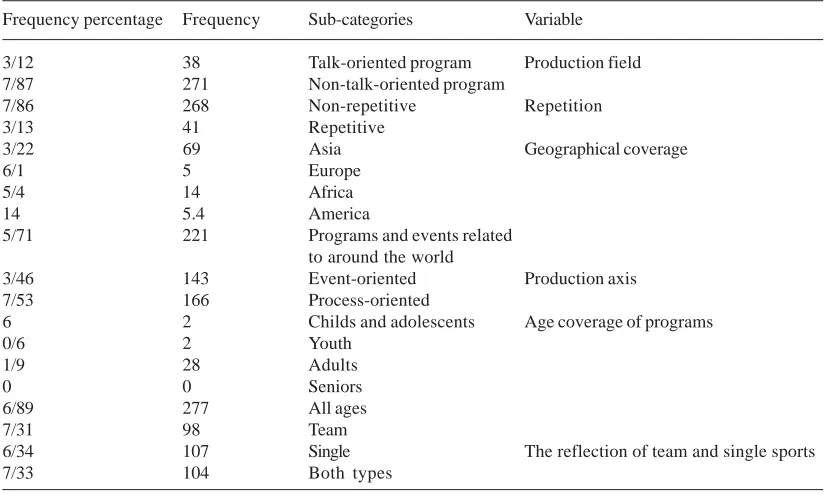
In the table 6 is provided the investigation of frequency of variables of production field, the program status according to repeat, geographical coverage, production-oriented programs, the age coverage of program and the reflection level of team and single sports.
From the total examined programs 87.7% of programs are composed of talk-orients programs and 13.3% of programs are composed of non-talk-oriented programs. In relation to repeat programs variable 86.7% of the available programs in the broadcast tables were non-repetitive programs and 14.3% were repetitive programs. In relation to geographic belongs of programs 71.5% of sport programs were related to around the world (like
World Cup and World League and so on). Also 22.3% of programs are related to the Asia continent events. In relation to the production axis of programs 57.3% of them are composed of process-oriented programs and 46.3% of them are composed of event-oriented programs. In the age variable the most level of programs were programs which are related to the all ages and the sport programs relevant and specific to the elderly, childes and adolescents and youths was very low. Finally, the analysis of reflection the team and single sports shows that 34.6% of programs are composed of single sports and 31.7% of programs are composed of team sports.
compare the sexuality, functional roles, four components of sport, production background and production axis variables of sport programs in the examined sport channel is indicated this subject that there is a significant difference in the four examined variables in the sport program but in the production axis variable of sport programs (event-oriented or process-(event-oriented of programs) there isn’t a significant difference in the examined programs. The statistics level of Chi2 and the significant level in the variables of sexuality (x2 = 161.78 and sig= 0.0001), functional roles (x2 = 192.47 and sig=0.001), reflection of four components of sport (x2=134.18 and sig= 0.001) and production background of programs (x2 = 175.69 and sig=0.001) have sign of a significant difference in the (p< 0.01) level in the all above variables in the sport program, therefore and with relying on the obtained results the suppose of researcher is confirmed based on the availability of difference in the mentioned variables among the examined channels and there was no enough reasons for confirmation of null hypothesis. In relation to production axis of programs (event-oriented or process-oriented of sport programs) the amounts of statistics of Chi2 and the significant (x2 = 1.71 and sig=0.191) in the (p< 0.05) hasn’t a significant difference in the programs based on event-oriented and process-oriented.
DISCUSSION
The aim of this research was the analysis of content, programs structure and functional roles of TV sports. As the results of table 1 shows most of the sport programs of sport channel are composed of non-live programs with 75.4% and live programs are assigned 24.6% of programs to themselves. The results show that the most frequency among the sport programs is related to sport championship of different fields with 45%. Also the lowest level of programs was related to entertainment programs with 0% and interpretation and analysis programs with 1.9%. 42.4% of programs is assigned to men’s sport and only 0.3 % of programs is assigned to women’s sports. Also 57.3% of programs is without emphasis on gender (like sport news, sport pictures, interpretation and analysis and conversation). According to the obtained results football sport field with frequency
with the research of Shokrani and Aghapour which during a research concluded that the time period of broadcasting of programs related to public sport is low in compare with professional and championship sport. The broadcasting period time the championship sport programs is long in TV. Broadcasting time of programs related to base sport is very low in TV. The broadcasting time of the programs related to women’s sport is very low in TV. Also is consistent with researches of Askari, Ghasemi and Keshkar and Molaee and Emami. The reason for conformity in the results can be known the channels’ use of professional and championship sport programs and events in attracting more audiences which is arising from the policies of these channels. Of course, in the broadcasting programs tables, the use of charming and pleasant sport programs of the people which is placed among the championship and professional sport programs is more concerned. In this regard Lim’s research shows that the events and sports which are along with more charming and violence have more viewers and have a rapid development in the world. In relation to the production background of TV programs variable in terms of focused on the talk-oriented programs, the result of this research is consistent with the research of Askari, Ghasemi and Keshkar.
Depending on what is in the introduction in relation with the mutual effect of sport in media and media in sport development, the programs special to children and adolescents (the championship and educational) will not unpleasant. Because on one hand the reflection of news and events of this age group which are in the basic level will fill a background and interest to participate of this class in sport and in the other hand the blank space of public and educative sport (schools) in the broadcasting tables of sort channel. The point which is seen lower in the studied broadcasting tables was the blank space of basic sports (the events and programs with thematic axis of these fields) like track and field, swim and gymnastic and as provided in the various sources are as foundation for comprehensive development of sport which the media reflection of these fields can bear a little burden of develop of these sport fields. In general look and in examines variables in this research and earlier researches isn’t observed the balance in the allocation and
reflection programs in the broadcasting programs of Iran sport channel which demands the need to review and consider of topics which is raised which can be reached to the promotion of the position of sport channel among the audiences.
REFERENCE
1. Shokrani, Ebrahim & Agha pour, Seyed Mehdi To investigate and analyze the content of sport programs of Islamic Republic of Iran Broadcasting. The contemporary researches in the sport management, 2014; 4(8): 81-92. 2. Shokrani, Ebrahim. The assessment of sport
status in the sound and vision. Master thesis, Tehran Payam Noor University, 2007. 3. Sadeghi, Reza, Keshkar, Sara & Ghasemi, Hamid
The role of modern and traditional media in the promotion of popularity of sport events in the expert’s opinion and to provide solution. First national conference of management organization of sport events, Isfahan Payam Noor University, 2013.
4. Askari, Bahman, Ghasemi, Hamid & Keshkar, Sara., The study of quantitative content of sport programs of cannel three. Research communication, 2011; 18(4), consecutive 68, 135-151.
5. Askari, Bahman, Ghasemi, Hamid & Keshkar, Sara). The study of content conductors of sport programs of youth and sport channel (channel three). Sixth national conference of students of physical education and sports science, Tehran University, 2012.
6. Ghasemi, Hamid & Keshkar, Sara. The rule of trust to the sport media in its effectiveness level on the student athletes. Journal of Sports Science Research, 2011; 2(5): 75-89.
7. Ghasemi, Hamid., The analysis of the content of sport newspapers with emphasis on the coverage of sport components in the final semester of 2009. The second national specialist conference of the sport management, Shahrod industrial University, 2012.
8. Ghasemi, Hamid, Farhani, Abolfazl, Shakermi, Zahra & Hosseini, Seyed Saeed. The content analysis of sport programs of broadcasting provinces with emphasis on the coverage of women’s sport. Communication management in the sport media, 2013; 1(2): 23-30.
2013; 2(4): 43-54.
10. Karami, Abdollah., The content analysis of sport programs in Iran TV channels. Master thesis, Azad University of Central Tehran Branch, 2012. 11. Karami, Abdollah, Ghasemi, Hamid & Nemati Anaraki, Davood. The content analysis of sport programs of the country TV channels with the approach of women’s sport. Research-scientific journal of communication research, 2011; 19 (1): 135-155.
12. Mahdavian Mashhadi, Maryam. The comparing of existing and desirable situation of radio, TV, press role in the women’s sport in the perspective of experts. Research-scientific journal of communication research, nineteenth research,
2012; 69.
13. Al Jazeera Sport teams up with OMD and TBWARAAD: http://www.mediame.com/en/ n e w s / a n n o u n c e m e n t / a l _ j a z e e r a _ sport_teams_omd_and_tbwaraad. 04/29/2013 14. Curran, J., Media and power. London: Routledge.
Holland, P. (2000). The Television Handbook. First Published, Landon: Routledge, 2002. 15. Lawrence A. Wenner., Mediasport. Psychology
Press, Social Science, 1998.
16. Louise Gee, B., Sport media decision-making in France: How they choose what we get to see and read. At Massey University, Manawatu
New Zealand, 2009.
17. Lull, J., Media, communication, culture. Cambridge: Polity Press, 2000.
18. McCombs, M., Agenda setting function of mass media. Public Relations Review, 1977; 3(4): 89-95.
19. Rowe, David. Sport, Culture and the Media. Mc Graw Hill Education, Second edition, 2004. 20. Van Puymbroeck Marieke., Does the Media Impact Athletic Performance? University of Illinois, 2006.
21. Wu, P., Sport and the media. In P. Craig & Beedie (Eds), sport sociology. Exeter: Learning Matters. 2008; 148-163
22. Zhang, J, J. Smith, D, W., Impact of Broadcasting on Attendance of Professional Basketball Games. Sport marketing quarterly. 1997; 6(1): 1997.