Original Research Article
The effect of mindfulness therapy on the pregnant women’s anxiety
level in facing childbirth
Apri N. Wulandari
1*, Brigitta A. D. Susanti
2INTRODUCTION
Maternal Mortality Rate (MMR) is an indicator of health status in the context of maternal services. In 2015, MMR showed a decrease to 305 maternal deaths per 100,000 live births based on the results of the Survei Penduduk Antar Sensus.1 However, this figure has not reached 2015 national target of 102 per 100,000 live births. Various health efforts are needed to reduce the MMR that is still quite high. Medical efforts that can be done is to improve the health status of pregnant women through improving maternal health services themselves which includes care
services for pregnant women from antenatal, labor, to postpartum period.2
The health improvement for pregnant women when antenatal is not only focused on maintaining physical health, but also the psychological health. One of the factors of maternal psychological health is anxiety. Anxiety is common in pregnant women caused by maternal concerns about complications that accompany the mother and fetus.3 Anxiety and fear will also increase, especially in third trimester primigravida mothers. The increasing anxiety in pregnant women can have an impact on pregnancy complications.4
ABSTRACT
Background: The health improvement for pregnant women in antenatal phase is not only focused on maintaining physical health, but also the psychological health. One of the factors of maternal psychological health is anxiety. Anxiety is common in pregnant women caused by maternal concerns about complications that accompany the mother and her fetus. The increasing anxiety in pregnant women can have an impact on pregnancy complications. Therefore an intervention is needed to overcome anxiety in pregnant women. The purpose of this study was to determine the effect of mindfulness therapy on the anxiety level of pregnant women in labor.
Methods: This study uses a quasi-experimental design with a pre-test and post-test with control group. Implemented in the Public Health Center working area like Sleman in August-September 2018. There were 26 participants selected using purposive sampling, with 13 assigned in experiment and control groups. The questionnaire used is Pregnancy Related Anxiety Questionnaire-Revised 2. Independent sample t-test used for data analysis.
Results: There was a significant difference in the mean of anxiety score after the intervention in the experimental group compared to the control group with a value of p=0.017 (p<0.05). The mean of anxiety score after intervention in the control group was 32.00, while the average of anxiety score after intervention in the experimental group was 24.54.
Conclusions: Giving mindfulness therapy to pregnant women is able to reduce maternal anxiety levels significantly in facing labor.
Keywords: Anxiety, Mindfulness, Pregnant woman
1
Department of Maternity Nursing, 2Department of Medical Surgical Nursing, Notokusumo Nursing Academy,
Yogyakarta, Indonesia
Received: 08 July 2019
Accepted: 17 August 2019
*Correspondence:
Dr. Apri N. Wulandari,
E-mail: [email protected]
Copyright: © the author(s), publisher and licensee Medip Academy. This is an open-access article distributed under the terms of the Creative Commons Attribution Non-Commercial License, which permits unrestricted non-commercial use, distribution, and reproduction in any medium, provided the original work is properly cited.
Anxiety in pregnant women is often undiagnosed and not handled properly so that it can have an impact on the health of the mother and the fetus.5 The impacts that occur in pregnant women such as influencing heart rate, blood pressure, adrenal production, sweat gland activity, and secretion of stomach acid and cause complaints such as fatigue, irritability, anxiety, dizziness, insomnia, nausea, appetite disorders and feeling lazy in doing daily activities.6 The incidence of anxiety in pregnant women in Indonesia reaches 18-70%.3 The highest incidence of anxiety in pregnant women reached 53.3% (severe anxiety level) in primigravida and 73.3% (moderate anxiety) in multigravida.7 More than 75% of pregnant women who experience anxiety do not get the right treatment.8
Seyegan public health center has a high child and mother health visits from year to year. The number of visits in child and mother health in 2014 was 1557 patients, in 2015 there was an increase to 2078 patients and in 2016 it also increased by 2210 patients. Whereas in 2016, there were 15,488 pregnant woman in the Seyegan Public Health Center and first visit after labor (K1) reached 100%.9
Based on the result of interviews with three pregnant women who made antenatal visits at the Seyegan Public Health center, the result was that the mother was worried about her delivery. They had negative thoughts, anxiety, fear, and worry if later they are unable to give birth properly, and are anxious if their child has less weight. They stated that they needed advice or treatment regarding to their anxiety.
Nurses, as providers of nursing care, play a role in creating the readiness of pregnant women in preparing the delivery process. Nurses can act as therapists in providing intervention to patients, one of which is providing mindfulness therapy.
Mindfulness therapy is one therapy that focuses on training consciousness through meditation techniques. The concept of this therapy is to change the relationship of individuals to situations and thoughts that are full of distress. This is achieved by reducing emotional reactions and positively increasing cognitive assessment. A study that has been conducted shows the effectiveness of mindfulness meditation in patients with hypertension, indicating that this program is an effective treatment both for reducing stress and anxiety in everyday life and in reducing symptoms of chronic diseases such as high blood pressure.10
Some of the techniques used in mindfulness therapy are based on a mindfulness approach and they are remarkably effective in reducing stress. These techniques include: the first technique is self-talk technique (talking to yourself), visual or guided imagery; the second technique is deep breathing; and the third technique is progressive muscle
relaxation training (progressive muscle relaxation training).11
The research on mindfulness therapy given to pregnant women has been done in Indonesia. But in this study, the researcher will conduct research on the provision of mindfulness therapy, using the subjects of both primigravida and multigravida pregnant women in the second and third trimesters; and using a difference questionnaire from previous study. Therefore, the researchers wanted to know the effect of giving mindfulness therapy to the anxiety level of pregnant women in the facing labor process.
METHODS
This study uses a quantitative approach with a quasi-experimental design with a pre-test and post-test with control group design. This research design used to determine the effect of giving mindfulness therapy to the anxiety level of pregnant women in facing labor.
The population in the working area of the public health center in Sleman is on the period of August-September 2018. The sampling technique used was purposive sampling. This sampling technique is used because of limitations in recruiting research subjects. Many factors influence pregnant women in taking part in research. One of them is the birth that is not the same as the estimated day of birth.
The inclusion criteria in this study were as follows: 1) pregnant women both primigravida and multigravida second and third trimesters; 2) pregnant women with indications of normal labor; 3) willing to be a respondent. Exclusion criteria in this study: 1) pregnant women who have a disease or pregnancy disorder that can affect the birth process such as hypertension and diabetes mellitus; 2) not willing to take the posttest.
pregnant women who could not participate in the training.
The questionnaire used in this study was the pregnancy-related anxiety questionnaire-revised 2 (PRAQ-R2) which has modified by previous researcher.12 PRAQ-R2 is a questionnaire used to assess and identify anxiety in pregnancy. PRAQ-R2 can assess anxiety in both nulliparous and multiparous women who have 10 item questions with a Likert scale of 1 (definitely not true) to 5 (definitely true) with a minimum total score of 10 to a maximum of 50. The higher the score obtained the higher anxiety experienced by pregnant women. Question items in PRAQ-R2 include fear of giving birth, worries about bearing physically or mentally handicapped child, and concern about own appearance.13
Test the validity and reliability of the instrument has been carried out by previous researchers. The results of the validity and reliability test of the PRAQ-R2 questionnaire are as follows: R value is calculated (0.396-0.814) >R table (R table is 0.361) with a reliability value of 0.874.12 So it can be concluded that each question in the PRAQ-R2 questionnaire was declared valid and reliable to be used in this study.
The intervention group received standard therapy at antenatal care (ANC) such as pregnancy checks, education using Kesehatan Ibu dan Anak (KIA) books, pregnancy exercises, and getting additional therapy, namely mindfulness therapy. Mindfulness therapy is held once and is given by the therapist. Furthermore, mindfulness therapy is carried out independently by respondents in their respective homes for two weeks. Before giving therapy, respondents were asked to fill out a questionnaire to get the pretest data. The implementation of mindfulness therapy and pretest data collection in the experimental group were carried out on the same day.
The implementation of mindfulness therapy was carried out at the Seyegan public health center hall. Mindfulness therapy is given by therapists who have received mindfulness training. The therapist explains to the respondent how to do mindfulness therapy while practicing it. After being given an intervention, respondents were asked to do it at home for 2 weeks, at least one day for 15-30 minutes. Respondents were given a schedule for doing mindfulness therapy at home. The
researcher monitored and always reminded the
respondent to do the therapy. Monitoring is done through group WA (WhatsApp), telephone, and looks in detail the mindfulness activities that have been carried out through the schedule forms that each respondent has.
Giving mindfulness therapy to pregnant women to overcome labor anxiety does not provide side effects that cause harm in any form. Because in this therapy, pregnant women are conditioned as calm and comfortable as possible so that the mother relaxes. There is no
contraindication to the implementation of this therapy in pregnant women.
Whereas in the control group, respondents received standard therapy obtained during ANC only such as antenatal care, education using KIA books, and pregnancy exercises. Posttest data collection was carried out 2 weeks after the pretest in each group.
Paired t-test was used to determine the mean difference in anxiety scores in the experimental group, before and after standard ANC intervention and mindfulness therapy. Whereas to determine the difference in mean anxiety score after intervention between the experimental and control groups using the independent sample t-test.
This research obtained ethical clearance from the Research Ethics Commission of Yogyakarta Health Polytechnic, with LB.01.01 / KE-01 / XXXI / 725/2018 approval number. Each participant prior to data collection signed consent. All have the right to withdraw their participation at any given moment.
RESULTS
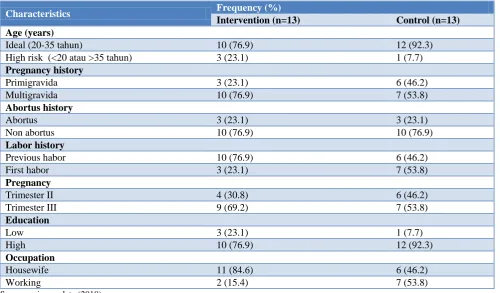
Respondent characteristics measured in this study were maternal age, pregnancy history, history of abortion, labor history, gestational age, mother's education level, and maternal occupation. Characteristics of respondents are presented in the form of frequency distributions and percentages as shown in Table 1.
Respondents in this study were dominated by pregnant women who were ideally aged to get pregnant, namely <35 years of age; had previously been pregnant (multigravida); never experienced abortion before; had had previous childbirth experience; gestational age in the third trimester with gestational age between 29-40 weeks; maternal education level in the higher education category namely high school or vocational school, diploma and bachelor degree; and the respondents occupations are housewives.
The level of anxiety of pregnant women in facing labor is presented in numerical data by describing the mean, min-max, and standard deviation values. The anxiety level of pregnant women is seen based on the anxiety score of each respondent. The anxiety score is in the range of 0-50 where the higher the anxiety score, the greater the anxiety of labor.
Table 1: Frequency distribution based on the characteristics of respondents (n=26).
Characteristics Frequency (%)
Intervention (n=13) Control (n=13) Age (years)
Ideal (20-35 tahun) 10 (76.9) 12 (92.3)
High risk (<20 atau >35 tahun) 3 (23.1) 1 (7.7)
Pregnancy history
Primigravida 3 (23.1) 6 (46.2)
Multigravida 10 (76.9) 7 (53.8)
Abortus history
Abortus 3 (23.1) 3 (23.1)
Non abortus 10 (76.9) 10 (76.9)
Labor history
Previous habor 10 (76.9) 6 (46.2)
First habor 3 (23.1) 7 (53.8)
Pregnancy
Trimester II 4 (30.8) 6 (46.2)
Trimester III 9 (69.2) 7 (53.8)
Education
Low 3 (23.1) 1 (7.7)
High 10 (76.9) 12 (92.3)
Occupation
Housewife 11 (84.6) 6 (46.2)
Working 2 (15.4) 7 (53.8)
Source: primary data (2018).
Table 2: The comparison of the mean scores of the pre-test and post-test anxiety scores in the intervention group in the work area of Seyegan Public Health Center as of 2018 (n=13).
Group Pre-test Post-test P value
Mean±SD min-max mean±SD min-max
Intervention group 29.38±7.665 12-43 24.54±7.688 10-34 0.033 Source: primary data (2018).
Table 3: The comparison of the difference in anxiety levels in the intervention group and the control group after being given therapy in Seyegan Community Healthcare Center working area in 2018 (n=13).
Intervention group Control group P value
Mean±SD 24.54±7.688 32±7.106
0.017
Min-max 10-34 24-46
Source: primary data (2018).
From Table 2 it can be concluded that there was a decrease in anxiety levels in the intervention group after mindfulness therapy was carried out. When the pretest was obtained the average anxiety score was 29.38. and when the posttest was conducted, the average anxiety score decreased to 24.54. P value=0.033 (p<0.05) so it was concluded that there was a significant decrease in anxiety scores in the intervention group after being given mindfulness therapy.
Table 3 shows that there are differences between the mean scores of anxiety scores of pregnant women in the intervention group and the control group. The control group (score 32) had a higher average anxiety score than the intervention group (score 24.54). It can be concluded
that the group that obtained standard therapy from the community healthcare center added with mindfulness therapy had a lower anxiety score. The results of unpaired t-test obtained p value=0.017 (p<0.05) which means that there are significant differences between the intervention group and the control group.
DISCUSSION
Anxiety is interpreted as unpleasant emotions, including feelings of uncertainty, anxiety, fear, or worry that are
felt subjectively by pregnant women.5 Anxiety in
conditions (labor faced).14 This condition, also known as mindlessness, is a condition where the individual's mind is trapped in a superficial pattern of thought so that he is unable to comprehend the context of an event as a whole. Mothers do not interpret events after events or complaints that occur during pregnancy and childbirth, so they are unable to respond to these events appropriately. If these conditions occur continuously, frustration, anxiety can lead to stress.15
In pregnant women there is an increased concern about the health and safety of the fetus that is conceived, worried about their own safety, and concerns about the labor process that will be faced. Such conditions make the mother more focused on her pregnancy and tend to
avoid things that are considered to endanger
pregnancy.16,17 However, there are those who lose control because anxiety is felt to be excessive.
Anxiety in pregnant women increases the risk of complications.18 Anxiety not only affects pregnant women, but also has a negative effect on the fetus. The impact includes increasing the risk of premature labor, abortion, low birth weight, and can affect the baby's temperament after birth. While the effects on the mother can cause weight loss and aggravate complaints of nausea
and vomiting during pregnancy.19 Anxiety during
pregnancy that is not handled properly can provide long-term effects such as increasing the risk of the occurrence of baby blues and postpartum depression which can interfere with the closeness of the relationship and inner
bond between mother and baby.20
Mindfulness is an intervention approach that uses stages where individuals are able to pay attention and realize what is happening now without being reactive to the situation. Mindfulness is also defined as the awareness that arises as a result of paying attention to a current experience intentionally and without judgment in order to be able to respond with acceptance, rather than reacting to everyday experiences.21
Mindfulness therapy has been widely used and proven its effectiveness in overcoming various psychological problems.22 Mindfulness therapy carried out in this study refers to the concentration method to reduce anxiety in the face of pregnancy and childbirth. The mindfulness therapy given to pregnant women in this study includes mindful breathing, mindful eating, mindful sleeping, mindful body scan, and mindful with family. The implementation of therapy is focused on mindful breathing. Mindful breathing or focused breathing is the basis or prefix of the mindfulness stage.23 Based on interviews with several respondents it was found that mothers often felt short of breath along with increasing gestational age. Mothers also often feel pain in the lower abdomen. These complaints cause a burden of mother's thoughts and worries. So that the intervention is done so that the mother can be more relaxed by controlling breathing.
The result of this study provided the evidence that giving mindfullness therapy can reduce the anxiety level of pregnant women in facing labor. A decrease in anxiety score after giving mindfulness therapy. In addition, there were differences in anxiety scores between groups that received mindfulness therapy and those who did not get mindfulness therapy. The difference was very significant. After monitoring the results of the independent mindfulness therapy implementation conducted by respondents at home, it was found that respondents obediently carried out therapy independently and stated that their feelings were calmer in undergoing pregnancy and facing the labor process.
This supports the research conducted by previous researcher on the effectiveness of mindfulness-based cognitive therapy in pregnant women who are less than 20 years old. The results show that mindfulness-based cognitive therapy is significantly effective in reducing levels of stress, anxiety and depression in young pregnant women.24 Mindfulness-based interventions also benefit various outcomes during the perinatal period such as anxiety, depression, stress, and levels of mindfulness.25 The results of another study also stated that mindfulness-based intervention programs were effectively applied to pregnant women to reduce anxiety and symptoms of depression experienced.26
Mindfulness therapy can reduce anxiety because through mindfulness, conditions of stress, anxiety, anxiety, which are often considered pressing will be able to be seen and interpreted differently. Mindfullness encourages clients to pay attention to things that are felt so that an individual is aware, understands, accepts what happens to them. Individuals no longer feel threatened by the source of stress or concern but have clarity of thought to respond to these stresses.21,27 Thus, after giving mindfulness therapy, the anxiety that was felt before was reduced.
CONCLUSION
The additional mindfulness therapy to pregnant women can have a significant effect to reduce anxiety scores for pregnant women in facing labor compared to standard therapy alone. In nursing practice, nurses can provide psychological support to pregnant women, one of which is by conducting a special class for the implementation of pregnant women mindfulness therapy to deal with psychological problems experienced. Further research need to taking into account other variables such as the presence or absence of support from the husband, family involvement in pregnancy and facing labor that are urgently needed.
ACKNOWLEDGEMENTS
Funding: This study was funded by LLDIKTI Region V Conflict of interest: None declared
Ethical approval: The study was approved by the Institutional Ethics Committee
REFERENCES
1. Republic of Indonesia Ministry of Health (Ministry
of Health). Indonesia Health Profile 2015. Jakarta: Ministry of Health of the Republic of Indonesia; 2016.
2. Republic of Indonesia Ministry of Health (Ministry
of Health). 2013 Basic Health Research. Jakarta: Ministry of Health of the Republic of Indonesia; 2013.
3. Resmaniasih, K. Effect of Diaphragm Respiratory
Technique on Anxiety in Trimester III Pregnant Women. Semarang: Diponegoro University; 2014.
4. Setyaningsih MM. The Influence of Giving a
"Harmony" Package to High Risk Pregnant Mothers Against Anxiety in Mothers Facing Labor in Malang City. Depok: University of Indonesia; 2012. 5. Jeyanthi I, Kavitha P. Anxiety And Stress Among The Primigravida And The Multigravida- A Comparative Study. Departement of Social Work,
Cauvery College for Women, Trichy.
2008;1(2):126–31.
6. Panuntun RA. Description of Physical and
Psychological Discomfort in Trimester III Pregnant
Women in Bantul District Health Center,
Yogyakarta Special Region. J Gadjah Mada University. 2016.
7. Rahmawati DN. Perception Relationship about
Childbirth with Anxiety Level in Primigravida Trimester III Mothers at Mlati Sleman Sakina Idaman Children and Mother Hospital. J Gadjah Mada University; 2016.
8. Pareira VM, Nardi AE, Silva AC. Sexual
dysfunction, depression, and anxiety in young women according to relationship status: an online
survey. Trends Psychiatry and Psychother.
2013;35(1):55-61.
9. Seyegan Public Health Center. Health Profile of
UPT Seyegan Public Health Center. 2017.
10. Yeh GY, Wang C, Wayne PM, Phillips RS. The
Effect of Tai Chi Exercise on Blood Presssure: a systematic review. Prev Cardiol. 2008;11(2):82-9. 11. Stahl B, Goldstein E. A Mindfulness-Based Stress
Reduction Workbook. Canada: New Harbinger Publications, Inc; 2010.
12. Widiastuti PH. Relationship between Anxiety in
Pregnancy with Sexual Function in Trimester III Pregnant Women at Mlati 1 Public Health Center, Sleman, Yogyakarta. Yogyakarta: Gadjah Mada University, 2017.
13. Huizink AC, Delforterie MJ, Scheinin NM,
Tolvanen M, Karlsson L, Karlsson H. Adaption of pregnancy anxiety questionnaire-revised for all
pregnant women regardless of parity: PRAQ-R2. Arch Womens Ment Health. 2016;19(1):125-32.
14. Hidayat S, Sumarni S. Anxiety for Pregnant Women
in Facing Labor. Health Journal of Wiraraja Medika. 2013;67-72.
15. Snyder CR, Lopez SJ. Positive Pychology: The
Scientific and Practical Exploration of Human Strength. London: Sage Publications; 2007.
16. Cedli LG. Husband's Sexual Function During a
Couple's Pregnancy Period. Depok: University of Indonesia, 2012.
17. Chang S, Ho HN, Chen K, Shyu MK, Huang L, Lin
W. Depressive Symptoms as a Predictor of Sexual Function during Pregnancy. J Sex Med. 2012;9(10):2582-9.
18. Westerneng M, De-Cock P, Spelten ER. Factorial
Invariance of Pregnancy-Specific Anxiety
Dimentions Across Nulliparous and Parous
Pregnant Women. J Health Psychol. 2015;20:164-72.
19. Khorsandi M, Vakilan K, Salehi B, Goudarzi M,
Abdi M. The Effect of Stress Inoculation Training on Perceived Stress in Pregnant Women. J Health Psychol. 2016;21(12):2977-82.
20. Laili R. Relationship between Age, Education
Level, and Family Support with Anxiety Levels Approaching Childbirth in Primigravida Trimester III at the Midwifery Polyclinic in Public Hospital of Dr. M. Djamil Padang. Andalas University Journal. 2010.
21. Kabat-Zinn J. Full Catasthrope Living: Using the Wisdom of Your Body and Mind to Face Stress, Pain, and Illness. New York: Bantam Dell; 1990.
22. Davis LW, Strasbunger AM, Brown LF.
Mindfulness an intervention for anxiety in Schizophrenia. J Psychosocial Nursing. 2007;45:23-9.
23. Arch JJ, Craske MG. Mechanisms of mindfulness:
Emotion regulation following a focused breathing induction. Behav Res Therapy. 2006;44:1849-58.
24. Narimani M, Musavi SKS. Effectiveness of
mindfulness based cognitive therapy on anxiety, stress, and depression of pregnant youths: A randomized clinical trial. European J Forensic Sci. 2015;2(1):1-4.
25. Dhillon A, Sparkes E, Duarte RV.
Mindfulness-Based Interventions During Pregnancy: a
Systematic Review and Meta-analysis. Mindfulness. 2017;8:1421-37.
26. Mohamed S, Elsharkawy NB, Awad MH.
Mindfulness Based Intervention Program on Anxiety and Depressive Symptoms among Pregnant Women. American J Nursing Sci. 2017;6(3):232-9.
27. Kabat-Zinn, J. Mindfulness-based Intervention in
Context: Past, Present, and Future. Clinical Psychol Science Practice. 2003;10(2):144-56.