Original Research Article
Knowledge and personal hygiene practice among food handlers in
public university campus of Bangladesh
A. H. M. Shamim Al Mamun*, Kamrul Hsan, M. Shanjid Sarwar,
M. Ruhul Furkan Siddique
INTRODUCTION
Food is a potential source of infection and is often contaminated by microorganism that frequently leads to food poisoning or food borne illness. The global burden of food borne diseases in 2010 was 33 million healthy life years lost (DALY) with about 600 million food borne illnesses and 420,000 deaths.1 So food hygiene are given more emphasis in modern times.2 Food hygiene largely depends upon the state of personal hygiene and habits of the personnel (food handlers) prepared food both in the home and in the food establishments (hotel and restaurant). If personal hygiene is not satisfactory, they
may cross-contaminate foods and may contribute to the spread of diseases.3 The mishandling of food and the disregard of hygienic practices facilitate pathogens to come into contact with food and thereby cause illness in consumers.4 The food handlers often be carrier of different harmful parasitic agents and spread contamination.5 So good personal hygiene are emphasized to ensure proper handling of foods. Personal hygiene of the food handlers include daily bathing, clean clothing, washing hands before meals and after toilet, care of nails, feet and teeth.6 Foods may acquire contamination at any stage of its production, processing, distribution, and preparation. The chance of food being
ABSTRACT
Background: Millions of people are suffering from food borne illness and it has become a growing public health concern in the world. To reduce the burden of food borne illness, food handlers must have accurate knowledge of food safety. The objective of the study was to assess the knowledge and level of personal hygiene practice among food handlers of Jahangirnagar University.
Methods: It was a descriptive cross sectional study, done among the food handlers in Jahangirngar University Campus, Dhaka, Bangladesh from May 2016 to September 2016. Data were collected from 119 food handlers by using face to face interview using a pre-tested questionnaire. Statistical Package for Social Sciences (SPSS 22.0) software was used for data analysis.
Results: Study found that 65.55% of the food handlers did not have adequate knowledge regarding personal hygiene.
The study also found that 71.4% of the food handlers had poor hygiene practice. The study revealed that age, education and sleeping place and knowledge regarding personal hygiene were significantly associated with the respondent’s personal hygiene practice.
Conclusions: The study shows that knowledge and its practice among the food handlers is very poor. Implementation
of training and awareness program on personal hygiene are required to improve their knowledge and personal hygiene practice.
Keywords: Hygiene, Knowledge, Practice, Food handlers, Public university
Department of Public Health and Informatics, Jahangirnagar University, Savar, Dhaka, Bangladesh
Received: 20 May 2019
Accepted: 08 July 2019
*Correspondence:
A. H. M. Shamim Al Mamun, E-mail: [email protected]
Copyright: © the author(s), publisher and licensee Medip Academy. This is an open-access article distributed under
the terms of the Creative Commons Attribution Non-Commercial License, which permits unrestricted non-commercial use, distribution, and reproduction in any medium, provided the original work is properly cited.
contaminated depends largely on the knowledge and practice of personal hygiene of the food handlers7. As food handlers and consumers are directly connected, food handlers have an effective role in prevention of food poisoning and reducing the burden of food borne diseases. So food handlers need to improve their knowledge toward food safety.8
The main existing challenges include that food handlers have little knowledge about food hygiene and are not much aware about their roles in ensuring food hygiene9. Although the role of the food handlers is important in reducing the risk of food borne diseases among the university students, there was no studies assessed the knowledge and personal hygiene practice among food handlers in any university campus in Bangladesh. The objective of this study was to assess the knowledge and practice of personal hygiene practice among the food handlers of Jahangirngar University, a residential university nearest in the capital of Bangladesh.
METHODS Study design
This was a descriptive type of cross-sectional study.
Study area and population
Study area was in Jahangirngar University Campus. The Study population was the hotels’ food handlers of Jahangirngar University Campus.
Study period
The study was conducted fromMay 2016 to September 2016.
Sampling technique
A total 119 food handlers were selected through purposive sampling.
Data collection tools and technique
Data were collected by using a pre-tested questionnaire through face to face interview. There were three sections in the questionnaire:
Section 1: Contained socio-demographic variables such as name, age, sex, education, religion, sleeping place etc.
Section 2: Consist of questions to assess the knowledge of personal hygiene such as understanding about personal hygiene, critical times for hand washing, appropriate hand washing agent etc.
Section 3: Consist of questions to assess the self-reported practices regarding personal hygiene like hand washing
practices, practice of nail paring, defecation practice, food handling practice etc.
There were 10 multiple choice questions in section-2 and in section-3. A score of “1” (one) was given for each correct response and “0” (zero) score was given for each wrong or don’t know response. Knowledge score was arbitrarily classified as adequate knowledge (>7/10) and inadequate knowledge (≤7/10). Similarly practices score was also labeled as good (>7/10), and poor (≤7/10).
Data analysis
The data were analyzed by using Statistical Package for Social Sciences (SPSS) version 22.0. The frequency and percentages were calculated and chi-square tests were used to reveal the relationship between variables.
Ethical consideration
The study was approved by the protocol review committee of the department of Public Health and Informatics, Jahangirnagar University (Savar, Dhaka-1342, Bangladesh). An informed written (for literate) or verbal (for illiterate) consent was taken from all the study participants before data collection commenced. Confidentiality of data and anonymity to the participants was ensured.
RESULTS
A total of 119 food handlers were studied in the present study. Socio demographic characteristics of the respondents are represented in the Table-1. In our study the mean age of the respondents was 25.9±9.7 years ranging from 15 to 50 years. The majority of the respondents (59.7%) were in the age group of <25 years and minimum respondents frequency (6, 5%) was in the age group of ≥45 years. Among the total respondent 88.2% were male and 11.8% were female. Almost half of the respondents (49.6%) were illiterate, 43.7% respondents had primary education and the rest 6.4% had secondary level of education. Majority of the respondents (93.3%) were Muslims and others were Hindus (6.7%). Majority of the respondents used to sleep on the hotels’ floor (74%) and other 23.5% sleep in their own residence (Table 1).
Table 2 shows distribution of the respondents’ according to knowledge regarding personal hygiene. In the present study, it was found that majority of the respondents (65.55%) had not adequate knowledge regarding personal hygiene. Only 34.45% respondent had adequate knowledge about personal hygiene.
defecation and wear shoes during use of toilet. Most of the respondent (99.5%) did not washed their hands with soap after defecation. Majority of the respondents (98.2%) took bath regularly, 42% brushing teeth at least two times in a day and 35.3% used tooth paste. In addition, 40.6% washing hands before food handling, 17.7% paring nails regularly and no one had habit of wearing hand gloves before food handling.
Table 1: Socio-demographic characteristics of the respondents (n=119).
Characteristics Frequency Percentage (%)
Age (year)
<25 71 59.7 25-34 20 16.8 35-44 22 18.5
≥45 06 5.0
Education
Illiterate 59 49.6 Primary 52 43.7 Secondary 08 6.4
Sex
Male 105 88.2 Female 14 11.2
Religion
Islam 111 93.3 Hindu 08 6.7
Sleeping place
Hotel 91 76.47 Own residence 28 23.53
Table 2: Distribution of the respondents’ according to knowledge regarding personal hygiene (n=119).
Knowledge Frequency Percentage (%)
Adequate 41 34.45
Inadequate 71 65.55
Total 119 100
Table 4 shows distribution of respondents’ according to personal hygiene practice. Out of 119 respondents, 85
(71.4%) had poor hygiene practice and 34 (28.6%) had good hygiene practice.
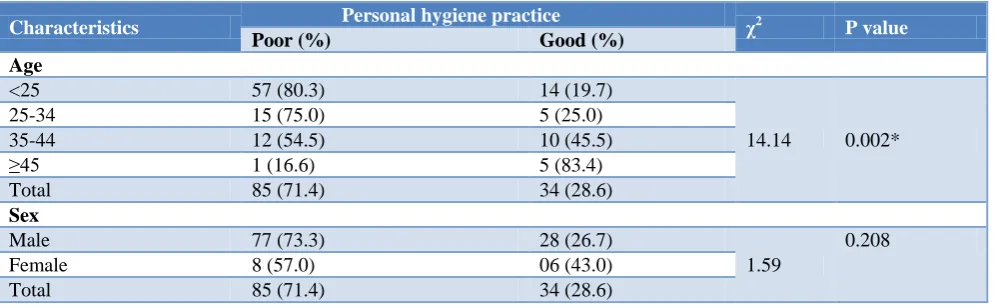
Table 5 shows association between the study variables and personal hygiene practice. The present study is the first that assess the factors associated with the personal hygiene practices among the food handlers in a university campus in Bangladesh. The study found that personal hygiene practice were significantly associated with age (χ2=14.14; p=0.002), education (χ2
=9.7; p=0.006) and sleeping place (χ2
=11.2, p=0.001). In addition, personal hygiene practice were significantly associated with the knowledge of personal hygiene (χ2
=23.22; p<0.001).
Table 3: Distribution of the respondents according to personal hygiene practice (n=119).
Variables Frequency %
Hand washing with soap
before eating 18 8.40
Wearing of shoes during use
of toilet 119 100
Hand washing with soap after
defecation 30 25.21
Regular bathing 118 99.5
At least two-time teeth
brushing 50 42.0
Teeth brushing by tooth paste 42 35.3
Hand washing before food
handling 48 40.6
Regular nail paring 17 17.7
Regular washing cloth 18 15.0
Wearing hand gloves before
food handling 0 0
Table 4: Distribution of respondents’ according to personal hygiene practice (n=119).
Food hygiene practice Frequency Percentage
(%)
Poor 85 71.4
Good 34 28.6
Total 119 100
Table 5: Association between the study variables and personal hygiene practice.
Characteristics Personal hygiene practice χ2 P value
Poor (%) Good (%)
Age
<25 57 (80.3) 14 (19.7)
14.14 0.002* 25-34 15 (75.0) 5 (25.0)
35-44 12 (54.5) 10 (45.5)
≥45 1 (16.6) 5 (83.4)
Total 85 (71.4) 34 (28.6)
Sex
Male 77 (73.3) 28 (26.7)
1.59
0.208 Female 8 (57.0) 06 (43.0)
Total 85 (71.4) 34 (28.6)
Characteristics Personal hygiene practice χ2 P value
Poor (%) Good (%)
Education
Illiterate 48 (81.3) 11 (18.7)
9.7 0.006* Primary 35 (67.3) 17 (22.7)
Secondary 02 (25) 06 (75) Total 85 (71.4) 34 (28.6)
Religion
Islam 79 (71.2) 32 (28.8)
0.054 0.817
Hindu 6 (75) 2 (25)
Total 85 (71.4) 34 (28.6)
Sleeping place
Hotels 72 (79.1) 19 (20.9)
11.2 0.001* Own residence 13 (46.4) 15 (57.6)
Total 85 (71.4) 34 (28.6)
Knowledge
Adequate 18 (43.9) 23 (56.1)
23.22 <0.001* Inadequate 67 (85.9) 11 (14.1)
Total 85 34
P values were calculated using the Pearson’s chi-square test. *Significant p value (<0.05).
DISCUSSION
The study assessed the knowledge and practice of personal hygiene among food handlers in Jahangirngar University campus, Savar, Dhaka, Bangladesh. Total 119 respondents (food handlers) were selected for the study.
In the present study, maximum food handlers (59.7%) were in the age group of <25 years and minimum food handlers (5%) in the age group of ≥45.
Some other studies also revealed similar findings that the maximum food handlers were in the young age groups.5,7,10,11
In the present study, 88.2% of the food handlers were male and 11.8% were female. Other studies also reported that majority of the food handlers in their study were male.5,7,10,11
About half 49.6% of the respondents were illiterate followed by 43.7% had primary level of education and 6.4% had secondary level of education. This findings are supported by the study conducted by Takalkar and Kumavat but contrary to some others studies where most of the food handlers had secondary or higher secondary level education.4,11,12 In the present study found that 71.4% of the food handlers had poor hygiene practice and only 28.6% food handlers had good personal hygiene practice. Our findings are supported by the study conducted by Takalkar et al where28.9% food handlers had good personal hygiene practice.11
The study found that personal hygiene practice were significantly associated with age (χ2
=14.14; p=0.002), education (χ2
=9.7; p=0.006) of the food handlers. This
findings are in contrast with the study of Mutalib et al.13 Our study also found significant association between the personal hygiene practice and sleeping place of the food handlers (χ2
=11.2, p=0.001). In addition, the present study found that food handlers’ personal hygiene practice were significantly associated with their knowledge regarding personal hygiene (χ2
=23.22; p<0.001). This findings is supported by the findings of other studies.4,13
CONCLUSION
The findings of the study revealed that majority of the food handlers had inadequate knowledge and poor practices regarding personal hygiene. Predictably, findings showed that knowledge of personal hygiene, age, education and sleeping place were associated with engaging in personal hygiene practice. An effective intervention of hygiene awareness programs should be introduced to improve their knowledge and personal hygiene practices.
Limitations
and more representative samples to overcome such limitations.
ACKNOWLEDGEMENTS
We would like to express our deepest appreciation to Sahadat Hossain, Dept. of Public Health & Informatics, Jahangirnagar University, Savar, Dhaka-1342, Bangladesh for his kind support.
Funding: No funding sources Conflict of interest: None declared
Ethical approval: The study was approved by the Institutional Ethics Committee
REFERENCES
1. Iwu AC, Uwakwe KA, Duru CB, Diwe KC, Chineke HN, Merenu IA, et al. Knowledge, attitude and practices of food hygiene among food vendors in Owerri, Imo State, Nigeria. Occup Dis Environ Med. 2017;5:11.
2. Soedjoto S and Suwaji AW. Analyzing the food hygiene based on the HACCP system in Lucky City Restaurant, Hoofddorp, the Netherlands. Petra Christian University, 2008.
3. van Tonder D, Tech I. The personal and general hygiene practices of food handlers in the delicatessen sections of retail outlets in South Africa. J Environ Health. 2007;70:33.
4. Zain MM, Naing NN. Sociodemographic characteristics of food handlers and their knowledge, attitude and practice towards food sanitation:a preliminary report. Southeast Asian J Trop Med Public Health. 2002;33:410-7.
5. Mohan U, Mohan V, Raj K. A study of carrier state of S. Typhi, intestinal parasites & personal hygiene amongst food handlers in Amritsar city. Indian J Community Med. 2006;31:60-1.
6. Park K. Park's textbook of preventive and social medicine. 21st ed. Jabalpur, India; 2011: 636-637.
7. Mudey AB, Kesharwani N, Mudey GA, Goyal RC, Dawale AK, Wagh VV. Health status and personal hygiene among food handlers working at food establishment around a rural teaching hospital in Wardha District of Maharashtra, India. Global Journal of Health Science. 2010;2:198.
8. Soon J, Singh H and Baines R. Foodborne diseases in Malaysia: A review. Food Control. 2011;22:823-30.
9. Gavaravarapu SM and Nair KM. From farm to plate & beyond-A culture & context sensitive perspective for food safety. The Indian J Med Res. 2015;141:377.
10. Kubde SR, Pattankar J, Kokiwar PR. Knowledge and food hygiene practices among food handlers in food establishments. Int J Community Med Public Health. 2017;3:251-6.
11. Takalkar AA, Kumavat AP. Assessment of personal hygiene of canteen workers of Government Medical College and Hospital, Solapur. National J Community Med. 2011;2:448-51.
12. Elechi CE, Gladys A. Knowledge, Attitude and Practice of Food Hygiene among Food Handlers in Port Harcourt Local Government Area of Rivers State.
13. Abdul-Mutalib NA, Abdul-Rashid MF, Mustafa S, Amin-Nordin S, Hamat RA, Osman M. Knowledge, attitude and practices regarding food hygiene and sanitation of food handlers in Kuala Pilah, Malaysia. Food Control. 2012;27:289-93.
Cite this article as: Al Mamun AHMS, Hsan K,