Original Research Article
Utilization of Rajiv Aarogyasri Health Scheme by rural policyholders
of Chittoor district in Andhra Pradesh
Manjuram Mannuru*
INTRODUCTION
This study was conducted as part of the thesis requirements of the University (Tata Institute of Social Sciences, Mumbai) for the degree of Master’s in Health Administration (completed on February, 2016). This paper will be helpful for further evidence generation to the policy decisions and future studies related to health insurance schemes of Andhra Pradesh.
Background
In India, Current Health Expenditure (CHE) as a percentage of Gross Domestic Product is only 4% and 77% of CHE is from private expenditure, of which major contribution (73% of CHE) is Out-of-Pocket Expenditure (OOPE) in 2005.1 According to Ghosh (EPW, 2011) the incidence of catastrophic healthcare expenditure (OOPE>10%) increased from 13.1% in 1993-94 to about 15.4% in 2004-05.2,3 Also, his study found out that 35
ABSTRACT
Background: Rajiv Aarogyasri has covered 86.53% of the families across the state. Majority of its people are living
in rural areas. Hence, our study will explore gaps in accessibility of urban centric health services by rural policyholder’s under the scheme. To find out the current status of Aarogyasri coverage, awareness, utilization and experiences of rural policyholders in Chittoor district of Andhra Pradesh during the year 2014-15.
Methods: This is a cross-sectional quantitative study and a total of 200 households were surveyed by using multi-stage random sampling technique to obtain primary data, and for background & discussion secondary data was reviewed. SPSS software was used for data analysis
Results: In the past one year, 6.77% of the families have received benefits under the scheme. Amongst the ones who
have utilized RAS services, 2/3rd of the families were protected from catastrophic illnesses and the mean average of 91.70% of the total costs was covered by RAS. Another 19.21% of the families were in need of healthcare but did not utilize the services due to lack of RAS card, lack of awareness, listed therapies, procedural difficulty, non-availability of caretaker, loss of wage and low quality of services.
Conclusions: Overall, 66.66% of the beneficiaries expressed their satisfaction, 16.66% opinionated fair while 16.66%
were dissatisfied with the RAS services. Beneficiaries experienced shortage of supportive services in Government hospitals under the scheme. Further, IEC activities, alternatives for excluded conditions, strengthening of public facilities will improve the utilization of RAS and reduce the OOPE.
Keywords: Challenges of Rajiv Aarogyasri, Rural BPL families, Utilization of Rajiv Aarogyasri, Accessibility of Rajiv Aarogyasri health scheme, Dr NTR Vaidya Seva
Independent Public Health Researcher [Former State Manager (Grievances & Settlements)-Health Insurance Schemes, Punjab Health Systems Corporation, State Institute of Health & Family welfare, Government of Punjab], Punjab, India
Received: 04 May2019
Accepted: 02 July 2019
*Correspondence:
Dr. Manjuram Mannuru,
E-mail: [email protected]
Copyright: © the author(s), publisher and licensee Medip Academy. This is an open-access article distributed under
the terms of the Creative Commons Attribution Non-Commercial License, which permits unrestricted non-commercial use, distribution, and reproduction in any medium, provided the original work is properly cited.
million people in 1993-94 and 47 million people in 2004-05 were pushed into poverty due to healthcare payments. Since 2005, both Central & State Governments have undertaken several initiatives to cut down OOPE on healthcare like Rashtriya Swasthya Bima Yojna (RSBY), Yashasvini in Karnataka, Rajiv Aarogyasri in Andhra Pradesh, etc.
In 2006, the situation in Andhra Pradesh (A.P) was that the existing Government facilities were not adequate to meet the tertiary care needs of the poor. The incidences of catastrophic expenditure are 5.3% among households of A.P and the percentage of people impoverished due to OOPE is 2.76% in 2004-05.2 Then, the Government realized the need and importance of providing healthcare financial protection to the poor and launched Rajiv Aarogyasri Community Health Insurance Scheme in 2007. By 2011, last (5th) phase of the scheme covered 86.53% of the families (198.25 lakh families out of total 229.11 lakh families) across the State.4
Later, the following new Government renamed Rajiv Aarogyasri (RAS) scheme as NTR Vaidyaseva (Deccan Chronicle, 2014) and included 100 more diseases in the list of 1038 procedures with the extension of Sum Assured amount to 2,50,000 rupees per family per year.5
This scheme showed some positive outcomes
(International Development Research Centre, 2013), but equity of access to health care and to reduce the burden of OOPE especially in the most vulnerable sections of the population are likely to need more interventions that address gaps in the availability and accessibility of healthcare.6
Rationale of the study
It is observed that 30 of the hospitals which are located in six urban locations have undertaken more than 50% of interventions (Rao M, Kadam S and et al) in 2009, contrary to this 66.64% (Census, 2011) of the population in A.P are living in rural areas.7,8 Therefore, this study is conducted in rural areas of the backward district of the State where majority of vulnerable people are living. Hence, this study will find out the gaps in accessibility & availability of services under RAS scheme among rural RAS policyholders of Chittoor District (rural population-70.50%) in A.P.9
Objectives
This study found out the current situation of Rajiv Aarogyasri Health Scheme in Chittoor District of Andhra Pradesh in terms of the population covered, awareness and utilization by the rural policyholders of Chittoor District in A.P during the year 2014-15. Further, this study brought out the issues faced by policyholders for not accessing the scheme services and also the beneficiaries’ experiences and their OOPE on healthcare during utilization of Aarogyasri.
METHODS
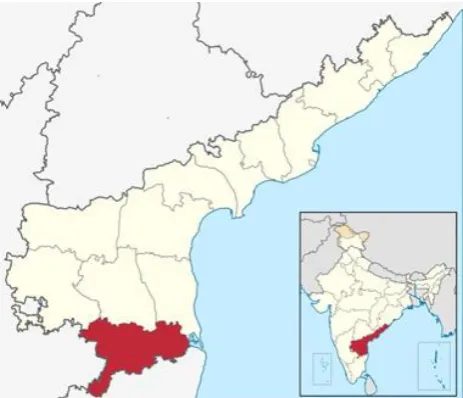
This was a cross-sectional quantitative study conducted in the rural areas of Chittoor district in May 2015. The RAS was rolled out in Chittoor district as part of the second phase on 2008. This district is surrounded by Tamil Nadu on the East and South, and by Karnataka State on the West, Anantapur, Kadapa and Nellore Districts form its Northern boundary.11 The district has an area of 15,152 square kilometer and is divided into 66 revenue mandals. (Figure 1).
Figure 1:Map of India highlighting the Chittoor district of Andhra Pradesh with red colour. Source: Wikimedia Commons.
A total of 200 households were surveyed by using a multi-stage random sampling technique to obtain the primary data. For equal consideration, we have used lottery method at each stage to reach the sample villages; first draw was done to select 4 mandals from 66 mandals, then next draw was done to select 4 villages one from each mandal. Final draw was done after numbering each house to select 50 households and in case the selected household is not available then the next house was selected by tossing a coin (for randomization, heads was assigned to right). The selected sampling villages are Pulliahgaripalle from Chandagiri Mandal, Chenna Reddy Palle from Renigunta Mandal, Nennuru from Rama Chandrapuram Mandal and Nagur colony from Tirupati Rural Mandal. Before the interview, informed consent was obtained from respondents by explaining their rights and purpose of the study.
the answer is no, then they were asked the reason for the same and if the answer is yes then in-depth interviews were conducted to explore their experiences during the utilization of RAS services. The primary data was analyzed by SPSS software, but for the background study and discussion earlier studies, RAS scheme official documents, Census 2011 and printed news articles were reviewed.
Wherever we use “policyholders’ it means families having any one or more of the following 6 Government issued cards for the purpose of social benefits as white ration card, Antyodaya Anna Yojana card, Annapurna card, Rajiv Aarogyasri health card, temporary ration card and Rachhabanda ration card. These cards are called eligibility cards. Beneficiary means person who received benefit from RAS.
RESULTS
RAS coverage in the community
The total number of households with eligibility card to avail of benefits are 177 out of 200 households (88.50%),
of that 74.57% of the families had Aarogyasri card (132 out of 177). The total number of policyholders are 718 from 177 BPL families {BPL card holder’s Income level must be not>60,000 rupees
(G.O.No.27, CS Dept; dt: 23.07.2008)}.12 The total average annual expenditure of BPL families is 76142.37 rupees, of those 49.72% families expenditure >60,000/- rupees. The mean average household health expenditure is 7282 rupees (9.56% of total annual expenditure).
Awareness on RAS
The level of Awareness on RAS among the respondent BPL families is 85.80% (152 out of 177). The very first source of information (Table 1) for the respondent BPL families was through the Gram Panchayat (32.23%), through hospitals (17.50%), through neighborhood (16.44%), television ads (14.47%), through the DWCRA (Development of Women & Children in Rural Areas) meetings (8.55%), newspapers (5.92%), through relatives (2.63%), through ANM (0.65%), by school teacher (0.65%), through 104 services (0.65%) and during election campaign by politicians (0.65%) (Table 1).
Table 1: Source of very first information about Aarogyasri health scheme for policyholders (primary data source).
Accessibility of RAS
There were 6.77% of the (12 out of 177) households who have received benefits under the RAS during 2014-15 in the study area. The beneficiaries had received treatment for accident & trauma, chest pain, CHRD, dengue, heart surgery, kidney stones and spinal surgery under the scheme.
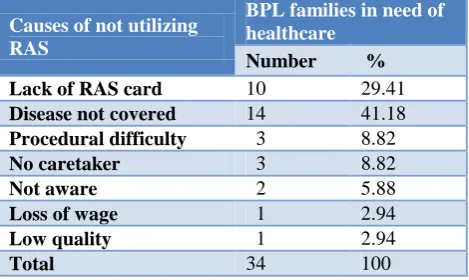
Table 2:Reasons for not accessing RAS services by policyholders with need (primary data source).
Causes of not utilizing RAS
BPL families in need of healthcare
Number %
Lack of RAS card 10 29.41
Disease not covered 14 41.18
Procedural difficulty 3 8.82
No caretaker 3 8.82
Not aware 2 5.88
Loss of wage 1 2.94
Low quality 1 2.94
Total 34 100
The data shows (Table 2) that 19.21% of the BPL families are in need of healthcare but are unable to utilize the healthcare services. The reasons were as follows: lack of RAS card (29.41%), treatment not covered under the listed therapy (41.18%), due to procedural difficulty (8.82%), non-availability of caretaker (8.82%), not aware of RAS (5.88%), due to loss of wage (2.94%) and low quality (2.94%) of services under the scheme. Among these households, 20.59% of the families were facing catastrophic expenditures on health and the mean average distance from the sample villages to the nearest network hospital is 15 kilometers (Table 2).
Experiences of beneficiaries’ during utilization of services
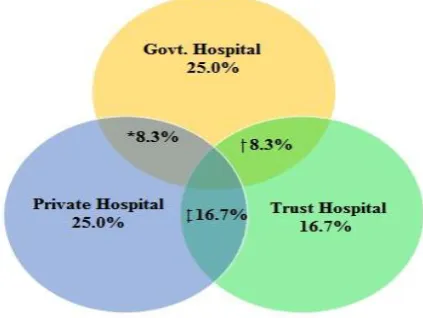
When it comes to the choice of hospital (Figure 2) for their treatment, 25% of the beneficiaries preferred getting treated in government hospitals, 33.33% of the beneficiaries were treated in private hospitals and 41.66% beneficiaries were treated in trust hospital. Also, this study found out that 33.33% of the beneficiaries are referred between two hospitals during their treatment. The referrals from the Government hospital to the private
Source of information
Gram Panchayat
DWA-CRA T.V
News
Paper Neighbors Hospitals
Blood
relatives ANM Teacher
104 services
Election Campaign No. of
families (152)
49 13 22 9 25 26 4 1 1 1 1
hospitals are 8.33%, another 8.33% to trust hospital and from private hospitals to trust hospitals are 16.7%. The respondents explained the reasons for referral that the Government hospitals didn’t have the required equipment; however the reason for referral from private hospitals to trust hospital was that the condition of the patient became very critical and there was risk of death.
Among the beneficiaries, 42% (5 out of 12) are aware of Aarogya Mitra (AM herein), amongst those who are aware of the AM are satisfied by the behaviour of AM and expressed that the AM is useful in providing information.
Table 3: Facility wise experiences of beneficiaries on different services during utilization of RAS (primary data source).
Type of facility used by
beneficiaries
Case Processing Time [A+B] * Total Avg Mean of 2 hr 42 min
Medicines shortage (yes/no)
Health professional behavior satisfied (yes/no)
Diagnostics facilities shortage (yes/no)
Malpractice in form of bribe (yes/no)
Immediate Availability of Doctors (yes/no) Registration
process including Preauthorization [A]
(48 min/case)
Wait Time for
consultation [B]
(1hr. 54 min)
Govt 60 min/case 90 min/case Yes No Yes Yes No
Private 23 min/case 106 min/case No Yes No No Yes
Trust 82 min/case 144 min/case No Yes No No Yes
*Exclusion of emergency conditions since they are treated first before preauthorization.
Figure 2: Beneficiaries choice of hospital utilized under the scheme.
(Primary data source); *referral from Govt. hospital to private hospital; +referral from Govt. hospital to trust hospital; referral from private hospital to trust hospital.
The (Table 3) mean average case processing time is 2 hours 42 minutes per beneficiary under the scheme (case processing time is duration from the time of beneficiary reaching hospital to the consultation of a doctor. This is registration time including preauthorization and wait time for consultation). Among all the hospitals, private hospitals had the lowest case processing time, followed by government hospital and highest time is taken in the trust hospital. Patients treated in government hospitals reported about the shortage of supportive services like medicines in pharmacy & availability of in-hospital diagnostic centers, non-availability of doctors on time,
rude behaviour of health professionals’ and cases of taking bribe came into light. However, the private and trust hospitals were well equipped and maintained the required stock of medicines in the pharmacy, were having own diagnostics, doctors were available on time, professionals were empathetic and no bribe was taken from the beneficiaries (Table 3).
OOPE on healthcare of beneficiaries
Our study found that the total mean average cost of healthcare is 110048 rupees, out of which the average mean amount of 100916 rupees was covered under the RAS but, the remaining average mean amount of 9132 rupees was spent by beneficiaries. In other words, an average of 91.70% of the total costs covered by the RAS and the rest 8.3% of the costs by the beneficiaries. However, 33.33% of the families were facing the catastrophic expenditure on health with an average amount of 25,000/- rupees per beneficiary, but the remaining 66.66% of the families have spent an average amount of 1198/- rupees per beneficiary during their hospitalization.
Overall opinion on scheme
gave score of 4, 16.66% of beneficiaries gave a score of 3 and remaining 16.66% of the beneficiaries gave a score of 2. When we relate this to facility wise then the results are as follows: Government hospitals rated minimum score of 2 and maximum of 3, private hospitals rated a minimum score of 4 & reached maximum possible score of 5, and trust hospitals got a minimum score of 2 but also achieved the highest possible score of 5.
DISCUSSION
In the study area, 88.50% of the population was covered by Aarogyasri scheme and it was close to the value of the total RAS coverage of the State which was 86.53%.4 The awareness (85.80%) on RAS is high among policyholders’ families comparatively 21.6% of households on RSBY in Maharashtra.14
More than 2/3rd of the policyholders reported that the services are not listed under the scheme (example of ovarian cysts & minor illnesses etc). Since there is a chance of malpractices by private hospitals, a few procedures are reserved for public hospitals under the scheme. Due to this reason, a few services were denied by private hospitals under the RAS and treated them directly without providing information to the beneficiaries. Also, there are a few beneficiaries not accessing services due to lack of RAS card. The beneficiaries don't have information otherwise they would have used the services with any one of the 6 eligibility cards and few services are reserved for public hospitals under the scheme. Hence, RAS card distribution to all the eligible beneficiaries and undertaking IEC activities for the scheme will improve the utilization of services. The other reasons for not accessing RAS services were the procedural difficulty, no caretaker, wage loss and low quality of services under the scheme.
The Aarogya Mitra is the first point of contact for the registration process in the hospital and beneficiaries opinioned that AM was useful in providing information and in registration process.
The higher case processing time (3 hrs. 46 min) at trust hospital compared to the Government (Avg.2hrs. 30 min/beneficiary) and private hospitals (Avg. 2hrs 9 min) is due to patient load. The lower processing time in private facilities is due to the availability of more hospitals. However, a few beneficiaries also stated that because of higher case processing time in the hospitals, they are not accessing the services. Further, only one tertiary care Government hospital is available within the distance of 100 km radius but many private facilities are available in a feasible distance of 10 to 20 km radius. Moreover, the high utilization of trust hospitals is due to quality infrastructure and referrals from other facilities. Therefore, establishing more government hospitals, placing a functional infrastructure in existing government hospitals along with an appropriate gate-keeping
mechanism will improve the accessibility of RAS services.
The public sector hospitals are underutilized due to AarogyaSri because people are choosing healthcare from private hospitals over public hospitals.15 Our study found out that this is due to the shortage of medicines & consumables, lack of functional diagnostic facilities, the problem with on-time availability of doctors, demanding of bribe and rude behaviour of hospital staff in Government hospitals, but the case is not so at the private facilities. This allows a room for profit-making by the private sector which leads to inefficiency of the scheme. Similar findings were reported by a study that beneficiaries’ priority of private hospitals under Aarogyasri is due to the poor infrastructure of public facilities in the State.16
The sum assured amount of Rs. 2,00,000/- including buffer amount of Rs. 50,000/- per family per year under RAS is 6 times more than RSBY which has a maximum limit of Rs.30,000/- per family per year. The average cost of treatment for each illness is Rs. 1,10,048/- rupees per beneficiary, of this beneficiary contribution is Rs.9,132 (8.30%) only and the remaining Rs.1,09,509 (91.70%) is by the RAS. But, still 33.33% of the beneficiary families were facing the catastrophic expenditure on health. However, the remaining 66.66% beneficiary households were protected from catastrophic illnesses and further impoverishment. Therefore, this scheme has shown positive impact on poor families.
Overall 66.66% of the beneficiaries have expressed their satisfaction towards RAS services, another.16 66% have opinionated fair and 16.66% were dissatisfied with RAS services. Facility wise, the percentage of beneficiaries satisfied follows 100% at the private hospitals, 75% at the trust hospital and 50% at the Government hospitals. Therefore, satisfaction with private facilities is more than other facilities under the scheme.
Recommendations
Based on beneficiaries’ expectations, we would like to give a few suggestions to improve the scheme efficiency, accessibility of services and reduces OOPE of beneficiaries under the scheme.
RAS among policyholders there is still a need for IEC (Information, Education & Communication) activities to improve utilization among weaker sections.
Limitations
After bifurcation of the State in 20, the scheme has been continuing as Dr. NTR Vaidyaseva in A.P and Aarogyasri in Telengana. Data related to the amount of money spent may not be of exact values, because the respondents may not recall the exact figures. A small sample size of 200 may not represent entirely the State.
CONCLUSION
This scheme has covered around 86% of the entire State population and the majority of them are living in rural areas, but the services are urban-centric. One third of the policyholders, who needs healthcare were unable to reach RAS services due to lack of information. Two thirds of the beneficiaries was protected from the catastrophic health expenses and associated impoverishment by RAS.
However, increased demand for private facilities under RAS was due to a shortage of supportive services in Government hospitals. Therefore, placing the functional infrastructure in Government facilities will not only satisfy the beneficiaries but also brings efficiency into the scheme. Moreover, people are also spending a considerable amount of money on minor and chronic illnesses; providing tertiary care alone would not be enough to prevent impoverishment. Finally, IEC activities are required to improve accessibility of the scheme and if the beneficiaries are not covered under the scheme then the alternatives for such services would need to be explored to prevent impoverishment.
ACKNOWLEDGEMENTS
I acknowledge all the respondents of this study.
Funding: No funding sources Conflict of interest: None declared
Ethical approval: The study was approved by the Institutional Ethics Committee
REFERENCES
1. World Health Organization: Global Health
Expenditure Database. Updated 2014. Available at: http://apps.who.int/nha/database/ViewData/Indicato rs/en. Accessed on 3 April 2019.
2. Ghosh S. Catastrophic Payments and
impoverishment due to out-of-pocket health spending. Economic and Political Weekly. 2011;46(47).
3. Van Doorslaer E, O’Donnell, Eliya RRP,
Somanathan A, Adhikari SR, Garg CC, et al. Effect of Payments for Healthcare on Poverty Estimates in
11 countries in Asia: An Analysis of Household Survey Data. Lancet. 2006;368(9544):1357-64. 4. Yellaiah J. Governance and Provision of Health
Security: A Case Study of the Implementation of the National Rural Health Mission Programme in East Khasi Hills District of Meghalaya. IOSR J Humanities Social Sci (IOSR-JHSS). 2013;8(1):1-6. 5. Deccan Chronicle. AP Cabinet renames Rajiv Aarogyasri scheme as the NTR Vaidyaseva, 2014. Available at http://www.deccanchronicle. com/ 141119/nation-current-affairs/article/ap-cabinet-renames-rajiv-aarogyasri-scheme-ntr-vaidyaseva. Accessed on 3 April 2019.
6. IDRC Final Technical Report. An evaluation of the Rajiv Aarogyasri Health Insurance Scheme, 2013. Available at: https://accessh.org/wp-content/ uploads/2014/07/An-efficient-model-for-improved- access-to-quality-healthcare-services-and-reduced-catastrophic-healthcare-expenditure.pdf. Accessed on 3 April 2019.
7. Rao M, Ramachandra SS, Bandyopadhyay S,
Chandran A, Shidhaye R, Narayana ST, et al. Addressing healthcare needs of people living below the poverty line: A rapid assessment of the Andhra Pradesh Health Insurance Scheme. Natl Med J India 2011;24(6):335-41.
8. The Indian National Census 2011. Population Census, Andhra Pradesh Population 2011 Census, 2011. Available at https://www.census2011.co. in/census/state/andhra+pradesh.html.
9. Press Information Bureau, Government of India, Ministry of Panchayati Raj. BRGF Funds for
Andhra Pradesh, 2012. Available at
http://pib.nic.in/newsite/PrintRelease.aspx?relid=90 606.
10. Wikimedia Commons, India-Andhra Pradesh-
Chittoor.svg, 2016. Available at https://commons. wikimedia.org/wiki/File:India_-_Andhra_Pradesh_-_Chittoor.svg. Accessed on 3 April 2019.
11. The Official Website of Chittoor District, District Profile, CENSUS 2011, 2014. Available at https://www.chittoor.ap.gov.in/Cencus.apo.
Accessed on 3 April 2019.
12. Andhra Pradesh Scheduled Castes Co-operative Finance Corporation Ltd; Identification of Beneficiaries & Functional Convergence, 2014. Available at https://apsccfc.cgg.gov.in/District home.do?dId=20&dt=1&oId=10. Accessed on 3 April 2019.
13. Susan Jamieson. Likert scale, SOCIAL SCIENCE, Encyclopaedia Britannica; 2017. Available at https://www.britannica.com/topic/Likert-Scale. 14. Thakur H. Study of Awareness, Enrollment, and
Utilization of Rashtriya Swasthya Bima Yojana (National Health Insurance Scheme) in Maharashtra, India. Front. Public Health. 2016;3:282.
16. Hooda SK. Health Insurance, Health Access and Financial Risk Protection. Economic & Political Weekly EPW. 2015;50(50).
17. Kotler, Philip & Armstrong, Gary. Principles of Marketing; Prentice Hall of India. 14th ed. Available at http://library.aceondo.net/ebooks/Business _Management/Principles_of_Marketing (14th ed). pdf. Accessed on 3 April 2019.
18. Rao M, Kadam S, Sathyanarayana T, Shidhaye R, Shukla R, Ramachandra S, Shatrugna V, et al. A
rapid evaluation of the Rajiv Aarogyasri community health insurance scheme in Andhra Pradesh, India. BMC Proc. 2012;6(Suppl 1):04.
Cite this article as: Mannuru M.Utilization of Rajiv