Original Research Article
Knowledge and practices regarding self-directed learning among
undergraduates from a medical college in Kerala
Suba J. Yesubakthan*, Blessed S. Sargunam, Judith Rajendran, Beena I. Bhasy
INTRODUCTION
Learning is an art that needs to be cultured lifelong in an individual. Medical education for undergraduates is a challenging area as we know that the component of learning is so vast and it has to be a continuous process. Traditional methods of learning where teacher teaches and the student learns could be useful only to a limited extent. It is the need of the hour for all medical colleges
to facilitate andragogy, i.e., adult learning. With emphasis on students taking the initiative in learning, new learning methods like problem-based learning (PBL) and self-directed learning (SDL) have emerged in medical curricula over the past few decades.1 Self-directed learning is an adult learning process. In its broadest meaning, self-directed learning describes a process in which individuals take the initiative, with or without the help of others, in diagnosing their learning needs, ABSTRACT
Background: Medical education for undergraduates is a challenging area and medical professionals are life-long learners. Self-directed learning (SDL) is adult learning process. SDL describes a process where individuals take initiative, with or without the help of others, in diagnosing their learning needs, formulating learning goals, identifying human and material resources for learning, choosing and implementing appropriate learning strategies, and evaluating learning outcomes. This study assessed knowledge and practices regarding SDL among medical undergraduates and looked for association between gender and year of study with knowledge and practices of different components of SDL.
Methods: A cross-sectional study was conducted among 192 students doing final year and internship at Dr. Somervell Memorial CSI Medical College, Kerala from April to July 2018 after obtaining clearance from Institutional ethics committee. Data was collected using a predesigned and pretested structured self-administered questionnaire on socio demographic profile, knowledge, practices, barriers and opportunities regarding SDL. Data was entered in excel sheet and analyzed using SPSS trial version 21.0.
Results: Majority of the students had good knowledge regarding the components of SDL and practiced components like identifying their learning needs, objectives, commitment and implementation of the learning process. Only 57.3% students evaluated learning process and 31.8% alone had an educator as facilitator. Important barriers identified were self-motivation (88%) followed by time (81.8%).
Conclusions: Interns had better knowledge and practice of SDL components compared to final year students. Though females had a better knowledge and practice of SDL components compared to males it was not statistically significant.
Keywords: Self-directed learning, Medical colleges, Kerala, Medical education
Department of Community Medicine, Dr. Somervell Memorial CSI Medical College, Karakonam, Kerala, India
Received: 15 May 2019
Revised: 01 July 2019
Accepted: 05 July 2019
*Correspondence:
Dr. Suba J. Yesubakthan, E-mail: [email protected]
Copyright: © the author(s), publisher and licensee Medip Academy. This is an open-access article distributed under the terms of the Creative Commons Attribution Non-Commercial License, which permits unrestricted non-commercial use, distribution, and reproduction in any medium, provided the original work is properly cited.
formulating learning goals, identifying human and material resources for learning, choosing and implementing appropriate learning strategies, and evaluating learning outcomes.2 Learning independently can be challenging, even for the brightest and most motivated students. SDL also enables health professionals to continue learning and updating knowledge during their careers.3 Very few studies are done across India so far looking into the aspect of Self- Directed Learning among medical undergraduates. In-depth literature review revealed that no such studies are done from Kerala. So this study is planned to assess the knowledge and practices regarding different components of SDL among medical undergraduates, to find the barriers and opportunities in engaging in SDL among medical students in a teaching institute in Kerala and to look for any association between gender and year of study with the knowledge and practices of different components of SDL.
METHODS
An institution based cross sectional study was conducted among 192 undergraduate medical students doing final year and internship at Dr. Somervell Memorial CSI Medical College, Karakonam, Trivandrum district, South Kerala from April to July 2018. Written permission was obtained from the principal of the medical college and clearance from Institutional ethics committee was also obtained. Undergraduate medical students who were present on the day of data collection and consented to participate alone were included in the study. Two batches of interns and one batch of final year students participated in the study. There were 133 interns in two batches and 82 final year students thus totalling to 215 students. However data was collected on 192 students who were available during the data collection period. The non-response rate is 10.7%. Data was collected using a predesigned and pretested structured self-administered questionnaire with details regarding socio demographic profile, knowledge, practices, barriers and opportunities regarding SDL which required 20 minutes for completion. Expert validation of the questionnaire was done by a senior faculty from the medical education unit of the Institution. The identity of the students was kept confidential by not asking for their names in the questionnaire and data was collected by the trained postgraduates from department of Community Medicine.
The data thus collected was entered in excel sheet and analyzed using SPSS trial version 21.0 available as free download. Proportions were calculated for questions related to knowledge, practices, barriers and opportunities. Association between gender, year of study and knowledge and practice of components of SDL were analyzed and chi-square test was used to look for meaningful inferences and p value <0.05 was calculated to find statistical significance. The study report were shared with the principal and the Medical Education Convener so as to have an awareness regarding the SDL
culture of students in the campus and to look for facilitating factors in the campus so as to benefit the medical students.
RESULTS
192 medical students participated in this study. The median age of the medical students was 23±1.16 years where the minimum and maximum age of the participants were 21 and 30 years respectively. 61 (31.8%) and 131 (68.2%) of the medical students were males and females respectively and 112 (58.3%) were interns and 80 (41.7%) were final year students.
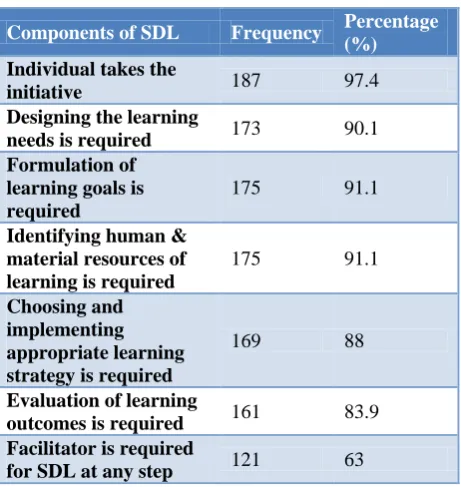
Majority of the medical students had good knowledge regarding all the components of SDL the highest being the individual takes the initiative for SDL and the least being the knowledge regarding the requirement of a facilitator at any step (Table 1).
Table 1: Distribution of medical students based on their knowledge regarding the components of
self-directed learning (n=192).
Components of SDL Frequency Percentage
(%) Individual takes the
initiative 187 97.4
Designing the learning
needs is required 173 90.1 Formulation of
learning goals is required
175 91.1
Identifying human & material resources of learning is required
175 91.1
Choosing and implementing appropriate learning strategy is required
169 88
Evaluation of learning
outcomes is required 161 83.9 Facilitator is required
for SDL at any step 121 63
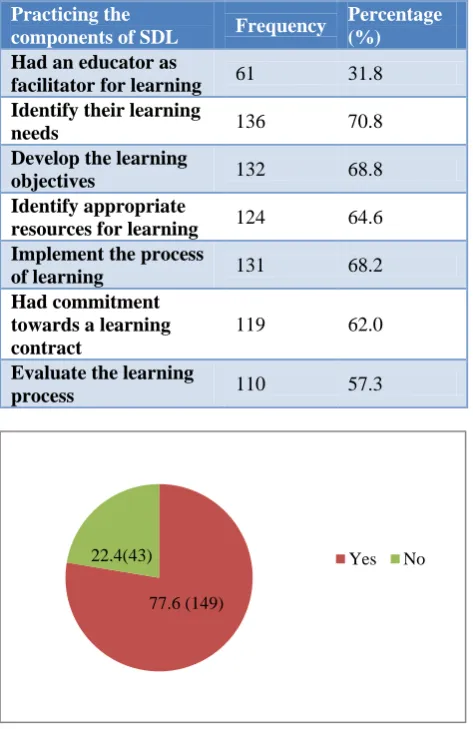
Majority 149 (77.6%) of the medical students participated had practiced at least one component of SDL method (Figure 2). Of the students who practiced SDL 60 to 70% had practiced the components of having a commitment, seeking resources, developing objectives and implementing learning process and have identified their learning needs. However, only 57.3% of students have evaluated the learning process and 31.8% alone had an educator as facilitator for learning (Table 2).
(59.9%) of the students opined having adequate institutional support as an opportunity in using SDL method (Table 3).
Table 2: Distribution of medical students based on their practice of different components of self-directed
learning (n=149).
Practicing the
components of SDL Frequency
Percentage (%) Had an educator as
facilitator for learning 61 31.8 Identify their learning
needs 136 70.8
Develop the learning
objectives 132 68.8
Identify appropriate
resources for learning 124 64.6 Implement the process
of learning 131 68.2
Had commitment towards a learning contract
119 62.0
Evaluate the learning
process 110 57.3
Figure 1: Distribution of medical students based on their practice of any component of SDL in % (n=192).
Table 3: Distribution of medical students based on their opinion regarding the barriers and opportunities
in using SDL as a learning method in their institution (n=192).
Barriers and
opportunities Frequency
Percentage (%) SDL method is not
familiar 100 52.1
Poor faculty response
towards SDL method 131 68.2 Adequate institutional
support in the form of resource (e-learning, Journals, Books)
115 59.9
Self-motivation as a
challenge for SDL 169 88 Time as a constrain
for SDL method 157 81.8
On analyzing the association of year of learning and knowledge regarding various components of SDL among medical students, requirement of formulating the learning goals, designing the learning needs, requirement of facilitator and identifying human & material resources were high among the interns as compared to final year students and this difference found was statistically highly significant p<0.01 (Table 4).
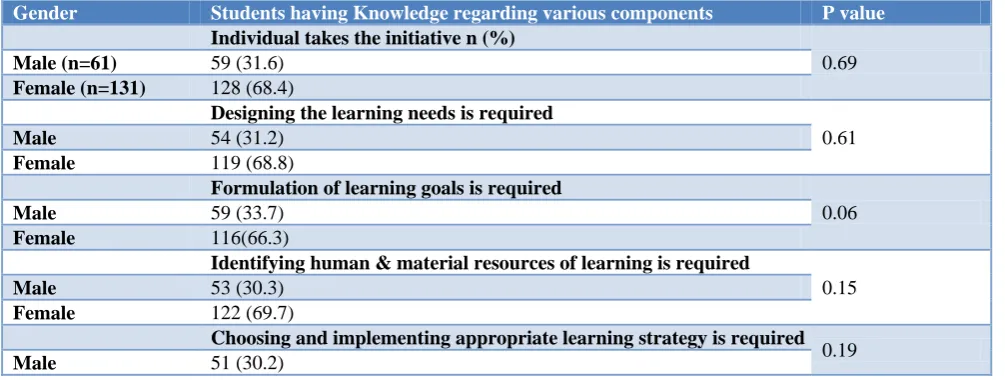
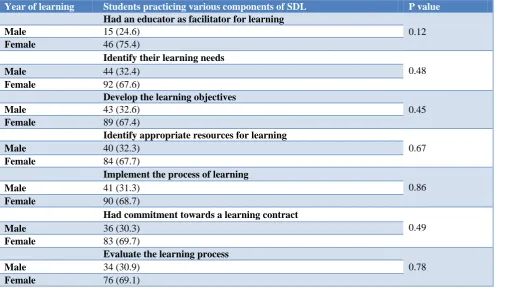
All the components of SDL were practiced by majority of the interns compared to final year students however the components like identifying appropriate resources for learning, implementing and evaluating the process of learning were found to be statistically significant (Table 5). Female medical students were found to have better knowledge regarding all the components of SDL compared to male medical students; however the difference found was not statistically significant with any of the components (Table 6). Female medical students had better practice of all the components of SDL compared to male medical students; however the difference found was not statistically significant with practice of any of the components of SDL (Table 7).
Table 4: Association of year of learning and knowledge regarding various components of SDL among medical students (n=192).
Year of learning Students having knowledge regarding various components N (%) P value
Individual takes the initiative
0.40
Final year 77 (41.2)
Intern 110 (58.8)
Designing the learning needs is required
<0.001
Final year 64 (37)
Intern 109 (63)
Formulation of learning goals is required
0.01
Final year 68 (38.9)
Intern 107 (61.1)
Identifying human & material resources of learning is required
0.01
Final year 68 (38.9)
77.6 (149)
Year of learning Students having knowledge regarding various components N (%) P value
Intern 107 (61.1)
Choosing and implementing appropriate learning strategy is required
0.27
Final year 68 (40.2)
Intern 101 (59.8)
Evaluation of learning outcomes is required
0.40
Final year 65 (40.4)
Intern 96 (59.6)
Facilitator is required for SDL at any step
0.01
Final year 42(34.7)
Intern 79 (65.3)
Table 5: Association of year of learning and practice of various components of SDL among medical students (n=149).
Year of learning Students practicing various components of SDL P value
Had an educator as facilitator for learning
0.98
Final year 23 (37.7)
Intern 38 (62.3)
Identify their learning needs
0.06
Final year 48 (35.3)
Intern 88 (64.7)
Develop the learning objectives
0.74
Final year 49 (37.1)
Intern 83 (62.9)
Identify appropriate resources for learning
0.01
Final year 41 (33.1)
Intern 83 (66.9)
Implement the process of learning
0.007
Final year 44 (33.6)
Intern 87 (66.4)
Had commitment towards a learning contract
0.11
Final year 41 (34.5)
Intern 78 (65.5)
Evaluate the learning process
0.04
Final year 36 (32.7)
Intern 74 (67.3)
Table 6: Association of gender and knowledge regarding various components of SDL among medical students (n=192).
Gender Students having Knowledge regarding various components P value
Individual takes the initiative n (%)
0.69
Male (n=61) 59 (31.6)
Female (n=131) 128 (68.4)
Designing the learning needs is required
0.61
Male 54 (31.2)
Female 119 (68.8)
Formulation of learning goals is required
0.06
Male 59 (33.7)
Female 116(66.3)
Identifying human & material resources of learning is required
0.15
Male 53 (30.3)
Female 122 (69.7)
Choosing and implementing appropriate learning strategy is required
0.19
Male 51 (30.2)
Gender Students having Knowledge regarding various components P value
Female 118 (69.8)
Evaluation of learning outcomes is required
0.18
Male 48 (29.8)
Female 113 (70.2)
Facilitator is required for SDL at any step
0.64
Male 37 (30.6)
Female 84 (69.4)
Table 7: Association of gender and practice of various components of SDL among medical students (n=149).
Year of learning Students practicing various components of SDL P value
Had an educator as facilitator for learning
0.12
Male 15 (24.6)
Female 46 (75.4)
Identify their learning needs
0.48
Male 44 (32.4)
Female 92 (67.6)
Develop the learning objectives
0.45
Male 43 (32.6)
Female 89 (67.4)
Identify appropriate resources for learning
0.67
Male 40 (32.3)
Female 84 (67.7)
Implement the process of learning
0.86
Male 41 (31.3)
Female 90 (68.7)
Had commitment towards a learning contract
0.49
Male 36 (30.3)
Female 83 (69.7)
Evaluate the learning process
0.78
Male 34 (30.9)
Female 76 (69.1)
DISCUSSION
A review article conducted by M. Hassan Murad on SDL among health professions education concludes that the components of self-directed learning though not addressed fully by medical students, yet some components are practiced.4 Our study revealed that 77.6% of students practiced at least any one component of SDL (Figure 1) and more than 80% of the students had the knowledge of components of SDL, however there was only 63% of students who thought there could be a need of a facilitator for SDL (Table 1). Among the students who practiced any component of SDL it is found that only 31.8% has had a facilitator to help them in their learning process (Table 2). Though SDL can be carried out without a facilitator yet studies done by Abraham et al and Allen et al has shown that the presence of a facilitator enhances the self-directed learning process as they don’t deliver contents but help the student with other components of SDL like finding for resources, providing motivation and so on.5,6 Hence this study throws light that
the current institution should facilitate the participation of the faculty to improve the self-directed learning process of the students.
Our study also has found only 57.3% of students has evaluated their learning process. Studies done earlier by Fung, Travena et alhas shown that maintaining internet based portfolios, MCQs and modified essays helps the students with self-evaluation and facilitator guided evaluation as well.7,
with knowledge and practice of different components of SDL.9
In our study students have reported lack of self- motivation and time constrain as the most important barriers for SDL whereas in a study by Kohen et al among postgraduate medical students regarding SDL barriers like information overload and lack of focus on learning, communication barriers like inadequate coping skills and inadequate writing skills and educational environment barriers like heavy workload and role ambiguity were considered as barriers for SDL method.10
CONCLUSION
Majority of the medical students had good Knowledge regarding the components of SDL. Considering the practice of components of SDL by medical students though majority of them practiced components like identifying their learning needs, objectives, commitment and implementation of the learning process yet, only 57.3% of students have evaluated the learning process and 31.8% alone had an educator as facilitator for learning. The most important barrier identified by the students were lack of self-motivation (88%) followed by no availability of time (81.8%). Analysis of association of year of learning and knowledge and practice revealed that interns had better knowledge and practice of SDL components compared to final year students whereas gender though females had a better knowledge and practice of SDL components compared to males it was not statistically significant.
Implications
The results of this study have helped us to know the self directed learning culture among medical students in our institution. The barriers and opportunities reflected are eye openers for the medical institutions to strengthen various areas in the institution to develop the SDL culture among medical students.
Limitations
The students across all the batches could not be included in the study for ethical reasons and only one college was included. So the results cannot be generalized.
ACKNOWLEDGEMENTS
The authors of this study thank the Principal and the Medical Education Unit Coordinator of Dr. SM CSI Medical College, Karakonam for the support rendered throughout the study. Also we deeply acknowledge the support and guidance rendered by the convener and
faculty from MCI Nodal Centre for Faculty Development, Govt. Medical College, Kottayam, Kerala.
Funding: No funding sources Conflict of interest: None declared
Ethical approval: The study was approved by the
Institutional Ethics CommitteeofSMCSIMCH.
REFERENCES
1. Barrows HS. Problem-based, self-directed learning. JAMA.1983;250(22):3077–80.
2. Self-directed learning. Available at http://infed.org/ mobi/self-directed-learning/. Accessed 17 April 2018.
3. Greveson GC, Spencer JA. Self-directed learning-the importance of concepts and contexts. Med Educ. 2005;39(4):348-9.
4. Murad MH, Varkey P. Self-directed learning in health professions education. Ann Acad Med Singapore. 2008;37(7):580-90.
5. Abraham RR, Upadhya S, Ramnarayan K. Self-directed learning. Adv Physiol Educ. 2005;29:135-6.
6. Allen E, Zerzan J, Choo C, Shenson D, Saha S. Teaching systems-based practice to residents by using independent study projects. Acad Med. 2005;80(2):125-8.
7. Fung MF, Walker M, Fung KF, Temple L, Lajoie F, Bellemare G, et al. An internet-based learning portfolio in resident education: the KOALA multicentre programme. Med Educ. 2000;34(6):474-9.
8. Trevena LJ, Clarke RM. Self-directed learning in population health: a clinically relevant approach for medical students. Am J Prev Med. 2002;22(1):59-65.
9. Premkumar K, Banerjee A, Pahwa P, Baptiste K, Bhatt H, Lim HJ. Does Medical Training Promote or Deter Self Directed Learning? A Longitudinal Mixed Methods Study. Acad Med. 2013;88(11):1754-64
10. Kohan N, Arabshahi KS, Mojtahedzadeh R, Abbaszadeh A, Rakhshani T, Emami A. Self- directed learning barriers in a virtual environment: a qualitative study. J Adv Med Educ Prof. 2017;5(3):116-23.
Cite this article as: Yesubakthan SJ, Sargunam BS, Judith R, Bhasy BI.Knowledge and practices