Original Research Article
Knowledge and attitude regarding eye donation among the people of
rural area in Kinaye, Belagavi: a cross sectional study
Asha Bellad*, Shirin Hukkeri
INTRODUCTION
Blindness due to diseases affecting cornea is estimated to affect approximately 6 to 8 million people across the world.1 In India, approximately, 6.8 million people have vision less than 6/60 in one eye due to corneal diseases whereas both eyes are involved in around one million people.2 Studies report that by 2020, approximately 10.6 million people will have unilateral corneal blindness.3 According to the National Programme for Control of Blindness (NPCB), there are approximately 120,000 blind people in India and around 25,000-30,000 new cases are reported every year.4 Corneal blindness is caused due to infections, inflammation in eyes, trachoma,
traditional eye medicines. It may also occur due to nutritional deficiency such as vitamin A, degenerative disorders or may be iatrogenic. These conditions may affect the transparency of cornea, cause corneal scarring leading to blindness.5
Transplantation of cornea is a very effective treatment in corneal blindness with a high success rate of restoring vision. The major issue in corneal transplantation is the unavailability of donor tissue. Global survey reports that only one cornea is available for every 70 people who require transplantation which shows a drastic mismatch between the demand and supply of corneas.6 The shortage of available donors is mainly due to the lack of awareness
ABSTRACT
Background: Corneal diseases are the second major cause of blindness. Corneal transplantation is the most effective treatment with high rate of success but there is a shortage of corneal donors. The study analyzed various factors affecting the willingness to donate cornea.
Methods: This community based cross sectional study was conducted among the adults residing in 9 sub-centres under PHC Kinaye, Belagavi in Karnataka, India. The participants (n=400) answered questionnaires which included details such as the demographic profile and, awareness and willingness to donate eyes. Univariate logistic regression analysis was performed for the data.
Results: Out of 400 participants, 80.5% were aware of eye donation among which 52% were willing to donate. Univariate analysis showed that adults who were less than 40 years were more aware when compared to those who were more than 40 years (p=0.0001) and more educated adults were willing to donate than illiterate. Adults from joint family were more aware when compared to those from nuclear family (p=0.005). Religious beliefs influenced the willingness of adults for donation as 83.6% denied willingness to donate.
Conclusions: The results of our study strongly suggest that there are a lot of misconceptions regarding eye donation in most parts of our country. It is evident from our study that education and involvement of those in health sector, will help to spread knowledge about eye donation and to eliminate misconceptions and ignorance about corneal donation.
Keywords: Corneal transplantation, Corneal blindness, Eye donation, Eye bank
Department of Community Medicine, Jawaharlal Nehru Medical College, Kaher, Belagavi, Karnataka, India
Received: 28 May 2019
Accepted: 15 July 2019
*Correspondence:
Dr. Asha Bellad,
E-mail: [email protected]
Copyright: © the author(s), publisher and licensee Medip Academy. This is an open-access article distributed under the terms of the Creative Commons Attribution Non-Commercial License, which permits unrestricted non-commercial use, distribution, and reproduction in any medium, provided the original work is properly cited.
eyes. The aim of this study was to assess the knowledge and awareness about eye donation and attitude of people towards donating their eyes, among the adults residing in the rural areas of Belagavi, Karnataka, India. The various factors such as lack of awareness, religious beliefs, socioeconomic status, education, knowledge regarding the procedures of eye donation, consent of family members etc. which may influence their decision are also included in this study. Detailed analyses of all these factors will help to use the information in order to intervene into the limiting factors and address the concerns related to the procedures and thus increase the public awareness regarding eye donation. This will eventually help to reduce the apprehensions and increase the number of corneal donors.
METHODS
This community based cross-sectional study was conducted in the area of PHC Kinaye, Belagavi and the study population were the adults residing in 9 sub-centres under PHC Kinaye. The duration of the study was from 14th February to 31st March 2017. The inclusion criteria for the study were that the subject should be a permanent resident of the area for the past 1 year. A total of 400 participants were included in the study according to the inclusion criteria. The study was approved by Institute Ethical Committee. The participants answered a detailed questionnaire which included sociodemographic profile, knowledge and awareness regarding eye donation and factors related to willingness for donation of their eyes. “Awareness” was realizing the fact that a person can donate his/her eyes after death and can be used to give vision to another person with corneal blindness. The section “knowledge” included the different aspects of eye donation like who can donate eyes and when a person can donate them. The attitude of participants towards donating eyes were influenced by lot of factors which were assessed by including details such as support from family members, any religious beliefs or any misconceptions which may influence the decision to donate eyes. Details were collected and data was analysed for further evaluation. Univariate regression analysis was performed to analyse the statistical significance of various factors influencing the knowledge and awareness regarding eye donation.
RESULTS
Out of 400 participants included in the study, 42% male and 58% were female. Among them 80.5% were aware of eye donation and 52% were willing to donate their eyes. The source of awareness for majority of the participants were media like television and newspapers (61.8%), followed by family or friends (22.9%), health personnel (14.9%) and other sources (0.31%). When the factors related to the knowledge about eye donation were
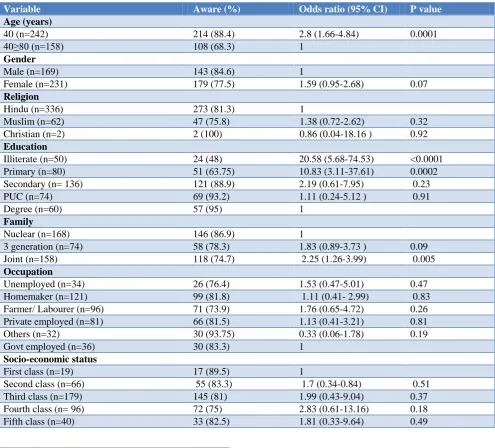
analysed it was observed that 12.42% believed that eyes can be donated only when they are alive, whereas 75.47% were aware that it can be done after death and another section of about 12.11% participants believed that eyes can be donated anytime, before or after death. 52.8% participants answered that by donating eye only one person will get vision, while 38.5% were aware that two people can restore vision and 8.7% believed that more than two people can get vision. Among the different factors (Table 1) analysed by univariate regression showed that adults who were less than 40 years were more aware of eye donation when compared to those who were more than 40 years (p=0.0001). When illiterates and literates were compared, it was observed that graduates (95%) were more aware of eye donation than illiterates (48%). Adults who were residing in a joint family had knowledge regarding eye donation compared to those who were in nuclear family (p=0.005).
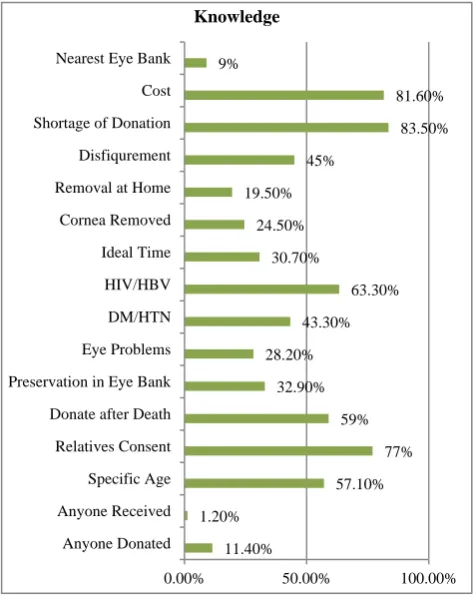
The detailed analysis of the knowledge regarding various procedures involved in eye donation and facts related to the process (Figure 1) revealed that 83.5 % were aware of the shortage of eyes for replacement.
Figure 1: Representation of different factors related to knowledge regarding eye donation.
The attitude of the participants for donating their eyes and the factors influencing their decision such as religious beliefs and consent from families were analysed (Figure 2). 11.40% 1.20% 57.10% 77% 59% 32.90% 28.20% 43.30% 63.30% 30.70% 24.50% 19.50% 45% 83.50% 81.60% 9%
0.00% 50.00% 100.00%
Anyone Donated Anyone Received Specific Age Relatives Consent Donate after Death Preservation in Eye Bank Eye Problems DM/HTN HIV/HBV Ideal Time Cornea Removed Removal at Home Disfiqurement Shortage of Donation Cost Nearest Eye Bank
Table 1: Univariate analysis showing an association between awareness of eye donation and various variables (n=400).
Variable Aware (%) Odds ratio (95% CI) P value
Age (years)
40 (n=242) 214 (88.4) 2.8 (1.66-4.84) 0.0001
40≥80 (n=158) 108 (68.3) 1
Gender
Male (n=169) 143 (84.6) 1
Female (n=231) 179 (77.5) 1.59 (0.95-2.68) 0.07
Religion
Hindu (n=336) 273 (81.3) 1
Muslim (n=62) 47 (75.8) 1.38 (0.72-2.62) 0.32
Christian (n=2) 2 (100) 0.86 (0.04-18.16 ) 0.92
Education
Illiterate (n=50) 24 (48) 20.58 (5.68-74.53) <0.0001 Primary (n=80) 51 (63.75) 10.83 (3.11-37.61) 0.0002 Secondary (n= 136) 121 (88.9) 2.19 (0.61-7.95) 0.23
PUC (n=74) 69 (93.2) 1.11 (0.24-5.12 ) 0.91
Degree (n=60) 57 (95) 1
Family
Nuclear (n=168) 146 (86.9) 1
3 generation (n=74) 58 (78.3) 1.83 (0.89-3.73 ) 0.09
Joint (n=158) 118 (74.7) 2.25 (1.26-3.99) 0.005
Occupation
Unemployed (n=34) 26 (76.4) 1.53 (0.47-5.01) 0.47
Homemaker (n=121) 99 (81.8) 1.11 (0.41- 2.99) 0.83 Farmer/ Labourer (n=96) 71 (73.9) 1.76 (0.65-4.72) 0.26 Private employed (n=81) 66 (81.5) 1.13 (0.41-3.21) 0.81
Others (n=32) 30 (93.75) 0.33 (0.06-1.78) 0.19
Govt employed (n=36) 30 (83.3) 1
Socio-economic status
First class (n=19) 17 (89.5) 1
Second class (n=66) 55 (83.3) 1.7 (0.34-0.84) 0.51 Third class (n=179) 145 (81) 1.99 (0.43-9.04) 0.37 Fourth class (n= 96) 72 (75) 2.83 (0.61-13.16) 0.18 Fifth class (n=40) 33 (82.5) 1.81 (0.33-9.64) 0.49
Figure 2: Attitude of participants towards eye donation and factors influencing their decision.
Among the participants 84 % were Hindus, 15.5% were Muslims and 0.5% were Christians. It was observed that religious beliefs influenced the willingness of adults for donation as 83.6% denied willingness to donate due to their religious beliefs. 94% believed that they will be blind in next life if they donate; but still 96% of the participants agreed to the fact that it is a service to mankind.
DISCUSSION
newspaper which was also similar to the findings in the study conducted in Pondicherry. In the area where study was conducted, most of the houses had television sets and hence mass media can be the best mode for awareness campaigns which will reach even the illiterates who cannot read newspapers. There was a statistically significant difference about the awareness of eye donation among adults who were less than 40 years of age when compared to more than 40 years (p=0.0001). This could be because of the fact that young people are more exposed to mass media and other forms of communication than the members of elderly age group. This may generate more awareness in younger aged people.
Even though there were more female (n=231) than male (n=169) population, there was more awareness amongst male respondents (84.6%) than female (77.5%) which was similar to the study done in Pondicherry. Among the 322 who were aware about eye donation, 52% were willing to donate. Lesser donation rates among females (38.5%) may be because of their family ties and the necessity to seek permission from the family members before pledging their eye which was matching with the studies reported previously.10 It was observed that there was a significant difference among literates and illiterates and a steady increase in the percentage of people who are aware of eye donation as there educational qualification also increased. Religion is a major contributing factor to the awareness and attitude towards eye donation. The study shows that different religious beliefs affect the willingness to donate their eyes due to the fear of lacking an intact body after death (83.60%) or disfigurement (45%) which was also reported by Randhawa et al in another study.11 The major factors affecting the willingness for eye donation was not found to be the socioeconomic status or awareness, but the consent of their family members and religious beliefs related to life after death which was very much similar to the results observed by Tandon et al which should be considered important and addressed by religious leaders which will help to eradicate ignorance related to eye donation.12
CONCLUSION
It is evident from the surveys conducted globally, that there is a shortage of availability of cornea for replacement in people with corneal blindness. As this procedure have high successful rate and can help a person to lead a life with better quality after restoring the vision, there is a need for creating more awareness about corneal donation. Major hurdles which are encountered are related to lack of awareness, illiteracy, religious beliefs and consent of family members. Public can be encouraged for donating their eyes by generating awareness related to the facts of eye donation. This can be conducted by health care workers, ophthalmologists, paramedical staffs in hospitals and laboratories, non-government organisations, social workers and teachers in schools and colleges. Religious leaders and media can
play a major role in this regard by preaching the service one will be doing to other fellow human beings by donating their eyes and eradicating the concerns and ignorance related to the requirement of an intact body even after their death. Family members also should be counselled for donating their relative’s eyes after death by doctors and staffs by emphasizing the importance of donation and the significant social impact of their action. These steps by policy makers will significantly improve eye donation and help reduce corneal blindness.
ACKNOWLEDGEMENTS
We are thankful to the Principal, Jawaharlal Nehru Medical College and Medical Officer of Kiney, PHC. We are also grateful to the post graduates, interns and staff of PHC, Kiney for their support and cooperation in data collection.
Funding: No funding sources Conflict of interest: None declared
Ethical approval: The study was approved by the Institutional Ethics Committee
REFERENCES
1. WHO bulletin. Available at: www.who.int/entity/ bulletin/ archives/79(3)itmb.pdf. Accessed on 3 June 2019.
2. National Programme for Control of Blindness. Report of National Programme for Control of Blindness, India and World Health Organization. 1986-89.
3. Dandona R, Dandona L. Corneal blindness in a southern Indian population: Need for health promotion strategies. Br J Ophthalmol. 2003;87(2):133-41.
4. National Programme for Control of Blindness. Available at http://pbhealth.gov.in/pdf/Blindness. pdf.
5. Burton MJ. Corneal blindness: prevention, treatment and rehabilitation. Community Eye Health. 2009;22(71):33.
6. Gain P, Jullienne R, He Z, Aldossary M, Acquart S, Cognasse F et al. Global survey of corneal transplantation and eye banking. JAMA Ophthalmol. 2016;134(2):167-73.
7. Patil R, Ram Prasath E, Boratne A, Gupta SK, Datta SS. Status of eye donation awareness and its associated factors among adults in rural Pondicherry. J Clin Diagn Res. 2015;9(2):01. 8. Yew YW, Saw SM, Pan JC, Shen HM, Lwin M,
Yew MS et al. Knowledge and beliefs on corneal donation in Singapore adults. British J Ophthalmol. 2005;89(7):835-40.
10. Krishnaiah S, Kovai V, Nutheti R, Shamanna BR, Thomas R, Rao GN. Awareness of eye donation in the rural population of India. Indian J Ophthalmol. 2004;52(1):73.
11. Randhawa G. An exploratory study examining the influence of religion on attitudes towards organ donation among the Asian population in Luton, UK. Nephrol Dial Transplant. 1998;13(8):1949-54. 12. Tandon R, Verma K, Vanathi M, Pandey RM,
Vajpayee RB. Factors affecting eye donation from
postmortem cases in a tertiary care hospital. Cornea. 2004;23(6):597-601.