Original Research Article
Information gap amongst animal bite victims and their care givers: a
study conducted at anti rabies centers of a city in North India
Amudeep Singh*, Amarjeet Singh
INTRODUCTION
Globally, animal bites are a neglected public health problem and remain a significant cause of morbidity and mortality. Animals tend to avoid humans but they can attack if they perceive threat, are protecting their young or territory, and are injured or ill. Attacks by wild animals are rare whereas attacks by domestic animals are common, and may result in serious systemic diseases.1 Animals can transmit various zoonotic (a disease that is transmitted to humans from animals) infections like rabies, monkey scratch fever, cat scratch fever, Herpes B Encephalitis, leptospirosis, plague etc. Amongst all rabies is the most significant health concern following animal bites. There are no global estimates of animal bite
incidence. Each year, an estimated 12 million people throughout Asia receive treatment after being exposed to animals that are suspected of rabies.2 In India, estimated animal bites per year are around 2.28 million and the annual incidence of animal bite is 1.7%.3 The frequency of animal bites in India lies at 1 per 2 seconds.4 Globally, dog bites are the most prevalent among animal bites followed by snake bites, cat bites and monkey bites.5
The Hindu religion worships many animal deities. Rabies has been recognized in India since the vedic period and is described in the ancient Indian scripture of Atharvaveda, wherein Yama, the mythical god of death, has been depicted as attended by 2 dogs as his constant companions, the emissaries of death. A common belief exists that caring for dogs paves way to heaven for them.6 ABSTRACT
Background: Animal bites are a neglected public health problem. The irony is that majority of mortalities are due to unawareness of wound management procedures and prevailing various myths and misconceptions. There is dearth of evidence pertaining to it thus we aim to ascertain the information gap amongst victims regarding various aspects of managing animal bites.
Methods: A cross sectional study was undertaken at ARCs of Chandigarh. 100 purposively selected animal bite victims were interviewed from January 2015 to April 2015. Information Gap was ascertained by using pre tested semi structured questionnaire. Data was analyzed using EpiInfo and MS Excel.
Results: An overall high information gap of 63.5% was seen amongst the knowledge of respondents’ i.e. materials to be used, time and duration for wound washing; place of reporting; knowledge pertaining to disease caused by animal bites and it’s prevention strategies; vaccination related information; location and timing of ARCs.
Conclusions: A definitive information gap needs to be addressed through to implementation of public health promotion based programmes.
Keywords: Animal bite, Rabies, Information gap, Knowledge, Anti rabies centre
Department of Community Medicine, School of Public Health, Post Graduate, Institute of Medical Education and Research, Chandigarh, Punjab, India
Received: 01 June 2018 Revised: 12 July 2018 Accepted: 13 July 2018
*Correspondence: Dr. Amudeep Singh,
E-mail: [email protected]
Copyright: © the author(s), publisher and licensee Medip Academy. This is an open-access article distributed under the terms of the Creative Commons Attribution Non-Commercial License, which permits unrestricted non-commercial use, distribution, and reproduction in any medium, provided the original work is properly cited.
An animal bite victim in India usually tends to ignore the bite/attack and seeks no professional care. In case the bite is severe and fails to heal, many of the victims due to lack of awareness consults a faith healer or goes for sorcery/witch craft. Those who report to local health facility, due to non-availability vaccination in the facility or lack of knowledge and skills on part of medical fraternity the victim is sent to a city anti rabies centre. Here the victim is often provided incomplete treatment as the city hospitals are often overburdened with cases. Serum or vaccine is out of stock in most instances. By the time the clinical symptoms occur and seriousness of the issue is realized, an animal bite victim may have succumbed to the fatal disease called rabies.
Animal bite victims need care as soon as possible. Immediate wound toilet with copious amount of water and soap/detergent or antiseptic is the cornerstone for prevention of rabies. Wound washing is a lifesaving procedure for any animal bite victim. Wound washing alone can decrease up to 80% chances of getting rabies. Therefore, self-care is important for preventing rabies. In a rabies endemic country like India every warm blooded animal bite is suspected as a potentially rabid animal bite and requires post exposure prophylaxis (PEP). Vaccinated animals are less likely to transmit infection. However a history of rabies vaccination in an animal does not guarantee that the biting animal is not rabid. PEP has 3 main strategies depending on type of contact with the suspected rabid animal viz. local treatment of wound, immediate vaccination and administration of rabies immunoglobulin.
Despite being 100% preventable, India reports maximum rabies deaths in the world. Animal bites are prevalent in both urban and rural India. The principal biting animal is the dog and victims mainly belong to poor families. Though considerable research has been done on rabies, profile of victims and pattern of animal bites; relatively less focus has been given to explore myths and misconceptions related to animal bites/attacks. Also not much work has been done to document the information needs of the victims. The present study was carried to assess the information gap regarding various aspects of managing animal bites among the victims and their caregivers.
METHODS
Chandigarh is a union territory in the northern part of India that serves as the capital of the states of Punjab and Haryana. The urban population constitutes of as high as 97.25% and rural as 2.75% of the total population. There are 2 anti-rabies centers in Chandigarh; with ARC in Sector 19 Civil Dispensary providing anti rabies services since 1952 and a new ARC in Sector 38 Civil dispensary since august 2014. Emergency care to animal bite victims is also provided in the 3 major public sector hospitals (PGIMER, GMSH-16 and GMCH-32) of the city. The
animal bite victims reporting at Anti Rabies Centers of Sector 19 and Sector 38 of Chandigarh from January to April 2015. Face to Face interview were taken of 100 purposively selected animal bite victims with 72 cases from ARC Sector 19 and 28 cases from ARC Sector 38. In case of child victims; escorts were interviewed. An quantitative descriptive analysis was performed to estimate knowledge of respondents’ i.e about materials to be used, time and duration for wound washing; place of reporting; knowledge pertaining to disease caused by animal bites and it’s prevention strategies; vaccination related information; location and timing of ARCs.
Inclusion criteria
Quadruped animal bite cases including dog, cat, monkey and rat bite victims.
Exclusion criteria
Unreported cases, cases reported at other centers/hospitals, snake bite and other animal bite cases.
Pre tested semi structured questionnaires were used. Animal bite victims were interviewed on the basic information regarding wound management and related aspects. Knowledge of the victims was assessed regarding various domains viz. rabies prevention strategies, self-care, treatment available, vaccination, prognosis and do’s and don’ts.
Information gap refers to the gap between ideal knowledge level and actual knowledge level required for management of animal bites amongst victims. Information gap was calculated by comparing ideal responses with actual responses where each response was scored. For each domain maximum score was given for ideal response. Rest of the responses was scored as per the degree of conformance to the ideal response (i.e. Table 1. Here first three responses get a score of 10 i.e. ideal score. Use of water or antiseptic only is scored @ 7, herbs/oil @ 4, urine @ 3 and chilly/other irritants and don’t know reponses were scored @ 0).
A, B, X, Y, Z and I were defined as follows:
A= Number of respondents choosing a particular response category
B= Score allocated to the response
X= A*B = Score obtained by the respondent
Y= Total of the scores obtained by all the respondents
Information gap= Ideal Information level–Actual Information present
Information gap (I)= Ideal score – Total score obtained
I= Z - Y
Percent Information gap= I/Z* 100
Data was analyzed using Epi Info and MS Excel. Prior consent was obtained from the victims/escorts and all the data obtained was kept confidential.
RESULTS
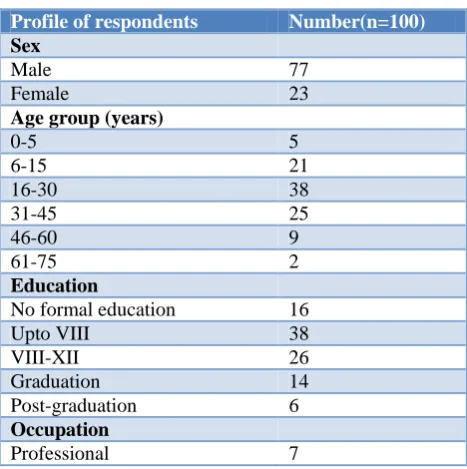
Majority of victims belonged to age group of 16-30 years (38%) and 77% victims were males. 16% had not received any formal education and only 20% were graduate or post-graduation. Many (35%) victims were students followed by semi-skilled workers (19%). 18% victims were unemployed (Table 1).
Around 60% of victims knew that wound is to be washed in water after a bite incident. 39% victims knew that water and soap or water and antiseptic should be used for wound washing. 18% victims believed that chili/lime or other irritants must be applied on wound while 14% did not know what to use. An information gap of 42% was seen for this domain (Table 2).
Table 1: Profile of respondents.
Profile of respondents Number(n=100)
Sex
Male 77
Female 23
Age group (years)
0-5 5
6-15 21
16-30 38
31-45 25
46-60 9
61-75 2
Education
No formal education 16
Upto VIII 38
VIII-XII 26
Graduation 14
Post-graduation 6
Occupation
Professional 7
Majority (59%) of the victims did not know when the wound washing procedure should be initiated. 19% of the victims stated that wound washing should be performed as soon as possible followed by within 5–10 minutes by 10%, 10-20 minutes by 9% and within 5 minutes was stated by only 3% of the victims. Information gap of around 68% was seen regarding time interval between bite and wound washing (Table 3).
Table 2: Knowledge of respondents about the materials to be used for wound washing.
Materials to be used for wound washing
A
(number of respondents choosing a particular response category)
B
(score allocated to the response) (maximum score of 10)
A*B= X (score obtained by the respondent)
Water, soap and antiseptic 1 10 10
Water and soap 22 10 220
Water and antiseptic 16 10 160
Water only 21 7 147
Antiseptic only 4 7 28
Herbs/oil 3 4 12
Urine 1 3 3
Chilly/other irritants 18 0 0
Don't know 14 0 0
Total 100 580
Table 3: Knowledge of respondents about the time interval between bite and washing.
Time interval between bite and washing A B (maximum score of 8) A*B= X
As soon as possible 19 8 152
Within 5 minutes 3 8 24
5-10 minutes 10 5 50
10-20 minutes 9 3 27
Don't know 59 0 0
Table 4: Knowledge of respondents about the duration for which wound washing should be performed.
Duration for wound washing should be performed A B (maximum score of 5) A*B= X
10-15 minutes 1 5 5
5-10 minutes 5 4 20
Less than 5 minutes 3 2 6
Don't know 91 0 0
Total 100 31
Table 5: Knowledge of respondents about the agency where and when to report.
Knowledge of respondents A*B= X
A B (maximum score of 3) Agency where to report
ARC/Doctor 99 3 297
Don’t know 1 0 0
Total 100 297
When to report B (maximum score of 8)
As soon as possible 26 8 208
Within 24 hours 2 7 14
In 1-2 days 17 3 51
2-5 days 8 1 8
Don't know 47 0 0
Total 100 281
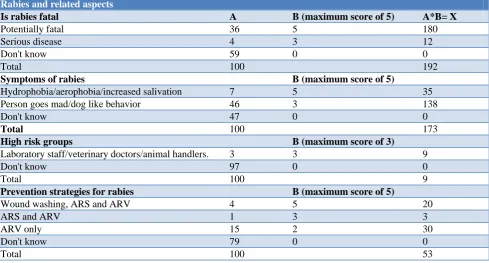
Table 6: Knowledge of respondents about rabies and related aspects.
Rabies and related aspects
Is rabies fatal A B (maximum score of 5) A*B= X
Potentially fatal 36 5 180
Serious disease 4 3 12
Don't know 59 0 0
Total 100 192
Symptoms of rabies B (maximum score of 5)
Hydrophobia/aerophobia/increased salivation 7 5 35
Person goes mad/dog like behavior 46 3 138
Don't know 47 0 0
Total 100 173
High risk groups B (maximum score of 3)
Laboratory staff/veterinary doctors/animal handlers. 3 3 9
Don't know 97 0 0
Total 100 9
Prevention strategies for rabies B (maximum score of 5)
Wound washing, ARS and ARV 4 5 20
ARS and ARV 1 3 3
ARV only 15 2 30
Don't know 79 0 0
Total 100 53
More than 90% victims were unaware of the duration for which wound washing should be performed. An information gap of around 94% was seen regarding duration of washing (Table 4).
Almost all victims were aware that after an animal bite, a doctor is to be consulted. Information gap was negligible
Almost 60% victims were unaware that rabies is a potentially fatal disease. Also, 47% of the victims were unaware of the symptoms of rabies. Only 7% victims were aware of the cardinal symptoms of rabies while 46% victims responded that a rabid patient shows mad/dog like behavior. An information gap of 66% was seen. More than 90% victims were unaware of the high risk groups for rabies. Around 80% of the victims were
unaware of the prevention strategies for rabies, followed by 15% who responded that vaccination was done to prevent rabies. Awareness regarding wound washing as a prevention strategy for rabies was also negligible amongst the victims. A total information gap of 76% was seen regarding rabies, high risk groups and its prevention strategies (Table 6).
Table 7: Knowledge of respondents about vaccination and related aspects.
Vaccination and related aspects
Vaccine site A B (maximum score of 3) A*B= X
Arm 32 3 96
Abdomen 10 0 0
Don’t know 58 0 0
Total 100 96
Vaccine schedule B (maximum score of 3)
5 doses required 10 3 30
Multiple doses required 27 2 54
Don’t know 63 0 0
Total 100 84
Vaccine dose B (maximum score of 2)
1 ml per dose 3 2 6
Don’t know 97 0 0
Total 100 6
Table 8: Knowledge of respondents about do’s and don’ts after vaccination and revisiting the ARC.
Knowledge of respondents A B (maximum score of 3) A*B= X
Do’s and don’ts after vaccination
Complete the course of vaccination, don't apply chilly/irritants, don't touch/rub wound or vaccination site (any 2)
1 3 3
Visit ARC/doctor if any problem occurs 6 1 6
Don't know 93 0 0
Total 100 9
Revisiting the ARC
According to treatment schedule, if any problem
occurs 6 3 18
According to treatment schedule 92 2 184
Don't know 2 0 0
Total 100 211
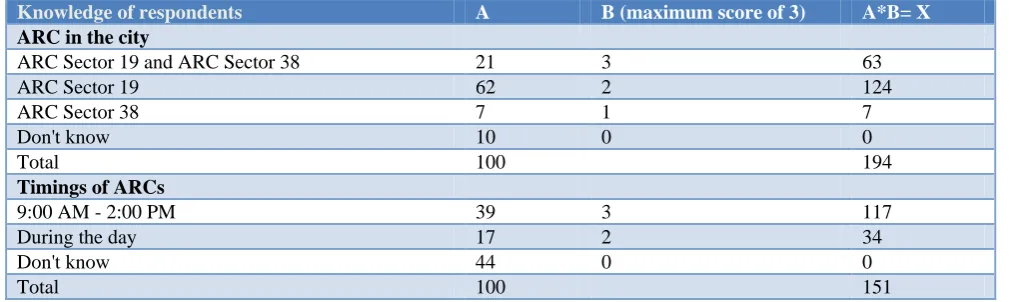
Table 9: Knowledge of respondents about ARCs in city and timings of ARCs.
Knowledge of respondents A B (maximum score of 3) A*B= X
ARC in the city
ARC Sector 19 and ARC Sector 38 21 3 63
ARC Sector 19 62 2 124
ARC Sector 38 7 1 7
Don't know 10 0 0
Total 100 194
Timings of ARCs
9:00 AM - 2:00 PM 39 3 117
During the day 17 2 34
Don't know 44 0 0
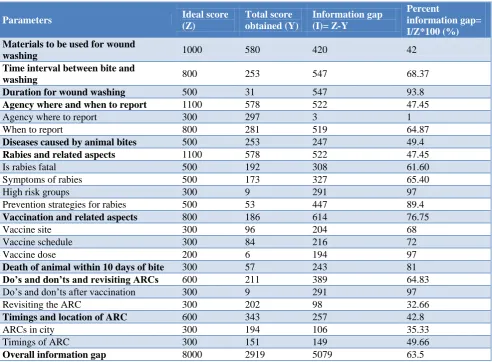
Table 10: Information gap among respondents regarding various aspects of animal bites.
Parameters Ideal score
(Z)
Total score obtained (Y)
Information gap (I)= Z-Y
Percent
information gap= I/Z*100 (%) Materials to be used for wound
washing 1000 580 420 42
Time interval between bite and
washing 800 253 547 68.37
Duration for wound washing 500 31 547 93.8
Agency where and when to report 1100 578 522 47.45
Agency where to report 300 297 3 1
When to report 800 281 519 64.87
Diseases caused by animal bites 500 253 247 49.4
Rabies and related aspects 1100 578 522 47.45
Is rabies fatal 500 192 308 61.60
Symptoms of rabies 500 173 327 65.40
High risk groups 300 9 291 97
Prevention strategies for rabies 500 53 447 89.4
Vaccination and related aspects 800 186 614 76.75
Vaccine site 300 96 204 68
Vaccine schedule 300 84 216 72
Vaccine dose 200 6 194 97
Death of animal within 10 days of bite 300 57 243 81
Do’s and don’ts and revisiting ARCs 600 211 389 64.83
Do’s and don’ts after vaccination 300 9 291 97
Revisiting the ARC 300 202 98 32.66
Timings and location of ARC 600 343 257 42.8
ARCs in city 300 194 106 35.33
Timings of ARC 300 151 149 49.66
Overall information gap 8000 2919 5079 63.5
Around 60% of the victims were unaware of the site of vaccination as well as schedule of vaccination. Almost all of the victims were also unaware of the dose of vaccination. An information gap of around 77% was seen regarding vaccination and its related aspects (Table 7).
Around 70% of victims were unaware of the implication of death of biting animal within 10 days of bite. Only 15% victims knew that death of biting animal in 10 days of bite meant that the animal was rabid. An information gap of 81% was seen.
More than 90% of the victims were unaware of the Do’s and Don’ts after vaccination. But 92% of the victims knew that they had to revisit the ARC according to the treatment schedule (Table 8).
Around 60% of animal bite victims were aware of the ARC of Sector 19 and around 20% knew about ARC sector 19 as well as ARC Sector 38. Awareness regarding ARC at Sector 38 was low. Majority (44%) of patients were unaware of the working time of the ARC’s while around 40% knew that centre is open only during day time. Information gap of 43% was seen regarding the location and timings of ARC (Table 9).
The respondents did not know much about the managing an animal bite as evident by the score obtained (36.5%). An overall high information gap of 63.5% was seen amongst the respondents (Table 10).
DISCUSSION
Animal birth control and vaccination programs have decreased the risk of rabies from dogs in a number of regions of the world. Despite the advances made in science and technology, India is still lagging in rabies control.
same.9,10 These differences in the findings could be attributed to education status of victims
Time interval between bite and initiation of wound washing is critical in prevention of rabies. Wound washing procedure should be initiated as soon as possible and preferably within 10 minutes of bite. In the study, an information gap of around 68% was seen regarding time interval between bite and wound washing. Wound washing should be performed for a minimum of 10-15 minutes to remove virus from the wound site. An information gap of around 94% was seen. The findings portray the low awareness amongst victims regarding correct wound washing technique. The findings could be attributed to low education status of victims. Also majority of victims were from peripheral villages of the city where myths and misconceptions relating to animal bites are prevalent. In another study, Kumar et al observed that 33.1% victims knew that local treatment should be taken as soon as possible.9 Another similar study done in India by Kole et alstated that only one third of victims know how to wash the wounds after animal bites.11
In India each animal bite should be considered as a potential rabid animal bite and must be treated as an emergency. Knowledge of victims regarding where and when to report after an animal bite incident was assessed. Almost all victims were aware that a doctor should be consulted after the bite. This shows modern outlook of city where people have more faith in medical fraternity compared to quacks and faith healers. These results are unlikely with some previous studies where around one third of the people opined to visit doctor in case of dog bite.8,12
Ideally animal bite victims must receive vaccination within 24 hours. In the present study it was seen that around half of the victims were unaware of when to report to a doctor/ARC following an animal bite incident. This could be attributed to the ignorant attitude of victims towards an animal bite. Victims may not take an animal bite incident seriously and may tend to ignore it considering it will be fine by itself within a few days. And only when the wound fails to heal a doctor is consulted. Results of our study is almost in accordance to other study where 33.3% knew that ARV should be taken immediately.9
Amongst other diseases, animal bites carry the risk of deadly diseases as rabies and tetanus. Knowledge regarding diseases caused by animal bites was assessed amongst the victims. Though majority of people were aware that an animal bite could result in rabies around 35% victims were still unaware of the same. The people who were aware of rabies may have seen or heard of a rabies patient in their neighborhood. Since not all animal bites result in rabies therefore the information gap seen could be attributed to a past experience of a bite where the victim did not develop any disease. Similarly, some
studies in India (stated that only 70% and 63.7% respectively had ever heard of rabieswhile Rumana et al in Bangladesh it was found that 65% of subjects were aware of rabies and 99.1% knew a dog bite was the cause of rabies.9,11,13 Few other authors reported more than 90% of victims.8,14 In contrary to above results, another study found 20% subjects knew the name of disease named rabies but 63.7% victims knew that rabies is caused by biting of animal.7 These differences could be attributed to differential education status and age profile of victims.
Rabies is invariably fatal and perhaps the most painful and horrible of all communicable diseases in which the victim is tormented at the same time with both thirst and fear of water. In the present study, knowledge of animal bite victims regarding various aspects of rabies was assessed including symptoms, high risk groups and prevention strategies.
Majority of victims did not know that rabies is a fatal disease. But Jain et al and Kumar et al reported 18% and 55% of cases respectively were aware about the fatality rate (100%) of the disease once occurred.7,9
In our study, victims also did not have the desired information regarding symptoms of rabies. This could be because of low education status of victims as out of the 59 victims who were unaware of the fatality of rabies majority (around 86%) were educated only upto XII class. Similarly, out of the 47 victims who were unaware of the symptoms of rabies, 85% were educated only upto XII class. Around half of the victims knew about some of the typical symptoms of rabies. This could be due to a past experience where the victim might have seen or heard of a rabies patient.
Some professions pose a higher risk of rabies transmission. Animal handlers, hunters, veterinary surgeons, dog lovers and laboratory staff are vulnerable to rabies. Also children and handicapped people are more likely to be attacked by stray dogs. Almost all of the victims lacked information on high risk groups for rabies. This could be attributed to the low overall awareness of rabies amongst animal bite victims.
Rabies is a 100% preventable disease. Knowledge regarding prevention strategies for rabies was assessed which showed a high information gap of 90%.Victims were not aware of the significance of wound washing or vaccination. Similarly another study also reveals serious gaps in understanding of wound severity, classification and correct application of PEP with ARV vaccine and RIG.7 But few others studies found that more than three fourth of respondents believed that rabies can be prevented by vaccination.8,12,15
various aspects of vaccination including site of vaccination, dose of vaccination and schedule of vaccination was ascertained. A combined information gap of around 77% was obtained. This shows that victims were poorly aware regarding vaccination procedure. It could be because for majority the victims this was their first animal bite incident. Though in earlier studies information gap regarding the same varies from 40 to 60%.8,9 This difference could be attributed to difference in the question asked and estimation parameters.
Observation of a biting dog for 10 day period is done for after all dog bite incidents. If the dog dies within the observation period it is believed that the cause of death was rabies. The head of the dog is then immediately sent for laboratory investigation. In the present study, it was seen that majority of the victims were unaware of the implications of death of biting animal during the observation period. Few authors reported that information gap regarding the same varies from 42 to 63% which could be attribute to general awareness, education status as well as age profile of victims.9,10
Also, almost all patients were unaware regarding the dos and don’ts after vaccination. Most probable reason for this could be the partial information provided by the ARC staff. ARC staff which remains overburdened with patient load may tend to ignore counseling of the victim which is often a time consuming process. Ignorant and callous attitude of staff towards providing information to the victims could be another reason. An information gap of around 33% was seen regarding revisiting the ARC.
An anti-rabies centre should provide facilities round the clock; but this is not seen in Chandigarh. There are 2 ARCs in the city as a part of civil dispensaries of Sector 19 and Sector 38. Both the ARCs are functional from 9:00 am to 2:00 pm from Monday to Saturday. Knowledge of victims regarding location and timings of the ARCs was assessed. An information gap of around 43% was obtained. While majority of victims were aware of the ARC at Sector 19, only few victims knew about the ARC in Sector 38. This could be attributed to the fact that ARC Sector 19 is functioning since 1950. Therefore more people are aware about it. ARC sector 19 became functional only recently in 2014 and therefore people are still not aware regarding its existence. As far as timings of the ARC are concerned an information gap of 50% was seen. This could be due to the reason that people tend to consult a doctor during day time and find the ARC open, therefore they do not bother to know about the exact timings of the ARC. Similarly, another study reported a gap of 25%.9
CONCLUSION
Most of the victims were unaware of the wound management practices like wound washing, agency where and when to report, rabies and related aspects and
overall high information gap of around 63.5% was seen amongst victims regarding management of an animal bite wound. Various myths and misconception associated with these injuries have also been reported among the victims of animal bite attending ARCs in Chandigarh.
The present study shows a differential information gap. Higher information gap was seen regarding technical aspects of managing animal bites as duration of wound washing, prevention strategies of rabies, high risk groups, vaccine dose, death of biting animal within 10 days of bite, and do’s and don’ts after vaccination. For domains as; materials to be used for wound washing, agency where to report, revisiting the ARC, location and timings of ARC a lesser information gap was seen.
Practical implications
Community awareness is critical amongst general public regarding prevention and control of disease caused due to animal bites. To address this huge information gap, well planned public extensive health promotional programmes must be framed and implemented. Public campaigns on prevention and management of animal bites must be organized from time to time. IEC activities should be given impetus to dispel myths and misconceptions. Rabies and its prevention strategies with special focus on urgency and correct technic of wound washing practices must be incorporated in IEC activities.
Limitations
Holding back of information by the victims is possible and Information gap of unreported animal bite victims could not be taken.
ACKNOWLEDGEMENTS
We are grateful to the Centre for Public Health Department in Panjab University, Chandigarh, India, Chandigarh Administration and ARCs staff for their cooperation in data collection.
Funding: No funding sources Conflict of interest: None declared
Ethical approval: The study was approved by the Institutional Ethics Committee
REFERENCES
1. Keystone JS, Kozarsky PE, Connor BA, Nothdurft HD, editor. MC. 3 ed. Philadelphia: Saunders Elsevier; 2013.
2. WHO. Strategic Framework for Elimination of Human Rabies Transmitted by Dogs in the South East Asia Region. Geneva, Switzerand: WHO; 2012.
4. Park KP. Textbook of Preventive and Social Medicine. 16 ed. Jabalpur: Banarasidas Bhanot Publishers; 2000.
5. Facts Sheet. Geneva, Switerland: WHO, 2014. 6. Animals in Indian civilization and mythology.
Panchangam. 2009: 10.
7. Jain P, Jain G. Study of General Awareness, Attitude, Behavior, and Practice Study on Dog Bites and its Management in the Context of Prevention of Rabies Among the Victims of Dog Bite Attending the OPD Services of CHC Muradnagar. J Family Med Primary Care. 2014;3(4):355-8.
8. Singh US, Choudhary SK. Knowledge, Attitude, Behavior and Practice Study on Dog-Bites and Its Management in the Context of Prevention of Rabies in a Rural Community of Gujarat. Indian J Community Med. 2005;30:81-3.
9. Sanjeev Kumar RT, Saxena M, Niranjan A, Kumar M. A study on knowledge of animal bite victims regarding animal bite and rabies attending tertiary care hospital of Rewa City, Madhya Pradesh. Int J Med Sci Public Health. 2016;5(5):1005-9.
10. Kakrani VA, Jethani S, Bhawalkar J, Dhone A, Ratwani K. Awareness about dog bite management in rural population. Indian J Community Health. 2013(3):304-8.
11. Kole AK. A RRaDCK. Human rabies in India: a problem needing more attention. 2014.
12. Sonia SASSAKPG. Misconceptions And Myths In The Management Of Animal Bite Cases. Indian J Community Med. 2002;1(3):9-11.
13. Rumana R, Sayeed AA, Basher A, Islam Z, Rahman MR, Faiz MA. Perceptions and treatment seeking behavior for dog bites in rural Bangladesh. The Southeast Asian J Trop Med Public Health. 2013;44(2):244-8.
14. Kabeta T, Deresa B, Tigre W, Ward MP, Mor SM. Knowledge, Attitudes and Practices of Animal Bite Victims Attending an Anti-rabies Health Center in Jimma Town, Ethiopia. PLoS Neglected Trop Dis. 2015;9(6):e0003867.
15. Manning SE1, Rupprecht CE, Fishbein D, Hanlon CA, Lumlertdacha B, Guerra M, et al. Human rabies prevention--United States, 2008: recommendations of the Advisory Committee on Immunization Practices. MMWR Recomm Rep. 2008;57(RR-3):1-28.