Original Research Article
Perception and prejudice about organ donation among medical
students in a tertiary healthcare, Mysuru
Rashmi S.*, Narayana Murthy M. R.
INTRODUCTION
Organ donation is often the only treatment of end state organ failure. Many deaths due to organ failure can be avoided if organ donors are available. Lack of donors may be because of the lack of knowledge and awareness of many issues about organ donation. Organizational and legislative framework for organ transplantation is present in 94 coutntries.1 To regulate the removal, storage and transplantation of organs, government of India has also
enacted the transplantation of human organs act, 1994, for therapeutic purposes and for the commercial dealings in human organs. In supersession of the transplantation of human organs rules, 1995, government of India notified the Transplantation of human organs and tissues rules, 2014.2 Non availability of organs has led to around 500,000 deaths every year in India due to organ shortage. Among those 200,000 deaths are due to liver disease and 50,000 because of heart disease. Out of 150,000 people waiting for a kidney transplant, only 5,000 get among them.3 There is a wide gap between patients who need
ABSTRACT
Background: Today, increase in deaths due to organ failure can be avoided if organ donors are available. Many states in India adopted the transplantation of human organs act and enthusiastic medical professionals and philanthropists joined hands to move the matter further forward. Lack of awareness about organ donation has been noted among the general public including medical professionals. Awareness can be promoted through medical students to bridge the gap of knowledge about organ donation and they can carry the message to the community. Hence an attempt has been made to probe this issue with objective to assess the perception and prejudice about organ donation among medical students.
Methods: This cross-sectional study was conducted among medical students in a tertiary healthcare centre, Mysuru. A total of 201 students from 1st and 3rd term, consenting to participate were included in the study. A semi-structured self-administered questionnaire was used to collect data and was analysed using SPSS 22 version.
Results: Knowledge about brain death was 73.1%, transplant of harvested organs was 59%, compatibility tests were 89% and organs donated by live donors were 89.6% for kidneys and 66.7% for cornea in cadaver donors. Regarding legal issues 73% knew that organ selling is criminal offence. 90% supported organ donation and related to prejudice 53% agreed that there are no religious constraints to donate organs.
Conclusions: Knowledge and awareness regarding procedure, pre-requisites and legal issues related to organ donation needs to be improved among the medical students.
Keywords: Perception, Prejudice, Organ donation, Medical students
Department ofCommunity Medicine, JSS Medical College, JSSAHER, Mysuru, Karnataka, India
Received: 20 February 2019
Revised: 10 March 2019
Accepted: 11 March 2019
*Correspondence:
Dr. Rashmi S.,
E-mail: [email protected]
Copyright: © the author(s), publisher and licensee Medip Academy. This is an open-access article distributed under the terms of the Creative Commons Attribution Non-Commercial License, which permits unrestricted non-commercial use, distribution, and reproduction in any medium, provided the original work is properly cited.
transplants and the organs that are available in India. In another report it is said that out of an estimated around 1.8 lakh persons who suffer from renal failure every year, the number of renal transplants done is around 6000 only and an estimated 2 lakh patients die of liver failure or liver cancer annually in India among whom about 10-15% can be saved with a timely liver transplant. Hence nearly 25-30 thousand liver transplants are needed annually in India but only about 1500 are being performed. Similarly about 50000 persons suffer from heart failures annually but only about 10 to 15 heart transplants are performed every year in India. In case of cornea, about 25000 transplants are done every year against a requirement of 1 lakh.4 Organ transplant in the country is performed most among the relatives means the person donate the organs only to his relatives. Around 4000 kidney and 500 liver live donations are being carried out by relatives to their patients only annually in the various hospitals. They donate one kidney and 3/4th of their liver (as it can regenerate to the normal size after six weeks). Around 20 heart and lungs are transplanted annually at the center in Chennai whereas the demand is high.5
Even after many states in India have adopted the transplantation of human organs act and many medical professionals are contributing to promote organ donation and transplantation, the required progress is not yet equal to the need. In spite of all the efforts, the awareness about the organ donation is in dearth even among the students who join medical profession. The best way to start this is to promote the awareness of the college students, especially those in the medical field, towards organ donation as they will be the most suitable persons to carry the message to the community. Hence in this study an attempt has been made to probe this issue from the students in medical field.
METHODS
This cross sectional study was conducted among 1st and 3rd term medical students of JSS Medical College, for a period of 3 months from October 2017 to December 2017, with an objective to assess the perception and prejudice about organ donation among medical students. Universal sampling technique was employed and all students present during the time of study and willing to participate were included, and thus sample size was 201. Institutional ethics committee approval was obtained before the start of the study. Data was collected by self-administered semi structured questionnaire. The questionnaire included sections related to demographic information, questions related to knowledge and attitude regarding the organ donation, harvesting and transplant of organs from live donors and cadavers, and legal aspects of organ donation, and also questions related to any prejudice present based on religious beliefs and other prejudices. Data thus collected was coded and entered in Microsoft Excel spreadsheet, extracted and analysed in
SPSS version 22. Descriptive statistics like percentages were calculated.
RESULTS
The study participants included medical students from a tertiary healthcare centre, Mysuru. The students from 3rd term were 82 (41%) of the participants and 1st term were 119 (59%) of them. In the study 101 (50.2%) participants were male and 100 (49.4%) were female. Most of them belonged to the age-group of 18 to 20 years (n=172, 85.7%).
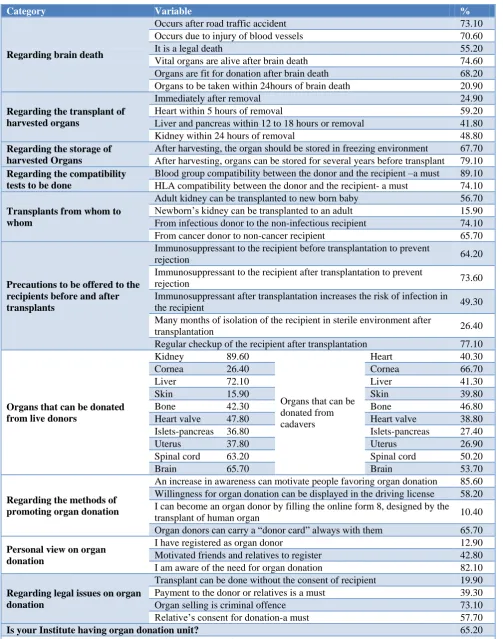
Among the study participants, correct knowledge about the brain death was analysed, with 74.6% being aware that vital organs are alive after brain death, 59.2% answered correctly regarding question related to heart to be transplanted within 5 hours of removal and 67.7% answered correctly about the organ storage in freezing environment. Maximum correct responses were noted for the question regarding compatibility of the tests where 89.1% had correct knowledge for blood group compatibility and 74.1% had for HLA compatibility between donors and recipients. 56.7% had correct knowledge about transplant of adult kidney to newborn, 73.6% regarding immunosuppressant use to prevent rejection and 77.1% regarding regular check-up after transplantation. 89.6% had correct knowledge of transplanting kidney from live donors and only 15.9% had correct knowledge regarding skin transplant from live donors. About transplant of organs from cadaver, 66.7% gave correct answers for corneal transplant and only 29.6% regarding transplant of uterus (Table 1).
Among the study participants 85.6% answered that an increase in awareness can motivate people favouring organ donation and 85.6% supported organ donation. 73.1% of the study participants agreed that organ selling is criminal offence. 65.2% knew that there is an organ donation unit in their institute, only 36.3% knew where to register for organ donation and 79.1% answered that they think that education about organ donation should be made a part of primary education (Table 1).
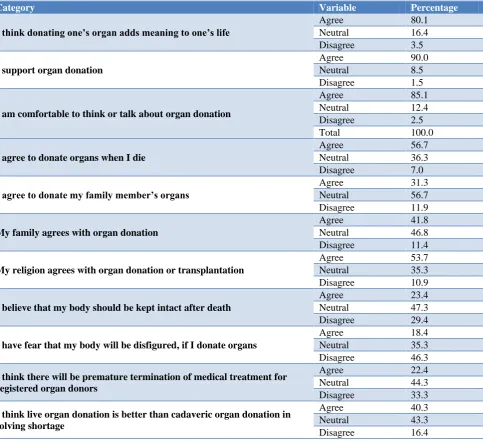
Regarding personal view on organ donation, 80.1% agreed that donating organs adds meaning to one’s life, 90% supported organ donation and 85.1% were comfortable to think or talk about organ donation. Fifty six per cent agreed to donate their organs and 40.3% thought that live organ donation is better than cadaveric donation in solving shortage. (Table 2).
Table 1: Distribution of the correct responses given by the study participants related to knowledge about organ donation.
Category Variable %
Regarding brain death
Occurs after road traffic accident 73.10 Occurs due to injury of blood vessels 70.60
It is a legal death 55.20
Vital organs are alive after brain death 74.60 Organs are fit for donation after brain death 68.20 Organs to be taken within 24hours of brain death 20.90
Regarding the transplant of harvested organs
Immediately after removal 24.90
Heart within 5 hours of removal 59.20 Liver and pancreas within 12 to 18 hours or removal 41.80 Kidney within 24 hours of removal 48.80
Regarding the storage of harvested Organs
After harvesting, the organ should be stored in freezing environment 67.70 After harvesting, organs can be stored for several years before transplant 79.10
Regarding the compatibility tests to be done
Blood group compatibility between the donor and the recipient –a must 89.10 HLA compatibility between the donor and the recipient- a must 74.10
Transplants from whom to whom
Adult kidney can be transplanted to new born baby 56.70 Newborn’s kidney can be transplanted to an adult 15.90 From infectious donor to the non-infectious recipient 74.10 From cancer donor to non-cancer recipient 65.70
Precautions to be offered to the recipients before and after transplants
Immunosuppressant to the recipient before transplantation to prevent
rejection 64.20
Immunosuppressant to the recipient after transplantation to prevent
rejection 73.60
Immunosuppressant after transplantation increases the risk of infection in
the recipient 49.30
Many months of isolation of the recipient in sterile environment after
transplantation 26.40
Regular checkup of the recipient after transplantation 77.10
Organs that can be donated from live donors
Kidney 89.60
Organs that can be donated from cadavers
Heart 40.30
Cornea 26.40 Cornea 66.70
Liver 72.10 Liver 41.30
Skin 15.90 Skin 39.80
Bone 42.30 Bone 46.80
Heart valve 47.80 Heart valve 38.80 Islets-pancreas 36.80 Islets-pancreas 27.40
Uterus 37.80 Uterus 26.90
Spinal cord 63.20 Spinal cord 50.20
Brain 65.70 Brain 53.70
Regarding the methods of promoting organ donation
An increase in awareness can motivate people favoring organ donation 85.60 Willingness for organ donation can be displayed in the driving license 58.20 I can become an organ donor by filling the online form 8, designed by the
transplant of human organ 10.40
Organ donors can carry a “donor card” always with them 65.70
Personal view on organ donation
I have registered as organ donor 12.90 Motivated friends and relatives to register 42.80 I am aware of the need for organ donation 82.10
Regarding legal issues on organ donation
Transplant can be done without the consent of recipient 19.90 Payment to the donor or relatives is a must 39.30 Organ selling is criminal offence 73.10 Relative’s consent for donation-a must 57.70
Is your Institute having organ donation unit? 65.20
Do you know where you can register for organ donation 36.30
Table 2: Distribution of the study participants based on attitude towards organ donation.
Category Variable Percentage
I think donating one’s organ adds meaning to one’s life
Agree 80.1 Neutral 16.4 Disagree 3.5
I support organ donation
Agree 90.0 Neutral 8.5 Disagree 1.5
I am comfortable to think or talk about organ donation
Agree 85.1 Neutral 12.4 Disagree 2.5 Total 100.0
I agree to donate organs when I die
Agree 56.7 Neutral 36.3 Disagree 7.0
I agree to donate my family member’s organs
Agree 31.3 Neutral 56.7 Disagree 11.9
My family agrees with organ donation
Agree 41.8 Neutral 46.8 Disagree 11.4
My religion agrees with organ donation or transplantation
Agree 53.7 Neutral 35.3 Disagree 10.9
I believe that my body should be kept intact after death
Agree 23.4 Neutral 47.3 Disagree 29.4
I have fear that my body will be disfigured, if I donate organs
Agree 18.4 Neutral 35.3 Disagree 46.3
I think there will be premature termination of medical treatment for registered organ donors
Agree 22.4 Neutral 44.3 Disagree 33.3
I think live organ donation is better than cadaveric organ donation in solving shortage
Agree 40.3 Neutral 43.3 Disagree 16.4
Table 3: Distribution of the study participants based on prejudice regarding organ donation.
Category Variable Percentage
My religion agrees with organ donation or transplantation
Agree 53.7 Neutral 35.3 Disagree 10.9
I believe that i will not be included in conducting rituals after organ donation
Agree 26.4 Neutral 38.3 Disagree 35.3
I will not be leaving for heavenly abode after organ donation
Agree 24.4 Neutral 31.3 Disagree 44.3
DISCUSSION
Organ donation has been the last option at the end of life and most important field among the medical students to learn and transfer out the right information and also
Ilango et al, which reported 63.4% of the medical students had correct knowledge about organ donation.6 Regarding the storage of harvested organs, correct knowledge noted was in 67.7 to 79% of the students in comparison with 84.5% of medical students in study by Ilango et al.6 Regarding compatibility to be checked between donors and recipients, 89% gave correct answer about blood group compatibility and 74% about HLA compatibility similar to study by Ilangoin which 83.3% of medical students gave correct answer. Regarding transplantation, among the individuals less than 60% correct answers were noted similar to the results of less than 60% from the study done by Ilango.6 Knowledge about transplantation of kidney from live donors was high with 89.6% but that of skin was only 15.9%. In a study done by Bathija et al among the medical interns and postgraduates, they had good knowledge about kidney transplantation (91%) which was similar to our study.7 Knowledge regarding organ transplant from cadavers were noted to be more for cornea with 66.7% and that in the study by Bathija et al was more than 90%.7 In our study 79.1% believed that education about organ donation should be made a part of primary education whereas that in study done by Sahana et al was 86.5%.8 In our study 73.1% believed that organ selling is a criminal offence similar to 75.2% from study done by Ilango.6
In our study 90% of the participants agreed to support the organ donation similar to the study by Ilango where 88.4% of the medical students support organ donation.6 In our study 56.7% agree to donate organs which is less than that in the study done by Bathija et al where 71.3% of interns and 73.6% of postgraduates were willing to donate organs.7 In our study 10.9% of the participants believed that their religion does not agree with organ donation and the same in the study by Sahana et al was 13.3%.8
CONCLUSION
The perception about organ donation is adequately good but the prejudice associated with organ donation among the medical students is also prevalent among the medical students. Knowledge regarding the legal issues on organ donation needs to be stressed on and there is need to educate students from primary level off education. Organ donation from deceased donor and live donor is in its infancy in India. There is significant increase in organ demand and is not met with the equal increase in the organ donation not only in India but in the whole world. There is a need to bridge the gap between the need of organs and availability of donors. This gap can be reduced by educating people on organ donation through
various measures. One of the best ways is to educate the youngsters in the medical field who can carry the message to the level of family, friends, relatives, patients and community levels.
Funding: No funding sources Conflict of interest: None declared
Ethical approval: The study was approved by the Institutional Ethics Committee
REFERENCES
1. Second Global Consultation on Regulatory Requirements for Human Cells and Tissues for Transplantation: Towards Global Harmonization through Graduated Standards. Available at: https://www.who.int/transplantation/2dHTTGHrepo rt.pdf. Accessed on 27 February 2019.
2. Highlights of national organ and tissue transplant programme and operational guidelines for its implementation. Available at: https://www.notto. gov.in/95_1_guidelines.pdf. Accessed on 27 February 2019
3. National Health Portal. Available at: https://www. nhp.gov.in/Organ-Donation-Day_pg. Accessed on 27 February 2019.
4. Directorate General of Health Services. Ministry of Health and Family Welfare. Available at: http://dghs.gov.in/content/1353_3_NationalOrganTr ansplantProgramme.aspx. Accessed on 27 February 2019.
5. India Celebrating.com. Available at: https://www. indiacelebrating.com/events/organ-donation-day/. Accessed on 27 February 2019.
6. Ilango S, Nandhini MU, Manikandan S, Sembulingam P. Awareness of Organ Donation among Fresh Students in Medical Field. Int j med sci clinical invention. 2014:1(6):274-83.
7. Bathija GV, Ananthesh BG, Bant DD. Study to Assess Knowledge and Attitude towards Organ Donation among Interns and Post Graduates of a MedicalCollege in Karnataka, India. Natl J Community Med. 2017;8(5):236-40.
8. Sahana BN, Sangeeta M. Knowledge, attitude and practices of medical students regarding organ donation. Int J Cur Res Rev. 2015:7(16):74-7.
Cite this article as: Rashmi S, Murthy MRN.