Original Research Article
Awareness about organ donation in medical and non medical
students in Patan city of Gujarat, India
Jatinkumar Amaliyar
1, Punit Patel
2*
INTRODUCTION
“Organ donation (OD) is the process of giving an organ or a part of an organ for the purpose of transplantation into another person(s).”1
Expert says that the organs from one donor can save or help as many as 50 people.2 More than 4 lakh Indians require transplantation annually. However, not even 10% get it. Around 1.5 lakh brain death occurs due to road traffic accidents (RTA) and if even 20% of them would donate, organ
transplantation shortage in our country would be fulfilled.3 Once a patient is declared brain dead, almost 37 different organs and tissues can be donated including heart, kidney, liver, lungs, and pancreas. An average of 21 people die each day because organ they need are not donated at time.4 Every 10 minutes another name is added to the national organ transplant waiting list.5 Awareness, positive attitude and consent by relatives for organ donation in brain death patient are the prerequisites organ donation.6 Lack of understanding, religious
ABSTRACT
Background: More than 4 lakh Indians require transplantation annually. However, not even 10% get it. Awareness, positive attitude and consent by relatives for organ donation in brain death patient are the prerequisites organ donation. Lack of understanding, religious attitudes along with myths and misconceptions added to the low percentage of organ donation. To bridge this gap we have conducted this research.
Methods: A cross sectional study was conducted among 300 students of last 4 semesters after getting permission was obtained from Institutional Ethics Committee and principals/dean of above mentioned colleges. Self-administered questionnaires were allotted to students. Questionnaire contained demographic information and questions regarding the knowledge and attitude toward organ donation. After answering, the answer sheets were collected for evaluation.
Results: Satisfactory knowledge was observed regarding consent before OD (58.0%), organ transplantation act (70.6%) and, risk involved in OD (77.7%). However, low level of awareness was found about legalisation of brain death (39.3%), organ donation centre (29.3%) and organ donation card (11.3%) was very low among students. About 3/4th of students (78.3%) were willing to be a donor, and their preferences of the recipient were 49.7% for family members, 31.3% for friend, 24.2% for relative and 43.6% for unknown person.
Conclusions: There is gap between knowledge and attitude about OD among youth. Media should take up the initiative of broadcasting of the legislative laws related to process of OD and also information regarding organ donation card, organ donation centre.
Keywords: Organ donation, Student, Awareness, Attitude
Department of Community Medicine, 1GMERS Medical College, Patan, 2Banas Medical College and Research Institute, Palanpur, Gujarat, India
Received: 29 April 2019
Revised: 09 May 2019
Accepted: 131 May 2019
*Correspondence:
Dr. Punit Patel,
E-mail: [email protected]
Copyright: © the author(s), publisher and licensee Medip Academy. This is an open-access article distributed under the terms of the Creative Commons Attribution Non-Commercial License, which permits unrestricted non-commercial use, distribution, and reproduction in any medium, provided the original work is properly cited.
attitudes along with myths and misconceptions added to the low percentage of organ donation. Superstitious beliefs have generated fear and mistrust in the minds of the common man and, especially, the terminally ill patients.7,8 Although, college students are aware of ideas of blood donation, organ donation after death continues to be a problem. To bridge this gap we have conducted this research.
Aim and objectives
To assess the knowledge, attitude and practice about organ donation among non medical college students Patan.
To compare the awareness among students of different streams.
METHODS
A cross sectional study was conducted among 300 students from Shri & Smt. P.K. Kotawala Arts college (n=100), Smt. T.S.R Commerce college (n=100) and GMERS medical college (n=100) during September to December 2018. There are 70 colleges of different streams in Patan district. Out of which three colleges were selected randomly. Student of last 4 semesters were included in the study to evaluate knowledge and attitude regarding OD. Student who denied consent and absent on data collection day were excluded from the study. The permission was obtained from Institutional Ethics Committee and principals/dean of above mentioned colleges. A purposive sampling technique was used for selection students.
The participants were informed of the objective of the study. A self-administered questionnaires were allotted to students and sufficient time was given to them to fill the questionnaires. Questionnaire contained two sections. Section A included demographic information such as age, gender, and history of organ donation in the family. Section B assessed the level of knowledge and attitude toward organ donation. After answering, the answer sheets were collected for evaluation.
Statistical analysis
The data was entered in “Microsoft Excel” and analyzed using the Epi info 7. Qualitative variables were described in percentages. Association between qualitative variables was done by chi- square test. A p values less than 0.05 was considered significant was considered significant.
RESULTS
A total of 300 students were included in the study. Of them, 192 (64.0%) subjects were males. About 217 students (72.4%) are in age group of 18-20 years. Majority of the students (90.6%) were Hindu. There was no significant difference between sociodemographic
characteristics or knowledge about organ donation between two genders.
Table 1: Socio demographic detail of students.
Socio demographic
characteristics Frequency
Percentage (%)
Gender
Male 192 64.0
Female 108 36.0
Age
18-20 217 72.4
21-23 83 27.6
Religion
Hindu 272 90.6
Muslim 28 9.3
Marital status
Married 6 2.0
Unmarried 294 98.0
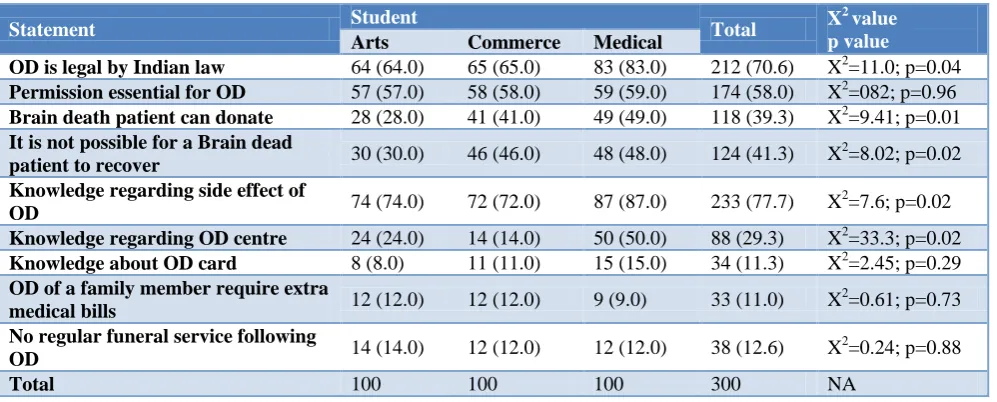
Knowledge regarding OD was shown in Table 2. Total 212 (70.6%) students were aware of the “organ transplantation act. More than half of students (174, 58%) knew that consent was essential for OD. Only 119 students (39.3%) were aware about legalisation of brain death by Indian law and organ can be donated by brain dead patient. Most of the students (77.7%) believe that there are no side effects of organ donation. Awareness regarding organ donation centre and organ donation card was very low among students (29.3% and 11.3% respectively). About 33 (11.0%) and 38 (12.6%) students had misbelieved regarding paying extra bill for OD and no regular funeral services after OD respectively. It was reported that awareness regarding eye donation (80.0%), kidney (64.3%), liver (57.0%) among the students. The medical students were more aware about various aspect of organ donation than other students except consent required for OD, organ donation card, misbelieve regarding paying extra bill for OD and no regular funeral service following OD. Major source of information is television (71.33%), followed by newspaper (52.67%), family (39.67%), internet (33%), etc.
Table 3 shows attitude of students towards OD. More than 3/4th of students (179, 78.3%) had strong willingness towards OD and it was more observed in science students (92.0%) as compared to commerce (86.0%) and arts students (57.0%). Among these 179 students, most common preference for OD was family member (49.7%) followed by friends (31.3%) and close relative (24.0%). Whereas 78 students (43.6%) were willing to donate their organs to unknown needy persons.
Table 2: Comparison of knowledge regarding OD among students of different stream.
Statement Student Total X
2
value p value
Arts Commerce Medical
OD is legal by Indian law 64 (64.0) 65 (65.0) 83 (83.0) 212 (70.6) X2=11.0; p=0.04
Permission essential for OD 57 (57.0) 58 (58.0) 59 (59.0) 174 (58.0) X2=082; p=0.96
Brain death patient can donate 28 (28.0) 41 (41.0) 49 (49.0) 118 (39.3) X2=9.41; p=0.01
It is not possible for a Brain dead
patient to recover 30 (30.0) 46 (46.0) 48 (48.0) 124 (41.3) X
2
=8.02; p=0.02
Knowledge regarding side effect of
OD 74 (74.0) 72 (72.0) 87 (87.0) 233 (77.7) X
2
=7.6; p=0.02
Knowledge regarding OD centre 24 (24.0) 14 (14.0) 50 (50.0) 88 (29.3) X2=33.3; p=0.02
Knowledge about OD card 8 (8.0) 11 (11.0) 15 (15.0) 34 (11.3) X2=2.45; p=0.29
OD of a family member require extra
medical bills 12 (12.0) 12 (12.0) 9 (9.0) 33 (11.0) X
2
=0.61; p=0.73
No regular funeral service following
OD 14 (14.0) 12 (12.0) 12 (12.0) 38 (12.6) X
2
=0.24; p=0.88
Total 100 100 100 300 NA
Table 3: Comparison of attitude regarding OD among students of different stream.
Variable Student Total X
2
value p value
Arts Commerce Medical Willingness level for OD
Strong willingness 33 (33.0) 67 (67.0) 79 (79.0) 179 (78.3)
X2=57.6 p<0.01 Will think about it 24 (24.0) 19 (19.0) 13 (13.0) 56 (18.6)
Unwillingness 43 (43.0) 14 (14.0) 8 (8.0) 65 (21.7)
Total 100 100 100 300
Priority for OD
Family member 24 (72.5) 26 (38.8) 39 (49.4) 89 (49.7)
X2=3.80 p=0.13 Friends 18 (54.5) 18 (26.9) 20 (25.3) 56 (31.3)
Relative 12 (36.4) 13 (19.4) 18 (22.8) 43 (24.0) Unknown 27 (81.8) 19 (28.4) 32 (40.5) 78 (43.6)
Total 33 67 79 179
Reasons for opting against organ donation
Thinking that family members would
not approve 16 (37.2) 11 (78.6) 6 (75.0) 33 (50.8)
X2=0.83 p=0.93 Do not wish to go through the
disfigurement involved 12 (27.9) 8 (57.1) 5 (62.5) 25 (38.5) Misuse of organ which are donated 13 (30.2) 6 (42.9) 3 (37.5) 22 (33.8) Do not believe in organ donation1 6 (14.0) 4 (28.6) 2 (25.0) 12 (18.5)
Total 43 14 8 65
DISCUSSION
Organ donation and transplantation is an important treatment modality of many end organ diseases.9 A total of 300 students were enrolled in present study. Satisfactory knowledge was observed regarding consent before OD (58.0%), organ transplantation act (70.6%) and, risk involved in OD (77.7%). However, low level of awareness was found about legalisation of brain death (39.3%), organ donation centre (29.3%) and organ donation card (11.3%) was very low among students. The medical students were more aware about various aspect of organ donation than other students except consent required for OD, organ donation card, misbelieve
regarding paying extra bill for OD and no regular funeral service following OD.
Sam et al observed satisfactory knowledge regarding organ transplant act (54.0%) and risk involved (49.0%).10 A study conducted by Ramadurg reported that only 12.9% were aware about the laws legalizing brain death in India.11 This deficiency might be due to lack of awareness about legal terminologies and information. Knowledge about donor card was also reported low in different studies (42.0%, 35.0%).10,12
according to students opinion, This observation was similar to the study conducted by Annadurai et al In the present study, major source of information is television (71.3%), followed by newspaper (52.6%) and family (39.6%) and internet (33%).13 Bapat et al reported major source of information as television (61.0%), newspaper (60.0%) and magazines (51.0%).14 The role of effective communication to family members was highlighted by many researchers.15,16
In the present study, about 3/4th of students (78.3%) were willing to be a donor, and their most common preferences of the recipient were family members (49.7%) followed by friend (31.3%), relative (24.2%) and unknown person (43.6%). Similar findings were observed by Sam et al.10 It was reported 70.4% willingness level and their preferences were 32.7% for family members, 23.7% for friends, and 43.6% for unknown persons.
In the present study, total 56 (18.6%) were in the undecided category. By giving right knowledge, they can be pooled into the category of future organ donors. Total 65 students (21.6%) were not ready for OD. The reasons for unwillingness for OD were their misbelieve regarding disfigurement (8.6%), misuse of organ (7.6%) and 16.0% students stated that their family would not approve. Sam et al reported similar reasons for unwillingness.10 About 13.6% was not willing to go through the disfigurement, 29.4% had no trust in the legal system, and 49.2% stated that their family would not approve.
CONCLUSION
There is gap between knowledge and attitude about OD among youth. As media is major source of information, they should take up the initiative of broadcasting of the legislative laws related to process of OD and also information regarding organ donation card, organ donation centre. Motivational messages and facts, advertisements on internet, campaigns and exhibitions can improve the awareness and attitude about OD among youth.
Limitation
The study was conducted among the students who were present within the colleges on the particular day which restrict generalization the findings.
ACKNOWLEDGEMENTS
I express my sincere gratitude to Dr. Nitin Solanki, Associate professor to sharing her wisdom during the course of this research. I am thankful to Dr. Rakesh Ninama, Assistant Professor for their valuable suggestions. Last but not the least I want to thank whole heartedly to the studens without whom this study would not have been completed.
Funding: No funding sources Conflict of interest: None declared
Ethical approval: The study was approved by the Institutional Ethics Committee
REFERENCES
1. Types of Organ Donation. Donate Life America. 2019. Available at: https://www.donatelife.net/ types-of-donation/. Accessed on 27 April 2019. 2. How Many Lives Can One Organ Donor Affect? |
UPMC HealthBeat. UPMC HealthBeat. Available at: https://share.upmc.com/2015/04/the-impact-of-one-organ-donor/. Accessed on 27 April 2019. 3. Mukharya P. How to Give Life After Death. The
Hindu, 2014.
4. Donate Life America: Organ, Eye, and Tissue Donation Registration. Donate Life America. 2019 Available at: https://www.donatelife.net/. Accessed on 27 April 2019.
5. Gortmaker SL, Beasley CL, Sheehy E, Lucas BA, Brigham LE, Grenvik A, et al. Improving the request process to increase family consent for organ donation. J Transplant Coordination. 1998;8(4):210-7.
6. Shroff S, Navin S, Abraham G, Rajan PS, Suresh S, Rao S, Thomas P. Cadaver organ donation and transplantation-an Indian perspective. Transplantation Proceedings. 2003;35(1);15-17. 7. Reddy AV, Guleria S, Khazanchi RK, Bhardwaj M,
Aggarwal S, Mandal S. Attitude of patients, the public, doctors, and nurses toward organ donation. Transplantation Proceedings. 2003;35(1):18. 8. Spencer M. The barriers to organ and tissue
donation in palliative care. End of Life J. 2012;2(2). 9. Grinyó JM. Why is organ transplantation clinically
important?. Cold Spring Harbor perspectives in medicine. 2013;3(6):a014985.
10. Sam N, Ganesh R, Indrapriyadarshini V, Jeyamarthan S, Nandhini CK. Awareness, knowledge, and attitude regarding organ donation among final year students of medical, Dental, Engineering, and Arts and Science Colleges in Thiruvallur and Chennai City, India. Indian J Transplantation. 2018;12(1):25.
11. Ramadurg UY, Gupta A. Impact of an educational intervention on increasing the knowledge and changing the attitude and beliefs towards organ donation among medical students. Journal of Clinical and Diagnostic Research:JCDR. 2014 May;8(5):JC05.
14. Bapat U, Kedlaya PG, Gokulnath. Organ donation, awareness, attitudes and beliefs amongst post graduate medical students. Saudi J Kidney Transplant. 2009;20:174-80
15. Morgan SE, Miller JK. Beyond the organ donor card. The effect of knowledge, attitudes, and values on willingness to communicate about organ donation to family members. Health Communication. 2002;14(1):121-34.
16. Lange SS. Psychosocial, legal, ethical, and cultural aspects of organ donation and transplantation. Critical Care Nursing Clin. 1992;4(1):25-42.