BUYER SUCCESS AND FAILURE IN BARGAINING AND ITS CONSEQUENCES
Chutinon Putthiwanit (Corresponding Author)
Graduate Student, Department of International Business Providence University, Taiwan Email: [email protected]
Dr. Shu-Hsun Ho
Professor of Marketing, Department of Business Administration Providence University, Taiwan Email: [email protected]
ABSTRACT
This study aims to investigate the process of buyers’ subsequent attitudes and subsequent actions and their relationships depended on the bargaining outcomes. Depth interviews were employed in order to explore the success, the failure, and the consequent actions in dyadic bargaining under the condition of one buyer and one seller. Ten international respondents were invited to be interviewed. Approximately one hour of each interview is taken, while English is the medium of the interviews. After the interviews, respondents were given five USD as an incentive. The results show that successful bargainers tended to be younger people and easterner, compared to unsuccessful bargainers who tended to be older people and westerner. When buying product in computer and vehicle category, it might provide higher chance in getting the discount, while buying product in garment category gave the partial tendency to win the bargain. Since garment seems to have fewer profit margins when compared to the other category like computer or vehicle, it thus is obligatory for the seller to avoid discounting this kind of product. During the interviews, author found that confident interviewees shared their successful bargaining experiences; whereas, interviewees with very calm and quiet attitude seemed to express about their unsuccessful bargaining stories. This research also provides insights of buyer as bargainer profoundly. It therefore helps the seller, especially in computer, garment, and vehicle industry, knows how to balance mutual-interest and maintain the strong relationship with customer.
Keywords: Bargaining, Negotiation, Price, Buyer-seller relationship, Satisfaction, Dissatisfaction
INTRODUCTION
Bargaining between buyer and seller is the most essential of the marketing process (Graham et al., 1988). It is considered to be the core of interactions within a number of marketing contexts (Angelmar and Stern, 1978). Bargaining occurs when there is negotiation between two parties. Its task is engaged with the cycles of offer and counteroffer (Schurr and Ozanne, 1985). Through this bargaining relationship, as long as an agreement is still unresolved, the bargaining between two parties will continue ceaselessly. Kwon et al. (2010) mention that, seeking a discount is a necessary aspect of shopping behavior, and bargaining from a business aspect must deal with the marketing transaction between sellers and buyers. Such bargaining mainly relates to the monetary factor, but also the concerns about the process known as tangible product exchange. Why do all buyers enjoy negotiating the price of a product? The answer is that, after the negotiation, the outcome can generate satisfaction that is important to bargainers (Patton and Balakrishnan, 2010). Notwithstanding, the fact remains that some buyers feel that bargaining is always disappointing, embarrassing (Herrmann, 2004; Schneider et al., 1999), and some even loathe it (Lee, 2000). Therefore, it is intriguing to understand buyer success and failure in bargaining and its consequences.
bargaining does not directly relate to the monetary factors involved in selling a product; instead this kind of
bargaining relates to an intangible product, such as compensation or work regulation.
There is a considerable amount of research examining the characteristics of buyers or sellers in bargaining situations. For example, the study of White and Neale (1994) explore the bargainers’ expectations on the bargaining outcomes; Maxwell et al. (2003) examine buyers’ behavior to think of fairness in price negotiations; while Kwon et al. (2010) study the characteristics of the bargain hunters over the forward-looking price expectation. There is a number of studies reporting about the characteristics of buyers or sellers. Although there are numerous studies that concentrate on exploring the relationship among buyers’ attitudes and actions, research on the bargaining outcome is still limited. Hence, this research aims to investigate the process of buyers’ subsequent attitudes and actions and their relationship to the bargaining outcome.
LITERATURE REVIEW Bargaining
Bargaining is the part of negotiation process that is directed towards agreement (Dwyer, 1984; Stroeker and Antonides, 1997). Therefore, it is essential for both parties to negotiate when doing a bargain (Lee, 2000). Bargaining skills can be learned and skilled the bargainer is more likely to bargain when there is a perceived chance for success (Herrmann, 2004). We can see that bargaining exists in services such as transportation, the sale of durable items such as houses, automobiles, gadgets, and even non-durable items such as garments and food products (Alserhan, 2009). As in the marketing context, a buyer and a seller create an interactive practice to reach a mutual price for merchandise, where each party brings decisions and values to the process determining the worth of an item (Herrmann, 2004). Alserhan (2009) also mentions that, in the process of buying and selling, the seller expects the buyer to bargain and therefore will overstate the initial price. Conversely, the buyer always assumes that seller is overstating the price and bargains for the lowest possible price of the product. In short, bargaining is usually a brief interaction initiated by a buyer in response to a seller’s offer (Herrmann, 2004). A strategic bargainer will obtain the product at the final plausible price (Schneider et al., 1999), whereas the reciprocity of the bargaining exchange allows the buyer to compete against the seller (Alserhan, 2009; Schneider et al., 1999).
Buyer-seller relationship in bargaining
By exploring one dyad consisting of one buyer and one seller in a marketplace, there must be at least a relationship (either positive or negative) between them. For the buyer and seller, bargaining is bound to values, personal judgment, bargaining skill, and feelings (Herrmann, 2004). We can assume that a bargaining is comprised of the seller determining the lowest acceptable price, and the buyer determining the highest acceptable price (White and Neale, 1994). A study by Maxwell et al. (2003) also supports that for price haggling, there is a perfectly negative correlation in payoffs between buyer and seller. From this relation, it is therefore comprehensible that both the buyer and seller will try to maximize personal benefit (Cakravastia and Nakamura, 2002; Maxwell et al., 2003).
Bargaining outcomes
Stroeker and Antonides (1997) state that the market structure influences bargaining outcomes and bargaining outcomes per se are determined by the proportion of sellers and buyers. However, Antonides (1991) suggests that a particular person’s outcome is referenced in a way that it should not be less than others’ outcomes. The outcome of bargaining can be described in two categories, successful and unsuccessful. In successful bargaining, highly analytical bargainers tend to reach a mutual outcome with the opponent (Giacomantonio et al., 2010). While, Graham et al. (1988) mention that bargaining sellers are definitely concerned with balancing the outcome between their personal profits and buyers’ satisfaction. In unsuccessful bargaining, the unsuccessful bargainer may possess insufficient negotiation skills (Alserhan, 2009); that is, this insufficiency results in paying higher price for a product when compared to a successful bargainer. In addition, reaching an agreement does not always mean that haggling is successful, a study by Deutsch (1961) mentions that some bargainers even accept an agreement that is undesirable in order to avoid negative feelings.
Post-bargaining attitude (PBAT)
Buyer’s satisfaction or pride
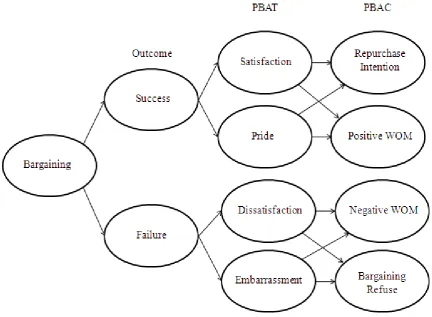
When the needs of both bargaining parties are fulfilled, both of them will be satisfied (Campbell et al., 1988; Schneider et al., 1999; and Maxwell et al., 2003). On the other hand, Patton and Balakrishnan (2010) criticize that, when purchasing a product, some buyers will use win-lose style of bargaining as to totally satisfy themselves at the expense of sellers. Consequently, Folkes (1988) mentions that pride, as a positive feeling, can lead a successful bargainer to brag about the purchase. Murnighan (1992) also supports that, immediately after purchasing the product, most believe that a good deal has been made.
Buyer’s dissatisfaction or embarrassment
The bargaining outcomes can generate dissatisfaction or even embarrassment for the bargainers. It is true that when there is a winner, there must be someone who has succumbed to the opponent’s better bargaining skill. A study by Simonson (1991) mentions that an unsuccessful deal will lead the buyer to dissatisfaction. However, Richins (1983) complements that if dissatisfaction is minimal, the buyer may not take any further action at all. In fact, for the feelings of embarrassment, Deutsch (1961) reports that when the bargainer is incapable of reaching an agreement, face has been lost. Patton and Balakrishnan (2010) also claim that the unsuccessful negotiators do not only feel upset about the unavailing negotiations but also feel less of a tendency for future negotiations. As a result, these negative feelings may affect the subsequent bargaining behavior.
Post-bargaining action (PBAC)
It is intriguing to know what the further action will be when a buyer can or cannot get the cheaper price for a product. A research by Burns and Bowling (2010) claims that buyer satisfaction relates to repeat buying intention and positive Word-Of-Mouth (WOM). It is problematic whether there are more actions (PBAC) resulting from the succession in bargaining or not. Hence, in this section, the subsequent actions of buyers will be discussed.
Repurchase intention with positive emotions
Satisfaction can influence a range of behavior after the succession in bargaining (Novemsky and Schweitzer, 2004). Therefore, it is no wonder that when a bargainer is satisfied with the succession in buying a discounted product, there is a tendency toward repeated purchase (Schindler, 1989). Herrmann (2004) also mentions that successful negotiation will make the bargainer feel proud since a cheaper price has been achieved.
Positive and negative WOM
Positive and negative PBAT affects the result of PBAC. For example, a buyer continues to purchase a product which is related to satisfaction (Richins, 1983); a product’s positive information will be passed on to the other buyers (Folkes, 1988; Richins, 1983). Schindler (1989) reports that buyer tends to tell the others about the successful purchase (e.g. getting discount on a product bought).
Burns and Bowling (2010) also support that positive WOM includes the action that buyer talks favorably to friends and family about a product or service. Surprisingly, Schindler (1989) reports that a trained seller can shape the buyer’s attitude in order to make buyer feel that the best discount has been obtained.
But, in contrast, Folkes (1988) mentions that the embarrassed unsuccessful bargainer may try to avoid talking about the purchase. Halstead and Page, Jr. (1992) also report that buyer dissatisfaction can lead to a complaint. As a result, we may assume that bargainer dissatisfaction and embarrassment may lead to negative Word-Of-Mouth.
Bargaining refuse due to unsuccessful past experience
Figure I Theoretical grounding of the bargaining process
METHODOLOGY Research position
This exploratory research aims to gain consumer’s insights on their PBAT and PBAC. Thus, our research approach employs qualitative techniques in the form of depth interviews and intends to explore the success, the failure, and the consequent actions in dyadic bargaining under the condition of one buyer and one seller. To this end, three research objectives were clarified as follows:
1) To explore buyers’ recent shopping experiences, their bargaining skills and tactics.
2) To identify PBATs and PBACs based on their outcomes in bargaining (successful/unsuccessful).
3) To discover buyers’ perceptions on bargaining and their reflections on bargaining.
Case selection and data collection
Respondents were recruited for depth interviews when they reported a purchase within the last three months and where one has had the sole power to make a decision on a purchase without the interruption from a family member. Later on, ten international respondents were invited to be interviewed in the cities of Taichung and Shalu, Taiwan. Interviews were conducted in restaurants, coffee shops, etc. The interview period was the 25th–
29th January 2011. Respondents were between the ages of 22 and 63 years old. All respondents were asked for
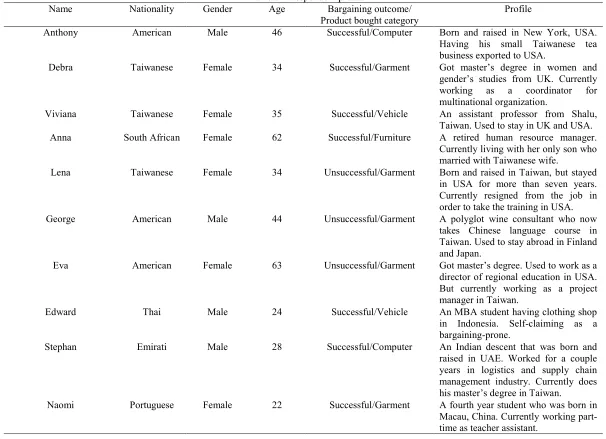
Table IRespondent profile
Name Nationality Gender Age Bargaining outcome/
Product bought category Profile
Anthony American Male 46 Successful/Computer Born and raised in New York, USA.
Having his small Taiwanese tea business exported to USA.
Debra Taiwanese Female 34 Successful/Garment Got master’s degree in women and
gender’s studies from UK. Currently
working as a coordinator for
multinational organization.
Viviana Taiwanese Female 35 Successful/Vehicle An assistant professor from Shalu,
Taiwan. Used to stay in UK and USA.
Anna South African Female 62 Successful/Furniture A retired human resource manager.
Currently living with her only son who married with Taiwanese wife.
Lena Taiwanese Female 34 Unsuccessful/Garment Born and raised in Taiwan, but stayed
in USA for more than seven years. Currently resigned from the job in order to take the training in USA.
George American Male 44 Unsuccessful/Garment A polyglot wine consultant who now
takes Chinese language course in Taiwan. Used to stay abroad in Finland and Japan.
Eva American Female 63 Unsuccessful/Garment Got master’s degree. Used to work as a
director of regional education in USA. But currently working as a project manager in Taiwan.
Edward Thai Male 24 Successful/Vehicle An MBA student having clothing shop
in Indonesia. Self-claiming as a bargaining-prone.
Stephan Emirati Male 28 Successful/Computer An Indian descent that was born and
raised in UAE. Worked for a couple years in logistics and supply chain management industry. Currently does his master’s degree in Taiwan.
Naomi Portuguese Female 22 Successful/Garment A fourth year student who was born in
Furthermore, from the depth interviews, we can generate more positive/negative PBAT and PBAC resulted from the bargaining outcomes. For PBAT, it can generate positive or negative PBAC depends on the result of the bargaining outcome. Some bargainers explained their positive PBAT as happiness:
I’ve bought a second-hand motorcycle from my Malaysian friend. The price was 12,500 TWD or something. For my first perception of the bike, I asked for the price for 8,000 TWD. But he (seller) didn’t want to sell with that price. So, I went to repair shop before making the decision. I took that bike and ask the repair shop to check how much this bike should cost. Then, I came back and deal with him again and asked him for 10,000 TWD. But he said that price is still low. Eventually, I came up with the final price of 10,500 TWD. It took around five minutes for the negotiation. We paid 1,000 TWD as the deposit on that day and paid the remaining on the following day. I felt happy since I had spent a few weeks looking for the bike (Edward, Thai, age 24).
Last time, I bought one pair of stockings and three pairs of socks at down market. I tried to bargain. I got like 20 bucks cheaper, not much. It didn’t take long time for the bargaining, around five minutes. I felt happy since I’ve got a cheaper price than its original price (Naomi, Portuguese, age 22).
We can see that a happy feeling is an immediate response when the outcome is desirable or at least it is matched with the expectation. Furthermore, some bargainers explained their PBAT as a good/nice feeling instead of happy. It may be assumed that though a discounted price was achieved, perhaps other factors exist(e.g. having the complementary product other than getting a cheaper price for main product bought, getting discount from the second seller in lieu of the first seller, etc.) that still did not fulfill their needs. For example:
When I bought a curtain for my bedroom, She’s (seller) got a lovely curtain and some beautiful materials, really nice. And I like all these materials and I asked her I may buy them from you and she said I’ll give it to you for free. So, when they came to deliver my curtain, they brought big bag full of different pieces of materials, around 50 pieces of them. If you go to the material shop, it will cost 100 TWD each. That was really nice. So I think if I want more materials, I will go to that shop and buy from them. I told my sister that I’ve got a really nice curtain but I wasn’t telling about the price (Anna, South African, age 62).
About my new car, I went to the showroom, asked the sale representative, and then I tried to drive the car. Afterwards, we talked about the price of the car, let say the deal, he (sale representative) said he could give me 40,000 TWD discount. But after a long negotiation, he went to talk with his supervisor and told me “No, there won’t be 40,000 TWD discount. Maybe, 15,000 TWD discount only.” At that time, I felt like I was cheated. So, I felt uncomfortable at that moment and decided to leave the showroom. Later, I came to university and other professor told me that he has an MBA student who is selling car. I talked to that student and told him my situation. He came to my office and tried to finish the deal. He asked me what the final price the first seller offered and gave the same discount as the first seller used to offer. I felt very good (Viviana, Taiwanese, age 35).
For one of the respondents, it was interesting that Viviana was an unsuccessful bargainer at first. But later on, after the second attempt, this bargainer became successful. Various kinds of PBAT were also generated, such as being cheated, uncomfortable, as well as positive feelings. From the theoretical grounding, it is assumed that unsuccessful bargainers may generate PBAT as dissatisfaction or embarrassment. But however, one of the respondents described her PBAT as regret:
successful bargainer used social network website as a tool to spread the successful purchase story. Here are some examples of positive PBAC:
I talked about this (successful bargaining) story with other friends in the campus since they have seen my new bike and asked how much I have bought. One of my friends, H_____, who knew about this, he also bought the new motorcycle just one week after I had bought mine. A few weeks later, another one of my friends, M_____, also bought a new bike, you know, it’s like neighborhood effect (Edward, Thai, age 24).
I told everyone, even in Facebook, that I bought a new car and it was a very good deal. My neighbor even asked me which showroom I have bought the car from because he would like to buy exactly the same model and same price with mine. So I gave him phone number of that dealer. My friend in Kaohsiung who knew about this news also told me that she would like to buy the car from this dealer also (Viviana, Taiwanese, age 35).
Negative PBAC can certainly affect to sales volume since buyer tries to spread the negative news about the buyer or even move to other seller; that is, it will reward the higher sale volume and customer loyalty to competing seller. Here is Lena’s experience who shared about her undesirable PBACs (negative WOM and moving to other seller) for seller:
Since I cannot get the discount from this seller I won’t recommend my friends to buy from her. In this kind of market, too many people sell the same thing. It’s very competitive. Okay, if you don’t want to treat me as your customer, I can go to other seller. I no need to come back for you (Lena, Taiwanese, age 34).
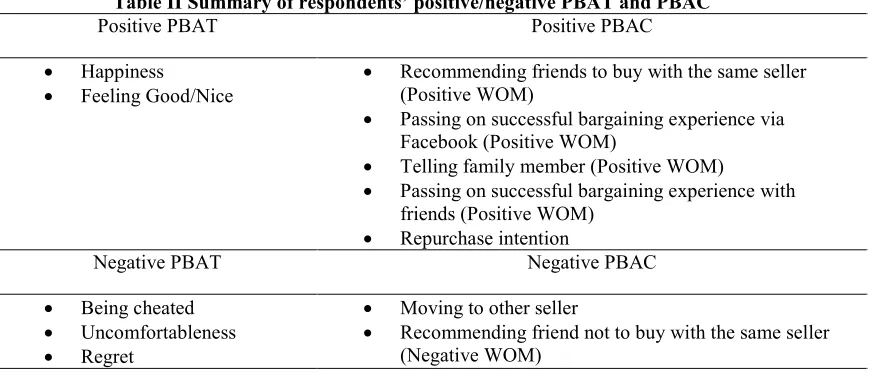
It was clear that the effect of negative PBAC was so severe since buyers have the power to make so many decisions. In sum, table II is the summary of these findings.
Table II Summary of respondents’ positive/negative PBAT and PBAC
Positive PBAT Positive PBAC
Happiness
Feeling Good/Nice
Recommending friends to buy with the same seller
(Positive WOM)
Passing on successful bargaining experience via
Facebook (Positive WOM)
Telling family member (Positive WOM)
Passing on successful bargaining experience with
friends (Positive WOM)
Repurchase intention
Negative PBAT Negative PBAC
Being cheated
Uncomfortableness
Regret
Moving to other seller
Recommending friend not to buy with the same seller
(Negative WOM)
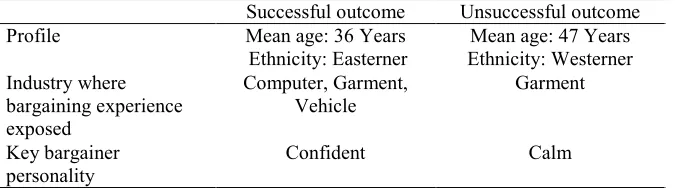
Next, the major bargainer responses to bargaining outcomes were analyzed, see table III. The authors found that successful bargainers tended to be younger people (mean age = 36 years) and Asians, compared to unsuccessful bargainers who tended to be older people (mean age = 47 years) and westerners. And, surprisingly, almost half of the successful bargainers are currently students (Edward, Stephan, and Naomi).
Table III Summary of major bargainer responses to bargaining outcomes
Successful outcome Unsuccessful outcome
Profile Mean age: 36 Years
Ethnicity: Easterner Ethnicity: Westerner Mean age: 47 Years Industry where
bargaining experience exposed
Computer, Garment, Vehicle
Garment
Key bargainer
personality Confident Calm
In addition, for clearer bargainer insights, some successful bargainers have demonstrated interesting tactic and style when doing the bargaining. For example:
For me, for the bargaining thing, it could come up with two reasons; first, when someone has financial disadvantage; and second, when the original price of the product is higher than our perception. For example, like second-hand cell phone, I perceive that the maximum price should be around 5,000 TWD (Edward, Thai, age 24).
To me, I have my perception price. For example, this laptop should be 15,000, 16,000, 18,000, or even 20,000 TWD. Any laptop less than 20,000 TWD, I’m happy to buy it. But when the seller said this computer is 23,000, 24,000, 30,000 TWD. Then, we had a conflict. Because of this I started to bargain. If the price you give me matches the price I’ve perceived, then I’ll be happy (Stephan, Emirati, age 28).
Normally my style of bargaining is like “If I buy two, will you give me a discount?” I feel a little bit cheap if I buy a t-shirt for 100 TWD and ask sell “Can you give me 80?” I used to do this when I was younger. That was a classic for a bargaining thing. Especially for a student, and you said you have no money and the seller is obligated to give you a small discount (Anthony, American, age 46).
From these results, it can be explained that self-esteem is an antecedent factor to shape buyer becoming bargainer. If the buyer is afraid to lose face, it may be decided not to bargain and accept the seller’s initial offer. This condition supports a research by Deutsch (1961) which states that individuals try their best not to lose face whenever there is a social interaction. Bargaining, as well, is one kind of social interaction between buyer and seller.
DISCUSSIONS AND CONCLUSIONS
In the bargaining process, buyer success or failure can produce PBAT and PBAC positively or negatively. Nonetheless, it is obvious that bargaining is concerned with the relationship between cost and benefit (Lindenberg and Oppenheim, 1978). An individual wants to be a bargainer based on the belief that there will be a discount in terms of a lower priced product, a free gift, or a service (Lee, 200). During the process of bargaining, in the seller’s mind, profit is the money earned above cost; while in the buyer’s mind, profit is the cheaper product bought (Stuhlmacher and Citera, 2005). The current research expands these concepts and calls the attention from buyer and seller to maintain mutual-interest, and simultaneously retain the long-term relationship (win-win situation).
Managerial implications
however, by giving excessive discount for a certain product, in consumer’s mind, he/she may perceive that a low price product infers a low quality and image (Swani and Yoo, 2010). We recommend that seller should use experience and bargaining tactics to give an appropriate discount.
Research limitations
Negotiation is a very complicated process (Cakravastia and Nakamura, 2002) and its outcomes are difficult to evaluate (Novemsky and Schweitzer, 2004). This is the raison d'être why bargaining, as a part of the negotiation process, is also very difficult to understand. Moreover, it is difficult to predict the result of a particular bargaining process and what PBAT and PBAC should be taken into account. Since our sample is relatively small (ten interviewees) and they sometimes had problems recalling their recent bargaining experiences since authors asked them to explain their bargaining experience in last three months. As a result, it may have an effect on accuracy in explaining bargaining attitude and further action.
Future research
Further research should increase samples in order to improve accuracy and precision in similarity in PBAC and PBAC among bargainers. Researchers should ask the respondents about their bargaining experiences in last one month in order to allow them recalling their experiences more obviously, precisely, and accurately. Antecedent factors before deciding to bargain (e.g. self-esteem, confidence, etc.) should be study to see what influent factors strong enough to drag buyer from bargaining (bargaining refrain/bargaining retraction). Moreover, it is suggested that future research may study the phenomena after the PBAC in order to see how effectively PBAC can shape the subsequent phenomena.
REFERENCES
1. Alserhan, B.B.A. (2009), “Propensity to bargain in marketing exchange situations: a comparative study”,
European Journal of Marketing, Vol. 43 No. 3/4, pp. 350–63.
2. Angelmar, R. and Stern, L.W. (1978), “Development of a content analytic system for analysis of bargaining
communication in marketing”, Journal of Marketing Research, Vol. 15 No. 1, pp. 93–102.
3. Antonides, G. (1991), “Psychological variables in negotiations”, Kyklos,Vol. 44 No. 3, pp. 347–62.
4. Benton, A.A. (1975), “Bargaining visibility and the attitudes and negotiation behavior of male and female
group representative”, Journal of Personality, Vol. 43 No. 4, pp. 661–77.
5. Burns, G.N. and Bowling, N.A. (2010), “Dispositional approach to customer satisfaction and behavior”,
Journal of Business and Psychology, Vol. 25 No. 1, pp. 99–107.
6. Cakravastia, A. and Nakamura, N. (2002), “Model for negotiating the price and due date for a single order
with multiple suppliers in a make-to-order environment”, International Journal of Production Research, Vol. 40 No. 14, pp. 3425–3440.
7. Deutsch, M. (1961), “The face of bargaining”, Operations Research, Vol. 9 No. 6, pp. 886–97.
8. Dwyer, R.F. (1984), “Are two better than one? Bargaining behavior and outcomes in an asymmetrical power relationship”, Journal of Consumer Research, Vol. 11 No. 2, pp. 680–93.
9. Folkes, V.S. (1988), “Recent attribution research in consumer behavior: A review and new directions”,
Journal of Consumer Research, Vol. 14 No. 4, pp. 548–65.
10. Giacomantonio, M., De Dreu, C.K.W., Shalvi, S., Sligte, D. and Leder, S. (2010), “Psychological distance
boosts value-behavior correspondence in ultimatum bargaining and integrative negotiation”, Journal of Experiment Social Psychology, Vol. 46 No. 5, pp. 824–29.
11. Gómez-Mejía, L.R., Balkin, D.B. and Cardy, R.L. (2010), Managing Human Resources,Pearson Education,
Upper Saddle River, NJ.
12. Gottlieb, M. and Healy, W.J. (1990), Making Deals: the Business of Negotiating, New York Institute of Finance, New York, NY.
13. Graham, J.L., Kim, D.K., Lin, C.Y. and Robinson, M. (1988), “Buyer-seller negotiations around the Pacific
Rim: Differences in fundamental exchange processes”, Journal of Consumer Research, Vol. 15 No. 1, pp.
48–54.
14. Halstead, D. and Page, Jr., T.J. (1992), “The effect of satisfaction and complaining behavior on consumer repurchase intentions”, Journal of Consumer Satisfaction, Dissatisfaction and Complaining Behavior,Vol. 5 No. 1, pp. 1–11.
15. Herrmann, G.M. (2004), “Haggling spoken here: Gender, class, and style in US garage sale bargaining”,
16. Kwon, K.N., Schumann, D.W. and Fairhurst, A. (2010), “Consideration of an expected future deal in
assessing the value of a present deal: Forward-looking bargain shopping”, Journal of Business Research,
Vol. 63 No. 1, pp. 84–90.
17. Lee, D.Y. (2000), “Retail bargaining behavior of American and Chinese customers”, European Journal of
Marketing, Vol. 34 No. 1/2, pp. 190–206.
18. Lindenberg, S. and Oppenheim, P. (1978), “The bargaining principle”, Synthese, Vol. 37 No. 3, pp. 387–
412.
19. Mathews, H.L., Wilson, D.T. and Monoky Jr., J.F. (1972), “Bargaining behavior in a buyer-seller dyad”,
Journal of Marketing Research,Vol. 9 No. 1, pp. 103–5.
20. Maxwell, S., Nye, P. and Maxwell, N. (2003), “The wrath of the fairness-primed negotiator when the reciprocity norm is violated”, Journal of Business Research,Vol. 56 No. 5, pp. 399–409.
21. Murnighan, J.K. (1992), Bargaining Games: a New Approach to Strategic Thinking in Negotiations, William Morrow, New York, NY.
22. Novemsky, N. and Schweitzer, M.E. (2004), “What makes negotiators happy? The differential effects of
internal and external social comparisons on negotiator satisfaction”, Organizational Behavior and Human
Decision Processes, Vol. 95 No. 2, pp. 186–97.
23. Patton, C. and Balakrishnan, P.V.S. (2010), “The impact of expectation of future negotiation interaction on bargaining processes and outcomes”, Journal of Business Research,Vol. 63 No. 8, pp. 809–16.
24. Richins, M.L. (1983), “Negative Word-Of-Mouth by dissatisfied consumers: A pilot study”, Journal of Marketing,Vol. 47 No. 1, pp. 68–78.
25. Schurr, P.H. and Ozanne, J.L. (1985), “Influences on exchange processes: Buyers’ preconceptions of a seller’s trustworthiness and bargaining toughness”, Journal of Consumer Research,Vol. 11 No. 4, pp. 939– 53.
26. Schneider, K.C., Rodgers, W.C. and Bristow, D.N. (1999), “Bargaining over the price of a product: Delightful anticipation or abject dread?”, Journal of Product & Brand Management,Vol. 8 No. 3, pp. 232– 43.
27. Simonson, A. (1991), “Examining consumer losses and dissatisfaction due to broken sales and service
agreements”, Journal of Consumer Satisfaction, Dissatisfaction and Complaining Behavior,Vol. 4 No. 1,
pp. 50–61.
28. Stroeker, N. and Antonides, G. (1997), “The process of reaching an agreement in second-hand markets for
consumer durables”, Journal of Economic Psychology,Vol. 18 No. 4, pp. 341–67.
29. Stuhlmacher, A.F. and Citera, M. (2005), “Hostile behavior and profit in virtual negotiation: A meta-analysis”, Journal of Business and Psychology,Vol. 20 No. 1, pp. 69–93.
30. Swani, K. and Yoo, B. (2010), “Interactions between price and price deal”, Journal of Product & Brand Management,Vol. 19 No. 2, pp. 143–52.
31. White, S.B. and Neale, M.A. (1994), “The role of negotiator aspirations and settlement expectancies in
bargaining outcomes”, Organizational Behavior and Human Decision Processes,Vol. 57 No. 2, pp. 303–