* To whom all correspondence should be addressed.
Numerical Study of Improvement in Heat Transfer Coefficient
of Cu-O Water Nanofluid in the Shell and Tube Heat Exchangers
Yones Afshoon and Ahmad Fakhar
Department of Mechanical Engineering, Kashan Branch, Islamic Azad University, Kashan, Iran.
doi: http://dx.doi.org/10.13005/bbra/1330
(Received: 03 April 2014; accepted: 04 May 2014)
This research evaluated improved rate of heat transfer coefficient and friction factor of Cu-O water nanofluid compared to water-based fluids by Cu-O water nanofluid as a incompressible, homogeneous and turbulent flow in the shell and tube heat exchangers by numerical methods in FLUENT, given the constant thermophysic properties of nanofluids in the size of nanoparticles at nanofluid volume concentrations of 0.015, 0.031, 0.078, 0.157 and 0.236% of nanofluids, in the range of 6000 to 31000 Reynolds as a fully developed turbulent flow compared to the base fluid, water, and setting initial conditions and boundary conditions based on temperature and inlet velocity of nanofluids. Increase in the volume concentration and Reynolds of nanofluid increase the local heat transfer coefficient, overall heat transfer coefficient and pressure drop of nanofluids. Improved heat transfer coefficient compared to water-based fluids is concluded as 32 percent.
Key words: Heat transfer, Nanofluid, Nanoparticles, copper oxide, Heat exchanger.
Heat exchanger is a device which transfers heat between two or more fluids at different temperatures. This could be a liquid-liquid, gas-gas, or gas-liquid. Heat exchangers are widely used in various industries including power plants, refineries, petrochemical, oil and gas, HVAC, automotive, pharmaceutical and food industry, metal smelting industries and in various devices such as boiler, steam generator, condenser, evaporator, cooling towers, pre-heaters of fan coils, oil coolers and heaters, radiators, stoves, etc. 1. Peyghambarzadeh and colleagues numerically compared three-dimensional plane flow and heat transfer of two different nanofluids, alumina oxide and copper oxide by combining water and ethylene glycol in extensive radiator tubes. They
of nanoparticles causes more heat transfer in Fe-O water nanofluids than Cu-O water nanofluids5. Empirical analysis of heat transfer coefficient shows that heat transfer characteristics improve as Reynolds number increases and concentration of nanofluids decreases. For heat load, the required pumping power increases as concentration of nanofluids increases. For hot and cold fluid flow rate, both energy consumption and heat transfer ratio were lower for water compared to nanofluids. Nanofluids required a lower flow rate, but the higher-pressure drop of water occurred for it. The pump with specified power can eliminate more heat by nanofluids than water, although, maximum ratio of heat transfer was obtained at the lowest concentration of nanofluids6. Evaluation of deionized water by 35nm Cu in nanofluids inside the tube with constant wall heat flow showed that the ratio of Nusselt number in nanofluid to pure water under the same conditions of flow rate varies from 1.05 to 1.14 by increasing volume fraction of nanoparticles, from 0.5 to 1.2% 7. Growth of temperature for nanofluids is larger than pure water. Because of the increased heat transfer for nanofluids, thickness of thermal boundary layer decreases because of non-uniform development of thermal conductivity and viscosity resulting from Brownian movement of nanoparticles. The wall shear stress increases with Reynolds number and concentration of nanoparticles8. Heat transfer ratio decreases as the load of nanoparticles increases; this shows that nanoparticles with more than 2% volume fraction need to be avoided, because they are both more expensive and cause intensive pressure loss. They also increase viscosity which is not favourable for heat transfer; thus, power consumption increases dramatically for the considered thermal load as nanofluid volume concentration increases. In other words, the effect of viscosity increase on heat transfer coefficient is more than that of increase in thermal conductivity for the optimal and higher volume concentration6. For example, Farajollahi et al used Al-O and Ti-O nanofluids in shell and tube heat exchanger and showed that nanofluids could increase the heat transfer characteristics compared to baseline nanofluids9. Convective heat transfer and pressure drop of turbulent flow of diluted Cu-O water nanofluid in rotational tube was empirically evaluated and it was found that addition of Cu-O
nanoparticles to the base fluid substantially increased heat transfer coefficient. On average, a 25% increase in heat transfer and 20% pressure drop was observed; this did not reflect specific changes of Cu-O concentration in this nanofluid. Stability of this flow increased also compared to the baseline fluid and even at very low concentrations of Cu-O. The term nanofluid was used by the Choi to explain suspended materials with thermal conductivity compared to the base fluid. Nanofluids have greater stability, higher surface area, and lesser obstruction and erosion10. Das et al evaluated the effect of temperature on thermal conductivity of nanofluids with water and base fluid in which there was Cu-O and Al-O particles as suspended particles. The results indicate that the thermal conductivity of nanofluids continued with temperature and thermal conductivity of nanofluids could not predicate heat transfer of nanofluids. Mansour et al evaluated the effect of potentials on physical characteristics for forcible convection of the fully developed laminar and turbulent flow in tube with constant heat flux. Many numerical and empirical researches have been conducted on the convective heat transfer of fluid in slow flow10. Some of these cases are subject to the convective heat transfer during turbulent flow. Mayga et al evaluated hydrodynamic and thermal properties of nanofluids inside a pipe with uniform temperature under laminar and turbulent flows by a single-phase model with specific characteristics; the results suggested that increase in nanoparticles could increase the heat transfer compared the base fluid10.
Ding and colleagues examined a maximum increase of heat transfer by up to 350% in the carbon nanopipe nanofluid with Reynolds number 800 in 110 times the diameter of the tube. Increase in convective heat transfer is also subject to increased heat conduction, organized particles, increased heat flux, and reduced thickness of thermal boundary layer, based on nanoparticles and nanofluids in a high proportion of carbon nanopipes11.
nanofluids and a new relationship was developed for Nusselt number of nanofluids, which is a function of the Nusselt number of base fluid and fraction of particles with descending linear function (12). Brownian movement of nanoparticles at the molecular and nanoscale level is the main mechanism of conductivity and thermal behaviour of nanofluids. Their model not only underlies temperature-dependent conductivity and fraction of particles, but also predicts the conductivity which is strongly dependent on the size. Different models like Einstein, Brickman, and Brownie can predict the viscosity of nanofluids13.
EXPERIMENTAL
This study was first numerically used in Gambit software, version 2.3.16 as a pre-processor software to generate geometry of the flow field, to adjust the flow network and to determine the boundary conditions. To generate the desired geometry, draw a cylinder with 1m in length and 32mm in diameter and another cylinder with 1m in length and 5mm in diameter inside a large cylinder by three-dimensional environment of gambit; then, split the shell to separate the fluid passage into two single areas. To generate the network and to generate the hexahedron mesh, use two perpendicular planes with 1m in length and 32mm in width. Then, split the shell and the pipe, respectively, from these two perpendicular planes to divide the total volume of shell and tube to 8 parts. In defining the boundaries, in both tube and shell, one side is called as velocity inlet and the other side as pressure outlet and the tube is called tube wall; therefore, the software automatically introduces the tube as tube wallshadow. This is very important because the tube is introduced as a two-sided border. Navier-Stokes equations are used, including equations of mass conservation and conservation of momentum as well as energy equations. These equations governing the flow field in a turbulent flow change the Reynolds equations. To determine Reynolds stress tensor and calculate vortex viscosity, a two-equation model k- [ is used.
50-30nm Cu-O water nanoparticles were evaluated as the base fluid called as Cu-O nanofluid with 0.015, 0.031, 0.078, 0.157 and 0.236% volume concentrations by thermophysic characteristics of water and Cu-O nanoparticles, according to Table
1, by Reynolds numbers in the range of 6000 <Re> 31000, in the analyst FLUENT.
RESULTS AND DISCUSSION
Effect of Reynolds Number on the Heat Transfer Coefficient
Figure 1 shows variations of heat transfer coefficient for Cu-O water nanofluids with different Reynolds numbers at different volume concentrations. To understand the effects of Reynolds number and volume concentration of nanoparticles on heat transfer of nanofluids, the ratio of convective heat transfer coefficient of nanofluids to water was studied. It is worth noting that the increase in heat transfer coefficient is caused by small amount of suspended Cu-O particles in water. The ratio of convective heat transfer coefficient of nanofluids to convective heat transfer coefficient of water, which is maximally 1, indicates a decreasing trend for the Reynolds number in all concentrations of Cu-O. This ratio states that the effect of nanoparticles is most noticeable at lower Reynolds numbers. Analysis of Pressure drop of nanofluids is also necessary when evaluating heat transfer function, because there is an increase in pressure drop of Cu-O nanofluid compared to the base nanofluid. This indicates that increase in Reynolds number increases pressure drop. By experimental and numerical techniques and results of this study, it is suggested to avoid nanofluids with more than 2% volume concentration, because they are both expensive and extensively drop pressure of the nanofluid. They also increase viscosity without benefit of heat transfer.
Effect of Volume Fraction of Nanofluids on Thermal Conductivity
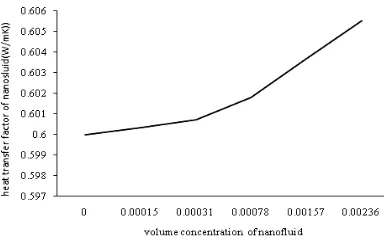
Fig. 2. Effect of volumetric concentration of Cu-O water nanofluid on its thermal conductivity
Fig. 1. Variations of heat transfer coefficient for Cu-O water nanofluid by Reynolds number at different
concentrations
Fig. 3. Effect of volumetric concentration of Cu-O water nanofluid on its specific heat
Fig. 4. Effect of volumetric concentration of Cu-O water nanofluid on its viscosity
Fig. 5. Effect of volume concentration of Cu-O water nanofluid on its density
stability of Cu-O water nanofluids. As volume fraction of Cu-O water nanofluids increases, the thermal conductivity also increases at evaluated concentrations according to the following figures. However, as volume concentration of nanofluid increases, other properties of nanofluid such as viscosity and density increase, while specific heat of nanofluids is reduced.
Figure 2 and Figure 3 represent effects of volumetric concentration of Cu-O water nanofluid on its thermal conductivity and volume concentration of Cu-O water nanofluid on its specific heat, respectively. As the figures show, the thermal conductivity of nanofluid increases while its specific heat decreases
Fig. 7. Effect of diameter on the specific heat of copper oxide nanoparticle
Fig. 8. Effect of diameter on thermal conductivity of copper oxide nanoparticles
Fig. 9. Variations of the pipe wall temperature as Reynolds number increases, Cu-O nanofluid
and the base fluid
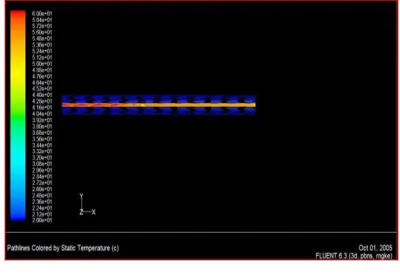
Fig. 10. Representation of temperature lines for Cu-O water nanofluid in the shell and tube of the heat
exchanger
Fig. 11. Variations of Reynolds number with Nusselt number of Cu-O water nanofluid in heat exchanger
Fig. 12. variations of Péclet number by Reynolds number
Figure 4 and Figure 5 represent effects of volumetric concentration of Cu-O water nanofluid on its density and volume concentration of Cu-O water nanofluid on its viscosity, respectively. As the figures show, both density and viscosity of nanofluid increase.
Evaluation of the Size of Nanoparticles on Heat Transfer
Fig. 13. Variations of Péclet number by concentration of the nanofluid at a constant Reynolds
Fig. 14. Effect of volumetric concentration of nanofluid on the Prandtl number
Fig. 15. Variations in flow rate of Cu-O water nanofluid and water versus Reynolds
Fig. 16. variations in heat transfer coefficient of Cu-O water nanofluid and water versus flow rate
Fig. 17. Variations of Nusselt number and heat transfer coefficient in volume concentration
of Cu-O water nanofluid
viscosity and density of Cu-O water nanofluid increases. Increase and effect of density is more than that of viscosity on increased Reynolds number and decreased thermal capacity, which play an effective role on improved heat transfer. Nanoparticles may be in triangular, square, cylindrical, and spherical shapes. Non- spherical shapes may have more thermal conduction due to fast heat transfer in relatively large distances of
nanoparticles; in turn, their viscosity increases, which itself increases temperature of the wall in its sharp tips whereby decreases Reynolds criterion. They may cause instability in the nanofluid flow due to aggregation instability. Therefore, sphericity is good. The following figures compare nanoparticles with 20, 40, and 60nm in diameters. As shown in Fig 6, Fig 7, Fig 8, increase in the
diameter of Cu-O nanoparticles increases density and thermal conductivity of copper nanoparticles, while their specific heat decreases.
Effect of Reynolds Number on the Wall Temperature
tube wall and absorbance of heat energy contained in it, however, wall temperature decreases. The evaluation between the wall temperature and Reynolds number showed that the heat energy absorbed in it and reduced wall temperature reduces the wall temperature while increasing nanoparticles to the base fluid. Therefore, when the temperature increases, the viscosity of nanofluid decreases and rapid alignment of nanoparticles occurs to create some contact between nanoparticles; in addition, decreasing particle in a fluid phase and near the wall causes a decreased thermal conductivity of boundary layers in the tube wall. In a constant concentration at different Reynolds numbers, this evaluation shows that temperature of a tube wall containing water flow as the base fluid is higher than the nanofluid flow and wall temperature decreases in both flows for higher Reynolds numbers. Figure 9 shows the pipe wall temperature in Celsius degrees, with increasing Reynolds at 0.015 and 0.031% volumetric concentration and water.
Figure 10 represents temperature of Cu-O water nanofluid in the shell and tube of the heat exchanger as a fully turbulent and fully developed flow as well as the boundaries of heat transfer.
Figure (11) shows variations of Reynolds number by Nusselt number of Cu-O water nanofluid in a shell and tube heat exchanger. Increase in the Reynolds increases Nusselt number. The highest volume concentration, i.e., 0.236%, and the Reynolds number 3000, Nusselt number of Cu-O water nanofluid increased approximately by ~32% compared to the base fluid and this increased by 17% in the optimal volume concentration.
Consistent with the increase in volume concentration and Reynolds number, Nusselt number of Cu-O water nanofluid gradually increases. By increasing volume concentration of nanofluid, Reynolds number of nanofluid increases due to the increased density of the nanofluid. Although viscosity of nanofluid increases, it is negligible compared to density. This is followed by increased shear stress of nanofluid, along with increased volume concentration of the nanoparticle. 3.5. Effect of Péclet Number on Heat Transfer Coefficient
As nanoparticles increase to the base fluid, the heat transfer coefficient increases; in addition, heat transfer coefficient of nanofluid increases by
increasing Péclet number, by increasing Reynolds number at a constant concentration, due to the constant Prandtl number and increased velocity compared to water. However, the heat transfer coefficient of nanofluid decreases as the volume concentration increases in a constant Reynolds number. Péclet number is equal to the product of the Prandtl number by the Reynolds number; the Reynolds number which occurs only in the velocity boundary layer is constant and the velocity is also constant. In contrast, the Prandtl number which occurs in the thermal boundary layer and the velocity boundary layer decreases. Because the reduced Prandtl number is more than increased Reynolds number, Péclet number decreases. Assuming that the temperature changes linearly in the thermal boundary layer, thermal conductivity and viscosity of the nanofluid increase as the volumetric concentration increases. As the volumetric concentration of nanofluid increases, the effects of increased viscosity on heat transfer coefficient are greater than the effects of increased thermal conductivity thereby increased hydraulic thickness and increased thermal boundary layer. Because of this increase in hydraulic thickness and thickness of the thermal boundary layer, the heat transfer coefficient reduces. All of these explanations are true for the overall heat transfer coefficient. It is worth noting that velocity and Reynolds increase simultaneously as the volumetric concentration of nanofluid increases; therefore, the overall increase in Reynolds number is higher; this increase is greater than decrease in the Prandtl number. In other words, it compensates for decline in Prandtl number; finally, Péclet number increases, which increases the heat transfer coefficient.
As shown in Figure 12, Figure 13, and Fig 14, Prandtl number decreases gradually as volumetric concentration of Cu-O water nanofluid increases; assuming the constant Reynolds number, Péclet number reduces. While, as the Reynolds number increases, as shown in Figure 11, the Péclet number increases providing that increase in volumetric concentration of Cu-O water nanofluid does not exceed the increase in Reynolds number; otherwise, the result will be reverse.
Effect of Nanofluid Flow Rate on the Heat Transfer Coefficient
of nanofluid; thus the convective heat transfer coefficient increases and the slope of the increase is higher in the overall heat transfer coefficient. One of the possible dynamic effects of nanofluid flow rate causes nanoparticle dispersion, increased thermal conductivity, reduced boundary layer, and increased shear stress boundary layer when the heat flows the network.
Figure 14 shows that increase in Reynolds number, flow rate increases due to the increased velocity of nanofluid. Figure 15 shows that heat transfer coefficient increases as the mass flow rate increases due to increased Reynolds number and velocity of nanofluid.
Effect of Nusselt Number on the Heat Transfer Coefficient
Nusselt number is the slope of dimensionless temperature at surface and the ratio of convection to the pure thermal conductivity of heat transfer; Nusselt number plays the same role in thermal boundary as the friction factor plays in the velocity boundary layer. By increasing Nusselt number at a constant concentration, as Péclet number, the heat transfer coefficient increases. As discussed earlier, this negatively influences Nusselt number along with increase in the volumetric concentration, because the thermal conductivity increases and negatively influences the Prandtl number. As a result, heat transfer coefficient decreases at a constant Reynolds number. However, these changes depend on constant or declining velocity. Therefore, as the volumetric concentration of nanofluid increases compared to water, increase in the Reynolds number is greater than decrease in Prandtl number, although the Prandtl number decreases by reduced specific heat capacity and increased thermal conductivity. Finally, these all cause increase in Nusselt number followed by increase in the heat transfer coefficient. There is a remarkable agreement between the heat transfer coefficient of nanofluid and Dittos-Bolter forecasts (Figure 16). It is also notable that these coefficients obtained for nanofluids are larger than water. As explained earlier, the effect of nanoparticle concentration ö on the heat transfer coefficient will be positive, that is, when assessing the very low concentration of Cu-O water nanofluids, increase in the heat transfer coefficient cannot be associated with increased thermal conductivity. An evaluation of the Nusselt number of Dittos-Bolter
and Nusselt number of other experiments found a good agreement 10.
Figure 16 and the description given above show that heat transfer coefficient of Cu-O water nanofluid at volumetric concentration of nanofluid increases as the Nusselt number increases. At Reynolds 30,000 and the given volumetric concentration, there are 8, 11, 15, 20 and 31% increase in Nusselt number of Cu-O water nanofluid compared to water.
CONCLUSION
the volumetric fraction of nanoparticles. Rate of increasing variations in the heat transfer coefficient of Cu-O water nanofluid is more than that of thermal conductivity. For example, the heat transfer rate was examined at Reynolds 7000, 10000, 12000, 18000, 25000 and 30000 in water and Cu-O nanofluid with various concentrations of 0.015, 0.031, 0.078, 0.157, and 0.236%. At volumetric concentration of 0.236% and Reynolds 30000, the local heat transfer coefficient was approximately 20000 W/m2K and the ratio of thermal conductivity was 0.60553 W/mK. At volumetric concentration of 0.078% and Reynolds 30000, the local heat transfer coefficient was approximately 16000 W/ m2K and the ratio of thermal conductivity was 0.60182 W/mK.
Best volumetric concentration is 0.078%, because its percentage increase in pressure drop is less than the percentage increase in heat transfer coefficient. At the highest volumetric concentration, i.e., 0.236%, and the Reynolds number 3000, the Nusselt number of Cu-O water nanofluid increased by 32% compared to the base fluid and this increased by 17% in the optimal volume concentration.
REFERENCES
1. Yu .W, France .D.M, Routbort .J.L, Choi., Review and Comparison of Nanofluid Thermal Conductivity and Heat Transfer Enhancements. Heat Transfer Engineering, 2009; 29: 432-460. 2. Naraki. M, Peyghambarzadeh .S.M, Hashemabadi
.S.H, Vermahmoudi .Y., Parametric Study of Overall Heat Transfer Coefficient of CuO/Water Nanofluids in a Car Radiator. International Journal of Thermal Sciences, 2013; 66: 82- 90. 3. Vajjha .R.S, Das .D.K, Namburu .P.K., Numerical
Study of Fluid Dynamic and Heat Transfer Performance of Al2O3 and CuO Nanofluids in the Flat Tubes of a Radiator. International Journal of Heat and Fluid Flow, 2010; 31: 613- 621.
4. Avramenko .A.A, Blinov .D.G, Shevchuk .I.V. Self Similar Analysis of Fluid Flow and Heat Mass Transfer of Nanofluids in Boundary Layer.
Phys Fluids, 2011; 23: 82- 95.
5. Peyghambarzadeh. S.M, Hashemabadi .S.H, Naraki .M, Vermahmoudi .Y., Experimental Study of Overall Heat Transfer Coefficient in the Application of Dilute Nanofluids in the Car Radiator. Applied Thermal Engineering, 2013;
52: 8- 16.
6. Pandey .S.D, Nema .V.K., Experimental Analysis of Heat Transfer and Friction Factor of Nanofluid as a Coolant in a Corrugated Plate Heat Exchanger. Experimental Thermal and Fluid Science, 2012; 38: 248- 256.
7. Kwon .y.k, Kim .D, Li .C.G, Lee .J.K, Hong D.S, Lee .J.G, Lee .S.H, Cho .Y.H, Kim .S.H., Heat Transfer and Pressure Drop Characteristics of Nanofluids in a Plate Heat Exchanger. J. Nanosci. Nanotechnol, 2011; 11: 5769- 5774.
8. Pandey .S.D, Nema .V.K., An Experimental Investigation of Exergy Loss Reduction in Corrugated Plate Heat Exchanger. Energy, 2011;
36: 2997- 3001.
9. Lotfi .R, Rashidi .A.M, Amrollahi .A., Experimental Study on the Heat Transfer Enhancement of MWNT/Water Nanofluid in a Shell and Tube Heat Exchanger. International Communications in Heat and Mass Transfer, 2012; 39: 108-111.
10. Fotukian .S.M, Nasr Esfahany .M. 2010. Experimental Investigation of Turbulent Convective Heat Transfer of Dilute c-Al2O3/ Water Nanofluid Inside a Circular Tube. Int J Heat Fluid Flow. IntCommun Heat Mass Transfer, 2012; 31: 606- 612.
11. Suresh .S, Chandrasekar .M, Selvakumar .P. Experimental Studies on Heat Transfer and Friction Factor Characteristics of CuO/Water Nanofluid under Laminar Flow in a Helically Dimpled Tube. Heat Mass Transfer, 2012; 48: 683- 694.
12. Abouali .O, Falahatpisheh.A., Numerical Investigation of Natural Conv ection of Al2O3 Nanofluid in Vertical Annuli. Heat Mass Transfer, 2009; 46: 15- 23.