Original Research Article
Recognition and interpretation of road signs by commercial drivers in
Enugu Nigeria
Wilfred O. Okenwa
1, Ikenna K. Ndu
2, Uchenna Ekwochi
2, Obinna C. Nduagubam
2*
,
Ogechukwu F. Amadi
2, Isaac N. Asinobi
2, Edmund N. Ossai
3INTRODUCTION
The Romans were the first civilization to construct an extensive transport network of roads from the 4th century BC which were key factors in the economic, political and militaristic expansion of the Roman Empire.1 Transportation has been recognized as very essential in the development of any society and the historical transition from riding on horseback reveals that an
alignment of technical, economic, political and social benefits resulted in the acceptance of mechanical transportation especially the automobile.2, 3 However, this progress has also led to the problem of road traffic injuries (RTIs) which cause more than 1.2 million deaths per year and injure 25-50 million more, making them the third largest contributor to death and injury in the world.3
Road traffic injuries are a cause of public health concern globally, with 85% of all deaths due to traffic crashes,
ABSTRACT
Background: Sub-Saharan Africa has the highest road injury death rate of all regions in the world with Nigeria being one of the four countries accounting for half of all these deaths. Road, traffic signs or codes are salient ways of communication to road users geared towards reducing road traffic accident and studies that traffic violation are considered to be amongst the causes of road traffic accidents. Recognition, interpretation and observance of road signs could be of great importance in reducing the incidence of road accidents. This study was aimed at assessing the knowledge of road signs by commercial drivers in Enugu South-East Nigeria.
Methods: This was a cross sectional descriptive study carried out in Enugu metropolis over a period of 3 months using a pre-tested structured questionnaire. Commercial drivers in Enugu participated in the study. Common road signs in their usual colors were showed to the drivers to test their ability to correctly identify the signs.
Results: The mean age of the respondents was 42.4±9.6 years. Majority of the respondents, 59.4% are on intra-city transport route. Over 65% of the driver’s attained secondary education and beyond. Nearly a half (49.4%) of the drivers had poor knowledge of road signs. Drivers who have attained primary education and less (AOR=0.2, 95% CI: 0.1-0.3); who are on intra-city transport route (AOR=0.08, 95% CI: 0.05-0.1) or had less than 11 years driving experience (AOR=0.3, 95% CI: 0.1-0.5) were less likely to have good knowledge of road signs.
Conclusions: Significant gaps still exist in knowledge of road signs among commercial drivers in Enugu, Nigeria.
Keywords: Road signs, Drivers, Recognition, Interpretation, Enugu
1
Department of Surgery, 2Department of Paediatrics, College of Medicine Enugu State University of Science and Technology, Enugu, Enugu State, Nigeria
3Department of Community Medicine, College of Health Sciences Ebony State University Abakiliki, Ebonyi State,
Nigeria
Received: 06 July 2019
Revised: 18 August 2019
Accepted: 19 August 2019
*Correspondence:
Dr. Obinna C. Nduagubam, E-mail: [email protected]
Copyright: © the author(s), publisher and licensee Medip Academy. This is an open-access article distributed under the terms of the Creative Commons Attribution Non-Commercial License, which permits unrestricted non-commercial use, distribution, and reproduction in any medium, provided the original work is properly cited.
90% of lost disability-adjusted life years (DALYs) and 96% of all child deaths due to RTIs occurring in developing countries.4 In fact, sub-Saharan Africa has the highest road injury death rate of all regions in the world and four countries, Nigeria, Ethiopia, South Africa, and Sudan, together account for half of all these deaths.5 In Nigeria, children account for 21% of all road traffic injury-related deaths and road traffic deaths ranked ahead of the most important causes of infant deaths such as neonatal sepsis, preterm birth complications, protein-energy malnutrition, neonatal encephalopathy, and meningitis.5,6 It has also killed more than three times as many adults as maternal disorders and almost twice as many people as tuberculosis.5 According to the Federal Road Safety Command (FRSC) Enugu State Sector command, in 2017, 758 road traffic accidents (RTAs) occurred in Enugu State, with 115 fatalities.7 It is projected that if current trends continue and new initiatives are not instituted, by 2020, RTAs will rank third for DALYs lost globally, and road traffic deaths in developing countries could increase by up to 80%.4,8,9
Road signs are traffic control devices which aim to regulate and control traffic by providing information about the road and its environment for road users in order to promote safety.10 Road traffic deaths in developing countries have been attributed mainly due to fatalities that occur in commercial vehicles such as taxis, trucks, buses and minibuses.11-14 Studies about the rising incidence of RTA in developing countries have focused on the well documented associations between RTA and poor knowledge or observance of road signs by commercial drivers.2,15,16 These studies suggest that city drivers in Nigeria do not have a satisfactory level of comprehensibility of road signs in parts of Nigeria where they were conducted. However no such study has been conducted in Enugu South East Nigeria. This study was therefore carried out to determine commercial drivers’ knowledge of road signs in Enugu city and the factors that influence their knowledge. We hope that our findings will contribute positively to the discourse on reducing morbidity and mortality from RTAs.
METHODS
The study was conducted in Enugu metropolis which is the capital city of Enugu state in south east Nigeria. The metropolis is spread over three local government areas of Enugu North, Enugu South and Enugu East. The study which was a cross sectional descriptive study was carried over a 3 months period (March 2018 to May 2018) in taxi, bus bays and garages in different parts of the city. Selection of bays or garages was random and covered the three LGAs in the metropolis. Each LGA had a taxi and a bus garage in it selected. Only commercial drivers in those bays were involved. The bays used were open to drivers who are registered in the bay and not drivers from large fleet companies that operate from their own exclusive garages. The head of the drivers association in each bay was approached and the study aimed to explain
clearly in other to solicit co-operation of the drivers. The consent of each driver to participate in the study was sought and obtained.
Data collection
A pre-tested and validated structured questionnaire was administered to consenting participants by a trained research assistant who had experience in such studies. The questionnaire was designed to contain common signs covering different categories of road signs such as regulatory signs, warning signs, guide signs and advisory signs. The signs were in color as the usually appear on the road sides. Respondents looked at the signs and chose out of four options, one correct interpretation of the sign. Other information obtained include age, marital status, educational level, driving route (intra- and inter- city) as well as driving experience.
Data collected was analyzed using IBM SPSS version 20 (Armonk, NY. IBM Corp). Where appropriate, Pearson’s Chi-square was used to evaluate relationship between respondents’ knowledge of road signs and driving route, age, educational attainment as well as involvement in road traffic accident. A multivariate regression analysis was employed in determining predictors of good knowledge of road signs. Results obtained were calculated and presented in tables as percentages. The adjusted odd ratio (AOR) was calculated with 95% confidence interval (CI) and statistical significance set at p<0.05.
Ethical clearance
Ethical clearance for this study was obtained from the institutional board (IRB) of Enugu State University of Science and Technology Teaching Hospital, Enugu. Chairmen or executives of the Drivers Associations in the various garages also gave their approval for their members to participate in the study. Participation in the study was purely voluntary and did not interfere with the activities of the drivers. They had the option to back out of the study at any stage without consequences. There was no financial inducement or remuneration to participate in the study and information generated was handled with utmost confidentiality.
RESULTS
The mean age of the respondents was 42.4±9.6 years and the highest proportion of the respondents, 38.2% were in the age group 35-44 years. Majority of the respondents, 59.4% are on intra-city transport route. The highest proportion of the respondents, 59.4% have attained secondary education while the least proportion, 6.0% have attained tertiary education (Table 1).
overtaking sign. All the drivers correctly identified children crossing sign while a minor proportion (16.8%) correctly identified slippery road sign. However overall,
nearly a half (49.4%) of the drivers had poor knowledge of road signs (Table 2).
Table 1: Socio-demographic characteristics of the respondents.
Variable Frequency (n=500) %
Age of respondents in years
Mean±(SD) 42.4±9.6
Age of respondents in groups (in years)
<35 108 21.6
35-44 191 38.2
45-54 138 27.6
≥55 63 12.6
Marital status
Not married 40 8.0
Married 439 87.8
Divorced 17 3.4
Widowed 4 0.8
Driving route
Intra-city transport 297 59.4
Inter-city transport 203 40.6
Educational attainment of respondent
No formal education 34 6.8
Primary education 139 27.8
Secondary education 297 59.4
Tertiary education 30 6.0
Driving experience (in years)
0-5 15 3.0
6-10 98 19.6
11-15 146 29.2
>15 241 48.2
Ever involved in an accident
Yes 350 70.0
No 150 30.0
Table 2: Knowledge of road signs among the respondents.
Variable Frequency (n=500) %
Thirty km per hour
Correct 378 75.6
Less than 2 meters high vehicle
Correct 131 26.2
Do not park
Correct 340 68.0
Park in night only
Correct 41 8.2
One way driving
Correct 230 46.0
Move to your right
Correct 132 26.4
No U turn
Correct 364 72.8
Narrow bridge
Correct 226 45.2
Drive without overtaking
Correct 308 61.6
Variable Frequency (n=500) %
Incorrect 192 38.4
Intersection with major road
Correct 246 49.2
Children crossing
Correct 500 100.0
Slippery road
Correct 84 16.8
Hospital
Correct 462 92.4
Men on road work
Correct 371 74.2
Knowledge of road signs
Good 253 50.6
Poor 247 49.4
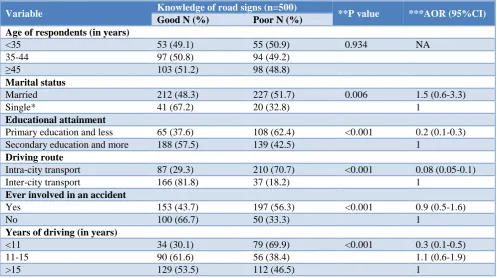
The respondents who have attained primary education and less were five times less likely to have good knowledge of road signs when compared with those who have attained secondary education and more (AOR=0.2, 95% CI: 0.1-0.3). The respondents who are on intra-city transport route were about thirteen times less likely to
have good knowledge of road signs when compared with those who ply the inter-city transport route, (AOR=0.08, 95% CI: 0.05-0.1). Also, the respondents have less than 11 years driving experience were three times less likely to have good knowledge of road signs when compared with those with more than 15 years driving experience, (AOR=0.3, 95% CI:0.1-0.5) (Table 3).
Table 3: Factors affecting good knowledge of road signs among the respondents.
Variable Knowledge of road signs (n=500) **P value ***AOR (95%CI)
Good N (%) Poor N (%) Age of respondents (in years)
<35 53 (49.1) 55 (50.9) 0.934 NA
35-44 97 (50.8) 94 (49.2)
≥45 103 (51.2) 98 (48.8)
Marital status
Married 212 (48.3) 227 (51.7) 0.006 1.5 (0.6-3.3)
Single* 41 (67.2) 20 (32.8) 1
Educational attainment
Primary education and less 65 (37.6) 108 (62.4) <0.001 0.2 (0.1-0.3)
Secondary education and more 188 (57.5) 139 (42.5) 1
Driving route
Intra-city transport 87 (29.3) 210 (70.7) <0.001 0.08 (0.05-0.1)
Inter-city transport 166 (81.8) 37 (18.2) 1
Ever involved in an accident
Yes 153 (43.7) 197 (56.3) <0.001 0.9 (0.5-1.6)
No 100 (66.7) 50 (33.3) 1
Years of driving (in years)
<11 34 (30.1) 79 (69.9) <0.001 0.3 (0.1-0.5)
11-15 90 (61.6) 56 (38.4) 1.1 (0.6-1.9)
>15 129 (53.5) 112 (46.5) 1
*Not married, divorced, separated **p value on bivariate analysis NA Not applicable ***Adjusted odds ratio (95% Confidence interval).
DISCUSSION
In this study on the recognition and interpretation of road signs by drivers in Enugu South East Nigeria, it was observed that nearly half of the drivers had poor knowledge of road signs. Similar findings were noted in South-South and South-West Nigeria.2,16 This is
licenses to ply the roads. However it has been put forward in a couple of studies that even among drivers that have knowledge of road signs the knowledge does not translate to observance of these traffic codes.2,17 Although this study did not go into comparing knowledge of these road signs with their actual observance on the road; drivers who had good knowledge of road signs were observed to be significantly less likely to have ever been involved in road traffic accident.
All the drivers who participated in this study were males and this depicts the level of participation of females in an occupation that is dominated by males in Enugu South East Nigeria. Similar finding was noted by Okafor and colleagues in Benin City Edo State Nigeria in their study among commercial long distance drivers in which only 1.3% of their participants were females a figure they considered surprisingly high going by what is obtainable in this part of the world.18 Similar low numbers of female commercial drivers were reported in Mekele city of Northern Ethiopia.19
There was no significant difference in the level of knowledge of road signs among the different age groups. This however contrasts with the finding by Adogu and colleague in a similar study on motorcyclists in Anambra State (a neighbouring state to the state where this study was carried out) South East Nigeria which noted that younger motorcyclists possessed better knowledge of traffic code than their older counterparts.15 Some studies on the contrary have suggested that young drivers are more likely to have poor knowledge of road signs and are more frequently involved in risky behaviors and traffic accidents than other age groups.20,21 On the other hand, Okafor et al reported poorest level of knowledge of road signs among drivers in the older age group.16 The absence of any significant difference on the knowledge of road signs among drivers of different age groups noted in this study may be related to the age of 18 which the drivers must attain before they can obtain driving license as all the drivers studied had their driving license and the least age of the participants was 20 years.7,19 Additionally, the participants within the age group <35 years in this study had fewer numbers of participants compared to the other two age groups. This may have influenced this finding.
Inter-city drivers had better knowledge of road sign compared to intra-city drivers. The reason for this finding is unclear but may be because they are exposed to road signs within and outside the cities and that there are regularly checked by agencies that ensure safety on the highways. By so doing these intercity drivers are more likely than intra-city drivers to have updated licenses and vehicle documents and these go with attendance to FRSC trainings and seminars on safety and observance of road signs. Although these studies reported poor knowledge of road signs among commercial drivers; they did not compare knowledge of road signs between intra-city and inter-city commercial drivers.2,6
Drivers who were married were significantly more likely to have good knowledge of road signs compared to those that are single (unmarried, divorced or separated). The reason is not clear but may be connected with the added responsibility that comes with marriage knowing that they have dependents which they should endeavor to live and take care of.
Drivers with low level of education (primary education and less) were about 5 times more likely to have poor knowledge of road signs were about 5 times higher among drivers with lower level of education compared to those with higher level of education (secondary and more). This finding collaborates the reports of earlier studies which had suggested that drivers with low level of education not only had higher likelihood of having poorer level of knowledge of road signs but also had higher risky driving behaviors than drivers with higher educational status.16,19,22 In contrast however, Onuka and colleagues in 2012 reported that despite training and education from the FRSC, drivers still exhibited risky driving behaviours.17 They however did not compare these drivers along their level of formal education as against periodic FRSC training as the level of formal education received by theses drivers could significant impact their appreciation of the FRSC trainings and positively influence their observance of these road signs thereby reducing risky driving behaviours. This is in alignment with the findings by Adogu and colleague who reported that knowledge of and attitude towards traffic codes and safety improved with increase in educational level.15
Drivers with less than 11 years driving experience had significantly poorer knowledge of road signs when compared to those with over 11 years driving experience. This stands to reason as the more years and experience they have in driving; the higher their exposure to road signs. Although similar studies in Lagos Nigeria and in Tanzania have shown that drivers without driving experience had high risky driving behaviors; some other studies either showed that driving experience was not a predictor variable for risky driving behavior or noted that drivers who had more driving experience exercised more risky behaviors.16,20,21,23 The reason for these variations is unclear. Differences in study design and socio-demographics of the participants could be contributory.
CONCLUSION
Significant gaps still exist on the knowledge of commercial drivers on road signs in Enugu South East Nigeria. There is need to intensify efforts on driver education to improve their knowledge.
Recommendations
including knowledge of road signs for commercial drivers. Basic formal education should be considered a pre-requisite for obtaining driving license.
ACKNOWLEDGEMENTS
Special thanks to all the commercial drivers in Enugu who participated in this study.
Funding: No funding sources Conflict of interest: None declared
Ethical approval: The study was approved by Health Research Ethics Committee of Enugu State University Teaching Hospital, ESUTH/Parklane, Enugu Nigeria.
REFERENCES
1. Laurence R. The roads of Roman Italy: mobility and cultural change. Routledge; 2002.
2. Asadu CA, Ayuwo JG. Knowledge and observance of road communication signs among commercial drivers in South-South, Nigeria. IISTE. 2018;67:81-7.
3. Sovacool BK. Early modes of transport in the United States: Lessons for modern energy policymakers. Policy Soc. 2009;27(4):411-27. 4. Hazen A, Ehiri JE. Road traffic injuries: hidden
epidemic in less developed countries. J Natl Med Assoc. 2006;98(1):73-82.
5. Bhalla K, Harrison J, Shahraz S, Abraham JP, Bartels D. Burden of road injuries in sub-Saharan Africa. Baltimore, USA: Department of Global Health and Population, Harvard School of Public Health; 2013.
6. Ndu KI, Ekwochi U, Osuorah DC, Ifediora OC, Amadi FO, Asinobi IN, Okenwa OW, Orjioke JC, Ogbuka FN, Ulasi TO. Parental practice of child car safety in Enugu, Southeast Nigeria. Pediatr Health Med Therapeut. 2016;7:141.
7. Federal Road Safety Commission (FRSC) Annual report. Enugu State Sector Command. Enugu State road traffic accident data; 2017.
8. Nantulya VM, Sleet DA, Reich MR, Rosenberg M, Peden M, Waxweiler R. The global challenge of road traffic injuries: can we achieve equity in safety? Inj Control Saf Promot. 2003;10(1-2):3-7. 9. Peden M, Scurfield R, Sleet D. World report on road
traffic injury prevention. World Rep Road Traffic Inj Prev; 2004.
10. Makinde O, Oluwasegunfunmi V. Comprehension of traffic devices amongst urban drivers- a study of
Ado-Ekiti, Ekiti State, Nigeria. Eur J Eng Technol. 2014;2(1):9-19.
11. Odero W, Khayesi M, Heda PM. Road traffic injuries in Kenya: magnitude, causes and status of intervention. Injury Control Safety Promot. 2003;10(1-2):53-61.
12. Mock C, Amegashie J, Darteh K. Role of commercial drivers in motor vehicle related injuries in Ghana. Inj Prev. 1999;5(4):268-71.
13. Hyder AA, Ghaffar A, Masood TI. Motor vehicle crashes in Pakistan: the emerging epidemic. Inj Prev. 2000;6:199-202.
14. Naci H, Chisholm D, Baker TD. Distribution of road traffic deaths by road user group: a global comparison. Inj Prev. 2009;15(1):55-9.
15. Adogu OU, Ilika AL. Knowledge of and Attitude towards Road Traffic. The Nigerian postgrad Med J. 2006;13(4):297.
16. Okafor I, Odeyemi KA, Dalapo DC. Knowledge of commercial bus drivers about road safety measures in Lagos, Nigeria. Ann Afr Med. 2013;12(1):34. 17. Onuka AOU, Akinyemi TF. The effectiveness of
FRSC public education programme of drivers’ road traffic habit in Lagos and Oyo State of Nigeria. Br J Arts Social Sci. 2012;6(1):129-39.
18. Okafor KC, Azuike EC, Okojie PW. The causes and prevalence of road traffic accidents amongst commercial long distance drivers in Benin City, Edo State, Nigeria. Niger J Med. 2017;26(3):220-30. 19. Hassen A, Godesso A, Abebe L, Girma E. Risky
driving behaviors for road traffic accident among drivers in Mekele city, Northern Ethiopia. BMC Res Notes. 2011;4:535.
20. Bjorn S. Globalization in road safety explaining the dawn ward trend in road accident rates. 2000;32:71-4.
21. Amichon J. What do we know; what should we do: human behavior and traffic safety. Netherlands: Plenum Press; 1995: 485-524.
22. Mike M. Traffic crash victimizations of California children and teenagers by drinking over-21 drivers. Californian J Health Promot. 2009;7:92-101. 23. Komba DD. Risk factors and road traffic accidents
in Tanzania; a case study of Kibaha district. Trondhein; 2006.