Original Research Article
Awareness of tuberculosis in the community: time to rethink strategies
Meera Shankar
1*, Ramasubramanian V.
2, Balasubramaniam Ramakrishnan
3INTRODUCTION
The burden of tuberculosis (TB) is high throughout the world and it has been identified as one of the top 10 causes of death. In 2017, 10 million people fell ill with TB, and 1.6 million died from the disease including 0.3 million among people with human immunodeficiency virus (HIV).1 The incidence of the disease is equally high among children, including co-infection with HIV. The highest number of cases is recorded in South East Asia and Western Pacific regions, with 62% new cases. India is considered as one of the high TB burden countries accounting for two-thirds of new TB cases.1 As per the
Global TB report of 2017, the estimated incidence of TB in India was approximately 28,00,000, accounting for about a quarter of the world’s TB cases.2,3
At the national level, India has been one of the earliest countries to implement a programme for the control of TB. Initially named as National Tuberculosis Control Programme, the strategies of the programme were revised time and again based on the ground level needs and demands. Strenuous efforts were taken to curb the spread of the disease in India by pioneering sanatorium method for disease containment, followed by Directly Observed Treatment Short course to ensure compliance to therapy
ABSTRACT
Background: Tuberculosis is highly prevalent in developing countries like India and several strategies have been implemented by the World Health Organization and Government of India in order to minimize its burden. However, effectiveness of these strategies is best achieved when there is adequate awareness among the general population regarding the cause and spread of the disease. This study was carried out to evaluate the knowledge, attitude and practices regarding tuberculosis among general population.
Methods: This cross sectional study was carried out among 500 adults visiting our tertiary care center as patients or attenders for a period of one year between April 2018 and March 2019. A structured interview schedule was used to collect information regarding the knowledge, attitude and practices regarding the cause, spread and management of tuberculosis infection.
Results: About 73.6% of the study participants felt that tuberculosis was a genetic disorder, while only 12.4% of them were aware that the infection was transmitted through coughing, etc. Moreover, 18% of the participants believed that the medications for treating tuberculosis could be stopped without the supervision of the health care provider. Conclusions: This study has elicited the prevailing misconception regarding the cause, transmission, treatment and prevention of tuberculosis. It is important for policy makers and public health program implementation experts to develop health literacy campaigns to specifically create awareness among the population, so as to facilitate successful mitigation of the disease.
Keywords: Awareness, Communicable disease, Disease transmission, Health literacy, Tuberculosis
1Padma Seshadri Bala Bhavan Senior Secondary School, Nungambakkam, Chennai, Tamil Nadu, India
2Department of Infectious Diseases and Tropical Medicine, Apollo Hospital, Chennai, Tamil Nadu, India
3
Apollo Hospitals Enterprises Ltd., Chennai, Tamil Nadu, India
Received: 30 September 2019 Accepted: 18 October 2019
*Correspondence: Miss. Meera Shankar,
E-mail: [email protected]
Copyright: © the author(s), publisher and licensee Medip Academy. This is an open-access article distributed under the terms of the Creative Commons Attribution Non-Commercial License, which permits unrestricted non-commercial use, distribution, and reproduction in any medium, provided the original work is properly cited.
and so on. Currently, the World Health Organization advocates for “end TB strategy” to partner with our Government’s initiative to curb the incidence of TB by 80% and prevent the deaths by 90%.4
The Government of India has implemented a National Strategic Plan (NSP- 3) 2017-2025 for TB elimination. One of the key factors is “community engagement and multi-sectional approach”.6 In addition, The World Health Organization (WHO) has identified the need for innovative approaches and recommended an Advocacy, Communication and Social Mobilization framework for national TB Programs.5,6 For the success of such interventions, there should be a significant public awareness about TB. Lack of understanding and knowledge regarding this disease leads to rampant spread of the disease, increased number of undetected cases of TB, poor utilization of services, and improper treatment thereby leading to the emergence of multidrug-resistant strains of the bacteria.7 This in turn, poses serious challenges for the care providers to effectively manage the disease.
An extensive analysis on the level of awareness, perceptions and practices regarding TB disease and control will form the basis for structuring the strategies for effective prevention and control of the disease. It will also help the policy makers to address, educate, and also encourage the public to seek medical attention which leads to early detection and treatment.8,9 A population based study will give a diverse perspective of the prevailing attitudes and knowledge level so as to obtain unbiased and reliable information for effective action.
Objectives
The objectives of the present study were to assess the level of knowledge, attitude and practices regarding the cause, spread, prevention and control of TB and evaluate the factors that influence the level of knowledge, attitude and practices.
METHODS
Study setting and participants
This cross sectional study was carried out among all the adults visiting the outpatient department (both patients and attenders) of our tertiary care hospital for various ailments. The study was carried out for a period of one year, between April 2018 and March 2019.
Sample size and sampling technique
Based on intensive literature review, it was observed that the lowest prevalence of lack of knowledge regarding TB was 3.6%.10 At 95% confidence limits and 1.75% absolute precision, the sample size was calculated as 435.5. Accounting 10% for refusals, the sample size was further calculated as 478.9 and rounded off to 500.
The study participants were selected by convenience sampling.
Selection criteria
All adults >18 years who were willing to participate in the study were selected.
Ethical approval and informed consent
Approval was obtained from the institutional ethics committee prior to the commencement of the study. Each participant was explained in detail about the study and informed consent was obtained prior to the commencement of data collection.
Data collection
A structured interview schedule was used for obtaining information regarding demographic characteristics. Data pertaining to the level of knowledge, attitude and practices regarding the causes, transmission, clinical features, diagnosis, treatment, prevention and control of TB were elicited. The interview schedule was pre tested on 10% of the total sample size. The results of the pilot study were not included in the analysis.
Data analysis
Data was entered and analyzed using SPSS ver.20 software. The level of knowledge, attitude and practices regarding TB was presented as percentages. The association between the level of knowledge, attitude and practices and certain risk factors were analyzed using Chi-square test. A p value <0.05 was considered statistically significant.
RESULTS
This study was carried out among 500 adult participants. Majority of the participants were males (60.4%) and were educated upto graduation (41.4%). About 33.8% of the participants were businessmen while 6.4% were teachers (Table 1).
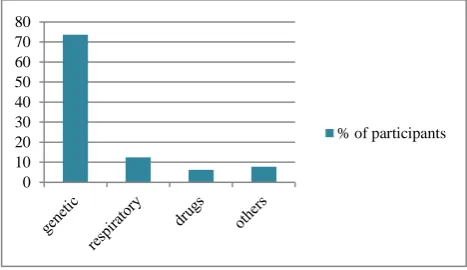
Figure 1: Awareness regarding the route of spread of tuberculosis.
0 10 20 30 40 50 60 70 80
Majority of the participants had poor awareness regarding the route of spread of TB. While 73.6% felt that TB was a genetic disease, only 12.4% of the participants correctly responded that it is spread by respiratory route (Figure 1).
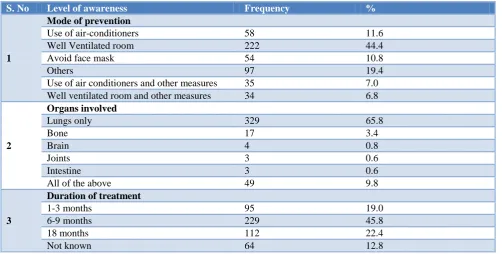
The awareness regarding the modalities to prevent the spread of TB was assessed. Majority of the participants correctly responded that a well ventilated room prevents the spread of TB (44.4%) while 11.6% of the participants felt that use of air conditioners prevented the spread of TB. 65.8% of people knew that the lungs were the organs affected, but only 9.8% of the participants were aware that TB could affect all organs. Also, 45% of the participants felt that the duration of treatment was for 6-9 months and 13% of them had no idea about the treatment at all. 19% believed that treatment was of short duration
(1-3 months), and 22% felt it was much longer (18 months) (Table 2).
The attitude of the participants regarding cure of TB was assessed. About 18% of the study participants thought that the medication could be stopped without the supervision of the treating health care provider (Table 3).
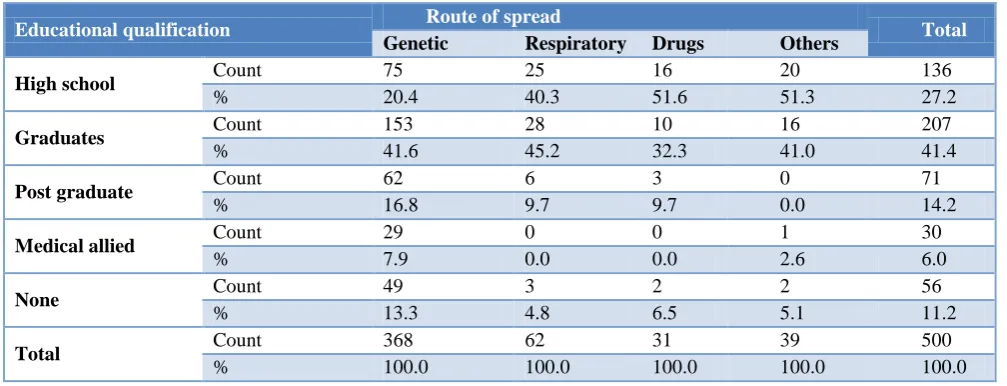
Among the study participants, 41.6% of the graduates responded that TB was a genetic disorder while 45.2% responded that it was transmitted through respiratory route. Similarly, while 16.8% of the post graduate qualified participants felt that TB was a genetic disease, only 9.7% responded that it was transmitted through respiratory route. The observed difference was statistically significant (p<0.0001) (Table 4).
Table 1: Background characteristics among the study participants (n=500).
S. No Characteristics Frequency %
1
Gender
Males 302 60. 4
Females 198 39.6
2
Educational qualification
Illiterate 56 11.2
School level 136 27.2
Gradation 207 41.4
Postgraduation 71 14.2
Medical/allied 30 6.0
3
Occupation
Business 169 33.8
Teachers 32 6.4
Healthcare 15 3.0
Others 284 56.8
Table 2: Awareness regarding the modalities to prevent spread of TB (n=500).
S. No Level of awareness Frequency %
1
Mode of prevention
Use of air-conditioners 58 11.6
Well Ventilated room 222 44.4
Avoid face mask 54 10.8
Others 97 19.4
Use of air conditioners and other measures 35 7.0
Well ventilated room and other measures 34 6.8
2
Organs involved
Lungs only 329 65.8
Bone 17 3.4
Brain 4 0.8
Joints 3 0.6
Intestine 3 0.6
All of the above 49 9.8
3
Duration of treatment
1-3 months 95 19.0
6-9 months 229 45.8
18 months 112 22.4
Table 3: Attitudes regarding TB cure (n=500).
S. No Level of attitude Frequency %
1
TB can be cured
Yes 390 78
No 80 16
Not sure 30 6
2
TB drugs can be stopped without the knowledge of the care provider
Yes 90 18
No 410 82
Table 4: Educational qualification vs route of spread.
Educational qualification Route of spread Total
Genetic Respiratory Drugs Others
High school Count 75 25 16 20 136
% 20.4 40.3 51.6 51.3 27.2
Graduates Count 153 28 10 16 207
% 41.6 45.2 32.3 41.0 41.4
Post graduate Count 62 6 3 0 71
% 16.8 9.7 9.7 0.0 14.2
Medical allied Count 29 0 0 1 30
% 7.9 0.0 0.0 2.6 6.0
None Count 49 3 2 2 56
% 13.3 4.8 6.5 5.1 11.2
Total Count 368 62 31 39 500
% 100.0 100.0 100.0 100.0 100.0
P=0.0001.
DISCUSSION
TB has a huge global burden. With India being one of the countries with the highest disease burden, the control and treatment of the disease is an important initiative and has been effectively taken up by both Government of India and the WHO. The key factor in any disease control is to first assess public knowledge and perception of the disease dynamics and treatment. This assessment will help in formulating educational and public awareness campaigns which will be effective in implementing strategies for prevention and control of TB.
Our study was carried out among 500 adults walking into our tertiary health care center. A detailed analysis based on the demographic characteristics was done in order to have a good cross section of people akin to the society at large. In our study, it is interesting to note that educational qualification did not translate to better health literacy. This is evidenced by the fact that 41% of graduates still believed that the spread of TB was genetic, as against only 45% knowing that it was spread through the respiratory route.
There was also a misconception about the lung being the only organ involved and it was dissimilar between men and women (60% males and 40% females). Correlating
this with the knowledge that more women had higher educational qualifications, only affirms that better educational qualifications does not equate to better health literacy. More males believed that staying in well ventilated rooms helped prevent spread, but knowledge about wearing a face mask to prevent spread was poor and majority of the participants believed that one must avoid a face mask. In this group, 33% were in fact, graduates.
Six percent of participants who thought that genetic spread was possible were, surprisingly, teachers, and an equal percentage identified the respiratory route of spread of TB. This highlights the fact that, even though some participants knew that the lungs were the common site of the disease, their knowledge did not extend to the logical; conclusion that using a face mask would be an effective barrier to disease spread. The awareness about the cure for TB also furthers the same point of disparity in education and health literacy, as evidenced by only a slightly increased percentage of graduates who knew that TB could be cured (43.1% versus 33.8%).
by Chinnakali et al, the awareness regarding the duration of treatment was analyzed and 42% of the participants felt that treatment should be provided for atleast six months.10 In another study done by Sagili et al, only 17% of the participants had appropriate knowledge regarding TB, similar to our study. Similarly, literacy did not show any considerable improvement in the knowledge level (22%) while 78% of the educated participants did not have adequate knowledge. This finding was also similar to our study.12
It is evident from this study that there is not only paucity of knowledge, but also incorrect information about the cause and spread of TB. Moreover, the fact that education qualification and employment status did not translate into health awareness is to be taken as a serious issue for urgency in creating awareness through campaigns. Ignorance and misconceptions lead to wrong practices in the prevention of spread, and treatment compliance.
We therefore propose targeted education through clear graphic and disease pathway elucidation, which is easy to understand even for the unlettered individual. Appropriate knowledge dissemination is required on route of spread so that strategies to contain this scourge can be implemented with full participation of the public.
CONCLUSION
The study results are an eye-opener in strategizing our approach to TB control. Identifying the sector by age with the poorest knowledge regarding TB and specifically reaching out to them is important. Understanding that educational qualification and health literacy are different ideologies, it is essential to provide simple knowledge-based public awareness campaigns, irrespective of the educational qualifications or occupation. Implementation of specific graphic, detailed, easy-to-understand, pictorial, flow-chart based knowledge dissemination to all sectors of the society regarding the spread, organs involved and prevention of spread of TB, is urgently mandated if we are to control the rapid spread of TB. Awareness among teachers appears to below, and therefore imparting good training and using them as further knowledge disseminators of this disease is important. Incorrect knowledge and perception among teachers is worse than ignorance. Incorporating a specific health information section in teacher training programs may be beneficial. Women-centric programs need to be implemented to reach the stay-at-home, educated women as well. Hence, the outreach needs to be tailored to different sectors.
Limitations
The study was conducted in a quaternary care corporate private referral centre. The patient population may not be representative of the lower socio-economic strata.
Funding: No funding sources Conflict of interest: None declared
Ethical approval: The study was approved by the Institutional Ethics Committee
REFERENCES
1. World Health Organization. Tuberculosis. Key facts. Available at: https://www.who.int/en/news-room/fact-sheets/detail/tuberculosis. Accessed on 25 September 2019.
2. India TB report, 2018. Revised National Tuebrculosis Control Programme. Annual Status Report. Available at: https://tbcindia.gov.in/show file.php?lid=3314. Accessed on 25 September 2019. 3. World Health Organization. Tuberculosis. Country Profiles. Available at: https://www.who.int/tb/ country/data/profiles/en/. Accessed on 25 September 2019.
4. World Health Organization. Tuberculosis (TB). End TB strategy. Available at: https://www.who.int/tb/ strategy/en/. Accessed on 25 September 2019. 5. Advocacy, Communication and Social Mobilization
to fight TB. ACSM subgroup at country level. World Health Organization. Available at: http:// www.stoptb.org/assets/documents/resources/publica tions/acsm/tb-advocacy.pdf. Accessed on 25 September 2019.
6. World Health Organisation. The Global Plan to Stop TB, 2006-2015: Actions for life, towards a world free of tuberculosis. Geneva: World Health Organisation; 2006. Available at: https://www.who .int/tb/features_archive/global_plan_to_stop_tb/en/. Accessed on 25 September 2019.
7. The global plan to stop TB. 2011-15. Transforming the fight. Towards elimination of tuberculosis. World Health Organization. Available at: http://www.stoptb.org/assets/documents/global/plan/ TB_GlobalPlanToStopTB2011-2015.pdf
8. Sockrider MM, Wolle JM. Helping patients better adhere to treatment regimen. J Respir Dis. 2005;17: 204-16.
9. Advocacy, Communication and Social Mobilization for TB control. A guide to developing knowledge, attitude and practice surveys. World Health Organization. Available at: https://apps.who.int/iris /bitstream/handle/10665/43790/9789241596176_en g.pdf?sequence=1. Accessed on 25 September 2019. 10. Chinnakali P, Ramakrishnan J, Vasudevan K, Gurumurthy J, Upadhyay RP, Panigrahi KC. Level of awareness about tuberculosis in urban slums: Implications for advocacy and communication strategy planning in the national program. Lung India. 2013;30(2):139-42.
12. Sagili KD, Satyanarayana S, Chadha SS. Is knowledge regarding tuberculosis associated with stigmatizing and discriminating attitudes of general population towards tuberculosis patients? Findings from a community based survey in 30 districts of India. PLoS One. 2016;11(2):e0147274.
Cite this article as: Shankar M, Ramasubramanian V, Ramakrishnan B.Awareness of tuberculosis in the community: time to rethink strategies. Int J