Original Research Article
Implications of the human immunodeficiency virus test and treat
strategy on antiretroviral treatment uptake and retention outcomes in
Cameroon
Rogers A. Awoh
1,2*, Halle G. Ekane
1, Anastase Dzudie
2, Egbe O. Thomas
1,
Adebola Adedimeji
3, Assob N. Jules
1INTRODUCTION
The human immunodeficiency virus (HIV) continues to be a major global public health problem. According to the World Health Organisation, an estimated 36.9 million people live with HIV, with over one million people dying of AIDS-related illnesses, and 1.8 million people newly
infected with HIV.1 The vast majority of this number live in low and middle income countries where the health systems are weak and unable to effectively control the epidemic.1
Several strategies have been adopted and implemented to control the HIV/AIDS pandemic with mixed results and progress in decreasing new HIV infections among adults
ABSTRACT
Background: Success of the human immunodeficiency virus (HIV) test-and-treat (T&T) strategy requires high antiretroviral (ART) uptake and retention. However, low ART uptake and retention continue to be reported in ART programs. This study assessed ART uptake and retention outcomes of the HIV T&T strategy in three HIV clinics in Cameroon.
Methods: A retrospective chart review was done for 423 patients who initiated HIV care within a period of three months prior to the implementation of the HIV T&T strategy, and for another 423 patients who initiated HIV care within a three-month period following the HIV T&T strategy implementation. For each group, sociodemographic, ART uptake and retention data were collected. Chi square and Student T tests were used to test for differences proportions and means between the two groups at p<0.05 and 95% confidence interval.
Results: The mean ages (years) in the pre-T&T and the T&T groups were 39.73 and 39.72, and the proportion of female were 65.85% and 65.08% respectively. ART uptake proportion was higher amongst those enrolled under the T&T strategy (98.08% vs 95.39%, p=0.02). A greater proportion of the patients in the T&T group initiated ART within 2 weeks following HIV diagnosis (55.84% vs 48.17%, p=0.03). However, ART retention at 24th month was lower in the T&T group (78.83% vs. 85.79%, p=0.01).
Conclusions: The findings suggest that the T&T strategy is associated with higher ART uptake, earlier ART initiation, and lower ART retention. This underscores a need for strategies to improve ART retention under the HIV T&T guidelines.
Keywords: Human immunodeficiency virus test and treat strategy, Antiretroviral treatment uptake, Antiretroviral treatment retention, Cameroon
1
Department of Public Health and Hygiene, University of Buea, Cameroon, Africa
2Clinical Research Education Networking and Consultancy, Yaounde, Cameroon, Africa
3Department of Epidemiology of Population Health, Albert Einstein College of Medicine, New York City,
United States of America
Received: 05 September 2019 Accepted: 09 October 2019
*Correspondence: Dr. Rogers A. Awoh,
E-mail: [email protected]
Copyright: © the author(s), publisher and licensee Medip Academy. This is an open-access article distributed under the terms of the Creative Commons Attribution Non-Commercial License, which permits unrestricted non-commercial use, distribution, and reproduction in any medium, provided the original work is properly cited.
has been slow in recent years. Since 2010, the annual number of new HIV infections among adults has remained around 1.9 million.2 In 2015, the WHO recommended the HIV test and treat strategy as a global approach for the control of the HIV/AIDS pandemic. The strategy posits that expanded testing and earlier treatment of HIV infection could markedly decrease ongoing HIV transmission, stemming the HIV epidemic.3 The approach aims at increasing antiretroviral therapy (ART) coverage in order to attain community viral suppression through testing everyone for HIV, placing those tested HIV positive on ART irrespective of CD4 count or clinical criteria, and maintaining HIV positive people on ART in order to achieve sustained viral suppression. The scientific basis for this approach is supported by evidence that early initiation of ART is associated with better treatment outcome and people on highly active antiretroviral therapy (HAART) are less likely to transmit the virus to others due to viral suppression.4-6 The overall goal of the universal test and treat (T&T) strategy is to end the AIDS epidemic as a public health threat by 2030, a target included in the 2030 agenda for sustainable development adopted by the United Nations General Assembly in September 2015. As new infections and HIV-related deaths are still unacceptably high, the immediate challenge is to reach the Fast-Track 2020 targets of reducing the number of people acquiring HIV to fewer than 500 000 and reducing the number of people dying from HIV-related causes to fewer than 500 000. Based on current estimates, this provides an opportunity to prevent over 1.6 million new infections and 600 000 deaths per year.3 In line with this WHO recommended approach to end the HIV/AIDS epidemic, the Joint United Nations Program on HIV/AIDS (UNAIDS) set the 2020 fast track 90-90-90 targets.7
Cameroon is one of the thirty-five countries accounting for more than 90% of the people becoming newly infected with HIV and designated Fast-Track countries requiring intensified action.3 With the ambition to accelerate antiretroviral therapy (ART) coverage as well as to reach the global objective of eliminating HIV by 2030 under the 90-90-90 response strategy, the Cameroon Ministry of Health, in May 2016, implemented the WHO HIV T&T strategy in all health facilities providing HIV services within the national territory. The HIV T&T strategy has been associated with mixed outcomes. While it has been associated with improved ART uptake and retention in some contexts, it has also showed lower ART retention in others, and there is paucity in literature on the HIV T&T outcomes in Cameroon.8-11 ART uptake and retention outcomes of the HIV T&T strategy, both representing important prerequisites for the success of the HIV T&T strategy, have not been extensively described in Cameroon. This study aimed at assessing ART uptake and retention outcomes of the HIV universal teat and treat strategy in three HIV clinics in Cameroon.
METHODS
Ethical considerations
An ethical clearance prior to the implementation of this study was obtained from the Faculty of Health Science Institutional Review Board of the University of Buea.12 The study was implemented within the institutional framework of the Cameroon International epidemiology Database to Evaluate AIDS (IeDEA) study approved by the National Ethics Committee of the Cameroon’s Ministry of Health.
Study design and data collection procedure
This is a comparative retrospective study in which a 24-month longitudinal medical chart review was done for patients who enrolled in HIV care within a three-month period preceding the implementation of the HIV T&T guidelines and another group of patients who enrolled within another three-month period following the implementation of the guidelines in three HIV clinics in Cameroon. The HIV T&T strategy was implemented in Cameroon in May 2016. The three preceding months included February to April, 2016 and the three months following the implementation of the strategy included July to September 2016. The months of May and June were considered the transition period and were thus excluded. Medical records were reviewed chronologically and a structured form was used to abstract data on; Sociodemographic characteristics, HIV related baseline and follow up outcomes, including ART retention.
Study sites
The study included all the three Cameroon IeDEA HIV clinics, located in three different regions of Cameroon. The clinics included: the Bamenda Regional Hospital (BRH) in the North West Region, the Limbe Regional Hospital (LRH) in the South West Region, and the Yaoundé Jamot Hospital (YJH) in the Centre Region of Cameroon. The hospitals are all tertiary level, government owned facilities, with specialized HIV clinics and provided care to a total of about 12,500 HIV positive clients; BRH (5000), LRH (4000) and YJH (3500). Each of the HIV clinics had at least a medical doctor in charge of the treatment center, and other staff including nurses, pharmacy attendants, counsellors and psychosocial workers.
Study population, inclusion and exclusion criteria
Data collection
Two lists of clinic codes of subjects enrolled in HIV care during the study reporting periods, representing the pre T&T and the T&T groups, were generated chronologically from the respective clinics’ enrolment registers, according to the date of first enrolment in care in the clinic. Using the generated lists for each group, the
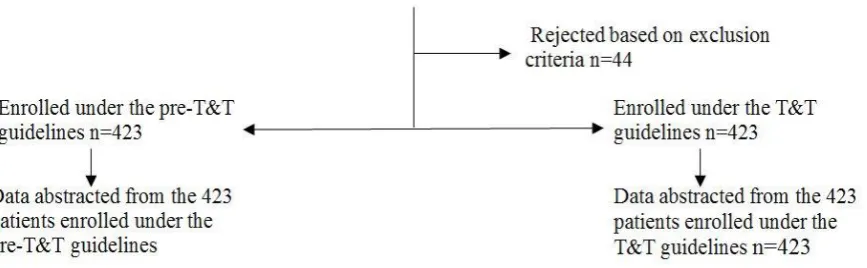
subjects’ medical records (medical charts, ART registers, ART dispensation registers) were sorted and sociodemographic, clinical, ART uptake and retention data were abstracted. In total, data was abstracted from 846 of 890 medical records reviewed. The number of records included per clinic was 252, 227 and 367 from Bamenda, Limbe and Jamot respectively. The data collection flow is schematically presented in the Figure 1.
Figure 1: Data collection flow chart.
Data handling and statistical analysis
Data from de-identified paper forms were progressively entered in an Epi Info database by a trained data clerk using a laptop. Data cleaning was done both locally and centrally depending on the source of the data problem. Data cleaning rules and cut-off ranges were devised and provided to all three sites. At the central level, abstracted medical records were reviewed and double data entry was done by the study investigator to control for data quality. The paper forms were safeguarded in a locked cupboard after entry and the database backed up in an external hard drive.
The data was analyzed using Epi Info version 7 software. Means and standard deviations were calculated for continuous variables while frequency distributions calculated for categorical variables. Comparison of proportions and means were done using Chi square and the Student T-test respectively.
The study outcome variables were defined as follows:
ART retention
Proportion of subjects known to be accessed ART in the study clinics during the specific study follow up periods (6, 12 and 24 months).
ART uptake
Proportion of subjects enrolled in HIV care and initiated ART during the study reporting period.
Lost to follow up
Proportion of patients who failed to return for drug pick-up after three consecutive months following the last expected pharmacy appointment date, and were not reported as deceased or transferred out.
Transferred out
Proportion of patients with clinic level documented evidence of being transferred from the study clinic to another HIV clinic.
Deceased
Proportion of patients with clinic level documented evidence of being deceased.
RESULTS
Baseline socio-demographic characteristics of the patients
A total of 846 records were analysed, constituting information from 423 files from participants in the pre T&T and 423 participants in the T&T groups. The mean ages (years) of the pre-T&T and the T&T groups were 39.72 ±10.72 and 39.72±11.10. The proportion of males enrolled in the pre T&T and the T&T group were similar (34.14% vs 34.92%, p=0.81).
vs. 36.03). However, the proportion with secondary education was higher in the T&T group (48.77 vs. 43.48).More than two thirds of the participants in the pre T&T and the T&T group had a monthly income of less than 50,000 XAF ($90), and the proportion was significantly higher in the T&T group (79.46 vs. 73,64, p=0.03). Unemployment proportion was slightly higher in the group enrolled under the T&T strategy (36.52% vs 31.41%, p=0.21).
Regarding the time spent traveling between patients’ home and HIV clinic, more than half of subjects in both groups lived less than 30 minutes from their respective HIV clinics. However, the proportion was greater in the group under the T&T strategy (55.90 vs. 51.53, p=0.51).
Regarding substance use, the proportions of patients who smoked in the pre T&T and T&T groups were 15.27% and 13.13%. Alcohol intake proportions were respectively 63.04% and 61.16%. Most of those who consumed alcohol in both groups were of the male sex (78.89% and 71.90%). Also, 84.73% and 86.87% of the patients enrolled under the pre T&T and T&T groups had never smoked cigarette.
Finally, the proportions of participants with disclosed HIV status were similar in pre T&T and the T&T groups (79.94% vs. 78.99%). A summary of the sociodemographic characteristics of the subjects is displayed in Table 1.
Table 1: Socio-demographic characteristics of the subjects.
Variable Pre-T&T group T&T group P value
N % N %
Age in years (n=824)
19-30 85 20.63 89 21.60
0.93
31-40 147 35.86 146 35.44
41-50 115 27.91 108 26.21
>50 65 15.78 69 16.75
Gender (n=831)
Male 140 34.15 147 34.92
0.81
Female 270 65.85 274 65.08
Marital status (n=775)
Married 142 37.87 152 38.00
0.45
Unmarried 174 46.40 172 43.00
Divorced 21 5.60 51 12.75
Widowed 38 10.13 25 6.25
Employment status (n=743)
Employed by an institution 86 24.78 81 20.40
0.21
Self-employed 152 43.80 171 43.07
Unemployed 109 31.41 145 36.52
Income (n=589)
<50,000FCFA 109 73.64 148 79.46
0.03
50-100000fcfa 31 12.02 45 13.06
>100,000fcfa 37 14.34 23 6.95
Level of education (n=776)
None 28 7.61 29 7.11
0.09
Primary 131 35.60 147 36.03
Secondary 160 43.48 199 48.77
University 49 13.32 33 8.09
Time of travel (n=607)
0-30 minutes 135 51.53 193 55.94
0.56
0.5-1 hour 79 30.15 98 28.14
1-2 hours 34 12.98 34 9.86
>2hours 14 5.34 20 5.80
Alcohol (n=621)
No 174 36.96 102 38.84
0.63
Yes 134 63.04 211 61.16
Smoking (n=743)
No, former smoker 34 9.80 38 9.60
0.43
No, never smoked 294 84.73 344 86.87
Yes, current smoker 14 5.48 19 3.54
Variable Pre-T&T group T&T group P value
N % N %
HIV status Disclosure (n=720)
Yes 69 20.06 79 21.01
0.75
No 275 79.94 297 78.99
P value for Chi square test.
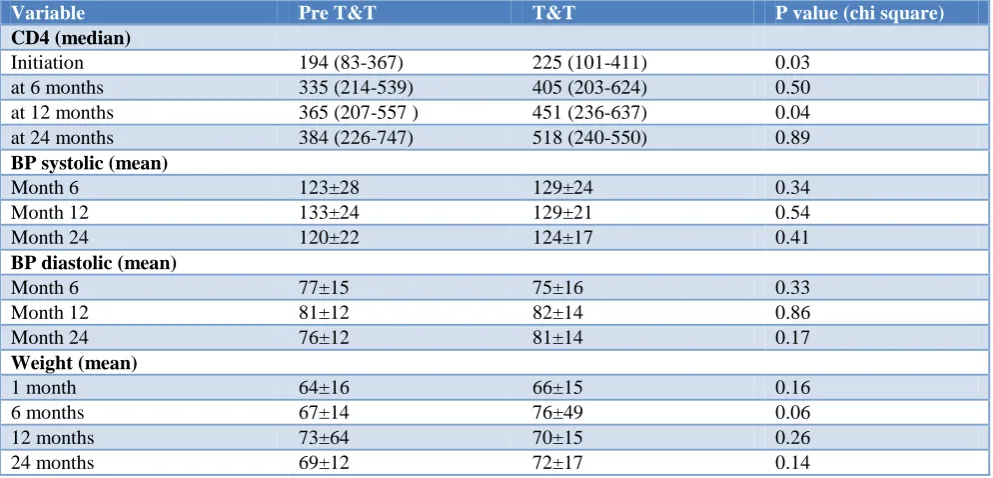
Table 2: Clinical outcomes.
Variable Pre T&T T&T P value (chi square)
CD4 (median)
Initiation 194 (83-367) 225 (101-411) 0.03
at 6 months 335 (214-539) 405 (203-624) 0.50
at 12 months 365 (207-557 ) 451 (236-637) 0.04
at 24 months 384 (226-747) 518 (240-550) 0.89
BP systolic (mean)
Month 6 123±28 129±24 0.34
Month 12 133±24 129±21 0.54
Month 24 120±22 124±17 0.41
BP diastolic (mean)
Month 6 77±15 75±16 0.33
Month 12 81±12 82±14 0.86
Month 24 76±12 81±14 0.17
Weight (mean)
1 month 64±16 66±15 0.16
6 months 67±14 76±49 0.06
12 months 73±64 70±15 0.26
24 months 69±12 72±17 0.14
HIV clinical characteristics at baseline and follow up care
The median CD4 count values (cells/mm3) at enrolment in the pre T&T and T&T groups were respectively 199 and 239, p= 0.01. There was a general increase in the median CD4 count values from baseline in both groups through months 6, 12, and 24 (326 vs.415 p=0.13; 365 vs.505, p=0.01; 448 vs. 518, p=0.62). The values were generally higher in the group enrolled during the test and treat and the difference was significant at initiation (month 1) and at 12th month.
Amongst those who did HIV viral load test, the proportions with undetectable viral load in the pre T&T and the T&T groups at months 6, 12, and 24 were; 59.09% vs. 82.86%, p=0.04; 59.26% vs.72.09%, p=0.18; 76% vs.83.33%, p=0.51. Viral Suppression proportion was significantly higher at month 6 amongst those enrolled under the T&T.
Regarding blood pressure (BP), the mean systolic BP at 6, 12 and 24 months were similar in the pre-T&T and the T&T group (123±27.79 vs. 129±24.26; 133±23.64 vs. 129±20.61; 120±21.91 vs. 124±17.45). Similar trends were observed for the diastolic BP (77±115.26 vs. 75±15.73; 81±12.1vs. 82±13.73; 76±12.33 vs. 81±13.7).
The pre T&T and T&T baseline mean weights were 64±15.64 and 66±14.76, p=0.16. The means generally increased through 6,12 and 24 months in both groups, though generally higher in the T&T group, with a significant difference at month 6 (67.04 vs.75.87, p=0.00).
A summary of the clinical outcomes is displayed in Table 2 below.
ART uptake and retention
ART uptake proportion was significantly higher in the T&T group compared to the pre T&T group (98.09% vs. 95.39%, p=0.02).
With regards to the respect of clinical appointment dates, patients in the pre T&T group were more likely to respect their appointment dates. The proportions of patients in the pre T&T and T&T groups who respected their clinic dates at months 6, 12, 24 were: 76.62% vs. 62.67%, p=0.00; 67.95% vs. 56% p=0.01; 53.49% vs. 42.98%, p=0.03.
decline in retention was higher in the T&T group, with a significant difference at 24 month. Figure 2 illustrates the
ART retention trends in both groups and ART uptake and retention statistics are summarized in Table 3.
Figure 2: HIV test and treat and pre-test and treat retention trends. Table 3: ART uptake and retention outcomes.
Variable pre-T&T group T&T group p-value (Chi Square)
N % N %
ART uptake (n=831)
Yes 393 95.39 411 98.09
0.02
No 19 4.61 8 1.91
Duration diagnosis ART uptake (n=740)
<2 weeks 171 48.17 215 55.84
0.03
>2 weeks 184 51.83 170 44.16
Respect of clinical follow-up visits Month 6 (n=456)
yes 177 76.62 141 62.67
0.001
No 54 23.38 84 37.33
Month 12 (n=459)
Yes 159 67.95 126 56.02 0.008
No 75 32.05 99 44.08
Month 24 (n=442)
Yes 115 53.49 98 42.98
0.04
No 99 46.51 130 57.02
ART retention at month 3 (n=829)
Retained 362 87.02 368 89.10
0.35
Not retained 54 12.98 45 10.90
Retention at month 6 (n=819)
Retained 350 84.95 332 81.57
0.19
Not retained 62 15.05 75 18.43
Retention at month 12 (n=809)
Retained 320 78.24 309 77.25
0.73
Not retained 89 21.76 91 22.75
Retention at month 24 (n=786)
Retained 338 85.79 309 78.83
0.01
Not retained 56 14.21 83 21.17
0% 10% 20% 30% 40% 50% 60% 70% 80% 90% 100%
inititation 3th month 6th month 12th month 24th month
DISCUSSION
The WHO recommended test and treat (T&T) strategy to avert the HIV/AIDS pandemic was implemented in Cameroon since 2016. There is, however, paucity of literature on the ART outcomes of the strategy in Cameroon. This study assessed the ART uptake and retention outcomes of the HIV T&T strategy in three Cameroon HIV clinics. The study found a higher ART uptake proportion and earlier ART initiation amongst patients enrolled under the HIV T&T strategy. However, ART retention at 24th month was lower amongst patients enrolled under the T&T guidelines. This study underscores a need for more extensive assessment of the ART outcomes of T&T strategy in diverse settings in order to contextualize ART programs to favour optimal outcomes.
Baseline comparisons revealed no significant difference in sociodemographic characteristics between patients enrolled in care in the study clinics under the pre T&T and the T&T guidelines. This was expected as the records analysed came from the same general population and within a similar time period (six months period including a three month period before and a three month period following the T&T strategy implementation).
As expected, some differences were observed in the clinical characteristics between the pre-T&T and the T&T group. The higher mean CD4 count at baseline and at 12th month in the T&T group is consistent with expectation as the T&T strategy has been associated with a higher proportion of asymptomatic patients initiating care. This is further illustrated by the observed higher mean weight amongst patients enrolled under the T&T group.
The very high ART uptake observed in both groups is not surprising as these were patients already enrolled in care in the HIV clinics. Patients already linked to care in HIV clinics are more likely to initiate ART.13,14 The higher ART uptake proportion (98.09 vs. 95.39, P=0.02), and higher proportion of patients who initiate ART within 2 weeks following HIV diagnosis in the T&T group is consistent with other studies, reporting higher ART uptake and earlier ART initiation under the T&T guidelines.15,16 These constitute very important positive outcomes of the HIV T&T strategy in Cameroon. It was interesting to note that the difference in ART uptake proportion and duration between HIV diagnosis and treatment was not very huge. This could be explained by the progressively less restrictive CD4 based ART eligibility criteria over the years, from <200 through 350 to <500 cells/mm3 just before the implementation of the T&T around mid-2016 in Cameroon.
This study found a general decline in ART retention in the T&T and the pre-T&T patients over a 24 month period, a typical trend in ART programs.17 Retention in care is expected to decrease over time as some patients die along the line while others get lost to follow up (LTF)
or transferred out. The highest decline in retention was recorded during the first six months in both the T&T and the pre T&T groups, with a the T&T group recording a greater than three times higher decline in ART retention during the 3rd to 6th month (7% vs. 2%), and significantly lower retention at 24th month. The higher decline in ART retention during first 6 months has been reported in ART programs.18 This disproportionate decline in retention raises major concerns and the trends are somewhat contradiction with those reported in other studies. A higher ART retention was reported at 12 under the T&T guideline (83.0% vs. 76.2%) by study in Malawi and by a study in rural South Africa (82% vs. 75%).19,20 It should however be noted that the higher T&T retention reported in the two aforementioned studies was at 12 month, while this study reported lower T&T retention at 24 month, and similar ART retention proportions at 12 month. The 12 month retention reported by this study is consistent with the results of ART retention survey in the ten regions of Cameroon conducted in 2015.21 A meta-analysis in 2017 found a trend toward an increased risk of being lost to follow-up at 6 months with rapid ART initiation.22 The differences observed in the retention outcomes of the T&T strategy could be related to contextual differences in the populations of persons living with HIV as well as the T&T strategy‘s implementation approach. Rushing of patients to initiate ART without adequate counselling, overcrowding and long waiting time in HIV clinics were reported to be linked with higher attrition rates observed at the early phase of the T&T implementation in some clinics in Cameroon.23
It was also noted that the higher proportion of asymptomatic patients enrolled under the T&T guidelines, constitutes a subgroup associated with higher ART attrition.24-26 This is seemingly true for this study which found a significantly higher median CD4 value in patients enrolled under the T&T. Lower retention has been reported in patients with higher CD4 count and gaining weight in Nigeria and South Africa.27,28 In the same light, “feeling healthy‘‘ was reported as a barrier to ART initiation and engagement by a study in Cameroon and another in Mozambique.23,29 These suggest that proper counselling, therapeutic education and close follow up amongst healthier patients initiating ART maybe be helpful in improving ART retention, especially under the T&T context.
CONCLUSION
more effective if retention outcomes are also improved. These findings underscore the need to assess patterns and determinants of early attrition under the test and treat guidelines in order to inform strategies to improve ART retention outcomes.
Limitations of the study
This study was a retrospective chart review, as such was subjected to some limitations associated with retrospective chart reviews. An explicit protocol and well defined inclusion and exclusion criteria were used and data abstracted from all the medical charts meeting the study inclusion criteria to minimized risk of selection bias. Standardized piloted abstraction forms were used and the variables to be collected were well defined in order to minimize misclassification bias. The data was abstracted across the three study sites by a trained team. Records with missing data on the outcome variables were not included in the analysis and this did not affect the results of the study as there were very few missing records which were random.
ACKNOWLEDGEMENTS
This paper is part of a PhD thesis by Rogers Ajeh Awoh, under the mentorship of Prof. Assob Nguedia Jules, Prof. Egbe O. Thomas, Prof. Halle Ekane, Prof. Adebola Adedimeji and Prof. Anastase Dzudie. Our profound gratitude to Prof. Kathryn Anastos of the Albert Einstein College of Medicine for financially supporting the PhD program. Gratitude to my family, the entire staff of the Department of Public Health of the University of Buea, the staff of CRENC-IeDEA, the Administration of the study hospitals and most especially the HCP and people living with HIV/AIDS for their contributions.
Funding: No funding sources Conflict of interest: None declared
Ethical approval: The study was approved by the Institutional Ethics Committee
REFERENCES
1. UNAIDS. Global HIV and AIDS statistics Fact sheet [Internet]. 2019 [cited 2017 Dec 27].
Available from:
https://www.unaids.org/en/resources/fact-sheet. Accessed 28th August 2019.
2. UNAIDS. 2016 Prevention Gap Report summary. 2016.
3. WHO. Progress Report on Prevent HIV,Test and Treat all. 2016.
4. INSIGHT START Study Group, Lundgren JD, Babiker AG, Gordin F, Emery S, Grund B, et al. Initiation of Antiretroviral Therapy in Early Asymptomatic HIV Infection. N Engl J Med. 2015;373(9):795–807.
5. Hosseinipour MC, Kumarasamy N, Hakim JG, Mehendale S, Chariyalertsak S, Santos BR, et al. New England J. 2011;493–505.
6. TEMPRANO ANRS 12136 Study Group, Danel C, Moh R, Gabillard D, Badje A, Le Carrou J, et al. A Trial of Early Antiretrovirals and Isoniazid Preventive Therapy in Africa. N Engl J Med. 2015;373(9):808–22.
7. UNAIDS. To help end the AIDS epidemic. U.N. 2014;40.
8. Alhaj M, Amberbir A, Singogo E, Banda V, van Lettow M, Matengeni A, et al. Retention on antiretroviral therapy during Universal Test and Treat implementation in Zomba district, Malawi: a retrospective cohort study. J Int AIDS Soc. 2019;22(2).
9. Ford N, Migone C, Calmy A, Kerschberger B, Kanters S, Nsanzimana S, et al. Benefits and risks of rapid initiation of antiretroviral therapy. AIDS Lond Engl. 2018;32(1):17–23.
10. Nhassengo P, Cataldo F, Magaço A, Hoffman RM, Nerua L, Saide M, et al. Barriers and facilitators to the uptake of Test and Treat in Mozambique: A qualitative study on patient and provider perceptions. Plos One. 2018;13(12):e0205919. 11. Carlos del Rio MD. Failure of a Universal
Test-and-Treat Strategy in Rural South Africa. NEJM J Watch. 2017;2017.
12. University of Buea IRB.
13. Pathmanathan I, Pasipamire M, Pals S, Dokubo EK, Preko P, Ao T, et al. High uptake of antiretroviral therapy among HIV-positive TB patients receiving co-located services in Swaziland. PloS One. 2018;13(5):e0196831.
14. Abrams EJ, Langwenya N, Gachuhi A, Zerbe A, Nuwagaba-Biribonwoha H, Mthethwa-Hleta S, et al. Impact of universal antiretroviral therapy for pregnant and postpartum women on antiretroviral therapy uptake and retention. AIDS. 2019;33(1):45. 15. Rufu A, Chitimbire VTS, Nzou C, Timire C, Owiti
P, Harries AD, et al. Implementation of the ‘Test and Treat’ policy for newly diagnosed people living with HIV in Zimbabwe in 2017. Public Health Action. 2018;8(3):145–50.
16. Abrams EJ, Langwenya N, Gachuhi A, Zerbe A, Nuwagaba-Biribonwoha H, Mthethwa-Hleta S, et al. Impact of universal antiretroviral therapy for pregnant and postpartum women on antiretroviral therapy uptake and retention. AIDS Lond Engl. 2019;33(1):45–54.
17. Mee P, Rice B, Lemsalu L, Hargreaves J, Sambu V, Harklerode R, et al. Changes in patterns of retention in HIV care and antiretroviral treatment in Tanzania between 2008 and 2016: an analysis of routinely collected national programme data. J Glob Health. 2019;9(1).
care in Myanmar, 2011–2014. Glob Health Action. 2016;9(1):31280.
19. Alhaj M, Amberbir A, Singogo E, Banda V, van Lettow M, Matengeni A, et al. Retention on antiretroviral therapy during Universal Test and Treat implementation in Zomba district, Malawi: a retrospective cohort study. J Int AIDS Soc. 2019;22(2):e25239.
20. Carlos del Rio M. Failure of a Universal Test-and-Treat Strategy in Rural South Africa. NEJM J Watch. 2017.
21. Billong SC, Fokam J, Penda CI, Amadou S, Kob DS, Billong E-J, et al. Predictors of poor retention on antiretroviral therapy as a major HIV drug resistance early warning indicator in Cameroon: results from a nationwide systematic random sampling. BMC Infect Dis. 2016;16(1):678. 22. Ford N, Migone C, Calmy A, Kerschberger B,
Kanters S, Nsanzimana S, et al. Benefits and risks of rapid initiation of antiretroviral therapy. AIDS. 2018;32(1):17–23.
23. Ajeh R, Ekane H, O Thomas E, Dzudie A, Assob J. Barriers and Implications on Engagement in Antiretroviral Treatment Services in Cameroon within the HIV Test and Treat Context. Am J Public Health. 2019;7:73–80.
24. Rougemont M, Stoll BE, Elia N, Ngang P. Antiretroviral treatment adherence and its determinants in Sub-Saharan Africa: a prospective study at Yaounde Central Hospital, Cameroon. AIDS Res Ther. 2009;6(1):21.
25. Koole O, Tsui S, Wabwire-Mangen F, Kwesigabo G, Menten J, Mulenga M, et al. Retention and risk factors for attrition among adults in antiretroviral
treatment programmes in Tanzania, Uganda and Zambia. Trop Med Int Health. 2014;19(12):1397– 410.
26. Boyer S, Iwuji C, Gosset A, Protopopescu C, Okesola N, Plazy M, et al. Factors associated with antiretroviral treatment initiation amongst HIV-positive individuals linked to care within a universal test and treat programme: early findings of the ANRS 12249 TasP trial in rural South Africa. AIDS Care. 2016;28 Suppl 3(Suppl 3):39–51.
27. Babatunde OA, Ojo OJ, Atoyebi OA, Ekpo DS, Ogundana AO, Olaniyan TO, et al. Seven year review of retention in HIV care and treatment in federal medical centre Ido-Ekiti. Pan Afr Med J. 2015;22.
28. Mukumbang FC, Mwale JC, van Wyk B. Conceptualising the Factors Affecting Retention in Care of Patients on Antiretroviral Treatment in Kabwe District, Zambia, Using the Ecological Framework. AIDS Res Treat. 2017;2017:1–11. 29. Nhassengo P, Cataldo F, Magaço A, Hoffman RM,
Nerua L, Saide M, et al. Barriers and facilitators to the uptake of Test and Treat in Mozambique: A qualitative study on patient and provider perceptions. Garcia J, editor. PLOS ONE. 2018;13(12):e0205919.