Evaluating CDDS functionalities Using Users’ Mental Evaluative
Model
Ifeoluwa Agboola
Aston University, Birmingham, UK
ABSTRACT
Clinical Decision Support Systems (CDSSs) have become important in the delivery of effective evidence-based assessment and treatment of patients in the medical environment. This is however dependent on the efficient user-centered design and its efficient integration into the workflow of the medical environment. Users’ perception and their evaluative view of the system can provide a good understanding of how the system works; how it meets users’ needs; and how it fits the purpose with its functionalities. Evaluation of CDSSs is therefore required to capture user’s needs due to constant changes in medical knowledge and practices. This paper examines how the elicitation of users’ mental evaluative model of a CDSS can be used to evaluate the system to inform an update of the system’s functionalities. Users’ interactions were monitored and repertory grid technique was used to construct users’-evaluative-mental model which identified patterns suggesting system update.
Keywords: Mental model; CDSS Evaluation; Concept Mapping; Repertory Grid Technique.
1. INTRODUCTION
Innovations of computing technologies and other smart tools and techniques have facilitated the development of decision support systems (DSS) designed to help organisations in different fields meet organisational and business challenges and requirements (Isern and Moreno, 2016). In the medical field, clinical decision support systems (CDSSs) are aimed to meet requirements of the complex health environment by enhancing effective clinical decision-making (Marco et al, 2009; Ranjit, 2003). CDSSs support healthcare workers with tasks that rely on the effective acquisition and manipulation of expert data and knowledge by providing clinicians, staff, patients and other individuals with expert knowledge and person-specific information. Clinical decision support systems (CDSSs) play a pivotal role in improving patient care and enhancing practitioner performance (Isern and Moreno, 2016; Plaisent et al, 2002). Nevertheless, adaption of CDSSs in an actual healthcare workflow setup is challenging. Despite a long history of CDSS development, most of the systems evaluated in academia have not been realized in a real clinical practice environment. The concerns for a mismatch between the functionality of most CDSSs and their organisational requirements have led to the issue of CDDS not fit for purpose.
Factors that have been considered as important for
successful implementation of CDSS in medical environments include workflow integration, flexibility, and response to user needs (Wetter, 2002). These factors reflect organisational requirements and policies which evolve over time and thus raise new requirements which the CDSS need to automatically identify and capture to evolve the functionalities of the system and the knowledge base. Failure to meet these changing requirements raises the issue of the CDSS not fit for purpose.
The need for a continuous evaluation of CDSS is becoming more obvious as more systems developed and tested in the laboratories as good systems fail to create desired impact in the actual work settings, most CDSSs are therefore considered not fit for purpose. There is a shift in the conceptualization of the goal of CDSS which raises evaluation questions that require answers provided by new methodological approaches (Chiasson, 2007).
2. RESEARCH FOCUS
as demonstrated in literature (Johnson et al, 2001; Su, 2003). It is argued that the system aspects of the user’s mental model (a system model) have a twofold value. Firstly it identifies user criteria, and secondly, designers of the system will gain a better understanding of the features and functions users consider as critical and most useful. Research also has it that users perception of a system is in relation to four components namely system, content, information organization, and interface which may be exploited to make the system more effective and useful (Zhang, 2008). Gaining an understanding of people’s mental models is therefore a major key to creating a service that ‘just works’.
The research will examine how CDSS is used; where interactions and outputs of the system are monitored and compared with the conceptual model of the system. This is to identify and investigate any divergence to give an understanding of undesirable outcomes from sequential interactive steps and how to improve the functionalities and the overall performance of the CDSS. This will identify any mismatch between the functionality of CDSSs and their organisational requirements to making CDSS fit for purpose.
3. EVALUATING CDSS
The complexity of medical practices and the desire to improve services and the proper application of CDSS make evaluation of existing CDSSs in organisations both a challenge and a necessity. CDSS evaluation is the process of collecting relevant data about the performance of the system against some criteria and how users use the system in carrying out their work. The collected data is analysed to provide answers to questions aimed at improving the system (Friedman and Wyatt, 1997). The questions and the types of questions may depend on the evaluation methodology which could be selected from a range of methodologies including objective and subjective methods.
The objective approach focuses on careful measurements of outcome variables where the presence or absence of CDS interventions is the independent variable. It is aimed at determining if the performance or output of the system measures up to standards and goals or original requirements of the organisation. This objective approach enables the users’ performance to be measured in terms of the process, systems’ usability, how the system is used and if the system meets the users’ need. It also provides the opportunity to measure patients’ outcome to evaluate the impact of the system.
On the other hand, the subjectivist approach to evaluation is more focused on qualitative understanding of the system’s impact on users. The approach uses some
ethnographic techniques such as participant observations, interviews, and analysis of documents and artefacts to study the impact of the CDSS on the clinical work in the organisational settings (Friedman and Wyatt, 1997). CDSSs have been successfully evaluated using subjectivist approach to understand the impact of the system on the work flow and general work practices among the staff.
The need for a continuous evaluation of CDSS is becoming more obvious as more systems developed and tested in the laboratories as good systems fail to create desired impact in the actual work settings and does not meet changing organisational requirements. Most CDSSs are therefore considered not fit for purpose. There is a shift in the conceptualization of the goal of CDSS which raises evaluation questions that require answers provided by new methodological approaches.
The evolving nature of systems necessitates the capturing of evolving knowledge and users’ requirements. This has given rise to evolutionary design which is said to be more effective in acknowledging the changing knowledge and users’ requirements as it is more dominant and focused on users’ satisfaction in decision support systems.
Furthermore, the need to combine qualitative and quantitative evaluation methods in order to study different dimensions of CDSS and acquiring relevant data and knowledge to improve and evolve the CDSS is becoming apparent (Heathfield, Pitty, and Hanka, 1998). However, the selection and use of evaluation methods that will provide an understanding of the changing requirements and knowledge to update and evolve the CDSS has some challenges and knowledge acquisition bottlenecks to deal with.
Building a user’s mental model which gives an evaluative view of the system from the user’s perspective has been demonstrated to be a useful method to capture and explain the human mind and human behaviour in the use of a system (Rutherford & Wilson, 1992). Mental models have been described as knowledge structures employed by users to represent, make sense of, and interact with the external world (Gentner & Stevens, 1983; Johnson-Laird, 1983). They are the source of users’ expectation which governs users’ expected actions of the system and guides the way the system is used and how feedback is interpreted (Van Der Veer, 1989).
the aspects and features that facilitate the accomplishment of a search task through interaction with the system. Zhang (2008) suggests that user’s perceptions of a system are usually in four components namely system, content, information organization, and interface which may be exploited to make the system more effective and useful.
The construction of user mental model will be helpful in identifying meaningful user-based criteria of the system which will be of immense value in the evaluation of the system (Johnson 2001; Su, 2003). It provides a better understanding of the features and functions users consider as critical and most useful. The construction of mental models is thus expected to inform the design of information systems that are easy to use, intelligent in supporting users to form an appropriate understanding of the system, effective in reducing unnecessary human errors as well as enhancing the overall decisions from intelligent systems (Graham, Zheng, & Gonzalez, 2006; Young, 2008).
4. CONSTRUCTING USER’S MENTAL
EVALUATIVE MODEL FOR SYSTEM
EVALUATION
There are different methods of eliciting user’s mental model with no standard technique. Most of the techniques involve generalisations based on the assumption that users’ mental models are formed on comparisons to similar systems (Staggers & Norcio, 1993). However, a user’s mental model and its details are created consequent upon the user’s interaction with the system no matter how brief (Norman, 1993). Users normally form a mental representation of the system during actual interaction with the system which makes the transaction log representing usage data very important and necessary for the construction of the user’s model. The transaction log could therefore provide much information relating to the mental model. Moreover, the system aspects of the model which form the basis of the users’ evaluative view are formed on the aspects and features that facilitate the accomplishment of a task through interaction with the system.
Transaction log analyses may therefore be useful in the construction of users’ mental model but few studies have made an explicit link between transaction logs and mental models (Spink et al, 2001; Silverstein et al, 1999; Moukdad and Large, 2001). One of the main methods used for eliciting user’s mental models has been interviews where user participants are asked to answer a set of questions concerning a system (Rutherford & Wilson, 1992; Sasse, 1991; Staggers & Norcio, 1993).
Another method that is widely used to elicit mental models is the identification of the type and/or strength of relationships between a set of concepts or the drawing of a concept map of a set of concepts (Chang, 2007; Hanisch, Kramer, & Hulin, 1991).
Other methods of constructing mental models are task analysis, contextual inquiry, concept listing, observation, and repertory grid technique. Task analysis is the interpretation of users’ common tasks and goals. It involves a listing of user tasks for the functionality layer. It is speculative but it is an easier way to deduct the user’s mental model. Its accuracy may however be low due to lack of user interaction with the system.
The method chosen for the study to elicit users’ evaluative mental models of a CDSS is the repertory grid approach originating from the field of clinical psychology (Kelly, 1991). It involves the elicitation of the system of interrelated constructs representing the hypotheses derived from human experiences that guide expectations of the world.
The Repertory Grid technique is based on the theory that a person’s processes are psychologically channelized by the ways in which he or she anticipates events and that users create their own network of pathways (cognitive structures/systems). The technique suggests that the user’s behaviour can be better understood by scanning the user’s undertakings during interactions with the system, questions asked, lines of inquiry initiated and the strategies employed. The repertory grid technique (RGT) allows the generation of a list of elements and a list of constructs based on the identified elements which are things or events under investigation, such as functions.
5. METHODOLOGY
The methodology will involve interactive sessions with a CDSS using GRIST which is a web based mental health assessment system to help provide decision support for mental health experts. The recordings / data from the interactive sessions will be used to generate constructs of navigational paths using the repertory grid technique.
5.1 Interactive sessions with GRiST
Five different interactive sessions will be carried out with GRiST where clinical users will be monitored using the system to carry out assessment tasks. This is to gain a deeper understanding of how the system works and also to identify how the user navigates through the system in achieving a task showing their thought process and behavior. This will be useful in drawing the user’s mental model.
Based on the recordings of the interactive sessions, the navigational paths undertaken which also represent the various functionalities or concepts are identified and drawn. The drawings indicate how the user views the system and how it is to be used. The elements and their attributes which indicate the nodes and sub nodes are thus used for concept mapping.
5.3 GRIST’s Functional Nodes/Model
GRIST ontology is based on functional hierarchical nodes. For the purpose of this study the assessment functional sub node is considered. This involves the patient management node which allows users to create, select or delete patient; the assessment node which allows the user to start a new assessment, repeat assessment, complete an already started assessment or fix errors; questions node where users provide answers/input data required for assessment on different risk categories with comments; risk judgement node; risk formulation node; safety plan node; and submit node. These are the path ways the user should navigate through to carry out the assessment on the system.
Patient Management Node----(create new, select patient, delete patient) ---- Assessment Interface Node—(Start New Assessment; Repeat Assessment; Resume Assessment; Fix Errors)--- Questions Node---(Risk category Answer Questions; Enter comments)---- Risk Judgement Node--- Risk Formulation Node----Safety Plan Node-- Submit
The Patient Management Node: PM
Here the patient to be accessed is selected or created. PM: 1. Create New Patient
2. Select Patient 3. Delete Patient
If it is a fresh assessment, a new one can then be started, here another node is realized:
Assessment Interface Node; here a new assessment can be started, assessment can be repeated or an incomplete assessment can be resumed. If there were errors in the previously made assessment, fix errors functionality will solve it.
When repeating assessments, previous assessment data is presented in grey on the assessment form next to each item. Items that are historical and do not change or are unlikely to change are marked with a gold or silver padlock respectively, as described in the key panel.
AIN: Start New Assessment Repeat Assessment
Resume Assessment Fix Errors
Finish Assessment Options: When assessment wants to be ended, it can be suspended; to be finished at a later
date after which the toll shuts down, submit to mark as a completed assessment after which the assessment reports can be viewed. It is advisable continuing a suspended assessment should be done at a short time as long time returns will be good as starting a new assessment. Saving helps save assessment on the go to ensure finishing the process up to the point the assessment is being saved. Suspend
Submit Save
Questions Node: The GRiST tool has different forms of questions and answers. These questions are structured in the decision tree of the system while the answers are also structured in the Answer Tree. The decision is narrowed down based on the answers to the questions given by the users. These questions are in the Yes/ No/ Don’t Know formats. The format also feature judgement scoring questions that enables answers to questions asked on the scale of 0 to 10.
Each branch of the assessment has questions Questions Node: Answers on the Answer Tree Questions Asked
Key Symbols and Features Node: A sub node of the question node. These are the symbols next to different questions which helps in understanding the information that is being asked, helps the user in recording additional contextual data to complement the data collected on the particular question, helps in developing patient management and safety plan as well as undertaking repeat assessments more quickly.
Risk Judgement Node
At the end of each section of risk specific questions, the risk judgement can be given. This node allows the overall rating of the service user for each particular risk. Comments or summary of the clinician personal thoughts regarding each risks that has been assessed. Risk Formulation Node
Here the risk assessment information is being evaluated to enable the risk management plan. It also involves developing an understanding of the risk profile of the individual service user and the level of potential risk the assessment has presented. The risk formulation helps to ascertain when the risks likely to be present, what trigger the risks as well as the risk indicators.
Safety Plan Node
This node helps in populating the safety plan for the service user in managing the risk judgement and risk formulation.
1. Using the Repertory Grid Technique
navigational paths, indicating a combination of different actions, clicks and activities of the user during an interaction with the system. The combinations of the constructs / concepts are then mapped to check the validity of the logical flow of each identifiable path in the matrix.
The findings below show the different mental models derived from the combination of different possible navigational paths of the system. It describes the different functionalities (Nodes and Sub-nodes of GRiST that the user selects / uses which illustrates the chosen paths of the system in carrying out a desired task. The model also describes the user’s perception and pattern of behavior which may be indicative of the user’s knowledge of the system, problems encountered or the possibility of new requirement or functional features which calls for a system redesign.
These identified patterns of activities of users or behavioral patterns of users during interaction with the
system provide an evaluative view of the system and criteria for the update and redesign of system functions and the interface. The common patterns include the ignoring of most questions by users and unfinished activities by users. This may imply that the questions or the unfinished process/task are outdated, not necessary and not in line with the current workflow of the organization. Such occurrences should be investigated for new requirements or knowledge update.
2. Findings
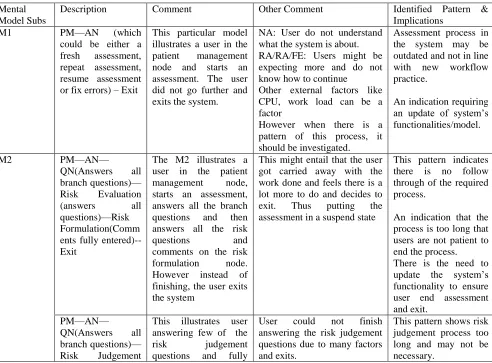
Using the relationship between the GRiST Ontology and the methods integrated, initial 20 mental models are drafted. The table below illustrates the analysis of the model and the identified pattern to inform update of system functionalities.
Table 1: Mental Model of User’ Navigational Paths
Mental Model Subs
Description Comment Other Comment Identified Pattern &
Implications
M1 PM—AN (which
could be either a fresh assessment, repeat assessment, resume assessment or fix errors) – Exit
This particular model illustrates a user in the patient management node and starts an assessment. The user did not go further and exits the system.
NA: User do not understand what the system is about. RA/RA/FE: Users might be expecting more and do not know how to continue
Other external factors like CPU, work load can be a factor
However when there is a pattern of this process, it should be investigated.
Assessment process in the system may be outdated and not in line with new workflow practice.
An indication requiring an update of system’s functionalities/model.
M2 PM—AN—
QN(Answers all branch questions)— Risk Evaluation
(answers all
questions)—Risk Formulation(Comm ents fully entered)-- Exit
The M2 illustrates a user in the patient
management node,
starts an assessment, answers all the branch questions and then answers all the risk
questions and
comments on the risk formulation node. However instead of finishing, the user exits the system
This might entail that the user got carried away with the work done and feels there is a lot more to do and decides to exit. Thus putting the assessment in a suspend state
This pattern indicates there is no follow through of the required process.
An indication that the process is too long that users are not patient to end the process. There is the need to update the system’s functionality to ensure user end assessment and exit.
PM—AN—
QN(Answers all branch questions)— Risk Judgement
This illustrates user answering few of the
risk judgement
questions and fully
User could not finish answering the risk judgement questions due to many factors and exits.
(answers few questions)—Risk Formulation(Comm ents fully entered)-- Exit
entered comments on the risk formulation node
An indication that the system process and set of questions may need adjustments.
PM—AN—
QN(Answers few branch questions)— Risk Evaluation
(answers all
questions)—Risk Formulation(Comm ents partially)-- Exit
This thought process illustrates users answering few of the questions in the assessment and end up answering all the risk judgement questions.
This shows the assessment is not properly done as user can only answer all the risk evaluation questions if all assessment questions are answered.
An indication that risk assessment process is lengthy and outdated.
The system’s model may need to be
checked and
functionality updated. PM—AN—
QN(Answers partially inadequate questions)—Risk Judgement (tries to
answer risk
questions)—Risk Formulation(tries to comment)-- Exit
User did not answer enough question and decides to answer the
risk judgement
questions and comment on the risk formulation node.
User may be looking forward to finish the assessment and decides to exit feeling its too much to do.
An indication that risk assessment process is lengthy and outdated.
The system’s model may need to be
checked and
functionality updated.
PM—AN—QN(No questions
answered)—Risk Evaluation (tries to
answer risk
questions)—Risk Formulation(tries to comment)-- Exit
User did not get to answer any assessment question and attempted
to answer risk
questions
User may not understand how the system works.
An indication that risk assessment process is lengthy and outdated.
The system’s model may need to be
checked and
functionality updated.
M3 PM—AN—QN
(With comments/No comments)—EXIT
User answers
assessment questions with comments and exits
User answers
assessment questions with no comments and exits
This entails the user does not understand the system. Do not feel the questions are enough to make risk judgements out of it. Other factors may affect this such as work load, computer issues
User do not understand or do not have a grip of how the system works
Again the set of questions is affecting the use of the system.
An indication that system functionalities need an update.
PM-AN-QN(Questions not answered)— Comment/No Comments
Users do not answer any question and exit
User do not understand the system
User training required.
M4
PM-AN-QN-SP-Exit
Selects patient, starts assessment, answers questions skipped risk evaluation, went to provide safety plan and exits
User do not populate risk evaluation sections, input safety plan and exit shows users may not understand risks need to be evaluated. Also may not know what to do next
by exiting.
M5 PM-EXIT This process projects
the user in the patient management node and exit
User may not understand what the node is about
Couldn’t find patient to be selected.
Update: User update patient’s details without continuing needs to be investigated when the pattern is gotten
Delete Patient: User only deletes patient and not continuing should be investigated.
User training required.
M6 PM- AN-SP-Finish This process illustrates the user in the PM
Node starts an
assessment and went to input safety plan and submit
This is against the GRiST concept as assessment questions need to be answered, risk evaluation sorted before the safety plan and then the assessment can be submitted. Process like this should be well investigated. Questions might be too much for the user or do not understand the next phases
System model / process out of tune with user expectation.
An indication of a need to update system functionalities.
M7
PM-AN-QN-SP-Exit
User starts an
assessment, answers questions and went straight to the safety plan node.
User may not understand how the system works.
User training required.
M8 PM-AN-RE-Exit User starts an
assessment without answering questions and then attempts risk evaluation and then exit
User need to answer assessment questions before evaluating the patient risk.
User training required.
M9
PM-AN-RE-SP-Exit
User starts an
assessment without answering questions and then attempts risk evaluation, input on the safety plan and then exit
User may not understand the essence of the Risk Evaluation nodes. Other factors may cause exit.
System model / process out of tune with user expectation.
An indication of a need to update system functionalities.
M10
PM-AN-QN-RE-Finish
Illustrates a well done assessment when all questions are answered, comments inputted. However the user has not clicked or accessed the safety plan.
User might not know what to input
User might not understand he/she is to input in the safety plan
User training required.
M11 PM-AN-Finish User starting an
assessment and submit almost immediately
Shows the system is not in use at all. User should be made aware of how GRiST is being used.
User training required.
User starting an
assessment and
suspend almost
immediately
user’s mental model and system’s model.
M12 PM-AN-QN-Finish This process illustrates user starting an assessment, answers assessment questions and submits the assessment
This process illustrates user starting an assessment, answers assessment questions and suspends the assessment
User did not give a judgement of the risk as well as the risk formulation before submitting makes the assessment incomplete
User did not give a judgement of the risk as well as the risk
formulation before
suspending. Pattern of this process must be investigated to avoid log of incomplete assessments.
An indication of a mismatch between user’s mental model and system’s model.
M13
PM-AN-QN-RE-SP-Finish
Illustrates a well done
assessment when
assessment has been
submitted. If
suspended, user has not fully finished the assessment
If assessment has been suspended, user should be notified or reminded to submit.
Suspended assessment may lead to log of incomplete assessments if not resumed.
This pattern indicates there is no follow through of the required process.
An indication that the process is too long that users are not patient to end the process. There is the need to update the system’s functionality to ensure user end assessment and exit.
M14 PM-RE-SP-Finish This process illustrates the user not answering
the assessment
questions, goes straight to the risk evaluation nodes, input safety plan and finishes the assessment.
Assessment is considered not started and incomplete when the assessment questions are not answered.
Assessment process in the system may be outdated and not in line with new workflow practice.
An indication requiring an update of system’s functionalities/model. M15 PM-AN-SP-Finish This process illustrates
the user not answering
the assessment
questions, risk
evaluation nodes then input the safety plan and finishes the assessment which can either be suspended or submitted
Assessment is considered not started and incomplete when the assessment questions are not answered.
Assessment process in the system may be outdated and not in line with new workflow practice.
An indication requiring an update of system’s functionalities/model.
M16
PM-AN-QN-SP-Exit
User ends assessment without evaluating
Assessment not completed and can be said to be suspended.
patient’s risk and submitting assessment
User may not have enough time to finish the process. Other work factors can be behind this process.
outdated and not in line with new workflow practice.
An indication requiring an update of system’s functionalities/model.
M17 PM-AN-RE-Finish User did not answer
assessment questions and safety plan before
submitting or
suspending
Pattern of incomplete assessment marked as submitted.
User’s expectation different from system model.
M18
PM-AN-QN-SP-Exit
User ends assessment without giving risk
judgement and
formulation and not submitting but exiting the system.
Assessment not completed and can be said to be suspended. User may not have enough time to finish the process. Other work factors can be behind this process.
An indication requiring an update of system’s functionalities/model.
The interactions are represented using mind map to illustrate the creation of hierarchical structures of the users’ navigations / thought processes as illustrated below. This enables the creation of the user’s own layered architecture design and development process from the beginning to identify the user’s needs and
Fig. 1. Concept Map of User’ model
5. CONCLUSION
The construction of user’s mental evaluative model which gives the conceptualisations of systems formed by users has been proposed to provide a better understanding of how the user perceives the system and how it works to carry out desired tasks. Users form mental models of a system during interaction which inform any subsequent use of the system and may be
The use of the repertory grid technique enabled the elicitation of the user’s mental model which identified any mismatch between the user’s mental model and the system’s model and identified areas where system’s functionalities need to be updated.
REFERENCES
[1] Chiasson M, Reddy M, Kaplan B, and Davidson E. (2007). Expanding multidisciplinary approaches to healthcare information technologies: what does information systems offer medical informatics? International Journal Medical Information, 1(76):89– 92.
[2] Chang Shu-Nu (2007). Externalising students' mental models through concept maps, Journal of Biological Education, 41:3, 107-112, DOI: 10.1080/00219266.2007.9656078
[3] Friedman, C. and Wyatt, J. (1997). Evaluation Methods in Medical Informatics, Springer-Verlag, New York. [4] Gentner, D.,&Stevens,A.L. (1983). Mental models.
Hillsdale, NJ: Lawrence Erlbaum Associates
[5] Graham, J., Zheng, L.Y., & Gonzalez, C. (2006). A cognitive approach to game usability and design: Mental model development in novice real-time strategy gamers. CyberPsychology & Behavior, 9(3), 361–366. [6] Hanisch, K.A., Kramer, A.F., & Hulin, C.L. (1991).
Cognitive representations, control, and understanding of complex systems: A field study focusing on components of users’ mental models and expert/novice differences. Ergonomics, 34(8), 1129–1145.
[7] Isern, David and Moreno, Antonio (2016). A systematic literature review of agents applied in healthcare. Journal of Medical Devices System, 2:40– 45.
[8] Johnson-Laird, P.N. (1983). Mental models. Cambridge, MA: Harvard University Press.
[9] Johnson, F. C., Griffiths, J. R., & Hartley, R. J. (2001). DEVISE: a framework for the evaluation of Internet search engines. Library and Information Commission Research Report 100.
[10] Johnson, F. C., Griffiths, J. R., & Hartley, R. J. (2003). “Task dimensions of user evaluations of information retrieval systems”, Information research, 8(4), Retrieved July 9, 2005 from http://informationr.net/ir/8-4/paper157.html
[11] Kelly, G.A. (1991). The psychology of personal constructs. London: Routledge (Original work published 1955).
[12] Marco Sorani, Amy Berlin and Ida Sim.(2009). A taxonomic description of computer-based clinical decision support systems. Journal of Biomedical Informatics, 39:656–667.
[13] Moukdad, H., & Large, A. (2001). “Users’ perceptions of the Web as revealed by transaction log analysis”, Online information review, 25(6), pp. 349-358.
[14] Norman, D.A. (1983). Some observations on mental models. In D. Gentner & A.L. Stevens (Eds.), Mental models (pp. 7–14). Hillsdale, NJ: Lawrence Erlbaum. [15] Plaisent-M P Cascante, L and L Maguiraga (2002). The
impact of expert decision support systems on performance of new employee. Information Resource Management Journal, 5:67–78.
[16] Ranjit Bose (2003). Knowledge management-enabled health care management systems: capabilities, infrastructure, and decision-support. Expert System with Applications, 24(1):59–71.
[17] Rutherford, A., & Wilson, J.R. (1992). Searching for mental models in human-machine systems. In Y. Rogers, A. Rutherford, & P.A. Bibby (Eds.), Models in the mind: theory, perspective, & application (pp. 195– 223). San Diego, CA: Academic Press.
[18] Sasse, M.A. (1991). How to t(r)ap users’ mental models. In M.J. Tauber & D. Ackermann (Eds.), Mental models and human-computer interaction 2 (pp. 59–79). Amsterdam: Elsevier Science.
[19] Silverstein, C., Henzinger, M., Marais, H., & Moricz, M. (1999). “Analysis of a very large Web search engine query log”, SIGIR Forum, 33(1), 6–12. [20] Spink, A., Jansen, B. J., & Ozmultu, H. C. (2000).
“Use of query reformulation and relevance feedback by Excite users”,Internet research, 10(4), pp. 317-328. [21] Staggers, N., & Norcio, A.F. (1993). Mental models—
Concepts for human computer interaction research. International Journal of Man-Machine Studies, 38(4), 587–605.
[22] Su, L. T. (2003). “A comprehensive and systematic model of user evaluation of Web search engines: I. Theory and background”,Journal of the American society for information science and technology, 54(13), pp. 1175-1192.
[23] Van der Veer, G. C. (1989). “Individual differences and the user interface”’Ergonomics, 32(11), 1431-1449.
[24] Young, I. (2008). Mental models: Aligning design strategy with human behaviour. Brooklyn, NY: Rosenfeld Media.
[25] Zhang, X. (1997). A study of the effects of user characteristics on mental models of information retrieval systems. Unpublished doctoral dissertation,University of Toronto, Ontario, Canada. [26] Zhang, Y. (2008). The influence of mental models on