Original Research Article
Evaluation of vaccine storage and cold chain management practices
during intensified mission Indradhanush in community health centers
of Tikamgarh district of Madhya Pradesh
Ram K. Panika
1*, Pankaj Prasad
2, Sunil Nandeshwar
1INTRODUCTION
Disease burden due to vaccine preventable diseases is high. These diseases cause premature death, disability and malnutrition in young children. These vaccine preventable diseases can be prevented by vaccination and immunization.1 Immunization is one of the most effective methods of preventingchildhood diseases.2 In May 1974, WHO officially launched Expanded Program on Immunization (EPI) against six most common
preventable childhood diseases. The Government of India launched EPI in 1978 with objective of reducing mortality and morbidity from vaccine preventable diseases of childhood.3 The program was revised and renamed as Universal Immunization Program (UIP) in 1985 focusing more on infants and pregnant mothers.4 With the implementation of universal immunization program, significant achievements have been made in preventing and controlling the vaccine preventable diseases. Immunization has to be sustained as a high ABSTRACT
Background: Vaccination is one of the most effective disease prevention strategies and potency of vaccine is dependent on effective management of cold chain at all levels of vaccine handling. An effective cold chain maintenance system is the backbone of success of any immunization program. This study was done to assess the cold chain management and vaccine storage practices in Tikamgarh district of Madhya Pradesh.
Methods: Cross-sectional study was carried out using a structured questionnaire.
Results: Dedicated room/space for dry storage not available in any of 03 CHCs. Dedicated table for conditioning of icepacks, dedicated clean clothes for wiping of icepacks after conditioning and power back up was available, ILR and DF were connected to separate functional voltage stabilizer and thermometers were placed correctly only in 66.6% CHCs. ILRs and DFs were properly placed, cabinet temperature of ILR and DFs was maintained in normal range in all the three (100%) CHCs. Record of power failure, records of defrosting/cleaning was maintained in temperature log book and cold chain handlers had knowledge of shake test in only 33.3% CHC.
Conclusions: Proper vaccine storage and management of cold chain system is essential for immunization. In order to improve quality of immunization services there is a need of space, temperature monitoring and regular defrosting with record keeping and regular training of cold chain handlers to keep their knowledge and skills updated. Monitoring and supervision of cold chain points by DIO should be on regular basis.
Keywords: Cold chain, Cold chain handler, ILRs, DFs
1Assistant Professor, Department of Community Medicine, Bundelkhand Medical College, Sagar, Madhya Pradesh,
India
2
Assistant Professor, Department of Community and Family Medicine, All India Institute of Medical sciences, Bhopal, Madhya Pradesh, India
Received: 08 December 2018
Accepted: 11 January 2019
*Correspondence:
Dr. Ram K. Panika,
E-mail: [email protected]
Copyright: © the author(s), publisher and licensee Medip Academy. This is an open-access article distributed under the terms of the Creative Commons Attribution Non-Commercial License, which permits unrestricted non-commercial use, distribution, and reproduction in any medium, provided the original work is properly cited.
priority to further reduce the incidence of all vaccine preventable diseases. India has one of the largest universal immunization programs in the world in terms of quantities of vaccines used, number of beneficiaries covered, geographical spread and manpower involved. India spends approximately 20,000 million INR every year in immunization program to immunize children against vaccine preventable diseases.2 despite the concerted efforts of the government and other health agencies, a large proportion of vulnerable infants and children in India remain unimmunized. India has the highest number (approximately 10 million) of such children in the world. In India only 43.5% of children in India received all of their primary vaccines by 12 months of age.5 Vaccines are the antigenic substances which when administered in an individual stimulate the production of specific antibodies and protects the individual against that particular disease.6 The Ministry of Health and Family Welfare, government of India launched Mission Indradhanush in December 2014 as a special drive to vaccinate all unvaccinated and partially vaccinated children under universal immunization program. Success of national immunization program is highly dependent on supply chain system for delivery of vaccines and cold chain equipments.7 Immunization against a disease is achieved only if a potent vaccine is administered. Vaccine potency once lost cannot be restored. The cold chain remains a highly vulnerable point for National Immunization Programs.8 A break in cold chain is indicated if the temperature goes above +80 Celsius or falls below +20 Celsius. The system of transporting, storing and distributing vaccines in a potent state at the recommended temperature from the point of manufacture to the point of use is the cold chain.9 Since most of the vaccines lose their potency within short time when exposed to room temperature, cold chain is an essential component for maintaining the quality of vaccine.10 In order to realize the full benefits of immunization, coverage of vaccination has to be increased and more importantly potent vaccines should reach the beneficiaries for which cold chain maintenance is crucial.11 The objective of this study was to assess the cold chain at Community health centers (CHC) and to assess the knowledge and the practices of cold chain handlers in CHCs regarding cold chain management in order to understand the gap in cold chain management.
METHODS
This cross sectional study was conducted during Intensified Mission Indradhanush from October 2017 to December 2017 in Tikamgarh district of Madhya Pradesh. The study was a part of a project of strengthening Routine Immunization program in association with UNICEF Bhopal. Tikamgarh is a district in Bundelkhand region in Sagar Division of Madhya Pradesh with population 1523183. The district is served by a district hospital, seven community health centers and 16 primary health centers. The study was carried out in three Community Health Centres of the Tikamgarh
district namely CHC Badagaon, CHC Prithvipur and CHC Baldeogarh during intensified Mission Indradhanush. Cold chain points were visited without giving prior information to DIO and Cold Chain handler. Cold chain equipment and cold chain maintenance Practice was assessed by direct observation and by asking related question to cold chain handlers. Information was collected on a pre-designed and pre-tested questionnaires provided by UNICEF regarding cold chain equipment, vaccines and other logistics. Data was compiled analyzed using percentages and proportions.
RESULTS
Table 1: Cold chain infrastructure.
Sl no. Parameter Yes (%) No (%)
01 Dedicated room/space for cold chain at facility 3 (100) 0 (00)
02 Dedicated room/space for dry storage at facility 0 (00) 3 (100)
03 Dedicated table for conditioning of icepacks 2 (66.6) 1 (33.3
04 Dedicated clean clothes for wiping of Icepacks after conditioning 2 (66.6) 1 (33.3
05 Power back up available 2 (66.6) 1 (33.3
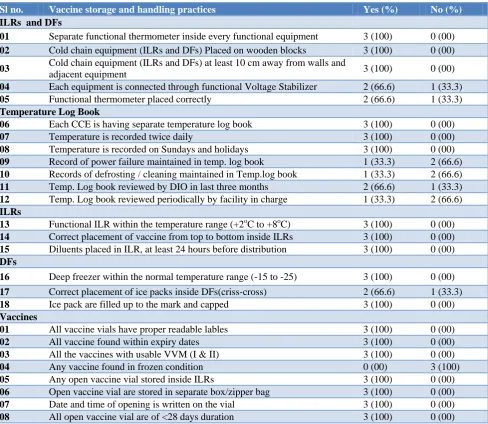
Table 2: Vaccine storage and handling practices.
Sl no. Vaccine storage and handling practices Yes (%) No (%)
ILRs and DFs
01 Separate functional thermometer inside every functional equipment 3 (100) 0 (00)
02 Cold chain equipment (ILRs and DFs) Placed on wooden blocks 3 (100) 0 (00)
03 Cold chain equipment (ILRs and DFs) at least 10 cm away from walls and
adjacent equipment 3 (100) 0 (00)
04 Each equipment is connected through functional Voltage Stabilizer 2 (66.6) 1 (33.3)
05 Functional thermometer placed correctly 2 (66.6) 1 (33.3)
Temperature Log Book
06 Each CCE is having separate temperature log book 3 (100) 0 (00)
07 Temperature is recorded twice daily 3 (100) 0 (00)
08 Temperature is recorded on Sundays and holidays 3 (100) 0 (00)
09 Record of power failure maintained in temp. log book 1 (33.3) 2 (66.6)
10 Records of defrosting / cleaning maintained in Temp.log book 1 (33.3) 2 (66.6)
11 Temp. Log book reviewed by DIO in last three months 2 (66.6) 1 (33.3)
12 Temp. Log book reviewed periodically by facility in charge 1 (33.3) 2 (66.6)
ILRs
13 Functional ILR within the temperature range (+2oC to +8oC) 3 (100) 0 (00)
14 Correct placement of vaccine from top to bottom inside ILRs 3 (100) 0 (00)
15 Diluents placed in ILR, at least 24 hours before distribution 3 (100) 0 (00)
DFs
16 Deep freezer within the normal temperature range (-15 to -25) 3 (100) 0 (00)
17 Correct placement of ice packs inside DFs(criss-cross) 2 (66.6) 1 (33.3)
18 Ice pack are filled up to the mark and capped 3 (100) 0 (00)
Vaccines
01 All vaccine vials have proper readable lables 3 (100) 0 (00)
02 All vaccine found within expiry dates 3 (100) 0 (00)
03 All the vaccines with usable VVM (I & II) 3 (100) 0 (00)
04 Any vaccine found in frozen condition 0 (00) 3 (100)
05 Any open vaccine vial stored inside ILRs 3 (100) 0 (00)
06 Open vaccine vial are stored in separate box/zipper bag 3 (100) 0 (00)
07 Date and time of opening is written on the vial 3 (100) 0 (00)
08 All open vaccine vial are of <28 days duration 3 (100) 0 (00)
Table 3: Correct knowledge of cold chain handlers.
Sl no. Parameter Yes (%) No (%)
01 Vaccine vial monitor 3 (100) 0 (00)
02 Shake test 1 (33.3) 2 (66.6)
03 Cold chain prayer 2 (66.6) 1 (33.3)
04 Time of use of reconstituted vaccine 3 (100) 0 (00)
05 Timing of placement of diluents inside ILRs 3 (100) 1 (33.3)
06 Vaccine requiring diluents 3 (100) 1 (33.3)
07 Open vial policy 2 (66.6) 1 (33.3)
Sl no. Parameter Yes (%) No (%) 08 Freeze sensitive vaccines 2 (66.6) 1 (33.3)
09 Temperature sensitive vaccines 2 (66.6) 1 (33.3)
10 Cabinet temperature range of ILRs and DFs 3 (100) 0 (00)
11 Conditioning of ice packs 3 (100) 0 (00)
DISCUSSION
Immunization is one of the most effective methods of preventing childhood diseases. One of the important elements for improving the immunization coverage with quality is holistic management of Immunization Supply Chain System which deals with cold chain and vaccine logistics along with human resource and infrastructure. Immunization supply chain system is the backbone of immunization program and plays a very important role in improving the Immunization coverage with quality by timely supply of safe and potent vaccines along with necessary logistics.2 The cold chain still remains a highly vulnerable element of any immunization program, both in developing and developed countries careful attention to storage and handling is essential to ensure optimal potency of vaccines and to maximize the resulting efficacy of vaccination.7
As for as dedicated room/space for cold chain and dry storage is concerned, in present study it was found that all 3 (100%) CHCs had dedicated room/space for cold chain but no 00 (0%) CHC had dedicated room/space for dry storage at facility. Sinhaet alin their study reported that among all CCPs visited only 40% had dedicated space/room and 75% had dedicated space for syringes and diluents.7 when icepacks are removed from a deep freezer, they are normally between -15 to -25°C temperature. If placed immediately inside a cold box and vaccine carrier, freeze-sensitive vaccines may freeze accidentally. As per guideline this ice pack needs to be kept at room temperature to allow the temperature of ice at the core of the icepack to rise to 0°C. This process is called conditioning. Conditioning of ice packs is done to prevent freezing of the freeze sensitive vaccines during transport and in emergency storage in cold box.2 In present study it was observed that dedicated table for conditioning of icepacks, dedicated clean clothes for wiping of icepacks after conditioning and power back up was available only at 22 (66.6) CHCs. Sinhaet alin their study reported that among all CCPs visited 45% CCPs had dedicated table/space for conditioning and clean cloth was available at 55% CCPs.7
As per guideline temperature of ILRs and DFs must be recorded twice daily. A break in the cold chain is indicated if temperature rises above +8°C or falls below +2°C in the ILR;and above -15°C in the Deep Freezer. Every ILRs and DFs should have separate thermometer. The thermometer should be kept in between the freeze sensitive vaccine inside the basket of the ILR. Voltage stabilizer is to monitor the range of fluctuations in the
main incoming voltage and to safeguard equipment from excessive voltage variation. Every ILRs and DFs must be connected to an individual stabilizer. Bypassing of stabilizer is not recommended; as such practice may lead to damage of the CCE and in turn safety of vaccines and hence must be avoided.2 In Present study it was observed that in all the 3 (100%) CHCs, ILR and DF were properly placed on wooden stand at the distance of 10 cm from the wall and adjacent equipment. A functional thermometer was placed inside every ILRs and DFs in all 03 (100%) CHCs but thermometers were correctly placed in ILRs and DFs and ILRs and DFs were connected to separate functional voltage stabilizer in only 2 (66.66%) CHCs. Gupta A et al in his study observed that in all 3 (100%) CHCs, ILRs and DFs were properly placed. ILR and DF were connected to functional Voltage Stabilizer in only 2 (66.66%) CHCs. A functional thermometer was placed inside every ILRs and DFs in all 3 (100%) CHCs.9 Biradar et al found that in only 76.1% health centers ILR and DF were properly placed, ILR and DF were connected to functional Voltage Stabilizer in 91.3% health centers. A functional thermometer was placed inside ILR and DF only in 76.1% health centers.10 Sharma DK et al in their study found that in 48(96%) PHCs, ILR and DF were placed on wooden block. In 42 PHC (84%) ILR and DF were connected through individual stabilizers.12 In their study Choudhury et al found that ILR and DF were connected to functional Voltage Stabilizer in only 9 (75%) cold chain points. A functional thermometer was placed inside every ILR and DF of all the 12 (100%) cold chain points.13
CHCs but review of log book by facility in charge was done only in 1 (33.3%) CHCs. Rao et al in their study showed that well maintained temperature record was seen in 94.2% PHCs and correct practices of defrosting and cleaning the ice lined refrigerator and steps in the event of power failure were seen in 61.8% and 73.7% of the medical officers.8 In their study Gupta et al reported that twice daily recording of temperature in temperature log book by cold chain handler was done in only two CHCs (66.66%). Record of power failures/cuts and defrosting of ILRs and DFs was maintained by only 01 (33.33%) CHC. Periodic checking of temperature log books by medical officers was done in all the three (100%) CHCs.9 Biradar et al found that temperature log books were monitored twice daily in 95.6% health centers. Record of power failures and defrosting of ILRs and DFs was maintained by only 65.2% health centers and periodic checking of temperature log books by medical officers was reported in 86.9% health centers.10 Sharma et al in their study showed that in 98% PHCs record of power failures were maintained and also verified by the facility in charge.12 In their study Choudhury et al found that there was no frost or frost less than 5 mm on inside walls of ILR in 11 (91.67%) cold chain points. Record of Power failures/cuts (if any) and Defrosting of ILRs and DFs was maintained by only 5 (41.67%) cold chain points.13 In a study Sanghavi et al observed that temperature log book was not properly maintained in some PHCs and record of defrosting was not available in 42.86% of PHCs.14 Mallik et al in a similar study observed that 55% of the organizations maintained temperature chart, 60% recorded temperature twice and 80% maintained temperature in optimal range.15
According to guidelines ILRs are to maintain a cabinet temperature between +2 to +80C and are used to store vaccines at district and sub district level. DFs are used for storage of vaccines at appropriate level and preparation of icepacks and cabinet temperature is maintained between -15 to -250C. All the vaccines should be kept in the basket provided with the ILR. Vaccine like OPV, BCG, Measles, RVV and JE can be kept at bottom of the basket while DPT, TT, Hepatitis B, IPV and Pentavalent vaccines are kept in upper part of the baskets. In case basket is not available, two layers of empty ice packs can be laid flat on the bottom of the ILR. Vaccines should never be kept on the floor of the ILR. The diluents should be stored in the ILR at the last cold chain point. If the ILR has space constraints then the diluents may be stored outside the cold chain. However diluents must be kept in ILR at least 24 hours before use or issuing to sessions to ensure that vaccines and diluents are at same temperature (i.e.+2 to +8°C) during reconstitution. Otherwise, it can lead to thermal shock that is, the death of some or all the essential live organisms in the vaccine.2 Present showed that in all 3 (100%) CHCs the cabinet temperature of ILRs and DFs was maintained within normal range, T-series or Hepatitis B vaccine vials were found correctly placed and Diluents were placed in ILR, at least 24 hours before distribution and ice pack were filled up to the
mark but in only 2 (66.6%) CHC ice packs were stored in DFs in cris–cross manner. Gupta A et al observed that in only two (66.66%) CHCs the cabinet temperature of ILR was maintained between +2 to +80 C. T-series or Hepatitis B vaccine vials were found correctly placed i.e. not placed in the bottom of ILR in only 02 (66.66%) CHCs. Diluents were placed in ILR, at least 24 hours before distribution in all 03(100%) CHCs. The Cabinet Temperature of DFs was maintained between 15 to -250C in only two (66.66%) CHCs. The Correct placement of ice packs inside DF (in crisscross manner) was found in only two (66.66%) CHCs. It was also found that in none of CHC had vaccines stored inside DFs.9 Biradar et al reported that temperature of ILR was maintained in 93.5% health centers. T-series or Hepatitis B vaccine vials were correctly placed in ILR in 84.8% health centers and in 95.6% health centers diluents were placed in ILR, at least 24 hours before distribution.10 Sharma et al found that diluents were placed within 24 hours before session in ILR, in 90% PHCs the vaccine arrangement was proper as T-series vaccine and Hepatitis B vaccine was not found at the bottom of the ILR.12 In their study Choudhury et al observed that in all 12 (100%) cold chain points the cabinet temperature of ILR was maintained between +2 to +80C. T-series or Hepatitis B vaccine vials were found correctly placed i.e. not placed in the bottom of ILR in all 12 (100%) cold chain points. In only 9 (75%) cold chain points, vaccine vials were correctly arranged inside labelled cartons. Diluents were placed in ILR, at least 24 hours before distribution in all the 12 (100%) cold chain points. In the present study the cabinet Temperature of DFs was maintained between -15 to -250 C in only 09 (75%) cold chain points. The Correct placement of ice packs inside DF (in crisscross manner) was found in only 05 (41.67%) cold chain points. It was observed that in none of cold chain point had vaccines stored inside DFs.13 Mallik et al in a similar study observed that 80% maintained temperature in optimal range.15
After the adoption of open vial policy, any open vial returned from the field has to be used within 4 weeks (28 days) from the date of opening, provided the VVM is in usable condition, vaccine has not been frozen and within expiry date.2 In present study it was observed that in all 3 (100%) CHCs, all vaccine vials have proper readable labels, all vaccines found within expiry dates, all the vaccines with usable VVM (I and II), no vaccine found in frozen condition, open vaccine vial were stored in separate box, date and time of opening was written on the vial, all open vaccine vials were of <28 days duration. Sinha et al observed at 70% CCPs open vials were correctly (i.e. separate box/zipper bag) placed inside ILR with date and time mentioned in it.7
(33.3) CHC cold chain handler was aware of shake test and in only 2 (66.6) CHCs cold chain handlers were aware of cold chain prayer, open vial policy, freeze sensitive vaccines, temperature sensitive vaccines. Sinha et alobserved that 75% of CCHs knew about all freeze sensitive vaccines.7 Gupta et al in his study observed that in all the three (100%) cold chain handlers had Knowledge about vaccine vial monitor, time of use of reconstituted vaccine and vaccine requiring diluents.9 In their study Bhatnagar et al revealed that all Cold Chain Handlers had knowledge about VVM, Open vial Policy, Freeze sensitive vaccines, correct temperature range and diluents which is a quite commendable finding. It was found in the present study that knowledge of “Shake Test” was present in only 11.6% of Cold Chain Handlers.16
CONCLUSION
Proper storage and management of vaccine in cold chain system is essential for immunization. Improper storage and poor management of cold chain equipment adversely affect the efficacy of vaccine thus immunization program. Our study reveals that the cold chain infrastructure, space,record of power failure/cut and regular defrosting, record keeping and knowledge and practice of cold chain handlers regarding cold chain management and handling practices were not adequate. They need regular training to keep their knowledge and skills updated. Cold chain handlers need reinforcement in skills like correct way of placing and reading thermometer, conducting shake test, conditioning of ice-packs and executing contingency plan. Medical officers in charge of the health facility and District immunization officer should be actively involved in the monitoring and supervision of the cold chain points and cold chain handlers on regular basis.
ACKNOWLEDGEMENTS
Authors express their sincere thanks to UNICEF Bhopal for providing financial support to carry out this study. We are thankful to Dean, Bundelkhand Medical College, Sagar (M.P.) for his continuous support.
Funding: From UNICEF Bhopal Conflict of interest: None declared
Ethical approval: The study was approved by the Institutional Ethics Committee
REFERENCES
1. Sunder LAP. Textbook of Community Medicine: preventive and Social Medicine. 4th ed. CBS Publishers and distributors Pvt. Ltd.; 2011: 557. 2. Handbook for vaccine and cold chain handlers.
Department of Health and Family Welfare, Ministry of Health and Family Welfare Government of India. 2nd ed. 2016.
3. Park K. Park’s Textbook of Preventive and Social Medicine. 23rd Ed. Jabalpur M/s Banarsidas Bhanot Publishers; 2015: 122.
4. Kishore J. National Health Programs of India. 11th ed. Century Publications; 2014: 178.
5. Government of India. Immunization Handbook for Medical Officers. Department of Health and Family Welfare. Ministry of Health and Family Welfare; 2008: 15.
6. Suryakantha AH. Community Medicine with Recent Advances. 3rd Ed. New Delhi: Jaypee Brothers Medical Publishers (P) Ltd; 2014: 280
7. Sinha A, Verma A, Chandrakar A, Khes S. Evaluation of cold chain and logistics management practice in Durg district of Chhattisgarh: pointer from Central India. Int J Community Med Public Health. 2017;4(2):390-5.
8. Rao S, Naftar S, Baliga S, Unnikrishnana B. Evaluation, Awareness, Practice and Management of cold chain at the primary health care centers in coastal south India. J. Nepal Paediatr Soc. 2012;32(1):19-22.
9. Gupta A, Gupta R. Study of cold chain practices at community health centers of damoh district of Madhya Pradesh. Natl J Community Med. 2015;6(4):528-32.
10. Biradar S, Biradar M. Evaluation of vaccine storage practices in primary health centres of Bijapur district of Karnataka. Int J Pharm Bio Sci. 2013;4:1290-3.
11. Lalitha K, Anniappan A, Voderhobli N, Krishna S, Yathiraj S and Sreekantaiah P. Evaluation of cold chain practices in urban health centers of a metro city in India. Natl J Community Med. 2014;5(3):288-92.
12. Sharma D, Varun A, Patel R, Singh U. Process evaluation of immunization component in mamta diwas and support services in Kheda district, Gujarat. Natl J Community Med. 2013;4(1):81-5. 13. Choudhury D, Baruah R, Ojah J. Knowledge and
practices of cold chain handler regarding cold chain equipment and vaccines storage in Chirang district, Assam. Int J Current Res. 2016;8(7):35464-7. 14. Sanghavi M. Assessment of routine immunization
program at primary health centre level in Jamnagar district. National J Med Res. 2013;3(4):319-23 15. Mallik S, Mandal P, Chatterjee C, Bagchi S,
Dasgupta S. Assessing cold chain status in a metro city of India: an intervention study. Afr Health Sci. 2011;11(1):128-33.
16. Bhatnagar P, Chopra H, Garg S, Bano T, Kumar A, Kumar S. Status of knowledge and skills of cold chain handlers in district Meerut, Uttar Pradesh, India. IOSR J Dental Med Sci. 2018;17(2):44-8.
Cite this article as: Panika RK, Prasad P, Nandeshwar S.Evaluation of vaccine storage and cold chain management practices during intensified mission Indradhanush in community health centers of Tikamgarh district of Madhya Pradesh. Int J