Cross-Border in
the E-Commerce
as Exemplified
by the Baltic
Countries
International Journal of Synergy and Research
Vol. 6, 2017 pp. 163–174
Cross-Border in the E-Commerce
as Exemplified by the Baltic Countries
Piotr Nieradka
Faculty of Economics
Maria Curie-Skłodowska University in Lublin, Poland
[email protected]
Katarzyna Niedźwiecka
PhD student, Faculty of Economics
Maria Curie-Skłodowska University in Lublin, Poland
[email protected]
Abstract
Intensification of activities in the field of e-commerce causes blurring of the boundaries of commercial space in the physical sense. As a result of globalization, organizations increasingly operating In a virtual space, use it to a greater extent and pass in a number of areas of its activities from the so-called “offline” to the “online” world.
The article deals with the subject of the phenomenon of cross-border, with particular emphasis on its importance In e-commerce. The analysis has been subjected to the current situation on the e-commerce market, as well as the latest trends and prospects for development of this sector. Next, there was characterized the concept of cross-border while pointing forecasted trends of its development and the existing barriers. The article ends with an analysis of the use of cross-border e-commerce in business practice.
Keywords – cross-border, e-commerce, Baltic countries, parcel machines, trends
1. Introduction
The electronic commerce is a phenomenon that recently has started to take an increasingly important place in the economies of developed and developing countries. Despite the fact that, in measurable terms, it still represents a small percentage of the retail trade, the interest in the issue and its conditions and perspectives of development has, in recent years, been a trend for both theoreticians and practitioners. Focusing on the electronic commerce, one should also pay attention to its international dimension – in terms of the cross-border e-commerce.
The purpose of this paper is to present the phenomenon of the electronic commerce, including its international dimension. The e-commerce and cross-border e-commerce market was analyzed in the article. Also the trends appearing in those areas were dis-cussed (multi-channel sales, i.e. omnichannel and ROTOPO effect). Then, selected barriers hindering the activities of companies in the analyzed area were presented.
IJSR
6
The paper ends with an analysis of the example of a logistics company operating on the international e-commerce market in the Baltic countries area.
2. E-Commerce
2.1. Definition
Shaping the information society and its continuous development, conditioned by the information and communication technologies creation and their successive changes, stimulate the economic and civilizational development. They played an important role, by enabling the achievement of the summary effects of globalization and the information revolution in the economic area. Those dynamic changes make the companies, wishing to achieve and maintain their competitive advantage, focus on new technologies and enter the emerging markets.
On the currently functioning market, it is necessary for the businesses to exist on the Internet, whose prevalence is growing rapidly, and which creates a substantial part of the new economy, i.e. the electronic economy. The pillars that build this new economy include, e.g. (Turban et al., 2000):
1. People who make the economy, which could include:
1.1. A global customer (living at any latitude and longitude of our globe).
1.2. Organizations (starting from small, one-man business activities, ending up with transnational corporations operating on all the continents).
1.3. Culture of the organization (i.e. social norms and systems of values). 1.4. Economic policy (which varies depending on regions of the world). 1.5. Social policy.
2. The latest technology, and in particular the computer technology, together with the developing infrastructure, which includes:
2.1. Electronic data transmission.
2.2. Programming languages (e.g. C, PHP, Java or Python). 2.3. Databases (from local to global ones).
2.4. Data warehouses.
2.5. Computer Networks (from local to global ones).
3. Applications used in business – starting from state institutions, ending up with organizations within different industries, e.g.:
3.1. Banking. 3.2. Trade. 3.3. Industry. 3.4. Marketing. 3.5. Other.
The above-mentioned pillars of the new economy should also include another pillar. Another, already the fourth pillar, should be the subject-matter of the transaction (regardless of its form – whether it includes services, goods or property rights) together with a holistic approach to the life cycle of the given subject-matter of the transaction.
E-commerce undoubtedly fits into the functioning of the digital economy. To present the phenomenon of e-commerce, one should begin with the story of Aldrich, who in 1979
Cross-Border in
the E-Commerce
as Exemplified
by the Baltic
Countries
presented the first in the world system of purchases via the Internet (Tkacz, Kapczynski,2009, p. 255).
Review of the literature shows a lack of a uniform and leaving no doubts approach to the definition of e-commerce. According to the Central Statistical Office, e-commerce can be defined as the electronic commerce, i.e. any activities via a computer network in order to conclude a commercial transaction, with the delivery and payment not having to be made in such a form (Berezowska et al., 2012, p. 64). On the other hand, Jasinski emphasizes that currently, e-commerce is very often erroneously identified only with the online trade. In his view, e-commerce also includes (in addition to the online trade) transaction operations performed through other sales channels, e.g. TV or phone (Cichoń et al.,2013, p. 17). A similar approach is presented by Köhler and Best who point out that the essence of e-commerce is “to enable digital conducting of the trading process between a company and its customers through a public and private network (the Internet)” (Köhler, Best, 2001, p. 11). However, the fact is that this area of the economy is dominated by the Internet medium.
2.2. Characteristics of the market
The global e-commerce market is constantly growing from 1.45% to 40% annually, depending on the region. In 2017, according to the Ecommerce Foundation, the electronic commerce market will reach a value of USD 1.84 trillion (Global B2C E-commerce Country Report 2017), and this value will increase 2.5 times during the next 4 years, reaching a value of approximately USD 4.5 trillion (Retail e-commerce sales worldwide from 2014 to 2021 (in billion US. dollars), 2017).
The largest increase of the market is projected for the regions of the Pacific and Asia (approximately 35.1% share). Further on we find: North America (approximately 31.1%), Western Europe (23.9%) and the rest of the regions exceeding a 5% share (Worldwide Ecommerce Sales to Increase Nearly 20% in 2014, 2014).
The Polish e-commerce market has been evolving intensively since the beginning of the 21st century and is characterized by constant growth. In the years 2006–2012,
the value of the Polish Internet economy has increased two times, reaching the value of PLN 93 billion. Only in 2014, the revenue from Internet trade has exceeded PLN 27 billion with an increase of over PLN 3.5 billion when compared to the previous year. The good condition of the Polish industry is also characterized by a 15% annual growth of the e-commerce market (Wałach, 2015). And even in spite of all of this, this section of the market still presents a huge potential for growth.
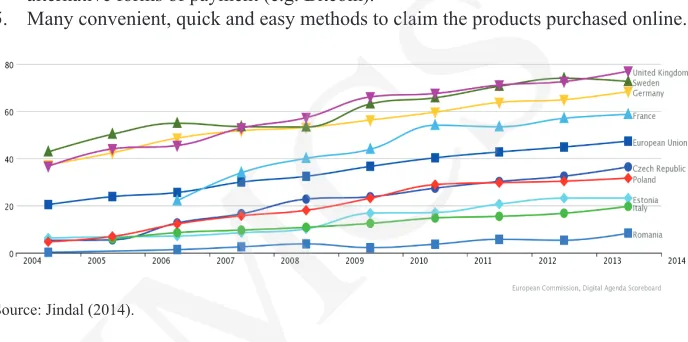
Figure 1 presents the populations of given EU countries and their shares of people using e-commerce services, taking into consideration a mean for the whole group. Poland is located below the European mean with a result of 30%, which means that the country is characterized by a larger potential for growth when compared to such EU countries as: the UK, Sweden, Germany and France, where the share is higher than 50%.
With the continuous development of the electronic commerce, which is driven by the countries with a higher participation, fast accustoming of consumers to the newly created solutions is noticeable. The customers are becoming more demanding expecting higher quality and diversity of services. They expect among other things:
IJSR
6
1. Modern and developing websites.
2. Availability and adapting of the sellers to mobile devices.
3. Different forms of delivery of products at low prices or even free of charge. 4. An extensive range of types of payment for the products and now also increasingly
alternative forms of payment (e.g. Bitcoin).
5. Many convenient, quick and easy methods to claim the products purchased online.
Source: Jindal (2014).
This kind of expectations does not only appear in the developed countries where the majority of the people use e-commerce. It is worth noting that global customers expect a wide range of possibilities for various activities related to the process of their shopping (different methods of payment, delivery). However, there is a tendency to unify the solutions included in the offer. This means that the e-commerce market is influenced by the process of globalization.
2.3. E-commerce – a result of globalization
Globalization is a “collection of processes leading up to the growing interdependence and integration of countries, societies, economies and cultures, resulting in the creation of »one world«, a global society” (Kempny, 1998, p. 241).
In 1964, H.M. McLuhan introduced a very good definition showing how, due to the development of mass media, the rapid circulation of information and communication, the globe “decreases”. He called them “a global village” (Kostelanetz, 1997).
The economic globalization aims to unify all the world markets. This would contribute to the creation of something like a global market accessible to everyone regardless of their location and their function in the purchase process: the seller or the buyer. It would be the unification to cancel many barriers that occur when making international transactions. The effect of normalization would be to increase local, regional and global competitiveness of the organization.
A good example of the globalization process is electronic commerce. This phenomenon is a relatively new creation, which is only the first stage of the life cycle where the most dynamic development is possible. The number of users and increase in the e-commerce market is diverse in different regions of the world, which is also associated with the different stage of development of the various regions of the world. Figure 1.
Percentage of people (aged 16–74) ordering online goods and services, broken down by each country
Cross-Border in
the E-Commerce
as Exemplified
by the Baltic
Countries
3. Cross-border
3.1. Definition
In the simplest way, the cross-border e-commerce can be described as an international electronic commerce. Therefore, this phenomenon is about making purchases via the Internet in countries other than the mother countries (International expansion, 2012). Some consumers are often not aware of the existence and use of this kind of commerce. The cause of lack of awareness is most often the use of the same currency (e.g. in the case of the EU countries belonging to the Eurozone), which reduces the sensation of making purchases on an international scale.
The phenomenon of the cross-border electronic commerce is based on eliminating the location of the buyer and the seller from the purchase process. This is possible thanks to wide Internet access, use of the evolving portfolio of mobile devices and the introduction of modern technologies. Additionally, fast growth and high competitiveness of the e-commerce market force businesses to react instantly to changes and new trends in order to maintain their market positions (Verhoef et al., 2015).
3.2. Trends
During the last two decades, we are witnessing changes taking place in the offline (retail) sales channel. This is a result of a dynamic online commercial growth and an unceasing digitization of the market. On some retail markets the online channel can become the dominant one and proves to be destructive to the growth of the offline market (Gold et al., 2003).
In 2014, we witnessed a turning point in the history of mobile devices. Despite the continuous increase in the number of stationery devices, the number of users of mobile devices increases much faster. Already in 2015, the number of users of mobile devices exceeded the number of users who used stationary equipment (Chaffey, 2017). The growing number of mobile users is largely the result of the development of new technologies. The new solutions result in a faster decline in the prices of equipment with lower performance. While the decline in prices contributes to increasingly easier access to a wider range of mobile devices for a wide variety of global customers in terms of their revenues.
A new, “be mobile” trend is emerging along with the growth of the mobile market and the increasing number of mobile users. This takes the form of customizing websites for mobile purposes and the multiplication of the number of applications for mobile devices. On the one hand, these apps simplify access to desired products and services. On the other, they gather numerous data (with the consent of the user) from various mobile devices where the programs are installed. This data is then analyzed by advanced algorithms. The algorithms, in turn, make it possible to present the Internet and multichannel audience with offers better tailored to their needs.
Another visible trend on the market is the emergence of the omnichannel, which combines sales through physical locations (offline) with those through the Internet (online). This trend connects two different sales channels into one. The solution, of course, has its financial cost as one needs to integrate the two sales channels, but after
IJSR
6
the implementation organizations are able to enjoy significant benefits. As a result, sales increase through a more comprehensive approach to potential customers, not only in the area of physical points of sale, but also via Internet stores, which can be scattered all over the country or the world.
To fully exploit the potential of the omnichannel solution, one should pay attention to the three issues mentioned below (Rutkowski, 2015):
1. Striving for a single and centralized all sales management center.
2. Availability of products or services offered through all kinds of devices (starting from stationary devices ending up with newer and newer mobile solutions and equipment).
3. Creating a coherent pricing policy in each of the sales channels.
Without considering the above-mentioned conditions, the operation of the organization can also be effective, but in the short period of time, because the prepared solution is usually optimal at a given moment of the company operation. With the passing of time, many factors and activity guidelines will change, and the organization will need much more time and work to keep all activities in check.
And, of course, we cannot forget about keeping up with the times. Modern customers use new technical solutions more and more frequently. This is evidenced by yet another new trend, the so-called ROTOPO effect (Research Online, Test Offline, Purchase Online), which is becoming more and more popular. First, a customer uses the Internet to find interesting products or services. Then, he/she browses through the offers and the other customers’ opinions to create a benchmark for the products on the market. After selecting a few interesting options, he/she visits the selected nearby stationary shops where, using the sense of touch (physically), he/she tests the products of his/her interest, also comparing their specification. The next step is to go back to the Internet. The customer, after having tested the goods, in reality, through physical contact, is looking for cheaper ways to buy the goods online. Very often, the place of purchase are no longer the United States (along with its commercial giants like eBay or Amazon) but China and its tycoon – Alibaba group. An example confirming the growing popularity of purchases in Asia is the establishment of cooperation between AliExpress portal (a subsidiary of Alibaba Service) and the Polish company Przelewy24. Such an action means that now goods can be ordered without any problems, e.g. through a simple Internet transfer (Szczęsny, 2015). This shows the potential of ecommerce, which is still possible to be used by numerous organizations.
Despite the excellent prospects for the development of the cross-border e-commerce market, it is not devoid of barriers that hinder the functioning of companies.
3.3. Barriers to the cross-border trade
According to the report E-commerce – New Opportunities, New Barriers (2012), developed by the National Board of Trade (a Swedish commercial agency dealing with foreign trade and trade policy), one of the most severe obstacles is the lack of knowledge and information about the new market. Small and medium-sized enterprises often indicate that a major problem in the expansion into foreign markets is the impossibility to find current information on the market. It is about both information on the characteristics of
Cross-Border in
the E-Commerce
as Exemplified
by the Baltic
Countries
the market (demography, estimated demand), but also regulatory and logistics solutions.The significance of the problem increases when a company operates in an area of a few dozen markets. Sometimes, this unclear situation also leads to an unconscious violation of the law by entrepreneurs involved in the international e-commerce (E-commerce –
New Opportunities, New Barriers, 2012, p. 6).
Another barrier (indirectly related to the lack of adequate information on the new market) are differences in laws of different countries. This concerns the regulations related to consumers (returns, replacements, complaints, withdrawals from contracts, consumer information), sales and promotion (advertising, website contents). It is worth noting that this barrier is particularly important in the case of business in countries not belonging to economic groupings, where the lack of efforts to harmonize legislation occurs. Non-uniform legislation results in large expenditures related to its adaptation to business and its requirements. On the other hand, they will reduce the attractiveness of the new market and generate a lack of confidence on the seller-buyer line (E-commerce – New Opportunities, New Barriers, 2012, pp. 8–9).
Differences in the requirements relating to payment methods also seem to be problematic. The priority in this matter is to ensure security. To this end, both legislation and technical solutions which are to provide such security, are created. Unfortunately, an excessive number of regulations completely different from each other (or in the best case incompatible technical solutions) generate additional costs hindering companies to expand into new markets. Businesses also pay attention to the fact that the use of different methods of payment (and technical solutions needed to support them) involves a threat of fraud and crime (E-commerce – New Opportunities, New Barriers, 2012, pp. 10–11).
It should be remembered that there is a number of other barriers, which either more or less influence the expansion of companies involved in e-commerce. Those could include: the issue of supply and supply chain organization, transport costs or lack of performance standards in the area of ecommerce. Usually, the companies try to respond to emerging problems, but there are also situations where excessive barriers result in giving up with further expansion.
Examples of successful expansion in the cross-border e-commerce will be discussed later in the article.
4. Parcel machines in the Baltic countries
A good example of the rapid development of the cross-border e-commerce is AS Eesti Post. This post-service was founded in 1918, right when the Republic of Estonia began to exist. In June 2014, the organization has started its new history by founding a new group named Omniva (responsible for international shipping and logistics), the name is used by Eesti Post responsible for the post-services in Estonia (The story of our changes, 2015). The group saw a potential development of electronic commerce, for which it offered its services in three Baltic countries.
Omniva Group was searching for an optimal logistics solution for the ever increasing number of parcels. The Group decided to create a network of parcel machines as a modern logistics solution for the delivered parcels. By the end of 2016, the group owned more than
IJSR
6
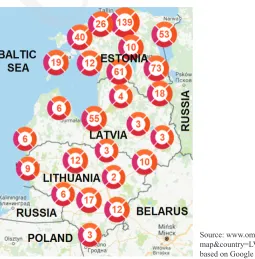
277 units located in three countries, as presented in Figure 2. This solution is becoming popular among users in all of those territories (Omniva will invest over 20 million euros in the parcel machine network, 2016). The popularity of the implemented solution is confirmed by the 2017 expansion of the network by yet another 8 new parcel machines in Estonia, 30 in Latvia and 25 in Lithuania. These numbers will increase by a minimum of 37 parcel machines in Estonia and another 100 units in other Baltic countries (Omniva’s parcel locker network will double in size, 2017). The popularity of the solution stems from the simple fact that this method for sending and receiving packages is easy and convenient, regardless of the time of day. At the same time, the solution has created strong ties between group offices, forming the foundation of the integrated strategy for the company’s operations in Estonia, Latvia, and Lithuania, with headquarters in Tallinn (Parcel machines revive the connections throughout the Baltics, 2016).
With the parcel machines services provided by Omniva in the three countries, the number of business customers, who see the three Baltic countries as one business market, is increasing. This is confirmed by the growth of the international trade from such countries as: China, the UK, the USA and Germany. The group data shows that the number of shipments from China more than doubled mainly due to AliExpress e-store. There is no doubt, shopping in this area is still attractive because of the low prices of the products and their free of charge or cheap shipping. However, there is also a large group of conscious clients who want to be sure about the quality of the products ordered from foreign online stores. Awareness of relying on the quality of the goods is confirmed by the upward trend in purchases made from Germany, in 2016 (Omniva will invest over 20 million euros in the parcel machine network, 2016).
Figure 2. Location of AS Eesti Post Parcel Machines
Source: www.omniva.ee/private/ map&country=LV [access: 01.01.2017], based on Google maps.
Cross-Border in
the E-Commerce
as Exemplified
by the Baltic
Countries
The expansion of Omniva Group is the largest in the cross border logistics areawhere growth in 2016 amounted to 142% compared to 2015. The company sees potential mainly in the logistics associated with the increase in parcels consignment generated by the international Chinese e-commerce. Major investments of the group shall be focused on the two areas (Omniva continued to go grow in the third quarter in all Baltic countries, 2016). The first one is to increase the existing network of parcel machines with new devices in the subsequent locations in the Baltic countries. The second goal is to increase investments in information technology. This year, the Company plans to create a modern software for the use of the network of parcel machines owned by the Group’s partners in the area of the Baltic countries, in order to stimulate the international electronic commerce development in their area (Omniva will invest over 20 million euros in the parcel machine network, 2016).
5. Conclusions
The electronic commerce is the result of the development of new technologies and the Internet. The changes taking place both in the economic sphere (electronic economy) as well as in the social sphere (electronic society) made the e-commerce sector gain a special significance. E-commerce is becoming wider and more well-established area of the economy showing a gradual growth.
The market specificity is conducive to expansion into new areas, thus, contributing to the internationalization of e-commerce. It is worth noting that, the companies that have decided to operate internationally are exposed to the impact of a number of factors limiting their freedom of operation. The sources of those barriers should be mainly seen in the differences that exist between countries regarding, e.g. the system solutions (law, transport, distribution, logistics). Such a situation creates the need for flexibility on the part of companies and the willingness to use individualized solutions for each area, which might give rise to additional expenses.
The cross-border e-commerce market is also characterized by its significantly rapid changes. The trends, being a response to customers’ demands, change very rapidly, they quickly appear and just as quickly lose their importance. It is significant that such a big dynamics of changes means that sometimes, companies cannot cope with implementation of new solutions at a time when the customer expects it.
Despite the fact that the market itself shows a high growth potential, it can be deduced, that only strong players who are creators rather than consumers of the emerging trends, can succeed. Activity in such a dynamic environment requires efficiency and a visionary approach above all.
Even though the market is characterized by dynamic growth, only the strongest par-ticipants will succeed. These are the creators, not only the recipients, of new technologies. Operating in such a dynamic environment requires efficiency and a visionary approach.
In connection to such strong dynamics of the cross-border e-commerce market we recommend the preparation of future analyses and research for the following areas: • European trans-border commerce,
• latest e-commerce trends, • e-commerce big data solutions,
IJSR
6
• e-commerce mobile solutions,
• e-commerce solutions implemented by the market leaders.
The presented contents should be accompanied by examples of organizations that provide e-commerce cross-border services for the European market. An analysis of the cross-border e-commerce market for other European countries, which are not part of the EU, along with the presentation of commercial barriers, is also recommended.
References
Berezowska, J., Huet, M., Kamińska, M., Kwiatkowska, M., Rozkrut, D., Szczepańska, B., et al. (2012). Społeczeństwo informacyjne w Polsce. Wyniki badań statystycznych z lat 2008–2012. Główny Urząd Statystyczny w Szczecinie, p. 64. Retrieved October 28, 2016 from: www. stat.gov.pl/cps/rde/xbcr/gus/nts_spolecz_inform_w_polsce_2008-2012.pdf
Chaffey, D. (2017). Statistics for consumer mobile usage and adoption to inform your mobile marketing strategy mobile site design and app development. Smart Insights. Retrieved January 10, 2017 from: www.smartinsights.com/mobile-marketing/mobile-marketing-analytics/mobile-marketing-statistics/
Cichoń, M., Cisek, M., Czopek, K., Dejnaka, A., Dudzic, J., Dudko, M. (2013). Biblia e-biznesu, Wydawnictwo Helion, Gliwice, p. 17.
E-commerce – New Opportunities, New Barriers, (2012). National Board of Trade.
Kommerskollegium, pp. 6, 8–11, Retrieved October 20, 2016 from: www.wto.org/english/
tratop_e/serv_e/wkshop_june13_e/ecom_national_board_e.pdf
Global B2C Ecommerce Country Report 2017, (2017). Retrieved December 29, 2017 from:
https://embed.ecommercewiki.org/wikis/embed.ecommercewiki.org/images/1/18/C_Light_ Global_Report_v170920_-_FINAL.pdf
Gold, S.F., Scharf, M., Valdes, M., Zaleski, J. (2003). Innovator’s Solution: Creating and Sustaining Successful Growth. Publishers Weekly, vol. 250(35), pp.78–79. Retrieved December 29, 2017 from: search.ebscohost.com/login.aspx?direct=true&db=lkh&AN=10709998&lang= pl&site=ehost-live
International expansion. CBEC. Retrieved December 02, 2016 from:
www.crossborder-ecommerce.com/international-expansion/
Jindal, I. (2014). Connecting with the Connected Customer. 10 trends for multi channel retailers
in 2014. Conference: Ecommerce Trends.
Kempny, M. (1998). Encyklopedia socjologii, Oficyna Naukowa, Warszawa.
Kostelanetz, R. (1997). Understanding McLuhan (In Part). Retrieved January 03, 2017 from: http://www.nytimes.com/books/97/11/02/home/mcluhan-magazine.html
Köhler, T.R., Best, R.B. (2001). Electronic Commerce. Koncepcje, realizacje i wykorzystanie
w przedsiębiorstwie, CeDeWu, Warszawa, p. 11.
Omniva continued to go grow in the third quarter in all Baltic countries, (2016). Omniva. Retrieved December 16, 2016 from:https://www.omniva.ee/index.php?article_ id=537&page=888&action=article&
Omniva will invest over 20 million euros in the parcel machine network, (2016).
Omniva. Retrieved December 16, 2016 from:www.omniva.ee/index.php?article_
id=544&page=888&action=article&
Omniva’s parcel locker network will double in size, (2017). Omniva. Retrieved December 28, 2017 from:https://www.omniva.ee/index.php?article_id=686&article_token=news&page=8 88&action=article&
Parcel machines revive the connections throughout the Baltics, (2016). Omniva. Retrieved December 27, 2017 from: www.omniva.ee/index.php?article_id=495&page=888&action=article&
Cross-Border in
the E-Commerce
as Exemplified
by the Baltic
Countries
Retail e-commerce sales worldwide from 2014 to 2021 (in billion U.S. dollars), (2017). Omniva.Retrieved November 02, 2016 from:https://www.statista.com/statistics/379046/worldwide-retail-e-commerce-sales/
Rutkowski, M. (2015). i-systems: wyzwania e-commerce w dobie omnichannel. RETAILNET. Retrieved October 29, 2016 from: https://retailnet.pl/2015/05/11/101678-i-systems-wyzwania-e-commerce-w-dobie-omnichannel/
Szczęsny, J. (2015). Za zakupyna Aliexpress zapłacisz jeszcze prościej – przelewem ze swojego banku!. antyweb. Retrieved October 28, 2016 from: www.antyweb.pl/za-zakupy-na-aliexpress-zaplacisz-jeszcze-prosciej-przelewem-ze-swojego-banku/
The story of our changes, (2015). Omniva. Retrieved December 12, 2016 from: www.omniva.ee/ about_us/about_company/brand_story
Tkacz, E., Kapczynski, A. (eds.). (2009). Internet–Technical Development and Applications, Springer, Berlin–Heidelberg, p. 255.
Turban, E., Lee, J., King, D., Chung, H.M. (2000). Electronic Commerce. A Managerial
Perspective, Prentice Hall, New Jersey. Retrieved November 07, 2016 from: www.tiger.edu.
pl/kolodko/ksiazki/Kolodko-Nowa_gospodarka.pdf
Verhoef, P.C., Kannan, P.K., Inman, J.J. (2015). From Multi-Channel Retailing to Omni-Channel Retailing: Introduction to the Special Issue on Multi-Channel Retailing. Journal of Retailing, vol. 91, no. 2, pp.174–181, DOI: https://doi.org/10.1016/j.jretai.2015.02.005
Wałach, D. (2015). RAPORT: wartość polskiego rynku e-commerce w 2015 r., Reseller-news. Retrieved December 12, 2016 from: www.resellernews.pl/raport-wartosc-polskiego-rynku-e-commerce-w-2015r/
Worldwide Ecommerce Sales to Increase Nearly 20% in 2014, (2014). eMarketer. Retrieved November 20, 2016 from: www.emarketer.com/Article/Worldwide-Ecommerce-Sales-Increase-Nearly-20-2014/1011039