http://www.sciencepublishinggroup.com/j/ijmsa doi: 10.11648/j.ijmsa.20180703.13
ISSN: 2327-2635 (Print); ISSN: 2327-2643 (Online)
The Effects of Ozone Bleaching and Ozone Desizing
Method on Whiteness and Water Absorption of 100%
Cotton Terry Fabrics
Yıldıray Turhan
1, *, Şeyma Soydaş
21Department of Textile Engineering, Engineering Faculty, Pamukkale University, Kinikli, Denizli, Turkey
2
Department of Research and Development, Yunsa Company, Tekirdag, Turkey
Email address:
*
Corresponding author
To cite this article:
Yıldıray Turhan, Şeyma Soydaş. The Effects of Ozone Bleaching and Ozone Desizing Method on Whiteness and Water Absorption of 100% Cotton Terry Fabrics. International Journal of Materials Science and Applications. Vol. 7, No. 3, 2018, pp. 85-94.
doi: 10.11648/j.ijmsa.20180703.13
Received: March 11, 2018; Accepted: March 27, 2018; Published: April 24, 2018
Abstract:
In this study, the effects of ozone desizing and bleaching on the hydrophilicity and whiteness of terry fabrics were investigated. The results were compared with those obtained after conventional desizing and bleaching (hydrogen peroxide bleaching). The test samples contain two side piled woven terry cloths of four different areal weights. The ozone desizing and bleaching process was carried out at fixed PH values (6) in four different ozonation times and two different ozone doses. The rate of water pickup in fabrics was 60%. It has been determined that as ozonation time and the ozone dose increase, the degree of whiteness and water absorption of the terry fabric increases. However, the increase in the ozonation time did not cause a significant change in the low ozone doses; the change in the ozonation time at high ozone doses is causing a marked change in the investigated properties of the towel fabric. The degree of hydrophilicity and whiteness achieved after ozonation was found to be close to the results obtained in conventional bleaching. However it was seen that although acceptable water absorbency was obtained by the ozone desizing method, these values were lower than those of the conventional desizing method. Ozone bleaching and desizing do not require the consumption of water, the consumption of heat energy, and the use of any chemical additive that harms the environment with its wastes. As a result, owing to ecofriendly, saving energy and acceptable fabric properties with regard to whiteness and absorptivity, ozone bleaching can be applied instead of the conventional bleaching and desizing method.Keywords:
Ozone, Bleaching, Desizing, Whiteness, Water Absorbency, Saving Energy, Ecofriendly Pretreatment1. Introduction
Terry Towel fabrics are generally used many places such as bathrooms, beaches, pools and wet surfaces etc. that are wet and moist areas and used for wearing such as terry sock and sweat-shirt. Dehumidification of surface, surface drying and water retention by rubbing can be stated as usage purpose of these fabrics. Therefore, the performance of terry fabrics is primarily evaluated by its absorbency that refers to both the rate at which fabric absorbs the water i.e. dynamic water absorbency, and the total water retention ability of the fabric; static water absorption [1].
In terry towel fabrics, foreign matter, which is also found
and heat energy. To this end, some recent studies have been reported on the use of ozone in textile finishing in recent years. The ozonation method is also proposed as one of these studies [2, 3].
Ozone is an abrasive gas that is not resistant to temperature and can break down automatically into oxygen [2, 3].Thanks to the ozone generator, ozone that can be produced from the air can be used at low temperatures and without the need of adding auxiliary chemicals by showing a strong oxidative property. In addition, the ozonation processes can also be carried out at room temperature or at lower temperatures. Because of these properties, these features offer a great advantage over conventional methods for ease of application, energy saving and environmentally friendly ozonation [4]. Ozone can be dissolved in water depends on its free radical mechanism and form nonstable intermediate hydroxyl radicals. Some of these intermediates may in part contribute to the whitening effect. The ozone water solubility varies with ozone concentration and temperature [5]. These properties indicate that ozone can be used for bleaching and hydrophilization. A lot of work has been done in this area [6-16].
It is to be seen that the majority of these studies are investigations about the effect of ozonation and very few of them investigated the effect of desizing with ozone. After applying ozonation to the cotton fabric, the whiteness and strength of the fabric had been measured. The whiteness grades and strengths obtained by this method had been compared with those of the conventional pre-treatment. In these studies, mainly, the effects of ozonation time, ozone dose, ambient pH and fabric moisture level on the degree of whiteness and strength during this process were investigated.
In previous studies of the researching effect of ozonation time, it was determined that as the time increased, the degree of whiteness of the fabric increased but the breaking strength decreased [6-16]. When the results were compared to conventional bleaching processes, it was seen that the highest whiteness degree and the lowest loss of strength are found in peroxide bleaching, the lowest whiteness degree and the highest loss of strength in hypochlorite bleaching [7, 8, 17]. In some of the studies, it has been determined that desorption efficiency increases with increasing ozonation time, but ozone desizing process cannot reach the desizing efficiency in the conventional method even in the longest ozonation time [6, 7, 9]. The effect of ozonation time on optical brighteners was also investigated in a study. In this study, PH value, water pickup amount of fabric and ozone dose were kept constant. Only the ozonation time was changed. The study showed that when the ozonation time increased, the removing optical brighteners from cotton fabrics increased and so the whiteness degree of cotton fabrics was decreased. [18]
When the investigations about the effect of ozone dose on using for the pretreatment of cotton fabrics were considered, it was seen that that as ozone doze increases, the whiteness of
the cotton fabric increased but the fabric strength decreased. The result of these studies were compared with those of conventional bleaching method (hydrogen peroxide) and it was seen that even at the highest ozonation dose tested, the whiteness achieved in conventional bleaching processes (peroxide bleaching) could not been reached [8, 10, 11].
In a study, the comparing the ozone bleaching with ozone bleaching process containing various additives was carried out. The study investigated the influence of methanol, isopropanol, oxalic acid and sodium borohydride on increasing in the bleaching performance of ozone in respect of whiteness and absorbency. It was determined in this study that Ozone bleaching process containing additives provided a better whiteness degree and water absorbency than those obtained ozone alone process to cotton fabrics. [19]
In a study, combination of ozone and ultrasound method was applied together to remove the sizing. This study shown that the results of desizing efficiency was nearly similar with those of conventional process [20].
In the researches about the effect of the amount of water pickup on the pretreatment of cotton fabrics, the results showed that the moisture content in the fabric (the rate of water pickup of fabric) before ozonation had a remarkable effect. In these studies, it was observed that the degree of whiteness of the cotton fabric increased as the value increased by a certain value (by 60-70% in some studies), and then decreased in whiteness after a certain value [9, 10, 13, 17]. The results of previous studies have shown that a good whiteness degree and an acceptable loss of strength are obtained at neutral and basic pH values [8-10, 13].
Evaluating previous studies, it has been seen that they focused on the investigating effect of ozone bleaching process on the whiteness of the plane cotton fabric. Also, it has been determined that very few of the studies was about research of using ozone for desizing process of cotton fabrics. The results of all previous studies reviewed show clearly that there is not any study about the effect of ozone bleaching and desizing process on the properties of %100 cotton Terry (towel) fabrics such as whiteness and water absorbency. As known, the towel fabrics are used to take water from surface and to wipe wet surface. And they are preferred in white color. So, the water absorbency is the most important characteristics of them. The purpose of this study is to investigate the effect of ozone bleaching and desizing process on the whiteness and water absorbency of %100 cotton terry fabrics and to compare the results with those of conventional bleaching and desizing method.
2. Material and Method
2.1. Material Fabric Properties
Table 1. Terry fabric properties.
Fabric Areal
Weight gr/m2 Pile Warp yarn Weft Yarn Ground Warp Yarn
Weft Density (pick/cm)
Ground Warp Density (end/cm)
Pile Warp Density (end/cm)
350
%100 Cotton, Ring, Ne 16/1
%100 Cotton, Ring, Ne16/1
%100 Cotton, Ring,
Ne 20/2 17 13 13
400 450 500
(a) Unit weave report [22].
(b) cross section view through out the warp yarn [23].
(c) cross section picture of terry fabric sample [21].
(d) picture of surface of terry fabric sample [21].
Figure 1. Terry fabric structure (a) unit weave report of terry fabric, (b) cross section of terry fabric [22, 23], (c ) cross section picture of terry fabric sample, (d) picture of surface of terry fabric sample [21].
2.2. Method
The experimental study consisted of two groups [21]: The First Group Experimental Study is as follows: Desizing by ozonation process
Conventional Desizing Process
Measuring the hydrophilicity of fabrics after processing Comparison of hydrophilic properties obtained after
ozonation and conventional desizing
The second group is the following as the experimental work order:
Bleaching by ozonation
Conventional Bleaching Process Measuring the whiteness of fabrics
Comparison of whiteness degree obtained after conventional and ozonation bleaching
2.2.1. Ozonation Treatment for Desizing and Bleaching
The ozone treatment was carried out by inserting samples between two glass bulbs having a. a volume of 140 ml and a radius of 27 mm. In the experiments, the Opal OS1 model ozone generator was used to convert the high purity oxygen needed for the reaction to ozone. All ozone tests were carried out under laboratory conditions.
During the ozonation process, the samples of cotton towel fabric placed between the two glass bulbs contact the ozone gas that is fed through the ozone gas distributor through the bulb. Because the system is continuously supplied with ozone gas, there is a pressurized supply opening in the upper bulb, from which the ozone gas coming into contact with the sample comes out and a new ozone gas is fed.
The ozone dosage was adjusted to be 500 ml / min and 1000 ml / min. This was determined by standard iodometric method (2350 E, APHA). To determine the ozone dosage, the ozone gas produced in the ozone generator was transferred to gas washing bottles filled with potassium iodide (KI) solution. It was selected as ozonation time of 5, 15, 30 and 45 minutes. Ambient temperature during ozonation was room temperature (20+-2oC). The process PH value was fixed as 6. The water pickup rate of all fabric samples was adjusted as 30% [21].
The drawing of the system in which the ozone process is performed is shown in Figure 2.
(b)
Figure 2. Ozonation chamber: (a) front view of glass bulb (b) top diagonal view of glass bulb [21].
2.2.2. Conventional Desizing
For 100% cotton fabrics, a compound and dispersant chemistry containing alpha-amylase and pectinase enzymes were used as biodegradable and sizing enzymes. Namely the two different enzymes for desizing and scouring treatments were used in the same solution bath. Thus, both of desizing and scouring treatments were carried out in same process.
After conditioning in the laboratory conditions, the samples were processed according to the following prescription [21]:
Desizing was performed in three steps in the bath at 1:20 flotte ratio.
Step 1: Processed with 1.5% ml/l of desizing enzyme at 60°C for 15 min.
Step 2: Rinse for 5 minutes at 95°C.
Step 3:%1.5ml/l of Dispenser / ion holder was applied at 60°C for 15 minutes.
The samples were rinsed by running water and then dried.
2.2.3. Conventional Bleaching
Hydrogen peroxide (H2O2) bleaching method was applied
to the samples. This bleaching is carried out in basic medium (pH 10-11) and boiling temperature. After bleaching, anti-peroxide enzymes are used to remove H2O2 remaining on the
bleaching bath and the fabric. Finally, the fabrics are rinsed in running water and are dried in lab. oven. The prescription of the peroxide bleach is as follows [21]:
- 1:20 flotte rate - 2 ml/l H2O2 (%50)
- 4 ml/l stabilization agent - 2 g/l Wetting Agent - 2 g/l NaOH - 120 minutes (time) - 95°C (temperature)
Sodium hydroxide (NaOH): Enables the bath to be basic and helps to bleach. In addition, oil, wax, pectin, and broken cotton seeds, which are left on the fabric, are removed.
Wetting: Provides easier and faster wetting of the fabric. Stabilizer: Chemical substances that reduce the decomposition of H2O2. Because the disintegration of H2O2
causes the fiber to be damaged and the strength to decrease. Hydrogen Peroxide (H2O2): Oxidizing substance which
acts as a bleaching agent.
Anti-peroxide: Provides removal of H2O2 in the bath and
on the fabric after bleaching.
2.2.4. Desizing Test
Potassium iodide (KI) solution was dripped onto the fabric to determine if starch desizing had been removed (Iodine Test). The color change in the place where the solution dripping to the various points of the sample fabric drips gives information about effectiveness of desizing pretreatment [21].
Dark blue color on the surface: Unremoved starch on fabric is too much.
Light blue color on the surface of fabric: unremoved starch on the fabric is very little.
Purple color on the surface of fabric: dextrin and glucose that are formed by the disintegration of starch are still on the fabric.
Yellow Color on the surface of fabric: starch completely removed.
2.2.5. Hydrophilicity Test
A water-drop absorbency test (AATCC 79-1986) was applied. The time passed until the test fabrics left on the water surface were completely discharged to the water was recorded. The shorter the sinking time, the faster the water absorption rate and the better the hydrophilicity of the fabric [21].
2.2.6. Whiteness Test
After the bleaching processes, the samples were examined in a spectrophotometer (Datacolor 600) to determine the whiteness grades of the fabrics. Measurements were taken from four different locations of each sample. The whiteness degree of the fabrics according was found by stensby equation as considering the average of the measured values [24]. This equation is
WI (Whiteness Index) = L+3a-3b [24]. Where,
L is the vertical coordinate of a three-dimensional system of colors, which has values from 0 (black) to 100 (for white); a is the horizontal coordinate the values of which range from –80 (green) to +80 (red);
b is the horizontal coordinate the values of which range from –80 (blue) to +80 (yellow).
3. Result and Discussion
3.1. Water Absorbency
Samples of terry towel fabrics of 4 different weights were moisturized by 30% and then subjected to ozonation process in 4 different times in 2 ozone gas flow after conditioning. The experiments were done in 3 repeats. The drop test was applied to the samples to determine the hydrophilicity values of the terry towel fabric samples.
3.2. The Effect of Ozonation Time on Water Absorbency
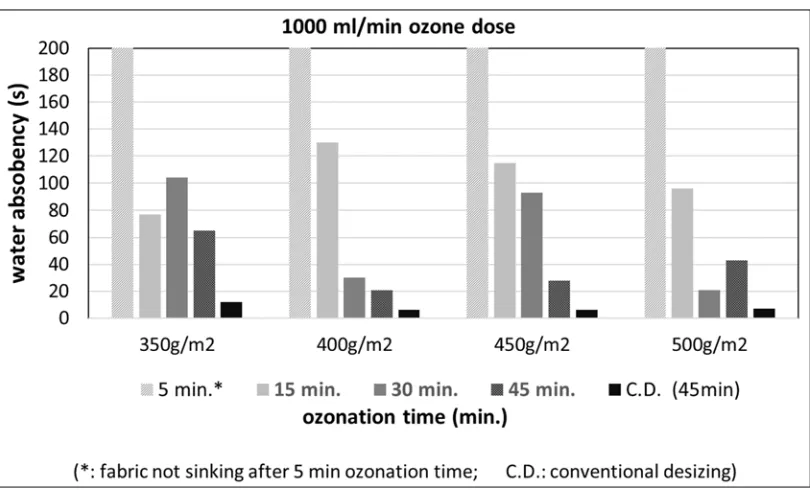
treatment time and drop test results (the sink time of the fabric on the water surface) at two different dosing doses for each terry fabric [21]. The results clearly show that as the
duration of ozonation increases, the time of sinking shortens, that is, the rate of absorption increases for all terry fabrics.
Figure 3. For 500 ml/min ozone dose, relationship between the drop test result and ozone time for four terry fabrics having different areal density.
Figure 4. For 1000 ml/min ozone dose, relationship between the drop test result and ozone time for four terry fabrics having different areal density.
3.3. The Effect of Ozone Dose on Water Absorbency
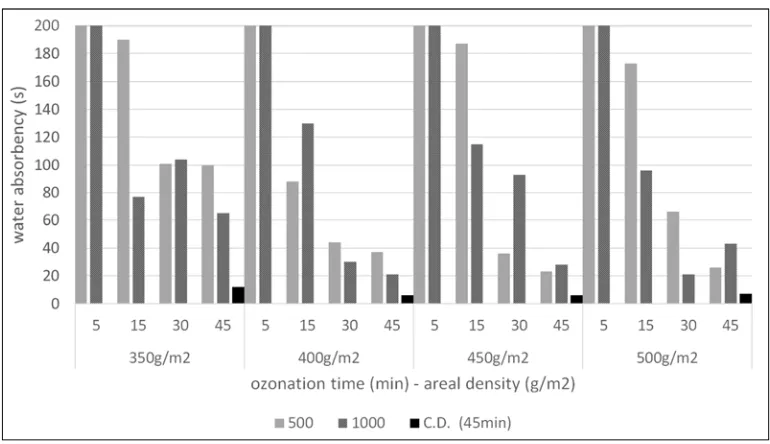
Figure 5. The relationship between ozone dosing and drop test for all terry fabric samples.
According to the figure, after desizing with ozone, - in all fabrics, as the ozone dose increased, the sinking time of terry fabric decreased. Namely water absorbency increased.
- The effect of increasing of ozone dose on water absorbency was more pronounced in the longer ozone times and fabric having more areal density,
- A certain increasing in fabric areal density (increasing of pile length) reduced the sink time of terry fabric. However, the further increase in this value did not effect this time too much.
- The water absorbency feature which had been desized by a shorter ozone time in a higher dose (1000ml/min)
approached the water absorbency property obtained by desizing with a longer time ozone
3.4. The Effect of Conventional Desizing on Water Absorbency
Figure 6 show sinking time of terry fabrics having four different areal density desized by conventional method [21]. It is clear that as the areal density decreased to a certain value (from 350 g/m2 to 400g/m2) sinking time reduced noticeably. However, a further increasing at areal density (from 400g/m2 to 450g/m2 and 500g/m2) did not change sinking time of terry fabric
Figure 6. The sinking time of terry fabric samples having different areal density after conventional desizing process.
3.5. Comparing Ozone Desizing with Conventional Desizing in Respect to Water Absorbency
When the results in Figures 3, 4 and 6 are examined, the
3.6. Analysis of Whiteness Degree Results
The color values after untreated (desizing, but not bleached), ozone bleached and hydrogen peroxide bleached fabrics were measured by using spectrophotometer and then stensby whiteness grades were calculated. The effects of ozone time, ozone doses and fabric whiteness on the degree of whiteness were evaluated.
3.7. The Effect of Ozonation Time on Whiteness Degree
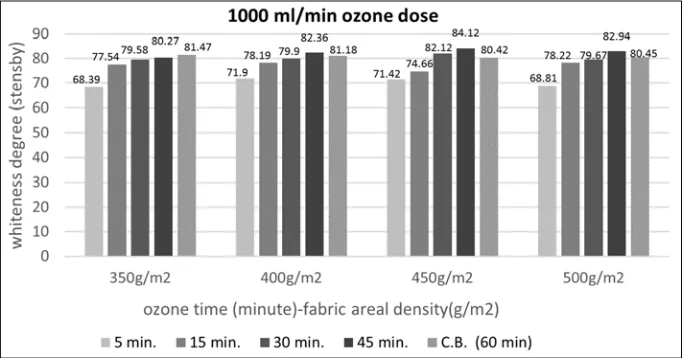
Figure 7 and 8 show the change in whiteness degree of the
terry fabric compared to the ozone bleaching time for 500ml/min and 1000ml/min of ozone dose [21]. First of all, in both figures, it is seen that acceptable whiteness grades for terry fabrics are obtained after all ozonation times. The results point out that as the ozonation time increases, whiteness grades increase in all towel fabric samples. However, when the ozone times of 30 and 45 minutes are compared, it is seen that the whiteness grades are very close to each other. Therefore, it can be concluded that the subsequent increase of the ozone duration from a certain point does not change the degree of whiteness.
Figure 7. For 500ml/min ozone dose, the relationship between ozone time and whiteness degree of all fabric samples. (C. B.: Conventional bleaching Method).
Figure 8. For 1000 ml/min ozone dose, the relationship between ozone time and whiteness degree of all fabric samples. (C. B.: Conventional bleaching Method).
Also, in the bleaching process performed with both ozone doses, a similar relationship between ozone time and whiteness degree is observed.
3.8. The Effect of Ozone Dose on Whiteness Degree
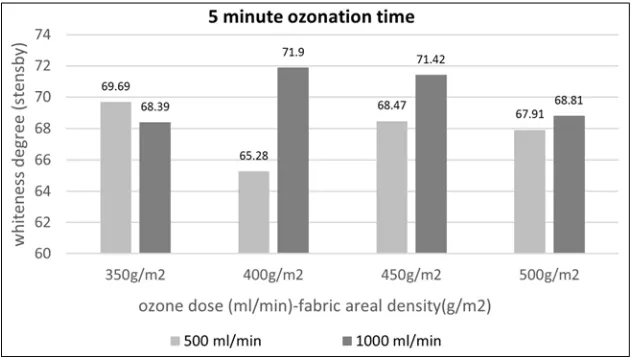
Two different ozone doses were applied to each towel fabric samples at 5, 15, 30 and 45 min. ozonation times and the stensby whiteness values were calculated. Figures 9 and
10 show the relationship between two different ozone doses and whiteness grades at two different ozonation times, 15 min and 45 min [21].
Figure 9. For 5 minute of ozonation time, the relationship between ozone dose and whiteness degree of all terry fabric samples.
Figure 10. For 45 minute of ozonation time, the relationship between ozone dose and whiteness degree of all terry fabric samples.
3.9. The Effect of Fabric Areal Density on Whiteness Degree
Figures 11 and 12 show the fabric whiteness grades obtained for different ozonation times of different towel fabric weights at two ozonation doses [21]. When the figure
is examined, it is seen that whiteness increases slightly when the fabric weight increases at high ozonation times (30 min and 45 min), but this increase is not significant. Moreover, it is noteworthy that there is no significant difference between the whiteness grades after ozonation time of 30 minutes and 45 minutes in all fabric samples.
Figure 12. For 500ml/min ozone dose, the relationship between fabric areal density and whiteness degree of all fabric samples.
3.10. Comparing Ozone Bleaching with Conventional
Bleaching (H2O2 Bleaching) in Respect to Whiteness
Degree
Figures 7 and 8 also show the relationship between ozone bleaching and conventional bleaching in terms of whiteness degree [21]. According to the figure, the whiteness degree reached in the bleaching with ozone during short ozonation times (5 min and 15 min) are slightly lower than those obtained with the conventional method. However, it can be seen that the whiteness degrees of the fabrics are better than in the conventional method during longer ozonation times (30 min and 45 min).
4. Conclusion
This study is focused on demonstrating that ozone can be used in textile finishing especially for pretreatment of Terry towel fabrics such as desizing and bleaching. When past studies have been examined, it has been determined that there is no study done with ozone applied to terry towel fabrics. Especially in terry fabrics, the impression is that there is no work on the effect of pretreatment with ozone on water absorption properties. There is no chemical use during ozone bleaching and desizing processes and no external heat energy is needed. Ozone processes can be performed at room temperature and the desired whiteness degrees and desired hidrophility results can be achieved. On the contrary, many auxiliary chemical substances are needed in desizing or bleaching processes by conventional methods, and operations can be carried out at much higher temperatures than room temperature. In addition to, in conventional methods, the process takes a very long time, such as 1 and 2 hours.
Desizing of the ozone results in a certain water absorbency (hidrophility) value in the towel fabric, but it has been found that the water absorption obtained in the conventional desizing process cannot be achieved. This result is in line with the results of the pre-treatment with ozone for plain cotton fabrics. This is thought to be due to the fact that the natural waxes and oils on the cotton are not completely decomposed during the ozonation. It is thought that this oil
and waxes can be removed by a simple rinse and rinse after ozone desizing process.
After bleaching with ozone, whiteness grades close to the degree of whiteness obtained after conventional bleaching were reached. This result differs from previous studies. Because previous studies have shown that the degree of whiteness in ozone bleaching is acceptable but lower than those in conventional bleaching. Unlike the previous studies, it is thought that the use of fabrics with pile yarns and the use of desized pile yarns facilitate ozone penetration into the yarn.
A new study involving post-desizing washing and rinsing is suggested to achieve much higher levels of water absorption with the ozone desizing method. Also, new studies can be carried out to examine the breaking and abrasion strengths to see if there is any degradation of the towel fabric after ozone bleaching and desizing. Energy consumption records can be obtained and unit costs can be determined by testing in the production line in a textile mill to determine the contribution of the ozone process in terms of energy consumption.
Acknowledgements
We would like to thank to Yünsa Worsted & Woolen Production and Trading Co. (in Tekirdag, Turkey) because they provided us to make all of test in their laboratory and funded the publication charge. We would like to thank to Altinbasak Tekstil Sanayi ve Ticaret Co. (in Denizli, Turkey) for providing woven terry fabrics samples. We would also like to thank to Prof. Dr. Huseyin Aksel EREN (at Uludag University, Department of Textile Engineering in Bursa) for providing the using of Ozone Generator.
References
[2] Calatayud, A. et al., “Effects of ozone on photosynthetic CO2 exchange, chlorophyll a fluorescence and antioxidant systems in lettuce leaves”, Phisiologia Plantarum, Volume 116, Issue 3, November 2002, Pages 308–316.
[3] Bocci, V., et al., “The Ozone Paradox: Ozone Is a Strong Oxidant as Well as a Medical Drug”, Medicinal Research Reviews, 2009, 29 (4), 646—682.
[4] Ozturk, D and Eren H. A., “The Use of Ozone in Textile Finishing”, Uludag University, Journal of The Faculty of Engineering, V. 15 (2), 2010.
[5] Strickland, A. F., Perkins, W. S., “Decolorization Of Continious Dyeing Wastewater by Ozonation”, Textile Chemist and Colorist, 27 (5), 11-15, 1995.
[6] Bahtiyari, M. I. and Benli, H., “Ozone bleaching of cotton fabrics with the aid of ultrasonic Humidifier”, Cellulose, 2016, 23:2715–2725.
[7] Aksel, H. E. and Ozturk, D., “The evaluation of ozonation as an environmentally friendly alternative for cotton preparation”, Textile Research Journal, 2010, 81 (5) 512–519.
[8] Arooj F. et al., “Application of ozone in cotton bleaching with multiple reuse of a water bath”, Textile Research Journal, 2014, Vol. 84 (5) 527–538014, Vol. 84 (5) 527–538.
[9] M. Prabaharan and J Venkata Rao, “Combined desizing, scouring and bleaching of cotton using ozone”, Indian Journal Of Fibre and textile Research, Vol 28, December 2003, pp 437-443.
[10] Piccoli, H. H. and et al. “Bleaching of Knitted Cotton Fabric Applying Ozone”, Ozone: Science & Engineering, 37: 170– 177, Copyright © 2015 International Ozone Association.
[11] Arooj, F. and et al, “A Pilot-Scale Application of Ozone to Bleach Raw Cotton Fabric Using Various Additives”, Ozone: Science & Engineering, 37: 203–215 Copyright © 2015 International Ozone Association.
[12] Eren, H. and et al., “Combined Use of Laccase, Ozone and Hydrogen Peroxide For Cotton Bleaching”, Tekstil Ve Konfeksiyon 4 (9) /2009, p 299-303.
[13] Prabaharan, M. and J Venkata Rao J. V., “Study on ozone bleaching of cotton fabric–process optimisation, dyeing and finishing properties”, Coloration Technology., 117 (2001); p98-103.
[14] Eren, H. and Eren, S., “Ozone bleaching of cellulose”, 17th World Textile Conference AUTEX 2017- Textiles - Shaping the Future; IOP Conf. Series: Materials Science and Engineering 254 (2017) 082009.
[15] I. Enomoto, I., Soeda, S., Masuko F., and Mitani, C., “The role of ozone micro-bubbles in cotton bleaching”, Proceedings of the International Symposium on Fiber Science and Technology 2014 (ISF 2014) ~ September 28 to October 1, 2014 Tokyo, Japan.
[16] Perincek, S. D., and et al., “Ozonatıon: A New Method Whıch Can Take Place Of Enzymatıc Desızıng”, XIIIth International Izmir Textile and Apparel Symposium April 2-5, 2014; p 506-514.
[17] Perincek, S. D., and et al., “An Investigation in the Use of Ozone Gas in the Bleaching of Cotton Fabrics”, Ozone: Science and Engineering, 29: 325–333 Copyright 2007 International Ozone Association.
[18] Perincek, S. D., “Ozonation: A New Patterning Method For Optical Bleached Fabrics”, Tekstil Ve Konfeksiyon 26 (1), 2016.
[19] Nazir A., And Et Al., “Comparison Of Various Additives In Cotton Bleaching Efficiency”, Journal Of Environmental Analytical Chemistry; Volume 4; Issue 4; 2017.
[20] Benli H., and et al., “Combination of ozone and ultrasound in pretreatment of cotton fabrics prior to natural dyeing”, Journal of Cleaner Production 89 (2015), pp. 116-124.
[21] Soydas, S. (Superviser: Turhan, Y.), “An Investigation Of Ozone Technology Impact On Woven Towel Fabrics In The Hydrophilite and Bleaching Feature”, Pamukkale University, Institute of Science, Textile Engineering Department, Master of Science Thesis, 2016.
[22] https://textlnfo.wordpress.com/2011/12/22/terry-fabrics/.
[23] Abo-Taleb et al., “Theoretical Prediction of Overall Porosity of Terry Woven Fabrics Hemdan”, Textile Science & Engineering, Volume 5 • Issue 6, 2015.
![Figure 1. Terry fabric structure (a) unit weave report of terry fabric, (b) cross section of terry fabric [22, 23], (c ) cross section picture of terry fabric sample, (d) picture of surface of terry fabric sample [21]](https://thumb-us.123doks.com/thumbv2/123dok_us/8469067.1710732/3.595.336.521.591.751/figure-structure-section-section-picture-fabric-picture-surface.webp)
![Figure 2. Ozonation chamber: (a) front view of glass bulb (b) top diagonal view of glass bulb [21]](https://thumb-us.123doks.com/thumbv2/123dok_us/8469067.1710732/4.595.63.267.74.222/figure-ozonation-chamber-view-glass-bulb-diagonal-glass.webp)