Characteristics crop plants
in the aspect of the process of spraying
Charakterystyka opryskowa roślin w aspekcie procesu opryskiwania
PhD Student Eng. Beata Cieniawska, Prof. Assoc. Deta Łuczycka, Prof. Assoc. Antoni Szewczyk Wrocław Univeristy of Environmental and Life Sciences, Institute of Agricultural Engineering, Poland
e-mail: [email protected]
Abstract:Pesticides used in agriculture during chemical plant protection against pests pose a significant threat to the environment. Pesticide should be characterized by: high toxicity in relation to pests and low toxicity compared to other organisms, adequate durability and high susceptibility to degradation. In practice, the achievement of these goals is often impossible. The aim of the study was, therefore, to use a parametric characterization of sprayed plant in the aspect of the process of spraying. In order to do this study the degree of coverage of sprayed objects using selected nozzles assessing which of the tested nozzles has the best properties in terms of covering horizontal and vertical surfaces sprayed plants. In the second part of the study was performed parametric characteristics selected for plant research at the surfaces of vertical and horizontal projections and ratio settings sprayed surface.
KEYWORDS: SPRAYING, PARAMETRIC CHARACTERIZATION OF PLANTS, THE DEGREE OF COVERAGE
1.
Introduction
Contemporary agricultural production which is in the stage of strong development as well as intensification of production. It is described by the growth of the use of artificial industrial agrochemicals, including pesticides. Nowadays they guarantee the high quality and
quantity of crops (Nieróbca i wsp. 2010). The use of plant health products is the basis of protecting plants from pests. The situation
will not change in the near future as there is no method which would substitute the present one, and without the use of pesticides the value of crops will drop dramatically. Moreover the change of plant health programs being in use would require significant amount of
financial investments (Pruszyński, 2010). Among the priorities in terms of using plant health products are: the high quality of plant protection treatments, improved efficiency, elimination of any threat to the environment as well as people protecting the plants (Oerke i wsp. 1994; Őzkan 2008; Pruszyński 2003; Szewczyk 2002;
Szewczyk 2010a). That is why a lot of attention in the literature of the subject has been paid to the issue of proper chemical plant health
treatment. So far one of the most important aspects of the atomization process, which is the characteristics of the sprayed object in terms of its morphology or an even more important feature
- the degree of the sprayed area's exposition to the stream of liquid sprayed by the nozzle, has not been considered. That is why a two-stage research has been carried out at the Institute Agricultural Engineering at Wrocław University of Environmental and Life
Sciences. Its aim was to present the degree of the sprayed objects' covering in terms of characteristics of sprayed plants in outdoor cropping
2.
Material and methods
The research was carried out in laboratory conditions at a specially prepared site used for examining the plants' surfaces.
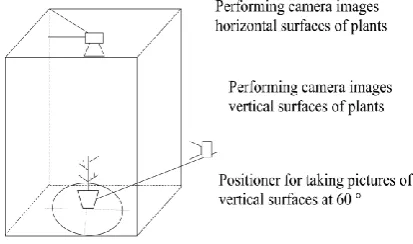
The scheme of the test site is displayed in figure 1. The examined
plant was put in a measurement chamber on a turntable. Next, the photos of horizontal and vertical projections were taken. The camera that was used for taking the photos of horizontal surfaces of the plants was placed inside the chamber, with the ability to
move it vertically (up-down) - the smaller the plant, the lower the position of the camera. The other one that was used for taking the photos of vertical surfaces of the plants was placed in front of the
measurement chamber on an inclined plane. It allowed the camera to be moved horizontally ( forward - backward), depending on the plant's size - the smaller the plant, the closer the camera's position. The distance between the camera and the plant did not matter as it
was the plants' surfaces ratio that was put for further analysis, and not the absolute value. The vertical surface photos of the plants were taken six times, thanks to the turntable which allowed the 60° rotation. In order to guarantee the best lightning condition in
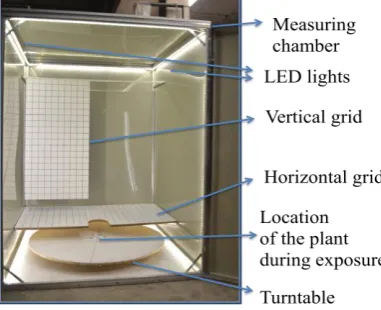
the chamber, LED battens were put on aluminium profiles. During particular acquisitions, some of the lights were switched off so as no to make the exposition glare. (fig 2).
Fig. 2 General view of the site.
The acquisition of the vertical surfaces was made against
the background of a vertical grid moved on a guide. The background for the horizontal photos on the other hand was a horizontal grid. One side of the grid's square was 5 cm long as it was a required condition allowing to create a graphic analysis in AutoCad 2011.
The analysis in this program allowed to calibrate the photos that had been taken. The program chosen by the authors is the tool that ensured reaching all goals that were set during the processing of the
photos.
Fig. 3. The photos of vertical projections
Fig. 4 The photos of horizontal projections
The following plants were chosen for the tests: a lucerne, a rape in the stage of forming its rosette, a rape in the stage of elongation of its shoots, a rape in the stage of falling flowers,
forming its shucks and a beetroot in the stage of forming its rosette.
After receiving the results of the graphic analysis in
AutoCad 2011 the modulus of the sprayed surfaces was calculated. It was done by the use of the following formula that included the vetical and horizontal projections of the sprayed surfaces ratio.
The site used for testing the degree of covering was described in the authors' publication (Szewczyk i in. 2012).
3.
Results and discussion
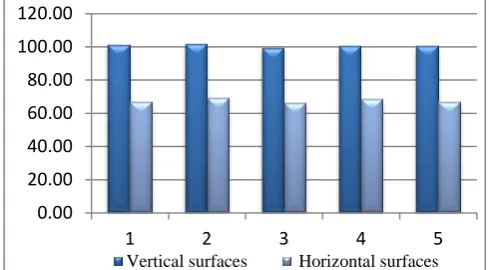
The results of the testing the spray characteristics were displayed on the graphs below (fig. 5 – 9). They present five
Fig. 5. Projections area horizontal and vertical lucerne
Fig. 6. Projections area horizontal and vertical rape in phase elongation shoot
Fig. 7. Projections area horizontal and vertical rape in phase fall flower petals
Fig. 8. Projections area horizontal and vertical beet in phase forming rosette
Fig. 9. Projections area horizontal and vertical rape in phase forming rosette
Table 1 presents the values for the modulus of the sprayed surfaces' location. The plants with bigger surface of horizontal projections than its vertical projections (a lucerne, a
rape in the stage of falling flower petals, a beet in the stage of forming its rosette, a rape in the stage forming rosette) – the modulus was bigger than 1. In the case of the rape in the stage of elogation of its shoots, where the surface of vertical projections
was smaller than the surface of horizontal projections- the modulus was lesser than 1.
Table 1. The results of the modulus of the sprayed surfaces' location Lucerne Rape in phase elongation shoot Rape in phase fall flower petals Beet in phase forming rosette Rape in phase forming rosette 1,50 0,89 2,71 1,23 2,20 1,46 0,88 2,81 1,14 2,47 1,50 0,88 2,76 1,14 2,42 1,46 0,88 2,75 1,24 2,22 1,49 0,88 2,74 1,25 2,19
The usefullness in the technique of plants' protection of the
presented modulus of the sprayed surfaces' location ( chart 2) was widely discussed by the authors in the published materials (Łuczycka i in. 2013).
A lot of books about examining the characteristics of plants show the interest of scientists in the issue discussed in this article. Among the main topics in that area are: determining the
photosynthetic surface of plants with the use of video-computer method (Kiełbasa i Juliszewski 2005), determining the influence of the mixed nitric fertilization on the crops, and the indluence of the chemical protection of plants in conditions of varied
cultivation systems (Andruszczak i in., 2012; Gołębiowska i Sekutowski, 2007), as well as research concerning the rate of the level of leaflage: LAI – the surface of leaves and MTA – the angle
of leaves' gradient (Biskupski i in. 2007; Biskupski i in. 2009; The double-stream nozzles are better than one-stream ones when it
0.00 20.00 40.00 60.00 80.00 100.00 120.00
1 2 3 4 5
Vertical surfaces Horizontal surfaces
400.00 420.00 440.00 460.00 480.00 500.00
1 2 3 4 5
Vertical surfaces Horizontal surfaces
0 50 100 150 200
1 2 3 4 5
Vertical surfaces Horizontal surfaces
0.00 100.00 200.00 300.00 400.00 500.00
1 2 3 4 5
Vertical surfaces Horizontal surfaces
0 10 20 30 40 50 60
1 2 3 4 5
Woźniak 2008). However, these methods cannot be used for
experiments connected with applying plant health products as they do not refer to the surface projections of the plants that are the main
target of the drops of liquid sprayed by the nozzle. It is related with the fact that during such treatment the sprayed surfaces are "seen" by the nozzle as a vertical or horizontal projection.
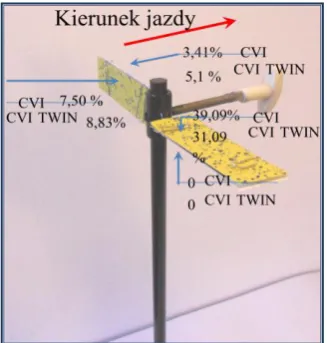
Ejector nozzles (one-stream CVI and double-stream CVI TWIN) were chosen for the research on the coverage degree of the sprayed objects. The results of the research on the coverage degree of particular surfaces were presented in fiures 10 and 11.
Fig. 9. Coverage degree of vertical and horizontal objects for selected type nozzles, 4 km/h
Fig. 10. Coverage degree of vertical and horizontal objects for selected type nozzles, 12 km/h
Figure 9 presents the results of the research on the coverage degree of the sprayed objects at the ride speed of 4 km/h, and figure 10 presents the results for the speed of 12 km/h. The coverage degree of horizontal surfaces was higher with the use of
the CVI nozzle. On the other hand, the CVI TWIN use resulted in receiving higher values during the sprayed of vertical surfaces.
comes to covering both vertical surfaces at the same time, regardless of the ride speed. In the course of all the measurements taken during the research, no trace of covering the bottom
horizontal objects was ascertained. A lot of authors indicate that the choice of the correct nozzle is an important aspect in plant protection on fields as well as in the gardens or indoors. (Guler i
wsp. 2007; Kierzek 2007; Tadel 2007; Kierzek i Wachowiak 2009).
4.
Conclusion
1. The analysis of the results of the research on the coverage degree of sprayed objects obtained with the use of select nozzles showed big differences in the coverage of horizontal
and vertical surfaces.
2. On the basis of received results and their analysis we can state that the characteristic feature of the examined nozzles is the different range of the coverage degree of vertical and
horizontal surfaces. One-stream nozzles are better at covering upper horizontal surfaces while double-stream nozzles are better at covering vertical surfaces.
3. The surface of horizontal and vertical projections and the
rates of sprayed surfaces are parametres in which the examined palnts differed most.
4. The Wpo factor determining the mutual ratio of the sprayed
surfaces makes it easier to make the right choice of the nozzle used for protecting plants when it comes covering the sprayed plants with liquid as efficiently as possible.
The project is co-funded by the European Union
under the European Social Fund.
5. Literature
Andruszczak S., Kwiecińska‐Poppe E., Kraska P., Pałys E. 2012. Wpływ niektórych środków ochrony roślin na kształtowanie powierzchni liści i kąta ich nachylenia u wybranych odmian
ozimych pszenicy orkisz (Triticum aestivum ssp. spelta L.). Postępy w ochronie roślin / Progress in plant protection. 52. 1:
163-166.
Biskupski A., Kaus A., Włodek S., Pabin J. 2007. Zróżnicowane nawożenie azotem a plonowanie i wybrane wskaźniki architektury łanu kilku odmian pszenicy jarej. Inżynieria Rolnicza. 91. 3:
29-36.
nachylenia liści (MTA). Inżynieria Rolnicza. 91. 3: 51-58.
Guler H., Zhu H., Özkan H.E., Derksen R.C., Yu Y., Krause C.R. 2007. Spray characteristics and drift reduction potential with air
induction and conventional flat-fan nozzles. Transactions of the ASABE. 50(3): 745−754.
Kierzek R. 2007. Skuteczna ochrona roślin [cz. II]. Dobór rozpylaczy do zabiegów polowych. Ochrona Roślin. 1. 52: 32–35.
Kierzek R., Wachowiak M. 2009. Wpływ nowych typów rozpylaczy na jakość pokrycia roślin ziemniaków cieczą użytkową. Prog. Plant
Prot./Post. Ochr. Roślin. 49. 3: 1145–1149.
Nieróbca A., Zaliwski A., Horoszkiewicz-Janka J. 2010. Rozwój internetowego systemu wspomagania decyzji w ochronie zbóż. Inżynieria Rolnicza 7(125). s. 167–173.
Łuczycka D., Szewczyk A., Cieniawska B. 2013. Ocena jakości opryskiwania w literaturze przedmiotu. Materiały Konferencyjne Racjonalna Technika Ochrony Roślin. 112-123.
Oerke E.C., Dehne W., Schönbeck F., Weber A. 1994. Crop
Production and Crop Protection: Estimated Losses in Major Food and Cash Crops. Elsevier Science. ISBN 0444820957.
Özkan H. E. 2008. Technological Solution to Problems Associated
with Application of Pesticides Jor. Of Agricultural Machines Sciences 4(2), s. 193-198.
Pruszyński S. 2003. Ochrona roślin – spojrzenie w przyszłość.
Racjonalna Technika Ochrony Roślin. Mat. Konf. s. 5-16.
Pruszyński S. 2010. Stan obecny i przewidywane kierunki zmian w ochronie roślin do 2020 roku. Studia i raporty IUNG – PIB. Puławy
14: 207-242.
Szewczyk A., 2002. The impact of sprayer work parameters on field beam position in a vertical plane for some tractor-attached sprayers. Maintenance and Reliability PAN Lublin. Nr 3(15). s. 13–18. Szewczyk A. 2010. Analiza ustawienia, parametrów i warunków
pracy rozpylacza w aspekcie jakości opryskiwania upraw polowych. Wydawnictwo Uniwersytetu Przyrodniczego we Wrocławiu. ISSN
1898-151.
Szewczyk A., Łuczycka D., Cieniawska B., Rojek G. 2012. Porównanie stopnia pokrycia obiektów opryskiwanych wybranymi
rozpylaczami eżektorowymi – jedno i
dwustrumieniowym. Inżynieria Rolnicza. Nr 2 (136). s. 325-334. Tadel E. 2007. Technika ochrony polowych upraw wysokich ze szczególnym uwzględnieniem kukurydzy. Mat. Konf. Racjonalna Technika Ochrony Roślin. 100-106.
Woźniak A. 2008. Wpływ zróżnicowanego udziału pszenicy jarej w zmianowaniu na indeks powierzchni liści (LAI). Acta Agrophysica.