MULTIPURPOSE SEED SOWING MACHINE
Raut Madhuri
1, Prof. P.S.Gorane
2, Pawar Ganesh
3, Patil Shubham
4,
Patil Nikhil
52
professors: Department of Mechanical Engineering, Gsmcoe Balewadi Pune, (India)
1,3,4,5
Department of Mechanical Engineering, Gsmcoe Balewadi Pune, (India)
ABSTRACT
This article addresses betterment in agricultural processes. Multipurpose seed sowing machine consist of two mechanisms one for sowing of the seed and another for fertiliser spraying. Both of these mechanisms run simultaneously. We can use insecticide instead of fertiliser. The essential objective of sowing operation is to put the seed and fertilizer in desired depth and provide required spacing between the seeds and cover the seeds with soil. We can achieve optimum yield by proper compaction over the seed and recommended row spacing. To meet the demands farmer have to use new techniques in cropping to increase the yield. The requirements of small scale sowing machines are, they should be simple in design, affordable for small scale peasant farmers, easy maintenance for effective handling by unskilled farmers. In this project the attempt has been made for reduction in cost of machine and developing the multifunctional sowing machine which can perform simultaneous operations.
KEYWORDS: seed, sowing, spraying
I. INTRODUCTION
Indian economy is based on agriculture. Development in agriculture leads to raise economic status of country. In
India farmers are facing problems due to unavailability of labors, traditional way of farming using non efficient farming equipment‟s which takes lot of time and also increases labor cost. This project is all about enhancement
in seed sowing and pesticide spraying like farming operations by using multifunctional seed sowing machine.
The main objective of sowing operation is to place seed at proper position respective of other placed seeds in
every row at particular depth and provide a cover of soil on it. As per change in shape and size of different seeds
the parameters like distance between two seed, depth of seed, planting rate chances. This project is attempt to
produce multifunctional and highly efficient seed sowing machine which will reduce time of plantation, cost of
labor, and enhances production.
Traditional method of seed sowing based on assumptions of seed to seed spacing and depth of placement which
is not at all efficient and beside this it requires lot of time and efforts too. Sometime it results in back ache of
farmers.
As per change in climate farmers are facing one more problem which occurs due to harmful insects and pest.
farmers have to stay alert for fighting to this problem by using different pesticides .pesticide spraying is one of
the common operation in agriculture field which requires lots of efforts to carry the pump in farm. it results in
This project addresses improvement in agriculture processes like sowing of seeds on ploughed land and
distribution of fertilizer combinely by using mechanisms. Primarily this system works manually, but with lesser
input energy requirement.
1.1 Traditional Seed Sowing and Pesticide Spraying Techniques
1. Line sowing :- It is the dropping of seeds into the soil with the help of implement such as mogha, seed
drill, seed-cum-ferti driller or mechanical seed drill. Crops like Jowar, wheat Bajara, etc. are sown by this
method.
Fig. 1 Line Sowing Technique
2. Dibbling : It is the placing seeds at cross marks made in the field . It is done manually by dibbler. This
method is followed in crops like Groundnut, Castor, etc.
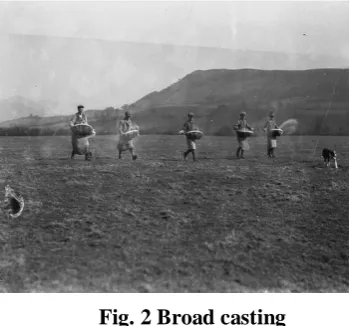
3. Broad Casting:- It is the scattering of seeds by hand all over the prepared field. Crops like wheat, methi, etc.
are sown by this method.
Fig. 2 Broad casting
4. Putting Seeds Behind The Plough: It is dropping of seeds behind the plough in the furrow with the help of
manual labour by hand. This method is followed for crops like wal or gram.
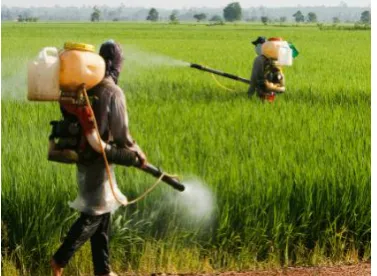
5. Manual Backpack Type Spraying: In this method farmer has to carry a pump on his shoulder during
.Fig. 3 Traditional Method of Pesticide Spraying
II. METHODOLOGY
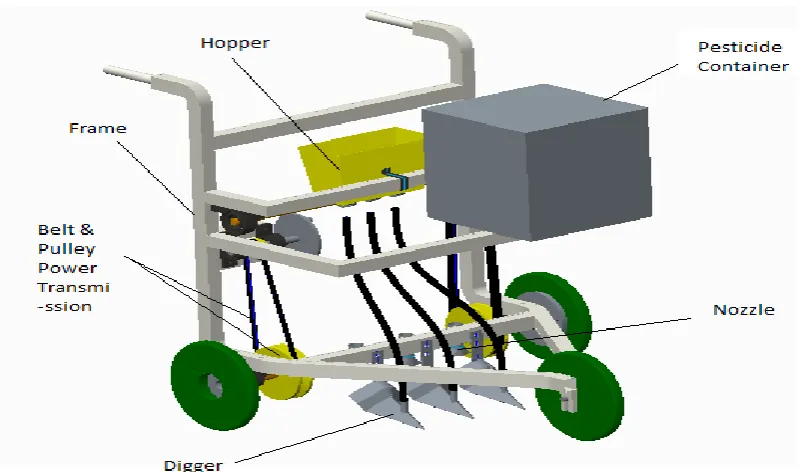
First we fill the hopper with seeds manually. System that will made, uses the manual push force to run
mechanism. Rotary motion of wheels provided to the sowing shaft (which will placed in seed storage tank) by
sprocket or belt drive. With controlled distance interval, seed get sowed in land vie pipe and digging
arrangement and seed is covered with soil.
Sprayer mechanism again uses rotary motion of wheels to convert it into reciprocating motion by slider crank
chain mechanism. Fertilizer distribution is done by mixing it with water and spraying it.
III. DEVELOPMENT OF SEED PLANTER MACHINE
Fig. 5 Seed Sowing Machine 3.1 Seed Meter Mechanism
Rotary motion of wheels provided to the sowing shaft (which will placed in seed storage tank) by sprocket or
belt drive. Due to this shaft will rotates and it drop the seed from hopeer or seed meter box to the digger
through the hose for digging purpose.
For one revolution of shaft only one seed is required to deposit this function can be fulfill by using bush.
3.2 Digger mechanism
Digger mechanism is used for digging and seeding. Digger itself is used as digging tool. Digger is connected to
the frame by nut bolt.
There are three adjustable diggers. Diggers has a flapper for opening into the cavity for seeding. Flapper is
connected to the hopper with the help of hose.
3.3 Power transmission mechanism
Power transmission is done by the belt pulley transmission system .Here different pulleys are used to speed
variation to get variable distance between the two seed.The belt is shift from one pulley to other to achieve
required distance between two seeds.
Main power of machine is available from wheels of machine. Once person push machine, wheel rotates
3.4 Sprayer Mechanism
The trolley when pulled will rotate the shaft; hence the U-bend component because of its eccentricity will
transmit motion to the piston pump via the connecting rod. The pump will then start to build up pressure as the
piston would be operated. The pressurized pesticide fluid will come out from the piston hole and supplied to the
three outlet pipes mounted on top of the frame to throw out the spray to 3 rows of crops simultaneously.
IV. DESIGN OF COMPONENTS 4.1Design of Belt-pulley
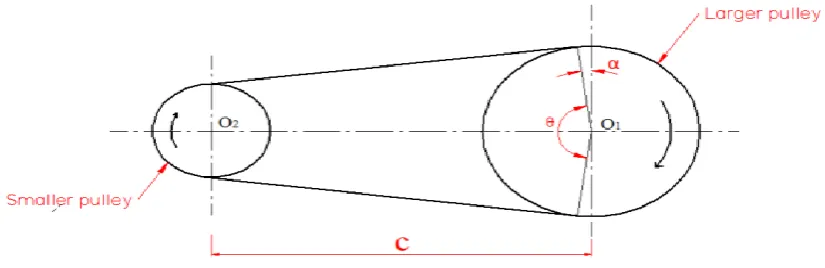
The Belt-Pulley are mostly used to transmit motion and power from one shaft to another, when the center
distance between their shafts is short
The Speed (velocity) ratio (S.R.) of a Belt-Pulley drive is given by
𝑆.𝑅.= 𝑛
𝑁= 𝐷 𝑑
Where, N = Speed of rotation of bigger pulley in rpm,
n = Speed of rotation of smaller pulley in rpm,
d = diameter on the smaller pulley in mm, and
D = diameter on the larger pulley in mm 𝑆. 𝑅. = 𝑛
25= 100
40 ; n = 62.5 rpm
The average velocity of the belt is given by
𝑉= 𝜋𝐷 𝑁
60
Where D = diameter of bigger pulley in mm, and
N = Speed of rotation of bigger pulley in rpm, Velocity ratio = D/d = 100/40 = 2.5
4.2 Length of Belt and Centre Distance Let
d = diameter on the smaller pulley in mm
D = diameter on the larger pulley in mm.
C = Centre distance.
L = length of the belt.
L = 758.4313mm
The center distance is given by
𝐿=2𝐶 +𝜋(𝐷+𝑑)
2 +
(𝐷+𝑑 )2 4𝐶
Considering
D = 100 d = 40
We get C = 270.92mm
Centre distance between the two pulley = 270.92mm
The average velocity of belt is given by
𝑉= 𝜋𝐷𝑁/60
V = (π x 0.1 x 25) / 60
V = 0.1 m/s
4.3 Selection of Pump
Let‟s consider a farm of size 1000m by 1000m in which fertilization is to be done
The fertilizer is mixed in the water. (Further noticed as water)
Total amount water required for a land of size 1000 m x 1000 m = 300-350 liters
Fertilization of this size land is to be done in 2.5 to 3 hours
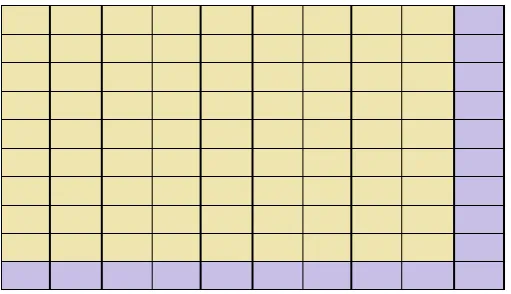
Consider 1 box of the farm of size 100m by 100m
Thus total number of boxes = 100
Fig. 7 Square of 1000m by 1000m. 100 boxes are to fertilized in 2.5 hour
527 | P a g e Therefore 350 / (2.5 × 3600) = 0.0388 liter/sec
Discharge (Q) = 0.0388lps = 2.34lpm
So we need to select a pump of discharge capacity 2 liters per minute
Now from the market selecting the pump whose discharge capacity is in range.
Discharge = 2 to 5lpm
Pressure = 4-7 kg/cm2
Operating RPM = 150 to 200
The theoretical discharge of the pump is given by
𝑄 = 𝜋
4 𝐷 ∗ 𝐷𝑋𝐿𝑋𝑁
60
Where, A = Area of piston
D = Diameter of piston = 35mm
L = Length of stroke = 25mm
𝑄 =(
𝜋
4)35𝑋35𝑋25𝑋120 60
Q = 2.78 lpm
4.4 Selection of Nozzle
Proper selection of a nozzle type and size is essential for correct and accurate fertilizer application. The nozzle is
a major factor in determining the amount of spray applied to an area, uniformity of application, coverage
obtained on the target surface, and amount of potential drift. In spraying systems, nozzles break the liquid into
droplets and form the spray pattern. Nozzles determine the application volume at a given operating pressure,
travel speed, and spacing. Selecting nozzles that produce the largest droplet size, while providing adequate
coverage at the intended application rate and pressure, can minimize drift. Follow the steps below to determine
the correct nozzle type and capacity needed.
Step 1: Consult the label: The most important source of information is the packet label. Not only will the label specify the application rates, controllable pests, and conditions needed to apply the fertilizer or pesticide, it often
will provide information concerning the droplet classification, nozzle type, and spacing as well. Follow the guidelines outlined on the pesticide‟s cover label.
Step 2: Select operating conditions: Select or measure ground speed in miles per hour (mph). Select the desired nozzle spacing and spray volume. Correct selection of a spray volume is important. It will influence
Step 3: Calculate required nozzle discharge: To select a specific orifice size, the spray volume, nozzle spacing, and travel speed are needed for the following calculation:
Equation 1
Nozzle discharge (LPM) =Travel speed x nozzle spacing x spray volume
Where,
Travel speed = meters per minute
Nozzle spacing = meters
Spray volume = liters per meter square
Step 4: Consult a nozzle catalogue: Once the nozzle discharge has been determined, consult a nozzle catalogue for a specific nozzle number or size. Review the specification of these nozzles in the
discharge-capacity column. Several consecutive nozzles may meet your needs, but select a nozzle that operates at a low pressure and gives the desired droplet classification that allows a range for “fine-tuning”.
The selected spray is of 3 to 5 lpm and the pressure of 5 to 8 kg/cm2
4.5 Selection of tank
In order to store fertilizer in liquid form small size tanks are used. The existing system of fertilizer spraying i.e.
the back pack sprayer has the tank capacity of 16 to 20 liters. So we need to replace it by increasing the capacity
up to 3 times. So we have used the tank of capacity 50 liters. It will last longer and more area of land will be
covered in one round. Material of the tank is simple plastic, even empty cans in some used way can be washed
and used for this purpose.
V. ADVANTAGES OF MACHINE
Following are the advantages of manual seed planter machine are
1. Improvement in planting efficiency.
2. Increase in crop yield and cropping reliability.
3. Seed can be placed uniformly in a row with required distance between plants.
4. It was made of durable and cheap material affordable for the small scale peasant farmers.
5. Lesser maintenance cost.
6. The seed can be placed at any required depth.
7. Requirement of labour also decreased.
8. Provide proper compaction over the seed.
9. Does not require any External Source of Energy.
10. Uniform Spraying.
VI. DISADVANTAGES OF MACHINE
1. Suitable for small Farms Only.
3. Seed Sowing for Cotton is Difficult.
VII. CONCLUSIONS
The main problem being faced by the farmer was to carry the entire load of the pests on his shoulder and this
problem can be very efficiently solved by the adoption of this method. With Improvement in planting efficiency,
Increase in crop yield and cropping reliability, Uniform Spraying of pesticide and fertilizer.
Using this machine improvement in agriculture processes like sowing of seeds on ploughed land and
distribution of fertilizer combinely by using mechanisms is possible.
VIII. ACKNOLEDGEMENT
First and foremost we would like to thank Savitribai Phule Pune University and Genba Sopanrao Moze College
of Engineering, Balewadi for providing a course where we could learn all about Mechanical Engineering and
for allowing us to work with one of the most saught after and respected research institutes in country
We also sincerely thank to our Project guide Prof P.S.Gorane for his valuable guideline and showing for faith
on us and rendering unwavering support
It is pleasure in expressing hearty thanks Dr.P.A.Makasare, Head of Department for allowing us to carry out this
project .Last and not the least ,we would like to thank the almighty for providing us the strength and support
afforded by the people that have helped us in every way possible.
REFERENCE
1. „Enhanced agriculture robotic system‟ by Mr.Sagar R. Chavan , Prof. Rahul D. Shelke, Prof. Shrinivas R.
Zanwar, International journal of engineering sciences & research technology, [Chavan , 4(2): February,
2015] ISSN: 2277-9655 Scientific Journal Impact Factor: 3.449 (ISRA), Impact Factor: 2.114.
2. „Design and development of wheel and pedal operated sprayer‟ by shivaraja kumar. a1, parames
waramurthy,Volume 2, Issue 6, June 2014,ISSN 2321-6441
3. „Design and development of manually operated Seed planter machine‟ by Kyada, A. R1*, Patel, D. B.2,
5th International & 26th All India Manufacturing Technology, Design and Research Conference (AIMTDR
2014) December 12th–14th, 2014, IIT Guwahati, Assam, India.
4. „Review of methods of seed sowing and concept of multi-purpose seed sowing machine‟ by Aditya
Kawadaskar1, Dr. S. S. Chaudhari2, Aditya Kawadaskar, IJPRET, 2013; Volume 1(8): 267-276, ISSN: