Its major sources of funding have been annual grants from the Department of Scientific and Industrial Research and the College. These grants have been supple-mented by others from commercial and other organisations for specific research projects within New Zealand and overseas.
The Unit has on hand a programme of research in the fields of agricultural economics and management, including production, marketing and policy, resource economics, and the economics of location and transportation. The results of these research studies are published as Research Reports as projects are completed. In addition, technical papers, discussion papers and reprints of papers published or delivered elsewhere are available on request. For list of previous publications see inside back cover.
The Unit and the Department of Agricultural Economics and Marketing and the Department of Farm Management and Rural Valuation maintain a close working relationship in research and associated matters. The combined academic staff of the Departments is around 25.
The Unit also sponsors periodic conferences and seminars on appropriate topics, sometimes in conjunction with other organisations.
The overall policy of the Unit is set by a Policy Committee consisting of the Director, Deputy Director and appropriate Professors.
UNIT POLICY COMMITTEE: 1976
Professor W. O. McCarthy, M.Agr.Sc., Ph.D. (Chairman) (Marketing)
Professor J. B. Dent, B.Sc., M.Agr.Sc., Ph.D. (Farm Management and Rural Valuation)
Professor B. J. Ross, M.Agr.Sc. (Agricultural Policy) Dr P. D. Chudleigh, B.Sc., Ph.D. UNIT RESEARCH STAFF: 1976
Director
Professor W. O. McCarthy, M.Agr.Sc., Ph.D. (Iowa) Deputy Director
Dr P. D. Chudleigh, B.Sc., Ph.D. (N.S.W.) Research Fellow in Agricultural Policy J. G. Pryde, O.B.E., M.A. (NZ.), F.NZ.I.M.
Senior Research Economist G. W. Kitson, M.Hort.Sc.
Research Economists
T. I. Ambler, B.A. (Cant.), B.CA. (Vic.), A.N.Z.I.M. R. J. Gillespie, B.Agr.Sc. (Trinity ColI.)
Temporary Research Economists
TH~
AMBULANCE FACILITY LOCATION PROBLEM
-A SURVEY OP METHODS -AND
A SIMPLE APPLICATION
Janet Go~gh ~nd
w.
o.
'McCar~~yR~se~ah Repo~t No, 75
As o~r list of publ ications indicates, an area of substantial
involvement for the Unit in recent years has been in location economics.
In these studies we have mainly been concerned with the location of
facil ities for processing, servicing and storage. As is appropriate
the focus has been on primary industry appl ications.
Nevertheless there are certain problems in methodology to be
investigated if we are to widen the scope of our research in primary
industry. Central issues include moving from a static to a dynamic
framework and allowing for stochastic supply and demand.
The purpose of this study is to explore this latter area.
Although removed from agriculture the ambulance problem was considered
appropriate because of its all ied nature, the amount of previous work
published on this topic and the availabil ity of local empirical data.
December 1975
CON TEN T S
PREFACE
1.0 THE NATURE OF THE PROBLEM
2.0
4,0
5.0
6.0
7·0
1.1 General
1.2 The Ambulance System THE SYSTEM
THE MODELS
3.1 Fitzsimmons
3.2 Toregas, Swain, ReVelle & Bergman 3.3 Swoveland, Uyeno, Vertinsky & Vickson
3.4
Savas 3.5 Hall3.6
Volz3.7
Schneider & Symons 3.8 La rson3.9
Kuehn & HamburgerCOMPARISON OF THE MODELS 4.1 Assumptions Made
4.2
4,3
4.4
4.1.1 Queuing Models 4.1.2 Analytic Models
Calculation of the Mean Response Time Amendment of the Feasible Location Set so as to Improve the Mean Response Time Evaluation of the Solution
CHOICE OF A MODEL
5.1 Advantages of the Models 5,2 Disadvantages of the Models
5.3
Selection of the ModelTHE CHRISTCHURCH STUDY
6,1 The Christchurch System 6.2 Preparation of the Data
6.3
6.2. 1 Ca 11 Times 6.2.2 Call Origins 6.2.3 System Data Results
6.3.1 6·3·2
Fitzsimmons Model: CALL
APPENDIX II Swoveland, Uyeno, Vertinsky, Vickson
Model 109
APPENDIX III Possible Alternative Approaches 139
APPENDIX IV Adaptions to the Simulation Progri'lm for the use with the Hooke & Jeeves Pattern
LIST OF FIGURES
FIGURE
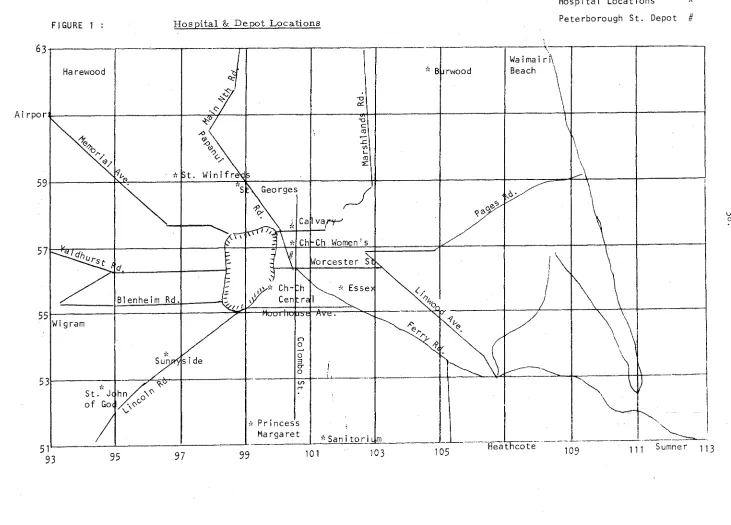
Hospital & Depot Locations
2 Location of 359 Call Areas
3 Location of 82 Call Areas
4
Location of 60 Call Areas5
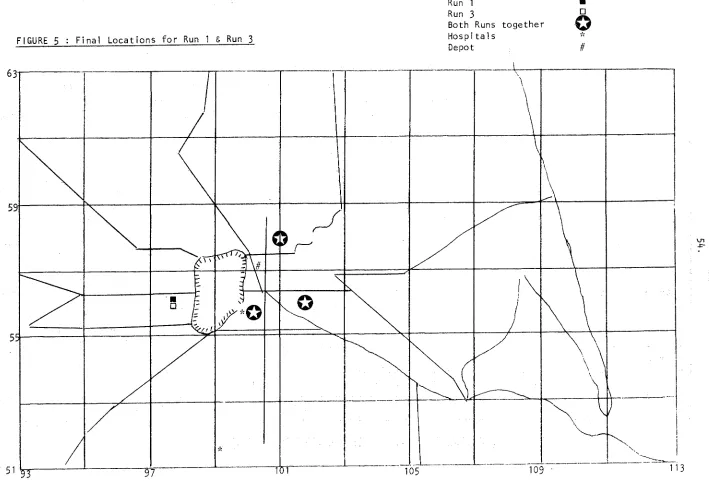
Final ~ocations for R~n 1 & Run)6
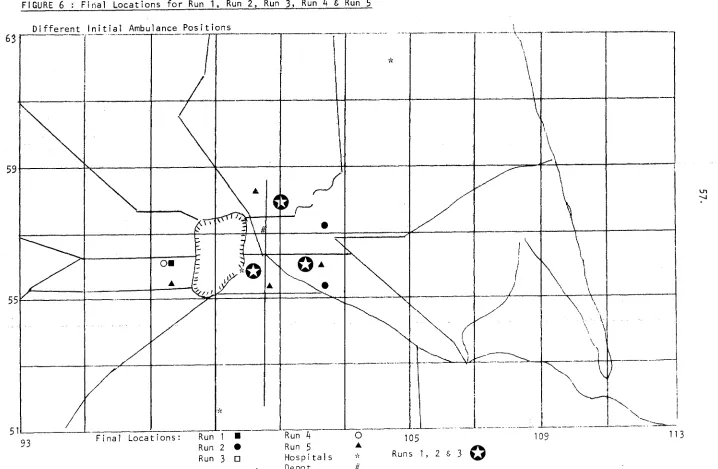
Final Locations for Run 1, Run 2, Run3,
Run 4 & Run 5
7
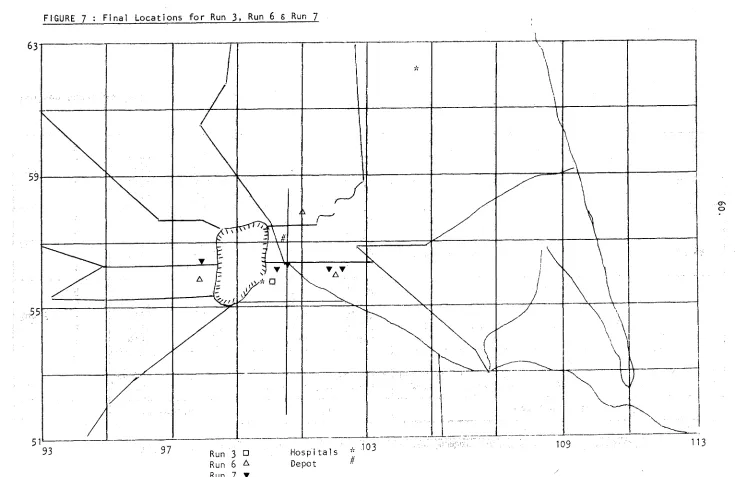
Final Locations for Run3,
Run6
& Run7
8
Final Locations for Run3,
Run8,
Run9,
Run 10, Run 11
9 Final Locations for Run
3,
Run 12, Run 13, RUn 14 & Run 1510 Final Locations for Run
3,
Run 9 & RI,m 1611 Final Locations for Run 3, Run 17 & Run 18
12 Final Locations for Run
3,
Run 19, Run 20 & Run 2113 Final Locations for Run ), Run 23, Run
24
& Run 25
Page
38
43
44
45
54
57
60
63
. 66
69
72
75
TABLE
2
3
4
5
6
7
8
9
10
11
12
Results of CALL
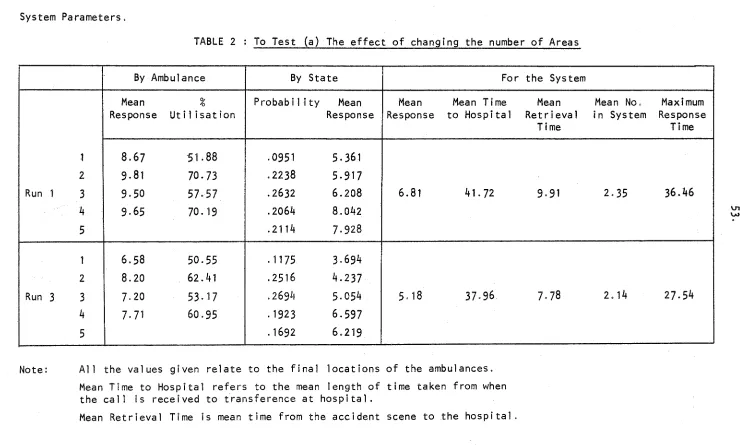
To Test (a) The effect of changing the number of Areas
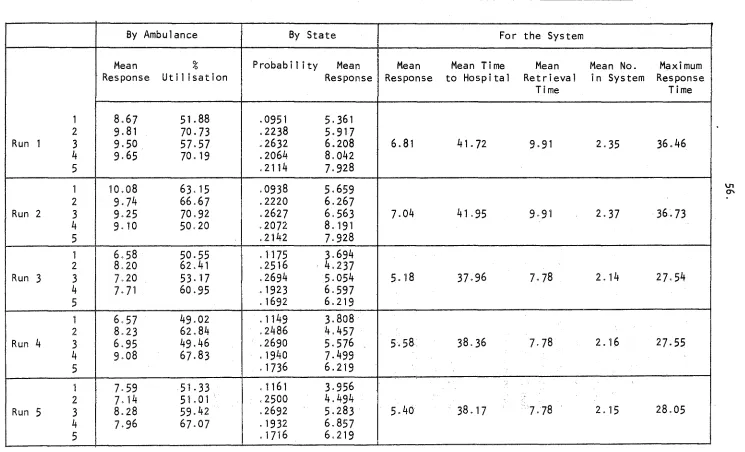
To Test (b) The effect of changing the initial positions of the ambulances
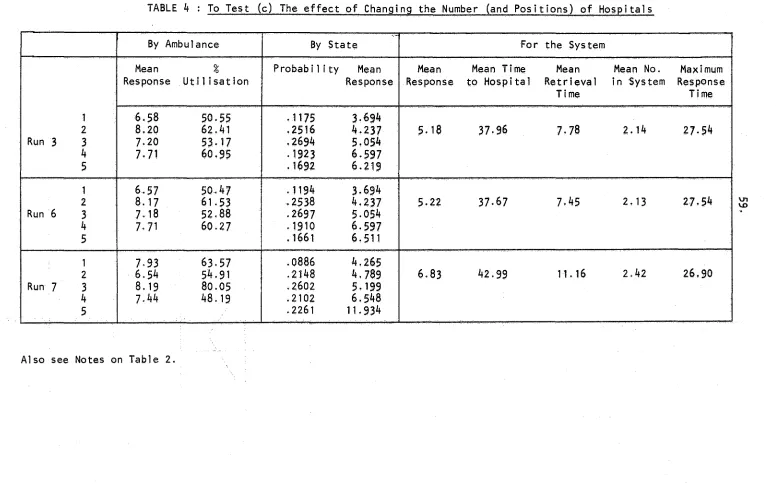
To Test (c) The effect of Changing the Number (and Positions) of Hospitals
(d) To Test the effect of changing the Number of Calls LAMDA
(e) The Effect of Restricting the Final Positions of Ambulances
(f) The Effect of Changing the Number of Ambulances
(a) The Effect of Changing the Number of Monte Carlo Samples Taken
(b) The effect of Changing the Seed of the Random Number Generator
(c) The Effect of Changing the Number of Times RBAR is iteratively Calculated, to Remove the Effect of the Initial Value
(b) The Effect of Changing the Number of Calls, on the Model Assumptions
Simulation Model Results
Page
51
53
56
59
62
65
68
71
74
76
79
1.
1.0 THE NATURE. OF THE PROBLEM
1 . 1 Gene.ral
A number of service facility location problems are concerned with
providing urban emergency services such as ambulances, fire and pol ice.
These problems differ from other service location problems such as the
location of personnel (e.g. farm advisers) in that the time and
location of demand for the service is uncertain.
Accordingly methods of solution are more complex.
The purpose of this study is to review various techniques which
have been used for locating ambulance systems, to comment on their
effectiveness, to. suggest improvements and to work through a simple
problem for Christchurch city.
1.2 The ambulance system
An ambulance system is concerned with several different functions.
It must perform emergency services (consisting of road accidents, home
accidents and sporting accidents); transfer functions (concerning
transfer of ~atlents between hospitals, or from hospital to home) and
normal functions (consisting of priority calls which are not necessarily
emergency calls).
Savas
(4)
considers the emergency medical care system (not tobe confused with the emergency ambulance service) as being composed of
three sub-systems:
(a)
(b) (c)
Communication
Transportation
Medical Treatment
of which the first two comprise the ambulance system. They are
concerned with the locations of ambulances and hospitals, the dispatching
of ambulances and the boundaries under which ambulances operate, as well
as the design of ambulances, speed of travel and use of siren and similar factors.
The Medical Treatment sub-system is concerned with the equipment
casualty stations.
The problem here considered is to attempt to improve the
communications and the transportation aspects of ambulance recovery
by means of locating ambulances in optimal positions. The constraints
which are inherent in the general ambulance communications system are
that all emergency calls must be answered, and that non-emergency and
transfer functions must be performed according to any restrictions
which may be placed on them.
The most important part of the ambulance service is the emergency
service, and the ' 0p timal ity' of the ambulance locations is here
considered primarily in terms of the emergency service.
The parameter usually 'used to measure the efficiency of the
emergency service is the I response time ' , which is defined as the
time taken from receiving a call for an ambulance, to the arrival of
the selected ambulance at the scene of the accident or emergency.
The optimising parameter is therefore the mean response time for the
system. Other parameters suggested wlii:ch may be used as additional
criteria for the evaluation of final solutions are: the mean
retrieval time to the hospital, the average round trip time, the
percentage of calls exceeding a certain 'maxlmum! response time, the
number of calls exceeding this 'maximum ' response time, the balance of the work load between ambulances as the percentage of calls handled
by each ambulance, the standard deviation of the mean response time, the probabll ity of a response time greater than a set of given times,
the number of busy ambulances9 with the associated probabil ity for
each occurrence, and the probability d1stribution of the response time.
In some of the studies considered (Toregas et a1. (7), Volz (13)),
an upper limit has been placed on mean response time from each area, or
on the distance of any area from an ambulance station. This is used
in an attempt to eliminate the problem which may arise of a low average
response time overall, but a very high response time for one or two areas
which have infrequent calls, that is, a low probabil ity of an emergency
The response time which may be considered as the most important
measure of efficiency can be divided into three parts:
(a) Despatch delay - the delay in the decision making
process as to which ambulance to sendo
(b) Waiting time - the time waiting for the selected
ambulance to become freeo
(c) Travel time - the Hme taken for the ambulance
to reach the scene of the emergency 0
The despatch delay is usually fixed and constant for all cases,
and an initial assumption in most cases is that the probability of all
ambulances being busy is zero, thus making the waiting time zeroo
The main reason for this assumption is that Parzen (15) has shown
that for a queuing system in which no waiting occurs, the number of
busy servers has a Poisson distribution, with mean equal to the ratio
of mean arrival rate to mean service rateo Savas
(4)
and Gordon andZel in (10) have shown that for the assumption to be valid, the
ambulance utll isatlon must be as low as 30% In the areas studied.
However, in most systems where this has been tested (Fitzsimmons (1), (2),
Volz (13)), the assumption has been shown to be quite val id. Therefore
the variable response time which it will be required to minimise, may
be considered as the time taken for the ambulance to travel to the
accident scene. (Note that if a complete simulation is performed the
possibility of a queue forming may be dealt with quite satisfactorily.)
Considering the major objective to be the reduction and
minimisation of the variable average response, there are several
courses of action available (Savas
(4)).
These are:(a) To relocate ambulances away from a central point.
(b) To increase the number of ambulances.
(c) To both increase and relocate ambulanceso
The first of these three courses of action will be considered,
with a later extension considering the effects of Increasing the number
of ambulances to be worked on the solution or solutions obtainedo
This will be the form of the sensitivity analysis to be performed on
There are also several ways In which ambulances may be located.
(a) All ambulances may be located at a central point
(trivial) .
(b) Ambulances may be located uniformly, according to
geographical boundaries.
(c) Ambulances may be located uniformly according to
sub-regions of heaviest demand,
On investigation of the eight systems studied (1), (3), (4),
(7), (9), (10), (12), (13), it was found tHat three different approaches
to the selection of 'demand areas l have been used.
(a) 'Areas ' have been del ineated by placing a grid system
over a map of the city or region (1), (3), (13), (7).
(b) 'Areas ' have been selected by some population criteria,
for example, each area contains approximately 10,000
people
(9).
(c) 'Areas ' have been selected according to some political
boundary system (12).
The initial placement of ambulances within these !areas l Is
generally according to distribution of demand, Swoveland et al. (9)
use (b) in conjunction with a further grouping of lareas' into 'regions ' of greatest concentration of demand, to each of which an ambulance is
assigned. The problem then becomes the selection of the optimal larea l
within each 'region ' for the ambulance to be located, (Regional Response. )
Fitzsimmons (1), (2), (Lazarus (3), a further appl ication of
Fitzsimmon's method) and Volz (13) use the grid system and placement of ambulances is performed by an optimising algorithm, Hall (12)
uses pol itical boundaries and Savas
(4),
and Gordon & Zel in (10) use a direct placement according to distribution of demand, (Theseare different kinds of studies as they are concerned primarily with
investigating the system and testing the hypothesis that locating
ambulances away from the hospital site will improve the performance
of the system.) Toregas et a I, (7) are concerned wi th a network,
5.
All the specific stud!es have included descriptions of the
operation of the system. The paper by Gordon and Zel in (10) is
concerned with a pre! !mlnary investigation of a part of the New York
ambulance system. Savas
(4)
later used their approach and deductionsto produce a much more comprehensive report. This was not really an
optimising studys but from Investigation of the system, Savas was able
to make a number of recommendations s and reach a number of conclusions relevant to other similar systems. Most of the later authors of
ambulance location papers use Savas as a base reference.
Another part of the system has been considered by Shonick and
Jackson (11), They are concerned with the hospital admittance problem,
which they approach by means of a two l!ne queuing model, This study
is not concerned with the Medical Treatment sub-system, and it is
assumed initially that an ambulance may always take a patient to the
hospital closest to the scene of the emergency. ('Hospital I here
means an emergency accepting hospital.) This is compatible with
New Zealand pol icy.
Hall (12) describes the Detroit ambulance system, and Volz (4)
describes the system In Washtenaw Countys Michigan. This latter area
is semi-rural s and possibly comparable to the typical New Zealand
situation.
Fitzsimmons (1) out! Ines the system parameters as follows:
1. Design Parameters
(a) number and locat!on of ambulances
(b) number and location of hospitals.
2. Operating Pol icles
(a) despatching po 1 i ci es (b) retrieval policies
(c) speed of retrieval
7·
3. Demand for Service
(a) system arrival rate
3.0
THE MODELSThree
(a)
(b)
in it i al assumptions will be made about the system.
That the probability of a call arriving at a time
when all ambulances are busy is zero.
That any patient may be taken to the nearest
hospital, and that there is no I imitation on
hospital numbers as far as emergency admittances
are concerned.
(c) That all calls may be considered as coming from
the centroid of the 'areal defined.
The following sub-sections take each of the models considered
in turn, and describe the way in which they are used to illustrate the
ambulance systems they represent.
3.1 Fitzsimmons
The model developed by Fitzsimmons (Los Angeles) (1), (2) and
later used also by Lazarus (Melbourne) (3) is very simple and flexible,
and provides for several options, including multiple hospitals, and
multiple ambulance types" it converges to a local optimum, and is a pa rt i a lsi mu I at Ion mode I . The demand pattern used to estimate the
mean response time is derived from actual demand data for a certain
period in the form of the probabil ity of a call coming from each area,
where lareas l are defined by a grid system. This is a common
approach to defining the probability of a call. In the Fitzsimmons
model, the same set of random numbers is used with the probabil ity
data each time a new set of locations is tested by establ ishing the
expected mean response time, in order to allow comparative evaluation
of the location sets. The Hooke and Jeeves technique (5) is used to
determine a new 'better ' location set. Fitzsimmons approaches the problem by noting from Savas
(4)
that the dispersal of ambulancesthroughout the service area considerably reduced the average response
time. Previous studies have also produced evidence that reduction of
the time taken to get the accident victim to hospital can reduce the
fatal ity rate, thus reinforcing the assumption that response time is a
9.
constructs a queuing model where the 'waiting time ' Is considered as the despatch delay plus the wait for an ambulance~ and the 'service
time ' is the total trip time, or the travel time to the scene, plus on-scene care time, travel time to hospital and transfer delay at the
hospital. From Parzen (15) he concludes that the arrival times fol low
a Poisson distribution. The system then becomes one with exponentially
distributed inter-arrival times, a general service time distribution and
an infinite number of servers (due to the first basic assumption). The
state of the system is considered to be the number of busy servers or
ambulances. Monte Carlo methods are used to estimate mean response times
for states where more than one ambulance is busy.
Additional assumptions made by Fitzsimmons includes one that is
difficult to avoid in an analytical approach, that Is, that all ambulances
respond to calls either from their depot or from a hospital, also, that
travel time may be computed as rectangular displacement between cartesian
co-ordinates. Service time must be independent of the state of the
system; however, as service time includes travel time to the accident
this is not strictly true. Since total service is usually much greater
than travel time to the scene, it may be considered approximately to hold.
This model established by Fitzsimmons computes the system mean
response time for a given set of locations. It is then combined with
the pattern search routine developed by Hooke and Jeeves
(5),
(14).Fitzsimmons considers that mean response time might not be sufficient
criteria for selecting an 'optlmumi set of locations, and suggests that
a constraint might be added so that mean response from any area should
not exceed a certain maximum. A number of addition parameters are
presented for subjective evaluation. The program CALL (2) includes a
facil ity allowing some ambulances to be fixed with certain boundaries
before optimising for the remaining 'free ' ambulances. 1
Fitzsimmons (1) does give some consideration to the question of
the minimum number of ambulances required for a particular system.
be calculated if all ambulances are to be stationed at a single central
stat ion.
Fitzsimmons gives an approximate calculation of the minimum number
of ambulances required for the dispersed station case, but only for the
situation where all ambulances are considered able to provide service
at any time.
Appendix I describes the • Computerized Ambulance Location Logic'
model CALL more fully,
3.2 Toregas, Swain, ReVelle & Bergman
Toregas et al. (7) formulate a model which can be solved by
1 inear programming. The approach is to place an upper 1 imit on the
response time or the distance from the nearest facl1 Ity for all areas,
and then, assuming costs to be identical for all possible fac!! lty
locations, to minimise the number of service facilities required to
meet the response time or distance restrictions set,
This approach will give both number and location of facil ities.
However, it must be assumed here, that each fac!l Ity location is able
to respond immediately, at all times, to a call, This is essentially
the same as restricting each ambulance to a fixed area (regional ised
response), and to allow all calls to be answered immediately may require
a number of ambulances to be positioned at each station,
A second study could be considered in which, assuming the minimum
locations established by the I inear programming minimisation above, the
problem would be to determine the number of servicing units or
ambulances which would be required at each depot~ to meet the assumption that a unit should always be available, However. this form of solution
would mean that a lot of unnecessary idle ambulance time would be
incurred,
110
that the demands may be assumed as occurring at central nodes of the
defined areas. and that the service facility location may be either
a subset or the whole of these nodes, and also, that the minimum
distances or response times between the service location node and
demand node pairs are known 0
In order to perform a 1 inear programming minimisation it is
necessary to produce sets of possible locations which satisfy the
restrictions that every demand node should be within the feasible
distance/time from the service nodeso These are produced by a program
which is linked to the MPS LP programo The solution of the LP program
produces fractional results rather than 0-1 solutions and therefore
consideration is given to the elimination of these, which is achieved
by the addition of a single cut constrainto
3.3
Swoveland, Uveno, Vertinsky & VicksonA different approach to the ambulance problem Is made by
Swoveland et al, (9) in which they apply a probab~listic Branch and Bound procedur~o Simulation output is used to construct an analytical approximation to mean response time and the combined optimisation problem
is solved by a probabilistic Branch and Bound algorlthmo
The initial partitioning of the area under study is into 'areas'.
The 'areas' are then grouped Into 'regions' to which a particular
ambulance is assigned. This assists in the balancing of workload
between ambulances and also achieves a reduction In problem size.
A program, separate from the main program is used to generate
an input call stream with nodes of origin, time of occurrence, priority,
load-unload time and travel time from the node of origin to destination.
Because It is a complete simulation the approach also has the facility
that some calls may be cancel led on route or at the scene of the emergencyo
Queues may develop and different hospitals may be specified by means of
a probability distribution for each 'arealo The two despatch rules,
closest ambulance response and regional ised ambulance response are both
used. and accordingly two separate solutions may be generatedo It is
One of the interesting things about this approach is that a
call may be given a priority, That Is, service and transfer calls
may be included in the study as well as emergency calls, This part
of the model is more flexible than the Fitzsimmons approach,
Having generated the call stream, the next step is to obtain an
estimate of the mean response time, The need for an approximation is
establ ished by restrictions on computing time, making it infeasible to
simulate each possible series of assignments, The expected response
time is approximated using a 'stability' hypothesis (which was tested
and found acceptable), This hypothesis conjectures that the fraction
of total calls per day arising at node i and serviced by the qth
nearest ambulance will not be significantly different when produced by
different 'assignments ° where the lasslgnments' refer to the different
placements of ambulances in 'areasD within the 'reglons',
It is assumed that all responses to calls originate from depots
(whereas Fitzsimmons allows for response from hospitals as well),
Simulation runs designed to test the estimated response time with the
computed response time showed that the approximation is satisfactory,
The minimisation or response time as a function of allocation
is performed by a Branch and Bound procedure where the best assignment
(Iarea') within the 'region ' is determined, So~ given a set of regions where each Iregion! Is given an ambulance, the best location
or larea l within that 'region ' will be determined,
Data pruning is an essential part of the process as certain
lareas' may be omitted from the study (by amalgamation)~ and others
may be 'fixedo by equating a 'region! with an 'area'o Considerable
testing of the solution of the Vancouver study was performed~ for the
purpose of verifying the procedure, Also9 the current situation was
simulated for comparative purposes and proved that the exercise
solution was marginally better, Parameters such as minimum and maximum
added extra weight to the hypothesis that the calculated solution was
superior to the currently operating system,
It has not been possible to obtain further information about
the Branch and Bound optimising section of this procedure for which
the estimate of the mean response time is calculated,
The full simulation part of the procedure has been tested and
found to be very comprehensive1 to the extent of reinforcing the
necessity of some simplification in the procedure for calculating the
mean response time for use with an optimising algorithm,
Appendix II describes the model more fully,
3.4
SavasThe simulation study perf0rmed by Savas
(4)
took as its generalobject i ve lito improve ambul ance servi ce" 1 and used as measures of
effect j veness
(a) the response time and
(b) the round trip time.
The spec1flc objective then selected was to reduce reSponSe time (thus
also reducing round trip time), and the alternatives available were to
redistribute the existing ambulances1 increase the number of ambulances,
or comb i ne the two.. Cost and effect i veness on average response time,
and percentage of calls exceed1ng a certain limit set on response time
were considered. A good flow diagram of the simulation of a case is
presented wlth the events followlng until the ambulance returns to its
depot. The's tudy was amenab I e to comp I ete s i mu 1 at i on and woul d a I so
have been suitable for analytical solution because of the small size
of the pfoblemin which only one depot and one hospital were considered
(see Fitzsimmons' thesis). Its main usefulness Is in showing the
effectlveness in reduction of average response time that will occur
with the use of dispersed locations for ambulances.
Recommendations produced were that for a city, ambulances should
according to demand, and redistributed periodically as the pattern of
demand changes, and also, that very rarely should two or more
ambulances be stationed at one location.
Other results recommended that the number of ambulances should
be sufficient to prevent the formation of significant queues, and
that large service areas with no district restrictions on ambulance
travel were the most efficient.
3.5
HallAnother study was performed for Detroit, Michigan, by Will lam
K. Hall (12). The system is smaller than the New York and Vancouver
systems and concerned with the use of pol ice vehicles and ambulances
(some of the pol ice vehicles doubling as ambulances). The locations were fixed as pol ice precincts, and three pol icies were examined for
four centres using eijther one, two, three or four ambulances assigned
to each precinct.
boundaries.
Ambulances were not able to cross the precinct
The three pol icies were:
(a) Assignijng the vehicles to the sub-regions of
heaviest demand for ambulances.
(b) Assigning the vehicles uniformly throughout
the precinct on a geographical basis.
(c) Assigning the recovery vehicles to a single
fixed station within the precinct (the pol ice
statijons were the obvious choice here).
Substantial improvements were obtained, with the criterion
for improvement being the probabil ity of an ambulance being available.
3.6
VolzVolz (13) In a study performed for Washtenaw County, sought to
minimise the average response time to emergency calls, but he also
. used the restriction that the average response time to any point within
15,
rule is that every time a call is received the nearest ambulance Is
sent. The remaining ambulances then relocate themselves in an optimal
manner for the number of ambulances currently available.
This policy has been used in Washtenaw County for some time.
The assumption that the probabil ity of all ambulances being busy is
zero is considered valid, since this event occurred only twice in the
year's recorded data prior to the study.
One interesting feature of this model is that it may not
necessarily be concerned only with emergency demand since the response
time is calculated as a function of time of day, weather conditions
and other related variables. Roads are divided into four categories.
The average response time is computed analytically.
The minimisation procedure is carried out by amending solutions
from an initial I guessed I arrangement by means of a Isteepest descent ' (14) method. Local minima exist and therefore it Is necessary to
restart the procedure from a number of different points. The val idlty
of the model for Washtenaw County was checked by computing the average
response time for the current system, and then checking this with the
actual average response time. Subject to qualification due to differences
In the current operation it proved satisfactory. The addition of the
constraint to restrict the average response time from any area to a
selected maximum caused a sl ightly different solution to be generated.
The computation does require a considerable amount of computer
storage and computing time. Usi.ng an IBM 360 model computer Volz
considers that he was very close to the 1 imits of feasibility with a
30 x 24 mile area with a one mile square grid pattern and six ambulances. The study was performed for three, four, five and six ambulances, and it
can be seen that the addition of one ambulance increases the computation
and time factors exponentially rather than linearly. (From later
experience, however, it may be noted that 720 grid areas constitute a
3.7
Schneider & SymonsThe Schneider and Symons study (17) is part of a planned series
of experiments designed to Investigate different possible approaches to
urban location problem solving. This particular paper discusses a
man-computer Interactive study of the location of ambulances In an
urban area.
The assumptions made of the system are quite general except that
a regional response rule with no overlapping Is imposed. The regions
are del ineated by the rule that each ambulance serves only those accidents
that are closer to it than to any other despatch centre. The
disadvantages of regional ised response models such as Toregas and
Hall, therefore apply at least In part, although here, the regions are
determined internally to the problem and not externally as, for example,
in the case of pol itical boundaries.
Two objectives are stated:
(a) To minimise total travel tlme for each ambulance
to reach all of the accident locations in their
service area.
(b) To restrict the trIp time from any ambulance
centre to any accident location to less than
X minutes.
The essential hardware components of the study were an IBM 1130
computer with 16K memory and a half mill ion word disk with on I ine card
reader, and one Advanced Remote Display Station (ARDS), incorporated with
a data keyboard and BjoystlckB
, The programs are set up to present the analyst with a graphic dlsplay of the problem as nodes and intersections
on the ARDS scope. The analyst then indicates the number of ambulances
he wishes to work with and selects locations for these, using the Ijoystickl . •
The computer calculates the required parameters and presents them to the
analyst who proceeds to attempt to improve upon his previous solution.
The conclusions of the study are that the ADLOC (Ambulance
Dispatch Centre Locator) system is a useful tool for finding good
17.
people to understand the problem and for assisting the development of
computer based heuristic techniques. Two heuristics are developed
in this study which attempted to improve upon initial locations set by
the analyst. Further work Is intended to consider larger and more
complex problems.
This type of approach to ambulance and general service fac!l Ity
location problems Is certainly different. Its main use may be In the
development and testing of heuristics suitable for use In the optrmlsing
phase of the problem. Also. the approach may be generalised to deal
with a number of types of service fac!1 tty rather more conveniently
than the other models discussed. However, a considerable emphasis must
be placed on the skill and experience of the analyst, and it is questionable
whether the criteria for 'best solution! being used at this stage in the
study are really sufficient.
3.8 Larson
Larson's paper (18) entitled "A hypercube queuing model for
facility location and re-dlstrlctlng in Urban Emergency Servlces" is
a very interesting one.
The abstract states "Th!s paper develops computationally efficient
algorithms for studying the analytical behaviour of a multi-serve queuing
system with distinguishable servers. The model Is intended for analysing
problems of vehicle location and response district design in urban
emergency services. includes interdistrict as well as Intradlstrict
responses and allows computation of several point specific as well as
area specific performance measures."
The model Is later described as a IIfinlte state continuous time
Markov process" and thus Is relevant to the discussion In Appendix I I I
on the Markov process approach. The mathematics involved In the
process, however. are very complex and it is considered that a
comprehensive study of the method would Involve some months. It does
appear to have far more general appl ication than the other models
studied» which means it might be used for the investigation of fire
Larson's interest is in the area of the general problem of
allocating urban emergency units as can be seen from his earlier paper
with J.M. Chaiken, "Methods for Allocating Urban Emergency Units A
Survey" (19). This paper discusses the general problems Involved In
urban emergency services which are considered as systems having the
following properties:
(a) Incidents occur throughout the city which give
rise to requests or calls for service; the times
and places at which these Incidents occur cannot
be specifically predicted in advance.
(b) In response to each call one or more emergency
service units are despatched to the scene of the
incident.
(c) The rapidity with which the units arrive at the
scene has some bearing on the actual or perceived
quality of the service.
(d) In addition to such examples as fire engine and
ladder trucks, pol ice patrol cars and ambulances,
emergency service units include certain tow trucks,
bomb disposal units. and emergency repair trucks
for gas, electric and water services.
It is noted that ~lthough all urban emergency service systems
share the above characteristics, they may differ in certain significant
details ' .
The most Important differences are that some emergency units
have fixed locations (e.g. fire engines) whilst others are mobile
(e.g. pol ice patrol cars) and that some services require the despatch
of one unit to a call (e.g. ambulances) whilst others require as a
matter of course, the immediate despatch of a number of units (e.g.
fire engines).
The section of this paper entitled 'Modelling Methods I is
with pol ice patrol cars. However, it does differentiate between
different types of nodes and different mathematical techniques which
have been used, The problems of region delineation (more specifically
for mobile units) and location, including pre-positioning and
re-positioning are considered, although no satisfactory conclusions
are reached,
In conclusion, the paper stresses the potential benefits
accruing from analysis of such systems and looks forward to increased
sophistication and appl ication of models of the systems,
3.9
Kuehn and HamburgerProblem evaluation is the area in which a solution is calculated
in analytical terms and an evaluation procedure is used to determine
whether or not a local optimum has been reached, and if not, how the
present location pattern may be changed so as to improve the solution
parameters.
Fitzsimmons uses a Hooke and Jeeves pattern search technique (5)
to perform this process and Volz uses a method of steepest descents,
Swoveland uses a Branch and Bound procedure,
Keuhn and Hamburger
(8)
discuss heuristic approaches to locatingwarehouses using three main heuristics which may be appl icable to the
ambulance system.
(a) Most geographical locations are not promising sites
for a regional warehouse, Locations of promise will
be at or near concentrations of demand,
Already It has been seen that initial location sets
can be chosen with facilities located according to
areas of demand, This does suggest an ilnitial
screening of potential locations, However, with
the ambulance location problem this should be
approached cautiously as a promising location may
be disregarded at an early stage because of lack
study. Also, a. site which is not close to a demand
area may be a useful part of a solution because it is
able to service two or more demand areas at points
ar0und it.
(b) Near optimum warehouse systems can be developed by
locating warehouses one at a time, adding at each
stage of the analysis that warehouse which produces
the greatest cost savings for the entire system.
For ambulance depot locations it is likely that the
above may n0t be the case. Most of the methods
considered work with a fixed number of locations,
and attempt to locate these by initial placement,
and shifting of these Initial placements. Variation
in number can only be achieved by 'running' the model
several times with different numbers of facil ities·
specified, and then comparisons may be made between
the various parameters. The exception to this is
the Toregas
(7)
model which seeks to minimise thenumber of ambulance fac!l It!es required.
One problem concerned with this second heuristic might
be that the method would probably lead to a small
concentration of depots around the central city area
where the greatest concentration of demand occurs.
A constraint would be needed to restrict the maximum
response time allowable.
(c) Only a small subset of all possible warehouse locations
need be evaluated in detail at each stage of the
analysis to determine the next warehouse site to be
added.
The reason for this proposal is connected with local
demand, and only those areas where local demand would
indicate a useful location are considered. This
would seem satisfactory again in a situation where the
facil ity deals only with demand from Its particular
area, but with the 'nearest ambulance' idea of
21.
The method followed by Keuhn and Hamburger selects
the number of locat~ons on the basis of adding the
locations which give the greatest reduction in cost,
until the addition of an extra facil ity would increase
the total costo Then it proceeds to a 'bump and
shift ' routine which modifies the solution by el iminating any warehouse wh~ch becomes uneconomical, and shifting
warehouses from the currently assigned locations to any
other potential sites from the original 1 isto This
part of the procedure might overcome the problems
involved w~th the method of ambulance assignment, that is, the number of fac!l Ities could be determined by
assuming each ambulance serves only a specific area,
then in the second part, this could be extended to
allow boundaries to be crossedo
Several reasons why the classic warehouse location
problem is not equivalent to the ambulance problem
are summarised by Fitzsimmons (1) with the primary
reason being that ambulances are moblle~ and that if the nearest ambulance !s not available, then another,
more distant one? must be sent to answer the call 0
This Idea of a 'closest ambulance! despatch rule
means that the response time to a call is dependent
In order to determine the set of the best possible locations,
the problem may be approached as an iterative process, formulated as
follows:
(a) Determine an initial set of feasible locations,
according to a given demand pattern (pre-positioning),
(b) Obtain the mean response time for this set of
locations, according to a given demand pattern,
(c) Test this solution for optimality (attainment
of a local optimum) and If it Is optimal,
terminate the procedure - otherwise, amend the
feasible location set and return to (b),
(re-positioning) ,
Therefore, to specify the model it is necessary to specify:
(a) The assumptions to be made about the system,
(b) A method of obtaining the expected response time
according to the current set of locations, This
includes specifying a rule for the dispatch of
ambulances (nearest ambulance, ambulance 'tied'
to that area or 'regional !sed response'), and a
method of computing the response time either
analytically, or through simulation,
(c) A method of amending the feasible location set so
as to improve the average response time (the
choice of the Initial set of feasible locations
will be dependent on the method used here),
(d). An evaluation criterion for determining the~oPtimal (solution) set of locations, This wIll be required
at two levels, Firstly, a means of determining
the local optimum for a particular 'run' is required,
Then, It may be considered necessary because of the
nature of the solution surface which will probably
contain a large number of local optima (Volz (13)) to
specify some means of selection of a 'best ' solution from a number of local optima obtained from several
23.
conditions. That is, a number of additional criteria
of optimal ity are required.
This section considers each of these above requirements and
describes the manner in which the models specify the method ..
The models are grouped into queuing models, which employ
queuing techniques to approximate the expected response time, and
analytical models using I inear programming and semi-Markov process
approaches.
The queuing models can be spl it further into those using
simulation to obtain the expected response time, and those using
analytical approximation methods to determine the mean response time.
4.1 Assumptions Made
The assumptions made depend on the type of model chosen. In
most cases the assumptions have been tested either by testing the data
or by verifying the model at the end of the analysis, using comparisons
with actual data.
The three assumptions that the probabil ity of a call arriving
when al I ambulances are busy, that all calls from an area originate
from the centre of that area and that all demand points are potential
supply points, mentioned in Section
3,
are common to most models.4.1.1 Queuing Models
(a) Fitzsimmons (1), (2)~ (3), Savas (4)
The main assumption: is that the system can be modelled
as a queuing process, for which it is required that
the waiting time for an ambulance to become available
is essentially zero (Parzen (15)). Fitzsimmons uses
a nearest ambulance dispatch rule, and Savas similarly
uses nearest ambulance in a descriptive study.
Fitzsimmons assumes that distance between lareas l
can be calculated as a rectangular displacement.
(b) Swoveland (9), Volz (13)
Swoveland et al. assume that all calls are answered
from depots, and uses two dispatch rules, nearest
ambulance and regional ised response. They also
propose a 'stability hypothesis' in which it is
assumed that the fraction of total cal Is arising per
day at node i and serviced by the qth closest ambulance is independent of which lareal in the
'region ' the ambulance is stationed for all and k. (This is used for the optimising section only.)
The model is a complete simulation model.
Volz uses a nearest ambulance dispatch rule, and
assumes an Instant relocation of ambulances corresponding to
each change In the system state. That is, the moment an
ambulance Is dispatched, the remaining ambulances Instantly
relocate themselves optimally. This is justified by
determining that the driving times for relocation are small
relative to the average time between calls. He also assumes
that the factors affecting driving time, the location from
which the call comes, and the number of ambulances In service
at that time are Independent of each other. The model Is
an analytical queuing model.
4.1.2 Analytic Models
Toregas et al. (7), Hall (12)
Toregas et alo (7) use 1 inear programming to minimise the number of facilities in the form of ambulance depots are
required, They make only one specific assumption and that is,
that the minimum distance, minimum times between every node and service facil ity pair are known, and this is easily calculated.
This model does not fall into the general iterative procedure
'and nor is it strictly relevant to the problem of Increasing
the effectiveness of the ambulance servIce. A linear
programming cutting plane algorithm Is used to minimise the
number of facl1itles required subject to an upper limit
constraint on response time. It is a set covering problem
25.
provided it can be assumed that each depot is able to
provide an ambulance, at all times. This is an unreal istic
assumption in the context of our study? therefore, the model
will not be considered further for the present.
Hall (12) assumes vehicles operate only within their fixed boundaries (precincts) and by means of a semi Markovian
determination of steady state probabilities obtains the number
of vehicles required to serve that precinct? from a central
point. It is considered that an extension of a Markovian
process to the complete system under study would not be
satisfactory, since one of the basic assumptions about a Markov
process is that the current state is independent of the previous
state for all states, and this is not practical when considering
ambulances which are able to cross boundaries. Therefore, this
study will also be ignored for the remainder of this section.
The model used by Schneider and Symons (17) is excluded from
further investigation, as the hardware requirements make it impractical
for our use and also because it is an exploratory model and intended for experimental .use.
The Larson model (18) Is excluded because of its generality.
Nevertheless it is discussed later and recommended for further study.
4.2 Calculation of the Mean Response Time
Queuing Models
The arrival of calls is considered as a Poisson process, and
the state of the system is given as the number of ambulances busy at that particular time.
(a) Fitzsimmons (1), (2), (3)>> calculates the mean response
time for each system state greater than one, using
simulation. For system states equal to one and zero
the mean response time is determined by use of the
probabil ities of a call arising from each area in
turn using a priority list. The system mean response
time is calculated from the state mean response times
order to stabil ise it.
Savas
(4)
simulates a series of calls from the demandpatterns given and obtains a mean response time from
this simulation. Because he is considering only one
ambulance depot it Is a simple matter to calculate the
mean response time In this manner, as there is little
computation involved in the decision as to which ambulance
to send. (Note that several ambulances may be stationed
at the depot.)
(b) Swoveland et al. (9) use simulation to compute the mean
response time, For the optimisation they use an
analytical approximation to the simulated expected
response time as a function of the locations of the
ambulances, which Is justified by use of the 'stabil ity
hypothesis',
Volz (13) also uses an analytical approximation to the
expected response time, but In his model this Is
comp1 icated by the introduction of a complex driving
time model designed for use In an area where roads may
vary considerably. ~t takes into account weather conditions, traffic conditions and other factors (but
in its present form requires the use of a rectangular
area, for ease of computation),
4.3
Amendment of the Feasible Location Set so as to Improve the Mean Response TimeQueuing Models
(a) Fitzsimmons uses the Hooke and Jeeves pattern search
technique
(5)
to determine a 'better direction! ofmovement for all locations. Notice that the set of the number of locations is fixed, locations are not
'dropped! or 'picked up' 0 The only way of obtaining
solutions with alternative numbers of locations is
by running the data several times with different
numbers specified for each run,
27.
terms,and the situaticn of one depot-and one hospital.
It was determined by simulation of:lal1 ,possible
locations! that the best placing for the depot was at
the centre of demand.
(b) Swoveland again uses a technique invo,lving a fixed
number of locations. He uses a Branch and Bound
procedure to determine in which !areal of each 'regionl
the station should be placed. A lot of pre1 iminary
work is required to determ!ne the optimal groupings of
lareas l into 'reglons' and several different solutions
might be obtained using different such groupings.
Volz minimises the mean response time using a discrete
version of 'steepest descentl (14). There are a large
number of possible local optima which may be obtained
by this method and a number of runs using different
starting points should be made.
4.4 Evaluation of the Solution
The method of evaluation of the solution Is directly dependent
on the method used to optimise, (minimise the mean response time).
Because of the nature of the problem's objective function there will be
a large number of local optima available, and both the Hooke and Jeeves
pattern search technique used by F!tzsimmons and the method of steepest
descent used by Volz will terminate on a local optimum. Of these two
methods it seems that the former may avoid some of the more trivial local
optima which will be found by the method of steepest descent, such as
the clustering around intersections which was noted by Volz. However,
it is 1 ikely that both methods produce different results when different
starting points are used, and when parameters are varied sl ightlY.
Therefore, it is necessary to select a further set of parameters which
may be studied in order to determine the Ibestl solution. The
parameters which may be used for this form of sUbjective evaluation of
alternative solutions have already been mentioned In Section 1 and are:
fa) average round trip
(b) standard deviation of the mean response time
(c) number and percentage of responses to calls
(d) percentage of calls handled by each ambulance (e) probability of a response time greater than
. a set of given times, e.g. 10, 15, 20 mins. (f) probab iIi tyass/pc i ated wi th each state, or
29.
5.0 CHOICE OF A MODEL
Of the models studied thus far, the four which are relevant are
those constructed by Fitzsimmons, Swoveland et al" Volz and Toregas
et al. The Savas, Gordon & Ze'j In moders may be omitted asthe;·studies were
principally concerned w!th ga~ning information about hospital and ambulance satel1 Ite stat!ons9 and with whether or not the use of
satell ite stations did reduce the mean response time, rather than
with the optimisation of the actuaij location of the satel1 ite stations.
Hall may be omitted as his study is concerned with a dual function
system, pol ice vehicle and ambulance, and also a system where ambulances
are restricted to certain areas and not able to cross boundaries.
Schneider and Symons, and Lawson are excluded for reasons given at the
end of 4.1.2.
Therefore, In evaluating the four models, two system characteristics will be required:
(a) that the mean response time be the primary measure of
the behaviour of the system, or that the major
objective will be to mlnlm!se mean response time.
(b) that the dispatch rule used will be that of nearest
ambulance, which is the most reallst!c.
5.1 Advantages of the Models
Fitzsimmons: the mode! Is simple, practically convenient as
far as computing time and core space required are concerned, and
available. It has a number of special features which may be used
for experimentation allowing for such things as hel icopter recovery,
two types of retrieval pol icy (emergency and subemergency), relocat ion
of ambulances at optimal1ocatlons corresponding to each change in
the system state, (as in Volz's model) and the use of mixed types
of ambulances. It is very tightly speclfled~ and uses a good
optimisation technique. recognised as a sw~ftly terminating method (14).
Swoveland et al 0: two dispatch rules are available and a
priority rating may be given to cal Is so that normal, transfer and
emergency functions may be performed. Calls may be cancelled on
to the mean response time is related to the complete simulation.
and distances between lareasl are entered for computation of the
distances between nodes and units are able to respond at any time
Times
after they release their patient at a hospital or destination. Each
may have up to 20 (different) possible destinations to which a
probabil ity is attached. If required each unit may be routed by an
organised path, different from the shortest distance which would be
the default. D~strlbut!ons for loading time, unloading time and
cancellation time are entered, allowing greater flexibility than the
mean times used by Fitzsimmons.
Volz: the analytical approximation to the mean response time
is again a function of a large number of variables which are relevant
including weather conditions arid time of day. This is because the
model is a sophisticated point to point driving time one (as against
the simple rectangular displacement used by Fitzsimmons), and a
constraint is added so that the mean response time to any point in the
service area will be less than a given maximum.
Toregas et al.: the model is simple and easily computed.
5.2 Disadvantages of the Models
Fitzsimmons: the dynamic aspects of the problem are not
expl icitly covered, in that a mean number of calls per day is taken
from a year's data and used as the parameter for the Poisson call
arrival distribution, This may be investigated by the use of different
parameters calculated for different times of the year, and the comparison of results,
This is a disadvantage common .to all models, due primarily
to the cost in computing time, and core space Involved in the
programming of a possible change in parameters into the system, Volz
considered the possib!1 ity of extension but was unable to attempt it
because of the small size of the computer being used,
Fitzsimmons has programmed two ambulance speeds into the CALL
31,
for the systems with which he was working, but which may not be
generally suitable. One disadvantage which all models using a grid
system and a rectangular displacement as an approximation to distance
travelled have, Is that this form of distance calculation simply may
be not appl icable. The geographical Ishapei of the Auckland area
for example, is not suited to rectangular displacement9 and a model
which works with times between demand areas, Is far more suitable.
The Fitzsimmons model has been adapted to accept as input the time
taken to get from each node to all other nodes. This is more
satisfactory in some ways, but it means that the definition of the
model is reduced, as placement must now be always at the centre of the
larea l defined. Using rectangular displacement, placement at
different points within the larea l is obtained. Also9 the step size
of PATS (the search routine) must be altered, as movement within an larea l will not have any effect on the calculation of the system mean
response, and at this stage, it is uncertain how this should be done.
A major disadvantage of Fitzsimmons model is that it is not
possible to adapt the model to deal with transfer data and normal calls,
mainly because of the necessary assumption that there is always one
ambulance available to answer a call. Although the present study is
primarily involved with emergency calls, a model which is able to be
extended to represent the complete system Is at least desirable. '
Swoveland et al.: the main disadvantage with the Swoveland
et al. complete simulation model is the amount of time required to
compute the response time for each set of given locations.
Two forms of the model are available. One is simply a
simulation model, which calculates the mean response time for a given
set of locations, and for a given number of simulated calls. Further
runs using slightly ammended Itemporaryl positions of the ambulances
may be made, but these positions must be entered by card. There is
no linked optimisation. The second form of the model I inks the
computation of the mean response time to a probabil istic Branch and
Bound (integer programming) optimisation technique. This form of
the model was not made available for study but it is known that an