69 |
P a g e
DEVELOPMENT AND MORPHOLOGICAL STUDY
OF THE STIR CAST AL/B
4
C COMPOSITE
Navneet Kumar
1, Dr. Ranvir Singh Panwar
2, Dr. JD Sharma
31,2,3
Materials and Metallurgical Engineering Department,
PEC University of Technology Chd, (India )
ABSTRACT
Aluminium Composites are strtagically applied to civil and defence applications since long. Boron carbide is
one of such additions to aluminium which has made the application more vibrant due to its excellent
combination of hardness and wear resistant properties. The size and dstribution of these boron carbide are
expected to control the mechanical and wear properties. Present work aims to understand the effect of size of
boron carbide particles on the morphology and hardness in aluminum The present study involves alumninum
alloy LM27 due to its stratagic applications in defence . Stir casting process has been used to fabricate the
composite. The composites fabricated by varying the amount and size of boron carbide particles.
Microstructural study has been undertaken by using optical microscope. Boron carbide particles of size
ranging 20-100 μm has been used in the present study. Micro hardness and bulk hardness measurement has
also been undertaken for developed composites.
Keywords:Al/B
4C Composite,hardnes,morphology,reinforcement,stircasting.
I. INTRODUCTION
Increasing demand for light metal alloys especially for their high strength to weight ratio and wear resistance, has
limited the use of aluminum and its alloys. These aluminum alloys has high strength and high stiffness at low
weight but are subjected to corrosion, fatigue and wear easily. Hence, to improve the corrosion resistance, fatigue
and wear properties of the alloy, they are replaced by aluminum matrix composites. Such Al alloy composite is
Al/ B4C composite. Now a day’s these aluminum matrix composites have wide range applications in automobile
and aerospace industry such as pistons, transmission system, brake drums, tubes, plates, panels and other
components.
The aluminum alloys reinforced with Silicon carbide, Boron carbide, Graphite, Zircon sand, Alumina and a
combination of above, to develop the aluminum matrix composite. Panwar et al. [1] had found that the wear
resistance of the Al-Si alloy (LM13) increases with increase in amount of reinforcement of zircon sand. The
wear rates of both the alloy and composite increased with increase in applied load. Nagaral et al. [2] found that
aluminum based metal matrix composites was successfully fabricated by Melt stirring method by two stage
addition of reinforcement combined with preheating of particulates and the wear rate decreases with increase in
percentage of silicon carbide.
Roystan et al. [3] proposed that Stir casting technique can be considered as an effective liquid based technique
70 |
P a g e
hardness increases with increasing the percentage contribution of SiC reinforcement. It was also found that,
increasing the SiC particles content in matrix reduces the material loss so that the wear resistance of the material
improves to the considerable extent. Thirumalai et al. [4] produced Al-B4C-Gr composites with the stir casting
method using various levels of B4C reinforcement and a constant amount of 3 % graphite addition. An
evaluation of the morphological properties and the wear showed that the B4C reinforcement of up to 9 % was
beneficial in increasing the wear resistance of aluminum hybrid composites.
Toptan et al.[5] in their work developed the Al-B4C composites through a casting route with addition of K2TiF6
flux to form a reaction layer contains TiC and TiB2 at the interface, in order to increase wettability and interface
bonding. The wetting issue was effectively solved by the formation of very thin (80-180 nm in thickness) TiC
and TiB2 reaction layers with addition of K2TiF6 flux. Rajesh et al. [6] found that wear rate of composite
containing 7 wt% of boron carbide was lower due to formation of tribolayer at pin disc interface thereby
reducing less exposure of pin surface with hard steel disc. Larger size wear debris was obtained for 6061Al alloy
with increase in normal load applied. Abrasion grooves on the small sized wear debris of composite was
observed which indicates abrasive wear mechanism.
Considering all these parameters, this study is aimed to analyze the effect of coarse, medium and fine sized
boron carbide particle reinforcement in commercial grade LM27 aluminum alloy composite. For this purpose
stir casting route is adopted for the development of composite. For the reinforcement a boron carbide particles in
different sizes and different amount composition has been taken to develop composite. In order to increase the
wettability of boron carbide with aluminum alloy potassium titanium fluoride (K2TiF6) flux has been added. The
surface morphology and the hardness testing have been carried out of the developed composite.
II. MATERIAL AND EXPERIMENTAL DETAILS
2.1. Materials
Commercial grade aluminum alloy LM27 containing 7.53 wt. % Si was chosen as the matrix and boron carbide
with a particle sizes ranging 100-20m are used. To cover the complete range coarse (100µm), medium
(50µm),fine(20 µm) are used for reinforcement. Potassium Titanium Fluoride with same amount as boron
carbide was added as flux in order to increase the wettability of boron carbide with aluminum alloy. The
chemical composition of aluminum alloy LM27 is given in Table 1.
Table 1.Chemical composition of LM27 alloy
2.2.Melting and Casting
For melting, a resistance furnace was used. The stirrer was attached at the top of the furnace. About 320gm of
aluminum alloy (LM27) was melted at 750 °C in a graphite crucible of 10 kg capacity. The molten metal was
stirred with stainless steel stirrer at 250 rpm to get the vortex condition in the melt. Boron carbide particles were
preheated at a temperature of 200°C and after preheating B4C particles were mixed with potassium titanium
fluoride in the same amount and the mixture was added inside the vortex during the stirring of molten metal.
Cu Mg Si Fe Mn Ni Zn Pb Sn Ti Al
71 |
P a g e
The details of processing parameters are shown in Table 2. The molten mass was poured into mould which has
cylindrical cavity of dimensions 160×Ø25 mm. From this stir cast composite material, specimens were prepared
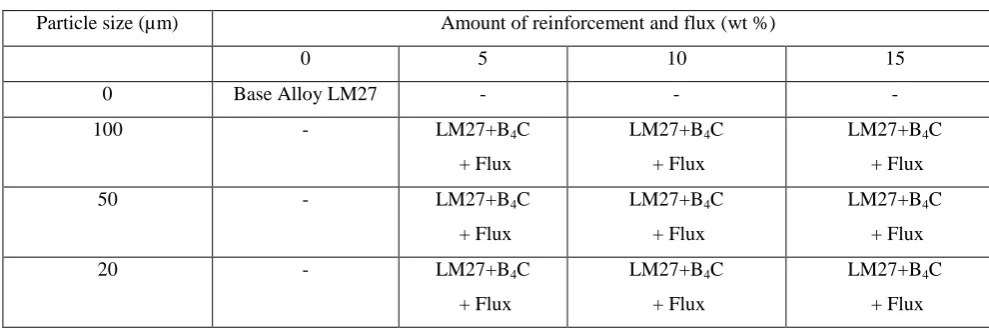
for the characterization and testing. Total ten samples were prepared including base LM27 sample with
composition detail are shown in Table 3.
Table 2. List of processing parameters for stir casting of B
4C alloy
2.3.Characterization and testing
For metallographic study, base alloy (LM27) and composite samples were mechanically polished and etched
with Keller’s reagent. The chemical composition of Keller’s reagent is shown in Table 4. The surface
morphology of each sample was examined with the help of optical microscope. Micro hardness values at
different phases were measured using Vickers hardness testing machine and bulk hardness was carried out using
Rockwell hardness testing machine.
Table 3. Composition of reinforcements and K
2TiF
6flux
Particle size (µm) Amount of reinforcement and flux (wt %)
0 5 10 15
0 Base Alloy LM27 - - -
100 - LM27+B4C
+ Flux
LM27+B4C
+ Flux
LM27+B4C
+ Flux
50 - LM27+B4C
+ Flux
LM27+B4C
+ Flux
LM27+B4C
+ Flux
20 - LM27+B4C
+ Flux
LM27+B4C
+ Flux
LM27+B4C
+ Flux
Table 4. Chemical composition of Keller’s Reagent
III. RESULTS AND DISCUSSION
Melting temperature 750°C
Preheat temperature of particles 200°C
Total stirring time 20-25 min
Mixing time 8-10 min
Stirring speed 250 rpm
No. of blades 3
Blade angle 60°
Position of stirrer in melt up to 2/3 depth
Chemicals Distilled water Nitric acid Hydrochloric acid Hydro-fluoric acid
72 |
P a g e
3.1.Microstructural Study
In order to analyze the microstructure of the base alloy and the developed composites optical microscopy was
used. Optical micrographs of the base cast LM27 alloy are shown in Fig.1(a&b).The dendretic growth of silicon
at grain boundaries has been observed in LM27 alloy.
Fig.1. Optical micrograph of base alloy LM27 (a) at 50 x and (b) at 500 x.
Fig.2. Optical micrograph of (a) LM27/5%B
4C (Size 100µm) at 50 x, (b) LM27/10%B
4C (Size
100µm) at 50 x, (c) LM27/15% B
4C (Size100µm) at 50 x,(d) LM27/Coarse size B
4C at 200 x.
Fig.2 (d) showing the coarse size particle, interface and matrix at higher magnification. It is clear from the figure
73 |
P a g e
silicon along grain boundaries, where as dendretic growth is seen in area where there is no particle. A thin layer
around the particles has been observed which was the reaction product of potassium titanium fluoride flux and
the boron carbide particles. The titanium react with boron carbide to form titanium carbide and titanium diboride
which increases the wettability of boron carbide particles with aluminum alloy and results in formation of strong
bond between aluminum matrix and boron carbide particles as earlier described by Toptan et al.[5]
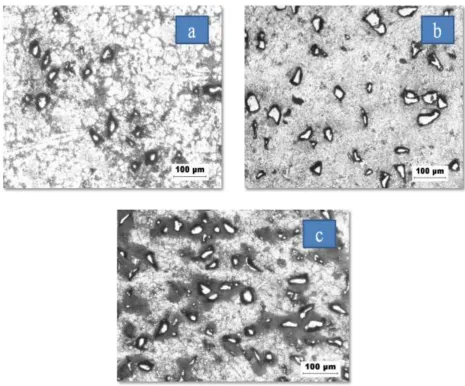
Optical micrographs of composites of particles size 50 µm with 5%, 10% and 15% composition are shown in
Fig. 3(a-c) respectively. It has been clear from the micrographs that the particles are uniformly distributed and
result in the formation of strong bond with the matrix. Similar type of thin layer has been observed around the
particles as in case of coarse size particles which results in formation of the strong bonding between aluminum
matrix and the boron carbide particles.
Fig.3. Optical micrograph at 100 x (a) LM27/5%B
4C (50µm) (b) LM27/10%B
4C (50µm) (c)
LM27/15%B
4C (50µm).
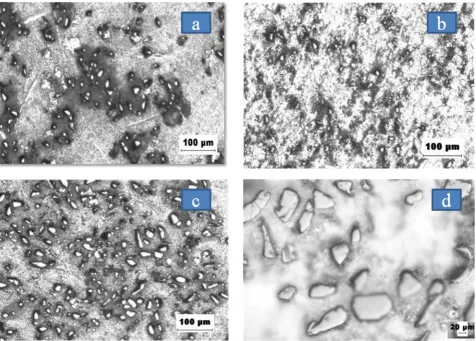
Optical micrograph of composites of particles size 20 µm with 5%, 10% and 15% composition are shown in Fig.
4(a-c) respectively. It has been clear from the micrographs that the particles are uniformly distributed and result
74 |
P a g e
matrix. As compared to coarse and medium size particles there is more agglomeration is observed in case of fine
size particles. But the inter-particle distance between the fine size particles is less as compared to coarse and
medium size particles which offer more advantageous properties to the composite.
Fig. 4(d) shows the bonding and interfaces formed by fine size particles with the matrix at higher magnification.
As it is clear from the figure that particles are strongly bonded to matrix and forming the clear interfaces.
Similar thin layer of titanium carbide and titanium diboride has also been observed around the boron carbide
particles which was also observed in case of medium and coarse size particles.
3.2 Hardness testing
The micro hardness of base LM27 alloy and alloy containing 10 wt% reinforcement of boron carbide particles
of sizes 100µm, 50 µm, 20 µm was observed. The micro hardness of the base alloy was observed as 103 HV.
Table 5 shows the micro hardness of composite at the particle, at interface between particle and matrix and at
the matrix.
Fig.4. Optical micrograph of (a) LM27/5%B
4C (20µm) at 100 x (b) LM27/10%B
4C (20µm) at
100 x (c) LM27/15%B
4C (20µm) at 100 x, (d) LM27/fine sized B
4C at 500 x.
Table 5. Micro hardness of LM27/B
4C composite containing 10 wt% reinforcement
Particle size
(µm)
Micro hardness (HV)
Particle Interface Matrix
75 |
P a g e
50 726 273 96
20 711 349 107
It is clear from the Table 5 that the micro hardness decreases as we move from particle to the matrix. The
interface formed between the particles and the matrix also shows a remarkable increase in the hardness as
compared to matrix which points towards the strong interfacial bonding between the particles and the matrix.
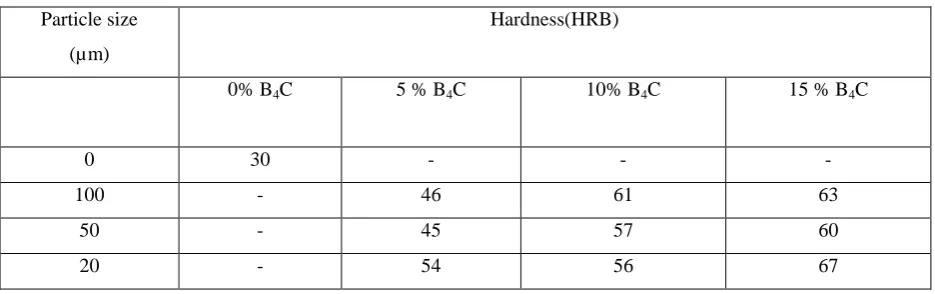
The bulk hardness of the developed composites was carried out by using Rockwell hardness testing machine.
The results obtained are shown in Table 6.
Table 6. Bulk hardness of LM27/B
4C composites
Particle size
(µm)
Hardness(HRB)
0% B4C 5 % B4C 10% B4C 15 % B4C
0 30 - - -
100 - 46 61 63
50 - 45 57 60
20 - 54 56 67
The bulk hardness of composite increases as we increase the amount of reinforcement from 0 to 15 wt% and
decrease with the increasing size of reinforcement particles from 20 – 100m. As it is concluded from the table
above that the fine size particles offers more resistance to indentation as compared to coarse size particles this is
because the inter particle distance between fine size particles is less as compared to coarse size particle. The
comparisons of bulk hardness of base alloy and alloy with coarse, medium, fine sized reinforcements are shown
76 |
P a g e
Fig.5. Bulk hardness comparisons of Base alloy LM27 and (a) Composite containing coarse size
particles with different amount of composition (b) Composite containing medium size particles
with different amount of composition (c) Composite containing fine size particles with different
amount of composition.
IV. CONCLUSIONS
The study on the effect of boron carbide reinforcement (with different sizes and different amount) in stir cast
LM27/B4C composites is concluded as follows:
Stir casting has resulted in uniform distribution of reinforced particles B4C within the Al matrix.
Potassium titanium flux increases the wettability of B4C with the aluminum matrix and results in the
formation of strong interfacial bonding.
There is sufficient increase in the micro hardness at the interface which decreases as we move away from
interface to matrix and increases as we move from interface to particle. It is also concluded that there is an
increase in micro hardness as the percentage of reinforcement increases.
The bulk hardness of the composite increases as the size of the particle decreases i.e. fine size particles
offers more resistance to indentation as compared to coarse size particles.
REFERENCES
[1] Panwar, R. S., & Pandey, O. P. (2013). Study of Wear Behavior of Zircon Sand-Reinforced LM13 Alloy
Composites at Elevated Temperatures. Journal of Materials Engineering and Performance, 22(6), 1765–
1775.
[2] Nagaral, M., Shivananda, B. K., Shambhuling, V. S., & Auradi, V. (2014). Wear Behavior of SiC
Reinforced Al6061 Alloy Metal Matrix Composites by using Taguchi’s techniques, 800–804.
[3] Roystan, D., Balaguru, M. S., & Devanathan, C. (2015). A Study on Mechanical Properties of Aluminium
LM25- SiC Composites Fabricated Using Stir Casting Technique Abstract : II(Xxii).
[4] Thirumalai, T., Subramanian, R., Radika, N., & Gowrisankar, A. (2015). Wear Behavior of B4C Reinforced
Hybrid Aluminum-Matrix Composites, 49(1), 9–14.
[5] Toptan, F., Kilicarslan, A., & Kerti, I. (2010). The Effect of Ti Addition on the Properties of Al-B4C
Interface : A Microstructural Study, 637, 192–197.
[6] Rajesh, G. L., Kushal, K. P., & Auradi, V. (2015). Room Temperature Wear Behavior of 6061AL Alloy