The Relationship Between Sleep Problems and
Daytime Behavior in Children of Different Ages
With Autism Spectrum Disorders
abstract
BACKGROUND:The purpose of the current study was to evaluate the relationships among sleep problems and daytime behaviors in a large, well-defined cohort of children with autism spectrum disorder (ASD).
METHODS: Out of a registry population of 3452 children with ASDs, a subset of 1193 children aged 4 to 10 years of age from 14 centers across the country was used to evaluate the relationship between vary-ing levels of sleep problems and daytime behavior. Measures included Children’s Sleep Habits Questionnaire, Vineland Adaptive Behavior Scales, Survey Interview Form, Second Edition, and Child Behavior Checklist. Multiple analysis of covariance was used to assess the association between sleep and behavior.
RESULTS:Results suggest that sleep problems, as identified by parent report by use of the Children’s Sleep Habits Questionnaire, have a neg-ative relationship with daytime behavior. More specifically, children with ASDs and sleep problems had more internalizing and external-izing behavior problems, as measured by the Child Behavior Checklist, and poorer adaptive skill development, as measured by the Vineland Adaptive Behavior Scales, than children with ASDs and no sleep prob-lems. Children with moderate to severe sleep problems had greater behavior difficulties, but not necessarily poorer adaptive functioning, than children with mild to moderate sleep problems. Both preschool-and school-aged children demonstrated a negative relationship between behavior and sleep, whereas the relationship between sleep and adaptive functioning was much more variable.
CONCLUSIONS:These results suggest that, although sleep has a neg-ative relationship with internalizing and externalizing behavior, it may have a different relationship with the acquisition of adaptive skills. Pediatrics2012;130:S83–S90
AUTHORS:Darryn M. Sikora, PhD,aKyle Johnson, MD,b
Traci Clemons, PhD,cand Terry Katz, PhDd
aDepartment of Pediatrics, Oregon Health & Science University,
Portland, Oregon;bDepartment of Psychiatry, Oregon Health &
Science University, Portland, OregoncThe EMMES Corporation,
Rockville, Maryland; anddJFK Partners, Autism and
Developmental Disabilities Clinic, University of Colorado School of Medicine, Denver, Colorado
KEY WORDS
autism spectrum disorders, sleep problems, behavior problems, adaptive skills
ABBREVIATIONS
ASD—autism spectrum disorder ATN—Autism Treatment Network CBCL—Child Behavior Checklist
CSHQ—Children’s Sleep Habits Questionnaire DLS—Daily Living Skills
HRQoL—health-related quality of life MANOVA—Multiple analysis of covariance
VABS-II—Vineland Adaptive Behavior Scales, Survey Interview Form, Second Edition
This manuscript has been read and approved by all authors. This paper is unique and not under consideration by any other publication and has not been published elsewhere.
www.pediatrics.org/cgi/doi/10.1542/peds.2012-0900F
doi:10.1542/peds.2012-0900F
Accepted for publication Aug 8, 2012
Address correspondence to Darryn M. Sikora, PhD, Providence Neurodevelopmental Center for Children, 830 NE 47th St, Portland, OR 97213. E-mail: [email protected]
PEDIATRICS (ISSN Numbers: Print, 0031-4005; Online, 1098-4275).
Copyright © 2012 by the American Academy of Pediatrics
FINANCIAL DISCLOSURE:The authors have indicated they have nofinancial relationships relevant to this article to disclose.
orders defined by impairments in the areas of communication and sociali-zation, as well as patterns of restricted or repetitive behaviors.1 Recently,
at-tention has shifted to treating medical conditions found in children with ASDs with the goal of improving overall function and health-related quality of life (HRQoL). One such comorbid con-dition is sleep disturbance.
Studies indicate that 50% to 80% of children with ASDs have sleep prob-lems.2–4Sleep-onset and maintenance
insomnia are the primary sleep problems reported by parents of children with ASDs.4–6Additionally, children with ASDs
experience irregular sleep-wake pat-terns, early morning awakenings, and poor sleep routines.7–10Attempts have
been made to control for the confound-ing variable of intellectual deficits when evaluating sleep problems in ASD, and it appears that ASD is an independent risk factor for sleep problems.4,11
Parents of typically developing children with sleep problems report a number of negative consequences during the day. These include behavior difficulties, af-fective problems, and cognitive dysfunc-tion.12–17In children with developmental
disabilities, poor sleep habits have been related to negative mood, irritability, self-injury, and aggression.18,19 Several
additional studies have emphasized the negative impact of childhood sleep dis-orders on the HRQoL for the child and family.20–22
Although the relationship between sleep and daytime functioning is established in heterogeneous groups of children with developmental disabilities, fewer stud-ies have looked at this relationship in children with ASDs. Mayes and Calhoun23
reported that children with ASDs and sleep problems had more severe autis-tic symptoms, hyperactivity, mood vari-ability, and aggression, than children with no sleep problems. Malow and
hyperactivity, ritualistic behavior, self-injury, and affective problems. Because behavior symptoms and sleep habits in children with ASDs change with age,27
it becomes important to look at the relationship between sleep problems and daytime functioning in children with ASDs at different ages.
The purpose of the current study was to further evaluate the relationship be-tween sleep problems and daytime behavior by using a large, well-defined cohort of children with ASDs and stratify the sample by age. We chose to evaluate not only problem behavior, but also adaptive behavior, which has not been the focus of previous studies. It was hypothesized that (1) participants with sleep problems would have more behavior problems and poorer adaptive functioning than those with no sleep problems, (2) participants with mod-erate to severe sleep problems would have more behavior problems and poorer adaptive functioning than those with mild sleep problems, and (3) sleep problems would have weaker rela-tionships to daytime behavior in older versus younger children.
METHODS
Recruitment and Sample Description
This research was conducted as part of the activities of the Autism Treatment Network (ATN), a registry collecting data on children ages 2 to 17 with ASDs across 14 sites in the United States and Canada. All ATN participants completed a multidisciplinary evaluation that in-cluded diagnostic, cognitive, behavioral, and physical assessments, including assessment of sleep. Parents or legal guardians of all participants pro-vided consent for participation, and an institutional review board at each participating ATN site reviewed and approved the study.
4 to 10 years; (2) a clinical ASD diagnosis according to one or more diagnostic measures: Autism Diagnostic Obser-vation Schedule, Autism Diagnostic Interview-Revised, or Diagnostic and Statistical Manual of Mental Disorders, Fourth Edition symptom checklist; (3) planned or ongoing care at an estab-lished ATN site that allowed for com-pletion of the research testing; and (4) parent/caregiverfluent in written and spoken English, and English spoken in the home with the child at least 75% of the time.
Measures Sleep
Children’s Sleep Habits Questionnaire (CSHQ).28Parents completed the CSHQ,
a survey used to screen for sleep problems, consisting of 45 sleep-related questions. Parents are asked to recall children’s sleep behaviors over a“typical”recent week. Items are rated on a 3-point scale:“usually” (be-havior occurred 5–7 times per week); “sometimes”(2–4 times per week); and “rarely” (0–1 time per week). Parents are asked to endorse whether each sleep behavior item is considered problematic (yes/no). Ratings on 33 of the 45 items are summed to generate a single total score; higher scores in-dicate more severe sleep difficulties.
The CSHQ had satisfactory psychomet-ric properties in a large sample of 4- to 10-year-old children28and was found to
be clinically useful for screening sleep problems in typically developing chil-dren ages 2 to 5.5 years.29A total CSHQ
score of.41 has been reported to be a sensitive cutoff for clinically signifi -cant sleep problems.30
sleep problems and those with mod-erate to severe sleep problems, as previously reported by Krakowiak et al6
using a different sleep measure. They found that sleep problem severity was associated with increased medication use and health problems. They did not explore the relationship between sleep problem severity and daytime behav-ior, which may be important clinically in terms of when to address reported sleep concerns. Groupings for the current study were determined based on calculating the CSHQ score at the 75th percentile (fourth quartile) for our participant population (a score of 56).31Participants with CSHQ scores of
41 to 55 fell in the mild sleep problem group, whereas participants with scores of 56 and above fell in the mod-erate to severe sleep problem group.
Adaptive Functioning
Vineland Adaptive Behavior Scales, Sur-vey Interview Form, Second Edition (VABS-II).32Parents were interviewed to
complete the VABS-II, a semistructured caregiver interview of a child’s every-day living skills. Open-ended questions are used to determine if the child “usually,” “sometimes or partially,”or “never” performs various behaviors within the domains of: Communication, Daily Living Skills (DLS), Socialization, and Motor Skills. Interviews were con-ducted and protocols scored by trained clinicians at each of the participating ATN sites. VABS-II standard scores have a mean of 100 and SD of 15. Scores between 85 and 115 are considered to be within normal limits, whereas scores of ,70 are considered to be within the impaired range of ability (lower scores = greater impairment). The VABS-II has adequate reliability and validity33and has been widely used for
years as a measure of adaptive skills in individuals with a wide variety of de-velopmental and chronic health condi-tions. Standard scores for the Adaptive Behavior Composite and Communication,
DLS, and Socialization domains were used in the current study.
Behavioral Functioning
Child Behavior Checklist (CBCL).34The
CBCL is a caregiver-completed mea-sure of a variety of childhood behavior problems; it consists of 2 separate forms: one for children between the ages of 1.5 and 5 years, and the other for children between the ages of 6 and 18 years. Both versions assess specific internalizing and externalizing prob-lematic behaviors. Caregivers are asked to rate the frequency of each behavior on a 3-point Likert scale (0 = Not True, 1 = Somewhat or Sometimes True, 2 = Very True or Often True). Scores are summed and converted to T scores (M = 50, SD = 10) on factor an-alytically derived syndrome scales, with higher scores suggesting greater behavior problems. Syndrome scales are combined to form an Internalizing Problems, Externalizing Problems, and Total Problems composite score. A composite scale T score of ,60 is considered “average,” whereas a T score of.65 is generally considered “clinically significant.” The manual for the CBCL reports adequate re-liability and validity for scale scores. Researchers have used the CBCL spe-cifically to examine the relationship between sleep problems and daytime behavior in children. For example, Stein et al35studied children aged 4 to
12 and found strong associations be-tween sleep problems and the exter-nalizing and interexter-nalizing scores on the CBCL. In the current study, parents completed the version of the CBCL ap-propriate to their child’s age, and composite scores were used in the analyses.
The CBCL manual34 reports that the
assignment of T scores at T = 50 were truncated and notes that raw scores “can reflect greater differentiation than T scores among children who obtain low scores on these scales.”We
followed recommendations outlined in the CBCL manual and converted our sample’s raw scores tozscores sepa-rately for each age range and gender with the sample. In this way, we were able to obtain a common metric for all children in the sample. Thus, each participant’s CBCL score reflects his or her standing relative to other children of the same age and gender in our sample.
Age stratification was based on the 2 different versions of the CBCL (for ages 1.5–5 or ages 6–18). The preschool-aged group included participants ages 4 to 5, whereas the school-aged group in-cluded participants ages 6 to 10.
Cognitive Functioning
Cognitive scores were used in this study only as covariates in the multivariate analyses. Participants were individually administered a cognitive instrument based on their age and ability to par-ticipate in standardized testing. Either the early learning composite from the Mullen Scales of Early Learning36or the
Abbreviated IQ from the Stanford Binet Intelligence Scale, fifth edition,33 was
used as a global indicator of cognitive functioning.
Procedure
All data collected as part of a partic-ipant’s initial, multidisciplinary evalu-ation at one of the ATN sites were deidentified and entered into a single data repository. The following data were extracted from the repository for analysis as part of the current study: age, gender, diagnostic classification, global indicator of cognitive function-ing, and scores from the CSHQ, VABS-II, and CBCL, as described above.
Data Analysis
Multiple analysis of covariance (MANOVA), with the use of the sleep groups as described above as a be-tween-subject variable, was used to
as measured by the CBCL and the VABS-II. MANOVA is an extension of the anal-ysis of variance model and used when there are 2 or more related dependent variables. MANOVA takes into consid-eration the pattern of covariation among the related dependent meas-ures while controlling the overall
a-level. In the current study, the MANOVA tested whether mean dif-ferences among the sleep groups (in-dependent variable) on a combination of dependent variables (CBCL total, in-ternalizing and exin-ternalizing subscales, or VABS-II domains) were likely to have occurred by chance. This is achieved by creating a single dependent measure from a combination of all dependent measures that maximizes the between-group differences. MANOVA determines whether there are statistically reliable mean differences among groups, after adjusting the newly created dependent measure on 1 or more covariates. Race, cognitive functioning, and diagnosis were designated as covariates. If the overall MANOVA F test showed the cen-troid of means (vectors of mean values of the dependent variables in the
variate F tests of group differences were used to determine which sleep group means differ significantly from others. Because of multiple comparisons, we used a Pvalue of .01 to reduce type 1 error. All analyses were conducted by using SAS Version 9.1.
RESULTS
Of 3452 children enrolled in the ATN at the time of database closure for these analyses (January 31, 2011), 1193 were eligible for participation in the current study. Those children excluded from the current study were outside the
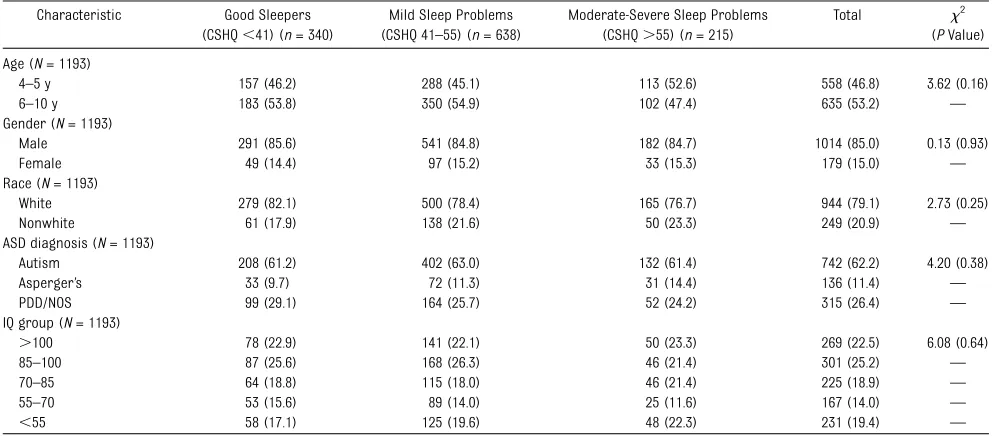
speci-fied age range or were missing 1 or more of the measures described below. Demographic characteristics of the sample are reported in Table 1.
Relationship Between Sleep Problems and Behavior Problems Zscores from the CBCL were compared across sleep groups for both pre-school- and pre-school-aged children. We found that the sleep groups differed on the CBCL total score as well as the in-ternalizing and exin-ternalizing
compos-P , .0001). The good sleep group scored significantly lower on the 3 composite scores than the sleep problem group (P,.0001). Within the sleep problem group, participants with mild sleep problems scored lower than participants with moderate to severe sleep problems. The MANOVA revealed an effect of being in the mild sleep problem group versus moderate to severe sleep problem group for both age groups (Wilksl= 0.77 and 0.83;P , .0001, respectively). Results are summarized in Table 2.
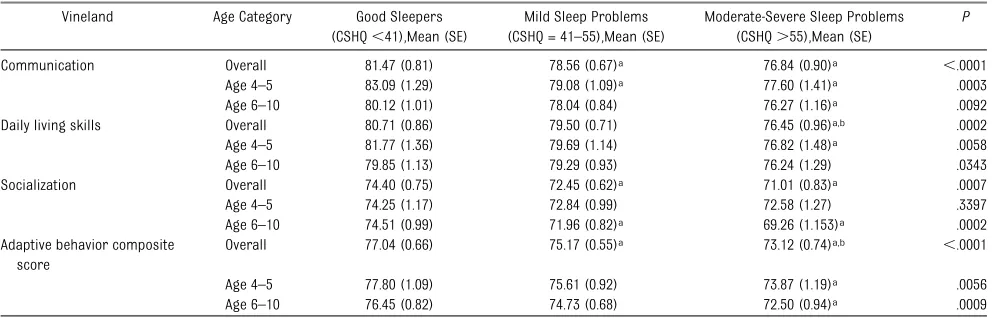
Relationship Between Sleep Problems and Adaptive Functioning Scores from the VABS-II were compared across sleep groups for both age groups. The MANOVA revealed an effect of sleep group overall and for both age groups (Wilksl= 0.97, 0.96, and 0.96; P,.0001, .003, and .005, respectively). For the sample as a whole, we found that all groups differed from each other on the composite score, with the moderate to severe sleep problem group having the lowest score of the 3 groups (P , .0001). For the
TABLE 1 Demographic Information for Each Sleep Group and Entire Participant Group
Characteristic Good Sleepers (CSHQ,41) (n= 340)
Mild Sleep Problems (CSHQ 41–55) (n= 638)
Moderate-Severe Sleep Problems (CSHQ.55) (n= 215)
Total x2
(PValue) Age (N= 1193)
4–5 y 157 (46.2) 288 (45.1) 113 (52.6) 558 (46.8) 3.62 (0.16)
6–10 y 183 (53.8) 350 (54.9) 102 (47.4) 635 (53.2) —
Gender (N= 1193)
Male 291 (85.6) 541 (84.8) 182 (84.7) 1014 (85.0) 0.13 (0.93)
Female 49 (14.4) 97 (15.2) 33 (15.3) 179 (15.0) —
Race (N= 1193)
White 279 (82.1) 500 (78.4) 165 (76.7) 944 (79.1) 2.73 (0.25)
Nonwhite 61 (17.9) 138 (21.6) 50 (23.3) 249 (20.9) —
ASD diagnosis (N= 1193)
Autism 208 (61.2) 402 (63.0) 132 (61.4) 742 (62.2) 4.20 (0.38)
Asperger’s 33 (9.7) 72 (11.3) 31 (14.4) 136 (11.4) —
PDD/NOS 99 (29.1) 164 (25.7) 52 (24.2) 315 (26.4) —
IQ group (N= 1193)
.100 78 (22.9) 141 (22.1) 50 (23.3) 269 (22.5) 6.08 (0.64)
85–100 87 (25.6) 168 (26.3) 46 (21.4) 301 (25.2) —
70–85 64 (18.8) 115 (18.0) 46 (21.4) 225 (18.9) —
55–70 53 (15.6) 89 (14.0) 25 (11.6) 167 (14.0) —
,55 58 (17.1) 125 (19.6) 48 (22.3) 231 (19.4) —
Communication domain, the good sleep group scored significantly lower than both the mild and moderate to severe sleep problem groups for the preschool-aged children but only sig-nificantly lower than the moderate to severe sleep problem group for the school-aged children. There was no significant difference in scores be-tween the mild and moderate to severe sleep problem groups. For the DLS domain, there were no differences in scores between the good sleep and mild sleep problem groups for both preschool- and school-aged children, but there were differences in scores between the good sleep group and the moderate to severe sleep group for preschool-aged children (P= .0052). In the Socialization domain, there were
no differences in scores across groups for the preschool-aged children, but there were differences in scores be-tween the good sleep group and the sleep problem groups for children 6 to 10 years old. There were no differences between the mild and moderate to se-vere sleep problem groups for any domain at any age. Results are sum-marized in Table 3.
DISCUSSION
Results from the current study support ourfirst hypothesis. Children with ASDs and sleep problems had higher scores on the CBCL (more behavior problems) and lower scores on the VABS-II (poorer adaptive functioning) than children with ASDs and no sleep problems. These
findings confirm previous studies looking at the relationship between sleep problems and daytime behavior of children with ASDs.9,23–26 DeVincent
et al37 reported that externalizing
behaviors were greater in children with ASDs and poor sleep in compari-son with children with ASDs and typical sleep habits. In the current study, not only were externalizing problems re-lated to sleep quality, but also in-ternalizing problems, such as emotional reactivity and anxiety. Internalizing behaviors are often problematic for children with ASDs, and it is relevant to document that they are also related to a child’s sleep habits.
The relationship between sleep and adaptive behavior was less robust. For
TABLE 2 ZScores From the CBCL (Mean = 0; SD = 1) by Sleep Group and Analysis Results
CBCL Age Category Good Sleepers (CSHQ,41), Mean (SE)
Mild Sleep Problems (CSHQ = 41–55), Mean (SE)
Moderate-Severe Sleep Problems (CSHQ.55), Mean (SE)
P
Total CBCL Overall 20.50 (0.06) 0.02 (0.05)a 0.70 (0.07)a,b ,.0001
Age 4–5 20.53 (0.10) 0.05 (0.08)a 0.64 (0.11)a,b ,.0001
Age 6–10 20.47 (0.09) 20.01 (0.07)a 0.76 (0.10)a,b ,.0001
Internalizing Overall 20.42 (0.07) 20.01 (0.05)a 0.57 (0.07)a,b ,.0001
Age 4–5 20.50 (0.10) 20.01 (0.09)a 0.49 (0.11)a,b ,.0001
Age 6–10 20.36 (0.09) 20.02 (0.07)a 0.62 (0.10)a,b ,.0001
Externalizing Overall 20.34 (0.07) 0.03 (0.06)a 0.56 (0.08)a,b ,.0001
Age 4–5 20.29 (0.10) 0.10 (0.09)a 0.49 (0.12)a,b ,.0001
Age 6–10 20.37 (0.09) 20.03 (0.07)a 0.67 (0.10)a,b ,.0001
The overall models were adjusted to all covariates including age. The age specific models were covariate adjusted (separate/stratified models by age).
aPvalue,.01 (good compared with either mild or moderate to severe). bPvalue,.01 (mild compared with moderate to severe).
TABLE 3 Standard Scores From the VABS-II (Mean = 100; SD = 15) by Sleep Group and Analysis Results
Vineland Age Category Good Sleepers (CSHQ,41),Mean (SE)
Mild Sleep Problems (CSHQ = 41–55),Mean (SE)
Moderate-Severe Sleep Problems (CSHQ.55),Mean (SE)
P
Communication Overall 81.47 (0.81) 78.56 (0.67)a 76.84 (0.90)a ,.0001
Age 4–5 83.09 (1.29) 79.08 (1.09)a 77.60 (1.41)a .0003
Age 6–10 80.12 (1.01) 78.04 (0.84) 76.27 (1.16)a .0092
Daily living skills Overall 80.71 (0.86) 79.50 (0.71) 76.45 (0.96)a,b .0002
Age 4–5 81.77 (1.36) 79.69 (1.14) 76.82 (1.48)a .0058
Age 6–10 79.85 (1.13) 79.29 (0.93) 76.24 (1.29) .0343
Socialization Overall 74.40 (0.75) 72.45 (0.62)a 71.01 (0.83)a .0007
Age 4–5 74.25 (1.17) 72.84 (0.99) 72.58 (1.27) .3397
Age 6–10 74.51 (0.99) 71.96 (0.82)a 69.26 (1.153)a .0002
Adaptive behavior composite score
Overall 77.04 (0.66) 75.17 (0.55)a 73.12 (0.74)a,b ,.0001
Age 4–5 77.80 (1.09) 75.61 (0.92) 73.87 (1.19)a .0056
Age 6–10 76.45 (0.82) 74.73 (0.68) 72.50 (0.94)a .0009
The overall models were adjusted to all covariates including age.
aPvalue,.01 (good compared with either mild or moderate to severe). bPvalue,.01 (mild compared with moderate to severe).
communication and socialization skills, regardless of the degree of sleep problems. In contrast, they were related to DLS only when sleep problems became moderate to severe. One pos-sible explanation for these results is differences in the VABS-II domains. The Communication and Socialization domains, in general, reflect core ASD symptoms, whereas the DLS domain more often reflects specific skill sets. Parent values and priorities often
in-fluence whether DLS are taught and which skills are emphasized. Children who are taught skills such as teeth brushing or taking a bath will score higher on the DLS domain than children who are not taught these skills. Mild sleep problems may not force parents to turn their focus away from teaching DLS. Only when sleep problems become more severe might a parent’s focus shift away from teaching DLS to treating sleep problems. In contrast, because Communication and Socialization skills are core ASD symptoms, any sleep problems, even mild ones, may be neg-atively related to skill development in these areas. Other researchers have found similar results. In a study looking at children with ASDs who were char-acterized by their parents as good and bad sleepers, children characterized as good sleepers were only reported to have problems in language, attention, and social interaction, whereas bad sleepers were reported to have prob-lems with attention, social interaction, language, hyperactivity, sensory issues, anxiety, eating behaviors, and self-stimulatory behavior.38
Results also support our second hy-pothesis that children with moderate to severe sleep problems have more daytime behavior problems than chil-dren with mild sleep problems. CBCL scores were statistically significantly higher for children with moderate to
These differences suggest a relation-ship between sleep and behavior problems such that children with greater sleep disturbance have greater behavior disturbance. Although all 3 CBCL scores evidenced these differ-ences, VABS-II scores did not. Only the Adaptive Behavior Composite and DLS scores differed between the mild and moderate to severe sleep groups. A possible reason for this difference is the impact that both sleep and problem behaviors have on parenting stress. Behavior and sleep problems have been found to have a stronger negative re-lationship with parenting stress than autistic symptom severity in children with ASDs.25As suggested above, when
sleep problems increase and parents become more stressed, they may be-come less available to teach their children DLS.
Results did not support our third hy-pothesis, that sleep problems would have a weaker relationship to daytime behavior in older versus younger chil-dren. Although thisfinding was true for DLS domain scores, the opposite was true for Communication domain scores. On the CBCL, a relationship between sleep and behavior was significant for both older and younger children. Therefore, our results indicate that age may not be an important factor in looking at the relationship between sleep and behavior in children ages 4 to 10. There is, however, research that indicates that sleep problems in early childhood persist through adolescence but that the nature of an individual’s sleep difficulties may change.39
Whereas results of the current study are important in determining the re-lationship between sleep problems and daytime functioning, it is necessary to look also at clinical implications of the data presented. With a few exceptions, clinically significant scores were only
reached clinical significance for the no or mild sleep problem groups. Although our results further support the re-lationship between sleep and behavior problems, they also suggest that be-havior problems may only reach clinical significance, where direct intervention is warranted, in children with moderate to severe sleep problems. Therefore, by bringing moderate to severe sleep problems down to the mild range of severity, parents may experience im-proved daytime functioning in their children with ASDs. However, thisfinding also supports the possible bidirection-ality of the sleep–behavior relationship. It may be that, by improving some aspects of daytime functioning, such as decreasing anxiety and emotional re-activity, children may have an easier time falling and staying asleep.
There are limitations to the current study. First, although groups evidenced statistically significant differences, few differences would reach the level of clinical significance. Despite the lack of clinically significant differences, fi nd-ings strongly support a relationship between sleep problems and daytime functioning, particularly because sig-nificance was set at a Pvalue of .01 rather than .05. Second, information about both sleep and daytime behavior was gathered via parent report. Al-though parent report is generally used as a proxy for self-report of children, Wiggs and Stores40 suggested that
determined that higher scores (.41) on the CSHQ are correlated with more meaningful impairment. However, the fact that there were differences be-tween the sleep problem groups on many measures suggests that higher scores may mean more impairment.
Finally, although this study emphasizes the bidirectional relationship between sleep and daytime behavior, there could be other factors that influence both. For example, having a neurodevelopmental disorder might not only result in core ASD symptoms but also impaired be-havior and regulation of sleep. ASD symptoms, such as a lack of social awareness or nonfunctional routines, may impact both sleep and daytime behavior. In addition, cognitive level
may be related to both sleep and day-time behavior, which is why, in the current study, our global measure of cognitive ability was used as a cova-riate. Environmental variables, such as parent stress or family circumstances, also may impact sleep and behavior. Future research should focus on the relationships among all of these vari-ables (ie, sleep, behavior, IQ, ASD symptoms, environmental factors) and the relative contribution of each to outcome and quality of life.
Despite these limitations, the results of this study provide additional support that nighttime sleep problems in chil-dren with ASDs are related to negative outcomes during the day, particularly in the area of internalizing and
external-izing behavior problems, although adaptive functioning is also related to sleep problems. In addition, children with ASDs and moderate to severe sleep problems seem to fare worse than children with ASDs and mild sleep problems, particularly in the area of adaptive functioning. Future studies need to examine the impact of im-proving sleep habits in children with ASDs and sleep problems. If improving sleep habits results in improved day-time functioning, then the HRQoL for both children with ASDs and their families may also improve.
ACKNOWLEDGMENT
We thank Rebecca Panzer, MA, RD, LD, for her editorial support.
REFERENCES
1. American Psychiatric Association. Di-agnostic and Statistical Manual of Mental Disorders. Revised 4th ed. Washington, DC: American Psychiatric Association; 2000
2. Hoshino Y, Watanabe H, Yashima Y, Kaneko M, Kumashiro H. An investigation on sleep disturbance of autistic children.Folia Psy-chiatr Neurol Jpn. 1984;38(1):45–51
3. Richdale AL. Sleep problems in autism: prevalence, cause, and intervention. Dev Med Child Neurol. 1999;41(1):60–66
4. Polimeni MA, Richdale AL, Francis AJ. A sur-vey of sleep problems in autism, Asperger’s disorder and typically developing children. J Intellect Disabil Res. 2005;49(pt 4):260–268
5. Couturier JL, Speechley KN, Steele M, Norman R, Stringer B, Nicolson R. Parental perception of sleep problems in children of normal intelligence with pervasive de-velopmental disorders: prevalence, sever-ity, and pattern.J Am Acad Child Adolesc Psychiatry. 2005;44(8):815–822
6. Krakowiak P, Goodlin-Jones B, Hertz-Picciotto I, Croen LA, Hansen RL. Sleep problems in chil-dren with autism spectrum disorders, de-velopmental delays, and typical development: a population-based study.J Sleep Res. 2008;17 (2):197–206
7. Schreck KA, Mulick JA. Parental report of sleep problems in children with autism.J Autism Dev Disord. 2000;30(2):127–135
8. Richdale AL, Prior MR. The sleep/wake rhythm in children with autism.Eur Child Adolesc Psychiatry. 1995;4(3):175–186
9. Honomichl RD, Goodlin-Jones BL, Burnham M, Gaylor E, Anders TF. Sleep patterns of
children with pervasive developmental disorders.J Autism Dev Disord. 2002;32(6): 553–561
10. Richdale AL, Schreck KA. Sleep problems in
autism spectrum disorders: prevalence, nature, & possible biopsychosocial aetiol-ogies.Sleep Med Rev. 2009;13(6):403–411
11. Bradley EA, Summers JA, Wood HL, Bryson
SE. Comparing rates of psychiatric and behavior disorders in adolescents and
young adults with severe intellectual dis-ability with and without autism.J Autism Dev Disord. 2004;34(2):151–161
12. Zuckerman B, Stevenson J, Bailey V. Sleep
problems in early childhood: continuities, predictive factors, and behavioral
corre-lates.Pediatrics. 1987;80(5):664–671
13. Hansen DE, Vandenberg B. Neuropsychological
features and differential diagnosis of sleep apnea syndrome in children.J Clin Child
Psychol. 1997;26(3):304–310
14. Owens J, Opipari L, Nobile C, Spirito A. Sleep and daytime behavior in children with obstructive sleep apnea and
behav-ioral sleep disorders.Pediatrics. 1998;102 (5):1178–1184
15. Smedje H, Broman JE, Hetta J. Associations between disturbed sleep and behavioural
difficulties in 635 children aged six to eight years: a study based on parents’perceptions.
Eur Child Adolesc Psychiatry. 2001;10(1):1–9
16. Halbower AC, Mahone EM. Neuropsychological morbidity linked to childhood sleep-disordered breathing. Sleep Med Rev. 2006;10(2):97–107
17. Fallone G, Acebo C, Arnedt JT, Seifer R, Carskadon MA. Effects of acute sleep re-striction on behavior, sustained attention, and response inhibition in children. Per-cept Mot Skills. 2001;93(1):213–229
18. Clements J, Wing L, Dunn G. Sleep problems in handicapped children: a preliminary study. J Child Psychol Psychiatry. 1986;27 (3):399–407
19. Quine L. Sleep problems in children with mental handicap.J Ment Defic Res. 1991;35 (pt 4):269–290
20. Didde R, Sigafoos J. A review of the nature and treatment of sleep disorders in indi-viduals with developmental disabilities.Res Dev Disabil. 2001;22(4):255–272
21. Didden R, Korzilius H, van Aperlo B, van Overloop C, de Vries M. Sleep problems and daytime problem behaviours in children with intellectual disability. J Intellect Dis-abil Res. 2002;46(pt 7):537–547
22. Robinson AM, Richdale AL. Sleep problems in children with an intellectual disability: parental perceptions of sleep problems, and views of treatment effectiveness.Child Care Health Dev. 2004;30(2):139–150
23. Mayes SD, Calhoun SL. Variables related to sleep problems in children with autism. Res Autism Spectr Disord. 2009;3(4): 931–941
notype in children with autism. Dev Neu-ropsychol. 2009;34(5):560–573
25. Goldman SE, McGrew S, Johnson KL, Richdale A, Clemons T, Malow BA. Sleep is associated with problem behaviors in children and adolescents with autism spectrum disorder. Res Autism Spectr Disord. 2011;5(3):1223–1229
26. Malow BA, Marzec ML, McGrew SG, Wang L, Henderson LM, Stone WL. Characterizing sleep in children with autism spectrum disorders: a multidimensional approach. Sleep. 2006;29(12):1563–1571
27. Esbensen AJ, Seltzer MM, Lam KS, Bodfish JW. Age-related differences in restricted repetitive behaviors in autism spectrum disorders.J Autism Dev Disord. 2009;39(1): 57–66
28. Owens JA, Spirito A, McGuinn M. The Children’s Sleep Habits Questionnaire (CSHQ): psychometric properties of a sur-vey instrument for school-aged children. Sleep. 2000;23(8):1043–1051
tionnaire in toddlers and preschool children. J Dev Behav Pediatr. 2008;29(2):82–88
30. Owens JA, Maxim R, Nobile C, McGuinn M, Msall M. Parental and self-report of
sleep in children with attention-deficit/ hyperactivity disorder. Arch Pediatr Ado-lesc Med. 2000;154(6):549–555
31. Altman DG, Bland JM. Quartiles, quintiles,
centiles, and other quantiles.BMJ. 1994;309 (6960):996
32. Sparrow S, Balla D, Cicchetti D. Vineland Adaptive Behavior Scales - Interview
Edi-tion. Circle Pines, MN: AGS; 1984
33. Roid G. Stanford-Binet Intelligence Scale. 5th ed. Chicago, IL: Riverside; 2003
34. Achenbach T, Rescorla L. Child Behavior Checklist. Burlington, VT: ASEBA; 2000
35. Stein MA, Mendelsohn J, Obermeyer WH, Amromin J, Benca R. Sleep and behavior
problems in school-aged children. Pediatrics. 2001;107(4). Available at: www. pediatrics.org/cgi/content/full/106/24/e60
Guidance Systems; 1995
37. DeVincent CJ, Gadow KD, Delosh D, Geller L. Sleep disturbance and its relation to
DSM-IV psychiatric symptoms in preschool-age children with pervasive developmental
disorder and community controls.J Child
Neurol. 2007;22(2):161–169
38. Goldman SE, Richdale AL, Clemons T, Malow
BA. Parental sleep concerns in autism spectrum disorders: variations from
childhood to adolescence.J Autism Dev Disord. 2012;42(4):531–538
39. Beebe DW, Fallone G, Godiwala N, et al.
Feasibility and behavioral effects of an at-home multi-night sleep restriction protocol
for adolescents.J Child Psychol Psychiatry. 2008;49(9):915–923
40. Wiggs L, Stores G. Sleep patterns and sleep
disorders in children with autistic
DOI: 10.1542/peds.2012-0900F
2012;130;S83
Pediatrics
Darryn M. Sikora, Kyle Johnson, Traci Clemons and Terry Katz
Different Ages With Autism Spectrum Disorders
The Relationship Between Sleep Problems and Daytime Behavior in Children of
Services
Updated Information &
http://pediatrics.aappublications.org/content/130/Supplement_2/S83 including high resolution figures, can be found at:
References
BIBL
http://pediatrics.aappublications.org/content/130/Supplement_2/S83# This article cites 35 articles, 4 of which you can access for free at:
Subspecialty Collections
http://www.aappublications.org/cgi/collection/autism:asd_sub Autism/ASD
al_issues_sub
http://www.aappublications.org/cgi/collection/development:behavior Developmental/Behavioral Pediatrics
following collection(s):
This article, along with others on similar topics, appears in the
Permissions & Licensing
http://www.aappublications.org/site/misc/Permissions.xhtml in its entirety can be found online at:
Information about reproducing this article in parts (figures, tables) or
Reprints
DOI: 10.1542/peds.2012-0900F
2012;130;S83
Pediatrics
Darryn M. Sikora, Kyle Johnson, Traci Clemons and Terry Katz
http://pediatrics.aappublications.org/content/130/Supplement_2/S83
located on the World Wide Web at:
The online version of this article, along with updated information and services, is
by the American Academy of Pediatrics. All rights reserved. Print ISSN: 1073-0397.