Evaluating Intervention Programs with a
Pretest-posttest Design: A Structural Equation Modeling
Approach
Guido Alessandri1*, Antonio Zuffiano2, Enrico Perinelli1
1Department of Psychology, Sapienza, University of Rome, Italy, 2Department of Psychology, Liverpool Hope University, United Kingdom
Submitted to Journal: Frontiers in Psychology Specialty Section:
Quantitative Psychology and Measurement ISSN:
1664-1078 Article type: Methods Article Received on: 21 Nov 2016 Accepted on: 06 Feb 2017
Provisional PDF published on: 06 Feb 2017
Frontiers website link: www.frontiersin.org Citation:
Alessandri G, Zuffiano A and Perinelli E(2017) Evaluating Intervention Programs with a Pretest-posttest Design: A Structural Equation Modeling Approach. Front. Psychol. 8:223.
doi:10.3389/fpsyg.2017.00223 Copyright statement:
© 2017 Alessandri, Zuffiano and Perinelli. This is an open-access article distributed under the terms of the Creative Commons Attribution License (CC BY). The use, distribution and reproduction in other forums is permitted, provided the original author(s) or licensor are credited and that the original publication in this journal is cited, in accordance with accepted academic practice. No use, distribution or reproduction is permitted which does not comply with these terms.
This Provisional PDF corresponds to the article as it appeared upon acceptance, after peer-review. Fully formatted PDF and full text (HTML) versions will be made available soon.
1
Evaluating Intervention Programs with a Pretest-posttest Design:
2
A Structural Equation Modeling Approach
3
4
Guido Alessandri
5
Sapienza University of Rome
6
Antonio Zuffianò
7
Liverpool Hope University
8
Enrico Perinelli
9
Sapienza University of Rome
10
11
Author Note
12
Guido Alessandri and Enrico Perinelli, Department of Psychology, Sapienza University
13
of Rome; Antonio Zuffianò, Department of Psychology, Liverpool Hope University.
14
The authors thank the students who participated in this study. Guido Alessandri declares
15
that he has no conflict of interest. Antonio Zuffianò declares that he has no conflict of interest.
16
Enrico Perinelli declares that he has no conflict of interest. This research was supported in part
17
by Research Grant (named: “Progetto di Ateneo”, 2016/2017) awarded by Sapienza University
18
of Rome to Guido Alessandri, and by a Mobility Research Grant (ID: 4389/2016) awarded by
19
Sapienza University of Rome to Enrico Perinelli.
20
Correspondence concerning this article should be addressed to Guido Alessandri,
21
Department of Psychology, Sapienza University of Rome, Via dei Marsi 78, 00185, Rome
22
(Italy). E-mail: [email protected]
23
24
Abstract
25
A common situation in the evaluation of intervention programs is the researcher’s possibility to
26
rely on two waves of data only (i.e., pretest and posttest), which profoundly impacts on his/her
27
choice about the possible statistical analyses to be conducted. Indeed, the evaluation of
28
intervention programs based on a pretest-posttest design has been usually carried out by using
29
classic statistical tests, such as family-wise ANOVA analyses, which are strongly limited by
30
exclusively analyzing the intervention effects at the group level. In this article, we showed how
31
second order multiple group latent change modeling (SO-MG-LCM) could represent a useful
32
methodological tool to have a more realistic and informative assessment of intervention
33
programs with two waves of data. We offered a practical step-by-step guide to properly
34
implement this methodology, and we outlined the advantages of the LCM approach over classic
35
ANOVA analyses. Furthermore, we also provided a real-data example by re-analyzing the
36
implementation of the Young Prosocial Animation, a universal intervention program aimed at
37
promoting prosociality among youth. In conclusion, albeit there are previous studies that pointed
38
to the usefulness of MG-LCM to evaluate intervention programs (Curran & Muthén, 1999;
39
Muthén & Curran, 1997), no previous study showed that it is possible to use this approach even
40
in pretest-posttest (i.e., with only two time points) designs. Given the advantages of latent
41
variable analyses in examining differences in interindividual and intraindividual changes
42
(McArdle, 2009), the methodological and substantive implications of our proposed approach are
43
discussed.
44
Keywords: experimental design, pretest-posttest, intervention, multiple group latent curve
45
model, second order latent curve model, structural equation modeling, latent variables
46
47
Evaluating Intervention Programs with a Pretest-posttest Design:
48
A Structural Equation Modeling Approach
49
Evaluating intervention programs is at the core of many educational and clinical
50
psychologists’ research agenda (Achenbach, in press; Malti, Noam, Beelmann, & Sommer,
51
2016). From a methodological perspective, collecting data from several points in time (usually T
52
≥ 3) is important to test the long-term strength of intervention effects once the treatment is
53
completed, such as in classic designs including pretest, posttest, and follow up assessments
54
(Roberts & Ilardi, 2003). However, several factors could hinder the researcher’s capacity to
55
collect data at follow-up assessments, in particular the lack of funds, participants’ poor level of
56
monitoring compliance, participants’ relocation in different areas, etc. Accordingly, the use of
57
the less advantageous pretest-posttest design (i.e., before and after the intervention) often
58
represents a widely used methodological choice in the psychological intervention field. Indeed,
59
from a literature research on the database PsycINFO using the following string “intervention 60
AND pretest AND posttest AND follow-up” limited to abstract section and with a publication
61
date from January 2006 to December 2016, we obtained 260 documents. When we changed
62
“AND follow-up” with “NOT follow-up” the results were 1,544 (see Appendix A to replicate
63
these literature search strategies).
64
A further matter of concern arises from the statistical approaches commonly used for
65
evaluating intervention programs in pretest-posttest design, mostly ANOVA-family analyses,
66
which heavily rely on statistical assumptions (e.g., normality, homogeneity of variance,
67
independence of observations, absence of measurement error, and so on) rarely met in
68
psychological research (Nimon, 2012; Schmider, Ziegler, Danay, Beyer, & Bühner, 2010).
69
However, all is not lost and some analytical tools are available to help researchers better
70
assess the efficacy of programs based on a pretest-posttest design (see McArdle, 2009). The goal
71
of this article is to offer a formal presentation of a latent curve model approach (LCM; Muthén &
72
Curran, 1997) to analyze intervention effects with only two waves of data. After a brief overview
73
of the advantageous of the LCM framework over classic ANOVA analyses, a step-by-step
74
application of the LCM on real pretest-posttest intervention data is provided.
75
Evaluation Approaches: Observed Variables vs Latent Variables
76
Broadly speaking, approaches to intervention evaluation can be distinguished into two
77
categories: (1) approaches using observed variables and (2) approaches using latent variables.
78
The first category includes widely used parametric tests such as Student’s t, repeated measures
79
analysis of variance (RM-ANOVA), analysis of covariance (ANCOVA), and ordinary
least-80
squares regression (see Tabachnick & Fidell, 2013). However, despite their broad use, observed
81
variable approaches suffer from several limitations, many of them ingenerated by the strong
82
underlying statistical assumptions that must be satisfied. A first series of assumption underlying
83
classic parametric tests is that the data being analyzed are normally distributed and have equal
84
population variances (also called homogeneity of variance or homoscedasticity assumption).
85
Normality assumption is not always met in real data, especially when the variables targeted by
86
the treatment program are infrequent behaviors (i.e., externalizing conducts) or clinical
87
syndromes (Micceri, 1989). Likewise, homoschedasticy assumption is rarely met in randomized
88
control trial as a result of the experimental variable causing differences in variability between
89
groups (Grissom & Kim, 2012). Violation of normality and homoscedasticity assumptions can
90
compromise the results of classic parametric tests, in particular on rates of Type-I (Tabachnick &
91
Fidell, 2013) and Type-II error (Wilcox, 1998). Furthermore, the inability to deal with
92
measurement error can also lower the accuracy of inferences based on regression and
ANOVA-93
family techniques which assume that the variables are measured without errors. However, the
94
presence of some degree of measurement error is a common situation in psychological research
95
where the focus is often on not directly observable constructs such as depression, self-esteem, or
96
intelligence. Finally, observed variable approaches assume (without testing it) that the
97
measurement structure of the construct under investigation is invariant across groups and/or time
98
(Meredith & Teresi, 2006; Millsap, 2011). Thus, lack of satisfied statistical assumptions and/or
99
uncontrolled unreliability can lead to the under or overestimation of the true relations among the
100
constructs analyzed (for a detailed discussion of these issues, see Cole & Preacher, 2014).
101
On the other side, latent variable approaches refer to the class of techniques termed under
102
the label structural equation modeling (SEM; Bollen, 1989) such as confirmatory factor analysis
103
(CFA; Brown, 2015) and mean and covariance structures analysis (MACS; Little, 1997).
104
Although a complete overview of the benefits of SEM is beyond the scope of the present work
105
(for a thorough discussion, see Kline, 2016), it is worthwhile mentioning here those advantages
106
that directly relate to the evaluation of intervention programs. First, SEM can easily
107
accommodate the lack of normality in the data. Indeed, several estimation methods with standard
108
errors robust to non-normal data are available and easy-to-use in many popular statistical
109
programs (e.g., MLM, MLR, WLSMV, etc. in Mplus; Muthén & Muthén, 1998-2012). Second,
110
SEM explicitly accounts for measurement error by separating the common variance among the
111
indicators of a given construct (i.e., the latent variable) from their residual variances (which
112
include both measurement error and unique sources of variability). Third, if multiple items from
113
a scale are used to assess a construct, SEM allows the researcher to evaluate to what extent the
114
measurement structure (i.e., factor loadings, item intercepts, residual variances, etc.) of such
115
scale is equivalent across groups (e.g., intervention group vs control group) and/or over time (i.e.,
116
pretest and posttest); this issue is known as measurement invariance (MI) and, despite its crucial
117
importance for properly interpreting psychological findings, is rarely tested in psychological
118
research (for an overview see Brown, 2015; Millsap, 2011). Finally, different competitive SEMs
119
can be evaluated and compared according to their goodness of fit (Kline, 2016). Many SEM
120
programs, indeed, print in their output a series of fit indexes that help the researcher assess
121
whether the hypothesized model is consistent with the data or not. In sum, when multiple
122
indicators of the constructs of interest are available (e.g., multiple items from one scale, different
123
informants, multiple methods, etc.), latent variables approaches offer many advantages and,
124
therefore, they should be preferred over manifest variable approaches (Little, Card, Preacher, &
125
McConnell, 2009). Moreover, when a construct is measured using a single psychometric
126
measure, there are still ways to incorporate the individuals’ scores in the analyses as latent
127
variables, and thus reduce the impact of measurement unreliability (Cole & Preacher, 2014).
128
Latent Curve Models
129
Among latent variable models of change, latent curve models (LCMs; Meredith & Tisak,
130
1990), represent a useful and versatile tool to model stability and change in the outcomes
131
targeted by an intervention program (Curran & Muthén, 1999; Muthén & Curran, 1997).
132
Specifically, in LCM individual differences in the rate of change can be flexibly modeled
133
through the use of two continuous random latent variables: The intercept (which usually
134
represents the level of the outcome of interest at the pretest) and the slope (i.e., the mean-level
135
change over time from the pretest to the posttest). In detail, both the intercept and the slope have
136
a mean (i.e., the average initial level and the average rate of change, respectively) and a variance
137
(i.e., the amount of inter-individual variability around the average initial level and the average
138
rate of change). Importantly, if both the mean and the variance of the latent slope of the outcome
139
y in the intervention group are statistically significant (whereas they are not significant in the
140
control group), that means that there was not only an average effect of the intervention, but also
141
some participants were differently affected by the program (Muthén & Curran, 1997). Hence, the
142
assumption that participants respond to the treatment in the same way (as in ANOVA-family
143
analyses) can be easily relaxed in LCM. Indeed, although individual differences may also be
144
present in the ANOVA design, change occurs at the group level and, therefore, everyone is
145
impacted in the same fashion after the exposure to the treatment condition.
146
As discussed by Muthén and Curran (1997), the LCM approach is particular useful for
147
evaluating intervention effects when it is conducted within a multiple group framework (i.e.,
148
MG-LCM), namely when the intercept and the slope of the outcome of interest are
149
simultaneously estimated in the intervention and control group. Indeed, as illustrate in our
150
example, the MG-LCM allows the research to test if both the mean and the variability of the
151
outcome y at the pretest are similar across intervention and control groups, as well as if the mean
152
rate of change and its inter-individual variability are similar between the two groups. Therefore,
153
the MG-LCM provides information about the efficacy of an intervention program in terms of
154
both (1) its average (i.e., group-level) effect and (2) participants’ sensitivity to differently
155
respond to the treatment condition.
156
However, a standard MG-LCM cannot be empirically identified with two waves of data
157
(Bollen & Curran, 2006). Yet, the use of multiple indicators (at least 2) for each construct of
158
interest could represent a possible solution to overcome this problem by allowing the estimation
159
of the intercept and slope as second-order latent variables (Bishop, Geiser, & Cole, 2015; Geiser,
160
Keller, & Lockhart, 2013; McArdle, 2009). Interestingly, although second-order LCMs are
161
becoming increasingly common in psychological research due to their higher statistical power to
162
detect changes over time in the variables of interest (Geiser et al., 2013), their use in the
163
evaluation of intervention programs is still less frequent. In the next section, we present a formal
164
overview of a second-order MG-LCM approach, we describe the possible models of change that
165
can be tested to assess intervention effects in pretest-posttest design, and we show an application
166
of the model to real data.
167
Identification of a Two-time Point Latent Change Model Using Parallel Indicators
168
When only two points in time are available, it is possible to estimate two LCMs: A
No-169
Change Model (see Figure 1 Panel A) and a Latent Change Model (see Figure 1 Panel B). In the
170
following, we described in details the statistical underpinnings of both these models.
171
Latent Change Model
172
A two-time points latent change model implies two latent means (κk), two latent factor
173
variances (ζk), plus the covariance between the intercept and slope factor (Φk).This resultsina
174
total of 5+T model parameters, where T are the error variances for (yk) when allowing
175
to change over time. In the case of a two waves of data (i.e., T = 2), this latent change model has
176
7 parameters to estimate from a total of (2) (3) / 2 + 2 = 5 identified means, variances, and
177
covariances of the observed variables. Hence, two waves of data are insufficient to estimate this
178
model. However, this latent change model can be just-identified (i.e., zero degrees of freedom
179
[df]) by constraining the residual variances of the observed variables to be 0. This last constraint
180
should be considered structural and thus included in all two-time points latent change model. In
181
this latter case, the variances of the latent variables (i.e., the latent intercept representing the
182
starting level, and the latent change score) are equivalent to those of the observed variables.
183
Thus, when fallible variables are used, this impedes to separate true scores from their
184
error/residual terms.
185
A possible way to allow this latent change model to be over-identified (i.e., df ≥ 1) is by
186
assuming the availability of at least two observed indicators of the construct of interest at each
187
time point (i.e., T1 and T2). Possible examples include the presence of two informants rating the
188
same behavior (e.g., caregivers and teachers), two scales assessing the same construct, etc.
189
However, even if the construct of interest is assessed by only one single scale, it should be noted
190
that psychological instruments are often composed by several items. Hence, as noted by Steyer,
191
Eid, and Schwenkmezger (1997), it is possible to randomly partitioning the items composing the
192
scale into two (or more) parcels that can be treated as parallel forms. By imposing appropriate
193
constraints on the loadings (i.e., λk = 1), the intercepts (τk = 0), within factor residuals (ek = e), 194
and by fixing to 0 the residual variances of the first-order latent variables ηk (ζk = 0), the model
195
can be specified as a first-order measurement model plus a second-order latent change model
196
(see Figure 1 Panel B). Given previous constraints of loadings, intercepts, and first order factor
197
residual variances, this model is over-identified because we have (4) (5) / 2 + 4= 14 observed
198
variances, covariances, and means. Of course, when three or more indicators are available,
199
identification issues cease to be a problem. In this paper, we restricted our attention to the two
200
parallel indicators case to address the more basic situation that a researcher can encounter in the
201
evaluation of a two time-point intervention. Yet, our procedure can be easily extended to cases in
202
which three or more indicators are available at each time point.
203
Specification. More formally, and under usual assumptions (Meredith & Tisak, 1990),
204
the measurement model for the above two times latent change model in group k becomes:
205
(1)
206
where yk is a mp x 1 random vector that contains the observed scores, { }, for the ith 207
variable at time t, i Î {1,2,.., p}, and t Î {1,2,.., m}. The intercepts are contained in the mp x 1 208
vector , is a mp x mq matrix of factor loadings, ηk is a mq x 1 vector of factor scores, and
209
the unobserved error random vectors is a mp x 1 vector. The population vector mean, , and
210
covariance matrix, , or Means and Covariance Structure (MACS) are:
211
and , (2)
212
where is a vector of latent factors means, is the modeled covariance matrix, and
213
is a mp × mp matrix of observed variable residual covariances. For each column, fixing an
214
element of to 1, and an element of to 0, identifies the model. By imposing increasingly
215
restrictive constraints on elements of matrix Λy and τy, the above two-indicator two-time points 216
model can be identified.
217
The general equations for the structural part of a second order (or change) model are:
218
ηk = Γk ξk + ζk , (3) 219
where Γk is a mp x qr matrix containing second order factor coefficients, ξkis a qr × 1 220
vector of second-order latent variables,and ζkis a mq x 1 vector containing latent variable
221
disturbance scores. Note that q is the number of latent factors and that r is the number of latent
222
curves for each latent factor.
223
The population mean vector, , and covariance matrix, , based on (3) are
224
, (4)
225
where Φkis a r x r covariance of the latent variables, and Ψk is a mq × mq latent variable
226
residual covariance matrix. In the current application, what makes the different in two models is
227
the way in which matrices Γk and Φkare specified.
228
Application of the MG-LCM to Intervention Studies using a Pretest-posttest Design
229
The application of the above two-times latent change model to the evaluation of an
230
intervention is straightforward. Usually, in intervention studies, individuals are randomly
231
assigned to two different groups. The first group (G1) is exposed to an intervention that takes 232
place somewhere after the initial time point. The second group (G2), also called the control 233
group, does not receive any direct experimental manipulation. In light of the random assignment,
234
G1 and G2 can be viewed as two equivalent groups drawn by the same population and the effect 235
of the intervention may be ascertained by comparing individuals’ changes from T1 to T2 across
236
these two groups.
237
Following Muthén and Curran (1997), an intercept factor should be modeled in both
238
groups. However, only in the intervention group an additional latent change factor should be
239
added. This factor is aimed at capturing the degree of change that is specific to the treatment
240
group. Whereas the absolute value for the latent mean of this factor can be interpreted as the
241
change determined by the intervention in the intervention group, a significant variance indicates
242
a meaningful heterogeneity in responding to the treatment. In this model is a vector
243
containing freely estimating mean values for the intercept (i.e., ξ1), and the slope (i.e., ξ2). is
244
thus a 2 x 2 matrix, containing basis coefficients, determined in for the intercept (i.e. , ξ1) and
245
for the slope (i.e., ξ2). Φkis a 2 x 2 matrix containing variances and covariance for the two 246
latent factors representing the intercept and the slope.
247
Given randomization, restricting the parameters of the intercept to be equal across the
248
control and treatment populations is warranted in a randomized intervention study. Yet, baseline
249
differences can be introduced in field studies where randomization is not possible or, simply, the
250
randomization failed during the course of the study (Cook & Campbell, 1979). In such cases, the
251
equality constraints related to the mean or to the variance of the intercept can be relaxed.
252
The influence of participants' initial status on the effect of the treatment in the
253
intervention group can also be incorporated in the model (Cronbach & Snow, 1977; Curran &
254
Muthén, 1999; Muthén & Curran, 1997) by regressing the latent change factor onto the intercept
255
factor, so that the mean and variance of the latent change factor in the intervention group are
256
expressed as a function of the initial status. Accordingly, this analysis captures to what extent
257
inter-individual initial differences on the targeted outcome can predispose participants to
258
differently respond to the treatment delivered.
259
Sequence of models
260
We suggest a four-step approach to intervention evaluation. By comparing the relative fit
261
of each model, researchers can have important information to assess the efficacy of their
262
intervention.
263
Model 1: No-change model. A no change model is specified for both intervention group
264
(henceforth G1) and for control group (henceforth G2). As a first step, indeed, a researcher may
265
assume that the intervention has not produced any meaningful effect, and therefore a no-change
266
model (or strict stability model) should be simultaneously estimated in both the intervention and
267
control group. In its more general version, the no-change model includes only a second-order
268
intercept factor which represents the participants’ initial level. Importantly, both the mean and
269
variance of the second-order intercept factor are freely estimated across groups (see Figure 1
270
Panel A). More formally,in this model, Φkis a qr x qr covariance matrix of the latent variables,
271
and Γk is a mq x qr matrix, containing for each latent variable, a set of basis coefficients for the 272
latent curves.
273
Model 2: Latent change model in the intervention group. In this model, a slope
274
growth factor is estimated in the intervention group only. As previously detailed, this additional
275
latent factor is aimed at capturing any possible change in the intervention group. According to
276
our premises, this model represents the “target” model, attesting a significant intervention effect
277
in G1 but not in G2. Model 1 is then compared with Model 2 and changes in fit indexes between
278
the two models are used to evaluate the need of this further latent factor (see section Statistical
279
Analysis).
280
Model 3:Latent change model in both the intervention and control group. In model
281
3, a latent change model is estimated simultaneously in both G1 and G2. The fit of Model 2 is
282
compared with the fit of Model 3 and changes in fit indexes between the two models are used to
283
evaluate the need of this further latent factor in the control group. From a conceptual point of
284
view, the goal of Model 3 is twofold because it allows the researcher: (a) to rule out the
285
eventuality of “contaminations effects” between the intervention and control group (Cook &
286
Campbell, 1979); (b) to assess a possible, normative mean-level change in the control group (i.e.,
287
a change that cannot be attributed to the treatment delivered). In reference to (b), indeed, it
288
should be noted that some variables may show a normative developmental increase during the
289
period of the intervention. For instance, a consistent part of the literature has identified an overall
290
increase in empathic capacities during early childhood (for an overview, see Eisenberg, Spinrad,
291
& Knafo-Noam, 2015). Hence, researchers aimed at increasing empathy-related responding in
292
young children may find that both the intervention and control group actually improved in their
293
empathic response. In this situation, both the mean and variance of the latent slope should be
294
constrained to equality across groups to mitigate the risk of confounding intervention effects
295
with the normative development of the construct (for an alternative approach when more than
296
two time points are available, see Curran & Muthén, 1999; Muthén & Curran, 1997).
297
Importantly, the tenability of these constraints can be easily tested through a delta chi square test
298
(Δχ2) between the chi squares of the constrained model vs. unconstrained model. A significant
299
Δχ2 (usually p < .05) indicates that the two models are not statistically equivalent, and the
300
unconstrained model should be preferred. On the contrary, a non-significant Δχ2 (usually p > .05)
301
indicates that the two models are statistically equivalent, and the constrained model (i.e., the
302
more parsimonious model) should be preferred.
303
Model 4: Sensitivity Model. After having identified the best fitting model, the
304
parameters of the intercept (i.e., mean and variance) should be constrained to equality across
305
groups. This sensitivity analysis is crucial to ensure that both groups started with an equivalent
306
initial status on the targeted behavior which is an important assumption in intervention programs.
307
In line with previous analyses, the plausibility of initial status can be easily tested through the
308
Δχ2 test. Indeed, given randomization, it seems likely to assume that participants in both groups
309
are characterized by similar or identical starting levels, and the groups have the same variability.
310
These assumptions lead to a constrained no-change no-group difference model. This model is the
311
same as the previous one, except thatκk = κ, or in our situation κ1 = κ2.Moreover, in our
312
situation, r = 1, q = 1, m = 2, and hence, = is a scalar, Γk = 12, and Ψk = ΨI2for each of 313
the kth population.
314
In the next section, the above sequence of models has been applied to the evaluation of a
315
universal intervention program aimed to improve students’ prosociality. We presented results
316
from every step implied by the above methodology, and we offered a set of Mplus syntaxes to
317
allow researchers estimate the above models in their dataset.
318
The Young Prosocial Animation Program
319
The Young Prosocial Animation (YPA; Zuffianò, Alessandri, & Roche-Olivar, 2012) is a
320
universal intervention program (Greenberg, Domitrovich, & Bumbarger, 2001) to sensitize
321
adolescents to prosocial and empathic values (Zuffianò et al., 2012).
322
In detail, the YPA tries to valorize: (a) the status of people who behave prosocially, (b)
323
the similarity between the “model” and the participants, and (c) the outcomes related to prosocial
324
actions. Following Bandura’s (1977) concept of modeling, in fact, people are more likely to
325
engage in those behaviors they value and if the model is perceived as similar and with an
326
admired status. The main idea is that valuing these three aspects could foster a prosocial 327
sensitization among the participants (Zuffianò et al., 2012). In other terms, the goal is to promote
328
the cognitive and emotional aspects of prosociality, in order to strengthen attitudes to act and
329
think in a "prosocial way". The expected change, therefore, is at the level of the personal
330
dispositions in terms of an increased receptiveness and propensity for prosocial thinking (i.e.,
331
both the ability to take the point of view and to be empathetic rather than directly affecting the
332
behaviors acted out by the individuals, as well as the ability to produce ideas and solutions that
333
can help other people; Zuffianò et al., 2012). Due to its characteristics, YPA can be conceived as
334
a first phase of prosocial sensitization on which implementing programs more appropriately
335
direct to increase prosocial behavior (e.g., CEPIDEA program; Caprara et al., 2014). YPA aims
336
to achieve this goal through a guided discussion following the viewing of some prosocial scenes
337
selected from the film “Pay It Forward”1. After viewing each scene, a trained researcher, using a
338
standard protocol guides a discussion among the participants highlighting: (i) the type of
339
prosocial action (e.g., consoling, helping, etc.); (ii) the benefits for the actor and the target of the
340
prosocial action; (iii) possible benefits of the prosocial action extended to the context (e.g., other
341
1Directed by Mimi Leder (2000).
persons, the more broad community, etc.); (iv) requirements of the actor to behave prosocially
342
(e.g., being empathetic, bravery, etc.); (v) the similarity between the participant and the actor of
343
the prosocial behavior; (vi) the thoughts and the feelings experienced during the viewing of the
344
scene. The researcher has to complete the intervention within 12 sessions (1 hour per session,
345
once a week).
346
For didactic purposes, in the present study we re-analyzed data from an implementation
347
of the YPA in three schools located in a small city in the South of Italy (see Zuffiano et al., 2012
348
for details).
349
Hypotheses
350
We expected Model 2 (a latent change model in the intervention group and a no-change
351
model in the control group) to be the best fitting model. Indeed, from a developmental point of
352
view, we had no reason to expect adolescents showing a normative change in prosociality after
353
such a short period of time (Eisenberg et al., 2015). In line with the goal of the YPA, we
354
hypothesized an small-medium increase in prosociality in the intervention group. We also
355
expected that both groups did not differ at T1 in absolute level of prosocial behaviors, ensuring
356
that both intervention and control group were equivalent. Finally, we explored the influence of
357
participants’ initial status on the treatment effect, a scenario in which those participants with
358
lower initial level of prosociality benefitted more from attending the YPA session.
359
Method
360
Design
361
The study followed a quasi-experimental design, with both the intervention and control
362
groups assessed at two different time points: Before (Time 1) YPA intervention and six months
363
after (Time 2). Twelve classrooms from three schools (one middle school and two high schools)
364
participated in the study during the school year 2008-2009. Each school has ensured the
365
participation of 4 classes that were randomly assigned to intervention and control group (two
366
classes to intervention group and two classes to control group).2 In total, six classes were part of
367
intervention group and six classes of control group. The students from the middle school were in
368
the eighth grade (third year of secondary school in Italy), whereas the students from the two high
369
schools were in the ninth (first year of high school in Italy) and tenth grade (second year of high
370
school in Italy).
371
Participants
372
The YPA program was implemented in a city in the South of Italy. A total amount of 250
373
students participated in the study: 137 students (51.8% males) were assigned to the intervention
374
group and 113 (54% males) to the control group. At T2 students were 113 in the intervention
375
group (retention rate = 82.5%) and 91 in the control group (retention rate = 80.5%). Little’s test
376
of missingness at random showed a nonsignificant chi-squared value [χ2(2) = 4.698, p = .10]; this
377
means that missingness at posttest is not affected by the levels of prosociality at pretest. The
378
mean age was 14.2 (SD = 1.09) in intervention group, and 15.2 (SD = 1.76) in control group.
379
Considering socioeconomic status, the 56.8% of families in intervention group and the 60.0% in
380
control group were one-income families. The professions mostly represented in the two groups
381
were the “worker” among the fathers (the 36.4% in intervention group and the 27.9% in control
382
group) and the “housewife” among the mothers (the 56.0% in the intervention group and the
383
55.2% in the control group). Parent’s school level was approximately the same between the two
384
2 Importantly, although classrooms were randomized across the two conditions (i.e., intervention group and control
group), the selection of the four classrooms in each school was not random (i.e., each classroom in school X did not have the same probability to participate in the YPA). In detail, participating classrooms were chosen according to the interest in the project showed by the head teachers.
groups: Most of parents in the intervention group (43.5%) and in the control group (44.7%) had a
385
middle school degree.
386
Measures
387
Prosociality. Participants rated their prosociality on a 16-item scale (5-point Likert scale:
388
1 = never/almost never true; 5 = almost always/always true) that assesses the degree of
389
engagement in actions aimed at sharing, helping, taking care of others’ needs, and empathizing
390
with their feelings (e.g., “I try to help others” and “I try to console people who are sad”). The
391
alpha reliability coefficient was .88 at T1 and .87 at T2. The scale has been validated on a large
392
sample of respondents (Caprara, Steca, Zelli, & Capanna, 2005) and has been found to
393
moderately correlate (r > .50) with other-ratings of prosociality (Caprara, Alessandri, &
394
Eisenberg, 2012).
395
Statistical Analysis
396
All the preceding models were estimated by maximum likelihood (ML) using Mplus 397
program 7 (Muthén & Muthén, 1998-2012). Missing data were handled using full information
398
maximum likelihood (FIML) estimation, which draws on all available data to estimate model
399
parameters without imputing missing values (Enders, 2010). To evaluate the goodness of fit, we
400
relied on different criteria. First we evaluated the values assumed by the χ2 likelihood ratio
401
statistic for the overall group. Given that we were interested in the relative fit of the above
402
presented different models of change within G1 and G2, we investigated also the contribution
403
offered by each group to the overall χ2 value. The idea was to have a more careful indication of 404
the impact of including the latent change factor in a specific group. We also investigated the
405
values of the Comparative Fit Index (CFI), the Tucker Lewis Fit Index (TLI), the Root Mean
406
Square Error of Approximation (RMSEA) with associated 90% confidence intervals, and the
407
Root Mean Square Residuals Standardized (SRMR). We accepted CFI and TLI values > 0.90,
408
RMSEA values < 0.08, and SRMR < 0.08 (see Kline, 2016). Last, we used the Akaike
409
Information Criteria (AIC; Burnham & Anderson, 2004). AIC rewards goodness of fit and
410
includes a penalty that is an increasing function of the number of parameters estimated. Burnham
411
and Anderson (2004) recommend rescaling all the observed AIC values before selecting the best
412
fitting model according to the following formula: Δi = AICi − AICmin, where AICmin is the
413
minimum of the observed AIC values (among competing models). Practical guidelines suggest
414
that a model which differs less than Δi = 2 from the best fitting model (which has Δi = 0) in a
415
specific dataset is said to be “strongly supported by evidence”; if the difference lies between 4 ≤ 416
and ≤ 7 there is considerably less support, whereas models with Δi > 10 have essentially no
417
support.
418
Results
419
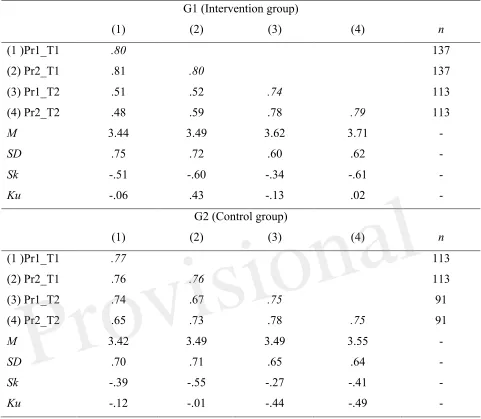
We created two parallel forms of the prosociality scale by following the procedure
420
described in Little, Cunningham, Shahar, and Widaman (2002, p. 166). In Table 1 we reported
421
zero-order correlations, mean, standard deviation, reliability, skewness, and kurtosis for each
422
parallel form. Cronbach’s alphas were good (≥ .74), and correlations were all significant at p <
423
.001.Indices of skewness and kurtosis for each parallel form in both groups did not exceed the
424
value of |.61|, therefore the univariate distribution of all the eight variables (4 variables for 2
425
groups) did not show substantial deviations from normal distribution (Curran, West, & Finch,
426
1996). In order to check multivariate normality assumptions, we computed the Mardia’s
two-427
sided multivariate test of fit for skewness and kurtosis. Given the well known tendency of this
428
coefficient to easily reject H0, we set alpha level at .001 (in this regard, see Mecklin & 429
Mundfrom, 2005; Villasenor Alva & Estrada, 2009). Results of Mardia’s two-sided multivariate
430
test of fit for skewness and kurtosis showed p-value of .010 and .030 respectively. Therefore the
431
study variables showed an acceptable, even if not perfect, multivariate normality. Given the
432
modest deviation from the normality assumption we decided to use Maximum Likelihood as the
433
estimation method.
434
Evaluating the impact of the intervention
435
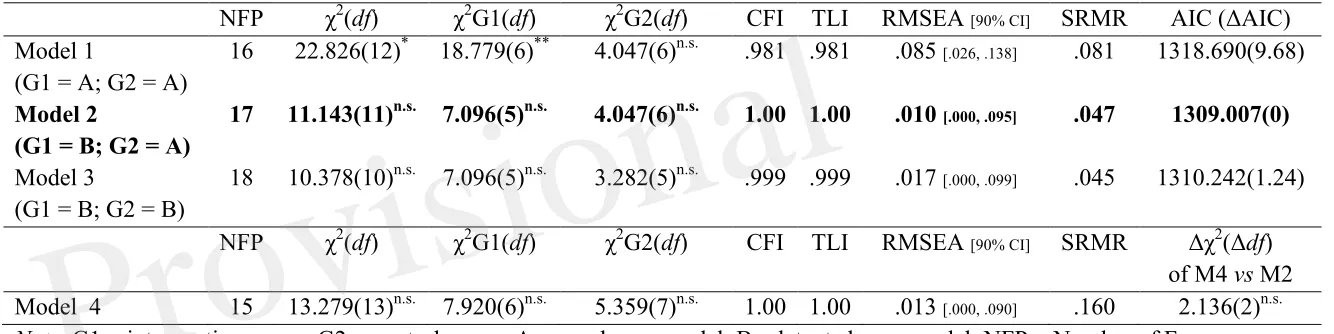
In Table 2 we reported the fit indexes for the three alternative models (see Appendices
436
B1-B4 for annotated Mplus syntaxes for each of these). As hypothesized, Model 2 was the best
437
fitting model. Trajectories of Prosociality for intervention and control group separately are
438
plotted in Figure 3. The contribution of each group to overall chi-squared values highlighted how
439
the lack of the slope factor in the intervention group results in a substantial misfit. On the
440
contrary, adding a slope factor to control group did not significantly change the overall fit of the
441
model [Δχ2(1) = 0.765, p = .381]. Of interest, the intercept mean and variance were equal across
442
groups (see Table 2, Model 4) suggesting the equivalence of G1 and G2 at T1.
443
In Figure 2 we reported all the parameters of the best fitting model, for both groups. The
444
slope factor of intervention group has significant variance (φ2 = .28, p < .001) and a positive and 445
significant mean (κ2 = .19, p < .01). Accordingly, we investigated the presence of the influence 446
of the initial status on the treatment effect by regressing the slope onto the intercept in the
447
intervention group. Note that this latter model has the same fit of Model2; however, by
448
implementing a slope instead of a covariance, allows to control the effect of the individuals’
449
initial status on their subsequent change. The significant effect of the intercept (i.e., β = -.62, p <
450
.001) on the slope (R2 = .38) indicated that participants who were less prosocial at the beginning
451
increased steeper in their prosociality after the intervention.
452
Discussion
453
Data collected in intervention programs are often limited to two points in time, namely
454
before and after the delivery of the treatment (i.e., pretest and posttest). When analyzing
455
intervention programs with two waves of data, researchers so far have mostly relied on
ANOVA-456
family techniques which are flawed by requiring strong statistical assumptions and assuming that
457
participants are affected in the same fashion by the intervention. Although a general, average
458
effect of the program is often plausible and theoretically sounded, neglecting individual
459
variability in responding to the treatment delivered can lead to partial or incorrect conclusions. In
460
this article, we illustrated how latent variable models can help overcome these issues and provide
461
the researcher with a clear model-building strategy to evaluate intervention programs based on a
462
pretest-posttest design. To this aim, we outlined a sequence of four steps to be followed which
463
correspond to substantive research questions (e.g., efficacy of the intervention, normative
464
development, etc.). In particular, Model 1, Model 2, and Model 3 included a different
465
combinations of no-change and latent change models in both the intervention and control group
466
(see Table 2). These first three models are crucial to identify the best fitting trajectory of the
467
targeted behaviour across the two groups. Next, Model 4 was aimed at ascertaining if the
468
intervention and control group were equivalent on their initial status (both in terms of average
469
starting level and inter-individual differences) or if, vice-versa, this similarity assumption should
470
be relaxed.
471
Importantly, even if the intervention and control group differ in their initial level, this
472
should not prevent the researcher to investigate the presence of moderation effects - such as a
473
treatment-initial status interaction - if this is in line with the researcher’s hypotheses. One of the
474
major advantage of the proposed approach, indeed, is the possibility to model the intervention
475
effect as a random latent variable (i.e., the second-order latent slope) characterized by both a
476
mean (i.e., the average change) and a variance (i.e., the degree of variability around the average
477
effect). As already emphasized by Muthén and Curran (1997), a statistically significant variance
478
indicates the presence of systematic individual differences in responding to the intervention
479
program. Accordingly, the latent slope identified in the intervention group can be regressed onto
480
the latent intercept in order to examine if participants with different initial values on the targeted
481
behavior were differently affected by the program. Importantly, the analysis of the interaction
482
effects does not need to be limited to the treatment-initial status interaction but can also include
483
other external variables as moderators (e.g., sex, SES, IQ, behavioral problems, etc.; see Caprara
484
et al., 2014).
485
To complement our formal presentation of the LCM procedure, we provided a real data
486
example by re-analyzing the efficacy of the YPA, a universal intervention program aimed to
487
promote prosociality in youths (Zuffianò et al., 2012). Our four-step analysis indicated that
488
participants in the intervention group showed a small yet significant increase in their prosociality
489
after six months, whereas students in the control group did not show any significant change (see
490
Model 1, Model 2, and Model 3 in Table 2). Furthermore, participants in the intervention and
491
control group did not differ in their initial levels of prosociality (Model 4), thereby ensuring the
492
comparability of the two groups. These results replicated those reported by Zuffianò et al. (2012)
493
and further attested to the effectiveness of the YPA in promoting prosociality among adolescents.
494
Importantly, our results also indicated that there was a significant variability among participants
495
in responding to the YPA program, as indicated by the significant variance of the latent slope.
496
Accordingly, we explored the possibility of a treatment-initial status interaction. The significant
497
prediction of the slope by the intercept indicated that, after six months, those participants
498
showing lower initial levels of prosociality were more responsive to the intervention delivered.
499
On the contrary, participants who were already prosocial at the pretest remained overall stable in
500
their high level of prosociality. Although this effect was not hypothesized a priori, we can
501
speculate that less prosocial participants were more receptive to the content of the program
502
because they appreciated more than their (prosocial) counterparts the discussion about the
503
importance and benefits of prosociality, topics that, very likely, were relatively new for them.
504
However, it is important to remark that the goal of the YPA was to merely sensitize youth to
505
prosocial and empathic values and not to change their actual behaviors. Accordingly, our
506
findings cannot be interpreted as an increase in prosocial conducts among less prosocial
507
participants. Future studies are needed to examine to what extent the introduction of the YPA in
508
more intensive school-based intervention programs (see Caprara et al., 2014) could represent a
509
further strength to promote concrete prosocial behaviors.
510
Limitations and Conclusions
511
Albeit the advantages of the proposed LCM approach, several limitations should be
512
acknowledged. First of all, the use of a second order LCM with two available time points
513
requires that the construct is measured by more than one observed indicators. As such, this
514
technique cannot be used for single-item measures (e.g., Lucas & Donnellan, 2012). Second, as
515
any structural equation model, our SO-MG-LCM makes the strong assumption that the specified
516
model should be true in the population. An assumption that is likely to be violated in empirical
517
studies. Moreover, it requires to be empirically identified, and thus an entire set of constraints
518
that leave aside substantive considerations. Third, in this paper, we restricted our attention to the
519
two parallel indicators case to address the more basic situation that a researcher can encounter in
520
the evaluation of a two time-point intervention. Our aim was indeed to confront researchers with
521
the more restrictive case, in terms of model identification. The case in which only two observed
522
indicators are available is indeed, in our opinion, one of the more intimidating for researchers.
523
Moreover, when a scale is composed of a long set of items or the target construct is a second
524
order-construct loaded by two indicators (e.g., as in the case of psychological resilience; see
525
Alessandri, Vecchione, Caprara, & Letzring, 2012), and the sample size is not optimal (in terms
526
of the ratio estimated parameters / available subjects) it makes sense to conduct measurement
527
invariance test as a preliminary step, “before” testing the intervention effect, and then use the
528
approach described above to be parsimonious and maximize statistical power. In these
529
circumstances, the interest is indeed on estimating the latent change model, and the invariance of
530
indicators likely represent a prerequisite. Measurement invariance issues should never be
531
undervalued by researchers. Instead, they should be routinely evaluated in preliminary research
532
phases, and, when it is possible, incorporated in the measurement model specification phase.
533
Finally, although intervention programs with two time points can still offer useful indications,
534
the use of three (and possibly more) points in time provides the researcher with a stronger
535
evidence to assess the actual efficacy of the program at different follow-up. Hence, the
536
methodology described in this paper should be conceived as a support to take the best of
pretest-537
posttest studies and not as an encouragement to collect only two-wave data. Third, SEM
538
techniques usually require the use of relatively larger samples compared to classic ANOVA
539
analyses. Therefore, our procedure may not be suited for the evaluation of intervention programs
540
based on small samples. Although several rules of thumb have been proposed in the past for
541
conducting SEM (e.g., N > 100), we encourage the use of Monte Carlo simulation studies for
542
accurately planning the minimum sample size before starting the data collection (Bandalos &
543
Leite, 2013; Wolf, Harrington, Clark, & Miller, 2013).
544
Despite these limitations, we believe that our LCM approach could represent a useful and
545
easy-to-use methodology that should be in the toolbox of psychologists and prevention scientists.
546
Several factors, often uncontrollable, can oblige the researcher to collect data from only two
547
points in time. In front of this (less optimal) scenario, all is not lost and researchers should be
548
aware that more accurate and informative analytical techniques than ANOVA are available to
549
assess intervention programs based on a pretest-posttest design.
550
551
References
552
Achenbach, T. M. (in press). Future directions for clinical research, services, and training:
553
Evidence-based assessment across informants, cultures, and dimensional hierarchies.
554
Journal of Clinical Child & Adolescent Psychology. doi:
555
10.1080/15374416.2016.1220315
556
Alessandri, G., Vecchione, M., Caprara, G. V., & Letzring, T. D. (2012). The Ego Resiliency
557
Scale Revised: A Crosscultural study in Italy, Spain, and the United States. European 558
Journal of Psychological Assessment, 28(2), 139-146. doi: 10.1027/1015-5759/a000102
559
Bandalos, D. L., & Leite, W. (2013). Use of Monte Carlo studies in structural equation modeling
560
research. In G. R. Hancock & R. O. Mueller (Eds.), Structural Equation Modeling: A 561
Second Course (2nd ed., pp. 625–666). Charlotte, NC: Information Age Publishing.
562
Bandura, A. (1977). Self-efficacy: Toward a unifying theory of behavioral change.
563
Psychological Review, 84(2), 191-215. doi: 10.1037/0033-295X.84.2.191
564
Bishop, J., Geiser, C., & Cole, D. A. (2015). Modeling latent growth with multiple indicators: A
565
comparison of three approaches. Psychological Methods, 20(1), 43-62. doi:
566
10.1037/met0000018
567
Bollen, K. A. (1989). Structural equations with latent variables. New York: Wiley.
568
Bollen, K. A., & Curran, P. J. (2006). Latent curve models: A structural equation perspective.
569
Hoboken, NJ: Wiley.
570
Brown, T. A. (2015). Confirmatory factor analysis for applied research. New York, NY: The
571
Guilford Press.
572
Burnham, K. P., & Anderson, D. R. (2004). Multimodel inference: Understanding AIC and BIC
573
in model selection. Sociological Methods & Research, 33(2), 261-304. doi:
574
10.1177/0049124104268644
575
Caprara, G. V., Alessandri, G., & Eisenberg, N. (2012). Prosociality: The contribution of traits,
576
values, and self-efficacy beliefs. Journal of Personality and Social Psychology, 102(6),
577
1289-1303. doi: 10.1037/a0025626
578
Caprara, G. V., Luengo Kanacri, B. P., Gerbino, M., Zuffianò, A., Alessandri, G., Vecchio, G.,
579
Pastorelli, C., & Bridgall, B. (2014). Positive effects of promoting prosocial behavior in
580
early adolescents: Evidence from a school-based intervention. International Journal of 581
Behavioral Development, 4, 386-396. doi: 10.1177/0165025414531464.
582
Caprara, G. V., Steca, P., Zelli, A., & Capanna, C. (2005). A new scale for measuring adults’
583
prosocialness. European Journal of Psychological Assessment, 21(2), 77-89. doi:
584
10.1027/1015-5759.21.2.77
585
Cole, D. A., & Preacher, K. J. (2014). Manifest variable path analysis: Potentially serious and
586
misleading consequences due to uncorrected measurement error. Psychological Methods, 587
19(2), 300-315. doi: 10.1037/a0033805
588
Cook, T. D., & Campbell, D. T. (1979). Quasi-experimentation: Design & analysis issues for 589
field settings. Boston, MA: Houghton Mifflin.
590
Cronbach, L. J., & Snow, R. E. (1977). Aptitudes and instructional methods: A handbook for 591
research on interactions. New York, NY: Irvington.
592
Curran, P. J., & Muthén, B. O. (1999). The application of latent curve analysis to testing
593
developmental theories in intervention research. American Journal of Community 594
Psychology, 27(4), 567-595. doi: 10.1023/A:1022137429115
595
Curran, P. J., West, S. G., & Finch, J. F. (1996). The robustness of test statistics to nonnormality
596
and specification error in confirmatory factor analysis. Psychological Methods, 1(1),
16-597
29. doi:10.1037/1082-989X.1.1.16
598
Eisenberg, N., Spinrad, T. L., & Knafo-Noam, A. (2015). Prosocial development. In M. E. Lamb
599
(Vol. Ed.) & R. M. Lerner (Ed.), Handbook of child psychology and developmental 600
science (7th ed., Vol. 3, pp. 610–656). Hoboken, NJ: Wiley. doi:
601
10.1002/9781118963418.childpsy315
602
Enders, C. K. (2010). Applied missing data analysis. New York: Guilford Press.
603
Geiser, C., Keller, B. T., & Lockhart, G. (2013). First-versus second-order latent growth curve
604
models: Some insights from latent state-trait theory. Structural Equation Modeling: A 605
Multidisciplinary Journal, 20(3), 479-503. doi: 10.1080/10705511.2013.797832
606
Greenberg, M. T., Domitrovich, C., & Bumbarger, B. (2001). The prevention of mental disorders
607
in school-aged children: Current state of the field. Prevention & Treatment, 4(1), doi:
608
10.1037/1522-3736.4.1.41a
609
Grissom, R. J., & Kim, J. J. (2012). Effect sizes for research: Univariate and multivariate 610
applications (2nd Ed.). New York, NY: Routledge.
611
Kline, R. B. (2016). Principles and practice of Structural Equation Modeling (4th ed.). New
612
York, NY: The Guilford Press.
613
Little, T. D. (1997). Mean and covariance structures (MACS) analyses of cross-cultural data:
614
Practical and theoretical issues. Multivariate Behavioral Research, 32(1), 53-76. doi:
615
10.1207/s15327906mbr3201_3
616
Little, T. D. (2013). Longitudinal structural equation modeling. New York, NY: The Guilford
617
Press.
618
Little, T. D., Card, N. A., Preacher, K. J., & McConnell, E. (2009). Modeling longitudinal data
619
from research on adolescence. In R. M. Lerner & L. Steinberg (Eds.), Handbook of 620
adolescent psychology (3rd ed., Vol. 2, pp. 15-54). Hoboken, NJ: Wiley.
621
doi:10.1002/9780470479193.adlpsy001003
622
Little, T. D., Cunningham, W. A., Shahar, G., & Widaman, K. F. (2002). To parcel or not to
623
parcel: Exploring the question, weighing the merits. Structural Equation Modeling, 9(2),
624
151-173. doi: 10.1207/S15328007SEM0902_1
625
Lucas, R. E., & Donnellan, M. B. (2012). Estimating the reliability of single-item life satisfaction
626
measures: Results from four national panel studies. Social Indicators Research, 105(3),
627
323–331. doi: 10.1007/s11205-011-9783-z
628
Malti, T., Noam, G. G., Beelmann, A., & Sommer, S. (2016). Good Enough? Interventions for
629
child mental health: From adoption to adaptation—From programs to systems. Journal of 630
Clinical Child & Adolescent Psychology, 45(6), 707-709 . doi:
631
10.1080/15374416.2016.1157759
632
McArdle, J. J. (2009). Latent variable modeling of differences and changes with longitudinal
633
data. Annual Review of Psychology, 60, 577-605. doi:
634
10.1146/annurev.psych.60.110707.163612
635
Mecklin, C. J., & Mundfrom, D. J. (2005). A Monte Carlo comparison of the Type I and Type II
636
error rates of tests of multivariate normality. Journal of Statistical Computation and 637
Simulation, 75(2), 93-107. doi: 10.1080/0094965042000193233
638
Meredith, W., & Teresi, J. A. (2006). An essay on measurement and factorial invariance.
639
Medical Care, 44(11), S69-S77. doi: 10.1097/01.mlr.0000245438.73837.89
640
Meredith, W., & Tisak, J. (1990). Latent curve analysis. Psychometrika, 55(1), 107-122.
641
doi:10.1007/BF02294746
642
Micceri, T. (1989). The unicorn, the normal curve, and other improbable creatures.
643
Psychological Bulletin, 105(1), 156-166. doi: 10.1037/0033-2909.105.1.156
644
Millsap, R. E. (2011). Statistical approaches to measurement invariance. New York, NY:
645
Routledge.
646
Muthén, B. O., & Curran, P. J. (1997). General longitudinal modeling of individual differences
647
in experimental designs: A latent variable framework for analysis and power estimation.
648
Psychological Methods, 2(4), 371-402. doi: 10.1037/1082-989X.2.4.371
649
Muthén, L. K., & Muthén, B. O. (1998-2012). Mplus User’s Guide (Seventh Edition). Los
650
Angeles, CA: Muthén & Muthén.
651
Nimon, K. F. (2012). Statistical assumptions of substantive analyses across the general linear
652
model: A mini-review. Frontiers in Psychology, 3:322, 1-5. doi:
653
10.3389/fpsyg.2012.00322
654
Roberts, M. C., & Ilardi, S. S. (2003). Handbook of research methods in clinical psychology. 655
Oxford, England: Blackwell Publishing.
656
Schmider, E., Ziegler, M., Danay, E., Beyer, L., & Bühner, M. (2010). Is it really robust?
657
Reinvestigating the robustness of ANOVA against violations of the normal distribution
658
assumption. Methodology, 6(4), 147–151. doi: 10.1027/1614-2241/a000016
659
Steyer, R., Eid, M., & Schwenkmezger, P. (1997). Modeling true intraindividual change: True
660
change as a latent variable. Methods of Psychological Research - Online, 2(1), 21-33.
661
Tabachnick, B. G., & Fidell, L. S. (2013). Using multivariate statistics (6th Ed.). New Jersey,
662
NJ: Pearson.
663
Villasenor Alva, J. A., & Estrada, E. G. (2009). A generalization of Shapiro–Wilk's test for
664
multivariate normality. Communications in Statistics - Theory and Methods, 38(11),
665
1870-1883. doi: 10.1080/03610920802474465
666
Wilcox, R. R. (1998). The goals and strategies of robust methods. British Journal of 667
Mathematical and Statistical Psychology, 51(1), 1-39. doi:
10.1111/j.2044-668
8317.1998.tb00659.x
669
Wolf, E. J., Harrington, K. M., Clark, S. L., & Miller, M. W. (2013). Sample size requirements
670
for structural equation models: An evaluation of power, bias, and solution propriety.
671
Educational and Psychological Measurement, 76(6), 913–934. doi:
672
10.1177/0013164413495237
673
Zuffianò, A., Alessandri, G., & Roche-Olivar, R. (2012). Valutazione di un programma di
674
sensibilizzazione prosociale: Young Prosocial Animation [Evaluation of a prosocial
675
sensitization program: The Young Prosocial Animation]. Psicologia dell’Educazione, 2,
676
203-219.
677
Table 1
679
Descriptive Statistics and Zero-Order Correlations for Each Group Separately (N = 250) 680
G1 (Intervention group)
(1) (2) (3) (4) n
(1 )Pr1_T1 .80 137
(2) Pr2_T1 .81 .80 137
(3) Pr1_T2 .51 .52 .74 113
(4) Pr2_T2 .48 .59 .78 .79 113
M 3.44 3.49 3.62 3.71 -
SD .75 .72 .60 .62 -
Sk -.51 -.60 -.34 -.61 -
Ku -.06 .43 -.13 .02 -
G2 (Control group)
(1) (2) (3) (4) n
(1 )Pr1_T1 .77 113
(2) Pr2_T1 .76 .76 113
(3) Pr1_T2 .74 .67 .75 91
(4) Pr2_T2 .65 .73 .78 .75 91
M 3.42 3.49 3.49 3.55 -
SD .70 .71 .65 .64 -
Sk -.39 -.55 -.27 -.41 -
Ku -.12 -.01 -.44 -.49 -
Note. Pr1_T1 = Parallel form 1 of the Prosociality scale at Time 1; Pr2_T1 = Parallel form 2 of
681
the Prosociality scale at Time 1; Pr1_T2 = Parallel form 1 of the Prosociality scale at Time 2;
682
Pr2_T2 = Parallel form 2 of the Prosociality scale at Time 2; M = mean; SD = standard
683
deviation; Sk = skewness; Ku = kurtosis; n = number of subjects for each parallel form in each
684
group.
685
Italicized numbers in diagonal are reliability coefficients (Cronbach’s α).
686
All correlations were significant at p≤ .001.
687 688