I
I
I
I
I
I
MACADAMIA AND AVOCADO SPRAY TECHNOLOGY
WORKSHOPS
Project HG97011
Final Report
Robert Battaglia
Horticulturist (Pesticide Application Technology) Gatton Research Station
Queensland Horticulture Institute Department of Primary Industries GATTON QLD 4343
QUEENSLAND
GOVERNMENT
,._..
_
_
...__
__
,_...,,-. - . . ...'k.~
0,. ~. -::. 4S
. ,,. . .,; . ,_ ..
~I
·• •.-· •· - ·v . i f. : - -." r- ~ •• • ..,~
I
I
I
j
l
1
Macadamia and Avocado Spray Technology
Workshops
Project HG97011
FINAL REPORT
This report includes an overview of some key issues affecting the long term
sustainability of orchard spraying practices for the avocado, macadamia
and other orchard industries.
Robert Battaglia
Horticulturist (Pesticide Application Technology) Gatton Research Station
2
TABLE OF CONTENTS
1. SUMMARY ... 3
Industry Summary ... 3
Technical Summary ... 3
PUBLICATION SCHEDULE ... 5
2. OVERIVIEW OF INDUSTRY ISSUES ... 5
Introduction ... 5
Canopy Management ... 7
Concentrate spraying versus dilute spraying ... 9
Does the sprayer do the job? ... 10
Equipment efficiency and timeliness of application ... 17
Environmental Issues ... 18
Matching spray volumes and pesticide dose to tree canopy size ... 20
3. RECOMMENDATIONS ... 29
REFERENCES ... 31 Appendix 1 ... 3 2
I
I
3
1. SUMMARY
Industry Summary
The workshop series on spray application technology for macadamia and avocado crop protection conducted in this project received overwhelming support from growers, agri-business staff and consultants. This demonstrated there was considerable enthusiasm by growers to receive information relating to technological advances or other techniques that may improve the efficiency and efficacy of their pesticide application systems. The workshops served to create awareness on general techniques that can be applied to make spraying tree crops more efficient. All users of agrochemicals in the farming sector are under close scrutiny by both the public and media. The avocado and macadamia industries are no different. Many avocado and macadamia production districts are in close proximity to highly valued urban developments. The long term viability and profitability of these farming enterprises may be decided by whether or not these farmers can continue to spray. It is therefore imperative that development and extension work in spray application be continued to enable these growers as well as the whole industry to become as efficient as possible.
Without detailed research in the specific tree canopies of these crops for spray coverage using a range of volumes and equipment types, firm recommendations on optimum sprayer configurations for growers are not possible.
Technical Summary
I
l
4
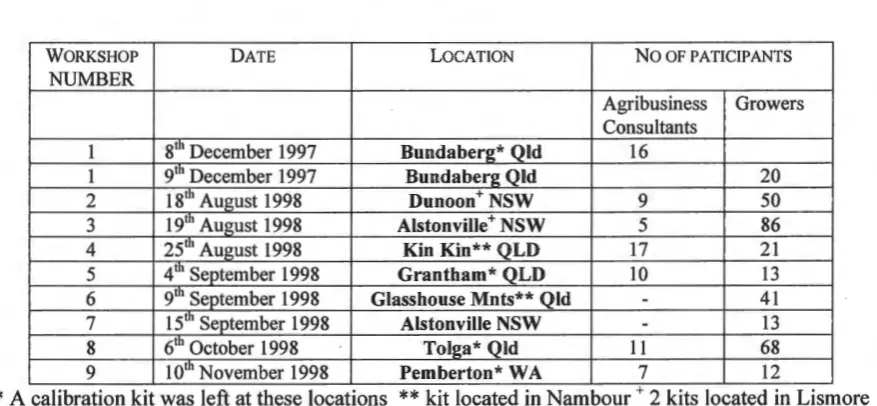
throughout the tree canopy as well as non-target areas. Approximately 400 participants attended the workshops with 75 from the agribusiness sector and industry consultants (Table
1 ).
Table 1. Workshop program summary:
WORKSHOP DATE LOCATION NO OF PATICIPANTS
NUMBER
Agribusiness Growers Consultants
1 gth December 1997 Bundaberg* Qld 16
1 9th December 1997 Bundaberg Qld 20
2 18th August 1998 Dunoon+ NSW 9 50 3 19th August 1998 Alston ville+ NSW 5 86 4 25th August 1998 Kin Kin** QLD 17 21
5 4th September 1998 Grantham* QLD 10 13
6 9th September 1998 Glasshouse Mots** Qld
-
41 7 15th September 1998 Alstonville NSW - 138 6t11
October 1998 Tolga* Qld 11 68
9 lOth November 1998 Pemberton* WA 7 12
*A calibration kit was left at these locations ** kit located in Nambour + 2 kits located in Lismore
I
I
5
The following key issues requiring further research were highlighted by the industry during
these workshops:
• Matching application volumes and chemical doses to tree size. This requires addressing
label shortcomings and requires significant input from experienced researchers, chemical
manufactures and the National Registration Authority.
• Developing strategies for canopy management that complement existing application
equipment and encourage more efficient pesticide application.
• Providing specific information on the performance of specific types of sprayers, including
air-shear technology and other innovations such as under tree conveyors and multi-headed
spray systems.
• Developing best practice strategies that can help reduce spray drift and minimise
environmental contamination.
PUBLICATION SCHEDULE
As the project did not have a research component no technical material was created for
publication. The workshops were featured in articles appearing in the "Queensland Country
Life", "Good Fruit and Vegetables" and the "Queensland Fruit and Vegetable News".
Proposed Publications relating to spray application in tree crops:
"Matching the pesticide dose to tree size: A proposed method for pomefruit"
"Improving spray deposit estimates on leaves by eliminating chlorophyll quenching on
fluoresce readings"
"Alternate row spraying: the possibilities for spraying apples"
"Pesticide residues in apples from dilute and concentrate spraying"
2. OVERIVIEW OF INDUSTRY ISSUES
Introduction
The appropriate use of suitable application equipment is an important component for
I
I
I
I
6
avocado crops. In Australia there are many newly planted macadamia orchards and a large proportion of established · orchards reaching maturity (> 1 0 years) (Battaglia and Harden 1997). The macadamias and avocados canopies are very dense and this makes pest management difficult due to poor spray penetration and uneven pesticide dosing. It is crucial that the application of pesticides to these crops is optimised so growers can improve their returns through improved pest control and importantly minimise off-target losses. Equipment such as low profile ai~blast sprayers are the dominant type of sprayer used by the macadamia industry and in some circumstances these can be modified to improve spray deposition levels in the tree canopy. Growers must however recognise the limitations of their equipment. Research undertaken for the pomefruit industry demonstrated improvements in the spray deposit levels by 20-30% as well as improvements in the uniformity of spray deposit could be achieved by modifying low profile airblast sprayers (Dullahide 1997).
The macadamia and avocado industries use similar types of equipment to apply pesticides to their orchards. Although the pest profiles differ for these industries they share some similar problems in relation to the use of pesticide application equipment and other issues relating to canopy size and tree canopy management.
Issues highlighted by growers across production regions where workshops were conducted included:
• canopy management,
• concentrated versus dilute spraying, • does the sprayer do the job?
• equipment work rate and efficiency of application, • off target movement of pesticides,
• matching spray volume and dose to canopy size.
I
I
I
I
I
I
I
I
I
I
I
I
I
I
7
Canopy Management
Tree size and crowding In mature trees is a significant issue with both industries.
Conventional tree spacings for avocadoes may range from 6-12m between rows and 6-15m
between trees and in macadamias 7-lOm between rows and 4-5m between trees. As trees
within an orchard mature they not only grow taller but the canopy fills the gap between rows
and between the trees to the point of forming a continuous wall of foliage. The depth of
canopy that results due to the wide row spacings is large in comparison to other crops such as
stonefruit and pomefruit. The crowding that occurs can cause yield losses due to poor light
infiltration, hinder tractor and sprayer access, impede spray penetration and affect spray
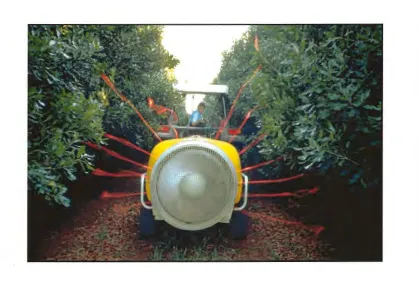
coverage uniformity. Figure 1 shows a tractor and sprayer positioned between two rows in a
mature macadamia orchard where crowding is evident. The practice of hedging where the
sides of trees are trimmed was not undertaken in this block and the access depicted in this
picture makes spraying difficult and also restricts the type of equipment that can be used.
Figure 1. A low profile airblast sprayer shown in a macadamia orchard with no hedging or tree shaping. The ribbons show the most likely path of droplets from the various nozzle
I
I
I
I
f
I
I
I
I
8
Although both industries undertake some form of canopy manipulation there are no universal
methods agreed upon by growers. Macadamia growers either hedge the sides of trees and
remove lower branches, known as skirting, to a height of 1.2 - 2m or do nothing. Hedging
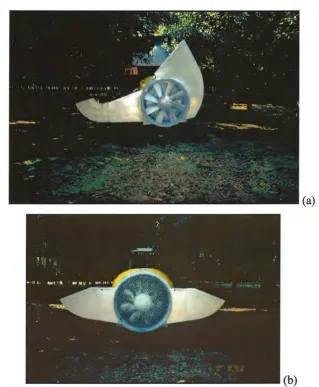
and skirting improves the access of equipment between row and gives access for under tree air
conveyors as shown in Figure 4a and b. Hedging and skirting of lower limbs is also practiced
in avocados. An extreme form of canopy management in avocados is called staghoming,
where trees are cut to a height of about 1.0 to 1.5m above the ground with the stubs of four or
five larger branches left behind. Some macadamia growers are removing and replanting large
trees with a good success rate. In the long term this practice will encourage the remaining
trees to grow larger as the canopy grows to fill the space made available.
With low profile sprayers, tree height is the most significant factor affecting the spray
distribution in the tree canopy. Trees taller than 4m cannot be evenly sprayed with a
conventional low profile airblast sprayer. The spray distribution may also be further affected
by canopy shape. Leaves or branches brushing past spray nozzles can result in significant
areas of the tree remaining unsprayed. Figure 2 shows the dye deposit on macadamia foliage
at 3 heights and at two canopy positions, these being inner and outer. In the top part of the
tree the average deposit was 70 to 90% lower than the bottom and middle positions. In this
trial the same sprayer was used in an orchard that was hedged and wasn't hedged. The deposit
average across all positions was the same in both canopies. Even though there was 21% and
40% more spray recovered in the lower inner position and top outer positions in the hedged
trees these differences were not significant. This was a preliminary trial investigating
numerous variables and the lack of significance was probably due to insufficient replicates
I
: I
I
I
I
!
I
9
1.4
• No hedging
• Hedged
1.2 (?
..c 0,
::::::::-~ 0.8
~
Cl .s
·u;
0 0.6
c. Q)
0
Q)
>-0
0.4 0.2 0
Inner Outer Inner Outer Inner Outer All Combined
1.7- 2.1m 2.9- 3.6m 5.2- 6.2m
Canopy position and sampling height (m)
Figure 2. Deposit distribution using a standard low profile airblast sprayer in a mature macadamia orchard (canopy hedged versus no hedging).
Concentrate spraying versus dilute spraying
A recent survey showed most macadamia growers are using pesticide concentrations of 1 X, 2X, 3X or as high as 8X (Battaglia and Harden 1997). The pesticide concentration used is usually a reflection of the water volume applied per hectare, ie the higher the concentration the lower the water volume applied per hectare. Application of low water volumes from 200-300 L/ha or less than 1 L/tree is attractive in large orchard plantations as there is an increase in the time efficiency. Fewer refills are required to complete a spraying operation and depending on where the filling station is, this can result in substantial time saving.
I
I
I
. I
I
l
I
I
!
I
10
consequently the pesticide dose applied is also increased. By manipulating water volumes the
dilution rate provides a means to adjust chemical rates per hectare or per tree. This does not
help the users of low volume equipment! With most low volume controlled droplet
application (CDA) and air-shear sprayers, the water volumes can not be significantly
increased as they are designed to operate effectively at low flow rates. The concentrate
spraying issue is also a concern in other industries such as pomefruit where growers are also
using conventional airblast sprayers at considerably lower volumes (500 -1000L/ha). Lower
application volumes are favoured for efficiency reasons as well as reducing spray losses
through run-off.
Further discussion on chemical rates appears in the section "matching spray volumes and
pesticide dose to tree canopy size". The issue of concentrate spraying especially for products
that do not specify rates, requires urgent attention as it affects all tree crop industries. It is
currently being addressed by an A vcare working party that will be forwarding a submission to
the National Registration Authority with proposed solutions to the problem.
Does the sprayer do the job?
It is no wonder growers have difficulty in deciding on the type of sprayer to purchase as there
are so many different types available on the market as well as numerous grower inventions or
modifications. Examples of the types of sprayers and modifications currently in use by
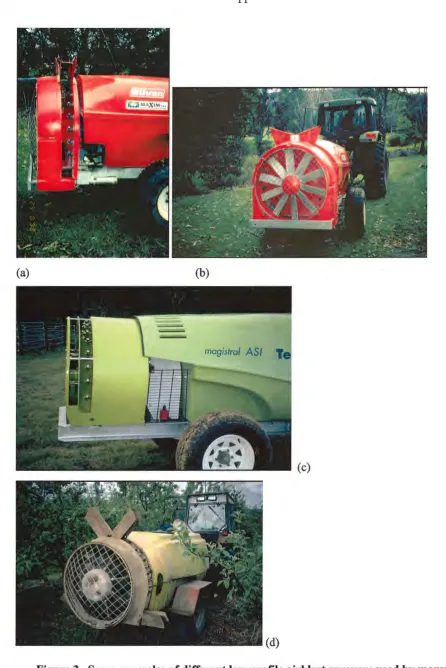
orchard industries are shown in Figures 3-10. These range from conventional low profile
airblast (single fan, Figure 3a-d), low profile sprayers with a single and double sided air
conveyors plus under tree air conveyors (Figure 4a-b ), low profile sprayers with twin fans
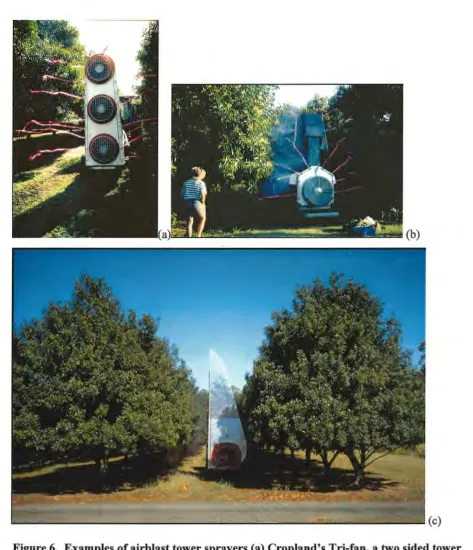
(Figure 5), single and double sided towers with one or more axial fans (Figure 6a-c ), custom
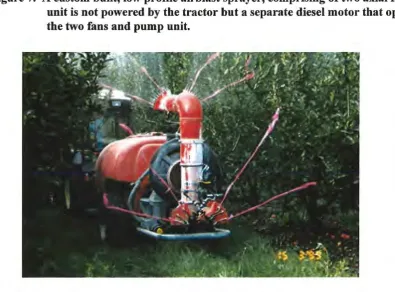
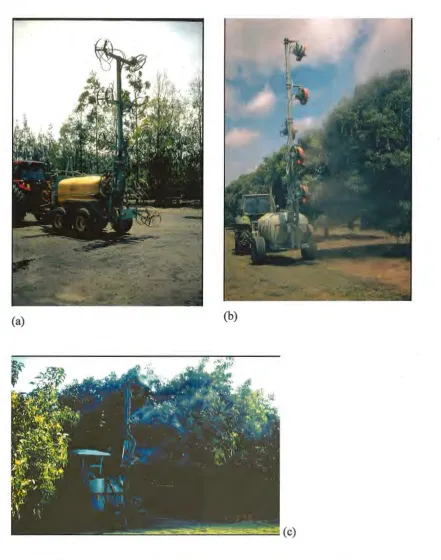
built sprayers (Figure 7), air-shear tower sprayers (Figure 8), multi-head spray towers (Figure
(
I
I
I
I
I
I
[
l
I
l
l
I
1
I
11
(a) (b)
(c)
Figure 3. Some examples of different low profile airblast sprayers used by many orchard industries. Air baffles have been fitted in sprayers a,b and d to manipulate the
!
!
I
I
I
I
f
I
I
!
\
I
I
I
1
I
I
12
(a)
(b)
Figure 4. A modified low profile airblast sprayer fitted with (a) single sided air conveyor and (b) and two sided air conveyor.
{
I
I
f
I
I
I
I
l
1
!
13
(c)
Figure 6. Examples of airblast tower sprayers (a) Cropland's Tri-fan, a two sided tower with 3 fans, (b) Jan-ell's Jen-Tech-Raider 2000, a two sided with two separate fans and
I
I
I
I
l
I
I
I
t
I
~
I
I
l
I
!
I
14
Figure 7. A custom built, low profile airblast sprayer, comprising of two axial fans. The unit is not powered by the tractor but a separate diesel motor that operates the two fans and pump unit.
I
[
l
I
I
I
I
I
I
t
!
, I
I
15
(a) (b)
Figure 9. Examples of multi-head spray systems mounted on single sided or two sided towers (a) A two sided tower with Spanspray heads (b) A single sided tower with
I
(
I
1
I
l
I
I
I
I
f
I
j
I
16
Figure 10. A combination of two sided air blast with two Hydra fan heads mounted on extended arms.
Growers must not only consider the sprayers' ability to achieve good coverage. Access in
their orchard, the power requirements to run the sprayer, the efficiency of the sprayer, the
cost and the after sales service are all important criteria when choosing equipment.
Obtaining good coverage is a serious concern amongst growers and this becomes more of an
issue in mature orchards. Fluorescent dyes and to a lesser extent water sensitive paper are
good visual tools that can be used to assess coverage levels on various parts of the canopy,
fruit, nuts, leaves and flowers as well as off target deposit or run-off to the ground. Figure
11a-b shows the fluorescent spray deposit on macadamia leaves sampled from 2m and 5.5m
from ground level. With most low profile airblast sprayers it is often unavoidable to overdose
certain parts of the canopy to get to other internal parts. Usually the coverage and doses
delivered to the lowest parts of the canopy are excessive as shown by the lower leaves in
Figure 11 a. This results in over dosing and substantial losses to the ground. The droplets are
more distinct in Figure 11 b with very little merging of droplets. The graph in Figure 2
showing the dye deposit in six positions in a macadamia canopy is very typical of the deposit
t
I
l
1
17
(a) (b)
Figure 11. Macadamia leaves sampled from two heights (a) 2m and (b) 5.5m showing fluorescent dye deposits. The leaves in Figure a show excessive deposit whilst Figure b shows adequate deposit with very distinct droplet stains.
Equipment efficiency and timeliness of application
axial-t
I
1
I
1
18
flow fans produces approximately 150,000 m3/hr and the multi-head system in Figure 9a
approximately 10,000 m3/hr per head (100,000 m3/hr for both sides). The canopy volume air
displacement theory does not apply to sprayers that use an air-shear principle to create
droplets. These sprayers produce low volume, high velocity air. The underlying factors that
influence the performance of air-shear technology on target orientated coverage need to be
determined by undertaking further research.
Environmental Issues
Endosulfan, an insecticide registered for use in numerous tree crops has received a barrage of
negative publicity relating to spray drift incidents, residues in beef cattle and its impacts on
riverine systems. Although the events receiving publicity have been largely associated with
the spraying of broad acre crops, the off-target movement of endosulfan and other pesticides
is also a concern for all users in the tree crop industries. The Queensland Fruit and Vegetable
Growers (QFVG) supported by funding from HRDC have developed the Farmcare Code of
Practice for sustainable fruit and vegetable production in Queensland (QFVG 1998). One of
the sections in the code of practice relates to air pollution management. Tree crop industries
need to develop and evaluate strategies in relation to minimising off-target losses of pesticides
that will assist growers in meeting the expectations of the code of practice.
Off-target losses not only result from airborne drift but also losses due to canopy run-off that
may result in soil contamination. Spray drift onto adjacent urban areas or rural properties is
clearly a concern for many growers. Twenty-five percent of growers who responded to an
industry survey in macadamias indicated urban encroachment was a significant issue for their
enterprise (Battaglia and Harden 1997).
Large, mature trees that are allowed to form hedges can provide effective barriers and
minimise spray drift. This is demonstrated by the fact that spray penetration through these
dense canopies is difficult. The following strategies can be promoted to assist with
minimising the levels of off-target movement, however these will require rigorous testing to
determine the most effective methods for reducing both airborne and ground spray losses.
• Selecting not to spray sections of the orchard when the prevailing wind is the
19
• If land is not a limiting factor, planting a vegetative buffer consisting of mixed
foliage types between the property and sensitive area. This is a long-term strategy
as it takes time to establish but should be considered when planning new
orchards.
• Selecting spray volumes per tree or hectare that do not result in significant canopy
run-off losses.
• Using existing rows of trees as an unsprayed buffer ( eg. 1 or 2 rows) on the
boundary adjoining the sensitive area.
• Using air baffles at the top section of the sprayer manifold so that air generated by
the sprayer is directed into the tree canopy and not above it (Figure 12). Air lost
between the row and above the tree entrains droplets resulting in spray losses.
• Using a single sided tower sprayer and only spraying the outer 1 or 2 rows from
one direction, that is away from the sensitive area (Figure 6c ).
Figure 12. An airblast machine spraying apple trees. The sprayer is fitted with top baffles so the air is parted and directed to match the tree height. This attachment
reduces spray loss between rows.
Matching spray volumes and pesticide dose to tree canopy size.
The two most common issues raised by growers in all production areas were: (1) physically
matching the nozzle outputs of the sprayer so that the distribution of pesticide within the tree
I
I
I
l
I
20
If the nozzle outputs on a sprayer or the spray distribution is not matched in the best possible way to evenly dose trees then there is little value in determining or recommending methods that match chemical dose to tree size. In fact this could be risky and result in extreme overdosing in lower parts of the canopy producing fruit residue problems. If changes to pesticide labels result in recommendation of product based on tree size then the types of equipment that should, or should not be used must be specified.
The difficulty in achieving an even spray distribution within a tree canopy relates to the size of the canopy and the type of sprayer used. Figure 13 shows the vertical spray distribution up to 5m from a low profile airblast sprayer. Cotton string was used as a collector to measure the spray profile without canopy interference for a sprayer applying about 1000 Llha. The deposit on the left-hand side of the sprayer is shown by red bars and the right-hand side by green bars. Although not all the spray was caught at the highest point the maximum spray deposit occurred at about 2.75 to 3.5m. Above 3.5m the spray deposit on the string starts to decline. These types of sprayers are used extensively to spray trees that are 7m or taller.
I
1
-
E-
'tJ t: :::s 0 llo. C) Q) > 0 .c ca -J: C) ·a; :I: 4.75 4.25 3.75 3.25 2.75 2.25 1.75 1.25 0.75 0.25300 250 200
21
150 100 50 0 50 100 150 200 250 300
Relative dye deposit on 1 mm string
Figure 13. Distribution of spray caught on 1mm string emitted by a low profile airblast sprayer fitted with air baffles in apples.
7.75 7.25 6.75 6.25
g
5.75'tJ 5.25
t:
:::s 4.75
0
...
C) 4.25
G)
> 3.75
0 .c 3.25 cu
-.c: 2.75 C) ·a; 2.25 :I: 1.75 1.25 0.75 0.25 100 920mm fan Blades 45° pitch Low gear80 60 40 20 0 20 40 60 80 100 Relative dye deposit on 1 mm string
22
The use of appropriate pesticide rates in tree crops is paramount as it has economic, legal,
environmental and occupational implications and yet the issues regarding label
recommendations in tree crops remains unresolved. Growers can not see the logic in having
chemical recommendations listed per hectare when this suggests the same amount of active
ingredient be applied to both small and large trees. The hectare rate would seem more
appropriate if it was applied to a mature orchard with dimensions specified with a reduced
rate in smaller trees. There are also differences in the legislation regarding pesticide rates
between Australian states. In Queensland, growers may legally apply lower rates than the
hectare amount however must not exceed the hectare rate, whereas in NSW growers can not
go below or above the hectare rate. An alternative method for recommending pesticide rates
appearing on pesticide labels is the dilution rate. As discussed previously the dilution rate
gives growers flexibility to manipulate water volumes applied to increase pesticide doses as
the canopy size increases. This however is not an option for users of low volume sprayers as
that type of equipment are specifically designed to operate at much lower flow rates than
conventional hydraulic nozzle technology. There is also confusion amongst growers as to the
appropriate volumes to be applied for a given tree size. Macadamia growers manipulate water
volumes according to tree size. Figure 15 shows that actual water volumes used by a sample
of growers for trees less than and greater than 5m tall. For trees less than 5m tall most
growers are applying between 2-5 L/tree and in trees taller than 5m there are more applying
between 5-8 L/tree (Battaglia and Harden 1997). Manipulating water volumes to increase
pesticide doses in larger trees will be inadequate if sprayers are not configured to evenly spray
large trees. All that will result are excessive spray deposits, pesticide residues and increased
]
23
50 ~----~==========================~----~
I
•
trees less than Sm • trees taller than Sm
I
40
~
~
0 30
(5
Ci>
.c 20
E :::J z
10
0
40
less than 2L 2-5 L 5-8L greater than 8 L
Water volumes applied per tree (Litres)
Figure 15. Water volumes applied by a sample of macadamia growers for tree canopies less than 5m and taller than Sm.
Growers frequently ask what water volume do they need to apply per tree' with their sprayer. The question should be what pesticide dose is required to achieve the desired biological response? Different volumes may be required for specific pests, however with many products providing the application to the tree is even, there is scope to use a range of volumes to deliver the dose required. This however can not be legally done when labels only specify dilution rates.
mean crop width
...
~Volume (m
3/ha)
=
crop
height
24
row distance
crop height (m) x crop width (m) x 10,000
row distance (m)
Figure 16. Formulae for calculating tree row volume. The only measurements required are row distance, tree height and mean canopy width.
When using a fixed rate of product per hectare how much do pesticide deposits vary with tree
size? This is illustrated with some actual data from a range of tree crops. Table 2 shows the
calculated tree row volumes for a range of tree crops in which trials have been conducted
measuring the dye deposit distribution for different application systems. The TRV volumes
range from 13,448 m3/ha for a high density apple orchard to 51,071 m3/ha for some large
25
Table 2. Calculated tree row volumes (TRV) for a range of tree crops.
Crop Canopy Tree Height (m) row distance Canopy Volume mean width (m) (m) (m3/ha)
Apple 2.5 4 5.5 18,205
(open vase)
Apple* 2 2.5 3.5 13,448
(central leader)
Apple* 2.5 4 5.5 15,800
Macadamia* 6 5.5 9.1 36,260
(15 yr) (ex skirt)
Macadamia* 5.5 6.5 7 51,071
Macadamia* 7 6.4 (ex. skirt) 10 44,800 Lychee* 5.7 4 (ex skirt) 9 25,333
*Tree formed a hedge
The water volumes applied to trees in these crops are shown in Table 3. The application
volumes are presented per hectare, per tree and per 1 000m3 of canopy.
Table 3. Tree row volumes and water volumes applied to various tree crops.
Crop TRV Trees/ha L/ha L/Tree L/1000 mj
(m3/ha) Canopy
Apple 18,205 330 25 0.76 14 (open vase)
Apple* 13,448 1905 22 0.12 17 (central
leader)
Apple* 15,800 606 57 0.95 37 (hedge)
Macadamia* 36,260 240 196 8.2 54 (15 yr)
Macadamia* 51,070 408 81 2 16 Macadamia* 44,800 200 167 8.4 37 Lychee* 25,333 222 76 3.4 9
For each row shown in Table 3., a comprehensive trial was conducted using fluorescent tracer
to evaluate the spray deposit in 6 positions in the tree canopy. Three heights were samples
and two canopy positions (inner and outer). The average dye deposit on leaves in nanograms
of dye per square centimetre (ng/cm2
) for each gram of dye applied per hectare versus
calculated TRV are shown in Figure 17. This figure shows a linear relationship between the
amount of dye recovered and the range of tree row volumes shown. As TRV increases there
26
1.6
•
1.4
1-•
•
1.2
--
NE 1
0
--
C)-S
•
-
0.8"(j)
-0
a.
Q)
•
•
0
0.6
Q) r-
>-0
0.4
1-•
0.2
r-0 I I I I j_
0 10 20 30 40 50 60
3
Tree Row Volume (m /ha) X 1 000
Figure 17. Average dye deposit (ng/cm2
) on leaves versus tree row volume (m3/ha). Data
from apple, lychee and macadamia tree crops.
If the objective is to dose the target area evenly, then a regression model that describes the relationship between dose and canopy volume for the data in Figure 17 may be used to determine how much the chemical rate needs to be modified. This assumes the required dose on the target is known.
The regression model describing the scatter of points in Figure 17 is:
Normalised dye deposit in (ng/cm2
) = 1.76-0.000027 x TRY (R-sq =89.1% p = 0.001)
Where TRY= tree row volume in m3/ha
This model can be used to predict normalised dye deposit based on tree row volume. In this case for every increase in 10,000 m3 of canopy there is a reduction in the average deposit by 0.27ng/cm2
• If the average dose on the largest tree size was adequate then the dose that
I
I
I
1
27
concentration so that the same dose is deposited on the target as in the larger trees. Further
work needs to be done to determine whether this relationship holds true when using data from
one crop only. Research is being undertaken in pomefruit to evaluate procedures that match
pesticide dose to tree canopy size.
Procedures have been published in the scientific literature describing methods to calculate
application volumes for different size tree canopies but none have been universally adopted in
Australia. These formulae are based on calculating a tree-row-volume and specify defined
water volume per unit canopy volume (m3). Sutton et al (1984) evaluated a tree-row-model
for full season pesticide application in apples with adjustments made for canopy density. The
model they used specified that 1 L of dilute chemical suspension was sufficient to wet 7 .48m3
of foliage to the point of run-off. The trials conducted by Sutton et al (1984) showed
consistent deposits were maintained on the same size trees within an orchard and over three
pruning methods. Similar deposits of tracer were recovered per square centimetre of foliage
even though the amount of material applied per hectare was reduced by 30-50% in well
pruned trees.
Furness et al (1998) proposed a sprayer calibration method for fruit trees and vines based on
height, width of canopy and row length. They used the concept of canopy retention volumes
for a unit canopy row (UCR), which is defined as (100m3 of foliage), lm high x lm wide by
lOOm of row length. They specify 8L of water per UCR could be considered a standard
volume for crops such as citrus and avocadoes but further research is required to determine
actual canopy retention volumes on a wide range of crops.
Byers et al (1984) investigated copper deposits on apple foliage using an airblast sprayer on
apple trees of increasing size. They found higher deposits as tree size decreased. Copper
deposit was related to tree-row-volume with a quadratic regression equation y
=
552- 9.8 x +0.05 X2 (y = copper deposit and X = tree-row-volume). They calculated tree row volume
assuming trees were a rectangular box (tree height x tree width x area of orchard/row width)
28
The canopies of mature macadamia and avocado trees are large with tree row volumes
approaching 30,000m3/ha or greater. If the water volumes proposed by Sutton et al (1984) or
Furness et al (1998) are calculated for a canopy of this size, then application volumes of2,400
to 4,000L/ha or approximately 12 to 20 L/tree would be required. Such volumes are well
above current industry practice. It may be that these volumes in a dilute spray contain the
correct amount of active ingredient for the size of the tree but if this is the case then most
growers are grossly under-dosing their trees. Further work is required to resolve chemical
rates for different canopy sizes and the efficiency of different sprayers in delivering that dose
29
3. RECOMMENDATIONS
Many of the issues discussed in this report are common to numerous tree crop industries. Although specific research has been undertaken in pomefruit (Dullahide 1997) and Citrus (Cunningham and Harden 1997), spray application research is required for the avocado and macadamia industries to address their own specific problems. The principals of operation for spraying equipment used in orchards are the same irrespective of the crop however each crop and often production areas have their own specific problems that require addressing. There are distinct differences in management practices from farm to farm, making blanket recommendations on equipment set-up and strategies for spraying impossible.
In order to resolve some of the issues relating to pesticide application highlighted in this report and promote sustainable and efficient orchard production systems, the avocado and macadamia industries should consider:
• Undertaking research that provides more specific information to growers on the coverage performance of different types of sprayers used by the avocado and macadamia industry and the equipment configurations that will give these crops the best pest and disease control. This will require investigating the interactions between canopy size and structure, droplet size, air volume and water volume. Improving target coverage does not necessarily guarantee better control therefore coverage will need to be linked with biological efficacy, yield and quality improvements.
• Evaluating and promoting best practice strategies so that growers can reduce the risk of off-target losses (airborne and run-off losses).
• Providing specific data where required to support the A vcare working party submission to NRA on the issue of concentrate spraying for products that only specify a dilute spray rate. This may require collating existing data or generating additional efficacy, occupational exposure and crop residue data.
J
•
Encouraging the use of lower pesticide rates by evaluating methods that can be used toj
l
I
l
30
ACKNOWLEDGMENTS
I wish to thank Mr Peter Hughes (Senior Extension Officer, farming Systems Institute, Dalby) and Nicholas Woods (Director, Centre for Pesticide Application and Safety, Gatton College) for their assistance in presenting segments of the workshop program.
The invaluable support of the following growers and farm managers is gratefully acknowledged for providing access to equipment and facilities for the workshop. Ian Mulligan , Honey and Nut "Kyntyre" Rocky Creek Dam Road, Dunoon NSW. Merv Dudgeon, Harriers, 189 Sneaths Rd, Alstonville NSW
Bonnie and Tony Walker, 62 Shaws Lane, "Neiderweningen" Tuckombil NSW Rod Dalton, Sandy Creek Road, Grantham Orchards, Grantham QLD
Robert, Shirley and David Brown, Coonowrin Road, Glasshouse Mountains QLD Ed and Jim Kochi, Kennedy Highway, Tolga QLD
Wayne and Jenny Francheschi, Avonova Orchards, Pemberton WA Ross and Robyn Litchfield, Como Park, Bates Road, Kin Kin QLD Lachlan Donovan, Dr Mays Crossing Road, Bundaberg QLD
The success of these workshops can also be attributed to the invaluable support provided by the following people.
Adrian V anBoven (Hinkler Park, Bundaberg QLD) Alec McCarthy (Ag W A, Bunbury W A)
Barry Back (Secretary for Sunshine Coast Avocado Growers Association) Ben Whiting (Jen-ell Agrispray, Bundaberg QLD)
Bruce Ensing (Nambour Tractors, QLD) Craig McLain (AgTech, Bundaberg QLD) Dave Elliot (NQAS, Bundaberg QLD) David Steel (lamia, Atherton QLD)
Eddy Mason (Manager North East, Jen-ell Agrispray, Toowoomba QLD) Erin Lynch (Erin Lynch Machinery, Yandina QLD)
Gavin Haig (Gatton Tractors, Gatton QLD)
Graeme Thomas (Grower/Consultant, Keys Road, Hampton QLD) Graham Betts (Croplands, Toowoomba QLD)
John Dirou (NSW Agriculture)
Kim Jones (Industry Development Officer- AMS)
Paul Blasutto (Director, Tornado Pumps and Sprayers Pty Ltd) Paul Haselgrove (Farmcare, Lismore NSW)
Paul O'Hare (DPI Gympie) Peter Mayers (DPI Maroochy)
Phil French (Grower, Pemberton WA) Richard Faulkner (Silvan, Brisbane QLD)
Robert Bianco & Bino Perin (Rural Buying Machinery Centre, Lismore NSW)
Ron and Joan Knowlton (President, Atherton tableland Avocado Growers Association) Sam Camp (Silvan Pumps and Sprayers, Malanda QLD)
Sean Thompson (Micromaster Sprayers, Yandina QLD) Shaun Hood (DPI Maroochy)
Simon Newett (DPI Maroochy)
[
I
l
31
REFERENCES
Battaglia R., and Harden, J. (1997) HRDC project MC615, Efficient and safe pesticide use as part ofl.P.M. strategies for macadamia production.
Byers, R.E., Lyons, Jr, C. G., Yoder, K.S, and Horsburgh, R.L. (1984) Effects of apple tree size and canopy density on spray chemical deposit. Hortscience 19(1 ):93-94.
Cunningham, G.P., and Harden, J. (1997) HRDC project CT122, Improving the application efficiency of pesticides in citrus crops and reducing off-target losses.
Dullahide S. (1997) HRDC project AP402. Pesticide reduction in pomefruit towards 2000. Furness, G.O., Magarey, P.A., Miller, P.H., and Drew, H.J. (1998) Fruit tree and vine sprayer calibration based on canopy size and length of row: unit canopy row method. Crop
Protection. 17(8):639-644.
I
I
-j
1
32
Appendix 1
I
I
j
A
vocado and macadamia growers from through-out sthrough-outh east Queens-land, north Queensland and northern New South Wales have attended a series of field days to learn the latest industry advances in spray technology.Spray Project team leader and Queensland Horticulture Institute horticulturist, Robert Battaglia, said the workshops had been held in key avocado and macadamia growing regions, with a further workshop scheduled for Western Australia later this year.
"The workshops, funded by the avocado and macadamia in-dustries in conjunction with HRDC, are being held to promote efficient spray application in or-chards.
'There are no two orchards the same and this means sprayers need to be set up appropriately and matched to the trees in your orchard," Mr Battaglia said.
"By improving spray deposit, spraying systems can be more ef-ficient. First measure sprayer air volume and match it to the tree canopy size. If you require higher flow rates use more nozzles of the same size instead of larger size nozzles," advised Mr Battaglia.
"A major aim is to help grow-ers ensure when they spray their orchards they do so in the most efficient and practical way, pos-ing least risk to the environment and their own safety."
Each workshop involves a background briefing of the latest spray trial results, a practical ex-ercise with spray equipment to measure water and sprayer air volume outputs and a night
inspection of fluorescent spray deposit patterns on trees.
"When the growers saw the results of the fluorescent sprays on the trees, the message really hit home," said Mr Battaglia.
A special kit containing orchard calibration equipment was sup-plied at each workshop and left for growers to calibrate their sprayers in the field.
Mr Battaglia said growers,
crop consultants, spray equip-ment and chemical resellers will have access to the kits should they want to do their own sprayer cali-bration.
He said sprayers need regular calibration so growers know what their sprayers are doing.
Individual nozzle outputs need to be checked and compared with manufacturers specifications. Nozzle outputs increase as they wear resulting in changes to the overall range of droplet sizes pro-duced. This can result in poorer coverage and pest control, due to -increased leaf or fruit run-off and cause unwanted ground contami-nation.
Top right - Gympie DPI horticulturist Paul O'Hare demonstrates to growers how to check spray air inflow volume readings, while streamers graphically show the spray path out of
the machine.
Bottom right • DPI Spray Technology Project leader
Robert Battaglia (L) discusses features of an electrostatic sprayer with Russ Stephenson, senior principal horticulturist, Maroochy Horticulture
Research Station.
\
"
----Spray technology workshops
MACADAMIA and avocado grow-ers from throughout South East Queensland. North Queensland and Northern NSW are attending a series of field days to learn the latest industry advances in spray tech-nology. Spray Project team leader and Queensland Horticulture Institute horticulturist Robert Battaglia said the most recent workshop was held at Como Park near Gympie. The events are being funded by the macadamia and avocado industries and the Hortic-ultural Research and Development Corporation (HRDC).
"The workshops are being held to promote efficient spray applic-ation in orchards. There are no two orchards the same and this means sprayers need to be set up appropriately and matched to the trees in your orchard. Measuring sprayer air volume and matching this to tree canopy size and using more nozzles of the same size
instead of larger sized nozzles where higher flow rates are required can make spraying systems more efficient by improving spray deposit," Mr Battaglia said.
"A major aim is to help growers ensure when they spray their orchards they do so in the most efficient and practical way. that poses the least risk to the environment and their own safety."
Each workshop involves a background briefing of the latest spray trial results, a practical exercise with spray equipment to measure water and sprayer air volume outputs and a night inspection of fluorescent spray deposit patterns on trees.
A special kit containing orchard calibration equipment is supplied at each workshop and left for growers to calibrate their sprayers in the field. Growers, crop consultants, spray equipment and chemical resellers will have access to the kits
Nozzle outputs increase as they wear, resulting in changes to the overall range of droplet sizes produced. This can result in poorer coverage and pest control due to increased leaf or fruit run-off and cause unwanted ground contamination.
should they want to do their own their sprayers are doing. Individual sprayer calibration, Mr Battaglia nozzle outputs need to be checked said. He said sprayers need regular and compared with manufacturers· calibration so growers know what specifications.
lf99S-, ..
FEATURE
PEST, DISEASE AND
.
:
WEED MANAGEM
_
ENT
:·<~-·~: ~··' ·.~~-·.
Spray technology workshops benefit
macadamia and avocado growers
Macadamia and avocado growers from throughout south east Queensland. North Queensland and Northern NSW are attending a series of field days to learn the latest indus-try advances in spray technology.
Spray Project team leader and Queensland Horticulture Institute horticulturist. Robert Rattaglia. said the most recent workshop was held at Como Park near Gympie. The events are funded by the· macadamia and avocado industries and the Horticultural Research and Development Corporation, (HRDC).
"The workshops are being held to promote efficient spray application in orchards. There are no two orchards the same and this means o;prayers need to he set up appropriately artd matched to the trees in your orchard. ·
Measuring sprayer air volume and
match-ing this to tree canopy size and usmatch-ing more nozzles of the same size instead of larger sized nozzles where higher flow rates are required can make spraying systems more efficient by improving spray deposit."
"A major aim is to help growers ensure when they spray their orchards they do so in the most efficient and practical way, that poses the least risk to the environment and their own safety," Mr Battaglia said.
Each workshop involves a background briefing of the latest spray trial results, a prac-tical exercise with spray equipment to mea-sure water and sprayer air volume outputs and a night inspection of fluorescent spray deposit patterns on trees.
A special kit containing orchard calibra-tion equipment is supplied at each workshop
and left for growers to calibrate their sprayers in the field. Growers, crop consultants, spray equipment and chemical resellers will have access to the kits should they want to do their own sprayer calibration, Mr Battaglia said.
He said sprayers needed regular calibra-tion so growers knew their sprayer capacity. Nozzle outputs need to be checked and com-pared with manufacturer specifications.
Nozzle outputs increase as they wear resulting in changes to the overall range of droplet sizes 'produced. This can result in poorer coverage and pest control, due to increased leaf or fruit run-off and cause unwanted ground contamination.
Contact: Robert Battaglia, Department of Primary Industries
Good Fruit and Vegetables October, 1998 31
:-: ''~ ;.: . ' :.~ .
.·
.
)~\\
Ill
..
II
II
I