Relay Selection for mmWave Communications
Sungoh Kwon
School of Electrical Engineering University of Ulsan Email: [email protected]
Joerg Widmer
Wireless Networking GroupIMDEA Networks Institute Email: [email protected]
Abstract—Due to high propagation loss and directivity, mmWave links are very susceptible to obstacles blocking the direct line-of-sight path for communication. In this case, indirect communication via a relay may help to circumvent the blockage. In this paper, we propose a two-hop relay selection algorithm for mmWave communications. For the relay selection, we analyze the probability that an indirect path is available given that the direct path is blocked trough geometric analysis. We then choose the most promising node among neighbors as relay. The analysis shows that the probability of an indirect path is a function of the obstacle density as well as the location of relay nodes. When the density is low, the correlation between the direct path and an indirect path is dominant, i.e., the angle between the direct path and the path to relay should be large, whereas the blockage probability of an indirect path becomes more dominant as the density increases, i.e., relay links should not be too long. The probability analysis also allows to decide an initial antenna angle for beam-training in mobile mmWave environments. Through numerical studies, we verify our analytical results.
I. INTRODUCTION
Millimeter-wave (mmWave) communication is a highly promising technology for the fifth generation cel-lular networks [1]. A mmWave communication system can support up to multiple gigahertz of bandwidth and can be used for mobile cellular access [2], indoor wire-less communications [3], or outdoor communications [4] such as wireless mesh networks. Several communica-tion standards already support mmWave frequencies, the most prominent being IEEE 802.11ad [5] which provides a very high throughput of up to 7 Gbps for short range communication for local area networks.
Compared to the bands below 6 GHz, mmWave has higher propagation loss, higher penetration loss, and higher directivity [6]. The higher propagation and pene-tration losses result in smaller coverage range. To over-come the range limitation due to propagation loss, large-scale phased antenna arrays or multiple input multiple-output (MIMO) can be used to achieve sufficiently high antenna gains. The higher penetration loss and directivity can lead to frequent link blockage, which degrades network performance.
For reliable connectivity, two approaches were pro-posed when a direct link is blocked. One is to switch from mmWave to a lower frequency band
be-low 6 GHz [5], referred to as a fast session transfer (FST) technique in IEEE 802.11ad. With FST, an IEEE 802.11 capable device seamlessly change its operational band from 60 GHz to 2.4/5 GHz. The other solution is to use multi-hop communications by relaying data [3]. Since using a lower frequency band significantly reduces the available bandwidth and thus the capacity, in this paper we consider multi-hop communication with directional antennas instead of FST to overcome link blockage.
In previous work, relay selection algorithms for two-hop or multi-two-hop settings have been extensively stud-ied [7], [8]. The algorithms enhance the performance such as capacity and connectivity without considering blockage. Lower frequency communications typically do not consider blockage, but mmWave is significantly affected by blockage. In [9], a relay selection algo-rithm is proposed to minimize the outage probability of mmWave links. However, the authors do not study random obstacles, which is the focus of this paper.
In case blockage is detected, a node steers its antenna beam towards a suitable relay to establish an alternative link to route around the obstacle. In selecting a relay, a node should consider not only the blockage probability of the alternative path, but also the relation between the direct and the relay path. In case direct and the relay path are close to each other, a single obstacle may block both paths at the same time, rendering the alternative link useless. Hence, a relay path should be as different from the direct link as possible. At the same time, the larger the angle between those two paths, the longer the length of the relay path, which makes it more vulnerable to blockage by an independent (second) obstacle.
In this paper, we analyze the impact of relay lo-cation on link connectivity under random blockage, using geometric probability as in [10], [11]. We also propose a relay selection algorithm when a direct path is unavailable. To this end, we model network entities as geometric elements, and apply geometric probability to analyze link blockage. Moreover, considering the link blockage probability, we provide a sequence of antenna sectors to probe to find the best relay.
Access point Mobile node Obstacle
3
4
5
1
Unblocked link Blocked link
2
M
R
P
Fig. 1. System model
paths. In Section IV, we present numerical studies and draw conclusions in Section V.
II. SYSTEMMODEL ANDPROBLEM TOSOLVE
We consider a mmWAVE network consisting of one access point (AP), 𝑁 mobile nodes, and obstacles, as shown in Fig. 1. All devices have beam-forming antennas. The set of the nodes is denoted as 𝒩 = {1,2,3,⋅ ⋅ ⋅, 𝑁}. Each mobile node 𝑀 ∈ 𝒩 has a list of its neighboring nodes, which is denoted as𝒩𝑀 ⊂ 𝒩. A communication link between two nodes is an ordered pair (𝑠, 𝑑), where nodes𝑠and𝑑are the source and the destination, respectively. We assume that each mobile node can measure distances from the node to the AP and neighboring nodes, and angles of neighboring nodes with respect to the AP (for example using [12]).
As long as a direct path between the AP and a node exists, the nodes communicate via that direct path. If the direct path is blocked by an obstacle, the node indirectly communicates with the AP via a neighboring node, referred to as a relay. While multi-hop wireless commu-nications improve network throughput [3], the increasing the number of hops reduces the nodal throughput [13] in the order of 𝑁1, where𝑁is the number of nodes. To limit overhead and delay, we thus consider only alternative paths with a single relay, i.e., composed of only two hops as in [14][15][16].
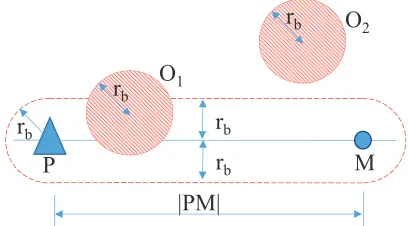
Obstacles are modelled as disks with radius 𝑟𝑏 [15], [17], and are assumed to be independently and randomly located in the AP’s coverage area. The distribution of the centers of obstacles follows a homogeneous Poisson distribution with density𝜆 in a two-dimensional space, which is expressed as
Pr{𝑘 obstacles are in area𝐴} = (𝜆𝐴)𝑘𝑒−𝜆𝐴
𝑘! . (1) Due to the Poisson distribution property [18], the number of obstacles occurring in disjoint (non-overlapped) areas are independent.
|PM|
r
br
br
br
br
bO
1O
2M
P
Fig. 2. Blockage probability of a single link: Obstacle𝑂1blocks link
(𝑀, 𝑃), but obstacle𝑂2 does not.
The obstacles randomly block communication links, so that a link from a mobile node 𝑀 to the AP (𝑃) can be disconnected when the sender transmits data. For notational simplicity, we denote by (𝑀, 𝑃) the event that the link between nodes 𝑀 and 𝑃 is unblocked and by (𝑀, 𝑃) the complementary event that the link between nodes 𝑀 and 𝑃 is blocked by an obstacle. Similarly, the event that a path from node𝑀 to node𝑃 via relay node𝑅is unblocked is denoted as(𝑀, 𝑅, 𝑃), and(𝑀, 𝑅, 𝑃)is the complement event of (𝑀, 𝑅, 𝑃).
In the case when a direct link from a mobile node is blocked, the node finds the best relaying node𝑅∗among neighboring nodes to indirectly deliver data to the AP via the neighboring node, which can be expressed as
𝑅∗= argmax
𝑅∈𝒩𝑀
Pr{(𝑀, 𝑅, 𝑃)∣(𝑀, 𝑃)}. (2)
Hence, we analyze the probability that an indirect path from a sender to the AP via a relaying node is available, under the condition that the direct path is disconnected by one or more obstacles.
III. ANALYSIS OFBLOCKAGEPROBABILITY
We first derive blockage probabilities of a direct path, a relaying path, and then the conditional probability that a relaying path is operational when a direct path is blocked. This analysis allows to determine the most suitable relay, i.e., the one that has the highest probability of being usable when it is needed.
A. Direct path
|PM|
MM
R
P
R
PA
MMA
PMA
PPA
PRA
MRA
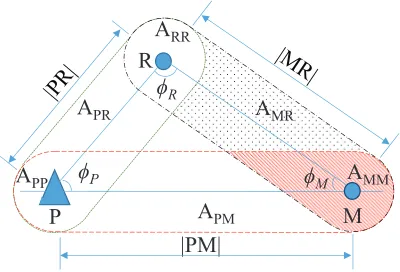
RRFig. 3. Blockage probabilities of a direct and an indirect path
The probability that the direct path from node 𝑀 to node 𝑃 is unblocked is the probability that there is no obstacle in area 𝐴. From (1), the probability that the direct path is available can be expressed as
Pr{(𝑀, 𝑃)}= Pr{𝐴}
=𝑒−𝜆𝐴, (3)
where the blockage area A is expressed as
𝐴= 2𝑟𝑏∣𝑃 𝑀∣+𝜋𝑟𝑏2.
The probability that the direct path is blocked is
Pr{(𝑀, 𝑃)}= Pr{𝐴} = 1−Pr{𝐴}
= 1−𝑒−𝜆𝐴. (4)
B. Direct path and alternative path
In this subsection, we consider two paths: a direct path and an indirect path, as in Fig. 3. The direct path is a single link (𝑀, 𝑃) from mobile node 𝑀 to the access point 𝑃, as in the previous subsection. The indirect path originating from node 𝑀 is a two hop communication via a neighboring node 𝑅, which is composed of two links (𝑀, 𝑅) and(𝑅, 𝑃). The direct and indirect paths from a mobile node to the AP compose a triangle△𝑀𝑅𝑃, as shown in Fig. 3.
The blockage area can be divided into six disjoint areas (𝐴𝑀𝑀,𝐴𝑀𝑅,𝐴𝑅𝑅,𝐴𝑅𝑃,𝐴𝑃 𝑃, and𝐴𝑃 𝑀). For example , if the center of an obstacle is in area 𝐴𝑀𝑀 (a diagonal pattern area in Fig. 3), the links(𝑀, 𝑅)and (𝑀, 𝑃) are simultaneously disconnected. If the center of an obstacle is in area𝐴𝑀𝑅(a dotted pattern area in Fig. 3), only one link(𝑀, 𝑅)is disconnected.
The six areas can be computed based on the data measured at node 𝑀, two distances ∣𝑃 𝑀∣ and ∣𝑀𝑅∣,
and the included angle 𝜙𝑀, as follows:
𝐴𝑀𝑀 =𝑟𝑏2 (
cot
(
𝜙𝑀
2
)
+𝜙𝑀 2 +
𝜋
2
)
,
𝐴𝑅𝑅=𝑟𝑏2 (
cot
(
𝜙𝑅
2
)
+𝜙2𝑅 +𝜋2
)
,
𝐴𝑃 𝑃 =𝑟𝑏2 (
cot
(
𝜙𝑃
2
)
+𝜙2𝑃 +𝜋2
)
,
𝐴𝑃 𝑀 = 2𝑟𝑏∣𝑃 𝑀∣+𝜋𝑟2𝑏−𝐴𝑀𝑀−𝐴𝑃 𝑃,
𝐴𝑀𝑅= 2𝑟𝑏∣𝑀𝑅∣+𝜋𝑟2𝑏−𝐴𝑀𝑀 −𝐴𝑅𝑅,
𝐴𝑅𝑃 = 2𝑟𝑏∣𝑃 𝑅∣+𝜋𝑟𝑏2−𝐴𝑅𝑅−𝐴𝑃 𝑃.
Similarly to the probability that a direct path is avail-able in (3), we can find the probabilities that both of direct and indirect paths are available, and that only an indirect path is available. For notational simplicity, we denote 𝐴𝑃 𝑀 as 𝐴1, (𝐴𝑀𝑀 +𝐴𝑃 𝑃) as 𝐴12, and (𝐴𝑀𝑅+𝐴𝑅𝑅+𝐴𝑅𝑃)as 𝐴2. When no obstacle exists
in areas𝐴1,𝐴12, and𝐴2, two paths are simultaneously operational. Hence, the probability that the two paths are available is expressed as
Pr{(𝑀, 𝑃)⋅(𝑀, 𝑅, 𝑃)} = Pr{(𝐴1⋅𝐴12)⋅(𝐴12⋅𝐴2)}
= Pr{𝐴1⋅𝐴12⋅𝐴2} (5)
= Pr{𝐴1}Pr{𝐴12}Pr{𝐴2} (6) =𝑒−𝜆𝐴1𝑒−𝜆𝐴12𝑒−𝜆𝐴2 (7)
=𝑒−𝜆(𝐴1+𝐴12+𝐴2). (8)
In (5), areas 𝐴1, 𝐴12 and 𝐴2 are non-overlapping. As mentioned in Sect. II, due to the Poisson distribution property, events in areas𝐴1,𝐴12, and𝐴2 are homoge-neous and independent. Hence, (5) becomes a product of three individual probabilities shown in (6), and it follows from (3) that we have (7) and (8).
The direct path is blocked when obstacles are located in area 𝐴1 or area 𝐴12, but the indirect path is op-erational when there is no obstacle in areas 𝐴12, and
𝐴2. Hence, the probability that only the indirect path is unblocked among the two paths is expressed as
Pr{(𝑀, 𝑅, 𝑃)⋅(𝑀, 𝑃)} = Pr{(𝐴2⋅𝐴12)⋅(𝐴1⋅𝐴12)}
= Pr{(𝐴2⋅𝐴12)⋅(𝐴1+𝐴12)}
= Pr{(𝐴2⋅𝐴12)⋅𝐴1} (9)
= Pr{𝐴2⋅𝐴12}Pr{𝐴1} (10)
=𝑒−𝜆(𝐴2+𝐴12)(1−𝑒−𝜆𝐴1). (11)
C. Best indirect path when a direct path is unavailable
Our problem is to find the best indirect path when a direct path is blocked. In other words, the problem is to select a neighbor node𝑅∈ 𝒩𝑀 as a relay such that the indirect path via the neighboring node has the lowest blockage probability conditioned on the direct path from a mobile node 𝑀 ∈ 𝒩 to the AP being blocked. The conditional probability is given by
Pr{(𝑀, 𝑅, 𝑃)∣(𝑀, 𝑃)}= Pr{(𝑀, 𝑅, 𝑃)⋅(𝑀, 𝑃)} Pr{(𝑀, 𝑃)} = Pr{(𝐴2⋅𝐴12)⋅𝐴1}
Pr{𝐴12⋅𝐴1}
= Pr{(1−𝐴2Pr{(⋅𝐴12𝐴)}Pr{𝐴12}
12⋅𝐴1)}
= 𝑒−𝜆(𝐴2+𝐴12)
(
1−𝑒−𝜆𝐴1) (
1−𝑒−𝜆(𝐴12+𝐴1)) .
(12)
Hence, our problem of (2) to find a best relay is to find a neighboring node that maximizes (12).
D. Impact of obstacle density on relay selection
In this subsection, we study the impact of the obstacle density on the probability of indirect path availability and the relay selection algorithm in the asymptotic regime under the condition that a direct path is blocked. The probability that a direct path is unblocked is a exponentially decreasing function of the density (𝜆), as shown in (3).
When the density of obstacles is large enough,(1−
𝑒−𝜆𝐴)becomes close to one. Hence, (12) can be
approx-imately expressed as
𝑒−𝜆(𝐴2+𝐴12)(1−𝑒−𝜆𝐴1)
(
1−𝑒−𝜆(𝐴12+𝐴1)) ≃𝑒−𝜆(𝐴2+𝐴12). (13)
When the density of obstacles is very low, by Taylor series expansion we have1−𝑒−𝜆𝐴 ≃𝜆𝐴. Hence, (12) approximately becomes
𝑒−𝜆(𝐴2+𝐴12)(1−𝑒−𝜆𝐴1)
(
1−𝑒−𝜆(𝐴12+𝐴1)) ≃
(
𝐴1
𝐴12+𝐴1 )
𝑒−𝜆(𝐴2+𝐴12).
(14)
From (13) and (14), the conditional probability that an indirect path is unblocked decreases exponentially as the density of obstacles increases. When the density is very large, the conditional probability is dominated by the area (𝐴2+𝐴12) that blocks the indirect path, while for low densities the conditional probability is a function of the area that blocks the indirect path as well as the ratio (𝐴12+𝐴1𝐴1 ) of the area that blocks only the direct path toallthe area that blocks the direct path. Moreover, as the density of obstacles decreases, the conditional
probability approaches
( 𝐴1 𝐴12+𝐴1
)
in the regime of a small obstacle density, i.e.,
lim
𝜆→0Pr{(𝑀, 𝑅, 𝑃)∣(𝑀, 𝑃)}=
𝐴1
𝐴12+𝐴1.
The exponential function in (13) decreases monoton-ically as the blockage area (𝐴2+𝐴12) of the indirect path increases. The blockage area (𝐴12+𝐴1) of a direct links is fixed in (14). Hence, according to the obstacle density, the relay selection algorithm is expressed as
𝑅∗= argmax
𝑅∈𝒩𝑀
{
−(𝐴2+𝐴12) when𝜆is large
𝐴1𝑒−𝜆(𝐴2+𝐴12) when𝜆is small.
IV. NUMERICALSTUDY
In this section, we numerically study these tradeoffs. For the numerical study, the AP (𝑃) and a mobile node (𝑀) of Fig. 1 are located at the origin and(10,0) on𝑥-axis, respectively, i.e., the communication distance is 10 m. We set the radius of the obstacles to 0.5 m, similar to the size of a person. Obstacles are randomly located over the AP coverage area following a Poisson distribution.
First, to study the impact of the obstacle density 𝜆 on the conditional probability of an indirect path, we set ∣𝑀𝑅∣ to 5 m, and 𝜙𝑀 to 60∘ (degrees), and vary the density from 0.0003 to 0.01 m−2. We consider three versions of the conditional probability computa-tion: one exact expression and two approximations. The exact expression marked with ‘Exact’ is from (12). One approximation marked with ‘ApproxH’ is computed by (13), which is the case when the density of obstacles is high. The other approximation marked with ‘ApproxL’ is computed by (14), which is the case when the density of obstacles is low. Fig. 4 plots the conditional prob-ability with logarithmic scale for 𝑥− and 𝑦−axes. As discussed in Sect. III-D, the conditional probability is an exponentially decreasing function of the density 𝜆and approaching
( 𝐴1 𝐴12+𝐴1
)
as the density goes to zero. As the density of obstacles increases, the exact conditional probability asymptotically becomes (13) while becoming (14) in the low regime of the obstacle density.
10−4
10−3
10−2
10−1
10−1
100
λ
Conditional probability
Exact ApproxL ApproxH
Fig. 4. The conditional probability that an indirect link is available a direct link is failed when the relay is located at(5 m,60∘).
of obstacles. The figure also shows that there exists an optimal location of a relay node among the neighboring nodes and a mobile node should try to deliver data via the neighboring node which has the highest probability to provide connectivity.
For a given density and a location of node 𝑀, the longer the distance∣𝑀𝑅∣and the greater the angle𝜙𝑀, the smaller is the blockage area 𝐴12 in (14), which blocks a direct and an indirect paths together (𝐴𝑀𝑀and
𝐴𝑃 𝑃 in Fig. 3). A smaller blockage area 𝐴12 means
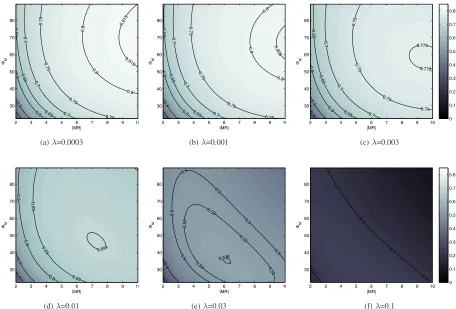
that the two paths are less correlated. Hence, in the regime of the low obstacle density, when distance∣𝑀𝑅∣ and angle 𝜙𝑀 increase together up to certain values, the probability that an indirect path is available under the condition that a direct path is blocked increases, as shown in Fig. 5. As the angle and the distance of a relay increase beyond the optimal values, the probability of an indirect path, 𝑒−𝜆(𝐴12+𝐴2), is dominant, and the condi-tional probability of relay availability in (14) becomes smaller. As the density𝜆increases, the dominance of the probability of an indirect path makes the optimal angle and distance smaller. The probability that an indirect path is available when a direct path is blocked becomes smaller as well. For example, for𝜆= 0.003the optimal location (∣𝑀𝑅∣, 𝜙𝑀) of a relay is (9.5 m,58.0∘) and the maximum probability of relay availability is 77.6%, as shown in Fig. 5c. For 𝜆= 0.03the optimal location becomes(6.1 m,35.7∘)and the maximum probability is reduced to 53.8%, as shown in Fig. 5e. At a high obstacle density, even an optimum relay becomes meaningless due to too low probability that it is available, as shown in Fig. 5f.
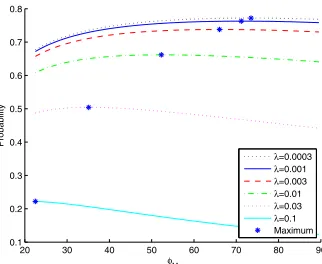
Fig. 6 shows the average probability that a candidate route is operational according to the angle 𝜙𝑀 when locations of neighboring nodes are randomly distributed with a Poisson distribution. The figure shows that the expected available probability of a candidate route is the highest around the angle of 50∘when the density is 0.01 while being the highest around 70∘ when the density is
20 30 40 50 60 70 80 90 0.1
0.2 0.3 0.4 0.5 0.6 0.7 0.8
φM
Probability
λ=0.0003 λ=0.001 λ=0.003 λ=0.01 λ=0.03 λ=0.1 Maximum
Fig. 6. The average probability that an indirect path is available
according to the angle𝜙𝑀.
0.001, i.e., given an approximate node density, a node can determine the best direction to probe for a relay.
Conventional 802.11ad would initiate exhaustive beam training whenever the primary link breaks, which re-quires time and consumes energy. Based on the previous analysis, it is possible to probe antenna sectors in a more efficient way. The probability of relay availability at each angle is obtained based on the estimated obstacle density and the distance from the AP, as in Fig. 6. Then, the node can set the initial direction for beam-training to the angle whose probability is highest, and steer an antenna beam in decreasing order of probability to find a best candidate relay.
V. CONCLUSION
We proposed a relay selection algorithm for mmWave communications when a direct path is not available. Unlike the bands below 6 GHz, mmWave links are vulnerable to blockage due to high propagation loss and directivity. To select a reliable relay, we analyzed the relay blockage probability using geometric analysis. The analysis showed that the correlation between the direct link and a candidate relay link plays an important role in selecting a good relay when the blockage density is low. In contrast, in the case of a high blockage density, the blockage probability of an indirect path has a higher impact on the relay selection. We also proposed to set the initial antenna beamforming direction to probe for a relay based on the link blockage probability.
ACKNOWLEDGMENT
0.5 0.6 0.6 0 65 0.65 0.65 0.7 0.7 0.7 0.75 0.75 0.75 0.75 0.8 0.8 0.8 0.8 15 0.815 |MR| ΦM
2 3 4 5 6 7 8 9 10 30 40 50 60 70 80 0 0.1 0.2 0.3 0.4 0.5 0.6 0.7 0.8
(a)𝜆=0.0003
0.5 0.6 0.6 0 65 0.65 0.65 0.7 0.7 0.7 0 .7 5 0.75 0.75 0.75 0.8 0.8 0.8 0.806 |MR| ΦM
2 3 4 5 6 7 8 9 10 30 40 50 60 70 80 0 0.1 0.2 0.3 0.4 0.5 0.6 0.7 0.8
(b)𝜆=0.001
0.4 0.5 0.6 0.6 0.65 0.65 0.65 0.7 0.7 0.7 0.75 0.75 0.75 0.75 0.775 0.775 |MR| ΦM
2 3 4 5 6 7 8 9 10 30 40 50 60 70 80 0 0.1 0.2 0.3 0.4 0.5 0.6 0.7 0.8
(c)𝜆=0.003
0.4 0.5 0.6 0.6 0.6 0.65 0.65 0.65 0.694 |MR| ΦM
2 3 4 5 6 7 8 9 10 30 40 50 60 70 80 0 0.1 0.2 0.3 0.4 0.5 0.6 0.7 0.8
(d)𝜆=0.01
0.4 0.5 0.5 0.5 0.5 0.5 0.5 0.52 0 .5 2 0.52 0.52 0.52 0.538 |MR| ΦM
2 3 4 5 6 7 8 9 10 30 40 50 60 70 80 0 0.1 0.2 0.3 0.4 0.5 0.6 0.7 0.8
(e)𝜆=0.03
0.2 0.2 0.2 0.2 0.2 |MR| ΦM
2 3 4 5 6 7 8 9 10 30 40 50 60 70 80 0 0.1 0.2 0.3 0.4 0.5 0.6 0.7 0.8
(f)𝜆=0.1 Fig. 5. The probability that an indirect link is available when the direct link is failed.
Regional Government through the TIGRE5-CM program (S2013/ICE-2919).
REFERENCES
[1] IMT Vision-Framework and overall objectives of the future devel-opment of IMT for 2020 and beyond, ITU-R Recommendation, Rev. M.2083-0, 2015.
[2] T. Rappaport, S. Sun, R. Mayzus, H. Zhao, Y. Azar, K. Wang, G. Wong, J. Schulz, M. Samimi, and F. Gutierrez, “Millimeter wave mobile communications for 5g cellular: It will work!”IEEE Access, pp. 335–349, 2013.
[3] J. Qiao, L. X. Cai, X. Shen, and J. W. Mark, “Enabling multi-hop concurrent transmissions in 60 ghz wireless personal area networks,”IEEE Trans. Wireless Commun., vol. 10, no. 11, pp. 3824–3833, 2011.
[4] S. Hur, T. Kim, D. J. Love, J. V. Krogmeier, T. A. Thomas, and A. Ghosh, “Millimeter wave beamforming for wireless backhaul
and access in small cell networks,” IEEE Trans. Commun.,
vol. 61, no. 10, pp. 4391–4403, 2013.
[5] IEEE 802.11ad, Amendment 3: Enhancements for Very High Throughput in the 60 GHz Bandnd, IEEE 802.11 Working Group Std., 2012.
[6] Z. Pi and F. Khan, “An introduction to millimeter-wave mobile
broadband systems,” IEEE Commun. Mag., vol. 49, no. 6, pp.
101–107, 2011.
[7] G. Kramer, M. Gastpar, and P. Gupta, “Cooperative strategies and capacity theorems for relay networks,”IEEE Trans. Inf. Theory, vol. 51, no. 9, pp. 3037–3063, 2005.
[8] L. Sanguinetti, A. A. D’Amico, and Y. Rong, “A tutorial on the
optimization of amplify-and-forward mimo relay systems,”IEEE
J. Sel. Areas Commun., vol. 30, no. 8, pp. 1331–1346, 2012.
[9] Z. Liu, X. Tao, W. U. Rehman, Z. Xu, and X. Xu, “Opportunistic relay selection and outage performance analysis for 60ghz
wire-less system,” inIEEE Globecom Workshop-Broadband Wireless
Access, Atlanta, GA, Dec. 2013.
[10] T. Bai, R. Vaze, , and R. W. Heath, “Analysis of blockage effects
on urban cellular networks,” IEEE Trans. Wireless Commun.,
vol. 13, no. 9, pp. 5070–5083, 2014.
[11] S. Kwon and N. B. Shroff, “Analysis of shortest path routing for large multi-hop wireless networks,”IEEE/ACM Trans. Netw., vol. 17, no. 3, pp. 857–869, 2009.
[12] J. Palacios, D. D. Donno, D. Giustiniano, and J. Widmer, “Speeding up mmwave beam training through low-complexity hybrid transceivers,” inIEEE PIMRC, Valencia, Spain, 2016. [13] J. Jun and M. L. Sichitiu, “The nominal capacity of wireless
mesh networks,”IEEE Wireless Commun. Mag., vol. 10, no. 5,
pp. 8–14, 2003.
[14] V. K. Sakarellos, D. Skarparlis, A. D. Panagopoulos, and J. D. Kanellopoulos, “Optimum placement of radio relays in
millimeter-wave wireless dual-hop networks,” IEEE Antennas
Propag. Mag., vol. 51, no. 2, pp. 190–199, 2009.
[15] G. Zheng, C. Hua, R. Zheng, and Q. Wang, “A robust relay placement framework for 60ghz mmwave wireless personal area
networks,” inIEEE Globecom, Atlanta, GA, Dec. 2013.
[16] Z. He and S. Mao, “A decomposition principle for link and relay
selection in dual-hop 60 ghz networks,” inIEEE INFOCOM, San
Francisco, CA, Apr. 2016.
[17] K. Song, R. Cai, and D. Liu, “A fast relay selection algorithm
over 60ghz mm-wave systems,” in IEEE ICCT, Guilin, China,
Nov. 2013.
[18] F. Baccelli and B. Blaszczyszyn,Stochastic Geometry and Wire-less Networks. Hanover, MA: Now, 2009, vol. I: Theory. [19] A. Papoulis and S. U. Pillai,Probability, Random Variable and