Multiple Access Techniques for Next Generation
Wireless: Recent Advances and Future Perspectives
Shree Krishna Sharma
1,∗, Mohammad Patwary
2, Symeon Chatzinotas
11SnT - securityandtrust.lu, University of Luxembourg, Luxembourg 2FCES, Staffordshire University, United Kingdom
Abstract
The advances in multiple access techniques has been one of the key drivers in moving from one cellular generation to another. Starting from the first generation, several multiple access techniques have been explored in different generations and various emerging multiplexing/multiple access techniques are being investigated for the next generation of cellular networks. In this context, this paper first provides a detailed review on the existing Space Division Multiple Access (SDMA) related works. Subsequently, it highlights the main features and the drawbacks of various existing and emerging multiplexing/multiple access techniques. Finally, we propose a novel concept of clustered orthogonal signature division multiple access for the next generation of cellular networks. The proposed concept envisions to employ joint antenna coding in order to enhance the orthogonality of SDMA beams with the objective of enhancing the spectral efficiency of future cellular networks.
Keywords: 5G, Multiple Access, Multiplexing, SDMA, Cellular Networks, Orthogonal Multiple Access Copyright © 0000 Shree K. Sharmaet al., licensed to ICST
doi:xx.yyy/trans.journalid.V.n.i
1. Introduction
The next generation of wireless networks is expected to provide better quality of service, lower latency, low energy consumption, and higher throughput [1]. In order to meet these requirements, several techniques such as ultra-high cell densification, bandwidth exten-sion beyond 6 GHz, i.e., mm-wave and the increased spectral efficiency utilizing massive Multiple Input Multiple Output (MIMO) techniques have been consid-ered as the promising solutions in the recent literature. The advances in multiple access techniques has been one of the main drivers towards moving to a new generation of wireless starting from the first generation (1G) to the current fourth generation (4G). The 1G cellular system, i.e., Advanced Mobile Phone Service (AMPS), was based on Frequency Division Multiple Access (FDMA) technology while the second generation system (2G) was based on Time Division Multiple Access (TDMA). In parallel to the TDMA, Code Division Multiple Access (CDMA) based systems were developed and eventually they were adopted in third generation (3G) cellular systems. Subsequently, Orthogonal Frequency Division Multiplexing Access
∗
Corresponding author. Email:[email protected]
(OFDMA) came as a candidate technique for 4G due to its several advantages such as intrinsic orthogonality, receiver circuit simplicity, better spatial diversity and multiplexing capabilities. The current 4G technology, also called LTE (Long Term Evolution), and is evolving towards LTE-Advanced (LTE-A) with the inclusion of several advanced features such as coordinated multi-point transmission and carrier aggregation [2].
In order to meet the increasing capacity demands of future wireless networks, there has been a great interest of moving towards higher frequency range such as millimeter-wave (mm-wave) frequencies [3]. Although a significant capacity gain is expected to achieve with mm-wave communication systems over the current 4G wireless networks, several aspects of cellular systems need to be redesigned in order to fully achieve the desired capacity gain. Among these aspects, multiple access scheme is of significant importance and the investigation of suitable multiplexing/multiple access schemes is crucial in designing future high-frequency wireless networks [4].
in an OFDM system is shaped using a rectangular window in the time domain, leading to sinc-shaped sub-carriers in the frequency domain [5]. Furthermore, its important characteristic that the spectrum can be divided into multiple parallel orthogonal sub-bands with the highest possible efficiency, is applicable only for the case of frequency synchronization and perfect time alignment within the duration of the cyclic prefix. The LTE technology is able to partially address this issue by employing a closed loop ranging mechanism and demanding oscillator requirements. However, from the energy efficiency point of view, this is not an efficient approach.
In addition to the commonly used time, and fre-quency multiplexing/multiple access schemes, the con-cept of Space Division Multiple Access (SDMA) has received important attention in the cellular literature [6–9]. In this scheme, multiple users can be served simultaneously in the same channel by the superpo-sition of the beam, thus leading to the better utiliza-tion of the available spectrum. In this paper, we first provide a review on the existing works in the area of the SDMA technique. We then discuss the emerg-ing multiplexemerg-ing/multiple access techniques such as Orbital Angular Momentum Multiplexing (OAMM), Polarization Division Multiple Access (PDMA), Inter-weave Division Multiple Access (IDMA) and Sparse Code Multiple Access (SCMA). Subsequently, we pro-pose a novel clustered orthogonal signature multiple access scheme for the next generation of cellular net-works.
The remainder of this paper is organized as follows: Section 2 provides an overview of the existing works on the applications of SDMA technique in wireless networks. Section 3 highlights the main features of the emerging multiplexing/multiple access techniques while Section4 proposes a novel clustered orthogonal signature division multiple access. Finally, Section 5
concludes this paper.
2. Space Division Multiple Access
2.1. Introduction
As compared to the traditional mobile communication systems, the radio capacity in an SDMA-based system can be increased by employing antenna arrays at the Base Station (BS) side, and subsequently forming adaptive directed beams in both uplink and downlink directions [6]. This scheme provides the possibility to serve multiple users simultaneously in the same channel by the superposition of the beams and thus allows to enhance the capacity of the system. The importance of SDMA in wireless is not only because of its multiple access capability but also it enhances the spectral efficiency by reducing a reuse factor in a cellular system.
The SDMA technology can be combined with the Orthogonal Frequency Division Multiple Access (OFDMA) technology in order to enhance the spectral spectral efficiency of future wireless systems, resulting in a joint SDMA-OFDMA system. The allocation of time, frequency and space resources to different user terminals in a joint SDMA-OFDMA system is a highly complex resource allocation problem [10]. However, in an SDMA system, the pre-processing of users’ signals assuming the channel knowledge at the BS can enable the simultaneous transmission of several data symbols to many users with the minimum multiuser interference. Furthermore, Multiple Input Multiple Output (MIMO)-based OFDMA-SDMA system can accommodate multiple users in both frequency domain and spatial domain, hence providing finer granularity of the resource allocation than the pure FDMA or pure SDMA systems [11]. Moreover, the capacity gain which can be achieved due to multiuser diversity can be more significant in SDMA-based systems. However, in practice, SDMA techniques have to deal with the following two main problems [12].
i In the scenarios where two or more users come close to each other or the spatial signatures of the users become almost identical due to the underlying scattering environment, the channel matrices of these users may become highly correlated. Due to this reason, multiuser detection problem becomes difficult in the presence of correlated scenarios. This subsequently may become a source of link failure or outage.
ii Since the mobile users are generally located at different distances from the BS, a near-far problem may arise in an SDMA based system This, in turn, causes the channel matrix, comprised of channel coefficients from the BS to all the served mobile users, to be heavily unbalanced. Such an unbalanced channel matrix may result in the degradation of the total system capacity due to a high eigenvalue spread.
With regard to the aforementioned problems, the two main constraints that limit the performance of SDMA based wireless systems are [13]: (i) users sharing the same radio frequency channel, i.e., co-channel users, should be located in different directions, and (ii) the difference in their received power levels should not be very large.
independent beams per traffic channel with the help of an adaptive antenna array at the BS. Furthermore, it has been illustrated that the consideration of the expected user density and an appropriate selection of the BS sites are of significant importance while planning an SDMA-based cellular network in order to enhance its overall spectrum efficiency.
On the other hand, the implication of the second constraint refers to the near-far problem as encountered in CDMA systems. In this regard, the contribution in [13] investigates the grouping of the mobile users into power classes. In CDMA systems, this objective is usually achieved by means of the power control mechanism, since the users’ grouping may further deteriorate the system performance. On the other hand, in a joint TDMA-SDMA system, individual TDMA channels can be assigned to different power classes and hence additional power control mechanisms are unnecessary. A power class can be either static or dynamic and the users belonging to the same class can share the same set of channels [13].
Towards the direction of enabling an efficient use of SDMA technique in future wireless networks, several techniques are being investigated in the literature. The key enabling techniques for future SDMA-based wireless networks along with their corresponding references are listed in Table 1. In the following, we review the existing works in the area of SDMA-based wireless systems considering several aspects such as transmission and reception techniques, resource allocation and scheduling, and research challenges.
2.2. Transmission and Reception Schemes
Multiple-input multiple-output (MIMO) wireless sys-tems, which employ multiple antennas at both the transmitter and receiver, have received significant attention due to the promising capacity improvement provided by these systems. In MIMO systems, a trans-mitter can split the information symbols into multi-ple streams and sends each data stream via a single antenna. Each receive antenna then receives a diff er-ent linear combination of the signals from the dif-ferent transmit antennas. This technology provides a significant capacity benefit and the achievable capacity asymptotically increases linearly with the increasing number of transmit and receive antennas [34].
Multiuser MIMO, which is the multiuser version of the MIMO system, relies on the principle that multiplexing streams for different users on different antennas can achieve large gains, even if each user device contains only a few antennas [35]. Although multiuser MIMO provides several advantages such as no requirement of the scattering environment, cheap single-antenna terminals, and simple resource allocation mechanism, this is not fully scalable with the
network size and the number of service/user antennas. To address these concerns, the concept of Massive MIMO, which uses a very large number of service antennas at the BS, has recently emerged [29,30]. This is known with several names in the literature such as Large MIMO, Hyper MIMO, and Full-Dimension MIMO. The main advantages of massive MIMO systems are [29]: (i) system throughput improvement, (ii) reduced latency, (iii) higher energy efficiency, (iv) robustness against jamming, and (v) simplification of the medium access layer.
In the context of LTE-Advanced and IEEE 802.16m networks, Coordinated Multiple Point (CoMP) trans-mission (also referred to as collaborative MIMO, net-work MIMO, etc.) has received important attention in the literature [19,20]. This CoMP transmission scheme is capable of enhancing cell-edge user performance in an interference-limited environment. Besides enhanc-ing the cell edge user performance, the CoMP approach can also improve the system capacity. In this context, the contribution in [19] evaluates the performance of various CoMP methods considering the ray-tracing based path loss calculation. Furthermore, the authors in [20] specify different scenarios of the CoMP based on the following information sharing levels: (a) no Channel State Information (CSI) sharing, (b) partial CSI sharing, (c) full CSI sharing, (d) no data sharing, (e) partial data sharing, and (f) full data sharing.
Based on the aforementioned scenarios, the CoMP techniques can be broadly categorized into the following two types.
i CoMP Joint Processing/Transmission (CoMP-JPT) [21]: In this scheme, multiple BSs collaborate to convert the interfering signal into a desired signal in the downlink and subsequently transmit data to the edge users in a cooperative manner in order to enhance the cell-edge throughput.
ii CoMP Coordinated Scheduling/Beamforming (CoMP-CSB) [22]: In this scheme, multiple BSs collaborate in order to mitigate the Inter-Cell Interference (ICI). Although most of the existing research on BS cooperation schemes focus on CoMP-JPT, CoMP-CSB is more practical since only the exchange of partial information such as CSI over the backhaul is required. In this context, the contribution in [22] proposes a CoMP-CSB scheme with user selection in order to enhance the cell-edge users’ throughput considering the scenario of partial CSI and no data sharing scheme.
Table 1. Key Enabling Techniques for Future SDMA-based Wireless Networks
Techniques References
Multiuser MIMO [9,15–18]
Coordinated Multiple Point (CoMP)/Collaborative MIMO/Network MIMO [19,20]
CoMP Joint Processing/Transmission (CoMP-JPT) [21]
CoMP Coordinated Scheduling/Beamforming (CoMP-CSB) [22–24]
Opportunistic Scheduling (OS) [25–28]
Massive MIMO [29,30]
Three dimensional (3D) Beamforming [31–33]
subsequently improves the multiuser diversity gain. In general, the use of spatial diversity is harmful to the multiuser diversity gain. In this regard, the multi-channel multiuser diversity scheduling scheme pro-posed in [36] simultaneously exploits both diversities. In addition, the contribution in [12] investigates the effect of distributed BS antennas on the reduction of intra-user correlations while analyzing the performance of a MIMO-OFDM system.
The main problems in designing transmission schemes for SDMA-based systems are: (i) difficulty in acquiring CSI, and (ii) poor synchronization. In this regard, authors in [37] have studied the performance degradation in SDMA networks that may result due to poor synchronization and the imperfect channel knowledge. Subsequently, a signal model for OFDM-based SDMA networks has been presented whose transmissions are impaired by the carrier frequency offset and the sampling frequency offset. It has been concluded that the poor knowledge of the channel state severely limits the maximum number of users that can be served, and is more important than the fine synchronization in terms of serving maximum number of users. In order to address the CSI acquisition difficulty, the contribution in [38] has studied the the optimal statistical precoder design for a simple multiuser case in which the transmitter has two antennas serving only two single-antenna users. Consequently, a closed-form expression for the ergodic sum-rate of the two-user broadcast channel has been derived, based on which the optimal beamformer structures have been obtained in different SINR regions using optimization methods. In the similar context, assuming only the statistical CSI knowledge at the BS, the contribution in [39] proposes a statistical eigenmode-based SDMA transmission approach for a two-user downlink system where two transmit antennas are deployed at the BS and each mobile user contains only one receive antenna.
Users’ data in a multiuser SDMA based system can be separated on the basis of their unique spatial signatures in the form of Channel Impulse Responses (CIRs). In this direction, several SDMA Multi-User Detectors (MUDs) have been proposed in the literature [9,17,18]. For an MUD to achieve near-single-user performance, the CIRs need to be accurately estimated. In order
to achieve a near optimal performance, joint channel estimation and signal detection schemes have recently received significant attention [7,8]. Among the existing linear MUD techniques, Minimum Mean Square Error (MMSE)-MUD [17] and the Constrained Least Square (CLS)-MUD [18] have been widely investigated in the literature in the context of Mean Square Error (MSE) performance analysis. Since minimizing the MSE doses not necessarily guarantee that the minimum Bit Error Rate (BER) or Symbol Error Rate (SER) of a communication system, the trend is towards exploring techniques which employ the minimum BER constraint such as in [40]. In the above context, the contribution in [9] proposes a differential evolution algorithm-aided iterative channel estimation and turbo MUD scheme for MIMO-aided OFDM/SDMA systems. The proposed scheme in [9] iteratively exchanges the estimated channel information and the detected data between the channel estimator and the MUD by employing a turbo technique. This iterative process gradually helps to improve the accuracy of the channel estimates and the MUD, especially in the first iteration.
Besides, the contribution in [41] studies and com-pares various MUD schemes such as Zero Forcing (ZF), MMSE, Maximum Likelihood (ML), QR Decomposition (QRD), and Minimum Bit Error Rate (MBER) consid-ering correlated MIMO channel models based on IEEE 802.16n standard. The ML detection provides the opti-mal performance but its complexity increases exponen-tially with the constellation size of the employed mod-ulation and the number of users. On the other hand, the QRD-based MUD scheme can be a substitute to the ML detection due its low complexity and near optimal performance. Although the MMSE MUD minimizes the MSE, this may not guarantee the minimum BER of the system. In [41], it has been concluded that the MBER MUD performs better than the classic MMSE MUD in term of the minimum probability of error by directly minimizing the BER cost function.
additional degrees of freedom while planning a cellular network.
2.3. Resource Allocation and Scheduling
In multiuser MIMO-OFDMA systems, adaptive resource allocation in different dimensions such as frequency, time, and space becomes challenging due to the inclusion of the space dimension and a large number of resources to be managed. In this context, the authors in [15] have investigated the performance, complexity, and fairness of suboptimal resource allocation strategies with the objective of maximizing the sum rate. Furthermore, the contribution in [16] analyzes the Symbol Error Rate (SER) performance of a capacity-aware adaptive MIMO beamforming scheme, which iteratively finds the beamforming weight vectors that enhance the capacity of OFDM-SDMA systems. Moreover, closed-form expressions for the SER performance of OFDM-SDMA systems have been derived with MIMO-Maximum Ratio Combining (MRC) and the proposed capacity-aware MIMO beamforming scheme. It has been claimed that the capacity aware MIMO beamforming scheme enhances the SER performance of OFDM-SDMA systems, and outperforms conventional beamforming schemes such as the MIMO-MRC system.
The system fairness can be measured in terms of Jain’s Index of Fairness (JIF), given by [42]
JIF = ( PK
k=1R¯k)2
KPK
k=1R¯2k
, (1)
where ¯Rkis the mean rate of userkand the value of JIF
ranges from 0 to 1. The higher the JIF, the more fair is the throughput distribution among users. Considering this fairness metric, the contribution in [42] studies the fair resource allocation problem of SDMA/ Multiple Input Single Output (MISO)/OFDMA systems. The Proportional Rate Greedy (PRG) algorithm proposed in [42] allocates powers among the selected users for each subcarrier considering user fairness into account.
Coordinated Beamforming (CBF) or coordinated scheduling is regarded as an effective way of mitigating ICI in OFDM-based systems. In order to take full advantage of multiuser diversity, an efficient scheduler should be able to schedule a set of users which experience favorable channel realizations in each time slot. In a cell containing multiple users, only the users having strong channel norms are usually selected as candidates for scheduling. In this context, the contribution in [23] proposes a CBF scheme based on leakage-controlled MMSE precoding. In addition, a regularized factor to maximize the Signal to Interference-plus-Noise Ratio (SINR) of the leakage controlled-MMSE precoding has been derived and the achievable throughput loss has been analyzed.
Furthermore, the contribution in [24] analyzes the sum-rate performance of joint opportunistic scheduling and the receiver design for multiuser MIMO-SDMA downlink systems. In this approach, the BS exploits the limited feedback on the effective SINRs, and schedules simultaneous data transmission on multiple beams to the user terminals which have the largest effective SINRs. Moreover, considering smart antennas at the access points and single antennas at the user terminals, the authors in [43] investigate the use of joint optimal downlink beamforming, power control and access point allocation in a multicell SDMA system. Additionally, the contribution in [44] provides an overview of the scheduling algorithms proposed for multiuser MIMO based 4G wireless networks.
Opportunistic Scheduling (OS) can be considered as another promising technique in an SDMA-based system in order to enhance the system throughput by exploiting multiuser diversity with the limited channel feedback [28]. Existing OS schemes can be classified into two categories, namely, Time-Sharing (TS) and SDMA-based OS schemes. In a TS-OS scheme, only the user terminal with the best instantaneous channel conditions is scheduled in one slot being independent of the number of beams employed by the BS. On the other hand, an SDMA-based OS serves multiple terminals simultaneously with multiple orthonormal beams in each time slot. The sum-rate of SDMA-based OS grows linearly with M whereas for the TS-OS, it increases only linearly with min(M, N), M and N being the number of transmit and receive antennas, respectively [25]. In this context, the contribution in [26] proposes the SDMA-based OS for systems with single-antenna mobile terminals while for the mobile terminals having multiple receive antennas, the contribution in [25] proposes to allow each antenna compete for its desired beam as if it was an individual terminal. In the latter case, each beam is assigned to a specific receive antenna of a chosen terminal but the signals captured by the undesired antennas of the mobile terminal are discarded, thus leading to inefficient utilization of multiple antennas.
high-order behavior of the asymptotic system perfor-mance.
A comprehensive overview on SDMA/OFDMA scheduling challenges are highlighted in [10], which further proposes an SDMA-OFDMA Greedy Scheduling Algorithm (sGSA) for WiMAX systems. The proposed solution in [10] considers feasibility constraints in order to allocate resources for multiple mobile terminals on a per packet basis by employing the following two approaches: a) a cluster-based SDMA grouping algorithm, and b) a computationally efficient frame layout scheme. The later approach allocates multiple SDMA groups per frame based on their packet Quality of Service (QoS) utility. In addition, the contribution in [45] considers Opportunistic Beamforming (OB) with finite number of single-antenna users under the constraint that the feedback overhead from the mobile terminals to the BS is constant. The impact of the fading variances of the users and the spatial correlation on the sum rate of TDMA and SDMA based OB has been analyzed. It has been concluded that for a small number of spread out users and moderate to high Signal to Noise Ratio (SNR) values, SDMA-OB scheme performs worse than the TDMA-OB. In addition, authors in [46] investigate a multiuser two-way relay system using SDMA communications and proposes an optimal scheduling method that maximizes the sum rate while ensuring fairness among users. Subsequently, rate and angle-based sub-optimal scheduling methods have been studied in order to reduce the computational load at the relay.
2.4. Research Challenges
The performance of an SDMA based system may degrade due to the imperfect channel knowledge and poor synchronization. Furthermore, the difficulty of obtaining instantaneous CSI knowledge at the transmitters may prevent the practical implementation of many multiuser SDMA systems. In the following, we highlight the main research challenges in SDMA-based wireless networks.
i A major challenge, common to all SDMA systems, is the requirement of CSI knowledge at the transmitter to enable the transmission of multiple streams without any harmful interference.
ii Under the scenarios that the receivers have their perfect CSIs but the transmitter knows only the statistical CSI, the optimization for downlink multiuser MIMO is still not well understood in the literature. This problem has been recently studied in [39] and [38] but only for the case of two users having single antennas. Therefore, the generalization of these results for arbitrary number
of antennas with arbitrary number of users is an important future research topic.
iii Massive MIMO has been considered as one of the key enablers for future 5G wireless networks. As the number of BS antennas in future SDMA networks increases, the system gets almost entirely limited from the reuse of pilots in neighboring cells. This leads to a pilot contamination problem, which appears to be a fundamental challenge for designing very large MIMO systems.
iv In order to take full advantage of the SDMA scheme, it is important to investigate suitable techniques which can simultaneously improve both the spatial and multiuser diversity gains.
v In order to make the best use of the available resources in different dimensions, suitable optimal scheduling algorithms need to be investigated by employing a cross-layer design with the cooperation between the Medium Access (MAC) and physical layers.
vi Inter-user interference is the main limiting factor in multiuser SDMA systems. In order to mitigate this, suitable resource allocation (joint carrier and power allocation) strategies need to be investigated.
vii Besides the effects of co-channel interference, channel fading and the noise, there may arise distortion in the system performance due to the presence of residual hardware impairments caused due to several reasons such as phase noise, analog to digital converter inaccuracies, oscillator mismatch, etc [47]. In this context, it’s important to investigate the residual hardware aware adaptive beamforming schemes in order to improve the system performance in the presence of practical impairments.
viii Opportunistic or cognitive radio communication has been considered as one of the key tech-niques to enhance the spectral efficiency of future 5G networks [48, 49]. In this context, SDMA-based cognitive wireless networks should employ suitable opportunistic spectrum access/user selec-tion/shceduling algorithms while providing suffi -cient protection to the already existing licensed systems.
3. Emerging Multiplexing/Multiple Access Schemes
3.1. Orbital Angular Momentum Multiplexing
Recently, Orbital Angular Momentum Multiplexing (OAMM)) has been shown as an important candidate for high capacity millimeter wave communications [4]. In this multiplexing method, one important property of an electromagnetic wave that each beam has a unique helical phase front is utilized in order to obtain multiplex multiple beams. The orthogonality of the beams is defined by a different Orbital Angular Momentum (OAM) state number which is the amount of phase front “twisting”. Authors in [4] demonstrated that this scheme can enhance the system capacity as well as the spectral efficiency of mm-wave wireless communication links by transmitting multiple data streams with a single aperture tranmit/receive pair.
The OAMM implementation is completely different from the implementation of the traditional radio frequency spatial multiplexing and therefore it requires a significant architectural change [4]. The traditional spatial multiplexing scheme requires multiple spatially separated transmitter and receiver aperture pairs for the transmission of multiple data streams whereas the multiplexed beams in the OAM scheme are completely coaxial throughout the transmission medium and it uses only single transmitter and receiver aperture.
3.2. Polarization Division Multiplexing/Multiple
Access
There is an emerging concept of polarization mod-ulation technique for carrying information bearing signals [50]. This approach uses circular polarization of the propagating electromagnetic carrier as a mod-ulation characteristic in contrast to amplitude, fre-quency and/or phase modulation attributes used in the conventional schemes. The circular modulation tech-niques have the capability of providing inherent ben-efits of circular polarization as well as the diversity gain in wireless fading channels. Moreover, the con-cepts of Polarization Division Multiplexing (PDM) and phase division multiplexing widely used in the optical communications can be regarded as other promising approaches in order to enhance the multiplexing gain of 5G wireless systems on the top of the currently used frequency/time/code multiplexing schemes.
In a PDM scheme, two data streams can be multiplexed with orthogonal polarizations at the transmitter side in order to enhance the channel capacity. The main problem that may arise in wireless fading channels with this approach is that channel depolarization may induce correlation between two corresponding data streams at the receiver which are expected to be received on orthogonal polarizations [51]. This effect can be partially mitigated by utilizing PDM in combination with multi-antenna techniques such as space-time block coding and beamforming [52].
Like PDM, the main concept behind Polarization Division Multiple Access (PDMA) is to transmit two independent data streams at the same time and at the same frequency to two different users by employing orthogonal polarizations [51]. Recently, the contribution in [53] analyzed the capacity of the PDMA scheme and expressed the relation between PDMA channel capacity and Cross Polar Discrimination (XPD) in a mathematical form. Furthermore, authors in [51] have investigated a PDMA scheme for the downlink of a cellular system by employing collaborative transmit-receive polarization and polarization filtering detection for non-line of sight wireless fading channels. It has been concluded that the proposed PDMA scheme has a great potential to be utilized as a new multiple access scheme in the next generation of cellular wireless communication systems.
3.3. Interweave Division Multiple Access (IDMA)
Interweave Division Multiple Access (IDMA) is an asynchronous multiple access scheme in which different interleavers are used to distinguish users in contrast to the use of different codes in a conventional CDMA system. In a conventional CDMA scheme, interleavers are placed before the spreaders and they are effective only when used in conjunction with channel coding. Interleavers, which are usually placed between Forward Error Correction (FEC) coding and spreading, are used to combat the fading effect in CDMA, whereas the arrangement of interleaving and spreading is reversed in IDMA, and different interleavers distinguish distinct data streams.
IDMA can be considered as a special case of random waveform CDMA, and the accompanying chip-by-chip estimation algorithm is essentially a low-cost iterative soft cancellation technique. Furthermore, the computational cost per user is independent of the number of users, which is significantly lower than that of the MMSE technique. Authors in [54] have shown that IDMA with equal power level can achieve near single user performance in multiuser environments.
forward strategy for the half-duplex IDMA relay chan-nel considering multiple users, single relay, and single destination.
Grouped IDMA. Grouped-IDMA is a version of the
IDMA scheme in which active users are arranged into several groups and each group is characterized by an orthogonal code. This scheme inherits the advantages of IDMA and orthogonal CDMA, utilizing the group specific orthogonal spreading code for group separation. It has been shown in [58] that the grouped-IDMA achieves better performance than the simple IDMA when the number of users is relatively large, especially in low/medium SNR region.
In the grouped IDMA scheme, each group of users works in the same way as the IDMA and each group is assigned to a group-specific orthogonal code. Therefore, inter-group interference can be eliminated by carrying out de-spreading at the receiver. Furthermore, interfer-ence among different users in the same group can be reduced by a chip-by-chip detection algorithm used in IDMA [58].
For a wireless system withKnumber of users divided intoGgroups, the grouped IDMA can be interpreted as
• IDMA whenG= 1
• Orthogonal CDMA whenG=K
• Grouped IDMA when 1≤G≤K
3.4. Universal Filtered Multi-Carrier (UFMC)
As stated earlier, OFDM technology is more demanding in terms of synchronization and energy consumption. To alleviate the drawbacks, Filter Bank based Multi-Carrier (FBMC) has been recently considered as an alternative to OFDM. In contrast to the OFDM, this technique applies a filtering functionality to each of the subcarriers. Therefore, side-lobes with FBMC become much lower and thus the intercarrier interference issue is far less harmful than in OFDM. Despite several benefits of FBMC technique, practical system configu-rations renders most of them [5]. In this context, there is an emerging concept of Universal Filtered Multi-Carrier (UFMC) which can benefit from the advantages of FBMC while addressing its drawbacks.
UFMC is a filtering operation applied to a group of consecutive subcarriers (e.g., a given allocation of a single user) in order to reduce out-of-band sidelobe levels. This subsequently minimizes the potential inter-channel interference between adjacent users in the case of asynchronous transmissions. In this technique, filtering operation is applied to a group of consecutive subcarriers instead of per subcarrier filtering employed in the FBMC technique [59]. The UFMC can significantly reduce the effect of sidelobe interference and is better suitable for fragmented
spectrum operation. It has been shown in [59] that the UFMC outperforms the cyclic prefix-based OFDM for both perfect and imperfect frequency synchronization between user equipments and the BSs.
3.5. Sparse Code Multiple Access (SCMA)
Due to the closed loop nature of the multiuser MIMO system, it suffers from different practical limitations such as channel aging and high feedback overhead required to feedback CSI from the serving users to the BS. To address these limitations, open loop multiplexing schemes such as non-orthogonal code domain multiple access can be considered as promising solutions [60]. In the category of non-orthogonal multiple access schemes, Sparse Code Multiple Access (SCMA) has been recently considered as a promising candidate. In this scheme, input information bits are mapped to multi-dimensional complex codewords which are selected from the predefined sets of the codebook. Subsequently, code-domain layers are allocated to different users without requiring the CSI knowledge of the paired user terminals [60,61].
In comparison to MU-MIMO, SCMA-based multiuser wireless system is more robust in the presence of time varying channel. Furthermore, the CSI feedback problem is removed due to its open loop nature. In addition, higher data rate and the robustness to mobility are two major advantages of multiuser SCMA. Moreover, compared to the spatial domain processing in MU-MIMO schemes, code-domain multiplexing has a significant advantage in terms of the transmit-side computational complexity [60]. On the other hand, the main drawback of SCMA approach is that it requires a non-linear receiver in order to detect the corresponding layer of each user, thus resulting in the decoding complexity. However, the sparsity feature of SCMA codewords allows to utilize low complexity detection algorithms such as message passing algorithm [62].
4. Proposed Clustered Orthogonal Signature
Division Multiple Access
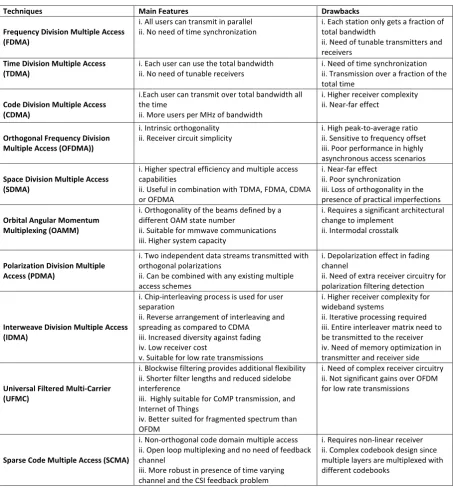
Table 2. Main Features and drawbacks of Several Existing and Emerging Multiple Access/Multiplexing Schemes
! "
#
$ %
&
!
! ' ( ) *( ) +(
,*(
&
-"
, , $
" %
! #
# $
# +
(
% %
+
"
+( !
-$
! %
& '
&
. #
$
+ & )
! . ,*(
,*(
! !
, #
+$! #
" %
+ #
#
technique should be adapted in future massive MIMO systems which will be possibly implemented in the mm-wave frequency range.
Herein, our proposition is to employ clustered orthogonal signature/power/code division multiple access on the top of the existing multiple access schemes such as SDMA. Unlike the grouped IDMA scheme, the idea here is to group users located within a cluster or a beam and to provide orthogonal codes to these groups. By employing the orthogonality over the conventional SDMA system, we can significantly enhance the number of users which can be supported
by a given set of frequency resources in a particular cluster/beam. The proposed clustered orthogonal signature division multiple access scheme envisions to address the aforementioned drawbacks of several approaches highlighted in Table 2. This will further address the problem of loss of orthogonality which may arise in many existing SDMA-based approaches due to the time varying nature of the wireless channel.
in different groups depending on the available radio resources. For future dense networks, the conventional SDMA may not be able to guarantee orthogonality between the beams where one beam implies one specific signature. In this context, the proposed idea is to enhance the orthogonality of the SDMA beams with the help of suitable orthogonal coding scheme by employing a joint antenna coding scheme. In order to design the orthogonal codes, there exist several possibilities in the literature such as Hadamard code [63], Gold code [64], and Polyphase orthogonal codes [65].
The proposed approach can be implemented in a two trier manner, meaning that one multiple access scheme in the first trier and another in the second trier. For example, in a heterogeneous network comprising of macro cells and small cells, the backhaul part, i.e., the link from the small cell BSs to the macro cell BS, may employ one multiple access scheme and the access part, i.e., from the end users to the small cell BS, may use another multiple access scheme. In this way, we suggest the following two approaches for implementing the proposed clustered orthogonal signature division multiple access.
i Code/signature division multiple access after employing SDMA: In this approach, the first trier uses signature (code) division multiple access and the second trier uses SDMA.
ii SDMA after employing code/signature division multiple access: In this approach, the first trier uses SDMA and the second trier uses code/signature division multiple access.
While devising a good multiple access scheme in a time varying wireless environment, the main objective should be to maximize the overall orthogonality. Depending on the deployed environment, if the beam sharpness and the surrounding environment cannot provide sufficient orthogonality, a suitable orthogonal coding can be implemented to enhance the overall orthogonality. The following advantages are foreseen in future wireless networks by employing the proposed multiple access scheme.
i Better flexibility to wireless design engineers
ii Better performance in the presence of time varying wireless channels
iii Easier to implement from the practical perspectives
iv Allocation of the available resources in an opti-mized way
However, from the practical perspectives, the fol-lowing factors need to be further investigated while realizing the proposed multiple access concept.
i Availability of the required digital signal processing hardware
ii Energy efficiency of the system and its implementa-tion complexity
iii Flexibility of accommodating users/services into the system: In most of the current wireless systems, we need to tune system parameters according to the requirements.
iv Orthogonality of the code: Higher the orthogonality of the code, better becomes the system performance at the cost of the restriction in the number of users/services that can be supported.
5. Conclusions
In order to address the issue of spectrum shortage in future wireless networks, investigation of suitable multiple access/multiplexing scheme is of significant importance. In this regard, this paper has reviewed various features of the widely discussed SDMA scheme. In addition, it has highlighted the main features and the drawbacks of other several emerging multiple access/multiplexing schemes. More importantly, it has proposed a novel concept of clustered orthogonal multiple access scheme as an important candidate for future dense cellular networks.
In our future work, we plan to validate the proposed concept with the help of system level simulations. Furthermore, the comparison of the proposed two-trier approaches in terms of the overall orthogonality improvement is the part of our ongoing works.
References
[1] Andrews, J.,Buzzi, S.,Choi, W.,Hanly, S.,Lozano, A., Soong, A.andZhang, J.(2014) What will 5G be?IEEE J.
Sel. Areas in Commun.32(6): 1065–1082.
[2] Viswanathan, H. and Weldon, M. (2014) The past,
present, and future of mobile communications.Bell Labs Technical J.19(8-21).
[3] Rangan, S., Rappaport, T. and Erkip, E. (2014)
Millimeter-wave cellular wireless networks: Potentials and challenges.Proc. IEEE102(3): 366–385.
[4] Yan, Y.,et al(2014) High-capacity millimeter-wave
com-munications with orbital angular momentum multiplex-ing.Nature Communications5(4876).
[5] Schaich, F. andWild, T. (2014) Waveform contenders
for 5G-OFDM vs. FBMC vs. UFMC. In6th Int. Symp. on Communications, Control and Signal Process.: 457–460.
[6] Rapajic, P. (1998) Information capacity of the space
division multiple access mobile communication system. InIEEE 5th Int. Symp. on Spread Spectrum Techniques and Applications, 3: 946–950 vol.3.
[7] Jiang, M., Akhtman, J.andHanzo, L.(2007) Iterative
[8] Ylioinas, J. and Juntti, M. (2009) Iterative joint
detection, decoding, and channel estimation in turbo-coded MIMO-OFDM.IEEE Trans. on Vehicular Technol.
58(4): 1784–1796.
[9] Zhang, J., Chen, S., Mu, X. and Hanzo, L. (2012)
Turbo multi-user detection for OFDM/SDMA systems relying on differential evolution aided iterative channel estimation.IEEE Trans. Commun.60(6): 1621–1633.
[10] Zubow, A., Marotzke, J., Camps-Mur, D. and
Perez-Costa, X. (2012) Sgsa: An SDMA-OFDMA scheduling
solution. In18th European Wireless Conf.: 1–8.
[11] Chan, P.andCheng, R.(2007) Capacity maximization
for zero-forcing MIMO-OFDMA downlink systems with multiuser diversity. IEEE Trans. on Wireless Commun.
6(5): 1880–1889.
[12] Dawod, N., Hafez, R. and Marsland, I. (2006) A
multiuser zeroforcing system with reduced near-far problem and MIMO channel correlations. InCanadian Conf. on Electrical and Computer Engineering: 936–939.
[13] Tangemann, M. (1995) Near-far effects in adaptive
SDMA systems. InIEEE Int. Symp. on Personal, Indoor and Mobile Radio Commun., 3: 1293–1297.
[14] Tangemann, M.(1994) Influence of the user mobility on
the spatial multiplex gain of an adaptive SDMA system. InIEEE Int. Symp. on Personal, Indoor and Mobile Radio Commun.: 745–749 vol.2.
[15] Maciel, T. andKlein, A. (2010) On the performance,
complexity, and fairness of suboptimal resource alloca-tion for multiuser MIMO-OFDMA systems.IEEE Trans-actions on Vehicular Technology59(1): 406–419.
[16] Sulyman, A.andHefnawi, M.(2010) Performance
evalu-ation of capacity-aware MIMO beamforming schemes in OFDM-SDMA systems. IEEE Trans. on Commun.58(1): 79–83.
[17] Vandenameele, P., Van der Perre, L., Engels, M.,
Gyselinckx, B. and De Man, H. (2000) A combined
OFDM/SDMA approach.IEEE J. Sel. Areas in Commun.
18(11): 2312–2321.
[18] Thoen, S., Deneire, L., Van der Perre, L., Engels,
M. and De Man, H.(2003) Constrained least squares
detector for OFDM/SDMA-based wireless networks.
IEEE Trans. on Wireless Commun.2(1): 129–140.
[19] Berger, S., Lu, Z., Irmer, R. and Fettweis, G.
(2013) Modelling the impact of downlink CoMP in a realistic scenario. InIEEE Wireless Communications and Networking Conference: 3932–3936.
[20] Bell, A.S.andLucent, A.(2008)Collaborative MIMO for
LTE-A downlink. Tech. Rep. R1-082501, 3GPP TSG RAN WG1 Meeting 53b.
[21] Zhang, R. (2010) Cooperative multi-cell block
diago-nalization with per-base-station power constraints.IEEE Journal on Selected Areas in Communications28(9): 1435– 1445.
[22] Jang, U.,Son, H.,Park, J.andLee, S.(2011) CoMP-CSB
for ICI nulling with user selection.IEEE Transactions on Wireless Communications10(9): 2982–2993.
[23] Zhou, T., Peng, M., Wang, W. andChen, H.H.(2013)
Low-complexity coordinated beamforming for downlink multicell SDMA/OFDM systems. IEEE Trans. on Veh. Technol.62(1): 247–255.
[24] Pun, M.O., Koivunen, V. and Poor, H. (2011)
Perfor-mance analysis of joint opportunistic scheduling and receiver design for MIMO-SDMA downlink systems.
IEEE Trans. on Commun.59(1): 268–280.
[25] Sharif, M.andHassibi, B.(2007) A comparison of
time-sharing, DPC, and beamforming for MIMO broadcast channels with many users. IEEE Trans. on Commun.
55(1): 11–15.
[26] Sharif, M. andHassibi, B. (2005) On the capacity of
MIMO broadcast channels with partial side information.
IEEE Trans. on Info. Theory51(2): 506–522.
[27] Pun, M.O., Koivunen, V. andPoor, H. (2007)
Oppor-tunistic scheduling and beamforming for MIMO-SDMA downlink systems with linear combining. In IEEE Int. Symp. on Personal, Indoor and Mobile Radio Commun.: 1– 6.
[28] Pun, M.O.,Koivunen, V.andPoor, H.(2008) SINR
anal-ysis of opportunistic MIMO-SDMA downlink systems with linear combining. InIEEE Int. Conf. on Commun.: 3720–3724.
[29] Larsson, E., Edfors, O., Tufvesson, F.and Marzetta,
T. (2014) Massive MIMO for next generation wireless
systems.IEEE Communications Mag.52(2): 186–195.
[30] Lu, L., Li, G., Swindlehurst, A., Ashikhmin, A. and
Zhang, R. (2014) An overview of massive MIMO:
Benefits and challenges. IEEE J. Sel. Topics in Signal Process.8(5): 742–758.
[31] Mohammad Razavizadeh, S.,Ahn, M.andLee, I.(2014)
Three-dimensional beamforming: A new enabling tech-nology for 5G wireless networks. IEEE Signal Process. Mag.31(6): 94–101.
[32] Halbauer, H., Saur, S., Koppenborg, J. and Hoek, C.
(2013) 3D beamforming: Performance improvement for cellular networks.Bell Labs Technical J.18(2): 37–56. [33] Sharma, S.K.,Chatzinotas, S.andOttersten, B.(2015)
3D beamforming for spectral coexistence of satellite and terrestrial networks. InIEEE Vehicular Technology Conf..
[34] Lozano, A.andTulino, A.(2002) Capacity of
multiple-transmit multiple-receive antenna architectures. IEEE Transactions on Information Theory48(12): 3117–3128.
[35] Choi, R.U., Ivrlac, M., Murch, R. and Utschick, W.
(2004) On strategies of multiuser MIMO transmit signal processing. IEEE Transactions on Wireless Communica-tions3(6): 1936–1941.
[36] Aktas, D.andEl Gamal, H.(2003) Multiuser scheduling
for MIMO wireless systems. In Vehicular Technology Conference, 2003. VTC 2003-Fall. 2003 IEEE 58th, 3: 1743–1747 Vol.3.
[37] Oberli, C. and Rios, M. (2007) OFDM-based SDMA
networks: Signal model under imperfect synchroniza-tion and channel state informasynchroniza-tion. In2th International OFDM Workshop.
[38] Raghavan, V., Hanly, S. and Veeravalli, V. (2013)
Statistical beamforming on the grassmann manifold for the two-user broadcast channel. IEEE Transactions on Information Theory59(10): 6464–6489.
[39] Wang, J., Jin, S., Gao, X., Wong, K.K. and Au, E.
[40] Alias, M., Chen, S. and Hanzo, L. (2005)
Multiple-antenna-aided OFDM employing genetic-algorithm-assisted minimum bit error rate multiuser detection.
IEEE Transactions on Vehicular Technology54(5): 1713– 1721.
[41] Das, S.andBagadi, K.P.(2011) Comparative analysis of
various multiuser detection techniques in SDMA-OFDM system over the correlated MIMO channel model for IEEE 802.16n.World Academy of Science, Engineering and Technology53(1).
[42] Lu, W.,Ji, F.andYu, H.(2011) A general resource
alloca-tion algorithm with fairness for SDMA/MISO/OFDMA systems. IEEE Communications Letters 15(10): 1072– 1074.
[43] Stridh, R., Bengtsson, M. and Ottersten, B. (2001)
System evaluation of optimal downlink beamforming in wireless communication. In IEEE Vehicular Technology Conference, 1: 343–347.
[44] Ajib, W. and Haccoun, D. (2005) An overview
of scheduling algorithms in MIMO-based fourth-generation wireless systems.IEEE Network19(5): 43–48.
[45] Jorswieck, E., Svedman, P. and Ottersten, B. (2008)
Performance of tdma and sdma based opportunistic beamforming. IEEE Trans. Wireless Commun. 7(11): 4058–4063.
[46] Joung, J.andSayed, A.(2010) User selection methods for
multiuser two-way relay communications using space division multiple access.IEEE Trans. Wireless Commun.
9(7): 2130–2136.
[47] Papazafeiropoulos, A.K., Sharma, S.K. and
Chatzino-tas, S.(2015) Impact of transceiver impairments on the
capacity of dual-hop relay massive MIMO systems. In
IEEE GLOBECOM Workshop.
[48] Sharma, S., Bogale, T., Chatzinotas, S., Ottersten,
B., Le, L.B. and Wang, X. (2015) Cognitive radio
techniques under practical imperfections: A survey.IEEE Communications Surveys Tutorials17(4): 1858–1884. [49] Sharma, S.,Patwary, M.,Chatzinotas, S.,Ottersten, B.
andAbdel-Maguid, M.(2015) Repeater for 5G wireless:
A complementary contender for spectrum sensing intelligence. InIEEE Int. Conf. on Communications: 1416– 1421.
[50] ul Abidin, Z., Xiao, P., Amin, M. and Fusco, V.
(2012) Circular polarization modulation for digital communication systems. InInt. Symp. on Communication Systems, Networks Digital Signal Processing: 1–6.
[51] Kwon, S.C.andStuber, G.(2014) Polarization division
multiple access on NLOS wide-band wireless fading channels. IEEE Trans. Wireless Commun. 13(7): 3726– 3737.
[52] Deng, Y.,Burr, A.andWhite, G.(2005) Performance of
MIMO systems with combined polarization multiplex-ing and transmit diversity. InIEEE Veh. Technol. Conf., 2: 869–873 Vol. 2.
[53] Kwon, S.C.(2014) Optimal power and polarization for
the capacity of polarization division multiple access channels. InIEEE Globecom: 4221–4225.
[54] Ping, L.,Liu, L.,Wu, K.andLeung, W.(2006) Interleave
division multiple-access.IEEE Trans. Wireless Commun.
5(4): 938–947.
[55] Nagaradjane, P., Chandrasekaran, S., Vishvaksenan,
K. andRamakrishnan, M. (2010) MIMO multi carrier
interleave division multiple access system with mul-tiuser detection. InInt. Conf. on Wireless Commun. and Sensor Comput.: 1–4.
[56] Zhang, R. andHanzo, L.(2008) Three design aspects
of multicarrier interleave division multiple access.IEEE Trans. on Veh. Technol.57(6): 3607–3617.
[57] Liu, L., Li, Y.,Su, Y.andSun, Y. (2015)
Quantize-and-forward strategy for interleave division multiple-access relay channel.IEEE Trans. on Veh. Technol.PP(99): 1–1. [58] Tu, Y.,Fan, P.andZhou, G.(2006) Grouped
interleave-division multiple access. InFirst Int. Conf. on Communi-cations and Networking in China: 1–5.
[59] Vakilian, V., Wild, T., Schaich, F., ten Brink, S.
andFrigon, J.F. (2013) Universal-filtered multi-carrier
technique for wireless systems beyond LTE. In IEEE Globecom Workshops: 223–228.
[60] Nikopour, H.,Yi, E.,Bayesteh, A.,Au, K.,Hawryluck,
M., Baligh, H. andMa, J. (2014) SCMA for downlink
multiple access of 5G wireless networks. In IEEE Globecom: 3940–3945.
[61] Taherzadeh, M., Nikopour, H., Bayesteh, A. and
Baligh, H.(2014) SCMA codebook design. InIEEE 80th
Vehicular Technology Conf.: 1–5.
[62] Hoshyar, R., Razavi, R. and Al-Imari, M. (2010)
LDS-OFDM an efficient multiple access technique. In
Vehicular Technology Conference (VTC 2010-Spring), 2010 IEEE 71st: 1–5.
[63] Del Rio, A. andRifa, J.(2013) Families of Hadamard
BBZ2BBZ4Q8-codes. IEEE Transactions on Information Theory59(8): 5140–5151.
[64] Das, B.,Sarma, M.,Sarma, K.andMastorakis, N.(2015)
Design of a few interleaver techniques used with Gold codes in faded wireless channels. InInt. Conf. on Signal Processing and Integrated Networks: 237–241.
[65] Liu, Y.C.,Chen, C.W.andSu, Y.(2013) New