Unified GUI Adaptation in
Dynamic Software Product Lines
Dean Matthew Kramer
A thesis submitted in partial fulfilment of the requirements of the
University of West London for the degree of Doctor of Philosophy
To the memory of my mother, Lynn Kramer, 1956-2015
Acknowledgements
I have to confess, when I embarked on this PhD, I was only interested in what I felt was the goal, and how best to get it. One of my supervisors always said “It’s not the
end that is important, it’s the journey”. At the time, I could not really understand how
the journey could be more important than the end. However, having completed this PhD, I now understand that message. On this journey, as all great journeys, important people always help shape it. For this, I feel deep gratitude is required.
Firstly, I wish to thank Dr. Samia Oussena, Prof. Peter Komisarczuk, and Prof. Tony Clark. A special thanks to Samia, for all the opportunities, guidance, and continual useful critiques of my research. Many thanks to Peter, your advice, suggestions and positivity have always been important. A big thanks to Tony, for being my external supervisor and your invaluable feedback and support.
I would like to thank all my fellow PhD students, particularly Dr. Anna Koc ´urov ´a and Malte Reßin. You both were so important during the good times, and the bad. Thank you for making this journey more fun, and in many cases, bearable. Thank you also to Antonio Khierkhazadeh, Jiva Bagale, and Christian Sauer for the great research discussions and advice.
I wish to express my thanks to all members of the School of Computing and Tech-nology at the University of West London. I especially wish to give my deep thanks and respect to the late Prof. Andy Smith for his support, and encouragement at the begin-ning of my PhD. I also wish to give thanks to Prof. Thomas Roth-Berghofer for all the valuable input, and idea inspiring research discussions. Thank you also to Dr. John Moore for always being a positive role model during my time as a research assistant and PhD student.
I would also like to thank all my non-academic friends back on Canvey Island. Thank you for always being behind me through the years!
Abstract
In the modern world of mobile computing and ubiquitous technology, society is able to interact with technology in new and fascinating ways. To help provide an improved user experience, mobile software should be able to adapt itself to suit the user. By monitoring context information based on the environment and user, the application can better meet the dynamic requirements of the user. Similarly, it is noticeable that programs can require different static changes to suit static requirements. This program commonality and variability can benefit from the use of Software Product Line Engi-neering, reusing artefacts over a set of similar programs, called a Software Product Line (SPL). Historically, SPLs are limited to handling static compile time adaptations. Dynamic Software Product Lines (DSPL) however, allow for the program configuration to change at runtime, allow for compile time and runtime adaptation to be developed in a single unified approach. While currently DSPLs provide methods for dealing with program logic adaptations, variability in the Graphical User Interface (GUI) has largely been neglected. Due to this, depending on the intended time to apply GUI adaptation, different approaches are required. The main goal of this work is to extend a unified representation of variability to the GUI, whereby GUI adaptation can be applied at compile time and at runtime.
Contents
1 Introduction 1
1.1 Motivation . . . 1
1.1.1 Challenges of Dynamic Software Product Lines . . . 3
1.1.2 A Scenario Application . . . 4
1.2 Problem Statement . . . 5
1.2.1 User Interface Variability . . . 5
1.2.2 Other issues . . . 5
1.2.3 Research Aim and Objectives . . . 6
1.2.4 Research Questions . . . 7
1.3 Contribution . . . 8
1.3.1 Publications . . . 9
1.4 Research Methodology . . . 10
1.5 Thesis Roadmap . . . 10
1.5.1 Part I: State of the Art . . . 10
1.5.2 Part II: Contribution . . . 11
1.5.3 Part III: Validation . . . 11
1.5.4 Part IV: Conclusion . . . 11
I
State of the Art
12
2 Background 13 2.1 Introduction . . . 132.2 Software Product Line Engineering . . . 13
2.2.1 Software Product Lines . . . 14
2.2.2 SPL Approaches . . . 15
2.2.3 SPL Processes . . . 15
2.2.4 Feature-Oriented Software Development . . . 17
2.2.5 Implementing Product Lines . . . 21
2.3 Context-Aware Adaptive Applications . . . 25
2.3.1 Context . . . 25
2.3.2 Context Acquisition & Adaptation . . . 26
CONTENTS
2.4.1 Model-View-Controller . . . 27
2.4.2 View Implementation . . . 28
2.4.3 Dynamic GUIs . . . 31
2.5 Summary . . . 33
3 Dynamic SPLs and Adaptive GUIs 35 3.1 Introduction . . . 35
3.2 Dynamic Software Product Lines . . . 36
3.2.1 Configuring a DSPL . . . 36
3.2.2 Implementation Approaches . . . 37
3.2.3 Summary of DSPLs . . . 40
3.3 Graphical User Interface Adaptation . . . 41
3.3.1 Design Time Adaptation . . . 41
3.3.2 Dynamic Variability . . . 43
3.3.3 Mixed Variability . . . 46
3.3.4 Summary . . . 47
3.4 Context-Awareness . . . 49
3.4.1 General Purpose Approaches . . . 49
3.4.2 Context and DSPLs . . . 50
3.4.3 Summary . . . 52
3.5 Research Goals . . . 53
3.5.1 GUI Variability Unification . . . 53
3.5.2 Context as a Feature . . . 53
3.6 Summary . . . 54
II
Contribution
56
4 GUI Variability 57 4.1 Introduction . . . 574.2 Types of Variability . . . 58
4.2.1 Presentation Units . . . 59
4.2.2 UI Elements . . . 60
4.2.3 Properties of UI Elements . . . 60
4.2.4 Dialogue of UI Elements . . . 61
CONTENTS
4.2.6 Visual Appearance . . . 62
4.2.7 Orientation . . . 62
4.2.8 Behaviour & Interaction . . . 62
4.2.9 Compound Variability . . . 63
4.3 Static and Dynamic Adaptation . . . 63
4.3.1 Timing . . . 63
4.3.2 Adaptation Isolation . . . 64
4.3.3 GUI State . . . 64
4.4 Conclusions . . . 65
4.5 Summary . . . 65
5 Design Phase 66 5.1 Introduction . . . 66
5.2 Domain Engineering . . . 68
5.2.1 Feature Models . . . 68
5.2.2 Context Model . . . 69
5.2.3 Context Event Rules . . . 73
5.2.4 GUI Document Variability . . . 74
5.2.5 Source Code Variability . . . 77
5.2.6 GUI State Retention Templates . . . 80
5.3 Application Engineering . . . 81
5.3.1 Configuration . . . 81
5.3.2 GUI Document Composition . . . 84
5.3.3 Code Generation and Transformation . . . 87
5.3.4 Language Preprocessor/Compiler . . . 89
5.4 Summary . . . 89
6 Runtime Phase 90 6.1 Introduction . . . 90
6.2 Application Architecture . . . 91
6.3 FeatureDroid . . . 92
6.3.1 Middleware Architecture . . . 93
6.3.2 Context-Acquisition Engine . . . 93
6.3.3 DSPL Management . . . 99
CONTENTS
6.4.1 Reconfiguration . . . 103
6.5 GUI Variant Manager . . . 107
6.5.1 Variant Retrieval . . . 108
6.6 Summary . . . 108
III
Validation
109
7 Implementation 110 7.1 Introduction . . . 1107.2 Design Phase Tools . . . 110
7.2.1 Feature Modelling . . . 111
7.2.2 GUI Document Composition . . . 112
7.2.3 Runtime Composition . . . 113
7.2.4 Source Generation & Transformation . . . 116
7.3 FeatureDroid . . . 120
7.3.1 ContextEngine . . . 121
7.3.2 DSPL Management . . . 125
7.3.3 Deploying FeatureDroid . . . 126
7.4 Summary . . . 127
8 Evaluation 128 8.1 Introduction . . . 128
8.2 Scenario-Based Evaluation . . . 129
8.2.1 Scenario SPLs . . . 130
8.2.2 Variability Categories . . . 130
8.2.3 Summary of Scenarios . . . 140
8.3 Scalability Evaluation . . . 140
8.3.1 Results . . . 142
8.4 Discussion . . . 145
8.4.1 Unification . . . 145
8.4.2 Scalability . . . 146
8.4.3 Extensibility . . . 147
8.4.4 Previous Approaches . . . 148
CONTENTS
IV
Conclusion
151
9 Conclusions and Future Work 152
9.1 Introduction . . . 152
9.2 Thesis Summary . . . 152
9.3 Thesis Contributions . . . 154
9.4 Future work . . . 156
Appendix A Implementation specific scripts 159
Appendix B Scenario Feature Models 161
Appendix C Scalability Data 163
List of Figures
2.1 Example Feature Model . . . 19
2.2 Model-View-Controller . . . 27
2.3 A GUI tree from the Android Wordpress Application . . . 30
4.1 Presentation Unit Variability . . . 59
4.2 UI Element Variability . . . 60
4.3 UI Element Property Variability . . . 60
4.4 Dialogue of UI Elements Variability . . . 61
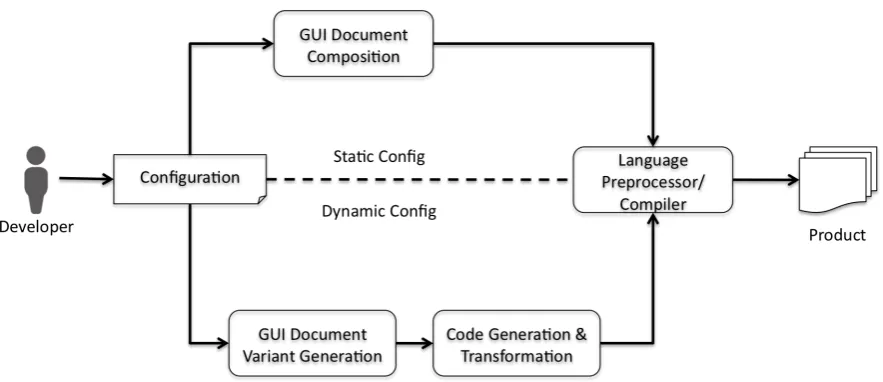
5.1 Overview of the DSPL Approach . . . 67
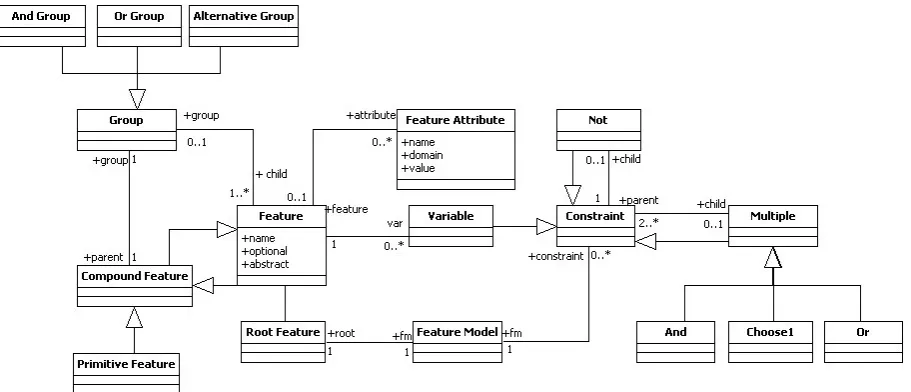
5.2 Feature Model Meta Model . . . 68
5.3 An Example Context Model . . . 70
5.4 Feature Model Aggregation . . . 73
5.5 Product Derivation Phases . . . 81
5.6 Composition of Home screen . . . 85
6.1 Application Architectures . . . 91
6.2 FeatureDroid Architecture . . . 92
6.3 A Context Component . . . 94
6.4 Context Engine Manager . . . 95
6.5 Runtime Deployment of Context Components . . . 97
6.6 The DSPL Manager . . . 99
6.7 A DSPL Application Instance . . . 100
6.8 Reconfiguration Process . . . 103
6.9 Map of features and main screen document variants . . . 108
7.1 FeatureIDE Feature Attribute Extension . . . 111
7.2 Source Generation & Transformations . . . 114
7.3 Generated Support Classes . . . 119
8.1 Screenshots of the main screen . . . 132
8.2 Screenshots of the main screen . . . 136
8.3 Generation Time (log) . . . 143
8.4 Installation Size Inc. (log) . . . 144
LIST OF FIGURES
List of Listings
2.1 Adding support for support for tweeting new events (SocialNetworks) . . 23
2.2 An Android GUI document . . . 31
5.1 An Android GUI Document refinement . . . 75
5.2 Refinement Ordering Tags . . . 76
5.3 Initialisation Method Refinement . . . 78
5.4 An example onGUIConfiguration Method . . . 79
5.5 Code Template for some Android Widgets . . . 80
5.6 Code transformation of an Android method . . . 88
6.1 Interface for reconfiguration call backs . . . 102
7.1 FOP-COP Transformation . . . 115
7.2 Reconfigure method template . . . 117
7.3 GUI Document Variant Retrieval Method . . . 120
7.4 ContextEngine Interfaces . . . 121
7.5 SendNotification and setupMonitor Implementations . . . 123
7.6 DSPL Service Interface . . . 125
8.1 Activity main screen Document Refinement . . . 133
8.2 MainScreen class Refinement . . . 134
8.3 GUI Document Refinements . . . 137
8.4 GUI Document Initialisation Refinement for ContentDetails.java class in Feature NoUserReview . . . 138
8.5 Auxiliary files needed for scenario . . . 138
8.6 The “Swipe to Delete” Gesture . . . 139
8.7 GUI Refinement for Feature 1 . . . 142
A.1 Ant build.xml target alterations to create context deployable jar . . . 159
List of Tables
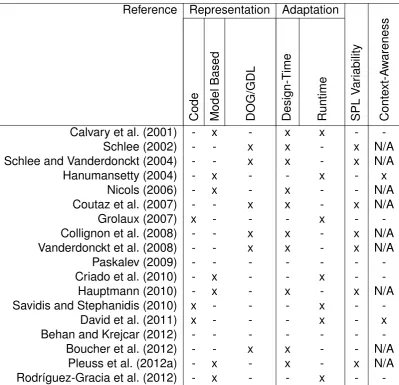
3.1 Summary of GUI adaptation approaches . . . 48
1
Introduction
Contents
1.1 Motivation . . . . 1
1.2 Problem Statement . . . . 5
1.3 Contribution . . . . 8
1.4 Research Methodology . . . . 10
1.5 Thesis Roadmap . . . . 10
1.1 Motivation
The high proliferation of mobile computing devices including smart phones and tablets displays a shift in how people interact with computers, realising Weiser (1991) vision of ubiquitous computing. This shift is allowing people to stay connected and active without needing to be in a fixed location. These mobile computing devices are het-erogeneous in different ways, including their physical hardware specifications, and the software that executes on them.
1.1. MOTIVATION
can require language changes, and other non trivial visual changes (Russo and Boor, 1993). Without useful and appealing GUIs, applications are likely to be purchased and used less by users.
A benefit of mobile computing devices, and their applications includes the ability to continue to be active in dynamic conditions, including one’s physical location. While different hardware elements of the device can and do differ, it is very common for these devices to include different sensors to monitor the changing conditions of the user and device. These sensors include accelerometers, GPS, light sensors etc. Using these sensors and different available internet resources can allow the mobile applications to gain a far better understanding of the current situation of the user, and potential intentions and requirements. Intelligent applications that take into account situation of the user, defined as context, are known as context-aware applications (Daniele et al., 2009). Examples of these applications include mobile tour guides (Abowd et al., 1997), reminder systems (Dey and Abowd, 2000), and interruption manage-ment systems (Avrahami and Hudson, 2006). Using context-awareness, application GUIs can adapt to suit the new context the user or device is in. These adaptations can include background logic in the application, which are not always explicitly noticeable to the user. Other adaptations can include the GUI using adaptive GUIs.
Adaptive GUIs though have seen much research activity over the years, whereby the GUI can be automatically adapted to suit changing runtime requirements, or to suit a particular user context. This can assist the user, and improve application usability. A problem however with adaptive GUI approaches is that they do not follow SPL ap-proaches, and therefore adaptation can only be made at runtime. This consequently means that depending on the time of adaptation, GUI variability will need to be de-signed and implemented differently. Other issues includes the ability for tailoring these adaptations for different users. Tailoring applications without systematic reuse leads the developer towards developing different program assets more than once.
Developing software products is often expensive and time intensive. Due to highly variable nature of mobile computing devices, and user requirements, developing and maintaining products to accommodate this variability is a difficult task. By using
Soft-ware Product Line Engineeringtechniques, this variability can be handled in a far more
1.1. MOTIVATION
designs for different cultures and languages. Using SPLs to handle GUI variability enables the developers achieve higher asset reuse.
As described earlier, while developers need to develop applications that can be statically applied to different user groups and requirements, they also often need to deal with changing dynamic conditions of the user and device. In essence, these two types of variability carry out the same objective: to adapt the application in a particular way to suit a new user requirement. Therefore, it is ideal for the developer if static and dynamic adaptations need only one implementation, which can be statically or dynam-ically applied. To fit this ideal, Dynamic Software Product Lines (DSPL) have been proposed (Hallsteinsen et al., 2008). DSPLs can be driven both by manual product reconfiguration, or also automatically using context-awareness (Parra et al., 2009).
1.1.1
Challenges of Dynamic Software Product Lines
The ability of a SPL to reconfigure at runtime is what defines it as a DSPL. As such, program adaptations and logic can be applied at different points, depending on dy-namic user requirements. Historically, DSPLs have concentrated on source code logic adaptation, whereby different program logic in a given operation is executed based on the current configuration. The Graphical User Interface (GUI) however, and what adap-tations that maybe needed, have largely been neglected. For a developer to implement a GUI that can be adapted statically, and dynamically, this can require the implemen-tation of GUI variability using a combination of approaches. Approaches for handling GUI variability in static SPLs have been proposed (Hauptmann, 2010), in addition to a number of dynamic approaches (Criado et al., 2010; Sottet et al., 2008; Hanu-mansetty, 2004). This presents a problem when certain variability might be required statically and dynamically in different final products, as it requires the implementation of adaptation twice. This can add considerable time and complexity to the product development and maintenance, which a single unified approach can avoid.
1.1. MOTIVATION
has the effect where the developer needs to program manually all GUI visual proper-ties. This process is far longer to undertake as these GUIs can often not be designed in a visual tool.
This research aims to investigate how to effectively handle static, and dynamic changes to the UI in a single unified approach using DOGUIs. Next, to help the reader and to illustrate the research contribution, we introduce a scenario application for use in this thesis.
1.1.2
A Scenario Application
Let us consider a mobile content store application as a scenario application, like the Google Play store. Alice is a 10 year old girl in the United Kingdom that takes her tablet to school as an education tool. The application on her tablet is designed to suit children in school by providing a more fun and appealing GUI. While at school, she downloads different books to her tablet for her to read including children’s story books, and educational books. When she gets home, she can practice her different acquired skills and knowledge applications to test her, and help her improve. Alice also enjoys watching videos from the content store. However, because her tablet lacks a large amount of storage space, videos can only be streamed to her device when she has a good data connection including wifi, 4G or 3G.
Tom ´a˘s is a 34 year old man from Slovakia that uses the content store on his mobile phone to download games, applications and books. He would like to also download and stream music and video, but currently this is not available to Slovakia due to li-censing restrictions from content owners. However, when travelling to some countries in the EU including France, and the United Kingdom he can buy and download this content. As he has the adult version of the content store, the GUI of the application is more suited to older audiences using a minimalistic design. As Tom ´a˘s has an expen-sive new phone with a large amount of storage space, when he is in other countries, he downloads this content so he can access it when he returns home.
As introduced with these different use scenarios, we can see that there are static, and dynamic user requirements.
1.2. PROBLEM STATEMENT
1.2 Problem Statement
Dynamic Software Product Lines have shown to the ability to provide a unified solution to tackle the need for both compile-time and runtime adaptation. There are still existing issues that remain regarding these types of systems includinguser interface variability,
andcontext design, and management.
1.2.1
User Interface Variability
The GUI just like the rest of the software system can exhibit variability (Pleuss et al., 2012b). This means different features of the system may crosscut the user interface in terms of its representation and/or functionality. When developing GUIs using docu-ments or GUI description languages, there are multiple artefact types that can contain this variability. Dealing with this variability at design time can be handled using current SPL techniques and tools. However, for runtime adaptation, this has yet to be achieved with SPLs, and is only tackled in using adaptive GUI approaches.
Adaptive GUIs though, are not conventionally developed using SPL techniques and often lack the ability to apply the adaptation statically. As a consequence, the developer is then required to use different approaches for developing GUI variability, be it static, or dynamic. While the adaptation is being applied at different times, they both have the same objective, which is to modify the GUI by adding, removing, or altering particular aspects of the GUI.
Because this adaptation focusses on the same objective, there should be a single unified development of this adaptation, whereby the developer need not use different techniques to achieve adaptation. By enabling unified development of GUI adapta-tions, the developer can choose after implementation where that adaptation should be applied, statically, or dynamically at runtime. This added flexibility can then pro-vide higher feature cohesion, as adaptation binding times can be applied both to GUI adaptation and logic simultaneously.
1.2.2
Other issues
Context Design and Management
Histori-1.2. PROBLEM STATEMENT
cally, DSPL methodologies have predominately used different notations for modelling context and the features of the system. This requires two different notions to be used, and requires a method of bridging context with the system it affects. By modelling both context and the features of the system using a single notation, the developer can then express the context-aware system in a unified model.
Not only should context be modelled in a unified way, it should be handled this way also. Context acquisition that is separated from the system is often static, and is therefore not context-aware. Depending on a given context, it might be applicable for different contexts to be acquired, or not. By considering context as a feature of the system, its acquisition can then be treated like other software features in the system, enabling static, and dynamic binding.
1.2.3
Research Aim and Objectives
This research aims to bring GUI variability realisation to DSPLs, targeting the chal-lenges discussed in the problem statement. By bringing GUI variability to DSPLs, GUI adaptation should be able to be viewed and realised in a single unified way. This adap-tation then should be able to be used either at compile time, or at runtime. We also look at how context, which is often used in DSPLs, can be reused over many DSPLs at runtime, allowing for context sharing over applications. With this research aim in mind, our main research objectives can be described as:
1. To investigate and extend current source code refinement approaches to include GUI representation in GUI documents.
2. To investigate and design a runtime mechanism to be capable of runtime adap-tation of the GUI using GUI documents.
3. To extend current variability models to include context information, and allowing for dynamic context acquisition.
4. To implement development tool support for variability modelling, and product derivation.
1.2. PROBLEM STATEMENT
1.2.4
Research Questions
Based on the aim of this research, this thesis attempts to answer the following research questions:
Reseach Question
How can compile time and runtime GUI adaptation be unified within a DSPL?
By unifying compile-time and runtime GUI adaptation, the developer can then im-plement the given adaptation once. Following this, the decision on where to apply this adaptation can be chosen, and changed, without the need for reimplementation. Chapter 4 provides a high level view of adaptation, with different types of adaptation. In Chapter 5, a description to how GUI adaptation is defined and implemented, with its runtime behaviour being described in Chapter 6.
Subquestions
• How can GUI adaptation be applied dynamically at runtime?
After GUI adaptation has been implemented, support is needed to allow for the adaptation to be applied on reconfiguration. In Chapter 6, this question is ad-dressed, showing how GUI adaptation can be applied using variants produced in Chapter 5.
• How can context be modelled, and treated by the system as a feature of the DSPL?
Context modelling is carried out in feature modelling, described in Chapter 5. This enables the developer to use a single modelling notation for the system. Runtime context handling as a feature is then addressed in Chapter 6, enabling contexts to become context aware.
1.3. CONTRIBUTION
1.3 Contribution
By answering the stated research questions, this thesis makes a number of contribu-tions including:
• An extended modelling approach to handle system variability and context:
When designing a DSPL, both the system and context that can affect the con-figuration need to be model. To avoid supplementary models, we use extended feature models, allowing the developer to design their system and context model within a single notation.
• A Feature-Oriented approach to GUI adaptation: We propose an approach for implementing GUIs in Dynamic Software Product Lines. GUI variability is im-plemented within refinements, following Feature-Oriented Programming (FOP). Within each refinement, we propose a hooking method to assist in refinement placement. Compile-time composition is handled using superimposition, in a stepwise fashion. Along side GUI document refinements, we describe an ap-proach that enables other source code GUI adaptations that require execution on reconfiguration, using FOP.
• A mechanism for runtime GUI adaptation: After the developer implements GUI adaptation, this can be applied dynamically at runtime. To facilitate visible runtime GUI adaptation, a mechanism is proposed. This mechanism handles automatic adaptation of the GUI, updating only widgets requiring adaptation. It also handles widget state retention to ensure no important state data is lost in the adaptation. This adaptation can be applied at two stages in a GUIs lifecycle, allowing for greater control of when an adaptation is suitable. The architecture, components, and algorithms needed to apply adaptation from GUI documents is defined in this thesis.
1.3. CONTRIBUTION
• Tool support and developed prototypes: In the process of validating the con-tribution of this dissertation, several implementation deliverables have been cre-ated. First, we provide tool support as an extension to an open source SPL tool for context modelling, and context rule formulation. This tool support also sup-ports the auto generation of components needed for runtime GUI adaptation, and software composition for the DSPL. Second, a complete software middleware for managing DSPL application configurations was developed for the Android mobile platform. This middleware includes a context management system which allows for context acquisition, and reconfiguration based on context.
The designed technology and methods intends to extend DSPLs to not just pro-gram logic, but to GUI representation.
1.3.1
Publications
During the development of this thesis, the author has published in international confer-ences and workshops, numbered in chronological order:
1. Kramer D., Oussena, S., Komisarczuk, P., Clark, T. (2013) Document-Oriented GUIs in Dynamic Software Product Lines. In the Proceedings of the 12th Inter-national Conference on Generative Programming: Concepts and Experiences.
2. Kramer D., Sauer, C., Roth-Berghofer, T. (2013) Towards Explanation Generation using Feature Models in Software Product Lines. In the Proceedings of the 9th Workshop on Knowledge Engineering and Software Engineering.
3. Kramer, D., Oussena, S., Clark, T., Komisarczuk, P. (2013) Graphical User Inter-faces in Dynamic Software Product Lines. In the Proceedings of the 4th Interna-tional Workshop on Product Line Approaches in Software Engineering.
4. Sauer, C., Kocurova, A., Kramer, D., Roth-Berghofer, T. (2012) Using canned explanations within a mobile context engine.In the Proceedings of the 7th Work-shop on Explanation-aware Computing.
1.4. RESEARCH METHODOLOGY
1.4 Research Methodology
Design Research (DR) and Software Engineering Research (SER) function differ-ently to traditional scientific research, by which traditional science studies existing
phenomena, while DR and SER study how to do things and how to create things
(Marcos, 2005). This research can be broken down into a number of phases:
• Within phase 1, exploration of the research area is carried out, with an analysis of the current methods for creating DSPLs for mobile systems. This primarily conducted via literature survey, and by experimentation with current methods in the new setting. This phase should end with a final research definition with questions and boundaries being set.
• In phase 2, using a iterative process of implementation and testing, investigation into how GUI elements of a program can be handled within a DSPL are carried, along with how context can be more easily modelled, and used within a DSPL. This research can be viewed as observing a constructivist view, by which that truth and meaning is constructed from our engagement with the world, instead of it being objectively discovered (Feast and Melles, 2010).
• Finally, in phase 3, an evaluation of the outputs from phase 2 is carried out using a combination of scenarios, and scalability tests. These scalability tests will be used to judge how applicable our approach can be for different SPL sizes.
1.5 Thesis Roadmap
In this thesis, there are four main components,State of the Art, Contribution, Validation
andConclusions. These components are broken down into the following chapters:
1.5.1
Part I: State of the Art
1.5. THESIS ROADMAP
• Chapter 3: Dynamic SPLs and Adaptive GUIs. This chapter surveys, and discusses the state of the art and related works of this dissertation. We introduce Dynamic Software Products as an approach for developing adaptive software, and their properties. Next we discuss research related to context-awareness and its use in DSPLs, and lastly we consider adaptive GUIs, and how GUIs are handled in SPLs. Finally we set out a concrete set of objectives for this dissertation, based on gaps in knowledge found in the reviewed work.
1.5.2
Part II: Contribution
• Chapter 4: GUI Variability. Within this chapter, we define different types of variability that can exist within the system. Following this an abstract specification of the system is proposed, along with requirements for runtime adaptation.
• Chapter 5: Design Phase. In this chapter we define the design time stages of the DSPL development, including variability design, implementation, and deriva-tion.
• Chapter 6: Runtime Phase. This chapter presents the runtime architecture of the DSPL applications. We present how context is acquired and used for system reconfiguration. Following this, the process of GUI reconfiguration is presented.
1.5.3
Part III: Validation
• Chapter 7: Implementation. This chapter presents implementation details of the tool support and middleware software prototype implemented for the Android platform.
• Chapter 8: Evaluation. In this chapter, we evaluate the proposed approach using the implementation presented before using scenario SPLs and scalability tests.
1.5.4
Part IV: Conclusion
Part I
2
Background
Contents
2.1 Introduction . . . . 13
2.2 Software Product Line Engineering . . . . 13
2.3 Context-Aware Adaptive Applications . . . . 25
2.4 Graphical User Interfaces . . . . 27
2.5 Summary . . . . 33
2.1 Introduction
In this chapter we introduce several aspects related to the work within this dissertation. The main goal of this chapter is to introduce a base of knowledge, that can be used throughout this thesis.
The structure of the chapter is as follows: Section 2.2 introduces Software Product Line Engineering. In Section 2.3, we introduce context-aware and adaptive applica-tions. Finally, in Section 2.4, we introduce engineering concepts and methods used for implementing Graphical User Interfaces in applications. Finally, we finish the chapter summarising the different presented approaches.
2.2 Software Product Line Engineering
2.2. SOFTWARE PRODUCT LINE ENGINEERING
suit different requirements when developing for different customers. Because of this variability, it has been viewed that it is beneficial to study common properties of pro-grams (Parnas, 1976). Product lines in other industries for example car manufacturing help give greater choice to the customer, where different requirements of the product e.g. colour, number of doors etc can be handled without a car needing to be designed from scratch. Software Product Lines aim at achieving this level of customisation in software systems.
2.2.1
Software Product Lines
Software product lines (SPL) focus on the development of similar software systems us-ing common artefacts. In this thesis, we use Clements and Northrop (2001)’s definition of a Software Product Line as:
a set of software-intensive systems sharing a common, managed set of features that satisfy the specific needs of a particular market segment or mission and that are developed from a common set of core assets in a prescribed way.
Using SPLs can bring multiple benefits including cost reduction and short time to market, when carried out over multiple products (Pohl et al., 2005). Cost reduction is achieve through the systematic reuse of common artefacts within each product. After each SPL artefact has been produced, they can be reused in a number of other prod-ucts. When considering each individual application developed traditionally requires every artefact to be developed from scratch, and each artefact has an attached cost to its development, being able to reuse this can gradually lower the total cost of de-velopment of a product. Time to market is also reduced because of the reduction of implementation effort required to develop a new product variant because of artefact reuse. For these benefits theough using an SPL, a certain number of products need to be produced, because up front costs can be seen to be higher than individual devel-opment. Empirical studies have shown cost break even point, the point where using an SPL costs no more than individual development, is usually around three systems (Weiss and Lai, 1999). This though does depend on many factors of the organisation and products involved.
2.2. SOFTWARE PRODUCT LINE ENGINEERING
improvements caused by the use of SPLs include Nokia being able to produce 30 different phones per year, instead of 4; Motorola realising a productivity improvement of 400 %; and HP reporting a factor of seven time to market, and factor of six productivity increase (Bass et al., 2003).
2.2.2
SPL Approaches
There are several approaches for developing a software product line including (Krueger, 2002):
• Proactive SPL development involves the analysis, design, and implementation of the full SPL at once. All foreseeable features requirements are analysed, designed, and implemented. This approach involves heavy initial investment and time, which can prove difficult by small for medium sized companies (Alves et al., 2005).
• Reactive SPL development involves the incremental growth of the product line, in light of new requirements and product demands. Features are designed, and implemented when needed. This approach can offer a faster and more agile approach to an SPL. Also, because of its ability to implement features when needed, this can enable much lower initial costs, as discussed easier.
• Extractive SPL development involves the extractions of commonality and vari-ability within existing software and either develop it into an SPL, or adding to an existing product line. With this approach, existing legacy systems can be decom-posed into more reusable assets, which may improve overall system extensibility and maintenance.
While these approaches suit different development circumstances, they can be combined. When considering common software evolution, it may be popular to use a proactive/extractive approach initially, but then move to a reactive approach after-wards.
2.2.3
SPL Processes
2.2. SOFTWARE PRODUCT LINE ENGINEERING
discrepancies in different proposed methodologies, there is a common understanding of two engineering processes involved in SPLs, domain and application engineering (Clements and Northrop, 2001; Czarnecki and Eisenecker, 2000).
Domain Engineering
Domain engineering specifically is aimed at the design, realisation, and testing of a re-usable platform. This process is broken up in three distinct parts;analysis, design,
andimplementation(Czarnecki and Eisenecker, 2000).
Domain Analysis This process aims to develop and document the domain re-quirements. This process includes the analysis of domain commonality and vari-ability, that is, what will be reused across multiple applications, and what is likely to differ in those applications. Different modelling techniques for expressing this commonality and variability of an application domain include thefeature-oriented
domain analysis(Kang et al., 1990) andvariability models (Pohl et al., 2006; Pohl
et al., 2005). Using feature-oriented domain analysis, the domain is modelled in terms of system features.
Domain Design. The aim of this process is to develop the domain/reference architecture.
Domain Implementation Within this process, the reusable assets are imple-mented by the SPL engineer. Many different implementation techniques have been used to implement the SPL variability including feature-oriented program-ming, aspect-oriented programprogram-ming, components, and service-oriented architec-ture.
Application Engineering
As stated earlier, the aim of application engineering is to derive a distinct product from the platform developed in the domain engineering. Just like domain engineering, this process features three distinct parts;analysis, design andimplementation.
2.2. SOFTWARE PRODUCT LINE ENGINEERING
Application Design. In this process, the domain/reference architecture de-signed in the domain engineering phase is specialised. The application archi-tecture is altered according to the application requirements.
Application Implementation. Application implementation is the process of de-riving the reusable software artefacts developed in the domain realisation pro-cess. A final product is then generated or composed of these software artefacts. Finally, any specific product changes that maybe required are handled here, for example, final customisations of the GUI (Pleuss et al., 2012a).
Commonality and Variability
SPLs are made up of product commonality and variability. Commonality of the product has been described as features that are found in each application from the SPL. Vari-ability on the other hand is what makes each product unique in that variable features are not found in every application. Variability has been shown to exist in time, and in space. (Pohl et al., 2005) has defined variability in time as“the existence of difference
versions of an artefact that are valid at different times” and variability in space as“the
existence of an artefact in different shapes at the same time”.
2.2.4
Feature-Oriented Software Development
Within this dissertation, we concentrate on the use of Feature-Oriented Software De-velopment (FOSD) for developing SPLs (Apel and K ¨astner, 2009). FOSD is a set of different modelling tools, language techniques, centred around the concept of a Fea-ture.
Feature
As FOSD aims at modularising and viewing a product as a collection of features, it is useful for us to have a clear understanding of what a feature actually is. In the past, several definitions of a feature have been proposed, and have been surveyed by (Apel and K ¨astner, 2009) (ordered from abstract to technical):
• “a prominent or distinctive user-visible aspect, quality, or characteristic of a
2.2. SOFTWARE PRODUCT LINE ENGINEERING
• “a distinctively identifiable functional abstraction that must be implemented, tested,
delivered, and maintained” (Kang et al., 1998)
• “a distinguishable characteristic of a concept (e.g., system, component, and so
on) that is relevant to some stakeholder of the concept” (Czarnecki and
Eise-necker, 2000)
• “a logical unit of behaviour specified by a set of functional and non-functional
requirements” (Bosch, 2000)
• “a product characteristic from user or customer views, which essentially consists
of a cohesive set of individual requirements” (Chen et al., 2005)
• “a product characteristic that is used in distinguishing programs within a family of
related programs” (Batory et al., 2004)
• “a triplet, f = (R, W, S), where R represents the requirements the feature satisfies,
W the assumptions the feature takes about its environment and S its
specifica-tion” (Classen et al., 2008)
• “an optional or incremental unit of functionality” (Zave, 2003)
• “an increment of program functionality” (Batory, 2005)
• “a structure that extends and modifies the structure of a given program in order
to satisfy a stakeholder’s requirement, to implement and encapsulate a design
decision, and to offer a configuration option” (Apel et al., 2008)
These definitions of feature though do not help explain exactly what a feature can be. Features can be a range of different items that are important to that product. Research into SPLs has predominately centred around features that contain source code, but features can encapsulate many more types of artefacts. Other types of considered artefacts include documentation (Rabiser et al., 2010). In this thesis, we mainly consider features as used for modularising software, and context. With software related features, Myers (1988) categorised features relating to capability into three areas:
• functional. (features that provide a service).
• operational. (features related to application interaction).
2.2. SOFTWARE PRODUCT LINE ENGINEERING
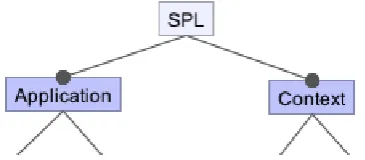
Figure 2.1: Example Feature Model
Feature Models
While there have been different modelling notations to model variability e.g. Orthog-onal Variability Models (Pohl et al., 2006; Pohl et al., 2005) and Covamof (Sinnema et al., 2004), feature models have become the de facto technique, with an example in Figure 2.1.
The origins of the feature model can be traced back to Kang et al. (1990), who proposed the Feature-Oriented Domain Analysis method (FODA). FODA included the modelling concepts of aggregation/decomposition, generalisation/specialisation, and parameterisation. Feature models are modelled using hierarchical trees of features, with each node representing commonality and variability of its parent node.
Feature Relationships
As said before, feature models comprise of features and the relationships between them. There are different relationships that can be applied to features, including:
• Mandatory. A child feature is defined as mandatory when it is included in all products where its parent is also contained.
• Optional. A child feature defined as optional when it optionally can be included or excluded when its parent is contained in a product.
• Or. A set of feature children exhibit an or-relationship when at least one or more children are selected along with the parent of that set.
2.2. SOFTWARE PRODUCT LINE ENGINEERING
Relationships among features are not only expressed within the tree, but also by tree constraints, written commonly using propositional formula. These cross-tree constraints typically apply feature inclusion or exclusion statements.
Propositional Formula
Feature models can be encoded in propositional logic, which then can be reasoned over for configurations (Batory, 2005). Propositional logic can be viewed as a logical representation of the feature model. By the use of logical connectives including ∨,
∧, ¬, ⇒, and ⇔ with primitive variables (Boolean values), a formula can be deter-mined to be either satisfiable, or non-satisfiable. Formula satisfiability is deterdeter-mined by whether the formula evaluates to true, given a set of variable assignments. Evalu-ating these formulas is usually carried out using SAT Solvers, BDD Solvers, Alloy, or SMV (Benavides et al., 2010). To use SAT solvers, the propositional formula has to be encoded into Conjunctive Normal Form (CNF). To evaluate a feature model then requires being mapped to propositional formula, normally using these following steps (Benavides et al., 2010; Czarnecki and Wasowski, 2007; Batory, 2005):
• Firstly, the feature model encoding is carried out by first assigning a variable to each feature.
• Secondly, each feature relationship within the feature model is encoded in to smaller formulas.
• Finally additional feature constraints added to the feature model are added to the formula.
Feature Model Extensions
2.2. SOFTWARE PRODUCT LINE ENGINEERING
Other extensions to feature models include feature types. It was noted by Thum et al. (2011) that some features are not always used to distinguish program variations but used more to structure the feature model. It was proposed that features can be either:
• Abstract. A feature contains no implementation artefact, and is used primarily to help structure the feature model.
• Concrete. A feature that has at least one concrete implementation associated with it.
Binding attributes to features has also been a proposed extension (Benavides et al., 2010). Feature Models including attributes have been calledextended feature model. Extended feature models give the ability to tag extra information to features. Feature attributes normally contain a name, a domain, and a value. This modelling extension is used later in this thesis for use with our context models.
2.2.5
Implementing Product Lines
Different software development technologies and paradigms have been used to en-gineer SPLs including Aspect-Oriented Software development and Service-Oriented Architecture. FOSD extends FODA by providing technologies to enable development and implementation of software systems in a feature oriented fashion.
Separation of Concerns
Separation of concerns is not a concept just regarding SPLs but a fundamental prin-ciple of software engineering (Apel, 2007). While a software concern can be seen as
any matter of interest in a software system (Sutton and Rouvellou, 2004), because
this variation in behaviour can affect different parts of the software, it is considered
a crosscutting concern. Crosscutting concerns are non modular concerns, that are
found scattered across multiple pieces of software modules (Bruntink et al., 2007). A concern can be any part of the system and be realised as a feature in SPLs, aspects in AOP, or class in OOP. It has been recognised that concerns cannot always be sep-arated at the same time, known as the tyranny of the dominant decomposition (Tarr et al., 1999). Concerns that can not be modularised separately normally equate to
2.2. SOFTWARE PRODUCT LINE ENGINEERING
concerns can be found to be implemented or scattered across multiple source code modules, for example classes in OOP. Code that is tangled can be found when more than a single concern are implemented together within a single source code module. In SPLs, features can be seen as different concerns of the system that can be separated. The are two primary approaches to dealing with separation of concerns in source code includingannotations, andcomposition.
Annotative and Compositional Approaches
Annotative and compositional approaches provide two different solutions to separat-ing concerns. Annotative approaches focus around the use of virtual separation of concerns (K ¨astner and Apel, 2009). Examples of tools that support annotative ap-proaches include the C preprocessor, and CIDE tool (Feigenspan et al., 2010). Using these tools, the developer can annotate parts of the source code that are part of each feature in the SPL. This approach can allow very fine grained adaptation including ex-tra statements to methods, and parameter alterations in method declarations. Product derivation is carried out by negative variability. Using negative variability, parts of the system are removed based on which features are present in the product configuration (Voelter and Groher, 2007). This causes code to be removed from the final variant of the source code if its associated feature is not included in a product.
Compositional approaches on the other hand focus around physical separation of concerns. By physically separating code into multiple modules, these can be com-posed into different variants at configuration (K ¨astner et al., 2009). This approach normally makes use of positive variability because elements that are variable to the product are added to the base product (Voelter and Groher, 2007). Many languages supporting software composition exist include Aspect-Oriented Programming, Delta-Oriented Programming, and Feature-Delta-Oriented Programming. In this thesis, we con-centrate on the use of Feature-Oriented Programming in implementing SPLs.
Feature-Oriented Programming
2.2. SOFTWARE PRODUCT LINE ENGINEERING
Refinements contain the adaptation for a particular class. A refinement is declared using the keyword refines in the refinement class declaration. Within these refine-ments, extra class members, methods, and method extension can be added. Method extensions function by overriding the method being extended, adding extra instruc-tions, and using the keyword Superto call the overridden method. The position of the
Super keyword can then dictate when in execution should the extensions take place,
in regards to the overridden method. In Listing 2.1, we depict an example from a program for events management. In lines 2-15, we declare the base version of the classManageEvents, and a refinement for the SocialNetworks feature in lines 18-30. In the refinement, functionality related to sending twitter status updates for new events is added.
Listing 2.1: Adding support for support for tweeting new events (SocialNetworks)
1 //Base implementation
2 public class ManageEvents extends Activity { 3 public void onCreate(Bundle savedInstanceState) { 4 super.onCreate(savedInstanceState);
5 setContentView(R.layout.manageeventlayout); 6 ...
7 }
8 private void addNewEvent(Event e) { 9 ... 10 events.add(e); 11 db.insertEvent(e); 12 updateMenuList(); 13 ... 14 } 15 } 16
17 //Refinement for Feature SocialNetworks
18 refines class ManageEvents { 19 TwitterClient mTwitter;
20 public void onCreate(Bundle savedInstanceState) { 21 Super.onCreate(savedInstanceState);
22 mTwitter = new TwitterClient(getApplicationContext()); 23 }
24 public void addNewEvent(Event e) { 25 Super.addNewEvent(e);
26 String t = getResources().getString(R.string.tweet_new_event) + e.name; 27 if (mTwitter.isLoggedIn())
28 new SendTweetTask().execute(t); 29 }
30 }
2.2. SOFTWARE PRODUCT LINE ENGINEERING
• Jampack based composition involves composing classes into a single pound class of the base class and each of it refinements. Each of these com-pound classes then include a union of all member variables, and one method for each method refinement chained together. This method has advantages over mixin based composition through its ability to create smaller and more scalable codebase (Rosenmuller, 2011).
• Mixin based composition involves recreating an inheritance chain from classes in each feature. Using this approach, each refinement is added as an abstract class, with the bottom declaration a public class. Each of these refinements then extends the previous refinement class in the inheritance chain. This method has advantages over jampack based composition through the ability to keep feature boundaries and ease of refactoring changes in generated code back into feature increments (Batory et al., 2004).
In FOP, modules play a role in facilitating separation of concerns, known asfeature modules. Feature modules encapsulate program refinements for that specific feature, which increments program functionality (Batory et al., 2004). In terms of their use, they are used via folders within an operating system to separate source code of different features. Feature modules are applied to a base program by a program generator, which then uses the modified program as the input for the following composition. This is commonly carried out usingsuperimposition (Apel et al., 2009; Batory et al., 2004; Apel, Kastner and Lengauer, 2009)
2.3. CONTEXT-AWARE ADAPTIVE APPLICATIONS
This general purpose superimposition technique was used in the composition tool
FeatureHouse (Apel, Kastner and Lengauer, 2009). Different languages can added
to FeatureHouse by the use of a language BNF, and specific annotations marking different elements in the grammar as Feature terminals and non terminals. This al-lows for different levels of refinement granularity. FeatureHouse also has an altered syntax used for implementing class refinements. Firstly, unlike other FOP languages, the refines keyword is not used. Depending on the order of composition, when the classes are read, if a class declaration for the same type already exists, it is then as-sumed to be a refinement of the previously read class declaration. This then means therefineskeyword is not required. Secondly, instead of the keyword Superfor call-ing the overridden method in other FOP languages, FeatureHouse uses the keyword
original.
2.3 Context-Aware Adaptive Applications
Software is being used in increasingly mobile environments. Because of this, tions of the user, device and other factors are often changing. This change in condi-tions can cause problems with traditional static applicacondi-tions. For example, how does an application requiring data from an internet source deal with connection loss? These events can be handled by context-aware adaptive applications. Context-aware appli-cations have been described by Daniele et al. (2009) as:
...intelligent applications that can monitor the users context and, in case of changes in this context, consequently adapt their behaviour in order to satisfy the users current needs or anticipate the users intentions.
2.3.1
Context
Context-aware applications are driven by context, whereby, given a particular context, the application adapts itself. Because of this, it is useful for us to define and discuss
whatcontext actually is. This thesis will use the definition of context as given by Dey
(2001):
2.3. CONTEXT-AWARE ADAPTIVE APPLICATIONS
Context data can be acquired from a range of sources. Because of this, contexts sources can be broadly categorised as one of the following:
• User. These types of contexts represent different characteristics of users. This includes the person using the application directly, or could refer to other people of interest. Examples of user contexts can include user preferences, their current activity, if they are available etc.
• Device. This context category refers to the current environment in which the ap-plication is being executed. In our case, we refer to mobile devices. Examples of contexts can include changing values like battery level, network connectivity, storage space. We can also include more static characteristics of the system in-cluding what hardware exists, or what software is on the device e.g. the operating system version.
• Environmental. These contexts refer to external conditions of the device. As smart devices are typically equipped with different sensors like GPS/GLONASS, digital compass, and gyroscopes, different characteristics of the external envi-ronment can be determined. This type of information can be used for retrieving location based information for example.
This data is can be heterogenous in nature, which requires abstracting to more meaningful information. In this dissertation we consider how context is used to drive dynamic feature binding, whereby different features are only needed when a particular context is active.
2.3.2
Context Acquisition & Adaptation
The first part in context-ware adaptive applications includes the acquisition of context. Context acquisition can be described as the process of collecting data from various sources, and then interfering the context in which a particular entity is in. This data can be either purely in a raw format from electronic sensors e.g. GPS, accelerometers etc, or can also be inferred by the reasoning on a collection of contexts together.
2.4. GRAPHICAL USER INTERFACES
Figure 2.2: Model-View-Controller
alters the system logic to adapt itself. Context adaptation is defined at design-time, and then realised at runtime.
2.4 Graphical User Interfaces
An important aspect to software includes the Graphical User Interface (GUI). In this section, we focus on how graphical user interfaces are engineered and implemented. GUIs can be traced back to the Xerox Star Interface, which lead to the WIMP model. The WIMP model was a type of interface that comprised of windows, icons, menus, and pointers. This model of interface became dominant in the desktop era of comput-ing. With the emergence of smart devices e.g the iPhone and Android, GUIs moved away from the WIMP model, and embraced touch. This included sets of different touch gestures including pinch and pull for enlarging/zooming on particular content. GUI development can be carried out from scratch, but is often carried out by the use of different software frameworks available to different platforms.
2.4.1
Model-View-Controller
In mobile and web application development, it is common to not have the entire ap-plication developed using a single language or technology. Because of the heteroge-neous nature of mobile devices, it is suggested that GUIs should not be programmed along with business logic. This is to help alleviate some of the difficulties resulting from tailoring to suit multiple device screen sizes and device capabilities. Also, when devel-oping user interfaces along with business logic, code is less maintainable and is harder to reuse when interface elements can be reused in multiple places of an application.
2.4. GRAPHICAL USER INTERFACES
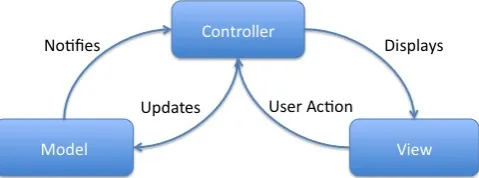
The Model-View Controller (MVC) design pattern (Krasner and Pope, 1988) aims to improve development of graphical applications by separating information from its representation, and its interaction. It was originally introduced in Smalltalk-80, and since been used in web applications, and mobile application development. The MVC pattern is driven by three aspects including:
• Model: Encapsulation of data, and behaviour relating to its state.
• View: The representation of the model, visually displayed to the user.
• Controller: Handles events from the user and or device, causing view and model changes if necessary.
There are various benefits of using the MVC pattern. Particularly, UI design and implementation can be carried out separately to the software controlling it, allowing for different types of developers to develop different elements of an application easier, while improving software reuse and maintainability.
2.4.2
View Implementation
As said above, the View is the representation of the model, displayed to the user. In terms of a GUI, a View is not a single entity, but more formed of other views. Each view corresponds to different elements of the GUI. Examples of GUI elements include the following:
• Textfields: Elements that are designed for text input and output. These textfields are normally used within forms, for example a page for editing contact details within a contacts application.
• Buttons: Elements that are pushed/clicked on by the user, which normally cor-respond to some particular application behaviour. Buttons can be used with a range of appearances. Particularly, image buttons can be used as a way of mak-ing static images of a GUI clickable, for example clickmak-ing on a contact photo, which then can prompt the user if they wish to change the image for the contact.
2.4. GRAPHICAL USER INTERFACES
• Radio Buttons: Elements that are designed for the user to select a single option only. Radio buttons are used in groups of two or more, whereby each button corresponds to a single option.
• Text Labels: Elements designed to help label and explain different widgets and or groups of widgets. Labels can be used to help the user know what data is expected within input widgets. If many text fields are on a single form without labels, it can be hard for the user to know what data is expected in each. By using labels, the user can know what type of data is expected.
• Layout Widgets: Elements designed to aid the developer in the layout of other widgets, usually by their use as View containers. GUIs can be designed with ex-act positioning where each widget is placed in a static position, but these perform badly when a GUI is used on different screen dimensions. By using layout wid-gets, GUIs can be made to support a wide range of screen dimensions, through more relative placements of widgets.
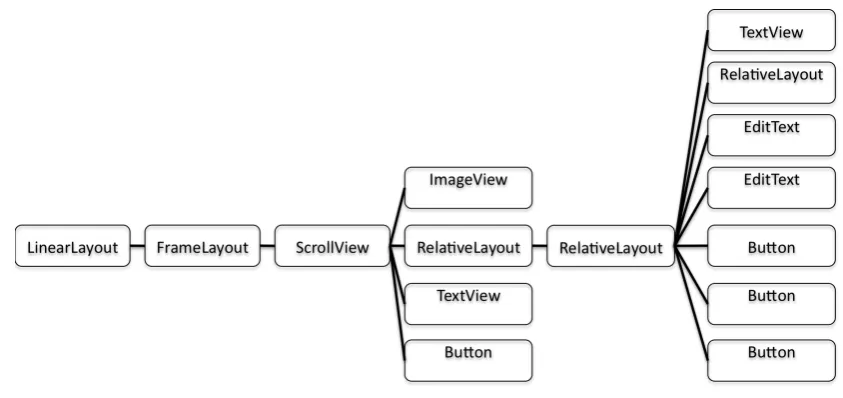
When creating a View, by using these different elements together, a tree structure of nodes and branches is formed (Kramer et al., 2011). These trees can be therefore created by the aggregation of other small GUI trees, creating more complex GUIs, while allowing for re-use in multiple windows. The GUI tree for adding new blogs in the Wordpress Android application has been depicted in Figure 2.3. This tree has a number of different layout widgets for relative and linear positioning. There are also different text fields, labels and buttons in the GUI.
Document-Oriented GUIs
GUIs have often been implemented through code statements in general purpose lan-guages e.g. C++, Java, Objective-C. Different elements of the GUI including visual properties and controls are created using program statements. This approach requires programming knowledge from the developer creating the GUI.
2.4. GRAPHICAL USER INTERFACES
Figure 2.3: A GUI tree from the Android Wordpress Application
and Android XMLBlock. For performance reasons, during compilation, many of these formats are preprocessed into formats for use in the final application.
By using a document oriented approach, there are many advantages discussed in Draheim et al. (2006) including separation of concerns, compatability, editability, and non-universality and abstraction. Furthermore, with many of the platform develop-ments, WYSIWYG editors are included, where a GUI can be built using drag and drop of widgets. This then means that the GUI can be previewed by the developer, without the need for compiling and running the application.
An excerpt of a GUI document for displaying blog posts in the Wordpress Android
1 application is shown in Listing 2.2. This document defines the layout for each row
of a list of blog posts, and also is an example of how documents do not define an entire GUI, but can define smaller reusable fragments. This layout is a collection of TextViews that act as labels for displaying important summary information of a post, including title, and date in which it was published etc. The LinearLayouts are used as layout widgets, which help to position the TextViews.
GUI documents in different platforms, while achieving similar goals, can differ in what and how elements are expressed. In iOS development for example, Interface Builder files take a far more close to metal approach to what is expressed, whereby the GUI document contains an XML representation of the runtime object graph. Be-cause of this, to avoid errors, the developer should keep the graphical tools of the SDK for editing these documents. Other platforms do not always take this approach, and
2.4. GRAPHICAL USER INTERFACES
instead use GUI documents that are far easier to edit by hand.
Listing 2.2: An Android GUI document
1 <LinearLayout xmlns:android="http://schemas.android.com/apk/res/android"
2 android:id="@+id/row_post_root"
3 android:layout_width="fill_parent"
4 android:layout_height="fill_parent"
5 android:orientation="vertical"
6 style="@style/WordPressListRowBackground"
7 ....> 8 <TextView
9 android:id="@+id/title"
10 android:layout_width="wrap_content"
11 android:layout_height="wrap_content"
12 android:textColor="#464646"
13 android:textSize="18sp" /> 14 <LinearLayout
15 android:layout_width="fill_parent"
16 android:layout_height="wrap_content"
17 android:orientation="horizontal"
18 ....> 19 <TextView
20 android:id="@+id/date"
21 android:layout_width="wrap_content"
22 android:layout_height="wrap_content"
23 android:textColor="#777777"
24 android:textSize="12sp" /> 25 ...
26 </LinearLayout> 27 </LinearLayout>
GUI documents are primarily designed for defining the visual representation of the GUI. This means that other aspects of the GUI including event listeners need to be defined within a view controller, or similar. In these controllers, GUI documents are instantiated in code, whereby GUI objects are created based on the documents. These objects are then displayed to the user and can be manipulated in code.
2.4.3
Dynamic GUIs
So far, we have discussed development of predominantly static GUIs. Nowadays though, as discussed earlier, the conditions in which the user and the application run is often changing with mobile devices. This has given a rise to more dynamic GUIs that can be adapted at runtime.
When discussing non static GUIs, two popular approaches have been proposed,
2.4. GRAPHICAL USER INTERFACES
adaptable, it means that the GUI can be altered by the user at runtime to suit their own needs. Alternatively, a GUI that is adaptive is not altered by the user, but by the system automatically based on different events or usage patterns. Many examples of adaptive GUIs exist, for example, the Eclipse2 development environment can be
considered as having an adaptive and adaptable GUI, due to additional buttons and controls being added to a users environment on installation of additional plugins. This GUI also allows the user to alter certain aspects of the GUI. In this dissertation our focus is centred around adaptive applications only.
Types of Changes
Using Adaptive GUIs (AGUI), the GUI can be subject to a number of changes. Here we attempt to look at the dynamic changes used in previous work to help understand the sort of changes we expect in a dynamic GUI, which will be used in the rest of this thesis:
• Alteration in layout based on visible widgets. This type of alteration can be based on the inclusion or deduction of widgets from a given layout. Depending on the condition, it may be right to add or remove different widgets on the screen, to help the user. An example of this includes removing buttons for unused func-tionality in a program, making the software more well suited for a usage pattern (Findlater and McGrenere, 2010).
• Alteration in widget visual properties. This alteration is primarily aimed at the alteration of widgets already on the screen. This can mean altering size and dimensions, or just give visual appearance (background image/colour) of the wid-get. An example of this includes indicating to the user that sound output is now muted by the alteration of the widget showing system sound volume (Paymans et al., 2004).
• Alteration in widget behaviour. Widget behaviour alteration encompasses changes in how the widget acts, or logic the widget invokes when clicked/pushed.
Usability of Adaptive GUIs
When considering GUIs that can be adaptive, one must always consider the usability effects. Several studies have considered the effects of adaptive GUIs on usability. In
2.5. SUMMARY
Paymans et al. (2004), the authors acknowledge that AGUIs can cause users to feel a lack of control, due to the interface being unpredictable and incomprehensible. As an experiment, it was considered that helping to build greater mental models of the system would increase the usability of the system. This study was carried out with 17 students from the Utrecht University, of which 8 were male, and 9 were female. The authors measured learnability and ease of use while simulated context changes were carried out using the tasks of watching video streams. Before and after watching the video streams each user had to complete a usability questionnaire. The study found that an improved mental model was not always needed. It was suggested that depending on the domain, to achieve ease of use, it may not be necessary to have an understanding of the system’s design.
Later studies including Lavie and Meyer (2010) examined the usability effects of adaptive GUIs within the context of in-vehicle systems. Within this study, four different factors were observed, including different tasks, routine and non-routine situations, age groups, and different levels of adaptivity. Different age groups were handle via two separate experiments, one for younger users using 64 participants with an average age of 25.7, and for older users using 24 participants with an average age of 58.6. The users were asked to carried out various takes, both routine and non routine, including reading a SMS message and sending a reply, reading an email message, reading news updates, and changing cd. It was found that intermediate level of adaptivity may be more beneficial to the user and that adaptivity does not benefit every condition. Fully adaptive systems were found to be more beneficial on routine user tasks.
2.5 Summary
In this chapter, the foundations of the subject areas in this thesis have been intro-duced. Firstly we introduced Software Product Lines as a software engineering ap-proach. Following this, context-aware adaptive applications were introduced. Finally, we introduced foundations in to GUIs, including adaptive GUIs.
2.5. SUMMARY
3
Dynamic SPLs and Adaptive GUIs
Contents
3.1 Introduction . . . . 35
3.2 Dynamic Software Product Lines . . . . 36
3.3 Graphical User Interface Adaptation . . . . 41
3.4 Context-Awareness . . . . 49
3.5 Research Goals . . . . 53
3.6 Summary . . . . 54
3.1 Introduction
3.2. DYNAMIC SOFTWARE PRODUCT LINES
3.2 Dynamic Software Product Lines
Until the last few years, SPLs were traditionally used for the creation of static software systems. These products were normally statically bound before the software is exe-cuted, and therefore cannot adapt at runtime. Lately the need for dynamic binding and the ability to alter a programs configuration at runtime has become a reality. Dynamic SPLs (DSPL) have been proposed as SPLs that bind variation points at runtime, which can exhibit the following properties (Hallste