1
Developing a National Framework for the
Effective Use of Lesson Observation in Further
Education
Project Report for UCU
By Dr Matt O’Leary
2
Contents
Pages
Figures and tables 3-4
Acknowledgements 5
1. Executive summary 6-7
2. Introduction 8-10
3. Literature review of lesson observation: understanding its role in
schools, colleges and universities in England 11-29
4. Research methodology 30-36
5. Findings and discussion 37-85
6. Conclusions and recommendations 86-91
7. References 92-97
3
Figures and Tables
Pages
Figures
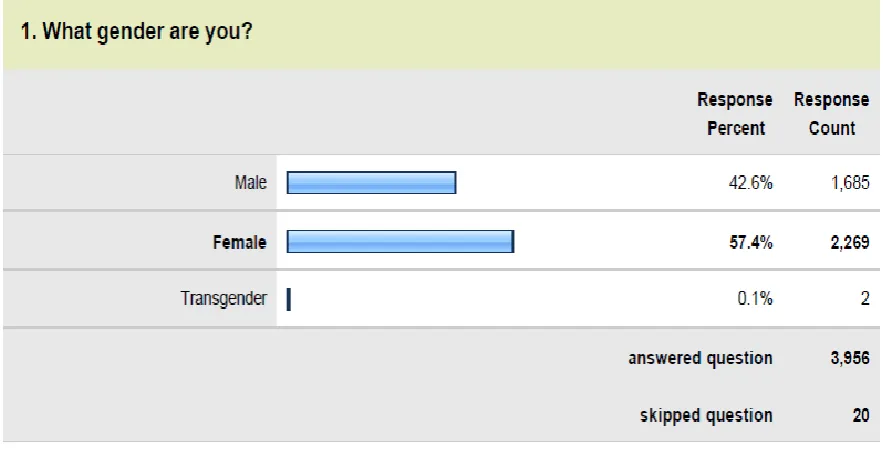
1 Gender 37
2 Employment status 38
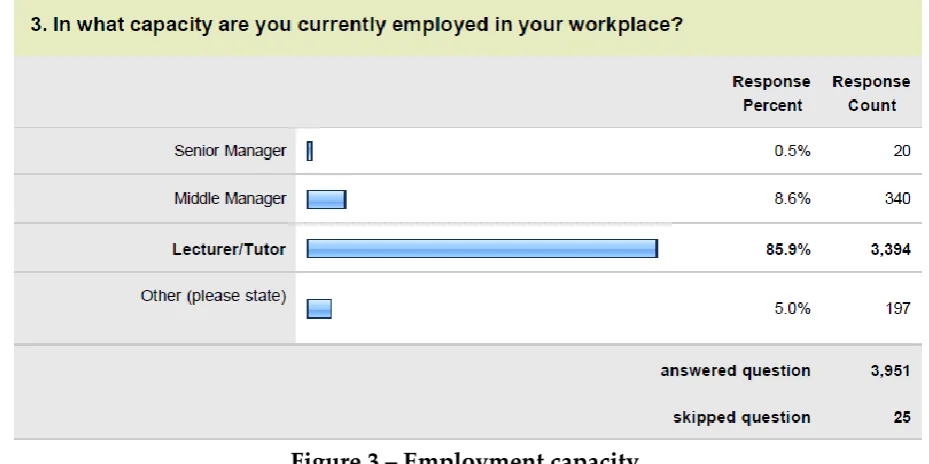
3 Employment capacity 38
4 Years of teaching experience 39
5 Observer, observee or both? 40
6 Contexts of lesson observation 40
7 Models of lesson observation 41
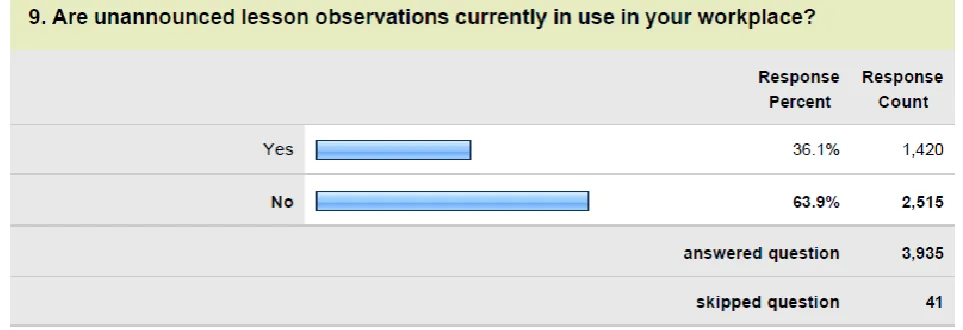
8 Use of unannounced lesson observations 42
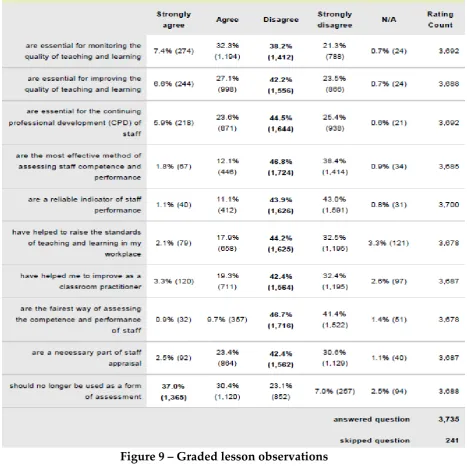
9 Graded lesson observations 44
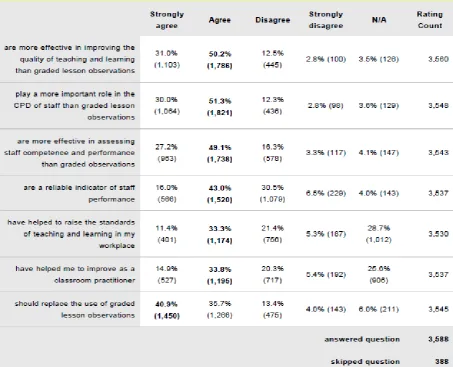
10 Ungraded lesson observations 48
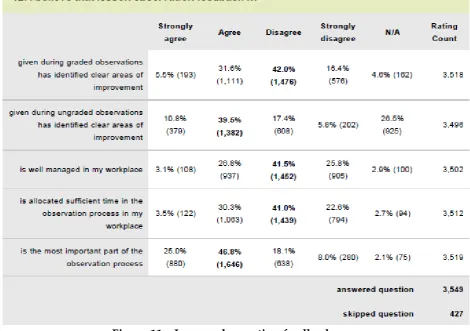
11 Lesson observation feedback 51
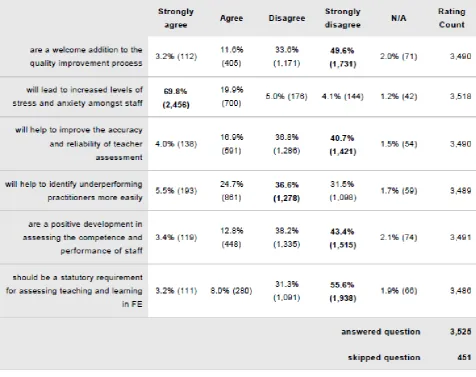
12 Unannounced lesson observations 53
13 Key thematic categories of the project’s findings 56
14 Multi-dimensional model of teacher appraisal 69
Tables 1 Sample of qualitative comments on graded observations 47
2 Sample of qualitative comments on ungraded observations 50
3 Sample of qualitative comments on lesson observation feedback 52
4 Sample of qualitative comments on unannounced observations 54
5 Summary of key themes and issues 57
6 Sample of qualitative comments on observation as a punitive tool 58
7 Sample of qualitative comments on observation as a ‘box-ticking’ exercise 60
8 Sample of qualitative comments on stress and anxiety associated with current observation regimes 62
9 Sample of qualitative comments on emphasis on judging and measuring rather than supporting improvements in teaching and learning 63
10 Sample of qualitative comments on preparation time for observations 65
11 Sample of qualitative comments on need for trust in the professionalism of teaching staff 66
12 Sample of qualitative comments on unfair reliance on observations to judge professional competence 68
13 Sample of qualitative comments on concerns about the validity and reliability of judgement 70
4
15 Sample of qualitative comments on importance of subject
specialist & fully trained observers 74
16 Sample of qualitative comments on professional credibility of
observers 76
17 Sample of qualitative comments on importance of observation
as a tool for professional learning 77
5 Acknowledgements
I would like to take this opportunity to thank everyone who contributed to this research project. From those UCU members who completed the online
questionnaire, to those who participated in the interviews and focus groups. Without the cooperation or generosity of these people in willingly giving up their time to take part, I would not have been able to gather such a rich collection of data, nor indeed compile a report that brings together such a comprehensive insight into the important topic of lesson observation in the FE sector. I would also like to thank Terry Pearson, an independent education consultant, for his contribution as a ‘critical friend’ in on-going discussions regarding the project, along with his
comments on an earlier draft of the report, all of which have proven very valuable.
Dr Matt O’Leary
6 1. Executive summary
This report explores one of the most widely debated and hotly contested initiatives to affect teaching staff in the FE sector in recent times, that of lesson observation. The report captures the views of thousands of UCU members working in a wide range of contexts and institutions and as such represents the largest and most extensive account of the topic to date.
Even before beginning to discuss the project’s findings, what emerges very clearly from this study is that the use of lesson observation and its impact on the
professional lives of the FE workforce is something that all the participants involved in this study felt very strongly about. To say that there was no shortage of opinions in all of the data collected for the project does not do justice to the magnitude of the responses. The qualitative responses in the online questionnaire are a good example of this. At the end of the questionnaire respondents were given the option of writing additional qualitative comments about the topic. Just under half of those
respondents who completed the survey (n = 1619) wrote comments in this section, which in itself is testament to the fact that lesson observation was a topic of
significant interest to them. To put this into perspective, these comments amounted to over 100,000 words of text. In short, whether it was written or verbal comments, lesson observation was undoubtedly a topic that generated a lot of discussion among the study’s participants and it was clearly something about which they had a lot to say and wanted to make sure their voices were heard.
Naturally the data presented in this report encompasses a breadth of views, as one might expect from the size and diverse representation of the sample (see section 3), though there were numerous aspects of the topic on which there was an overriding consensus among participants. One of the main findings to emerge from this study was the widespread discontent felt amongst UCU members towards the use of lesson observation as a form of teacher assessment. This dissatisfaction was
particularly targeted at graded models of observation, which have become the norm in FE over the last two decades (e.g. O’Leary 2013a). These were repeatedly criticised by a significant majority of participants for being little more than a ‘box-ticking’ exercise and, in some instances, a ‘disciplinary stick’ with which ‘to beat staff’. In relation to this, graded observations were also identified by many respondents as being a major cause of increased levels of stress and anxiety amongst teaching staff.
peer-7
based models with a focus on enhancing professional learning and development. Furthermore, many participants expressed the need to explore alternative
approaches and to move away from current normalised models of graded
observations driven by performance management agendas. What these alternative approaches might look like or consist of differed from one institution to another, though there are common features that seemed to apply regardless of contextual variables and these are explored in depth in sections five and six of this report.
There is little doubt that lesson observation has become increasingly associated with the monitoring of standards and teacher accountability in the sector over the last two decades. To say that respondents were fully supportive of the view that poor
teaching is not something that should be tolerated and that every effort should be made to eradicate it wherever it occurs might seem to be stating the obvious. How this should be done, however, was a matter of some debate. A recurring theme in the study’s data highlighted the shortcomings surrounding the current reliance of many institutions on graded lesson observation as the main – and sometimes sole – means of identifying and eradicating ‘poor teaching’, though opinions differed according to the employment role of some participants. Whilst teaching staff recorded high levels of disagreement regarding the effectiveness of graded observations, these views were not necessarily shared by senior managers, although it has to be acknowledged that the latter represented a very small percentage (n = 20) of the overall sample.
Many of the shortcomings expressed concerning graded lesson observations centred on the topic of assessment, in particular the key principles of validity and reliability of observation as a method of assessment. In other words, a viewpoint expressed by the majority of the study’s participants was that it was neither valid nor reliable to make a conclusive judgement about someone’s professional competence based on ‘snapshots’ or isolated, episodic performances. It was felt that any overall judgement needed to be inclusive of other key performance indicators (KPIs) such as student achievement rates, student evaluations, self-evaluations, peer reviews etc.
8 2. Introduction
In recent years lesson observation has become one of the most important methods of judging the performance of teaching staff in the FE sector both internally for colleges and externally for agencies such as Ofsted. The policy focus of the current coalition government suggests that this reliance on lesson observation as a key tool for assessing the quality of teaching and learning looks set to become even greater as teachers enter a new era of heightened scrutiny and performativity (e.g. DfE 2010; Ofsted 2012). Given its importance, it is somewhat surprising then that very little is known about the effects of observation on individual FE tutors or indeed its role in improving the quality of teaching and learning in general. This project seeks to make significant inroads in addressing that gap in knowledge.
Recent research carried out in FE has argued that the use of lesson observation has been predominantly shaped by a performance management agenda (e.g. Boocock 2013; O’Leary 2012a, 2012b, 2013a, 2013b). This has been reflected in the contexts and purposes for which observation has been used for assessing the performance of experienced, in-service teachers but also in the training and assessment of novice, pre-service teachers. This performance driven focus has culminated in a prescribed and codified model of what it means to be an effective teaching professional in some circles, with limited opportunities for the use of observation to stimulate
collaborative discussion about the process of teaching and learning. One of the principal aims of this research project was to construct an informed understanding of how observation operates across the sector, what the benefits and shortcomings are of current approaches and how observation might be harnessed most effectively to create collaborative networks between teachers whose collective goal is to enrich and support the continuous improvement of teaching and learning in classrooms.
Furthermore, recent reports into how lesson observation has ‘become an increasingly common flash point in colleges, triggering local negotiations, and in some places industrial disputes’ (UCU 2009: 1) have raised questions about the extent to which policy aims are being achieved and highlight the timeliness of this study. Over the last few years, UCU members have been involved in boycotting lesson observations in numerous colleges (e.g. UCU FE News, May 2012). There has also been an
increase in some colleges linking lesson observation outcomes with formal disciplinary procedures, heavily influenced by Ofsted’s recent policy shift to re-classify grade 3 from ‘satisfactory’ to ‘requires improvement’ (Ofsted 2012: 6). Yet, at the same time, there is also evidence of a move away from graded lesson
observations in some colleges.
9
expressed by all those present at the meetings with regard to members’ experiences of observation. Looking back on those meetings now, it is fair to say that many of the views and anecdotal evidence presented by college and regional representatives at that time were subsequently to be echoed repeatedly in the voices of the participants of this study.
It is anticipated that this study’s findings will have immediate relevance not just to UCU members working in the FE sector but to all staff involved in the process of lesson observation i.e. observers, observees and Senior Management Teams (SMTs). This does not apply solely to FE colleges, but to those involved in adult learning and work-based learning settings. In addition, the findings will be of interest to policy makers at national level, professional bodies and agencies with an involvement in or representation of the FE workforce. Finally, it is hoped the study will also contribute to wider discussions in the field of professional learning and development for staff in FE, but will also be relevant to the schools’ and HE sectors.
Overview of the research project and its focus
This project is concerned with investigating the role of lesson observation in the Further Education (FE) sector. It has two interrelated aims, the first of which is to explore and evaluate current models of lesson observation in use and their perceived purposes and effects on FE tutors’ professional practice and development. The
second seeks to examine and identify those aspects of lesson observation practice that create optimum opportunities for expansive professional learning and
development among tutors as well as those that restrict them. It is anticipated that the research findings will generate recommendations that in turn will help to form the basis of a national framework for colleges on how to make best use of lesson observation. This framework will be built on the core principle that observation is at its most effective as a form of intervention when it prioritises the growth of tutors’ professional learning and skills and empowers them to become active agents in the construction of their own professional identity, learning and development. The key objectives of this research project can thus be summarised as follows:
To conduct a national inquiry that examines the current use and impact of lesson observation schemes on UCU members working in the FE sector
To explore and identify observation models that are considered to reflect ‘good’ or ‘effective’ practice
To identify observation models that are considered professionally enriching and that prioritise the professional learning and development of FE tutors
10
The project is underpinned by the following interconnected research questions:
What models of lesson observation are currently in use in FE colleges?
What are the purported aims for their use and how well do the outcomes match these aims?
What is the impact of current models of lesson observation on improving standards in teaching and learning?
11 3. Literature review of lesson observation: understanding its role in schools,
colleges and universities in England1
Introduction
Lesson observation has a longstanding tradition in the assessment and professional development of new and experienced teachers in England. Over the last two decades it has progressively emerged as an important tool for measuring and improving teacher performance in schools and colleges. This section reviews relevant literature and studies across the three education sectors in England (i.e. schools, Further Education (FE) and Higher Education (HE)) in order to compare and contrast the role of observation. In doing so it discusses the key themes and issues surrounding its use in each sector and identifies common and contrasting patterns. It argues that in schools and FE, observation has become increasingly associated with performance management systems; a dominant yet contested model has emerged that relies on a simplified rating scale to grade professional competence and performance, although the recent introduction of ‘lesson study’ in schools appears to offer an alternative to such practice. In HE, however, there is limited evidence of observation being linked to the summative assessment of staff, with preferred models being peer-directed and less prescribed, allowing lecturers greater autonomy and control over its use and the opportunity to explore its potential as a means of stimulating critical reflection and professional dialogue about practice among peers. The section concludes with a synopsis of the recurring themes and issues to emerge across all three sectors with a view to establishing their significance to all those involved in the process of lesson observation. These themes and issues will also serve as useful reference points for discussion in later sections, particularly when analysing the study’s data.
The schools’ sector experience
Much of the existing literature on lesson observation is located in the schools’ sector with a particular focus on the practice of observation and takes the form of textbooks rather than research-based texts. Besides there being fewer studies in FE and HE, those that do exist have occurred mainly in the last decade. This in itself is
significant as it highlights how observation has a longer history in the schools’ sector (Grubb 2000; Wilcox and Gray 1996).
As discussed in the previous section, it was following the educational reforms of the 1980s and 1990s that observation materialised as well-established practice in schools. Although it had long been and continues to be a pivotal method of assessment in Initial Teacher Training (ITT) courses, its rise to prominence for qualified teachers was closely linked to wider political reforms at the time, which demanded increased public accountability and an educational reform agenda determined to impose greater control over what teachers did in the classroom (Lowe 2007). Amid concerns
1
12
about standards and the quality of teaching, observation emerged as a key method of collecting evidence on which to base subsequent systems of teacher appraisal. Marriott (2001: 3) has argued that:
The long term success of the school depends to a very great extent on the
quality of teaching … It is hard to see how the headteacher and other managers in schools can be fully aware of the quality of work unless they are gaining first-hand information by systematically observing in classes.
In a similar vein, back in the 1990s Wilcox and Gray (1996) referred to the
‘dominance’ of observation as the main method of collecting data about what went on in classrooms. This dominance was crystallised by the introduction of a cycle of inspection by Ofsted and formal appraisal for teachers as discussed previously.
Wragg’s seminal work, An Introduction to Classroom Observation (1999), is one of the most widely cited textbooks on the subject to date. It is located in the context of English primary schools and covers a wide range of themes related to observation pedagogy and theory, although the emphasis is largely on the practical application of observation as a pedagogic tool. Given the breadth of coverage in Wragg’s work it is helpful to use it as a starting point from which to explore some of the key issues and themes in the field and to relate these to other relevant studies.
At the beginning of his book Wragg raises the issue of the reliability of observation as a form of assessment. He remarks that ‘we often “observe” what we want to see’ (1999: vii). His comment draws attention to the subjectivity of observation and how events are ‘inevitably filtered through the interpretive lens of the observer’ (Foster 1996: 14). The subjectivity of observers’ interpretations is a common theme in the literature, particularly when discussing notions of good practice (e.g. Fawcett 1996; Montgomery 2002; Tilstone 1998). Wragg maintains that ‘mostly when we talk about a “good” teacher, an “effective” strategy or a “bad” lesson, we are referring to our own subjective perception (op. cit., p. 60). He exemplifies his argument by recalling a session in which thirty five highly experienced teacher educators were shown a videotape of a student teacher’s lesson and were asked to grade it on a scale of A-E (A at the top end of the scale and E at the bottom). Their grades varied from a D at the lowest end to a B+ at the top end of the scale. Such differing judgements illustrate the issue of observer subjectivity and reinforce the unreliability of observation as a sole method of assessment, especially when a grading scale is used to measure performance.
Wragg is critical of hierarchical grading systems as he claims that ‘the nature of the levels can still be vague and diffuse, using words like “adequate” or “considerable” that are open to widely differing interpretations (op. cit., p. 103). It cannot be
13
the meaning and interpretation of value-laden terms such as ‘good’ and
‘outstanding’, as used by Ofsted (See Brooks 2009; Wolf 1995). Wragg (1999) argues that these terms, together with the assessment criteria that underpin them, need to be carefully defined when used and attempts made to establish a collective
understanding. But even when such attempts are made e.g. standardisation exercises for observers in observation systems and associated assessment criteria, the
limitations of what they can achieve need to be acknowledged (Montgomery 2002).
In other words, whilst they might be useful in raising collective awareness among observers, it is unrealistic to expect the assessment criteria to be uniformly and consistently applied. Besides, extant research suggests that experienced assessors are likely to judge intuitively, even ignoring published criteria. Though it has to be said that this is not a phenomenon specific to observation as a method of assessment, but reinforces more widely held beliefs among key researchers in the field that
‘assessment is not an exact science and we must stop presenting it as such’ (Gipps 1994: 167). In her book on competence-based assessment, Wolf (1995) highlighted how ‘assessor judgement’ was underestimated as a significant variable in the assessment process, based largely on the misguided notion that the more detailed and specific the assessment criteria, the more objective it would make assessor judgement. Wolf goes on to say that this fails to understand the complexity of the assessment process and address the aspect of judgement.
In their two-year monitoring study of teacher appraisal in English primary and secondary schools, Wragg et al (1996) highlighted what they described as a ‘snapshot’ approach to lesson observation (i.e. one-off observations) as one of the main obstacles to identifying incompetent teachers. The reason for this was because such teachers could deliver the ‘rehearsed’ lesson as a one-off performance, hence avoiding detection. Marriott (2001: 8) has also highlighted the limitations of a
snapshot approach as ‘the impact of teaching on learning, and therefore progress, is harder to evaluate in the context of one lesson.’ As a means of mitigating such limitations, Wragg et al (1996) advocated the need for a series of observations to be carried out as part of a longitudinal approach to construct a more realistic picture of a teacher’s classroom competence. However, in their research into teacher
effectiveness, Campbell et al (2004: 133) maintain that ‘even successive observations of a teacher will only ever supply a collection of snapshots rather than a full picture of teacher behaviour over the year’. While they acknowledge the importance of observation as a source of evidence for systems of teacher appraisal, they also remark that as a method of data collection ‘it is often used with little regard for, or knowledge of, its characteristics’ (p.133). What they mean by this comment is that despite its widespread use as a means of gathering data, there is a lack of rigour in its application and insufficient awareness on the part of those carrying out
14
Wragg (1999: 3) succinctly summarises some of the paradoxes involved with observation when comparing the ways in which teachers respond to the different contexts in which it occurs and its application as a multipurpose tool in the following comment:
Skilfully handled, classroom observation can benefit both the observer and the person being observed, serving to inform and enhance the professional skills of both people. Badly handled, however, it becomes counter-productive, at its worst arousing hostility, resistance and suspicion.
The rules of observer-observee engagement are likely to differ according to who is observing whom, in what context and for what purpose. Underpinning Wragg’s comment and the observer-observee relationship are the notions of power and
authority. As Wragg comments, ‘the actual or perceived power relationship between observer and observed is not just a sociological concept, but rather a reality that needs to be recognised’ (op. cit., p.62). For example, if a head of department is
observing a newly qualified teacher (NQT), to what extent does the teacher feel able to challenge their assessment? Are efforts made to ensure that the observee’s voice is heard? How many observation schemes actually choose to tackle this issue? What efforts are made, if any, to address the distribution of power? These are questions that will be explored in later sections but for now it is worth acknowledging that what links them is the degree of ownership and autonomy afforded to the observee.
Ownership and autonomy are identified as key features of successful observation schemes in schools, which are characterised by a move away from authoritarian models where observation is something that is ‘done to teachers’ to a more
egalitarian approach in which ownership of the process is devolved to teachers (e.g. Metcalfe 1999; Tilstone 1998). Tilstone (1998: 59) advocates ‘partnership observation’, a term which she uses to express a more collaborative, democratic relationship
between observer and observee. She argues that ‘such partnerships will only work if the [observer] is not regarded as an authoritarian figure and is able to take on the role of facilitator with the teacher in control of direction of the observation and consequent actions’ (p. 60).
Metcalfe (1999: 454) reflects on his experience of the use of observation from the perspective of both a researcher and an Ofsted inspector:
15
These views can be seen to embody a wider, egalitarian philosophy of professional learning and development, sometimes referred to as ‘democratic professionalism’ (see, for example, Sachs 2001; Whitty 2000). A similar approach to observation is supported by two of the main professional associations for school teachers, the National Union of Teachers (NUT) and the Association of Teachers and Lecturers (ATL) (ATL 2008; NUT 2006). It is their shared belief that observation constitutes an important element of a teacher’s professional development and as such should be ‘neither a burden for the teacher concerned nor an opportunity to “police” a teacher’s performance’ (NUT 2006: 5), but ‘should be conducted in a manner that equates to a professional dialogue’ (ATL 2008: 1).
The advantages of observation programmes that prioritise development over surveillance are well documented. As Wragg argues (1999: 17), ‘good classroom observation can lie at the heart of both understanding professional practice and improving its quality’. When it is used insightfully observation can have a profound impact, which ‘can lead to a more open climate, greater trust between colleagues, and the development of strong professional relationships’ (Marriott 2001: 3). One of the biggest obstacles to the creation of such a climate would appear to be the issue of grading.
Historically, graded observation has been a contentious issue in schools and
provoked a resolute response on the part of the two largest professional associations for schoolteachers, the NUT and the National Association of Schoolmasters Union of Women Teachers (NASUWT) to campaign against its use (e.g. NUT 2007). Both unions believe that grading encourages school management to view observation as a surveillance mechanism with which to monitor the quality of teachers’ work, instead of seeing it as a valuable means of stimulating professional dialogue. Marriott (2001) maintains that the grade can take on such importance that it threatens to undermine the value of the dialogue and feedback between the observer and the observee. Both parties can ‘become hung up on what the grade means rather than how to improve the teaching’ (2001: 46). Such is the anxiety surrounding grading that the ‘teacher may become over-concerned about whether he or she has “passed”’ (Ibid.).
16
other islands – with students floating in between’ (Wang-Iverson 2002: 1). Far from being seen as a corrective mechanism to improve the practice of individual teachers, the planned impact of lesson study is meant to be collaborative and fully inclusive of all an institution’s practitioners. The emphasis is placed on the observation of an entire curriculum unit rather than an isolated lesson, and how those who teach that unit can enhance greater student understanding and achievement. In short, lesson study is broadly based on an action-research approach to studying what goes on in classrooms where teachers work collaboratively as active researchers. Furthermore, one of its unique characteristics is how it seeks to involve the learners in the
discussion and analysis of the observed lessons. According to Lieberman (2009), lesson study puts student and teacher learning at the centre of the observation process rather than teacher evaluation.
As part of a pilot project in England co-funded by the Teaching and Learning Research Programme (TLRP), the National College for School Leadership and the Centre for British Teachers (CfBT), teachers from twenty schools (both primary and secondary) across eight local authorities were involved in the trialling of lesson study with the aim of answering the project’s key question: ‘Would Lesson Study work in the UK and if so would it do so in a way which would add value to the range of professional development approaches already in use?’ (Dudley 2007). The research was conducted in two phases: the first phase from 2003-06 and the second from 2007-2010.
One of the findings to emerge from the first phase of the project was that lesson study was found to be a ‘popular, powerful and replicable process for innovating, developing and transferring pedagogic practices’ (Ibid.). According to Dudley ‘it was popular with both experienced and less experienced teachers alike’ and had a
‘demonstrable impact on the quality of teaching and on pupil progress and
attainment’ (Ibid.). It remains difficult to analyse the validity and reliability of these claims given that these were emergent findings from an on-going research project, the methodology of which was not made transparent.
The second phase of the research aimed to explore the ‘critical features of teacher learning in lesson study’ and what distinguished it as a form of classroom inquiry. Some of the key findings indicated that lesson study fostered joint risk taking among teachers, enabled teachers to develop evidence-based practice to inform their
professional learning and empowered them to take control of their professional development through their own classrooms (Dudley 2008).
Dudley (2007, 2008) claims that the use of lesson study has subsequently become more widespread across schools in England in recent years, with particular
17
there is evidence of a growth in the use of lesson study as a form of intervention in teacher development in other countries. Lieberman (2009), for example, has reported on the popularity of lesson study increasing in the USA over the last decade. In her research Lieberman (2009) found that lesson study encouraged greater openness among staff, which helped to expose vulnerability as an issue that affects both
experienced and novice teachers. Reinforcing some of Dudley’s (2007, 2008) findings, Lieberman argues that lesson study has helped to foster a collegial approach to teacher development through peer observation and thus prompted teachers to take more risks in their teaching.
The FE sector experience
There has been comparatively little research regarding the role of observation in FE to date. One of the first studies was Cockburn’s (2005). His qualitative research consisted of interviews and focus groups with observers and observees as well as documentary analysis of the chosen institution’s observation policy and feedback reports. The research was based in one college and although the number of
participants is not specified, one gets the impression that it was a relatively small cohort. The study’s aim was to report on the perceptions and attitudes of staff to the use of observation.
Cockburn (2005: 376) provides what he refers to as a ‘typology of resistance’ of those who expressed negative views about observation. Some of the issues that he lists resonate with other work (e.g. O’Leary 2006, 2011, 2012b, 2013a; Wragg et al 1996). For example, he suggests that there is evidence of ‘artificiality’ in lessons as a result of being observed, which leads some tutors to adopt an ‘orthodox style of delivering lessons’ (p. 380) on the basis that there is a ‘formula’ for effective teaching. Such changes in behaviour are considered symptomatic of the methodological problem of
reactivity or what is commonly referred to as the ‘Hawthorne’ effect (see section 5 for further discussion). That is the extent to which the behaviour of the observed
environment is influenced by the observer’s presence and/or the observee alters their behaviour due to an awareness of being observed. Nevertheless, in a much larger and more recent research study, O’Leary (2011) found that this ‘artificiality’ and ‘orthodox’ teaching style were largely due to the high stakes nature of the
assessment and what he describes as the ‘normalisation of practice’, which resulted in many teachers ‘playing the game’ in order to ensure a successful outcome during graded observations (see below for further discussion).
In Cockburn’s study the credibility of the observer also emerged as a contested issue amongst observees, specifically relating to their experience and suitability to
perform the role. O’Leary’s (2011) research unearthed similar findings. Many of his participants’ comments about credibility tended to converge around whether observers were still current practitioners. A popular complaint on the part of
18
for some time and thus had ‘lost touch with the classroom’. Equally a significant percentage of observers stated that they thought it was essential to still be teaching for them to remain credible in the eyes of their colleagues.
Related to the question of credibility in O’Leary’s (2011) research was whether the observer had knowledge and/or experience of teaching the subject area of the observee. There were numerous instances of teachers having been observed by colleagues from curriculum areas that appeared to have little in common with their own. Gavin, for example, was an agricultural studies tutor who was observed teaching tractor driving to a group of teenagers by an IT specialist. Debbie, a special needs teacher, was observed teaching a dance and movement class to a group of young adults with severe learning difficulties by a manager from engineering whose students were mainly HE level.
Like Wragg (1999) above, Cockburn makes reference to the power relationship between observer and observee, arguing that ‘the observer is commonly perceived as possessing greater power’, which ‘is legitimised by organisational arrangements’ (2005: 384). This is a phenomenon that has been commented on by other writers in the field particularly regarding how it threatens to undermine the developmental potential of observation. This is accentuated when it is used to fulfil the dual purpose of performance management requirements and the developmental needs/goals of teachers (e.g. Ewens and Orr 2002; O’Leary 2006, 2011).
O’Leary (2006) has argued that an assessment approach to lesson observation, like that employed by Ofsted and internal QA schemes, is ineffective in terms of its impact on improving the standards and quality of classroom teaching and learning. The primary purpose of such approaches ‘is not to inform and improve current practice but simply to make a judgement about the quality of teaching and learning being observed’ (p. 192). One of the main problems with such approaches according to O’Leary is that they ‘place an inequitable proportion of control and decision-making at the behest of the observer, thus limiting the role of the person being observed (the observee) to that of a passive recipient rather than an active participant’ (Ibid.).
O’Leary’s (2011) recent research adopted a mixed-methods approach and was carried out in a sample of 10 colleges situated across the West Midlands with a total of 500 participants, consisting of 50 from each college. The sample comprised
19
performance, prioritising the needs of performance management systems over those of their staff. Yet, in contrast, in those colleges where there was evidence of an
‘expansive approach’, grading was seen as less important, as the professional development needs of staff underpinned the way in which observation was used.
O’Leary’s (2011) research data also uncovered repeated examples of teachers being encouraged to demonstrate normalised models of ‘effective practice’ based on prescribed notions of ‘excellent’ or ‘good’ teaching, often cascaded from senior management, who were understandably keen to promote ‘best practice’ given the high-stakes nature of such observations particularly during inspections. One of the repercussions of this pressure on teachers to perform was how it encouraged what Ball (2003) refers to as ‘inauthenticity’ in teacher behaviour and classroom
performance during graded observation. This was typically manifested in the
delivery of the ‘rehearsed’ or ‘showcase lesson’, where the teacher concerned ‘played the game’ in order to succeed. For example, Terry, an engineering teacher with over twenty five years’ experience, provided a candid and detailed account of how he followed a ‘checklist’ in the planning and delivery of a recent observation to achieve in order to ensure that he achieved a grade one:
So you know your lesson plan inside out. You make sure there’s a plenary, a couple of plenaries in there, at the start and the end of the lesson. Put a load of crap in with regards to getting the students to do some sort of learning activity at the beginning to show that they have learnt from the previous week’s work, put your core tasks in and don’t forget that old chestnut about “differentiating” in the tasks you include! Give them a little quiz, move on to the next one and then make sure you do a good summary and do a nice little feedback session with them. Fiddle your scheme of work so you’re doing the lesson that you want to do, make sure that all the hand-outs have got the college logo on them and they’re all nice and neat with no smudges, do a lot of questioning, do a lot of walking around, then bring some work in with you so you can show that you’re giving them adequate feedback.
Terry was openly cynical of what was required to secure a high grade. His
knowledge of ‘which boxes to tick’ was indicative of many astute tutors’ pragmatic response to the use of graded observation and the need to ‘play the game’. In other words, they were able to assimilate those features of pedagogy that had been identified as part of a toolkit for ‘good’ or ‘outstanding’ lessons, often by SMTs and/or external consultants, and subsequently apply them to their own teaching when being observed. This resulted in such practice becoming normalised and adopted as the default model for all those striving to achieve a high grade, which itself raises questions concerning the validity and reliability of graded observation as a means of assessing classroom performance, two important factors that are
20
‘outstanding’ are reinforced by a plethora of publications and short courses currently available across the sector informing staff how to attain a ‘grade 1’.
O’Leary’s (2011) research drew on and was informed by the work of Foucault (1977, 1980, 2002) as its theoretical backbone, along with concepts relating to theories of new managerialism and performativity. Foucault’s work, in particular, provided a useful framework for analysing the phenomenon of lesson observation as some of the key concepts he explored provided a lens through which to examine
relationships of teacher agency and structure, as well as a language with which to describe and discuss the phenomenon of observation, for example, the concept of ‘normalisation’.
Normalisation is a Foucauldian term that can be defined as the adjustment of behaviour to fall into line with prescribed standards. Perryman (2009: 614) states that:
Normalization is a powerful mechanism of power which is achieved through the hegemonic internalisation of discourses of control. In general, this means that those who are subjects of power internalise expected behaviours and learn these behaviours through acceptance of a discourse.
In the case of O’Leary’s (2011, 2013a) research into the use and impact of models of graded observation, normalisation can be seen as a means of conceptualising the process by which teachers operate within the accepted norms of “good practice”, a concept largely determined by agencies such as Ofsted. In her research, Perryman (2006: 150) argued that it is the discourse of school effectiveness research that has been appropriated by Ofsted that forms the dominant discourse in the context of inspections, which ‘uses performativity and normalization as its mechanisms’. Perryman identifies this as an example of the use of knowledge to convey power.
Foucault (1977: 184) asserted that ‘the power of normalization imposes homogeneity; but it individualises by making it possible to measure gaps, to determine levels, to fix specialities and to render the differences useful by fitting them one to another.’ The ‘homogeneity’ that Foucault refers to is imposed by the requirement for all teachers to demonstrate standardised notions of good practice during graded observations. Those that are able to manifest such normalised behaviour become members of a homogenous community; those that fail to do so are identified through gaps in their assessed performance. The means by which such gaps are measured and levels determined is through a procedure that Foucault referred to as the
21
Hardman’s research (2007) adopted a case study approach in which the practice of observation was explored in three FE colleges and three HEIs. In seeking to identify differences between the two sectors, she reported that observation was much more heavily associated with Quality Assurance (QA) and performance management systems in FE colleges where there was an emphasis on grading staff. This contrasted with HE where there was a tendency for it to occur in developmental contexts, reflected in the prevalence of informal and ungraded peer observation as the most common model of practice and discussed in the following section. This viewpoint is echoed by Armitage et al (2003: 50) who refer to observation as the ‘mainstay of the [FE] institution’s quality assurance process’, although they are also keen to stress its value as ‘the basis of some of the most useful professional reflection you can undertake in order to improve performance’ (p. 47).
The three FE colleges in Hardman’s study all had observation policies and procedures that sought to combine the purposes of QA requirements for Ofsted, together with internal staff development agendas. Observation schemes are certainly time intensive and expensive for colleges. With limited budgets it is hardly
surprising that colleges should attempt to dovetail two different purposes into one scheme. However, as Hardman suggests, the effectiveness of such a strategy is questionable. QA requirements appear to take precedence over the developmental needs of teachers. Furthermore, the use of observation for QA purposes is not without its controversies as has been discussed elsewhere
O’Leary’s (2011) research revealed that the prioritisation of the performance
management agenda over the developmental led to the nullification of observation as a tool for CPD in many institutions. As a result, teachers have come to experience a growing sense of disempowerment, increased levels of anxiety and general
discontent in relation to its use. A recurring theme from O’Leary’s data was the perceived lack of benefit of graded observation to teachers. Some said that the
college management was the only beneficiary as it provided them with the necessary data to compare levels of performance to national benchmarks. Others referred to it as a ‘tick-box’ exercise that was more concerned with satisfying Ofsted than their development needs. Equally senior managers were sceptical of the use of such data as they saw it simply as part of the ‘evidence trail’ required for Ofsted.
Postlethwaite (2007) states that ‘observing classes as part of quality assurance procedures has become a contentious matter in many FE colleges’ (cited in James and Biesta 2007: 168). This is a viewpoint shared by the main professional association for the sector, the University and College Union (UCU) who report that it has
‘become an increasingly common flash point in colleges, triggering local
22
lesson observations with the Association of Colleges’ (UCU 2009: 2), though legislation in the 2010 white paper for schools (DfE 2010) has since threatened to undermine this agreement in schools. The FE stance came as a response to complaints from members regarding the draconian, ‘intimidatory and not
supportive’ way in which observation was being used by managers in some colleges (Lee 2007). At the centre of the debate was the issue of grading. O’Leary (2011) found in his research that in some cases, teachers are threatened with disciplinary action or denied annual pay increments if they are rated as a grade 4 or even a grade 3 on the Ofsted scale. In recent times the issue of unannounced observations has also become another hotly debated topic. Unions contest that they are being used by some
unscrupulous employers to single out and harass specific individuals, though practices seem to vary across the sector with some institutions including them as formal, graded assessments and others as informal, ungraded visits. Interestingly, in the USA, where they have been in use for some years, Downey et al (2004) argue that unannounced observations or ‘walk-throughs’ as they call them, were originally intended to be separate from any formal teacher evaluation process and to be used strictly as a means of engaging teachers in dialogue and reflection about teaching practices and school-wide goals.
From 2006-09, researchers based at the University of Huddersfield published three separate reports (Burrows 2008; Ollin 2009; Peake 2006) into the use of observation in the context of ITT programmes as part of the ‘Huddersfield Post-Compulsory
Education and Training (PCET) Consortium’.
The first of these reports (Peake 2006) explored the perceptions of teacher educators and trainee teachers concerning the purposes of observation and sought to identify examples of good practice. The research methods consisted of two survey
questionnaires, one for trainee tutors and the other for subject specialist mentors, as well as interviews with eleven teacher educators working at five different centres. In total there were 134 responses to the trainees’ questionnaire and only four responses to the mentors’ questionnaire, which had been sent to 12 mentors in total. No
explanation was provided for why there was such an imbalanced ratio between these two groups, which was surprising given how the report emphasised the importance of subject mentors in the observation process.
Although the research lacked a discernible theoretical framework with which to analyse the data, its key findings revealed some interesting areas of discussion resonating with issues covered in related studies. Below is an adapted summary of these based on the original report:
Importance of the observer being a subject specialist
23 Concerns regarding the lack of consistency and standardisation of practice
between observers across the consortium
Trainees avoid taking risks in observed sessions
Value of peer observation in professional development
Observation is resource intensive – it is time-consuming and expensive
The second report (Burrows 2008) focused on exploring trainees’ perceptions of observation as part of the ‘new curriculum’ i.e. the increase in observation to a minimum of eight hours under the LLUK qualifications (2007), together with the undertaking of mentor observations to support the development of subject specialist pedagogy. The project was underpinned by two aims: ‘To identify the perceptions of trainees of observations within the new curriculum [and] to formulate an action plan to improve observations based upon the analysis of the research’ (p. 5).
Although the research aimed to explore issues confronting both pre and in-service trainees and their observers during observation, only the former were included as part of the sample. Eighty participants completed a questionnaire similar in focus and design to that used in Peake’s (2006) study, followed by four focus groups in which sixty five trainees participated. Like Peake’s study, there is a lot of descriptive detail but no theoretical underpinning. Notwithstanding these shortcomings, the key findings summarised below add to the undeveloped field of observation in FE:
More structured training of observers needed, particularly subject mentors who are unfamiliar with the observation process
Over fifty per cent of respondents thought that ITE observation should not be graded compared to a third who thought that it should.
Observation as ‘formative’ assessment is a key means of supporting
professional development and more value should be attached to it than course assignments. Peer observation is highly valued.
The third report (Ollin 2009: 5) was carried out:
[I]n response to the introduction of Ofsted’s new grading criteria for inspection of ITE in the [sector] (2009), which state that over fifty per cent of trainees need to be judged ‘outstanding’ for an ITE provider to achieve the highest inspection grade.
The research explored the implications of introducing the Ofsted scale for teacher educators across the consortium. Ollin remarked that the grading criteria on
Huddersfield’s programmes ‘previously operated on a pass/fail basis’ and that the transition to the Ofsted scale ‘will influence the way that Certificate in
24
to adapt to changing policy, while also protecting the values and beliefs that underpin many ITE programmes i.e. the emphasis being on encouraging teacher development through a combination of formative and summative assessment where the former is prioritised over the latter. Nevertheless, Ollin fails to point out that providers are not obliged to adopt Ofsted’s scale as a replacement for their own assessment criteria. It is the choice of an institution to decide to do so or not.
The underpinning aims of Ollin’s (2009: 12) research were, ‘To develop a working conceptualisation of what constitutes ‘outstanding’ teaching [and] to use this information to further develop staff and quality systems, taking into account issues of grading of trainees’ practical teaching’. The research was ‘qualitative and
interpretive in nature’ and used interviews and observations. These included a small sample size of nine case studies of ‘outstanding’ and ‘weak’ trainees during which the ITE tutors were observed carrying out observation and giving feedback,
followed by a semi-structured interview ‘focussing initially on understandings and judgements of “outstanding” related to the specific observation’ (p. 15). Some of the key findings revealed:
Mixed interpretations as to what constitutes ‘outstanding’. The conclusion reached is that ‘outstanding teaching is more than the sum of its parts’ (p. 30).
The need to consider the effect of context on the notion of ‘outstanding’.
Tensions between the ‘dual identities’ of those in-service trainees observed on ITE programmes and as part of internal college QA schemes. In the first instance they are seen as ‘students’ with ‘developmental needs’ and in the second as employees with an obligation to prove their professional
competence. Similar tensions were revealed by observers who were involved in observation as ITE tutors but also in college observation for QA purposes.
Resistance on the part of observers to grading based on the premise that it undermined the developmental nature of ITE observation.
Like the two previous reports from the Huddersfield Consortium, this report is descriptive. The research concludes that the Ofsted grading criteria are likely to have a significant impact on future ITE programmes across the Huddersfield consortium and present a challenge in ‘balancing the underpinning values related to the learning and development of trainees with increasing demands for standards of teaching to be monitored and assured’ (p. 6). It is surprising though that there is no reference to previous studies carried out in this specific field (e.g. Cope et al 2003; Sharp 2006), which have argued that the graded assessment of observation for trainee teachers is unsustainable on the basis that:
25
from research and imply that the assessment of teaching is based on measurement rather than professional judgement (Cope et al 2003: 683).
Finally, Lawson’s recent research (2011) has explored the use of an ‘observational partnership’ between a university education department and three local colleges. After outlining the principles and processes underpinning the partnership, along with a brief summary of its history, he goes on to discuss the findings from his research, which was based on a content analysis of the texts of 924 observation report forms collected between 2002 and 2009. The aims of the analysis were to ‘establish an understanding of which practices may be successfully changed through observation of the classroom and which may be more resistant to transformation, as well as giving insights into the process of enacting change in the classroom’ (p. 10).
Lawson’s analysis identified two areas of teachers’ classroom performance that appeared to lend themselves more easily to change (‘planning for learning’ and ‘assessment for learning’) and two that were more resistant (‘questioning’ and
‘student involvement’). In relation to the former, the findings revealed no discernible patterns as to why these two aspects seemed more conducive to change than others. With regards to the latter though, Lawson argues that in the case of ‘questioning’, ‘the practice is so complex and nuanced that it is difficult for teachers to develop their practice’. As for ‘student involvement’, Lawson puts this down to ‘deeply ingrained habits and suppositions about teaching’ (p. 17). In other words, old habits die hard and it is difficult to get those who have spent their entire career using a teacher-centred approach to embrace a more student-centred philosophy in their teaching, though this is also exacerbated by the pressure faced by many teachers to ‘get through the curriculum’ so as to ensure as high a level of achievement amongst their learners as possible.
Lawson concludes by stating that ‘sustained observation offers a robust way of changing some classroom practices and of making inroads in others’. He attributes the success of the partnership’s observation scheme to its collaborative nature and its ‘continuity’, which has helped to establish a mutual understanding and trust
amongst those involved as to what its purpose is i.e. to encourage an open, shared dialogue between observer and observee with a view to further improving teaching and learning. Notwithstanding this, he is mindful of how not all those observees involved were ‘open to the possibilities of change’ and this was manifested by them ‘going through the motions’ (p. 18).
The HE sector experience
26
schools’ sector, its use is much less commonplace or prescribed. There is less
evidence of links to formal, centralised QA systems and it appears to operate mostly on an informal, voluntary and departmental basis. Hardman’s research (2007)
revealed that it also occured as part of academic programmes of professional study for staff, such as the postgraduate award in Learning and Teaching in HE, a
compulsory qualification for new staff in many post-1992 universities. Even in such contexts though, there seems reluctance to grade performance as the emphasis appears to be on the developmental support of staff rather than an evaluative judgement of them.
The dominant model used in HE would appear to be ‘peer observation’ (Hammersley-Fletcher and Orsmond 2004, 2005; Peel 2005; Shortland 2004). Shortland (2004: 220) defines peer observation as ‘peers observing each other’s teaching to enhance teaching quality through reflective practice, thereby aiding professional development’. There are some researchers, however, who contest the generic application of peer observation in HE as an all-encompassing term for observation and instead prefer the label ‘third-party observation’ (Fullerton 2003; McMahon et al 2007). For them the term peer observation refers to a specific model of observation based on a collaborative partnership between peers, which is
underpinned by ‘equality between observer and observed’ (McMahon et al 2007: 500). This is a legitimate and helpful terminological distinction to make, especially if we are to avoid a blurring of the boundaries between the different models, contexts and purposes of observation.
Extant research reveals a commonality in the key issues, most of which centre on the perceived opportunities and threats associated with the use of peer observation in HE. Peel (2005) is mindful of its potential danger as a surveillance tool on an institutional level. Research carried out among GP teachers revealed opposition to schemes that used peer observation to address the twin aims of teacher development and QA. Such schemes were considered ‘unlikely to succeed if seen to be conveying quality assurance in the guise of tutor support’ (Adshead et al 2006: 72). The
transparency of the aims and objectives of any peer observation scheme in HE is regarded as fundamental to avoid it being viewed with suspicion by lecturers (Hammersley-Fletcher and Orsmond 2005; Peel 2005; Shortland 2004).
27
a shared understanding of what was meant by the term ‘critical feedback’ was missing. It also exposed their lack of experience in providing constructive feedback.
In Hammersley-Fletcher and Orsmond’s study the success of the peer relationship between observer and observee was seen to be dependent on the notions of trust and confidentiality. These were considered fundamental to facilitating honest reflection. It also emerged as an important issue in other studies (e.g. Gosling 2002; Shortland 2004). Gosling (2002: 2) talks about the need for staff to be seen as ‘genuine peers in which there is real mutuality and respect for each of the participants as equal’. He suggests that the process can be undermined if the observer is senior in hierarchy to the observee, although his claim is unsubstantiated. His concerns seem to be based on the premise that such a relationship is likely to result in more senior members of staff taking charge, hence threatening the equality of the interaction.
In an autobiographical study, Peel (2005) reflects on her personal experiences as a new lecturer and examines the arguments for and against peer observation. She avers that it can be a useful means of facilitating reflection as long as it incorporates reflection on wider issues of the teaching and learning process and not just that of the observed lesson. She remarks that it was as a result of engaging in critical
reflective thinking triggered by the feedback element that led to her successful CPD rather than discussion centring on the observation itself. Thus, peer observation is being used as a ‘lens’ to stimulate critical reflection (Brookfield 1995). Similarly, Hammersley-Fletcher and Orsmond (2005: 223) highlight the importance of reflection. Like Peel, they see peer observation as ‘a vehicle for encouraging academics to develop their reflective thinking about their role as professional lecturers and to seek and engage in developmental processes as a result’.
Following the Browne (2010) review into university funding, the president of the National Union of Students (NUS), Liam Burns, called for all university lecturers to be subjected to similar training programmes to those of their counterparts in schools and colleges (Boffey 2012). His rationale for the need for the introduction of such qualifications was set against the background of the significant rise in university tuition fees and the need to ensure QA mechanisms that students were being taught by appropriately qualified staff. If the government were to follow up this
recommendation, it would suggest that it may not be long before the use of lesson observation is introduced as a form of measuring quality/standards in HE.
Synopsis of key themes and issues across the sectors
28
need to be established for this to work successfully i.e. notions of mutual trust, respect, ownership etc. At the same time, there are divergences between the three that partly reflect their historical status and the history of policy in each sector. In FE and schools observation appears to have operated principally to satisfy policy driven agendas of performance management systems, especially in FE. In HE, its role is less prescribed, thus allowing lecturers more autonomy and control over its use, though arguably this can be attributed to the fact that the observation of teaching is not included in Quality Assurance Agency (QAA) inspections of HEIs whereas it is one of the main sources of evidence in Ofsted inspections.
The use of graded observation has triggered debate regarding the reliability of observation as a form of assessment in schools (Wragg 1999) and more so recently in FE (O’Leary 2011). In some ways graded observation is perhaps the single most contentious issue relating to the topic. Its performance focus is something that seems to have provoked strong reactions across both sectors. Brown (in Brown et al 1993: 51) compared such models of observation to the traditional examination in that both teacher and student are required to produce ‘peak performance under stressful conditions with little opportunity for dialogue with the examiner and no real chance to gain meaningful feedback on how things are going.’ There is a natural link here to Foucault’s (1977) notion of the ‘examination’, where the performance of the teacher becomes subjected to a process of ‘objectification’ through the system of graded observation. Gipps (1994) refers to such types of assessment as ‘high stakes’. In her work on the assessment of high school students, she found that normative grading threatened collaborative learning by provoking unhealthy competition and impacted negatively on levels of motivation. More recently, Coffield (2012) has expressed similar concerns regarding the use of graded observations in FE colleges.
Some of the existing research has highlighted how the performative nature of graded observations has resulted in a decline in the creativity and innovation of teachers’ work in the classroom (e.g. Coffield 2012). There is a reluctance to want to ‘take risks’ for fear of being given a low grade. Teachers are aware of the need to ‘play the game’, which can result in them following a collective template of ‘good practice’ during observation. According to Elliott (1990: 83), this is an example of
‘management exercising control over performance by preventing teachers from reflexively developing new understandings of the nature of teaching and learning tasks’. In FE, Peake (2006) has illustrated how even in the context of ITE trainees avoid taking risks during observation. Yet recent research into the use of lesson study among qualified teachers in schools seems to suggest a counterbalance to this.
29
in HE. Referring to Ramsden (1992), Jones (in Brown et al 1993: 31) comments that in order for observation to work it needs to be part of a teacher’s professional
development and not something that is ‘done to them’:
Ownership of observation needs to be devolved down as much as possible to the participants in the teaching process. The closer the ownership of the process is located to the actual participants, the more likely it is that the aims will be achieved and the outcomes accepted by all concerned (Brown et al 1993: 10).
To conclude, across all three sectors previous studies have revealed that observation is regarded as an important means of evaluating, reflecting on and improving the quality of teaching and learning as well as contributing to a greater understanding of these processes. Whether this occurs as part of QA systems or CPD programmes, the central role that observation has to play in the professional practice of teachers seems incontestable. Where the contestations start to emerge, however, is in relation to the stated aims behind its use, the extent to which the outcomes match these aims and the way in which the process of observation is operationalised.
Wragg (1999) argued that the purpose of observation should largely determine how it is used, but evidence above and sections 5 and 6 of this report suggests that the boundaries between different models, contexts and purposes have become blurred and contested. At the heart of these contestations lies a conflict between ‘structure’ and ‘teacher agency’, and related notions of power and control that manifests itself in the sometimes paradoxical agendas of policy makers, the institution and its teaching staff. This conflict is epitomised by the way in which the developmental needs of staff and the requirements of performance management systems are forced to compete as they are often conflated into a ‘one-size-fits-all’ model of observation in schools and colleges, with the latter overshadowing the former.
Summary
This section has reviewed relevant literature and previous studies of lesson
observation across the schools’, FE and HE sectors. It has identified key themes and issues to emerge in each sector and provided a synopsis of areas of commonality and differences. Many previous studies and publications have focused largely on
descriptive accounts of practice with limited discussion of the wider contexts and cultures in which it is situated. Where there have been links to context these have often occurred in relation to ITT. Nevertheless, more recent work in FE (e.g. Coffield 2012; O’Leary 2011, 2013a, 2013c) has helped to develop a synthesis between the practice of observation and the contexts in which it occurs. The use of observation in the university sector is still relatively new, with much of the existing research
30 4. Research methodology
Research design
This research project adopted a mixed-methods approach involving quantitative and qualitative methods of inquiry. Johnson and Onwuegbuzie (2004: 17) define mixed-methods research as:
A class of research where the researcher mixes or combines quantitative and qualitative research techniques, methods, approaches, concepts or language into a single study.
It was anticipated that the combination of these methods would help to provide the study with a balance between breadth and depth in its data collection and analysis, as well as building on their complementary strengths. Online questionnaires, semi-structured interviews and focus groups were the main research tools used as part of a triangulated framework to address the project’s research questions as listed in the report’s introduction. Some of these questions were of a factual nature and thus leant themselves to a quantitative method of inquiry. Others sought to explore the
experiences and perspectives of practitioners in the form of a narrative and so required a qualitative approach. As Arksey and Knight (1999: 3) have argued, ‘perception, memory, emotion and understanding are human constructs, not
objective things’. Interviews and focus groups therefore represented an opportunity to gather ‘rich data on people’s views, attitudes and the meanings that underpin their lives and behaviours’ (Gray 2004: 213).
The rationale for a mixed-methods design was pragmatic and principled. It was pragmatic in the sense that developing as thorough an insight into lesson
observation as possible was what drove the selection of research methods overall rather than any affiliation to a specific methodological paradigm. As Tashakkori and Teddlie (1998: 21) state:
For most researchers committed to the thorough study of a research problem, method is secondary to the research question itself, and the underlying
worldview hardly enters the picture, except in the most abstract sense.
Thus decisions about what data to collect, what were deemed to be the most appropriate and effective means of collecting the data, along with what to do with the data were ‘dictated by the research question[s]’ (Newman and Benz 1998: 15), the underpinning aims of the study and a commitment to the quality of the research.
31
exclusively quantitative or qualitative; it is not an either/or world but a mixed world’ (Cohen, Manion and Morrison 2011: 22). Both methodological approaches have their strengths and weaknesses, as others have argued (e.g. Punch 2006) and ‘even greater strength can come from their appropriate combination’ (Gorard and Taylor 2004a: 1).
The quantitative data elicited through the use of an online questionnaire in the first phase of the project was expected to provide a broad, panoramic sketch of the research topic to which more colour and specific detail would be added with the qualitative aspect. For example, some of the survey data provided an overview of current models of lesson observation in use nationally as well as members’ views on the impact of these models. Yet to gain an understanding of how lesson observation could be used most effectively to promote lecturers’ professional learning and development, more detailed qualitative data were needed and this required the use of interactional methods of inquiry such as interviews and focus groups. Combining these different methods was important in adding to the triangulation of the data.
Triangulation is fundamental to strengthening the rigour of the data collection and analysis process and plays an important part in increasing the overall validity and reliability of the research undertaken and ultimately its findings. Combining
different research methods, data and participants allows for the capture of a range of viewpoints, which can lead to a better understanding of the research topic under investigation and a more rounded interpretation. Differing findings and perspectives can be compared and contrasted and consistent trends can help to strengthen the credibility of a particular category of analysis.
Triangulation is often mentioned as one of the main advantages of a mixed-methods approach (Gorard and Taylor 2004b; Tashakkori and Teddlie 1998). Miles and
Huberman (1994: 267) see triangulation as a ‘way of life’ rather than a ‘tactic’, which becomes an integral part of verifying the research process:
If you self-consciously set out to collect and double-check findings, using
multiple sources and modes of evidence, the verification process will largely be built into data collection as you go.
Denzin (1978) is commonly acknowledged as one of the first qualitative researchers to emphasise the importance of triangulation and its relevance to qualitative
methods. Denzin discussed four basic types of triangulation:
1. Data triangulation (the use of a variety of data sources in a study) 2. Investigator triangulation (the use of several different researchers)