A 3D VIRTUAL REALITY OPHTHALMOSCOPY TRAINER
Andrew Sean Wilson1*, Jake O’Connor1, Lewis Taylor2 and David Carruthers2
1
School of Computing and Digital Technology. Birmingham City University, Millennium Point, Curzon Street, Birmingham, B4 7XG.
2
Sandwell and West Birmingham Hospitals Trust Birmingham B18 7QH.
*Author for correspondence
SUMMARY
Background
Performing eye examinations is an important clinical skill that medical students often find difficult to become proficient in. This paper describes the development and evaluation of an innovative 3D virtual reality (VR) training application to support learning these skills.
Methods
The VR ophthalmoscope was developed by a clinical team and technologist using the Unity game engine, smart phone and VR headset. It has a series of tasks which include performing systematic eye examinations, identifying common eye pathologies and a knowledge quiz. As part of their clinical training 15, fourth year medical students were surveyed for their views on this teaching approach. The Technology Acceptance Model was used to evaluate perceived usefulness and ease of use. Data were also collected on the app’s usability together with the students’ written comments about it.
Results
Users agreed the teaching approach improved their understanding of ophthalmoscopy (n:14), their ability to identify landmarks in the eye (n:14) and recognise abnormalities (n:15). They found the app easy to use (n:15); the teaching approach informative (n:13) and that it would increase students’ confidence when performing these tasks in future (n:15).
Discussion
The evaluation showed that a VR app can successfully simulate the processes involved in performing eye examinations. The app was highly rated for all elements of perceived
BACKGROUND
Performing eye examinations is an important clinical skill used to diagnose common systemic or ocular diseases1 but is often underutilised in clinical settings2. Van Velden et al.,3 propose three factors for ophthalmoscopy training which include formal instruction, adequate time to practise and refresher training. Benbassat et al.,4 further suggest that students should also be able to identify the red reflex, optic disc; recognize signs of clinical emergencies and retinopathies. Simulations play an important role in learning clinical skills. Chung and Watzke5 developed a simulator that used a cylindrical plastic canister to view photographs of the fundus via the ophthalmoscope. Students found this easy to use and were able to identify the morphology of the eye and disease process. Kelly et al., 6 found that students preferred using photographs of the fundus as they felt it was a better way of initially learning how to assess the eye rather than starting with an ophthalmoscope. Improving student engagement in learning has seen the adoption of gamification which is described as the application of game mechanics to non-game contexts7. Studies have shown that this can improve students’ use of simulators in a thoracic surgery curriculum8 and encourage medical residents to learn outside of their teaching hours9. In this paper we describe how by combining VR and gamification we can engage students in learning complex ophthalmology skills.
METHODS
App Development
Figure 1. RITECH II headset avatar for red reflex
The app has five sections which include tutorial, red reflex, retinal navigation, pathologies and quiz.
Tutorial Level
Users are taught how to use the app for example how to move their head to locate objects and how to interact with them by using the
Red Reflex
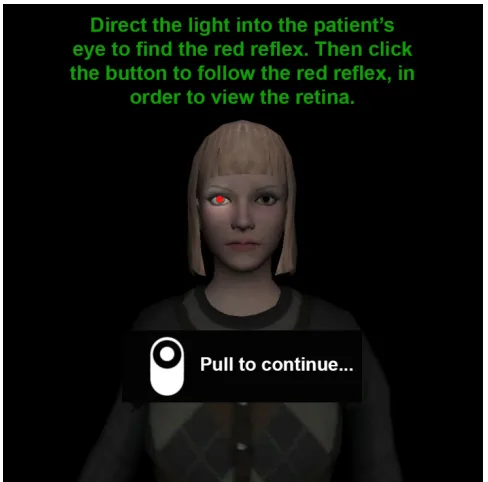
The user is taught how to perform the red reflex by shining the virtual ophthalmoscope light into the patient's eye (Figure 2). In order to complete the level the user has to correctly orientate the light to get the red reflex and to zoom in
headset [A] containing phone and displaying stereoscopic view of avatar for red reflex [B]
sections which include tutorial, red reflex, retinal navigation, pathologies and
sers are taught how to use the app for example how to move their head to locate objects and how to interact with them by using the VR headset’s trigger.
how to perform the red reflex by shining the virtual ophthalmoscope light into the patient's eye (Figure 2). In order to complete the level the user has to correctly orientate the light to get the red reflex and to zoom in and out of each eye.
and displaying stereoscopic view of
sections which include tutorial, red reflex, retinal navigation, pathologies and
sers are taught how to use the app for example how to move their head to locate objects and
Figure 2. Avatar for red reflex
Retinal Navigation
The user is instructed in a series of retinal examination procedures. They are given background information about them before being instructed how to navigate landmarks in the virtual eye. Next the user learns how to follow the four main blood vessels out from the disc and navigate four quadrants of the retina. The user then has to click on the image of the retina simulating the patient looking into the light allowing the macula be seen in more detail. Once the level is completed audio visual feedback reviews the stages just undertaken.
Pathologies
Audio visual commentary is given on common pathologies of the eye, for example cotton wool spots, haemorrhages and papilloedema. The user is shown annotated images of the
Quiz
Eight different images of eye (no abnormalities, cotton wool spots, swollen optic disc and haemorrhage) are randomly shown to the user who has to correctly identify them using the skills they have previous learnt.
Gamification
Within the app are a series of virtual rewards which are used to help inform and guide an individual’s progress when performing the tasks. For example if the user successfully completes each task within a level they are rewarded with a virtual badge that is hosted within the
program. In the quiz section the user has to correctly answer 8 questions which are
subsequently scored relative to the time taken to answer them. Based upon this score the user is awarded either a gold, silver or bronze virtual in-app badge. This shows them their level of achievement when learning ophthalmology skills using this simulator.
User Evaluation
A total of fifteen volunteer fourth year undergraduate medical students were surveyed for their views on the app. This occurred during one of their clinical skills teaching sessions at
RESULTS
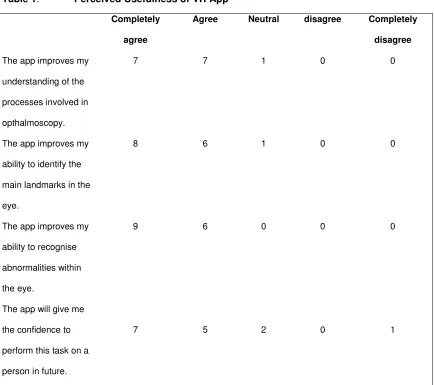
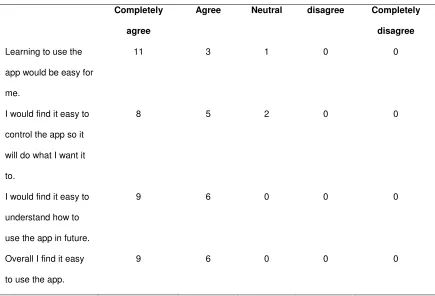
The medical students highly rated all elements of perceived usefulness and ease of use (Tables 1 and 2). They felt it improved their understanding of the processes involved in ophthalmology (n:14), their ability to identify main landmarks in the eye (n:14) and recognise abnormalities (n:15). They felt they would be more confident when performing the task on a person in future (n:12). They found learning how to use the app easy (n:14), it was easy to control (n:13) and they would be able to understand how to use it in future (n:15). Overall they found the app easy to use (n:15). When asked about engagement they found it enjoyable (n:15) and that both the technology (n:13) and teaching approach were appealing to them (n:15). All students said that they would like to be taught other medical skills in this way in future.
Table 1. Perceived Usefulness of VR App Completely
agree
Agree Neutral disagree Completely
disagree
The app improves my understanding of the processes involved in opthalmoscopy.
7 7 1 0 0
The app improves my ability to identify the main landmarks in the eye.
8 6 1 0 0
The app improves my ability to recognise
abnormalities within the eye.
9 6 0 0 0
The app will give me the confidence to perform this task on a person in future.
7 5 2 0 1
Table 2. Perceived Ease of Use of VR App Completely
agree
Agree Neutral disagree Completely
disagree
Learning to use the app would be easy for me.
11 3 1 0 0
I would find it easy to control the app so it will do what I want it to.
8 5 2 0 0
I would find it easy to understand how to
use the app in future.
9 6 0 0 0
Overall I find it easy to use the app.
9 6 0 0 0
Data is based upon the number of students responding to the question.
When asked “What one thing did you like about the app?” their written responses included:
"The descriptions about the pathologies showing you to look around and find it - thought this was useful and exactly what students need."
“I know more about fundoscopy than when I started. I feel more confident identifying the optic disc.”
"Easy to use and helpful to see clear pathology - much easier to see on a patient once you have used the app.”
When asked “What one thing did you least like about the app?” written responses included:
"One barrier to performing opthalmoscopy is the mechanisms of moving around, as you have to tilt and pivot about the centre of the eye.”
DISCUSSION
We have developed an innovative ophthalmology training app which can supplement traditional teaching practices and provide student with a way of self-studying these skills. The teaching approach incorporated within the app introduces students to a series of practical tasks that support learning how to use the program; how to perform a series of procedures associated with performing eye examinations and subsequently testing their knowledge of how to diagnose pathologies. The app assists the clinical teacher to confirm that important parts of the eye have been correctly identified; that the student has followed the right processes and has been able to identify both normal and abnormal structures. The system was evaluated using the Technology Acceptance Model10 as it is a recognised way of assessing adoption of new technology based upon its perceived usefulness and ease of use. The results of the evaluation showed that students who used the app felt that the teaching approach and concept improved their understanding of ophthalmology and it was fun and enjoyable for them. The app is now routinely used in clinical teaching at Birmingham City Hospital.
LIMITATIONS
The authors acknowledge that there were a limited number of participants in this study. This has resulted as the cohort of students studying clinical skills at Birmingham City Hospital is relatively small and as the evaluation was voluntary we may have selected only participants who were interested in technology-enhanced teaching. Therefore we are aware that extrapolating the findings to a wider audience needs caution. Further studies assessing the app by comparing its effectiveness to traditional teaching approaches are warranted to confirm our findings.
Virtual Reality Simulator
REFERENCES
1. Chatziralli IP, Kanonidou ED, Keryttopoulos P, Dimitriadis P, Papazisis LE. The value of fundoscopy in general practice. The Open Ophthalmology Journal 2012; 6:4-5.
2. Dalay S, Umar F, Saeed S. Fundoscopy: a reflection upon medical training? The Clinical Teacher 2013; 10(2):103-6.
3. Van Velden JS, Cook,C, Du Toit N, Myer L. Primary health eye care: evaluation of the competence of medical students in performing fundoscopy with the direct ophthalmoscope. South African Family Practice
2010; 52 (4):341-343.
4. Benbassat J, Polak BC, Javitt JC. Objectives of teaching direct ophthalmoscopy to medical students.
Acta Ophthalmologica 2012; 90(6): 503-7.
5. Chung KD, Watzke R.C. Simple Device for Teaching Direct Ophthalmoscopy to Primary Care Practitioners. American Journal of Ophthalmology 2004; 138(3):501-2.
6. Kelly LP, Garza PS, Bruce BB, Graubart EB, Newman NJ, Biousse V. Teaching ophthalmoscopy to medical students (the TOTeMS study). American Journal of Ophthalmology 2013; 156(5):1056-1061.
7. Deterding S, Dixon D, Khaled R, Nacke, L. From game design elements to gamefulness: Defining "gamification". MindTrek’11 Proceedings of the 15th International Academic MindTrek Conference: Envisioning Future Media Environments; 2011 September 28 – 30; Tampere, Finland p. 9-15. New York: ACM; 2011.
8. Mokadam NA, Lee R, Vaporciyan AA, Walker JD, Cerfolio RJ, Hermsen JL, Baker CJ, Mark R, Aloia L, Enter DH, Carpenter AJ, Moon MR, Verrier ED, Fann JI. Gamification in thoracic surgical education: Using competition to fuel performance. The Journal of Thoracic and Cardiovascular Surgery 2015; pii: S0022-5223(15)01282-9.
9. Nevin CR, Westfall AO, Rodriguez JM, Dempsey DM, Cherrington A, Roy B, Patel M, Willig JH. Gamification as a tool for enhancing graduate medical education. Postgraduate Medical Journal 2014; 90(1070):685-93.
![Figure 1. RITECH II headset headset [A] containing phone and displaying stereoscopic view of](https://thumb-us.123doks.com/thumbv2/123dok_us/1003576.1600189/4.595.170.427.70.265/figure-ritech-headset-headset-containing-phone-displaying-stereoscopic.webp)