Covert Voice over Internet Protocol Communications Based on
Spatial Model
HUANG Yongfeng1,2, TANG Shanyu3,4*
1Department of Electronic Engineering, Tsinghua University, Beijing 100084, China
2Tsinghua National Laboratory for Information Science and Technology, Tsinghua University, Beijing 100084, China 3School of Computer Science, China University of Geosciences, Wuhan 430074, China
4Department of Computing, London Metropolitan University, London N7 8DB, United Kingdom
This paper presents a new spatial steganography model for covert communications over Voice
over Internet Protocol (VoIP), providing a solution to the issue of increasing the capacity of
covert VoIP channels without compromising the imperceptibility of the channels. Drawing
from Orthogonal Modulation Theory in communications, the model introduced two concepts,
orthogonal data hiding features and data hiding vectors, to covert VoIP communications. By
taking into account the variation characteristics of VoIP audio streams in the time domain, a
hiding vector negotiation mechanism was suggested to achieve dynamic self-adaptive
ste-ganography in media streams. Experimental results on VoIP steste-ganography show that the
pro-posed steganographic method effectively depicted the spatial and temporal characteristics of
VoIP audio streams, and enhanced robustness against detection of steganalysis tools, thereby
improving the security of covert VoIP communications.
covert communication, multimedia networking, VoIP, data security
1 Introduction
Covert communication is the science of hiding the existence of secret information in innocent cover
ob-jects. In this paper, covert communications mean that secret messages are transmitted between the
communicating parties by using Voice over Internet Protocol (VoIP) steganography rather than
cryptog-raphy.
Streaming media have emerged as a new means of communications over the Internet, and the pace of
fresh developments is accelerating. It is anticipated that streaming media will dominate the long-distance
communications in the next few years. The applications of streaming media technologies include Video
on Demand (VOD), Audio on Demand (AOD), Internet Protocol Television (IPTV), and VoIP, etc.
With the upsurge of streaming media applications available for commercial use in recent years,
streaming media become one of the most interesting cover objects for information hiding. Unlike static
cover objects, such as text, images, and audio files, streaming media as cover objects have the following
characteristics:
a) Spatial characteristics of media streams. Media streams are dynamic chunks of a series of packets
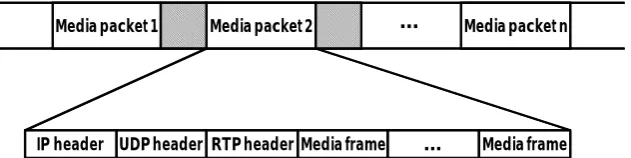
that consist of IP headers, UDP headers, RTP headers, and payloads i.e. audio and/or video frames.
These headers and frames have a number of unused fields, providing plausible covert channels and thus
giving scope for steganography. Each header or frame could be treated as a dimension, and so it is worth
exploring data hiding in headers and frames in view of spatial dimensions.
b) Temporal characteristics of media streams. The temporal behavior of media streams manifests in
two aspects. First, the payloads of media streams show a significant temporal characteristic. For example,
audio frames can be sorted into two groups, active voice and inactive voice; I, B and P frames appear
alternately in video streams. Second, the packet loss rate of media streams is related to time in the course
should be ‘self-adaptive’ in the temporal dimension.
c) Real-time media streams. Streaming media communications originate from the sender, and the
re-ceiver normally plays the arrived media streams without storing them. Steganography in media streams
is a dynamic process, which should not interrupt the real time distribution of media streams. It requires
both data embedding and data extraction to be conducted in a real time manner. Such real time data
em-bedding and extraction differentiates steganography in media streams from steganography in static cover
objects such as text, image and audio files.
Covert communications over streaming media are resulted from the integration of information hiding
and network media stream technologies, and have become the main focus of attention in the field of
in-formation security. There has been some effort to study covert communications over streaming media;
however, most existing studies focus mainly on the steganographic algorithms based on a single
charac-teristic of streaming media. Such approaches have bottlenecked efforts to improve data hiding capacity.
In this study, we seek ways to improve data hiding capacity by taking into account multiple
characteris-tics in the spatial and temporal dimensions of streaming media.
The motivation of this paper is to achieve dynamic self-adaptive covert communications over VoIP by
introducing two concepts, orthogonal hiding features and hiding vectors, to covert communications over
VoIP, with their orthogonal hiding features being abstracted as a multi-dimensional hiding space model
according to the spatial structure of IP packets of media streams, and use of hiding vectors in the model
to greatly improves the secret data conveying rate of covert VoIP communications.
2 Related work
Contrary to image and audio steganography, covert communications over streaming media are largely
unexplored so far. There have been some attempts to develop network protocols- and/or VoIP-based
TCP/IP protocols, suggesting headers substitution-based algorithms for hiding data in unused header
fields.
Bai et al. [4] suggested a covert channel over the jitter fields of RTCP headers, where a piece of secret
information is modulated into the jitter fields according to the statistical parameters computed.
Depend-ing on whether the secret information bit number is ‘0’ or ‘1’, the time intervals between packets are
modulated. The advantage of this method lies in high steganographic transparency, but data hiding
ca-pacity is relatively low and performance is less robust.
In light of audio/video frames, Huang et al. [5] investigated steganography in VoIP streams encoded
by G.711 codec, proposing a LSB matching-based steganographic algorithm with the help of the
redun-dant audio data mechanism to avoid loss of hidden information. Their method sustains better
conceal-ment level than traditional LSB algorithms.
Aoki [6] worked out a technique of lossless steganography in G.711μ encoded speech. The method
adopts audio streams encoded by pulse-code modulation (PCM) as cover objects, in which plenty of
least significant bits exist. When using μ-law G.711 in networks, the codec takes a 14-bit signed linear
audio sample as an input, increases the magnitude by 32 (binary 100000), and converts it to an 8 bit
val-ue; the sign bit ‘0’ is expressed as ‘-0’ and ‘+0’. With this method, the audio sample ‘0’ is altered to ‘-0’
or ‘+0’ when embedding secret data ‘0’ or ‘1’, respectively. So data hiding capacity is dependent on the
number of ‘0’s in the audio sample, and the applications are limited.
Hiding data in low bit rate VoIP streams is more challenging, as there is less redundancy in the audio
streams. By analyzing noisy resistance, Su et al. [7] suggested a codebook-based steganographic
algo-rithm for hiding secret data in VoIP streams coded by G.729A codec. Liu et al. [8] identified the G.729
speech parameters that are suitable for data hiding through analyzing the parameter characteristics of
G.729 encoded audio frames.
effort to improve the codebook partition by using Graph theory along with Quantization Index
Modula-tion. With this approach, random codebook partitions are prevented and speech quality is then
guaran-teed.
Mazurczyk et al. [10][11], Druid [12] and Kratzer et al. [13] developed various methods of hiding
da-ta in VoIP streams, suggesting synchronization mechanisms between the sending party and the receiving
party.
Analysis of the studies above shows the previously proposed steganographic algorithms are based
solely on a single hiding feature. Although these algorithms can achieve different levels of data hiding,
the corresponding data hiding capacities are not large enough to have practical applications in covert
communications systems. To improve usability of the systems, it is necessary to seek a new way to
fur-ther increase the data hiding capacity. Hence, in this study we suggest a new method capable of hiding
large amounts of data in multiple dimensions of media streams so as to greatly improve the data hiding
capacity.
To take up the challenges, this study is to build a multi-dimensional data hiding spatial theoretical
model for steganography in media streams through analyzing the fundamental characteristics of media
streams. The new model is then applied to covert communications over VoIP, which is widely used on
the Internet. The experimental results show that the model effectively depicts the spatial and temporal
characteristics of media streams, providing a good solution to data hiding capacity and security issues in
covert VoIP communications.
3 Proposed covert VoIP communication model
3.1 Structure of media streams
Media streams-based communications work on the same network principles (and often on the same
sections between the communicating parties; when the content of the request begins to flow, it is carried
over the real-time transport protocol (RTP). As shown in Fig. 1, audio and video media streams are
dy-namic chunks of a series of packets that consist of IP headers, UDP headers, RTP headers, and numbers
of audio and/or video frames, which can be regarded as a four-layer/dimension structure.
Media frame … Media frame
UDP header
IP header RTP header
Media packet 1 Media packet 2 … Media packet n
Figure 1 Structure of media streams.
Media streams are essentially a sequence of IP packets, which are the basic units consisting of
proto-col headers and payloads (frames) with unused fields. As cover objects, media streams can then be
char-acterized from the perspective of temporal and spatial dimensions. The proposed spatial model detailed
below describes the macro hiding features of media streams and their dynamic hiding behavior in the
temporal domain, with particular focus on designing a self-adaptive hiding algorithm and a mechanism
of hiding synchronization. The micro hiding features of individual IP packets are studied in view of
mul-ti-dimensional hiding space, so as to seek ways to largely improve data hiding capacity.
3.2 Spatial model for steganography in streaming media
Previous studies have established several algorithms for hiding data in different IP headers [3]. For
in-stance, there are IP protocol- or RTP protocol-based steganographic algorithms, as well as algorithms for
hiding data in media frames, which have laid the foundation for this work. On the basis of the research
results, we develop a new spatial model for steganography in media streams. The definitions below
in-troduce the proposed model.
abstracted as a multi-dimensional hiding space model; use of hiding vectors in the model greatly
im-proves the secret data conveying rate of covert communications over media streams. By taking into
ac-count the variation characteristics of media streams in the time domain, a hiding vector negotiation
mechanism is proposed in this study to achieve dynamic self-adaptive covert VoIP communications.
Suppose a media stream is denoted by P(k),
1
( ) ( )
k
P k p kT
∞
=
=
∑
, where p(kT) represents the IP packetsthat comprise the media stream P(k), and T is the time length of the media packet.
Definition 1: Hiding feature. It is the feature of a media packet which is suited to data hiding, denoted
by e. In general, a cover object has different features suitable for data hiding. From a hiding feature, ones
can design a variety of steganographic algorithms. For example, RTP timestamp is a hiding feature of a
media packet, on which different steganographic algorithms can be established [4][10].
Definition 2: Hiding feature set. It is a set of all the hiding features of a media packet, through which
data hiding is achievable, denoted by Rm, Rm =
{
e1,...,em}
, where ei is the ith hiding feature. For in-stance, in a media packet, codebook field of G.723.1 codec and RTP timestamp field have differenthid-ing features, which comprise the hidhid-ing feature set of the media packet.
Definition 3: Orthogonality of two hiding features. If two hiding features (eiand ej) of the media
packet p(kT) are used for data hiding through two corresponding steganographic algorithms, fi(ei) and
)
( j
j e
f , the two algorithms operate independently, and their results do not affect each other, the features
(eiand ej) are then considered to be orthogonal (statistically unrelated), denoted by ei ⊥ ej. The cor-responding algorithms, fi(ei) and fj(ej), are orthogonal too, i.e. fi(ei), fj(ej) =0.
Definition 4: Orthogonal hiding feature set. It is a group of pairs of orthogonal hiding features of a
media packet, denoted by Rn⊥={ek N∈ |∀i j, ∈N e, i ⊥ej},N=
{
1,...,n}
, and Rn Rm, n m⊥⊆ ∀ ≤ .
If the orthogonal hiding feature set of a media packet has n elements, the packet contains n dimensions
for data hiding, denoted by φn( (p kT))={ |e ii =1,... }n . Among them, the ith dimensional hiding feature ei
constitutes the ith dimensional axis in n-dimensional data hiding space.
Definition 6: Metafunction of hiding feature. In n-dimensional data hiding space of a media packet, if
mi steganographic functions are obtained through the ith dimensional hiding feature, those functions are
regarded as metafunctions, which can be described as ,
( )
, 1,..., ; 1,...,i
i k i i i
f e ∀ =i n k = m . They satisfy
( )
(
( )
)
,i ,i , 1,..., ; 1,...,
i k i i k i i
f e = f p kT ∀ =i n k = m. In particular, no hiding is denoted as the null metafunction
( )
,0 , 1,...,
i i
f e ∀ =i n.
Theorem 1: Judgment rule for steganographic function orthogonality.
If the media packet p(kT) has n-dimensional hiding space, the ith dimensional steganographic
meta-function fik
( )
ei i n ki mii , 1,..., ; 1,...,
, ∀ = = in the space is reciprocally orthogonal to the jth dimensional
ste-ganographic metafunction ,
( )
, 1,..., ; 1,...,j
j k j j j
f e ∀ =j n k = m in terms of the data hiding operation on the
packet, i.e. ( ( )) ( ( ))
j j i i k j k
i pkT f pkT i j n k m k m
f
j
i , , 0, , {1,..., }, 1,..., , 1,...,
, = ∀ ∈ = = .
The reciprocally orthogonal character of steganographic metafunctions mentioned above means that
there are no logical relevance to each other between the steganographic metafunctions in the ith and jth
dimensions, i.e., these steganographic metafunctions corresponding to different data hiding features
(al-gorithms) are not, of course, related reciprocally, leading to any decrease in the total hiding capacity
when they are used together in covert communications.
Definition 7: Hiding vector function. The hiding vector function FK3
(
p( )
kT)
is an ordered collectionof different dimensional hiding metafunctions, which are used for data hiding simultaneously, in
n-dimensional space of the media packet p(kT). It is given by
( )
( )
(
1,k1 n k,n)
( ( )), {1, , 1} {1, , n}Fk p kT = f f p kT ∀ ∈k m × × m
se-cret information hidden in a media packet by using the hiding vector ( ( )), 3 1,..., 3
3 p kT k m
FK ∀ = , in bits per
second (bps). The data hiding capacity of the hiding vector can be expressed as F p kT
(
( )
)
.Theorem 2: Data hiding capacity theorem.
If a media packet has an n-dimensional hiding vector function, the data hiding capacity of the vector
function is equal to the sum of the data hiding capacities of n metafunctions that constitute the hiding
vector, i.e. ( ( )) ( ) { } { } ( )
, 1
1
, 1, , 1, ,
i
n
i k i n n
i
F p kT f e m m M R⊥
=
=∑ ∀ ∈ × × =
k k
.
Definition 9: Imperceptibility of hiding vector. The imperceptibility of a hiding vector is a measure of
the degree of difficulty in distinguishing the difference between the untapped and stego media streams,
and it is dependent upon the worst imperceptibility among all the metafunctions that constitute the
hid-ing vector, i.e. the Buckets effect of the hiding vector. The imperceptibility of the hiding vector
( )
(
)
,( )
nFk p kT k∈M R⊥ can be expressed as
(
( )
)
min{
, | 1,...,}
,( )
i
i k n
Fk p kT = f i= n k∈M R⊥
uuv uuuv
.
Theorem 3: Imperceptibility theorem.
In n-dimensional hiding space of a media packet, the phase of the hiding vector Fk
(
p kT( )
)
uuv
repre-sents its imperceptibility. If there are two different hiding vectors with the same data hiding capacity in
the n-dimensional hiding space, the one whose phase direction is close to the space diagonal (i.e. the
difference in imperceptibility between each pair of dimensions is minimal) will have better
impercepti-bility.
Definition 10: Hiding capacity set F. In media streams-based covert communications systems,
differ-ent hiding metafunctions in n-dimensional hiding space of a media packet can constitute various hiding
vectors
3, 3 1,...,
K
F K = M . The hiding vector set provides the hiding capacity set for covert
communica-tion terminals, i.e.
{
}
3| 3 1,...,
K
F = F K = M . In the hiding capacity set, each hiding vector is marked by
3.3 Spatial model-based covert communications over media streams
Cachin [14] suggested an information-theoretic model applicable to image and audio steganography, but
the model is not suitable for covert communications over media streams because of heavy packet loss
during the transmission of media streams. To bridge the gap, we propose the following model based on
the spatial model detailed in the previous section.
In the Internet environment, UDP protocol is generally used to transfer streaming media such as VoIP,
etc., thus, packet loss is inevitable. And at different periods, because of the different numbers of users on
the Internet, there is a great difference in the size of network traffic. Therefore, the packet loss rate varies
with time in VoIP communications over the Internet. In our experimental environment, the average
packet loss rate was 17% for one week between 1 September 2015 and 6 September 2015; the average
annual packet loss rate was about 13% between 1 September 2014 and 1 September 2015, indicating
high variable packet loss rates for VoIP communications.
If VoIP packets are used as the carriers to realize covert communication, it needs to solve the problem
of the recovery and reliability of the hidden information in the streaming packets in the case of packet
loss. In the proposed algorithm, a spatial model for data hiding is used to achieve a high hiding capacity
for covert communications over VoIP. The proposed algorithm solves the packet loss problem by using
the fast starting retransmission algorithm, i.e. re-transmitting the packet once three irregular orders of
ACK occur without waiting until the expiry of the timer RTO, so as to achieve a reasonable conveying
rate of the hidden message (See Section 4.1 and Fig. 4).
Assuming the communicating parties have established the same hiding capacity set in their terminals
{
3 | 3 1,..., 1}
n
k i i
F = F k =
∏
= m , the key methodology ‘temporal and spatial hiding synchronization’, isintro-duced to covert VoIP communications.
In the media streams
1
( ) ( )
N
k
P k p kT
=
{0,1}i i N
M =∈ .
( )
(
( )
)
( )
(
( )
)
( )
( )
( )
( )
( )
1 2 3 1 2 1 2 1 2 1 * 1 1 1 * * 1 1 3 1 , , 1,..., ,n n N
k i
k k n k n
n n N
k k n k n
n i i i
P k F P k M p kT F p kT B p kT
P k p kT p kT p kT
k m B M
− = = = + − = = = + = = = + + = + + ∀ = ∈
∑
∑
∑
∑
∑
∑
∏
(1)where Bi is part of the bits of the secret data, P*(k) is the stego media streams consisting of media
pack-ets without any hidden data, p(kT),and those with hidden data, p*(kT). The stego media packets p*(kT)
are those packets, selected from the media packets p(kT), in which the secret data are embedded by using
some hiding vector functions
( )
3k
F in the hiding capacity set F.
The media streams with hidden data P*(k), originating from the sender, are transmitted over the
In-ternet and distributed to the receiver. As equation (1) shows, the receiver requires solving the following
two main problems before the secret data M can be extracted from the received stego media streams
P*(k).
(a) Identifying media packets with hidden data from those without hidden data in P*(k), and
(b) Judging which hiding vectors are used by the stego packets p*(kT) to embed the secret data.
The above problems are regarded as the ‘temporal synchronization’ and ‘spatial synchronization’
is-sues of covert communications.
Supposing a hiding vector F0() is added to the hiding capacity set of the communicating parties
{
3 | 3 1,..., 1}
n
k i i
F = F k =
∏
= m to form{
}
3 | 3 0,..., 1
n
k i i
F = F k =
∏
= m , where F0() is a void function representingno data hiding operation, equation (1) becomes
( )
3(
( )
)
( )
* *
3
1 1 1
, , 1,..., ,
n
N N
k i i i i
k k i
P k F p kT B p kT k m B M B
= = =
=
∑
=∑
∀ =∏
∈ ∨ = ∅ (2)media streams requires the communicating parties to set up an updating mechanism for consulting and
sharing the information on the hiding vectors having been used by individual media packets for data
hiding.
In other words, the temporal and spatial hiding synchronization means a negotiation mechanism
al-lows the communicating parties to share the information about the currently used hiding vector number
thorough a covert channel. For a media packet using the hiding vector F0(), there is no hidden
infor-mation; otherwise, the media packet contains secret data. If the receiving party has known the hiding
vector
( )
3
k
F used by the current media packet, the receiver can then extract the secret data from the
media packets. The data extracting process is described as
( )
(
)
(
( )
)
3 3
1 * 1 *
3
1 1 1
ˆ N N , 1,..., n
k i k i
k k i
B F− P k B F− p kT k m
= = =
= =
∑
=∑
∀ =∏
(3)where
( )
3
1
k
F− is the reverse engineering of the hiding vector, i.e. the process of extracting secret data.
( )
(
)
3
1 *
k
F− p kT refers to the process of extracting secret data from the media packets with hidden data.
To sum up, according to the multi-dimensional data hiding spatial model for steganography in media
streams, the temporal and spatial hiding synchronization in covert VoIP communications is essentially a
process of negotiating the hiding vectors of individual media packets.
4 Results and discussion
In this section, we detail an application of the proposed multi-dimensional data hiding spatial model to
improving covert VoIP communications software called StegTalk. It enables the software to adopt a
dy-namic self-adaptive method of selecting hiding vectors, and a mechanism for negotiating hiding vectors
4.1 Application of Spatial model to covert VoIP communications
In the experiments, VoIP streams were chosen as cover objects to conduct steganography experiments so
as to verify the proposed multi-dimensional data hiding spatial model.
VoIP is currently the most typical media stream application on the Internet, and relevant technologies
have been developed rapidly over the past 10 years. According to the data from IDC, VoIP usage in 2000
amounted to 15% of the long-distance communications, but it reached 70% in 2009. So the significance
of exploring steganography in VoIP streams becomes clear in media streams-based covert
communica-tions.
On the basis of our previous studies [4] [5] [7] [9] [15] and others [16] [17] on VoIP steganographic
algorithms, we first established a multi-dimensional data hiding spatial model and a hiding capacity set
for covert VoIP communications, and then developed VoIP-based covert communications software with
high data hiding capacity, high imperceptibility and high security. Taking this as an experimental
plat-form, we consequently summarized the advantages of the proposed multi-dimensional data hiding
spa-tial model through practical test and theoretical analysis.
F
C ... S S C S
C ... S S C S
+
M
Packets of a media-stream
Packets of covert communication
C’
sending
3 2
... 1 0
...
3 2
... 1 0
receiving
F
-C
M
Encryption Key K
C’
F
iF
iNote:F represents the hiding capacity Set,F={F0,F1···F15 } M represents the secret data M=Ui∈n{0,1}i
F represents the hiding -vector
K represents the key to control the selection of Fi
Figure 2 Implementation of covert VoIP communications using StegTalk.
The related work described in Section 2 shows that there are several algorithms for embedding data in
VoIP streams and we have suggested some algorithms for steganography in VoIP [4][5][7][9][15][18].
Based on our previous research and the proposed multi-dimensional data hiding spatial model, we
de-veloped software called StegTalk for covert VoIP communications (Fig. 2).
For the VoIP media streams
1
( ) ( )
N
k
P k p kT
=
=
∑
, the hiding feature set (R) of the packet p(kT) is given by, .723.1 .729 .723.1 , .723.1 si .729
{ RTP, PCM LSB G LSB, G A LSB, G QIM G l, G A sil}
R= e e − e − e − e − e − e −
(4)
where eRTPis the hiding feature using RTP header fields as cover objects [4], ePCM LSB− is the hiding
feature using the lowest bit position in PCM code as cover objects [5][6][11][19][20], eG.723.1−LSB is the
hiding feature using G.723.1 compression parameters as cover objects [7], eG.729A LSB− is the hiding
fea-ture using G.729A compression parameters as cover objects [7], eG.723.1−QIM is the hiding feature using
G.723.1 codebooks as cover objects [9], eG.723.1 si− l is the hiding feature using G.723.1 inactive voice
frames as cover objects, and eG.729A sil− is the hiding feature using G.729A inactive voice frames as cover
objects [18].
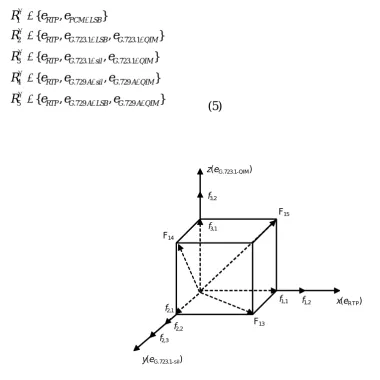
From the hiding feature set R of VoIP packets, ones can build various orthogonal hiding feature sets,
1
1
2 .723.1 .723.1
3 .723.1 .723.1
4 .729 .729
5 .729 .729
{ , }
{ , , }
{ , , }
{ , , }
{ , , }
RTP PCM LSB
RTP G LSB G QIM
RTP G sil G QIM
RTP G A sil G A QIM
RTP G A LSB G A QIM
R e e
R e e e
R e e e
R e e e
R e e e
⊥ − ⊥ − − ⊥ − − ⊥ − − ⊥ − − = = = = = (5) f3,2 F15 f3,1
z(eG.723.1-QIM)
F14
F13
f2,1
f2,2
f2,3
f1,1 f1,2
y(eG.723.1-sil)
x(eRTP)
Figure 3 Scheme for R3⊥ 3-dimensional orthogonal hiding space.
The different orthogonal hiding feature sets above can then be used to constitute different
mul-ti-dimensional orthogonal hiding space. For example, R1⊥ is 2-dimensional hiding space, R2⊥ to ⊥
5 R
are 3-dimensional orthogonal hiding space. Given that G.723.1 codec is the most commonly used audio
encoding protocol in VoIP and in view of our previous research, the following focuses mainly on the ⊥
3 R
3-dimensional orthogonal hiding space, as shown in Fig. 3.
In Fig. 3, the coordinates f1,1 and f1,2 on the axis x(eRTP) denote two different algorithms for hiding data
in RTP header fields [4]. The former employs LSB substitution of RTP header timestamp with data
ca-pacity of 4 bits/packet. Similarly, the coordinates f2,1, f2,2 and f2,3 on the axis y(eG.723.1-sil) refer to
algo-rithms for hiding data in G.723.1 (6.3kbps) encoded inactive voice frames at different data hiding
capac-ities of 16, 44 and 105 bits/frame [18]. The coordinates f3,1 and f3,2 represent two steganographic
algo-rithms using G.723.1 quantization codebook [9], with data hiding capacities of 3 and 6 bits/frame,
re-spectively. These algorithms in R3⊥ have been proved to be able to withstand steganalysis presented in
[21][22].
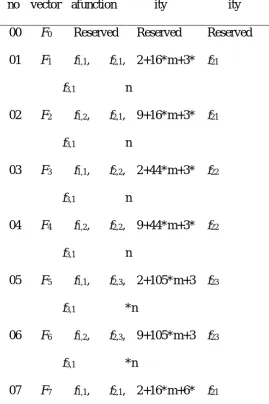
Table 1 Some commonly used hiding vectors
Vector
no
Hiding
vector
Hiding
met-afunction
Hiding
capac-ity
Imperceptibil-ity
00 F0 Reserved Reserved Reserved
01 F1 f1,1, f2,1,
f3,1
2+16*m+3*
n
f21
02 F2 f1,2, f2,1,
f3,1
9+16*m+3*
n
f21
03 F3 f1,1, f2,2,
f3,1
2+44*m+3*
n
f22
04 F4 f1,2, f2,2,
f3,1
9+44*m+3*
n
f22
05 F5 f1,1, f2,3,
f3,1
2+105*m+3
*n
f23
06 F6 f1,2, f2,3,
f3,1
9+105*m+3
*n
f23
f3,2 n
08 F8 f1,2, f2,1,
f3,2
7+16*m+6*
n
f21
09 F9 f1,1, f2,2,
f3,2
2+44*m+6*
n
f22
10 F10 f1,2, f2,2,
f3,2
7+44*m+6*
n
f22
11 F11 f1,1, f2,3,
f3,2
2+105*m+6
*n
f23
12 F12 f1,2, f2,3,
f3,2
7+105*m+6
*n
f23
13 F13 f1,1, f2,1 2+16*m f21
14 F14 f2,1, f3,1 16*m+3*n f21
15 F15 f1,1, f3,1 2+3*n f31
According to the theorem for hiding algorithm orthogonality, the coordinates on the three axes are
re-ciprocally orthogonal. So they can be used to constitute different hiding vectors, as listed in Table 1. The
value for n is the number of audio frames in a RTP packet, m is the number of inactive voice frames, and
m <= n. In the light of the definition of imperceptibility of hiding vectors, the imperceptibility of a
hid-ing vector equals the lowest imperceptibility among its hidhid-ing metafunctions.
In this study, secret data are segmented into various bit-strings that are hidden in different dimensions
by using different related algorithms, respectively. Such a multi-dimensional hiding method can improve
the imperceptibility of hidden data.
communica-tions. Considering the vector length affects synchronization efficiency, the hiding capacity set F does not
contain the hiding vectors with lower data hiding capacity. The hiding capacity set is composed of 15
commonly used hiding vectors, given by
F={F0, F1, F2, F3, F4, F5, F6, F7, F8, F9, F10, F11, F12, F13, F14, F15} (6)
Internet Reliability & Transparency Speech Stream RTP STM SAE SIA Reliability & Transparency Speech Stream RTP SIA STM SAE SAEDU STMDU Secret Message VoIP VoIP Remote shell Instant message Secret file Remote shell Instant message Secret file } ,... , {F0 F1 FN
F= F M ⊆ } ,... , {F0 F1 FN
F=
F
M ⊆
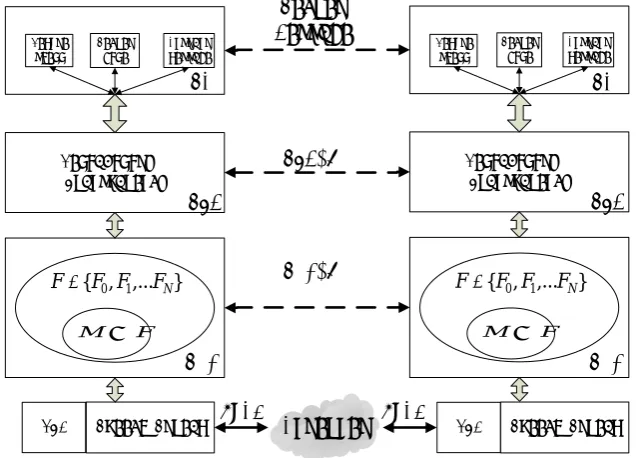
Figure 4 Improved hierarchical model for hiding vectors.
Based on ⊥
3
R 3-dimensional hiding space and the hiding capacity set F, we developed VoIP-based
covert communications software called StegTalk by using our hierarchical model for covert VoIP
com-munications [15]. In the hierarchical model, we suggested a 3-layer covert comcom-munications framework
to ensure the reliability and adaptability of different algorithms for steganography in VoIP in case of
packet loss. As shown in Fig. 4, the improved hierarchical model is suggested to adapt to the hiding
vector. The steganographic information application (SIA) layer provides three types of services for
end-users, Remote shell, Secret file and Instant message, forwarding streams to the steganographic
end-point-to-end-point manner. STM solves the packet loss problem by using the fast starting
retrans-mission algorithm, i.e. re-transmitting the packet once three irregular orders of ACK occur without
waiting until the expiry of the timer RTO, so as to achieve a reasonable conveying rate of the secret
message. The steganographic adaptation and embedding (SAE) layer is responsible for embedding the
message, which is performed under the control of a key by using a hiding vector chosen from the hiding
vector capacity set. So the hiding vectors can be chosen dynamically and adaptively for covert
commu-nications.
StegTalk uses a dynamic mechanism for negotiating hiding vectors between the communicating
par-ties to achieve hiding synchronization. With StegTalk, a special covert channel over the RTCP header
field is used to transmit the hiding vector number, accomplishing out-band synchronization. Details of
the synchronization algorithm are described below.
(a) For the VoIP media streams
1
( ) ( )
N
k
P k p kT
=
=
∑
, the VoIP packet p(kT) (k=1,…,n) is chosen as the datahiding unit. The hiding vector number used by each VoIP packet is transmitted by a covert channel over
the LSR (Packet loss rate) header field of the corresponding RTCP packet. The detailed description is
referred to our previous work [23].
(b) The mapping between the VoIP packet p(kT) and the RTCP packet is carried out through
correlat-ing the timestamp field values of their header fields, as shown in Fig. 4. If the timestamp field values are
the same, the VoIP packet p(kT) and the RTCP packet are corresponding.
(c) If the hiding vector number transmitted by the covert channel over the RTCP header field is 0, the
corresponding VoIP packet contains no hidden information; otherwise, secret information is embedded
in the VoIP packet, and the corresponding steganographic algorithm searches the hiding vector by the
hiding vector number from the hiding capacity set of the terminal.
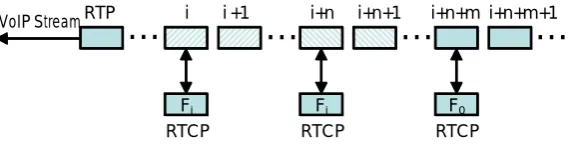
(d) In covert VoIP communications, the appearance that the hiding vector number transmitted by the
packet and subsequent packets in VoIP streams use the same hiding vector to embed data until the
ap-pearing of a different hiding vector number, as shown in Fig. 5.
i i +1
Fi
RTCP
…
i+n i+n+1Fj
RTCP
…
i+n+m i+n+m+1F0
RTCP
…
RTP…
VoIP Stream
Figure 5 Mechanism for negotiating the hiding vector numbers to achieve hiding synchronization.
In Fig. 5, the first RTCP packet uses the hiding vector Fi; through correlating the timestamp field of
the header, the corresponding packet p(kiT) starts data embedding, and all the packets between p(k1T)
and p((k1+n-1)T) use the same hiding vector Fi to embed data. From the p((ki+n)T) packet, the hiding
vector Fj is used for data hiding until the p((ki+n+m-1)T)packet. At the beginning of the p((ki+n+m)T)
packet, no data embedding occurs, as the corresponding RTCP sets the hiding vector F0. The process is
called ‘hiding vector negotiation mechanism’.
4.2 Performance and security analysis
We conducted testing on covert VoIP communications, performance and security analysis, thereby
sum-marizing the advantages of the proposed multi-dimensional data hiding spatial model.
4.2.1 Data hiding capacity
According to the proposed data hiding spatial model, the data hiding capacity of a hiding vector is
greater than any data hiding capacity of its vector components. The model makes the breakthrough
nec-essary to solve the contradiction problems between data hiding capacity and imperceptibility when the
im-prove the data hiding capacity of covert communications significantly, i.e. the data hiding rate, without
compromising imperceptibility.
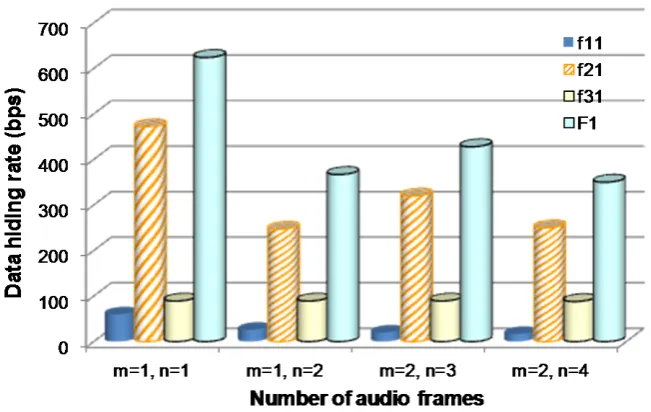
Figure 6 Data hiding rates (bps) when using StegTalk for covert VoIP communications.
Fig. 6 shows the real data hiding rates when different hiding vectors were used in the covert
commu-nications software StegTalk to embed data in VoIP streams. The results were obtained by assuming a
RTP packet contains n audio frames, m of which are inactive voice frames, without considering packet
loss. As Fig. 6 shows, the data hiding rates were much higher when the hiding vector F1 was used in
StegTalk for covert communications, compared with an individual hiding metafunction f11, f21 or f31
be-ing used as the steganographic algorithms, respectively.
4.2.2 Imperceptibility of covert VoIP communications
The imperceptibility of covert VoIP communications is a measure of evaluating the quality of the
stego speech. We adopted the ITU P.862 recommendation to measure the subjective quality of the stego
speech. The recommendation describes an objective method for predicting the subjective quality of
sub-jective quality of the stego speech.
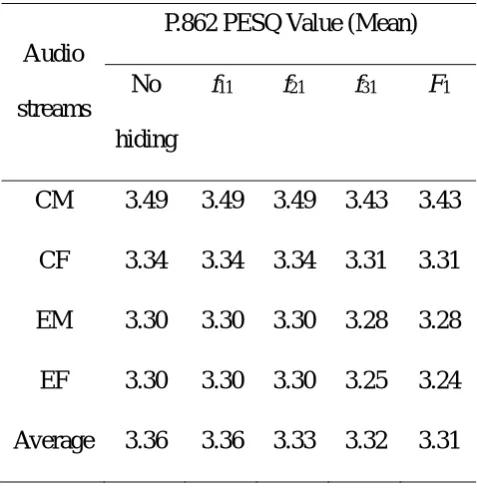
The testing results with the ITU P.862 method is listed in Table 2. Four groups of audio streams (CM,
CF, EM, and EF) were chosen as cover objects for covert VoIP communications in the experiments.
Ta-ble 2 shows comparisons in audio quality between non-covert communications and the covert
commu-nications that used the hiding vector F1 to hide secret information in four different VoIP streams.
Com-parisons in PESQ values between the covert communications using the hiding vector F1 and those using
the vector components (f11, f12, and f13) are also available in the table.
Table 2 Comparisons in audio quality between covert and non-covert communications
Audio
streams
P.862 PESQ Value (Mean)
No
hiding
f11 f21 f31 F1
CM 3.49 3.49 3.49 3.43 3.43
CF 3.34 3.34 3.34 3.31 3.31
EM 3.30 3.30 3.30 3.28 3.28
EF 3.30 3.30 3.30 3.25 3.24
Average 3.36 3.36 3.33 3.32 3.31
Analysis of the data listed in Table 2 shows, the imperceptibility (audio quality) of the covert
commu-nications using hiding vectors did not decrease, while the data hiding rate increased significantly. In
ad-dition, theoretical analysis reveals that segmenting the secret message into various sections and then
hiding these sections in different dimensions of the hiding vector can improve the imperceptibility of the
4.2.3 Security against steganalysis
In the proposed multi-dimensional steganography in media streams, the secret message is first
seg-mented into blocks according to the data hiding capacities of the hiding vectors in corresponding packets;
each block is further divided into bit-strings according to the data hiding capacities of the metafunctions
that constitute the hiding vector. Each metafunction hides a segment of different size of the secret
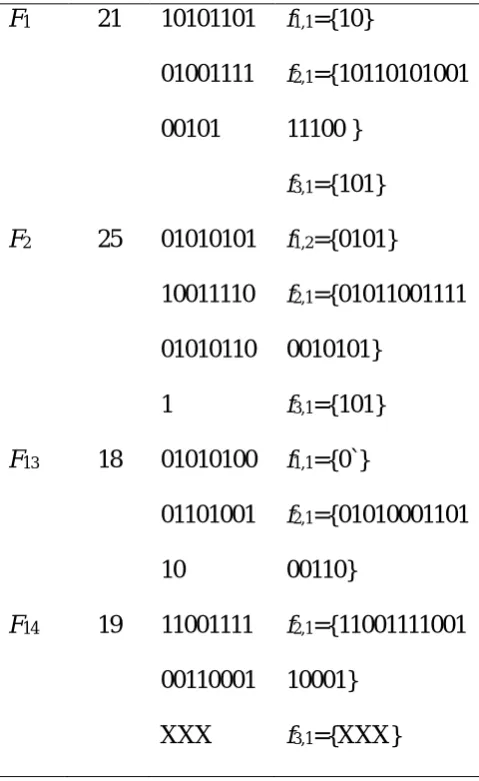
mes-sage. For instance, the secret message M2 consisting of 10 letters of the alphabet has 80 bits as follows:
M2=1010110101001111001010101010110011110010101101010101000110100110110011110011000
1
Suppose the vectors F1, F2, F13 and F14 in Table 1 are used to transmit the secret message M2.
Ac-cording to formulas for calculating the hiding capacity (Table 1), M2 can be divided into four segments;
each segment is divided into bit strings of different sizes, which are embedded into different
metafunc-tions of the hiding vector, as shown in Table 3.
As Table 3 shows, each metafunction (associated with a hiding feature) contains only a bit string of
the secret message. Since most of existing VoIP steganalysis methods are only effective in detecting a
specific steganographic algorithm based on a single hiding feature, they are unlikely to detect the whole
secret message that are embedded in multiple hiding features. The following experimental results prove
that the proposed multi-dimensional steganography greatly improved the security of covert VoIP
com-munications.
Table 3 Multi-dimensional embedding in metafunctions of the hiding vector
Hidi
ng
vec-tor
Ca-pacity
Secret
da-ta
seg-menting
F1 21 10101101
01001111
00101
f1,1={10}
f2,1={10110101001
11100 }
f3,1={101}
F2 25 01010101
10011110
01010110
1
f1,2={0101}
f2,1={01011001111
0010101}
f3,1={101}
F13 18 01010100
01101001
10
f1,1={0`}
f2,1={01010001101
00110}
F14 19 11001111
00110001
XXX
f2,1={11001111001
10001}
f3,1={XXX}
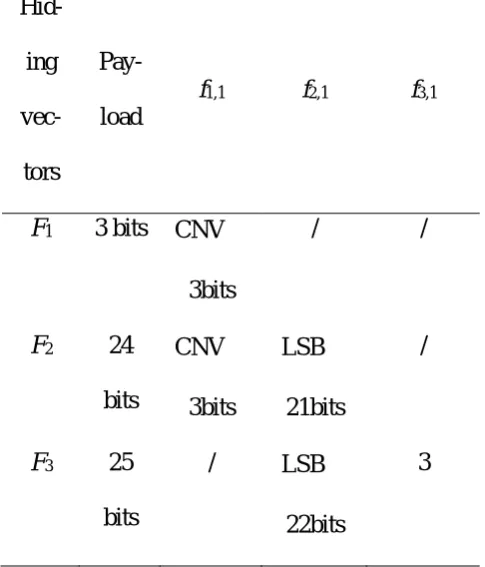
Four groups of audio streams (CM, CF, EM, and EF) were used as cover objects, each containing
three audio pieces of 10, 5 and 3 seconds in length with 333, 166 and 100 frames, respectively. Table 4
lists the hiding algorithms and hiding vectors used in the experiments. CNV denotes the CNV-based data
embedding algorithm proposed in [9]; LSB stands for data embedding into the last bits of the parameters
of encoded audio frames. The cover objects were categorized into three groups, the first used for data
hiding using the CNV-based algorithm, the second using the LSB algorithm [19] to embed data, and in
the last group, all the frames of each audio sample were divided into three pieces which were then used
to hide data using the three hiding vectors listed in Table 4.
Hid-ing
vec-tors
Pay-load
f1,1 f2,1 f3,1
F1 3 bits CNV:
3bits
/ /
F2 24
bits
CNV:
3bits
LSB:
21bits
/
F3 25
bits
/ LSB:
22bits
3
We used the Mel frequency cepstral coefficients (MFCC) method, one of the most effective
steganal-ysis methods [24], to perform security analsteganal-ysis, so as to verify the security of the proposed
mul-ti-dimensional steganography. Table 5 lists the detection accuracy of using MFCC to detect the hidden
message for CNV-based steganography, LSB-substitution based single steganography (LsbOnlyEmbed)
and multi-dimensional steganography (MultidEmbed), respectively.
Table 5 Detection accuracy of MFCC steganalysis
Length of audio pieces CNV LsbOnlyEmbed MultidEmbed
10s (333 frames) 54.50% 92.20% 81.26%
5s (166 frames) 51.94% 87.84% 72.15%
3s (100 frames) 51.62% 81.92% 65.24%
was very effective in detecting the hidden data embedded with the LsbOnlyEmbed algorithm, but it was
unlikely to detect the multi-dimensional steganography. For the 3-second samples, the accuracy of
de-tecting single steganography reached 81.92%, whereas that of dede-tecting multi-dimensional
steganogra-phy achieved 65.24% only, which is an extremely poor result for steganalysis.
The experimental results shows, for the same cover sample, it was unlikely to detect
mul-ti-dimensional steganography compared with single steganography. So the proposed mulmul-ti-dimensional
steganography could improve the security of covert communications. Even if part of the secret message
hidden in one dimension had been detected, it would have been unlikely to extract the whole message as
other parts of the message were hidden in other dimensions.
4.2.4 Hiding vector negotiation mechanism
Synchronization efficiency is defined as the ratio of the number of bits of the secret information m to
the number of all the bits transmitted over a covert communication section, given by
C m/
=
ρ
where ρ is the synchronization efficiency, m is the number of bits of the secret information, and C is the
number of bits of the stego streams consisting of the secret information and the controlling bits such as
synchronization controlling bits.
In one of the most influential literatures [12], the authors described their VoIP-based covert
commu-nications software, which gained synchronization efficiency of 45% - 91.2%. A hierarchical model for
covert VoIP communications was suggested in [15], attaining synchronization efficiency of 78% - 92%
by means of an effective method of optimizing communication efficiency. There is still room for further
improvement. If the hiding vector synchronization algorithm, suggested by the proposed
mul-ti-dimensional data hiding spatial model, were used for data hiding, synchronization efficiency would
vector negotiation mechanism can achieve the highest synchronization efficiency.
Our study also shows, with the hiding vector negotiation mechanism, synchronization efficiency is
re-lated to the updating frequency of hiding vectors of media packets. Fig. 7 shows the relationship
be-tween the synchronization efficiency and the updating frequency of hiding vectors using StegTalk. If
each RTP packet uses a different hiding vector to hide information, the updating frequency of hiding
vectors maximizes, and the overhead of hiding synchronization maximizes as well, thus resulting in the
lowest synchronization efficiency; on the contrary, if ten RTP packets share the same hiding vector, it
leads to the highest synchronization efficiency.
0.84 0.86 0.88 0.9 0.92 0.94 0.96 0.98 1
1 2 3 4 5 6 7 8 9 10
S
yn
ch
ro
n
iz
at
io
n
ef
fi
ci
en
cy
Updating frequency Message
File
Figure 7 Relationship between synchronization efficiency and the updating frequency of hiding
vec-tors.
The results shown in Fig. 7 are based on the test condition that the percentage of inactive audio frames
in a VoIP stream was about 70%. In the experiments, apart from 5 bits being used for implementing
hid-ing vector synchronization, 3 bits were introduced to mark the end position of the secret information. If
the secret information is an instant message, the overhead for marking the end position is higher;
over covert communications using StegTalk software is much higher than those for transmitting an
in-stant message (see Fig. 7).
5 Conclusions
In this study, we have built a multi-dimensional data hiding spatial theoretical model for covert VoIP
communications, breaking through the bottleneck problem of low data hiding capacity encountered
while implementing a sole conventional steganographic algorithm. A new concept of data hiding vectors
has been introduced to improve the synchronization efficiency by reducing overhead. The proposed
hid-ing vector negotiation mechanism for covert VoIP communications has been adopted to withstand
against detection of steganalysis. Testing on the application of the spatial model to VoIP streams has
shown that the covert VoIP communications can improve data hiding capacity, imperceptibility, as well
as synchronization efficiency to a great extent.
Exploring other methods for constructing data hiding vectors, and improving the imperceptibility of
the combined hiding vectors through balancing the imperceptibility of hiding vector components for
each vector are the subjects of future work to break through the Buckets effect limitation.
This work was supported by the National Natural Science Foundation of China (Grant Nos. 61271392,
U1405254 and 61272469), and the British Government under Grant ktp008263.
1 S. Zander, G. Armitage and P. Branch, “Covert channels and countermeasures in computer network
protocols,” IEEE Communications Magazine, vol. 45, no. 12, pp. 136-142, December, 2007.
2 X. Luo, E.W.W. Chan and R.K.C. Chang, “TCP covert timing channels: Design and detection,” in
Proc. of IEEE/IFIP International Conference on Dependable Systems and Networks (DSN), pp.
420-429, Anchorage, Alaska, June 24-27, 2008.
implementa-tion,” in Proc. of 28th IEEE International Conference on Computer Communications, pp.
2204-2212,Rio de Janeiro, Brazil, April 19-25, 2009.
4 L.Y. Bai, Y. Huang, G. Hou and B. Xiao, “Covert channels based on Jitter field of the RTCP
head-er,” in Proc. of the Fourth International Conference on Intelligent Information Hiding and
Multime-dia Signal Processing, pp. 1388-1391, Harbin, August 15-17, 2008.
5 Y. Huang, B. Xiao and H. Xiao, “Implementation of covert communication based on
steganogra-phy,” in Proc. of 4th International Conference on Intelligent Information Hiding and Multimedia
Signal Processing, pp. 1512-1515, Harbin, China, August 15-17, 2008.
6 N. Aoki, “A technique of lossless steganography for G.711 telephony speech,” in Proc. of Fourth
In-ternational Conference on Intelligent Information Hiding and Multimedia Signal Processing, pp.
608-611, Harbin, August 15-17, 2008.
7 Y. Su, Y. Huang and X. Li, “Steganography-oriented noisy resistance model of G.729a,” in Proc. of
2006 IMACS Multi-conference on Computational Engineering in Systems Applications, pp. 11-15,
Beijing, China, 2006.
8 L. Liu, M. Li, Q. Li and Y. Liang, “Perceptually transparent information hiding in G.729 bitstream,”
in Proc. of 4th International Conference on Intelligent Information Hiding and Multimedia Signal
Processing, pp. 406-409, Harbin, August 15-17, 2008.
9 B. Xiao, Y. Huang and S. Tang, “An approach to information hiding in low bit-rate speech stream,”
in Proc. of IEEE Global Telecommunications, pp. 371-375, USA, 2008.
10 W. Mazurczyk and J. Lubacz, “LACK - a VoIP steganographic method,” Telecommunication
Sys-tems Journal, vol. 45, no. 2-3, pp 153-163, October, 2010.
11 Józef Lubacz, Wojciech Mazurczyk, Krzysztof Szczypiorski, “Principles and overview of network
steganography,” IEEE Communications Magazine, vol. 52, no. 5, pp. 225-229, 2014.
13 C. Kratzer, J. Dittmann, T. Vogel and R. Hillert, “Design and evaluation of steganography for
Voice-over-IP,” in Proc. of 2006 IEEE International Symposium on Circuits and Systems, pp.
2397-2340, Island of Kos, Greece, 2006.
14 C. Cachin, “An information-theoretic model for steganography,” Information and Computation, vol.
192, no. 1, pp. 41-56, 2004.
15 X. Bo and Huang Yongfeng, “Reliable transmission of information hiding communication over
stream-media,” Journal of Xidian University, vol. 35, no. 3, pp. 554-558, 2008.
16 W. Mazurczyk and Z. Kotulski, “Covert channel for improving VoIP security,” in Proc. of 2006
Mul-ti-conference on Advanced Computer Systems, pp. 311-320, Międzyzdroje, Poland, 2006.
17 C. Wang and Q. Wu, “Information hiding in real-time VoIP streams,” in Proc. of 9th IEEE
Interna-tional Symposium on Multimedia, pp. 255-262, Taichung, Taiwan, 2007.
18 Y.F. Huang, S. Tang, and J. Yuan, “Steganography in inactive frames of VoIP streams encoded by
source codec,” IEEE Transactions on Information Forensics and Security, vol. 6, no. 2, pp. 296-306,
2011.
19 X. Li, B. Yang, D. Cheng, and T. Zeng, “A generalization of LSB matching,” IEEE Signal
Pro-cessing Letters, vol. 16, no. 2, pp. 69-72, 2009.
20 N. Aoki, “A band extension technique for G.711 speech using steganography,” IEICE Transactions
on Communications, vol. 89, no. 6, pp. 1896-1898, 2006.
21 Y. Huang, S. Tang, C. Bao, and Y.J. Yip, “Steganalysis of compressed speech to detect covert voice
over Internet protocol channels,” IET Information Security, vol. 5, no. 1, pp. 26-32, 2011.
22 Y. Huang, S. Tang, and Y. Zhang, “Detection of covert voice over Internet protocol communications
using sliding window-based steganalysis,” IET Communications, vol. 5, no. 7, pp. 929-936, 2011.
23 Huang Yong-feng, Yuan Jian, and Chen Mingchao, “Key distribution in the covert communication
24 Q.Z. Liu, A.H. Sung, and M.Y. Qiao, “Temporal derivative-based spectrum and mel-cepstrum audio
steganalysis,” IEEE Transactions on Information Forensics and Security, vol. 4, no. 3, pp. 359-368,