Bj¨orn Richerzhagen, Dominik Stingl, Julius R¨uckert, Ralf Steinmetz.Simonstrator: Simulation and Prototyping Platform for Distributed Mobile Applications. In Proc. EAI International Conference on Simulation Tools and Techniques (SIMUTOOLS), ACM, 2015. ISBN:
978-1-63190-079-2
The documents distributed by this server have been provided by the contributing authors as a means to ensure timely dissemination of scholarly and technical work on a non-commercial basis. Copyright and all rights therein are maintained by the authors or by other copyright holders, not withstanding that they have offered their works here electronically. It is understood that all persons copying this information will adhere to the terms and constraints invoked by each author’s copyright. These works may not be reposted without the explicit permission of the copyright holder.
Simonstrator: Simulation and Prototyping Platform for
Distributed Mobile Applications
Björn Richerzhagen
*, Dominik Stingl
*, Julius Rückert
†, and Ralf Steinmetz
* *Multimedia Communications Lab (KOM), E-Mail: [email protected]†
Peer-to-Peer Systems Engineering Lab (PS), E-Mail: [email protected] Technische Universität Darmstadt, Germany
ABSTRACT
The increasing market penetration of mobile devices, such as smartphones and tablets, poses additional challenges on the design of distributed systems. Due to the heterogeneous environment consisting of both, mobile and fixed devices, a multitude of effects on different scales need to be considered. Microscopic effects, such as an individual user’s interaction with the device, as well as macroscopic effects, such as scal-ability with the number of users have an impact on the sys-tem’s performance. The combined evaluation of micro- and macroscopic effects requires both, simulations and prototyp-ical deployments. Furthermore, insights obtained through prototypes during user studies can lead to refined protocols and algorithms, thereby contributing to the overall design process. To enable parallel assessment of micro- and macro-scopic effects, we propose the Simonstrator platform, con-sisting of a lightweight framework for the development and instrumentation of distributed systems as well as runtime en-vironments for (i) the interaction with common simulators, (ii) the deployment on testbeds, and (iii) Android devices. The platform is specifically targeted towards distributed sys-tems for heterogeneous scenarios, considering mobile and fixed networks. We show sample simulations and prototyp-ical deployments of two exemplary use cases: a live video streaming system and a middleware for augmented reality games, highlighting different evaluation goals and environ-ments supported by the proposed Simonstrator platform.
1.
INTRODUCTION
With the ubiquity of smartphones and tablets, an increas-ing number of distributed applications are runnincreas-ing on mobile devices. On the one hand, this platform offers new oppor-tunities due to the availability of sensor information and the tight coupling to the device user. On the other hand, the mobile environment poses additional challenges on the design of distributed systems. These challenges include a highly dynamic environment caused by user movement, un-stable connectivity, as well as different usage patterns than known from fixed devices.
To design distributed applications that cope with these chal-lenges, one has to evaluate the impact of the dynamic en-vironment on the systems’ performance. This has to be done on different scales, ranging from an individual user’s interaction patterns with the device and other users to ef-fects observed on a global scale, e.g., the scalability of the overall system. Depending on the scope of the evaluation, a multitude of simulators or emulators exist that address some of the effects by providing suitable models. However, it is well known that simulations can not capture the full range of effects caused by the environment [15]. Therefore, prototypical deployments and testbed evaluations need to augment the simulative study of a system [7]. Early proto-typical insights can then be fed back into simulation models and algorithms to study effects at larger scale.
To this end, there have been proposals to enable simulation models to be deployed as prototypes [3, 5] or to integrate simulators into testbed deployments [8], thereby increasing the scale of the scenario. However, existing systems mostly neglect the peculiarities arising on mobile devices such as smartphones and tablets. This includes access to sensors and other device-specific features, which constitutes an im-portant building block of today’s distributed applications. Furthermore, the resulting system is often limited to one specific simulator. This, in turn, limits the range of effects that can be studied using validated models.
We study the applicability of the Simonstrator platform for two exemplary use cases: a distributed live video streaming system and augmented reality gaming. Insights from early prototypes of the augmented reality game are used to define important properties of the middleware design. Based on the players’ movement and interaction patterns during a field study, the applicability of local ad hoc event dissemination is assessed. Subsequently, simulations enable fast assessment of a number of protocols suitable for the scenario. Due to the Simonstrator platform, these protocols can then be utilized in the prototype without any changes to the code. The insights gained from early prototypes stress the importance of combined prototypical and simulative evaluation.
The remainder of this paper is structured as follows. Sec-tion 2 details the Simonstrator platform, consisting of the Simonstrator framework and runtime environments. Two exemplary use cases for our platform are discussed in Sec-tion 3, highlighting its usage on mobile devices and simula-tors for two sample scenarios with distinct evaluation goals. Section 4 contains relevant related work. Section 5 concludes the paper and illustrates possible directions for future work.
2.
PLATFORM ARCHITECTURE
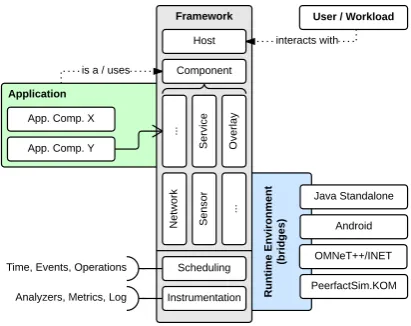
The Simonstrator platform consists of two main building blocks, as illustrated in Figure 1. TheSimonstrator frame-work represents the central building block of the platform (cf. Section 2.1), providing the base abstractions to be used by the distributed system. The framework is complemented by a set ofruntime environments (cf. Section 2.2) that en-able the deployment of applications in different environ-ments. With our Simonstrator platform we follow the con-cept introduced by Galuba et al. with ProtoPeer [5] by providing time and network related functions through our framework. However, in contrast to ProtoPeer, the Simon-strator framework also includes access to sensors commonly used by today’s distributed applications (e.g., location) as well as other communication methods (e.g., Bluetooth). Fur-thermore, it enables loose coupling of components, thereby allowing platform components to utilize protocol and appli-cation components and vice-versa.
The provided runtime environments enable code execution on Android devices, on common network simulators, and on a wide range of Java-based platforms. The architecture is realized with the Java programming language due to its high outreach on fixed and mobile (Android) platforms. In the following, the building blocks of the Simonstrator platform are discussed in detail.
2.1
The Simonstrator Framework
The Simonstrator framework can be divided into two con-ceptional layers, as indicated in Figure 1. The foundation for applications and systems built around the framework is the central scheduling abstraction. Here, representations for ab-solute and relative time are provided, enabling derived con-cepts such as events and operations. Furthermore, this layer includes instrumentation-related interfaces (c.f. Sec. 2.1.2) to capture relevant data from the conducted experiments for debugging or a subsequent evaluation. The application itself is composed out of differentcomponents utilizing these core abstractions. Components provide platform- or application-specific functionality. By combining multiple components
Application
Host
S
e
n
s
o
r
N
e
tw
o
rk
Framework
Scheduling
Instrumentation Component
..
.
OMNeT++/INET
PeerfactSim.KOM Java Standalone
Android is a / uses
App. Comp. X
App. Comp. Y
..
.
S
e
rv
ic
e
O
v
e
rl
a
y
R
u
n
ti
m
e
E
n
v
ir
o
n
m
e
n
t
(b
ri
d
g
e
s
)
User / Workload
interacts with
Analyzers, Metrics, Log Time, Events, Operations
Figure 1: Overview of the Simonstrator platform consisting of the core framework and a set of runtime environments.
within ahost, complex distributed applications are realized (c.f. Sec. 2.1.3). Please note that real-world code examples as well as additional documentation of the framework are provided in our public project repositories1and are omitted in this paper for brevity.
2.1.1
Time, Events, and Operations
To enable repeatable and deterministic executions of sim-ulations, access to time as well as functionality related to threading and scheduling needs to be encapsulated. The framework allows the retrieval of the current time as well as relative time calculations required for delayed execution of tasks. Instead of creating and maintaining own threads for concurrent, delayed, or periodic execution of specific tasks,
eventsandoperationsare created and scheduled through the framework. Using the aforementioned abstraction of time, an event is scheduled as shown in Listing 1. Once the event is due for execution, the provided event handler is notified. Depending on the runtime environment, deterministic exe-cution order of events is guaranteed (cf. Sec. 2.2).
Listing 1: Event scheduling and timing abstractions.
E v e n t H a n d l e r h a n d l e r = new E v e n t H a n d l e r () {
p u b l i c v o i d e v e n t O c c u r r e d ( O b j e c t content ,
int t y p e ) {
// [ do s o m e t h i n g ]
} }
E v e n t . s c h e d u l e W i t h D e l a y ( 1 0 * T i m e . SECOND , handler , null, 0);
While events are a reasonable abstraction for one-shot ac-tions, most distributed systems rely on operations that rep-resent an abstraction for an action → reaction type of in-teraction. Consider a simplerequest and reply case, where the sender of a message waits (i) for a reply to process it or (ii) reacts to a timeout beforehand. To maintain the state of the request (i.e., the timeout as well as the informa-tion contained in the request), isolainforma-tion within a dedicated thread is desired. The concept ofoperationshelps to realize
1
https://dev.kom.e-technik.tu-darmstadt.de/gitlab/
maki/simonstrator-api. Parts of the platform are not
these types of scenarios by providing an intuitive, thread-like programming interface on top ofevents. In contrast to the abstraction achieved through singleevents, this enables a separation of concerns while simultaneously guaranteeing determinism and avoiding common concurrency issues. Last but not least, generators for random numbers are provided through the framework to enable deterministic seeding of experiments in simulation scenarios.
2.1.2
Instrumentation
Instrumentation constitutes an inevitable step during both, prototypical and simulative evaluation to output data for debugging and analysis. The Simonstrator framework pro-vides access to platform-independent logging, using a sim-ple wrapper that mimics Apache’s popular Log4j framework. While logging is helpful during development and debugging, it is not suitable for full evaluation of a system. For this rea-son the Simonstrator framework offers two different concepts to ease the evaluation of an examined system: push-based
analyzersand pull-basedmetrics.
Analyzers are directly triggered by the evaluated system and are application specific. Consider a distributed video streaming system: to assess its performance, one has to cap-ture stalling events, where the user playback is interrupted due to empty buffers. APlaybackAnalyzerinterface would include methods such as onStall and onResume that are called by the streaming system as soon as such events oc-cur. The actual implementation of the analyzer is up to the runtime environment, enabling a broad range of use cases due to the respective runtime capabilities. In simulations, analyzers often rely on global knowledge to compute per-formance figures based on the whole system’s state. The simulator version of the analyzer could, for example, con-sider the current overlay topology using global knowledge to examine the root cause of the empty buffer. During pro-totypical deployments, where global knowledge cannot be used, analyzers can annotate events with platform-specific data. In the streaming example, this could be information about the video provided by the media player, indicating short-lived increases in the bitrate due to a scene change in the video.
Listing 2: Retrieval and usage of custom analyzers.
P l a y b a c k A n a l y z e r a = M o n i t o r . g e t A n a l y z e r ( P l a y b a c k A n a l y z e r .c l a s s);
a . o n R e s u m e ( [ . . . ] ) ; // A n a l y z e r - s p e c i f i c m e t h o d
By relying on platform-specific implementations of analyz-ers, each implementation can utilize the knowledge and tools of the respective platform at best. This enables evaluations with different scopes and goals to be conducted within the platform of choice through a single, unified instrumentation interface. The Simonstrator framework creates transparent proxies in case (i) the runtime provides multiple analyzers implementing the same interface, or (ii) the runtime provides no implementation of the analyzer. This enables simple an-alyzer retrieval and usage as shown in Listing 2.
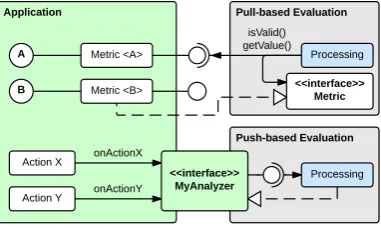
In contrast to the application-specific analyzers,metricsare passive probes that provide access to system state. They im-plement a common interface as shown on the upper left-hand side in Figure 2, enabling retrieval of the current value as
Figure 2: Concept of push- and pull-based instrumentation. Pull-based instrumentation uses the unified metric interface, whereas push-based instrumentation relies on application-specific analyzers.
well as a boolean indicating whether the probe’s value can be considered valid. In the aforementioned example of a video streaming system, the current size of the playout buffer in terms of video chunks can be exported as a metric. The com-mon interface, which is implemented by relevant metrics of a developed application (e.g.,Metric <A>andMetric <B>), enables a set of automated processing and analyzing steps depending on the runtime environment. Utilizing a simula-tor’s visualization capabilities to show an application’s met-rics can be easily achieved by bridging the metmet-rics to the respective visualization tools of the simulator. During the development and debugging phases the concept of metrics provides vital insights into the system’s current state. While metrics usually export numerical (or binary) states, they can be used to provide access to any kind of object, including application specific state containers. However, in this case, processing steps for the respective types need to be provided by the application developer, as the default set of process-ing steps are only defined for numerical values. Metrics and analyzers can be combined: this way, metrics can be pro-cessed upon specific actions triggered by an analyzer rather than solely based on periodic polling. This closely follows the concept of annotated data, but is more powerful when it comes to more complex analyzing steps involving the cor-relation of multiple probes. Following the design principles of the Simonstrator platform, one can bridge analyzers and metrics to the respective runtime’s built-in functionality, for example metric visualization in simulators or logging capa-bilities on Android. This is further discussed in Section 2.2.
2.1.3
Hosts and Components
An individual device is modeled as a host within the Si-monstrator framework. The host acts as container for any number of components. The composition of those compo-nents determines the host’s functionality within the dis-tributed system, comprising (i) the own developed compo-nents, (ii) already existing components from third parties, as well as (iii) components from the chosen runtime envi-ronment. Composition can be done during initialization or runtime, as components can request other registered com-ponents via the host.
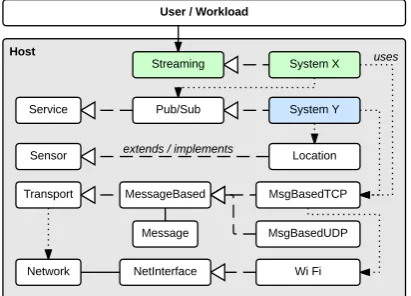
respec-tive implementation calledSystem X, which is based on the defined interface. System X utilizes a generic publish/sub-scribe component as defined in the framework, with one im-plementation of the component being provided by the cur-rent runtime environment (System Y). Listing 3 shows the corresponding registration and binding calls to enable uti-lization of the publish/subscribe system within the stream-ing component. Both components utilize runtime environ-ment components providing transport and network layer functionality. The specific realization of the pub/sub com-ponent furthermore utilizes a location sensor. Depending on the runtime environment, the location sensor component accesses real hardware (e.g., GPS on Android) or uses a movement model or data from a trace file.
Listing 3: Registration and retrieval of components.
// Pub / Sub r e g i s t r a t i o n ( d u r i n g i n i t i a l i z a t i o n )
P u b S u b s y s t e m Y = new S y s t e m Y (); h o s t . r e g i s t e r C o m p o n e n t ( s y s t e m Y );
// R e t r i e v a l ( in s t r e a m i n g c o m p o n e n t )
try {
P u b S u b ps = h o s t . g e t C o m p o n e n t ( P u b S u b .c l a s s); } c a t c h ( C o m p o n e n t N o t A v a i l a b l e E x c e p t i o n e ) {
// [ e x c e p t i o n h a n d l i n g ]
}
This enables natural development of complex distributed ap-plications by composing and utilizing functionality of differ-ent compondiffer-ents. Additionally, the approach enables isolated evaluation of single components by using stubs for other components. In the example shown in Figure 3,System Y
can be replaced with any other component implementing thePub/Sub interface. Such a component can be provided by the application developer or by the respective runtime environment. This enables transparent integration of third party libraries and platform-specific services such as Google Cloud Messaging on Android, as well as integration of global knowledge-based stubs in simulators. While this concept is already well-known in software engineering, it is largely ne-glected when it comes to the development and evaluation of scientific prototypes.
Host
Transport MessageBased
Message
Network
MsgBasedUDP MsgBasedTCP
NetInterface Wi Fi
Sensor Location
Service Pub/Sub System Y
Streaming System X
User / Workload
uses
extends / implements
Figure 3: Host for a video streaming system resulting from the composition of platform and application components.
Following the concept of components and in contrast to [5], we do not provide a single dedicated networking abstrac-tion. Instead, networking functionality is also realized via
components. By providing a number of interfaces of differ-ent granularity within the framework, an application can, for example, first query for a MessageBasedTCPtransport and relax the requirement to any kind of MessageBased trans-port in case of failure. This way, other network interfaces or transport protocols can be added easily to the framework and can then be utilized in the application code. Listing 4 illustrates binding and later usage of transport protocols. As first step, a network component is selected based on its name (or IP address), enabling support for multiple paral-lel network stacks. This is especially important to support applications for mobile devices, where multiple network in-terfaces are utilized (e.g., Bluetooth or Wi-Fi Direct for local communication and the cellular link for connections to a re-mote server). Protocol instances are created and listen for incoming messages on a given IP (and, thus, network inter-face) and port, invoking a message listener on each received message. Once the protocol is bound, it can be utilized as defined by the corresponding component interface. In the lower half of Listing 4, this is shown for the example of a
MessageBased protocol. The component interface enables sending of messages in asend-and-forget manner by simply invokingsendwith the respective target address and a mes-sage object. Forrequest-replyscenarios, it additionally pro-vides the convenience functionssendAndWaitandsendReply
that mask the complexity of callback and timeout manage-ment for this common communication pattern.
Listing 4: Binding and usage of transport components.
// I n i t i a l i z a t i o n ( b i n d i n g )
net = h o s t . g e t N e t w o r k C o m p o n e n t (). g e t B y N a m e ( N e t I n t e r f a c e N a m e .W I F I);
M e s s a g e B a s e d t r a n s ;
try {
t r a n s = h o s t . g e t T r a n s p o r t C o m p o n e n t (). g e t P r o t o c o l ( UDP .class, net . g e t L o c a l I n e t A d d r e s s () , P O R T ); t r a n s . s e t M e s s a g e L i s t e n e r ( l i s t e n e r );
} c a t c h ( P r o t o c o l N o t A v a i l a b l e E x c e p t i o n e ) {
// [ e x c e p t i o n h a n d l i n g ]
}
// U s a g e ( s e n d and f o r g e t )
t r a n s . s e n d ( M e s s a g e msg , N e t I D rcvNet , int r c v P o r t );
// U s a g e ( request - r e p l y s c e n a r i o s u p p o r t )
t r a n s . s e n d A n d W a i t ( M e s s a g e msg , N e t I D rcvNet ,
int rcvPort , R e p l y C a l l b a c k cb , l o n g t i m e o u t );
All message-based transport interfaces operate on objects implementing theMessageinterface provided by the Simon-strator framework. The interface enforces the implementa-tion ofgetSize, returning an estimation of the message size provided by the application developer. This method is used within simulation environments if actual payload is not re-quired for the simulation model, thus avoiding serialization overhead and increasing scalability. In environments that need to considerreal payloads, either for transmission or for calculation of the effective message size, the message object is serialized. This is further discussed in Section 3.1 for the use case of a live video streaming system. The Simonstra-tor framework relies on the Kryo library2 for serialization. Using Kryo, an application developermay provide custom serializers using Java annotations. However, default han-dling within Kryo ensures out of the box serialization of classes with significant performance increases and reduced overhead when compared to the default Java serialization.
2Available under the BSD license athttps://github.com/
Apart from interfaces for applications- and communication-related components, the Simonstrator framework contains interfaces for platform specific features such as access to sen-sors. Here, we largely mimic the API design of the Android platform, enabling developers to utilize a large fraction of the platform’s features within their components via already familiar interfaces. One can easily connect sensors to traces or generators, such as the BonnMotion movement genera-tor [2]. At the same time, real devices’ location data can be used in prototypical deployments by redirecting calls to the respective Android API. This is further discussed in Sec-tion 2.2.3.
2.2
Runtime Environments
Instead of relying on one concrete simulator, systems devel-oped on top of the Simonstrator framework can be deployed on a number ofruntime environments that are part of the Simonstrator platform. A runtime environment can be a network simulator, an emulator, a testbed, or even a sin-gle mobile device. This enables evaluations of a common system from different perspectives and with different evalu-ation goals, relying on state of the art tools and platforms. In the following, we briefly discuss the runtime environments currently supported by the framework and provide pointers to the integration of additional runtimes. Case studies and sample evaluations showing the capabilities of the platform are discussed in Section 3.
2.2.1
Simulation Runtime
Event-based network or overlay simulators are a natural fit to our framework, as our abstraction of time and events follows the concept of event-based simulation. Whereas in-tegration is straight forward for the Java-based Peerfact-Sim.KOM, an additional binding is required to communi-cate with the C++-based OMNeT framework, relying on a modified version of JSimpleModule3. Currently, the run-time environment for PeerfactSim.KOM features full access to all network and transport components (message-based) as well as integration with the movement models. Further-more, the instrumentation capabilities of the Simonstrator framework are connected to the visualization and evalua-tion toolchain of PeerfactSim.KOM. The simulator already includes the notion of ahostthat manages several functional layers. The respective runtime extends the host to support dynamic binding and initialization of components. Custom components can be configured using PeerfactSim.KOM con-figuration files, as component creation is done in a factory pattern based on Java reflections.
As detailed in the previous section, the framework relies on a loose coupling of components. Therefore, when integrating the framework within a simulation environment, one does not need to provide implementations for all component in-terfaces. Instead, only those components that are relevant in the scope of the current simulation scenario need to be bridged to their respective simulation models. The models themselves as well as the scenario parameters are config-ured via the respective simulator. Consequently, the overall Simonstrator platform, comprising the framework with the currently utilized environment, does neither introduce nor
3Available at http://www.omnetpp.org/pmwiki/index.
php?n=Main.JSimpleModule
require another configuration language. The only compo-nents that need to be provided by every runtime environ-ment are the scheduling component responsible for handling time, events, and operations, as well as the host acting as a container for all components. The concept of simulation runtime environments enables the utilization of a wide range of models and platforms currently available to researchers through common interfaces.
2.2.2
Standalone Runtime
As a foundation for testbed deployments and emulations, we provide the Standalone environment for the Simonstrator platform. Within this environment, the application runs as a simple Java program. By connecting the scheduling com-ponent to the operating system’s clock, real-time operation of the system is achieved. The Standalone environment pro-vides implementations for network components to support sending and receiving messages via TCP and UDP. In their default implementation, the network components rely on the KryoNet4library for network communication. A single-threaded deterministic scheduler is used, where all events (including incoming messages) pass through one queue be-fore being executed. As container for all components, the Standalone runtime additionally provides an implementa-tion of thehostinterface defined by the framework.
S
c
h
e
d
u
le
r
app
Tde-ser
mreply arrived deserialization
sendAndWait(m1, cbm1, dm1,timeout) Tser
net I/O m1
idle Event.schedule(cbm1, dm1,timeout)
cbm1,reply cbm1,time
reply handling
Event.schedule(cbm1,reply)
time
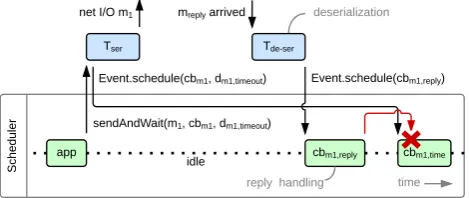
Figure 4: Decoupling of net I/O within the Standalone run-time in thesend-and-waitscenario.
The runtime provides the scheduling component by rely-ing on Java’sScheduledExecutorService, thereby ensuring that events are processed one after the other. As in event-based simulations, code has to be non-blocking. This prop-erty is achieved by utilizing callbacks and worker threads whenever blocking functions (such as net I/O) are called in the runtime environment. For net I/O, this is already taken care of by the KryoNet library. In order to avoid concur-rent execution of application code, incoming messages are added as new immediate events into the scheduling queue. As soon as the event is executed by the scheduler, the re-spective event handler (usually a message handler in the application code) is notified and can process the message.
Figure 4 illustrates the behavior of the scheduler for the
request-reply scenario outlined in Section 2.1.3. The appli-cation code invokes sendAndWaiton the transport compo-nent, passing a messagem1 to send, a callback cbm1 as well as a timeout. The runtime implementation of the transport component stores the callback object cbm1 and spawns a
4Available under the BSD license athttps://github.com/
new thread Tser. ThesendAndWaitmethod returns imme-diately afterwards, thereby ending the execution of the event in the scheduler and allowing the next event to be processed. The thread Tsertakes care of scheduling the timeout event cbm1,timeas well as serializing the message and passing it on to KryoNet. In the example, a replymreply arrives before the timeout fires, resulting in a new thread Tde-serthat takes care of deserialization. The message object is then enqueued for further processing by scheduling an immediate event. In our example, the scheduler is currently idle, leading to the immediate execution of the corresponding event. As part of the callback handling provided by theMessageBased trans-port component, the corresponding timeout event cbm1,time is disabled and will not be processed further.
2.2.3
Android Runtime
Extending the Standalone environment, the Android en-vironment adds an application stub and bridges Android-specific interfaces, such as access to sensors. It serves as the basis for the development of user interfaces and instru-mented applications. As the Android runtime relies on the Standalone runtime, both environments are fully compatible w.r.t. message serialization and net I/O. This enables het-erogeneous deployments with both, mobile Android clients and fixed computers running on a testbed such as Planet-Lab5 or G-Lab/ToMaTo6.
The Android runtime serves two purposes, depending on the scope of the intended evaluation. For technical evaluations, a fully fledged Android application is usually not required. In such scenarios, the runtime supports researchers and de-velopers by providing basic information about instrumented components throughmetrics. For user studies, an easy ac-cessible user interface is required, best developed using stan-dard Android development tools. By connecting interactions with the user interface to the respective calls of the com-ponents’ APIs, and by utilizinganalyzers to pass relevant component state to the user interface, a clear separation of the user interface and the functional components is achieved. In addition to the simplification of the application develop-ment, it also ensures that up-to-date component implemen-tations can directly be used within prototypes. Furthermore, applications developed with the framework can also run on the default Android emulator. This provides easy ways to control specific parts of the Android application, such as injecting location data though our sensor interfaces.
Using the instrumentation features of the Simonstrator frame-work, one can easily record sensor data or user interaction patterns obtained during a field study. Such data can then be fed back to simulation models for larger-scale evalua-tions. Possible applications include the recording of indi-vidual users’ movement traces (c.f. Section 3) as well as gathering statistics about the utilized network connection (e.g., signal strength) to later correlate that data with user behavior patterns.
2.2.4
Other Runtime Environments
Besides adding other network or overlay simulators by bridg-ing the respective components to the simulator’s models, one
5https://www.planet-lab.org/
6
http://master.tomato-lab.org
can easily extend the Standalone runtime to utilize genera-tors for specific data. One example is the BonnMotion [2] movement generator, which can be used to generate node mobility traces. Instead of relying on real GPS data, one can feed trace values generated by BonnMotion into the application by providing the respective implementation of the location sensor component. This is especially valuable during prototypical deployments relying on automated se-quences of sensor data (in this case movement) to trigger specific application behavior. By relying on the location sen-sor abstraction provided by the framework, the underlying implementation is completely transparent to the application or other components utilizing the sensor.
3.
EVALUATION
Within this section, exemplary use cases of the proposed Si-monstrator platform are discussed. We especially want to highlight the benefits of the component-based approach for the development and evaluation of complex distributed sys-tems on heterogeneous platforms. Therefore, two use cases are analyzed in the following: (i) a distributed live video streaming system, and (ii) a publish/subscribe middleware for augmented reality games. For each use case, the utiliza-tion and configurautiliza-tion of respective components from the Si-monstrator platform are discussed together with the lessons learned. As the Simonstrator platform utilizes existing sim-ulators and their models through the concept of runtime en-vironments, we do not intend to compare the performance of different simulation models.
3.1
Live Video Streaming
Video streaming is a prominent application on today’s mo-bile devices. To deal with an increasing user demand and simultaneously compensate for sudden increases in viewer numbers, CDN providers such as Akamai build large overlay-based distribution structures. They span both hundred thou-sands of managed servers [14] as well as actively contributing clients at the edge of the network, i.e. applying peer-to-peer (p2p) technology for an efficient distribution of content [21]. As an example for the latter case, consumers of a video stream can contribute some of their upload bandwidth to support the overall delivery process as well as reduce the load on the content provider and the CDN infrastructure. While there have been countless proposals for distributed streaming systems in fixed networks, efficiently supporting typical live streaming use cases remains a challenging prob-lem. Furthermore, the incorporation of mobile devices in p2p systems poses an additional challenge.
If a mobile device is connected via a cellular link (i.e. 3G/4G), the upload bandwidth is not only limited but also expensive in terms of energy consumption on the device. Therefore, uploading video data via the cellular link is usually not a viable option in typical mobile environments. However, in group scenarios, the video data can be shared with other nearby devices, e.g. using Wi-Fi Direct. If done in an intel-ligent manner, the overall bandwidth and energy consump-tion of a group of devices can be reduced. However, tablets tend to be used a lot at home, typically connected to the home network using Wi-Fi and often being connected to a charger. Suddenly, even mobile devices can become fully-fledged peers in a distributed system, contributing cheap
system. A more severe challenge for distributed streaming approaches is the ability of a system to cope with sudden increases in the overall number of viewers, so called flash crowds. In this context, scalability of the overall system, i.e. the ability of the streaming system toquickly leverage upload bandwidth of new peers to address the fierce com-petition for available resources is critical and an important focus of research in this area.
These different challenges open a wide area of different eval-uation scenarios that are to be considered when designing and studying new streaming systems. One recently proposed live streaming system that aims at supporting heterogeneous clients and to handle flash crowd events isTransit[20, 13]. It was evaluated using the Simonstrator framework and, this way, successfully evaluated using large-scale simulations and has shown to work also as prototype running on mobile de-vices for small-scale demonstrations. Currently, mid-scale testbed evaluations are in preparation to complete the pic-ture.
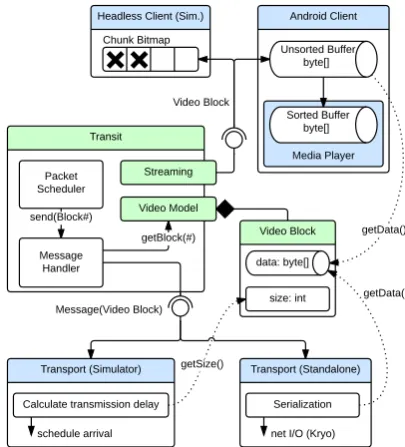
Figure 5 illustrates one host within the Transit overlay and its usage of framework components when transmitting video blocks. These components are then mapped to the re-spective runtime environment, here shown for the simulator PeerfactSim.KOM as well as the prototypical deployment on Android and on testbed PCs. Note, how real video data as well as packet serialization is only used in the prototypical deployments. Within simulations, theMessage interface is used to obtain the size of a message in bytes without actu-ally creating the corresponding payload (cf. Sec. 2.1.3). This example illustrates the choice of relevant effects within the considered scenario: the actual video payload is assumed to have no influence on the macroscopic system behavior dur-ing a flash crowd and therefore is omitted when studydur-ing streaming performance and structural properties in large-scale scenarios.
Figure 6 shows exemplary simulation results for synthetic flash crowd scenarios. The number of active peers as well as the arrival rate during two flash crowds with a peak of 2,500 concurrent peers and different intensities of arrival rates is shown in Figure 6a. In Figure 6b the performance of two configurations under the FC2-workload is shown in terms of video stalling events, i.e., interruptions in playback. The topology optimizations in the configuration TopT lead to a significant decrease of such interruptions during the flash crowd by lowering the average delivery tree depth (c.f. Fig-ure 6c) and, thus, reducing the impact of peer arrivals and departures. The objective of these studies was to investi-gate the scaling characteristics of an improved version of the Transitsystem in extreme scenarios and evaluate different system variants and configurations. For this purpose, simu-lative evaluations were chosen (i.e. a macroscopic view) as only feasible approach to investigate a large number of dif-ferent configurations with well-defined and controlled large-scale streaming scenarios.
Relying on the Simonstrator framework and, thus the same core implementation, currently, mid-scale testbed experi-ments (i.e. with up to several hundred headless clients) are in preparation to complement the simulation results de-scribed above. The objective is still to study the
scalabil-Transit
Streaming Video Block Headless Client (Sim.)
Chunk Bitmap
Android Client
Unsorted Buffer byte[]
Media Player Sorted Buffer
byte[]
Video Block
data: byte[]
size: int
getData() Video Model
Packet Scheduler
send(Block#)
Message Handler
getBlock(#)
Transport (Standalone) Transport (Simulator)
Message(Video Block)
Calculate transmission delay getSize()
schedule arrival
Serialization
net I/O (Kryo)
getData()
Figure 5: Handling of video data withinTransit. On An-droid, real video payload is transmitted and passed to the media player, whereas simulations rely ongetSizeprovided by theMessageinterface to increase scalability.
ity behavior of the system but under less resource-restricted conditions, now also considering more practical factors, such as variable-sized video chunks. For these testbed experi-ments, a recently extended version of the German-wide G-Lab testbed is used. The same version of the streaming soft-ware could be also run on PlanetLab or similar testbeds with no changes. For these experiments, the streaming system is run on Linux-based, headless testbed machines. While the data transmission of video packets is done in a full manner, the video playback at the clients is simulated. A virtual video player probes the buffer of the local streaming client for the availability of the video data and triggers stalling events on unavailable data. This allows to assess the stream-ing system performance across all clients in the same way as for the simulation studies, relying on a common analyzer interface as introduced in Section 2.1.2.
A step further was taken by bundling the streaming soft-ware in an Android project, where, again thanks to the Si-monstrator framework, it is used as library with no need to change the actual implementation. Here, the virtual video player was replaced by a real video player library as part of an Android application. This app is used for demonstration purposes [12] and was successfully shown at different occa-sions to demonstrate the adaptive behavior of the streaming system. For the demonstration, the focus is on small-scale scenarios and the user-centric view on the system. Here, the graphical user interface and the interactive behavior of the system plays a more important role than other aspects studied in the simulation or headless testbed evaluations.
3.2
Augmented Reality Gaming
be-60 120 180 time [min]
0 500 1000 1500 2000 2500
Peers Present
FC1 FC2
60 120 180
time [min] 0
100 200 300 400 500 600 700 800
Peer Arrival Rate [1/min]
FC1 FC2
(a) Simulated flash crowd scenarios of different strengths.
Transit TopT
0.00 0.05 0.10 0.15 0.20 0.25 0.30
Stalls count
0.0 0.2 0.4 0.6 0.8 1.0
Stalls count 0.0
0.2 0.4 0.6 0.8 1.0
P
[
X
≤
x
]
Transit TopT
(b) Performance comparison based on video stalling events.
60 120 180
time [min] 0
2 4 6 8 10 12 14 16 18
Tree Depth Avg
Transit TopT
(c) Influence on topol-ogy characteristics.
Figure 6: Typical scenario and results for streaming simula-tions comparing different streaming system variants for the FC2 workload (adapted from [13]).
coming increasingly popular. One important property, espe-cially of AR games, is the spatial relevance of information: interactions with the game mostly affect other players that are in physical proximity. Today, these communication char-acteristics are not reflected by the underlying communica-tion system. Instead, data is sent to a centralized infrastruc-ture (e.g., cloud data centers), although it is of local rele-vance. This leads to increased latencies, effectively prohibit-ing highly interactive applications. In previous work [11], we propose and evaluate a system for locality-aware messaging that utilizes local communication between nearby devices to augment communication via the central server.
In contrast to the video streaming example, the AR sce-nario is targeted solely towards mobile devices, relying on sensor data for location updates as well as on local com-munication, using Wi-Fi and Bluetooth. Furthermore, user movement and behavior is of primary interest as it directly determines the workload and, thus, the performance of the system. To collect realistic user traces that can then be used for larger scale simulations, an actual game is imple-mented using the Simonstrator Android runtime [10]. The game communicates with a central server (running within the standalone environment) using our communication mid-dleware. The middleware is instrumented to log all events that are triggered by user interaction with the game. These measurements are stored locally on each device for later pro-cessing. Evaluating data gathered during these field studies serves two main purposes: (i) improving the workload model in our simulations to enable assessment of different local communication strategies and (ii) later evaluate the strate-gies under realistic conditions, especially w.r.t. the wireless communication medium.
To study user behavior and the potential savings obtained through local communication, we conducted a field study with 40 players playing the game in a public park and its
0 10 20 30 40 50 60
0 10 20 30 40 50
Per
centage of
Saved Data
Direct Communication Range [m]
(a) Transmission ranges.
0 10 20 30 40 50 60
1 2 3 4 5
Per
centage of
Saved Data
Max. Number of Hops 3 m range 5 m range 10 m range 20 m range
(b) Multi-hop distribution.
Figure 7: Potential for direct local communication assuming different communication ranges as well as multi-hop distri-bution as obtained from the field study.
rect surroundings. The players were divided into two groups that each tried to win the session by conquering locations, similar to portals in Google’s Ingress. The locations were preselected based on map data and included public sights and monuments spread all over the park. In order to con-quer a location, a player spawns units that follow his real-life movements and attack towers built by players of the enemy group. Thus, the chance of winning increases if more players agree on a common target to attack. However, groups can split up to speed up the process by conquering multiple (po-tentially weaker) targets in parallel. Two findings affecting the design of the communication middleware are shown in Figure 7. Based on the movement data and the recorded communication events of two sessions of one hour each, (a) shows the percentage of events that could be distributed lo-cally over one hop, given a specific communication range. In (b), the corresponding results for multi-hop communi-cation are shown for selected communicommuni-cation ranges, indi-cating that for the observed user behavior the efficiency of multi-hop communication saturates at roughly three hops, independent of the communication range. Even with single-hop communication and a range of 3 m, 10 % of the overall data can be distributed locally, motivating low-power local transmission of events via Bluetooth.
The observed effects and characteristics (cf. Figure 7a and 7b) motivated us to investigate the influence of direct communi-cation for the transmission of events to nearby players. As published in [11], we examined the impact of different local communication protocols, which rely on Wi-Fi ad hoc, on our communication middleware by means of simulation. In a prospective step, we plan to analyze the obtained move-ment data from the field study to improve the utilized mo-bility model for a more accurate reflection of user behavior in the AR game.
4.
RELATED WORK
Related to the Simonstrator platform comparable simula-tion platforms have been developed that enable combined simulative and prototypical evaluations. In the following, we start with an overview on platforms that target specific types of networks, comprising delay tolerant networks (DTNs), p2p networks, and wireless sensor networks (WSNs). Sub-sequently, we present related work on solutions that combine virtual or emulated machines with simulators and complete this section with a review of common network simulators.
ONE [8] is a simulator for DTNs, focusing on node move-ment and the resulting contact characteristics to enable eval-uation of DTN protocols. The ONE simulator exports the DTN27 interface, enabling the integration of real-world ap-plications into the simulation environment. Additionally, the simulator can communicate with DTN2 bundle routers, thereby enabling utilization of its connectivity models in testbed deployments. Our concept of runtime environments further extends the potential deployment options when com-pared to the ONE simulator. Furthermore, the presented Simonstrator framework with its component-based composi-tion of experiments is not limited to one specific applicacomposi-tion scenario (DTNs). Instead, our framework enables a broader scope of evaluations with a common research prototype.
ProtoPeer [5] is closely related to our proposed framework, as Galuba et al. introduce a lightweight programming inter-face for developed applications on top of a simulator or a prototype. The proposed interface is limited to scheduling and network-related functionality and enforces a strict hori-zontal split between application and platform. The concept of Peerlets allows the composition of applications out of sev-eral functional building blocks, similar to our proposed com-ponents. However, Peerlets in ProtoPeer are limited to the application layer and cannot be provided by the platform it-self. This limits the usage of platform-specific features, such as utilizing location data provided through the Android API. Therefore, the ProtoPeer approach is sufficient for fixed p2p networks that exclusively rely on the interconnection of and communication between fixed hosts, as illustrated with the Chord example by the authors. In contrast, it does not en-able design and evaluation of today’s mobile applications, as the abstraction in ProtoPeer is limited to only time and network-related features.
WSN research also focuses on both, simulative and proto-typical evaluation of small-scale and large-scale behavior. Therefore, a number of WSN testbeds have emerged, that enable protocol assessment within a defined setup and at specific scale. For early insights as well as scenarios where not suitable testbed is available, researchers rely on sim-ulation tools that often come bundled together with the sensor nodes’ operating system. One prominent example is TOSSIM [9], providing a complete simulation environment for applications built on the TinyOS operating system. Ap-plications and protocols written for TinyOS can be deployed on real hardware or being simulated within TOSSIM with-out changes to the application code itself. The compile pro-cess ensures that instead of being executed on real hardware, calls are directed to the respective simulation models.
COO-7
http://www.dtnrg.org/wiki/Code
JA/MSPSim [4] goes one step further by enabling simulation and emulation of WSNs with heterogeneous operating sys-tems. The authors argue that testing of interoperability is a key requirement when developing applications and protocols for heterogeneous sensor networks. This claim can also be applied to today’s applications, running on a broad range of heterogeneous devices, ranging from mobile to fixed devices. By enabling component-based composition and evaluation of a system on different runtime environments, the Simon-strator platform helps to consider heterogeneity within the experiment setup.
Werthmann et al. [19] propose VMSimInt, utilizing virtual machines (VMs) integrated into a simulation framework. By controlling the VM’s time and clock speed, as well as ac-cess to network socket operations, they enable time-scaled experiments while providing full access to the operating sys-tem’s features. The focus of VMSimInt is on transport and network layer protocols, where the VM-based abstraction benefits from the realistic behavior of the network stack im-plemented in the operating system. Regarding the repro-ducibility of experiments, the authors do not control the random number generator of the host system. They argue that their approach still enables deterministic evaluation of TCP mechanisms, as protocol behavior is only affected by the system’s clock in this case. However, VMSimInt adds a considerable amount of overhead. Consequently, it can not be used to evaluate larger distributed systems such as the streaming system discussed in Section 3. Furthermore, it does not provide an abstraction for heterogeneous plat-forms, as the studied application has to be programmed for the respective OS. Still, one could integrate applications de-veloped with the Simonstrator framework into VMSimInt to study network-layer effects by using the Standalone runtime environment inside a virtual machine.
SliceTime [18] constitutes an emulation platform that com-bines event-based simulations with virtual machines to ex-amine macroscopic as well as microscopic effects on the eval-uated communication protocol. The platform consists of three components, comprising a synchronizer, a simulator, and one (or multiple) virtual machines. The synchronizer is used to coordinate and synchronize the execution of the considered communication protocol that is executed on the simulator and the virtual machines. Dependent on the speed of the simulation, the synchronizer either throttles the sim-ulator if simulations run faster than real time or stops the virtual machines otherwise. SliceTime relies on the network simulator ns-3 [6], which facilitates to reuse the code from simulations for the deployment on the virtual machines. As is the case with VMSimInt, SliceTime does not provide an abstraction for heterogeneous platforms, especially consid-ering mobile devices.
5.
CONCLUSIONS
Distributed mobile applications and the underlying com-munication systems are subject to a high number of en-vironmental factors influencing their performance. To as-sess the impact of these factors at different scales, differ-ent types of simulation as well as prototypical deploymdiffer-ents are necessary. In this paper, we proposed the Simonstrator platform, consisting of the component-based Simonstrator framework as well as runtime environments for existing sim-ulators, testbeds, and the Android mobile platform. The Simonstrator platform especially supports design and eval-uation of applications for heterogeneous mobile devices by enabling access to device-specific features such as sensors or multiple network interfaces (e.g., Bluetooth and Wi-Fi Direct). The component-based design in conjunction with different runtimes and powerful instrumentation capabilities enables evaluations of complex distributed applications un-der a wide variety of evaluation scopes. Systems developed with the proposed framework can run on any of the provided runtime environments without modifications to their code.
We demonstrate the capabilities of our platform by dis-cussing live video streaming and mobile augmented reality gaming as two exemplary use cases. Both use cases high-light the benefits of combined evaluations at different scales. Early user studies based on prototypes motivate design de-cisions for further research, while fast feedback of simulation models into the prototype helps in understanding the sys-tem’s behavior under realistic settings.
The Simonstrator platform is being used in a number of projects and benefits from their contributions. Currently, the Android runtime and the framework is being extended to support additional Android-specific features such as Near Field Communication (NFC). Furthermore, deeper integra-tion with automated deployment tools such as Plush [1] is being examined, allowing easier setup of testbed experi-ments and collection of evaluation results. Finally, the OM-NeT runtime environment is being finished for release, which includes integrating OMNeT’s visualization framework.
6.
ACKNOWLEDGMENTS
This work has been funded by the German Research Foun-dation (DFG) as part of projects B01/C02/C03 within the Collaborative Research Centre (CRC) 1053 – MAKI. Ralf Steinmetz has been partially supported by a Chair of Excel-lence from University Carlos III, Madrid, Spain.
7.
REFERENCES
[1] J. R. Albrecht, R. Braud, D. Dao, N. Topilski, C. Tuttle, A. C. Snoeren, and A. Vahdat. Remote control: Distributed application configuration, management, and visualization with plush. InProc. LISA, 2007.
[2] N. Aschenbruck, R. Ernst, E. Gerhards-Padilla, and M. Schwamborn. Bonnmotion: a mobility scenario generation and analysis tool. InProc. SIMUTools, 2010.
[3] I. Baumgart, B. Heep, and S. Krause. Oversim: A scalable and flexible overlay framework for simulation and real network applications. InProc. IEEE P2P, 2009.
[4] J. Eriksson, F. ¨Osterlind, N. Finne, N. Tsiftes, A. Dunkels, T. Voigt, R. Sauter, and P. J. Marr´on. Cooja/mspsim: interoperability testing for wireless sensor networks. InProc. SIMUTools, 2009. [5] W. Galuba, K. Aberer, Z. Despotovic, and
W. Kellerer. Protopeer: A p2p toolkit bridging the gap between simulation and live deployement. InProc. SIMUTools, 2009.
[6] T. R. Henderson, S. Roy, S. Floyd, and G. F. Riley. ns-3 project goals. InProc. WNS2, 2006.
[7] R. Jain.The art of computer systems performance analysis. John Wiley & Sons, 2008.
[8] A. Ker¨anen, J. Ott, and T. K¨arkk¨ainen. The ONE Simulator for DTN Protocol Evaluation. InProc. SIMUTools, 2009.
[9] P. Levis, N. Lee, M. Welsh, and D. Culler. Tossim: Accurate and scalable simulation of entire tinyos applications. InProc. ACM SenSys, 2003.
[10] B. Richerzhagen, M. Schiller, M. Lehn, D. Lapiner, and R. Steinmetz. Transition-enabled event
dissemination for pervasive mobile multiplayer games. InProc. WoWMoM. IEEE, 2015.
[11] B. Richerzhagen, D. Stingl, R. Hans, C. Gross, and R. Steinmetz. Bypassing the cloud: Peer-assisted event dissemination for augmented reality games. In
Proc. IEEE P2P, 2014.
[12] B. Richerzhagen, S. Wilk, J. R¨uckert, D. Stohr, and W. Effelsberg. Transitions in live video streaming services. InProc. ACM VideoNEXT, 2014. [13] J. R¨uckert, B. Richerzhagen, E. Lidanski,
R. Steinmetz, and D. Hausheer. Topt: Supporting flash crowd events in hybrid overlay-based live streaming. InProc. IFIP Networking, 2015.
[14] R. K. Sitaraman, M. Kasbekar, W. Lichtenstein, and M. Jain. Overlay Networks: An Akamai Perspective. InAdvanced Content Delivery, Streaming, and Cloud Services. John Wiley & Sons, 2014.
[15] A. Stetsko, T. Smolka, V. Matyas, and F. Jurneˇcka. On the credibility of wireless sensor network
simulations: evaluation of intrusion detection system. InProc. SIMUTools, 2012.
[16] D. Stingl, C. Gross, J. R¨uckert, L. Nobach,
A. Kovacevic, and R. Steinmetz. PeerfactSim.KOM: A simulation framework for peer-to-peer systems. In
Proc. HPCS, 2011.
[17] A. Varga et al. The omnet++ discrete event simulation system. InProc. ESM, 2001.
[18] E. Weing¨artner, F. Schmidt, H. V. Lehn, T. Heer, and K. Wehrle. Slicetime: A platform for scalable and accurate network emulation. InProc. NSDI, 2011. [19] T. Werthmann, M. Kaschub, M. K¨uhlewind, S. Scholz,
and D. Wagner. Vmsimint: a network simulation tool supporting integration of arbitrary kernels and applications. InProc. SIMUTools, 2014.
[20] M. Wichtlhuber, B. Richerzhagen, J. R¨uckert, and D. Hausheer. Transit: Supporting transitions in peer-to-peer live video streaming. InProc. IFIP Networking, 2014.