University of New Hampshire Scholars' Repository
Honors Theses and Capstones Student Scholarship
Spring 2018
Changing Attitudes: The Impact of a Disability
Awareness Class
Christine Ann Masci [email protected]
Follow this and additional works at:https://scholars.unh.edu/honors
Part of theRecreational Therapy Commons
This Senior Honors Thesis is brought to you for free and open access by the Student Scholarship at University of New Hampshire Scholars' Repository. It has been accepted for inclusion in Honors Theses and Capstones by an authorized administrator of University of New Hampshire Scholars' Repository. For more information, please [email protected].
Recommended Citation
Masci, Christine Ann, "Changing Attitudes: The Impact of a Disability Awareness Class" (2018).Honors Theses and Capstones. 382.
Changing Attitudes: The Impact of a Disability Awareness Class
Christine Masci
University of New Hampshire
ABSRACT
Attitudes towards people with disabilities can be either positive or negative. A
undergraduate college course about disability awareness followed a structure focusing on
awareness, interaction with PWD, and education in order to make a positive impact on
attitudes. The study compared the disability awareness class to a general education
humanities class. While results indicated that there was not a significant change in pre and
post scores when comparing the classes, there was a significant change in the disability
awareness class upon further analysis of data. There are additional suggestions to further the
impact of the class within the disability awareness class and the university.
INTRODUCTION
Attitudes and beliefs are present in everyone. These can be formed from a number of
sources and can impact how people interact with each other. This is especially true for attitudes
towards people with disabilities (PWD). The idea of the impact of these attitudes was stated by
Lundberg, Zabriskie, Smith and Barney, “The greatest impediment to a person’s taking full part in
his society are not his physical flaws, but rather the issue of myths, fears, and misunderstandings
that society attaches to them” (2008). People have varying attitudes towards PWD, whether they
are positive or negative, and those attitudes are developed in different ways.
Corrigan, Lundin, Penn, Uphoff-Wasowski, Campion, & Kubiak examined the idea that
attitudes towards PWD develop based on people’s personalities, as well as personal experiences
with PWD. Results indicated that people who have higher levels of openness and agreeableness
meaningful interactions with PWD lead to people developing positive attitudes as well (2001).
These are opportunities to shape a person’s perception towards PWD.
The attitudes that develop are either positive or negative. A study completed by Loo
(2001) examined attitudes towards PWD using undergraduate students in a managerial class. The
qualitative results showed supporting themes such as admiration, positive expectations, need to
accommodate, sympathy for unfair treatment, desire to improve attitude, positive contact and
importance of knowing what a person can do rather than cannot do (Loo, 2001). However, there
were also negative themes, such as fear of the unknown, not knowing how to behave in the
presence of someone with a disability, discomfort from interactions and belief that there should
not be preferential treatment in the workplace (Loo, 2001). The idea of “not knowing” what
could happen also appear in Fichten, Robillard, Tagalakis and Amsel’s study. Participants who
did not have a disability themselves shared themes of not knowing what to do or say in a
situation, worrying if they are doing or saying the correct thing, or that PWD will have negative
experiences from their conversation (1991).
With the way attitudes develop, it is questioned if they can change. If attitudes can indeed
be changed, is the shift positive or negative? Sometimes people can have experiences that change
their attitudes to be negative. An example is PWD being depicted in media such as movies and
TV shows as causing harm towards others, or meeting someone who has a disability who does
not have a friendly personality. On the other hand, some people may gain a new perspective from
knowledge on their own such as efforts like the “Spread the Word to End the Word” campaign
and groups like “Best Buddies”. Others may have positive interactions through family members,
these components (awareness, interaction with PWD, and education) were combined, would it be
more likely to have an impact and change people’s attitudes?
A disability awareness course, focusing on recreation, offered at a New England
university encompasses awareness, education and interaction with PWD. The class follows a
series of disability awareness content and is designed to change attitudes towards PWD.
Lundberg et al., stated the structure of disability awareness content promotes positive attitudes
towards disability through awareness, possible adaptations and modifications for recreation
activities for PWD and promotes wellness, regardless of level of ability (2008). It is also
suggested that negative attitudes such as prejudice and discrimination can be changed through
positive interactions between PWD and people without a disability (Lundberg et al., 2008).
Corrigan et al., discussed that education and contact leads to attitude change, while ignoring
attitudes lead to no change (2001). The class touches on all of these components during the
academic semester.
Components of the Disability Awareness Class
Awareness, education and interaction with PWD are broken down into five key
components (person first language, service learning, media awareness, history of PWD and
accessibility awareness) during the course. The content has potential to teach students about
disability related issues, help students with understanding and promote positive attitudes
(Lundgerg et al., 2008). Additionally, it is important to note that the class offered is as a part of a
program that is certified by the Committee on Accreditation of Recreational Therapy Education
(CARTE). Components of the class follow guidelines set by CARTE. The following guidelines
relate specifically to disability awareness: 1.1.5 “knowledge of personal and societal attitudes
physical, cognitive, social and emotional functioning upon independence in life activities
including work/school, self-maintenance and leisure” (2010.) When combined, these qualities of
the class provide a curriculum that has potential to positively change student’s attitudes towards
PWD.
Person First Language
Person first language is putting an individual before their disability. This helps to
decrease stigma that often comes along with a disability as well as the objectification of an
individual by their disability (Dunn & Andrews, 2015). Additionally, person first language
promotes that while two individuals may have the same disability, what they experience is
different and related directly to them as an individual (Dunn et at., 2015).
Service Learning
Service learning is when students take what is being taught in the classroom and utilize it
in real life. This involves three core concepts; the experience should be related to what is being
taught in class, students should be having a positive impact on the community and students end
the experience with a reflection (Moorman & Arellano-Unruh, 2002).
Media Awareness
Media awareness is recognizing how PWD are portrayed in the media. Often times,
media can affect people’s attitudes by portraying PWD into different contexts. An example is
when individual is being depicted; the focus is on sports involvement compared to focusing on
their disability (von Sikorski & Schierl, 2014). Additionally, media portrays PWD, especially
with mental illness, as a stereotype and stigma, e.g. violent, childlike behavior as an adult, or
History of People with Disabilities
The history of PWD is a long history that has important milestones from the movement
of deinstitutionalization to the passing of the American’s with Disabilities Act (ADA). The ADA
is the biggest stride for PWD, and shows how culture has changed to be more inclusive and
pushes to rule out discrimination (Forber-Pratt & Zape, 2017).
Accessibility Awareness
Accessibility awareness is being conscious of how the ADA affects business’ ability to
be accessible to all people, regardless of disability. When people who do not have a disability
experience the accessibility, or lack of accessibility, they gain a better understanding to what
challenges PWD may encounter (Pivik, Macfarlane & Laflamme, 2002).
Hypotheses
The purpose of this research is to examine if a class with a primary focus on disability
awareness can change student’s attitudes towards PWD compared to student’s attitudes in a
general education humanities course. The disability awareness class’s unique features have the
potential change students’ attitude.
Research Questions
• Is there a significant difference in pre-test scores between the disability awareness class
and the general education humanities class?
• Is there a significant difference in post-test scores between the disability awareness class
• Is there a significant change in the students’ score on the Attitudes Toward Disabled
Persons (ATDP) scale after taking the disability awareness class?
• What component of the disability awareness class had the strongest influence on
participants in the disability awareness class’ attitudinal change toward PWD?
Methods
Participants and Settings
In order to participate, subjects needed to be university students enrolled in the disability
awareness class or in a designated general education humanities class who voluntarily agreed to
participate. They were compensated for their time with extra credit towards the class in which
they were enrolled. There were twenty-eight students who participated in the disability
awareness class and twenty-four students who participated in the general education humanities
course (n=52). Between both classes, there were fifteen males and thirty-seven female students
(n=52).
Subjects were selected as only those students that completed both parts (pre and post test)
of the study. The students in the general humanities class who had either taken the disability
awareness class previously or were currently in the disability awareness class did not have their
data analyzed. Data of students who also did not complete both parts (pre and post test) of the
study were not analyzed.
Data Collection
Students created an identity to be used for comparing scores of the pre- and post-test. The
pretest opened to participants for two weeks after the first day of class. This was critical so
towards PWD. The posttest opened for the last two weeks of the semester, after participants in
the disability awareness class had been exposed to the majority of the course content.
Demographics were collected in the first part of the survey by asking participants to
identify age, gender, graduation year, and major. Participants were also asked about personal
experiences with disability including having family, friends, or neighbors with disabilities.
Attitudes were measured using the Attitudes Towards Disabled Persons (ATDP) scale, a 20
question Likert Scale with answers ranging from “I agree very much” to “I disagree very much”.
Mean scores range from 0 to 60. The closer the score is to 0, the more positive the attitudes
displayed are. A score closer to 60 indicates a more negative attitude.
Students in the disability awareness class had additional questions in their post test.
Questions asked participants to identify the most influential component of the course as it relates
to attitude change from a list including person first language, media awareness, service learning
or accessibility awareness and why they felt that aspect was most influential.
Data Analysis
Data was analyzed using the system SPSS and using quantitative methods for the ATDP
scale. Descriptive data is presented by using one-way ANOVAs and paired sample t-tests. This
shows pre and post test scores and if there are any changes.Interpretations of the data show if
there are any positive changes in pre and post test scores. This indicated that there was a positive
change in attitudes.
The different components of the disability awareness class (person first language, service
learning, media awareness, history of PWD and accessibility awareness) were ranked from most
effective to least effective in terms if changing attitudes.
Data
Is there a significant difference in pre-test scores between the disability awareness class and
the general education humanities class? No, p=.253
Data was analyzed using a one-way ANOVA, results showed no significant difference in
pre scores between the disability awareness class and the general education humanities class,
one-way ANOVA (F(1,50)=1.34, p=.253). There is no significant difference, evidence p=.253,
being more than p=.05, a value of significant difference. This indicated that both classes started
the semester with similar attitudes towards PWD. Mean scores and significance probability
reported in Table 1.
Is there a significant difference in post-test scores between the disability awareness class and
the general education humanities class? No, p=.344
Data was analyzed using a one-way ANOVA, results showed no significant difference in
post scores between the disability awareness class and the general education humanities class,
one-way ANOVA (F(1,50)=.913, p=.344). There is no significant difference, evidence p=.344,
being more than p=.05. Mean scores and significance probability reported in Table 1.
It can be indicated that participants in both courses maintained similar attitudes from the
beginning of the semester. However, it should be noted that the disability awareness class did
have an improvement in mean score by 2.54 points. The general humanities course did also have
an improvement in mean scores by 3.04 points. This is possibly attributed to the class covering
the topic of disability awareness towards the end of the semester, right before the post test was
Table 1, One-way ANOVA comparing pre and post test between disability awareness class
and general humanities class.
Variable DAC n=28 GHC n=24 Sig.
Pre test 18.75 16.79 .253
Post test 16.21 13.75 .344
DAC= disability awareness class GHC= general humanities class
Is there a significant change in the students’ score on the Attitudes Toward Disabled Persons
(ATDP) scale after taking the disability awareness class? Yes, .008
The disability awareness class is bimodal, meaning 17 participants scored 0 to 20 on the
ATDP scale (high scorer group) and 11 participants scored 21 or higher on the ATDP scale (low
scorer group). This prompted further analysis of the two groups using a paired sample t-test.
The high scorer group had no significance for pre test (M=14.35, SD=3.71) and post test
(M=14.76, SD=12.51) conditions t(16) = -.145, p=.886. This indicates that these students already
had positive attitudes towards PWD prior to the class, and continued to maintain those positive
attitudes after completion of the class. Mean scores and significance probability reported in
Table 2.
The low scorer group had a significant change in scores. The pre test (M=25.55, SD=
2.91) and post test (M=18.45, SD=6.99) conditions t(10)=3.316, p=.008. This is a significant
difference evidence by .008 being less than p=.05. There was an improvement in mean score by
significantly changed in positivity from the beginning of the class to the completion of the
course. Mean scores and significance probability reported in Table 3.
Table 2, Paired sample t-test of differences within pre and post for disability awareness
class for high scorers.
Variables High Scorers n=17 Sig.
Pre test 14.35 -
Post test 14.76 .886
Table 3, Paired sample t-test of differences within pre and post for disability awareness
class for low scorers.
Variables Low Scorers n=11 Sig.
Pre test 25.55 -
Post test 18.45 .008*
*= indicated significant difference
What component of the disability awareness class had the strongest influence on participants
in the disability awareness class’ attitudinal change toward PWD?
Participants in the disability awareness class ranked the following categories: media
awareness, person first language, service learning, history of people with disabilities and
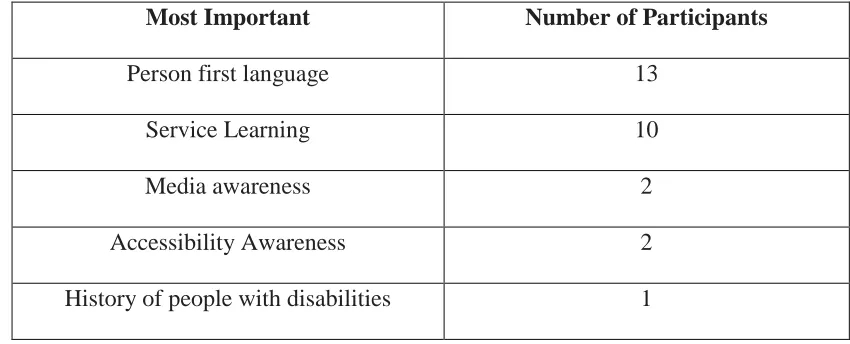
accessibility awareness, most to least effective. The rankings of most effective are reported in
Table 4. Thirteen participants listed person first language as the most effective component. The
ratings for least effective are reported in Table 5. Fifteen students ranked history of PWD as the
Table 4, Rankings for “most important” class aspect, ranked from greatest of most
important to lesser of most important.
Most Important Number of Participants
Person first language 13
Service Learning 10
Media awareness 2
Accessibility Awareness 2
History of people with disabilities 1
Table 5, Rankings for “least important” class aspect, ranked from greatest of least
important to lesser of least important.
Least Important Number of Participants
History of people with disabilities 15
Service Learning 6
Media awareness 4
Accessibility Awareness 2
Person first langauge 1
Discussion
The data for the disability awareness class was unique in the fact that it was bimodal.
This made comparing the change in scores between the disability awareness class and the
when looking at the two classes, that there was not an impact of attitudes for students who
took the disability awareness class compared to the general education humanities class.
However, as mentioned previously, when the disability class was split into the high scorer
and low scorer groups, there was a significant change.
There are a few reasons as to why there was a split in scores amongst the participants.
One reasons is the high scorers who signed up to take the disability awareness class could
have already had positive attitude towards PWD, and that intrigued them to want to take the
class. This aligns with a previously done study that noted student’s pre test scores on the
ATDP indicated positive attitudes towards PWD, and there was not a significant change in
post scores (Zychlinski, Ben-Ezra, & Raz, 2016). Further more, 18 participants listed having
regular interactions with PWD. These interactions ranged from occurring everyday to every
month. People who experience meaningful and personal interactions with PWD form positive
attitudes as a result (Page & Islam, 2015). These factors could be indicators as to why there
was division of scores in the class.
Another impactful factor on the data was the importance of person first language. For
students in the disability awareness class, thirteen out of twenty-eight participants, almost
half of the class, marked this as the most influential. One student noted, “Person first
language influenced my attitude towards PWD because it shows how much language and
your words can affect people. By using person first language I think it also influences your
mindset to pay more attention to the way PWD are treated by society”.
Person first language helps to break stigma that often comes with putting a disability
before a person (Jensen, Pease, Lambert, Hickman, Robinson, McCoy, & King, 2013). When
promoting attitudinal change in the speakers an others around them. It additionally promotes
inclusion and the feeling of community, regardless of a disability (Jensen et al., 2013).
Participants may have felt these impactful factors of person first language and led to them
selecting this aspect as the most influential part of the disability awareness class.
Limitations
There were multiple factors that influenced data results. The first is small sample size.
This was secondary to numerous students not taking both the pre test and the post test,
resulting in their scores being excluded from data analysis. Additionally within this small
sample size, there were 15 males compared to 37 females. This did not allow for the
comparison of how different genders perceive disability.
Another factor was that it is possible students did not attend every single class during
the semester. This can create gaps in their knowledge, e.g. they missed the day that the
importance of media was discussed in depth. These gaps of knowledge could effect how they
answered the ATDP scale. The next limitation is human error, many students could have
misinterpreted or read the questions wrong. Also, students could have not taken answering
the questions seriously, as it was an extra credit opportunity for them rather than a graded
assignment.
The last limitation is students answering the survey how they feel the ATDP scale
should be answered. Often times with a self reported survey, participants feel the need to
provide a self-deemed socially acceptable answer (Loo, 2001). This would have in return
provided an inaccurate representation of their attitudes.
In addition from the small sample size secondary to students not completing both the
pre and post test, the size was affected by the study being administered to only two classes.
The disability awareness class and the generally humanities class were only observed for one
semester, with only one group of students. Additional semesters could have helped to show a
data trend for one particular semester of students, given a larger male participation and
provided a difference in significant change pre and post test scores.
Recommendations
While the disability class is having a positive effect on the students who take it, there
are still areas to increase attitudes, especially in the students who come in with positive
attitudes by providing more knowledge. The two aspects of the class that should not change
are person first language and service learning, both being ranked as first and second
respectively as “most important” for influential factors in the disability awareness course.
The curriculum should be adjusted regarding the history of PWD, accessibility awareness
and media awareness based on participant’s responses to what was the most influential in
their learning.
For history of PWD, students learned how PWD were treated throughout history, with
the focus of unfair and unequal treatment. In Li, Wu & Ong’s study, participants learned
about influential people in history who had a disability. Participants reported how it
impactful in shaping their opinions of PWD to be positive (2014). The class could change its
focus from negative history such as institutionalization of PWD to important positive
milestones achieved by PWD, having potential to be more impactful towards students.
For accessibility awareness, students not only learned about it in the disability
business to see if it is correct with ADA regulations. This appeared to not be effective with
students. In a study done by Pivik et al., middle school students took part in a virtual reality
wheelchair experience. In the virtual simulation, students came across different barriers, both
physical and attitudinal. This helped improve student’s knowledge of accessibility barriers
(2002). A virtual reality simulator would provide the experience and a new perspective of
using a wheelchair.
Lastly, for media awareness students examine how PWD are portrayed in the media
and have to provide examples. A suggestion to make this more impactful is for students to
study the different theories that are associated with media portrayal of PWD. One example is
the theory of implicit anticipatory responses. This states that a stimuli, such as media, can
condition a person to have a response, whether it be positive or negative (Byrad, 1988). By
studying theories, students may better understand how media and attitudinal responses are
related. These suggestions are to enhance the impact of all factors regarding the disability
awareness class.
Even though there are some aspects of the class that could be potentially altered, the
disability awareness class still has an impact on student’s attitudes. Currently, the class is
being offered to fulfill requirements towards student in particular majors, such as allied
health professions. The university and department the class is run out of should consider
offering the class as credit towards a humanities course for basic university requirements.
This would encourage more students, not just those interested in working with PWD and
related major fields, to take the class. This could help to further promote positive attitudes
attitudes. The disability awareness class could have a positive and powerful impact on the
References
Byrad, K. (1988). Theory regarding attitudes and how they may relate to media portrayals of
disability. Journal of Applied Rehabilitation Counseling, 20(4), 36-38. doi: 0047-2220
Committee on Accreditation of Recreational Therapy Education - North Carolina
Recreational Therapy Association (2010). Accreditation of Education for
Recreational Therapy Practice, NCRTA, Unpublished work.
Corrigan, P. W., River, L. P., Lundin, R. K., Penn, D. L., Uphoff-Wasowski, K., Campion, J.,
& Kubiak, M. A. (2001). Three strategies for changing attributions about severe
mental illness. Schizophrenia Bulletin, 27(2), 187-195.
doi:10.1093/oxfordjournals.schbul.a006865
Dunn, D. S., & Andrews, E. E. (2015). Person-First and Identity-First Language: Developing
psychologists' cultural competence using disability language. American Psychologist,
70(3), 255-264. doi:10.1037/a0038636
Fichten, C. S., Robillard, K., Tagalakis, V., & Amsel, R. (1991). Casual interaction
between college students with various disabilities and their nondisabled peers: The
internal dialogue. Rehabilitation Psychology, 36(1), 3-20. doi:10.1037/h0079074
Jensen, M. E., Pease, E. A., Lambert, K., Hickman, D. R., Robinson, O., McCoy, K. T., &
King, J. K. (2013). Championing person-first language: A call to psychiatric mental
health nurses. Journal Of The American Psychiatric Nurses Association, 19(3), 146-151
Li, C., Wu, Y., & Ong, Q. (2014). Enhancing attitudes of college students towards people with
intellectual disabilities through a coursework intervention. Journal Of Developmental
And Physical Disabilities, 26(6), 793-803. doi:10.1007/s10882-014-9395-z
Loo, R. (2001). Attitudes of management undergraduates toward persons with disabilities: A
need for change. Rehabilitation Psychology, 46(3), 288-295.
doi:10.1037/0090-5550.46.3.288
Lundberg, N.R., Zabriskie, R.B., Smith, K.M. & Barney, K.W. (2008). Using wheelchair sports
to complement disability awareness curriculum among college students. Schole: A
Journal of Leisure Studies and Recreation Education, 23, 61-74.
Moorman, M. K., & Arellano-Unruh, N. (2002). Community service-learning projects for
undergraduate recreation majors. The Journal of Physical Education. Recreation &
Dance, 73, 42-47.
Nario-Redmond, M. R., Gospodinov, D., & Cobb, A. (2017). Crip for a day: The unintended
negative consequences of disability simulations. Rehabilitation Psychology, 62(3),
324-333. doi:10.1037/rep0000127
Page, S. L., & Islam, M. R. (2015). The role of personality variables in predicting attitudes
toward people with intellectual disability: An Australian perspective. Journal Of
Intellectual Disability Research, 59(8), 741-745. doi:10.1111/jir.12180
Pivik, J., McComas, J., Macfarlane, I., & Laflamme, M. (2002). Using virtual reality to teach
disability awareness. Journal Of Educational Computing Research, 26(2), 203-218.
Forber-Pratt, A. J., & Zape, M. P. (2017). Disability identity development model: Voices from
the ADA-generation. Disability And Health Journal, 10(2), 350-355.
doi:10.1016/j.dhjo.2016.12.013
von Sikorski, C., & Schierl, T. (2014). Attitudes in context: Media effects of salient
contextual information on recipients’ attitudes toward persons with disabilities.
Journal Of Media Psychology: Theories, Methods, And Applications, 26(2), 70-80.
doi:10.1027/1864-1105/a000113
Quintero Johnson, J. M., & Riles, J. (2016). 'He acted like a crazy person': Exploring the
influence of college students’ recall of stereotypic media representations of mental
illness. Psychology Of Popular Media Culture, doi:10.1037/ppm0000121
Zychlinski, E., Ben-Ezra, M., & Raz, Y. H. (2016). Changing attitudes about disability: The
impact of the ‘Accessible Community’ program. Journal Of Social Work, 16(6), 742-757.