Journal of Agriculture, Food Systems,
and Community Development
Volume 2, Issue 1
Fall 2011
Published online at www.AgDevJournal.com
New Leaf Associates, Inc.
ISSN 2152-0801 (online only)
Special Topic:
Advisory Committee
Laura Brown, University of Wisconsin Cooperative Extension (USA)*
Kate Clancy, Minnesota Institute for Sustainable Agriculture (USA)
Nevin Cohen, The New School (USA)* David Conner, University of Vermont (USA)* Cornelia Butler Flora, Iowa State University (USA) Julia Freedgood, American Farmland Trust (USA)* Gilbert W. Gillespie, Cornell University (Retired)
(USA)*
R. Bruce Gregory, Farmer, Mitchell Bay Farm & Nursery (USA)*
Shermain Hardesty, University of California (USA)* John Ikerd, University of Missouri, Columbia
(Emeritus) (USA)†
Anupama Joshi, National Farm to School Network/Occidental College (USA)* Larry Lev, Oregon State University (USA) Fred Magdoff, University of Vermont (Emeritus)
(USA)
Ken Meter, Crossroads Resource Center (USA)* † Joseph McIntyre, Ag Innovations Network (USA)* † Rich Pirog, Iowa State University (USA) Ken Robinson, Clemson University (USA)
John Smithers, University of Guelph (Canada) G. W. (Steve) Stevenson, University of
Wisconsin-Madison (USA)
Dawn Thilmany McFadden, Colorado State University (USA)
Mark Winne, Community Food Security Coalition (USA)
Larry Yee, Fairhaven Strategy Group (USA) Rami Zurayk, American University of Beirut
(Lebanon)* †
*Also serve on editorial committee. † Also write a regular column.
Editorial Committee
Paivi Abernethy, University of Waterloo (Canada) Mahbubul Alam, Ehime University (Japan) Mary Margaret Barth, Responsible Source, UIUC
(USA)
Sandip Banerjee, Hawassa University (India) Herb Barbolet, Simon Fraser University, Centre for
Sustainable Community Development (Canada) Ricky Martin Bates, Penn State University (USA) Molly K. Bean, The Ohio State University (USA) Anne C. Bellows, University of Hohenheim (Germany) Rachelle Bostwick, Farmer, Earthkeeper Farm (USA) Rebecca Briggs, Biodynamic Farming and Gardening
Association (USA)
Marcia Caton Campbell, Center for Resilient Cities (USA)
Megan Carney, U.C.–Santa Barbara (USA) Christine C. Caruso, City Univ. of New York (USA) Gina Cavallo Collins, Farmer, Victory Farms, Inc.
(USA)
Sean Connelly, Alberta Social Economy Research Alliance Centre for Sustainable Community Development (Canada)
Hendrik deWilde, The Gabriola Commons (Canada) Michael L. Dougherty, University of Wisconsin–
Madison (USA)
Leslie Duram, Southern Illinois University (USA) Patti Taranto Erickson, Salisbury University (USA) Ayman Ekram Fahim, Suez Canal University (Egypt) Anna Fedman, Univ. of California–Berkeley (USA) Melissa Fernandez Arrigoitia, London School of
Economics (UK)
Rok Fink, Univerza v Ljubljani (Slovenia)
Danielle Nicholas Fisher, Farmer, Eagle Ridge Ranch, Bozeman, MT (USA)
Nancy Franz, Iowa State University College of Human Sciences (USA)
Lynn Fredericks, FamilyCook Productions (USA) Hanna Garth, Univ. of California–Los Angeles (USA) Stephan Goetz, Northeast Regional Center for Rural
Development (USA)
Carol Goland, Ohio Ecological Food and Farm Association (USA)
Sheila L. Gray, Washington State Univ.–Lewis County Extension (USA)
Angela Gordon Glore, AmeriCorps/VISTA (USA) Leslie Hossfeld, University of North Carolina–
Wilmington (USA)
Susanne Howard, Missouri State University (USA) Guiping Hu, Iowa State University (USA) Lauren Hunter, Coop. Extension, Univ. of
Idaho-Blaine County (USA)
Valerie Imbruce, Bennington College (USA) George Irwin, Green Living Technologies (USA) Douglas Jack, Food Producer, Sustainable
Development Corp. (Canada)
Matthew James, Garifuna Seafood Collective (Belize) Hugh Josephs, Tufts University (USA)
Joel Kimmons, Centers for Disease Control and Prevention (USA)
Franz Klingender, Canada Agriculture Museum (Canada)
Jasenka Gajdoš Kljusurić, Prehrambeno Biotehnoloski Fakultet (Croatia)
Fiona Knight, Private food system consulting practice (Canada)
Uma Koirala, Tribhuvan University (Nepal) Jane Kolodinsky, University of Vermont (USA) John D. Lee, Farmer, Allandale Farm, Inc. (USA) Kristi Lekies, The Ohio State University (USA) Dale Levering, LCC International University
(Lithuania)
Charles Levkoe, University of Toronto (Canada) Matt Lobley, University of Exeter (UK) Bohdan Lojka, Czech University of Life Sciences
(Czech Republic)
Uford A. Madden, Florida A&M University (USA) Lisa Markowitz, University of Louisville (USA) Derek Masselink, Masselink Environmental Design
(Canada)
Mike McDonald, Florida Gulf Coast University (USA) Jesse C. McEntee, Cardiff University (UK) Laura McGough, University of Maryland, Baltimore
County (USA)
Jesse C. McEntee, Cardiff University (UK) Bethann G. Merkle, Missoula Urban Demonstration
Project (USA)
Bernadette Montanari, Univ. of Kent, Canterbury (UK) Vicki Morrone, Michigan State University (USA) Heidi Mouillesseaux-Kunzman, Cornell Univ. (USA) Phil Mount, University of Guelph (Canada) Scot Nelson, University of Hawaii at Manoa (USA) Kim L. Niewolny, Virginia Tech (USA) Kimberly Norris, University of Maryland (USA) Lydia Oberholtzer, Penn State University (USA)
Fernando Ona, Indiana University (USA) Aleck Ostry, University of Victoria (Canada) Isidro Ovando-Medina, Center of Biosciences, Univ. of
Chiapas (Mexico)
Tapan B. Pathak, University of Nebraska (USA) Mary Peabody, Northeast Regional Center for Rural
Development (USA)
Francois Pelatan, AMAP Dordogne (France) Jan Perez, University of California–Santa Cruz (USA) Greg Pillar, Queens University of Charlotte (USA) William A. Powers, Nebraska Sustainable Agriculture
Society (USA)
Madeleine Pullman, Portland State University (USA) Md. Masud Parves Rana, Rajshahi University
(Bangladesh)
Taylor Reid, Michigan State University (USA) Kristin A. Reynolds, The New School, New York
(USA)
David Richey, Lane Council of Governments (USA) Antonio Roman-Alcalá, Alemany Farm (USA) Natalie R. Sampson, Univ. of Michigan, School of
Public Health (USA)
Valerie M. Scopaz, VMS Planning Services (USA) Uma i Shankari, Rashtriya Raithu Seva Samithi, a
farmers’ organization (India)
Peggy Smith-Eppig, Maryland Agricultural Education Foundation (USA)
Christopher Sneed, The University of Tennessee Extension–Blount County (USA)
Lois Stanford, New Mexico State University (USA) Garry Stephenson, Oregon State University (USA) Bill Swanson, Valentine Hill Farm (USA)
Diana Vergis Vinh, Public Health Department, Seattle (USA)
Jessy Van Wyk, Cape Peninsula University of Technology (South Africa)
Gerald W. Warmann, South Dakota State Univ. (USA) Sue D. Weant, Partners for Family Farms (USA) E. Christian Wells, University of South Florida (USA) Melissa White Pillsbury, Maine Organic Farmers and
Gardeners Association (USA)
Niki Whitley, North Carolina A&T State Univ. (USA) Mollie Woods, Michigan State University (USA) Jen Wrye, Carleton University (USA)
Steve Young-Burns, PastureLand Cooperative and freelance food writer (USA)
Lorna Zach, University of Wisconsin (USA)
The Journal of Agriculture, Food Systems, and Community Development is published quarterly (Summer, Fall, Winter, Spring) by New Leaf Associates, Inc., ISSN 2152-0801 (online only). Corporate office: 295 Hook Place, Ithaca, NY 14850 USA
Online subscriptions: Farmer/Student/Sole Proprietor/Retiree: US$39; Agency/Nonprofit Staffperson: US$49; Faculty/Consultant/Corporate Employee: US$69; Institutional Library: US$239–US$693 (based on FTE students).
Contents /
Volume 2, Issue 1 / Fall 2011
For this issue’s cover, we include pioneers of food systems planning, along with up and coming professionals and researchers. The photos include (clockwise from top):
1 City of Des Moines’ (Washington) Healthy Des Moines Initiative staff and key stakeholders meet with urban planning consultants to discuss a land use assessment of healthy food access for inclusion of healthy eating goals, policies, and strategies in the comprehensive plan.
Names and affiliations (left to right): Branden Born, associate professor, Department of Urban Design and Planning, University of Washington (see his contribution in this issue’s Preparing Future Food System Planning Professionals and Scholars: Reflections on Teaching Experiences); Kara Martin, urban planner, Urban Food Link, LLC; Brice Maryman, landscape architect, SvR Design; Amalia Leighton, civil engineer, SvR Design; Barbara Houston-Shimizu, executive
director, South King County Food Coalition; Kim Richmond, volunteer project manager, Daisy Sonju Community Garden & Pea Patch; Laura Techico, land use planner, City of Des Moines; Denise Lathrop, planning manager, City of Des Moines; Eva Ringstrom, graduate research assistant, Department of Urban Design and Planning & Evans School of Public Affairs, University of Washington; Sean Keithly, urban planner, CollinsWoerman. Photo by Sue Anderson, policy analyst, Healthy Des Moines Initiative director, City of Des Moines, Washington.
2 Planner Jenna Silcott administers a rapid market survey at a farmers’ market on the Mississippi Gulf Coast. Visitors to the farmers’ market were asked about how often they come to the market, whether they will do additional shopping in the area, and how far they live from the market. See Evaluating Food Systems in Comprehensive Planning: Is the Mississippi Gulf Coast Planning for Food? in this issue.
3 John Lubczynski at the St. Jacobs Farmers’ Market in the Township of Woolwich, Ontario, in September 2011. John works as an urban planner at the Regional Municipality of Waterloo, Ontario, Canada, and helped draft the food system policies in the new Regional Official Plan. John co-authored Incorporating Policies for a Healthy Food System into Land Use Planning: The Case of Waterloo Region, Canada in this issue.
4 Jerry Kaufman (emeritus professor, Department of Urban and Regional Planning, University of Wisconsin–Madison) with Kami Pothukuchi (associate professor of urban planning, Wayne State University) at Wayne State in August 2011. See their contributions in this issue’s Preparing Future Food System Planning Professionals and Scholars: Reflections on Teaching Experiences.
In This Issue:
Planners Coming to the Table/ Duncan Hilchey 1Columns
The Economic Pamphleteer: Land Use Planning for Sustainable Food Systems/ John Ikerd 3
Metrics from the Field: Seventeen Reasons To Do Food System Assessments / Ken Meter 7
Global Views of Local Food Systems: Occupy the Global Food Regime / Rami Zurayk 11
Special Topic Call: Planners Coming to the Table
Preparing Future Food System Planning Professionals and Scholars: Reflections on Teaching Experiences / Wendy Mendes and Joe Nasr, with contributions from Timothy Beatley, Branden Born, Kristina Bouris, Marcia Caton Campbell, Jerome Kaufman, Barbara Lynch, Kami Pothukuchi,
The Emerging Role of a Food System Planner: Integrating Food Considerations into Planning /
Tammara Soma and Sarah Wakefield 53
Measuring the Food Environment: From Theory to Planning Practice / Leia M. Minaker, Pat Fisher,
Kim D. Raine, Lawrence D. Frank 65
Emerging Assessment Tools To Inform Food System Planning / Julia Freedgood, Marisol
Pierce-Quiñonez, Kenneth A. Meter 83
Evaluating Food Systems in Comprehensive Planning: Is the Mississippi Gulf Coast Planning for Food? /
Jennifer S. Evans-Cowley 105
Incorporating Policies for a Healthy Food System into Land Use Planning: The Case of Waterloo Region,
Canada / Ellen Desjardins, John Lubczynski, and Marc Xuereb 127
From Turf to Table: Grass Seed to Edible Grains in the Willamette Valley / Katlyn J. Giombolini,
Kimberlee J. Chambers, Joe W. Bowersox, and Peter M. Henry 141
Practicing Food Sovereignty: Spatial Analysis of an Emergent Food System for the Standing Rock Nation /
Morgan L. Ruelle, Stephen J. Morreale, and Karim-Aly S. Kassam 163
Do Fast Food Restaurants Cluster Around High Schools? A Geospatial Analysis of Proximity of Fast Food Restaurants to High Schools and the Connection to Childhood Obesity Rates / Hilary Nixon and
Lauren Doud 181
An Optimization Approach To Assessing the Self-Sustainability Potential of Food Demand in the Midwestern
United States / Guiping Hu, Lizhi Wang, Susan Arendt, and Randy Boeckenstedt 195
Toward a More Expansive Understanding of Food Hubs / Megan Horst, Eva Ringstrom, Shannon
Tyman, Michael K. Ward, Virginia Werner, Branden Born 209
Satiating the Demand: Planning for Alternative Models of Regional Food Distribution / Lindsey
Day-Farnsworth and Alfonso Morales 227
The Community Food Centre: Creating Space for a Just, Sustainable, and Healthy Food System /
Charles Z. Levkoe and Sarah Wakefield 249
Open Call
Consumer Preference for Locally Grown Produce: An Analysis of Willingness-To-Pay and Geographic Scale /
Perry Burnett, Todd H. Kuethe, and Curtis Price 269
Case Study: A Systems Analysis of Cattle Morbidity in a Niche Market Beef Cooperative / Kim McCuistion,
Jen Johnson Livsey, Doug Wilmeth, Dan Probert, Barry Dunn, Ryan Rhoades, and Clay Mathis 279
An Analysis of the Impacts of Health Insurance Rebate Initiatives on Community Supported Agriculture in
Acculturation and Consumption: Examining the Consumption Behavior of People of Afro-Caribbean Descent in
Canada / Bamidele Adekunle, Glen Filson, Sridharan Sethuratnam, and Dario Cidro 297
Book Reviews
A Better Philosophy for the Food Movement: Book review of Cultivating an Ecological Conscience: Essays from a Farmer Philosopher, by Fred Kirschenmann and edited by Constance L. Falk /
Review by Eliav Bitan 315
Planning Urban Foodscapes: Book review of Agricultural Urbanism: Handbook for Building Sustainable Food Systems in 21st Century Cities, edited by Janine de la Salle and Mark Holland /
I
NT
HISI
SSUED
UNCANH
ILCHEYPlanners coming to the table
Published online 1 January 2012
Citation: Hilchey, D. L. (2011). Planners coming to the table [Editorial]. Journal of Agriculture, Food Systems, and Community Development, 2(1), 1–2.http://dx.doi.org/10.5304/jafscd.2011.021.024
Copyright © 2012 by New Leaf Associates, Inc.
n this issue, “Planners Coming to the Table,” we focus on how the planning community has come in recent years to embrace food systems as a legitimate focus of their profession. This is a watershed event, since planners are trained to provide systematic analyses and process skills to opportunities and challenges faced by communities — things all too often lacking in agriculture and food system work.
Back in 1986 when I was a graduate student in the department of city and regional planning, with a focus on food systems and a minor in extension education, at Cornell University, I was a bit of an odd duck, talking in graduate seminars about food policy councils, how the city of Knoxville was retrofitting buses and changing their routes to accommodate inner-city grocery shoppers, and how farmers’ markets were really functioning as rural microenterprise incubators. My advisor, Pierre Clavel, the recently retired professor and author of Progressive Cities (1986) and Activists in City Hall (2010), humored my interests and encouraged me to passionately pursue food system planning. I wasn’t the only planning student interested in food and agriculture, but at that time we were few and far between.
Today the situation is quite different. The American Planning Association has adopted a “Policy Guide on Community and Regional Food Planning,” planning students are pressing their departments to offer food system planning courses, and Cornell and many other planning programs around North America have begun to accommodate them: hiring faculty with food systems expertise, developing new courses, PhD programs, research groups, and the like (e.g., efforts at the University of Buffalo and the University of Wisconsin). In this issue you will read about the pedagogical roots of this nascent field of planning and get a glimpse into cutting-edge practices.
We dedicate this issue to Jerome Kaufman and the intrepid young planners he has helped to inspire, some of whom are pictured on the cover of this issue (see the cover photos’ captions at the top of the table of contents). They have challenged the conventional wisdom in the planning profession and successfully argued that food systems uniquely bridge well established planning fields such as community and economic
development, land use, and transportation. While food system planners are really just at the beginning of this exciting period of growth, they have added their shoulders to the wheel, and as a result we will see an accelerated pace in the movement to create more equitable and sustainable food systems. For this, we take our collective hat off to you!
In this first issue of our second volume, papers cover a broad swath of the nascent food system planning field — from pedagogy to practice. Mendes and Nasr (with multiple contributors, including Jerome
Kaufman) and Soma and Wakefield explore the emerging roles (opportunities and challenges) of planning faculty and practicing planners. Minaker and co-authors and Freedgood and co-authors provide a thorough review of the approaches and tools used by planners and allied professionals to assess community-level food systems. Evans-Cowley and Desjardins and colleagues provide detailed case studies of incorporating food systems into regional comprehensive planning. One of the powerful analytical tools planners can bring to the table is geographic information systems. Giombolini et al., Ruelle et al., Nixon and Doud, and Hu et al., use spatial analysis to explore the potential for diversification, foodshed
development, food security infrastructure, and spatial characteristics of food deserts. Horst et al., Day-Farnsworth and Morales, and Levkoe and Wakefield make explicit cases for planner engagement in alternative value chains, food distribution systems such as urban food hubs (for which they propose a new typology), and community food centers.
Our open call papers in this issue include Burnett et al.’s consumer preference study, which suggests that a more narrow definition of “local” may not increase price premiums significantly. McCuistion et al. studied cattle morbidity in a niche beef cooperative and make management recommendations to minimize losses and costs. Jackson et al. provide a case study of the unique health insurance rebate program managed by a CSA coalition in Wisconsin. Finally, Adekunle et al. explore ethnic vegetable demand in Toronto and the prospects for farm diversification in response to that demand.
We also offer two superlative book reviews: Eliav Bitan reviews Fred Kirschenmann’s latest collection of essays, entitled Cultivating an Ecological Conscience, and Nevin Cohen reviews de la Salle and Holland’s Agricultural Urbanism: Handbook for Building Sustainable Food Systems in 21st Century Cities — calling it a “manifesto” about building place around food.
Lastly, our regular columnists offer their views on hot topics related to food system planning and current affairs. Rami Zurayk writes about the absurdities of the current global food regime and the need for it to be “occupied.” Ken Meter gives us 17 reasons to conduct food system assessments and challenges us to think deeper than numbers alone. John Ikerd explores the challenges of land use planning for sustainable food systems and offers a potentially more equitable and viable approach to farmland protection than purchasing development rights.
Happy reading — and best wishes for 2012!
T
HEE
CONOMICP
AMPHLETEERJ
OHNI
KERDLand use planning for sustainable food systems
Published online 7 November 2011
Citation: Ikerd, J. (2011). Land use planning for sustainable food systems. Journal of Agriculture, Food Systems, and Community Development, 2(1), 3–5. http://dx.doi.org/10.5304/jafscd.2011.021.010
Copyright © 2011 by New Leaf Associates, Inc.
sustainable food system must be firmly rooted in the wise use of land. Fortunately, local foods initiatives increasingly involve planned uses of agricultural land. While professional planners, architects, and staff of nongovernmental organiza-tions may all be involved, land use planning begins with decisions made by state and local govern-ments. Effective land use planning requires a public consensus to support making land use
decisions on some basis other than economic value. Such a consensus ostensibly exists in most urban areas for residential and commercial uses of land, although economic interests typically domi-nate actual planning and zoning decisions. Public support for planning and zoning of agricultural land in rural areas is even more tenuous. Lack of a public consensus for wise land use planning could
A
Why did I name my column “The Economic Pamphleteer”? Pamphlets historically were short, thoughtfully written opinion pieces and were at the center of every revolution in western history. Current ways of economic thinking aren’t working and aren’t going to work in the future. Nowhere are the negative
consequences more apparent than in foods, farms, and communities. I know where today’s economists are coming from; I have been there. I spent the first half of my 30-year academic career as a very conventional free-market, bottom-line agricultural economist. I eventually became convinced that the economics I had been taught and was teaching wasn’t good for farmers, wasn’t good for rural communities, and didn’t even produce food that was good for people. I have spent the 25 years since learning and teaching the principles of a new economics of sustainability. Hopefully my “pamphlets” will help spark a revolution in economic thinking.
become a major obstacle in the development of sustainable food systems, thus the need for greater understanding of the issue.
Sustainability is about the long run: meeting the needs of present generations without diminishing opportunities for generations of the future. Eco-nomic value is inherently short-run in nature. In the absence of land use
planning, economic incentives allocate parcels of land to their highest economic use.
Economic value accrues to the individual. There is no
economic value in doing anything solely for the benefit of someone else or for society in general. In addition, there is no means for individuals to realize economic value after they are dead. Since life is inherently uncertain, economic
value places a premium on the present relative to the future. It is worth more to the individual to have something today rather than to wait until sometime in the future. That’s why people are willing to pay interest — and why they expect interest when they borrow or loan money. For example, at an interest rate of 7%, an economic payoff of $1,000 expected one hundred years in the future is worth less than $1 today. The needs of future generations have little, if any, effect on the economic value of land. Allocating land to its highest economic use simply is not sustainable.
Land must be treated as a common good, rather than private property. There is no inherent prob-lem in allowing users of land to realize economic value from their improvements to land. Individuals should be able to benefit from improving fertility, reducing erosion, or building physical structures on their land. However, the inherent capacity of the land to produce things of value, including the geo-graphic space occupied by land, wasn’t created or produced by any individual. It does not and cannot belong to any individual. It is a part of the com-mons – meaning if it belongs to anyone, it belongs equally to all. The people in common, not the
mar-kets, must decide how land is to be used for the common good — for the good of society as a whole. There is no function of government more critical to sustainability than land use planning.
All natural resources were once in the commons — equally accessible to all. It wasn’t until the seven-teenth century that John Locke declared that
although “God hath given the world to men in common,” any individual could appropriate some bit of it for himself by mixing his labor with the resources of nature.1 This is the
classic justification for today’s private property rights. How-ever, Locke also wrote the Lockean Proviso, which states that although individuals have a right to acquire private property from nature, they must leave “enough and as good in common...to others.”2 Locke recognized
the equal rights of all to the use of land.
Land use planning for sustainable food systems must protect the productive potential of agricul-tural land. Current agriculagricul-tural production is sup-ported by cheap and abundant fossil energy. Those of future generations, however, will again have to rely for their food on the solar energy collected by healthy green plants grown on healthy, organic soils. The organic fraction of soil can be restored through wise use over time. However, the mineral fraction of healthy soils and hospitable climates and typographies are essentially nonrenewable resources that must be conserved and recycled in place. In addition, agricultural, residential, and commercial land uses must be integrated in the process of redesigning an efficient food distribu-tion system for a world running out of fossil
1 Locke, J. (1690). The Second Treatise of Civil Government
(Chapter V, Of Property). Retrieved from
http://www.constitution.org/jl/2ndtr05.htm
2Wikipedia,The Free Encyclopedia, Lockean Proviso (last
revised 6 July 2011, 22:49 UTC), retrieved 8 March 2011 from
http://en.wikipedia.org/w/index.php?title=Lockean_proviso &oldid=438136864
Land use planning for
sustainable food systems
must protect the
productive potential of
energy. If we continue to allow parcels of land to be allocated to their highest economic use, enough productive land simply will not be left in the right places to meet the food needs of future
generations.
Innovative land use planners have already devised various promising strategies for sustainable land use planning. Purchasing development rights for strategically located agricultural land probably is the most prominent. While commendable, the cost of acquiring rights to sufficient quantities of land to meet the food needs of future generations will almost certainly be economically prohibitive. A more promising economic alternative is cluster development, which can realize most of the devel-opment value while preserving the most productive agricultural land as key parts of planned develop-ments.
Ultimately, land use decisions must be made for the good of the people in common, including those of the future. This means large acreages of land will have to be permanently zoned for agriculture. Such
parcels will lose the portion of their current value associated with potential future development. This development value was created by society, not by landowners, so there is nothing ethically wrong with society taking it back. However, current land-owners may have purchased such parcels from someone else at priced inflated by the development potential, which raises legitimate questions of compensation for down-zoning to permanent agriculture.
M
ETRICS FROM THEF
IELDBlending insights from research with insights from practice
K
ENM
ETERSeventeen reasons to do food system assessments
Published online 30 November 2011
Citation: Meter, K. (2011, November). Seventeen reasons to do food system assessments. Journal of Agriculture, Food Systems, and Community Development, 2(1), 7–9. http://dx.doi.org/10.5304/jafscd.2011.021.014
Copyright © 2011 by New Leaf Associates, Inc.
If the purpose of a food system is to build health, wealth, connection, and capacity in our communities, then the process of assessing food systems should also contribute to those aims. Moreover, each food system assessment should be explicit about its approach to systemic analysis. Here are some detailed suggestions for why food system assess-ments should be compiled, and how they can better reflect core system dynamics.
hy do we compile food system assessments?
There are several solid answers to this question, of course: (1) Compiling a thorough set of measures of prevailing conditions helps establish an under-standing of the baseline situation, which is useful for evaluating progress over time. (2) Without creating an explicit vision for a local or regional food system, it is very difficult to make (or measure) progress toward that vision. Compiling an assessment can help define such a vision. Further, (3) having one vision clearly articulated can help bring stakeholders together to work for a
common purpose. Moreover, (4) it is deeply useful to consider the totality of the system, if possible. This helps (5) assure stakeholders that all of the major dynamics are in view, which may lead to more effective action. In addition, (6) by identi-fying central forces, pressure points, and contra-dictions within the system, local foods initiatives can more effectively set strategic priorities,
W
Ken Meter is president of Crossroads Resource Center in Minneapolis, Minnesota. He has performed 78 local food-system assessments in 30 states and one Canadian province; this information has promoted effective action in partner communities. He served as coordinator of the review process for USDA Community Food Project grants, and has taught economics at the Harvard Kennedy School and the University of Minnesota. He is co-convener of the Community Economic Development Committee of the Community Food Security Coalition. A member of the American Evaluation Association’s Systems Technical Interest Group, Meter also serves as an Associate of the Human Systems Dynamics Institute. He serves as a(6) better understand how the system may resist efforts to change, and (7) better estimate how actions in one arena might impact stakeholders and issues in another. Many food leaders also point out that food system planning has so far been accom-plished, by default, by private business interests who configured the system, and related public incentives, to maximize the profits of some key players in the system at the expense of others — leading to immense imbalances of power and access. We need to plan, this argument goes, (9) to foster private/public collaboration to build food systems that achieve better outcomes and that broaden participation in planning so our food systems actually contribute to
democracy.
All these replies strike me as true. Yet to me they also invite further questions at even greater depth: “What is the purpose of a food system?” and “Why do we call these food systems, anyway?”
To the first question, my
response is that a sustainable food system will achieve four main purposes. It will build health, wealth, connection, and capacity in our commu-nities (Meter, 2009). This seems common sense, yet the complexity of this purpose is often overlooked in the political fray.
I know farmers who feel that a food system is suc-cessful in any year in which they make good money — and not a subject for discussion when they do not. Other experts think the food system is work-ing if farmers have access to the most advanced technologies available — whether farmers or consumers benefit from these technologies or not. I know people who consider a food system suc-cessful if its major businesses are large — but who overlook the fact that at the same moment, large portions of the population are not eating well. The importance of connecting culturally around food is often ignored in our food planning discussions. Seldom do I hear food planners raise the issue of building the capacity of consumers to hold the
productive skills required to produce, prepare, and eat healthy foods.
Unfortunately, I see very smart people argue that the purpose of our work right now is to “go to scale,” when in fact “going to scale” is a strategy, not a purpose. If scaling up fails to build health, wealth, connection, and capacity at the community level, it is the wrong strategy. This test, of course, should be applied to any strategy being
contemplated.
My set of purposes is difficult to put forward amidst a political climate that is devoted to
short-term fixes. Part of the difficulty is that to assert this approach is to say that our purposes themselves are systemic — they cannot be boiled down to a single target. Our purposes interact with each other, and our ability to know how well we are progressing shifts daily. This is especially true now that so many people are diving into so much good work all at once. It is literally impossible to know all of what is happening.
I have already slipped into using systems language, which means I have entered the second of my two questions. Why do we call these food systems? Well, in part because what is going on is complicated, entangled, and not entirely knowable. Systems are not open to simple changes, because when one element of the system shifts, another force may resist, or reinforce, that change.
Some planners believe that if they put very system-atic tables of measures, facts, and maps into a large document, then they have succeeded in holistically describing “the food system.” This view suffers from the assumption that being systematic in one’s analysis is the same as understanding the systemic forces at work. Rather, I have come to understand — with the help of many generous colleagues — that food systems are complex and adaptive (Meter, 2006). The importance of
connecting culturally around food is often ignored in our
As I have argued in this column previously (Meter, 2010), the critical elements of food systems are changing rapidly, so what we measure this year may be less relevant next year. We need measures of emergence, and cannot afford to pretend the system sits still long enough for us to fully measure static facts. We must take measurements, and we must also understand their limits.
One of the complexities of systemic work is that the frames we use to analyze systems deeply impact what we see. If, for example, we view systems as predictable and static, we will tend to see those elements that might be considered stable, and may miss what is emerging. If we view systems as reducible to quantitative measures, we may only see those things than can accurately be counted, and may miss qualitative insights of deeper significance. If we focus on emergence, we may overlook more stable attributes.
The implication of this is that, as analysts, we need to be clear about the systems assumptions we make when we perform a food systems assessment, so we can help ourselves and our colleagues under-stand the potential strengths and blind spots of our own work. I am quite struck by how few analysts make their view of systems explicit, or even study systemic constructs enough to know there might be alternate frameworks that are useful for viewing a single system.
With this in mind, let me add to the list I offered at the start of this essay. The purpose of a food system assessment may also be (10) to build the capacities of local residents to understand, partici-pate in, shape, and help evaluate their own food systems; (11) to ensure that cultural connections to food, and social connections among food system stakeholders, are strengthened; (12) to understand prevailing economic conditions affecting the food system, and the potential economic impacts of food system activity; (13) to become more clear about the assumptions we make when we address complex issues and systems; (14) to become more sophisticated in building our own systems frame-works so they more accurately reflect conditions on the ground as we move forward; (15) to capture
insights into emergence, and how to effectively respond to changing conditions over time; and (16) to create transformative insights, including analysis of key “levers” that can move the system to a more sustainable place. Often all of this requires (17) giving voice to those who have been marginalized, since those on the margins — including low-income residents, immigrants, and ethnic commu-nities — often understand system dynamics more accurately than do those in more privileged positions, because they understand viscerally how the system pushes back.
If the purpose is to build health, wealth, connec-tion, and capacity in communities, then the very process of assessing the food system must advance those aims. Having performed 78 food system assessments to date, both large and small, I under-stand the value of the large, comprehensive docu-ments that are intended to reach policy makers (see Meter, 2012), but I am also aware of the small number of people who actually read such reports completely. I am quite persuaded that a relatively inexpensive but searching and honest analysis often has far more impact than the large tome — unless we are speaking strictly of the sound made when each document hits the floor when dropped from six feet in the air.
References
Meter, K. (2006). Evaluating farm and food systems in the U.S. In B. Williams & I. Imam (Eds.), Systems concepts in evaluation: An expert anthology. [American Evaluation Association monograph]. Point Reyes, California: EdgePress of Inverness.
Meter, K. (2009, October). Mapping the Minnesota food industry. Minneapolis, Minnesota: Crossroads Resource Center. Available at
http://www.crcworks.org/mnfood.pdf
Meter, K. (2010). Metrics from the field: Letting food systems emerge. Journal of Agriculture, Food Systems, and Community Development, 1(1), 23–25.
http://dx.doi.org/10.5304/jafscd.2010.011.006 Meter, K. (2012). Hoosier farmer? Emerging food systems in
G
LOBALV
IEWS OFL
OCALF
OODS
YSTEMSReflections on the growing worldwide local food movement
R
AMIZ
URAYKOccupy the global food regime
Published online 1 December 2011
Citation: Zurayk, R. (2011). Occupy the global food regime. Journal of Agriculture, Food Systems, and Community Development,2(1), 11–13. http://dx.doi.org/10.5304/jafscd.2011.021.015
Copyright © 2011 by New Leaf Associates, Inc.
here is a new Muppet on Sesame Street. She is named Lily and is sponsored by corporate giant Walmart.1 Her job is to educate American children about hunger, malnutrition, and food insecurity in the United States. I watched an episode on YouTube2 and learned that in the U.S., 50 million children go to bed hungry 3 or 4 times a month, and that, according to the USDA, 17 million children, or one in every four American kids under age 6, are affected by hunger and malnutri-tion. That this should happen in the country that is the world’s largest food producer and the world’s largest food exporter is undisputable evidence of the insanity of the current food regime.
That food regime was born sometime during the mid-twentieth century, when the Global South
1Walmart. (2011, October 4). Brad Paisley, Kimberly
Williams Paisley and the Sesame Street Muppets help families cope with hunger. Retrieved from
http://walmartstores.com/pressroom/news/10729.aspx
2 WIVBTV. (2011, October 5). Sesame St. Muppet will
highlight hunger. Retrieved from http://www.youtube.com/ watch?v=XxaI4ea58mA&feature=related
became the main recipient of food surpluses produced from Northern industrialized agriculture. Local food systems were destroyed in the process, and so was smallholder agriculture. The Green Revolution brought increases in yield in the South, associated with tremendous social disruptions and reliance on imported farm inputs produced by Northern corporations. A new capitalist, export-based agriculture flourished in some parts of the South, favoring traders and financiers, while basic food commodities and processed foods continued to be imported from the North. In the late 20th century, private corporations strengthened their hold on the global food regime. Holt-Gimenez and Shattuck (2011) describe it as being based on the
T
Rami Zurayk is professor at the Faculty of Agricultural and Food Sciences at the American University of Beirut, Lebanon. He studied at the American University of Beirut and at Oxford University, UK. His research addresses issues at the nexus of food, landscapes, and livelihoods. He is an active member of Lebanese civil society and a founder of Slow Food Beirut. He can be contacted at
“unregulated expansion of global markets…a belief that methods drawn from business can solve social problems” (2011, p. 119). They further contend that “the regime is firmly held in place by Northern-dominated international finance and development institutions (e. g. Cargill, Monsanto, ADM, Tyson, Carrefour, Tesco, Walmart),
agricultural policies of the G-8 (US Farm Bill, EU’s Common Agricultural Policy)
and big philanthropy capital (e.g., The Bill and Melinda Gates Foundation)” (Holt-Gimenez, 2011, p. 119).
The unregulated expansion of global markets, which is a main attribute of the global food regime, was at the core of the food crisis of 2008, in which speculations by companies that dominate the corporate food regime were a major cause of the spike in food prices that caused millions to fall into
malnutri-tion. If the globalized and corporatized food regime leaves millions of U.S. children hungry at bedtime while grain silos are overflowing, imagine what it can do in countries of the South that are plagued with shaky economies, chronic poverty, and corrupt governments. Take for example Ethiopia, one of the most food-insecure countries in the world.
A recent study completed by risk analysis and mapping consultants Maplecroft found Ethiopia to be the seventh most food-insecure country out of 196, not far behind Somalia and the Democratic Republic of Congo. The study used the FAO 12 key determinants of food security to determine the Food Security Risk Index (FSRI). These determi-nants include availability of food, access to food, and stability of food supplies at national and regional levels, as well as population health status. Droughts and conflicts were listed as major causes of food insecurity, but these were, according to Maplecroft, “compounded by human factors which have the greatest effects on the most vulnerable
populations. These include volatility in the com-modity market relating to speculation by bank and hedge funds and the increased use of biofuels in the developed world, both of which have contrib-uted to spikes in cereals and vegetable oil prices” (Maplecroft, 2011, “Global food stocks ‘alarmingly’ low,” para. 4). This is especially alarming as the markets continue to be totally deregulated and the
United States moves further into the production of inedible genetically modified corn destined for ethanol
production (Goldberg, 2011).
But speculation by banks and hedge funds do not only artificially raise food prices; they also drive large-scale investments aimed at the production of tradable food commodities. Land grabbing, or what is euphemistically called “international investments in agriculture,” has spread like the plague in Asia and Africa. Investors trying to make a profit from the spike in food commodities are rushing to acquire enormous swathes of land to practice intensive and export-oriented agricultural
production. As a result, small farmers from many countries of the Global South are being driven off their land and made even more food insecure. Investors implicated in land grabbing include states such as China and Saudi Arabia, commodity trading companies such as Cargill, and also, some reports suggest, prestigious U.S. universities through their endowment funds (Vatsal, 2011), and even some philanthropic foundations like the Walmart Foundation, which has reportedly set aside US$1 billion to invest in agriculture in Africa (Baxter, 2011). Ethiopia also suffers most from land grabbing. Much has been published about the issue, but a recent book by Aklog Birara entitled Ethiopia: The Great Land Giveaway fully documents this phenomenon and sheds light on the
ruthlessness of a global food regime in which food can be produced and exported from the very Land grabbing has spread like
the plague in Asia and Africa. Investors trying to make a profit from the spike in food commodities
are rushing to acquire enormous swathes of land to practice intensive and export-oriented
nations that suffer from endemic malnutrition and recurring famines.
The absurdity that can result from such export-driven agricultural investments is exemplified in a new wine production project implemented in Ethiopia’s fertile Rift Valley in partnership with the French company Castel. In a recent article in the British newspaper The Guardian, the head of sales at Castel was quoted as saying, “If our wine can contribute to improving this country’s image, we’ll have succeeded” (Lepidi, 2011, para. 4). Surely those dying from hunger in Ethiopia will be comforted at the thought that someone is thinking positively about their country while sipping Rift Valley chardonnay.
The injustice and indecency of the global food regime has been exposed time after time. Yet it continues to dominate our lives — and our land. Many are calling for its reform, especially in the institutions that are closest to the centers of power. Others contend that reforms today will only serve as temporary measures and that the food regime cannot be dissociated from the global economic regime. Some things are sure: discontent is rife and voices are rising across the world, from Tahrir Square to Zuccotti Park, demanding a complete overhaul of the system. But it looks like it will take more than Muppet Lily to convince them other-wise, even if it is sponsored by the Walmart Foundation.
References
Baxter, J. (2011, April 21). The war on Africa’s family farmers [Farmlandgrab blog post]. Retrieved from http://farmlandgrab.org/post/view/18501 Birara, A. (2011). Ethiopia: The great land giveaway - Yemeret
neteka ena kirimit. Gaithersburg, Maryland: Signature Book Printing.
Goldenberg, S. (2011, August 15). GM corn being developed for fuel instead of food. The Guardian. Retrieved from http://www.guardian.co.uk/ environment/2011/aug/15/gm-corn-development-food-fuel
Holt-Gimenez, E., & Shattuck, A. (2011). Food crises, food regimes and food movements: Rumblings of reform or tides of transformation? Journal of Peasant Studies, 38(1), 109–144. http://dx.doi.org/10.1080/ 03066150.2010.538578
Lepidi, P. (2011, September 6). Ethiopia uncorks a new export with French wine-making partnership. Guardian Weekly. Retrieved from
http://www.guardian.co.uk/world/2011/ sep/06/ethiopia-france-winemaking-parnership-lepidi
Maplecroft. (2011, August 31). Somalia, DR Congo top Maplecroft’s food security risk ranking – Horn of Africa food crisis worsened by human factors. Retrieved from http://maplecroft.com/about/ news/food_security.html
Vatsal, E. (2011, July 14). Prestigious U.S. Universities Exposed for “African Land Grab” [Toonaripost blog post]. Retrieved from http://www.toonaripost.
Preparing future food system planning professionals and scholars:
Reflections on teaching experiences
Principal authors:
Wendy Mendes, School of Community & Regional Planning, University of British Columbia
Joe Nasr, Centre for Studies in Food Security, Ryerson University
With contributions from:
Timothy Beatley, Branden Born, Kristina Bouris, Marcia Caton Campbell, Jerome Kaufman, Barbara Lynch, Kami Pothukuchi, Gerda Wekerle
Submitted 7 May 2011 / Accepted 6 October 2011 / Published online21 December 2011
Citation: Mendes, W., Nasr, J., with Beatley, T., Born, B., Bouris, K., Caton Campbell, M., Kaufman, J., Lynch, B., Pothukuchi, K., & Wekerle, G. (2011). Preparing future food system planning professionals and scholars: Reflections on teaching experiences. Journal of Agriculture, Food Systems, and Community Development, 2(1), 15–52.
http://dx.doi.org/10.5304/jafscd.2011.021.022
Copyright © 2011 by New Leaf Associates, Inc.
Abstract
This article fills a gap in knowledge related to the preparation of future food systems professionals and scholars. Specifically, the article explores
challenges and opportunities encountered by educators who teach food systems courses in university settings. The topic of food systems has recently experienced a boost in acceptance as an area of academic inquiry and legitimate profes-sional practice. The article presents seven first-hand accounts by university educators who reflect back on their early experiences teaching courses on food systems in the discipline of urban plan-ning. Set within a specific global region — North America — the findings are relevant to other
Principal authors:
Wendy Mendes, School of Community & Regional Planning, University of British Columbia, #433-6333 Memorial Road, Vancouver, BC V6T 1Z2, Canada;
Joe Nasr, Centre for Studies in Food Security, Ryerson University, 350 Victoria Street, Toronto, Ontario, M5B 2K3, Canada; [email protected]
Wendy Mendes, PhD, is adjunct professor at the School of Community and Regional Planning, University of British Columbia Vancouver, Canada. She is also research associate at the Centre for Studies in Food Security at Ryerson University, instructor at Ryerson’s Certificate in Food Security, and social planner for the city of Vancouver, Canada.
professions and academic disciplines grappling with the topic of food systems. The analysis points to tensions and opportunities related to the professionalization of this emergent field of research and practice.
Introduction
The motivation for writing this article stems from discussions between the two principal authors, Joe Nasr and Wendy Mendes. Both Joe and Wendy have taught university-level food systems planning and/or urban agriculture courses since 2005.1 Our
courses have included both undergraduate courses and graduate seminars in face-to-face and internet-based formats. Early conversations about this topic revolved around changes we have observed regarding the willingness (or lack thereof) of different universities to mount courses on food systems topics, as well as around dramatic changes that we have encountered over the years in the knowledge and first-hand experience that our students bring to class; and of course, around our own pedagogical changes in response.
We quickly noted that a number of our colleagues in planning2 programs across Canada and the
United States who were also early adopters of food systems as a topic of instruction, would surely have similar observations. It was from these realizations that we felt that documenting the early experiences
1 Wendy Mendes first co-taught, at the School of Community
and Regional Planning at the University of British Columbia, Vancouver, Canada, the course “Food Systems Policy & Planning” in 2005 (with Kristina Bouris — see her reflections later in this paper), and since then has continued to offer it alone. Joe Nasr includes an emphasis on urban food systems in several courses he has taught that deal with urban sustainability and environmental planning, at Bryn Mawr College, the University of Michigan, the University of Toronto, and the University of Western Ontario. They also co-teach several courses at Ryerson University (Dimensions of Urban Agriculture in Wendy’s case, Urban Food Security and Understanding Urban Agriculture in Joe’s case), although those who take these courses are not exclusively planning students.
2 We are focusing here on urban, rather than regional or rural,
planning. How food system considerations fit in regional planning or within the work of rural planners would differ from the examples cited in this paper, though many issues would be in common.
of university educators would serve as an
important point of reference as we move forward into what is certain to be an era of unprecedented complexity for food system research and practice.
The paper begins with an overview of how food systems came to be decoupled from — and recently reconnected to — urban and regional planning. The approach used in this article is outlined next, along with a quick sketch of the seven experiences of university educators who here reflect on their early experiences teaching courses on food systems within the planning discipline. This is followed by an analysis of key themes and findings from the seven first-hand accounts that were commissioned from these educators (see appendix). The paper concludes with some thoughts on what this may suggest about current and future training for food systems professionals and scholars.
Food as an Urban and Regional Planning Issue
Historically, cities and their food systemshave been tightly linked, with urban populations depending on contiguous food production and distribution systems to sustain themselves (Steel, 2008). Even at the peak of the Industrial Revolution, these ties remained intimately connected, as exemplified by the intensive productive activities found in and around major cities of Western countries well into the first years of thetwentieth century.3 It is thus
not surprising that several of the founders of the planning profession as it has come to be known today did not ignore the question of the food system in the theories they developed involving planned urbanization. We can cite here Ebenezer Howard’s Garden City (as the name itself implies), Patrick Geddes’ foundational ideas on regional planning, and Frank Lloyd Wright’s Broadacre City, to remind us of the centrality of the question of food systems in the thinking of early planning theorists.
3 For historical examples of urban agricultural activities, see
However, intensive rural-to-urban migration over the latter half of the twentieth century, combined with the rise of technologies including mechanized farming, long-distance food transportation, refrigeration and food processing, have resulted in the loss of local farmland and dramatic changes in land use patterns (Mougeot, 1994; Pothukuchi & Kaufman, 1999). The result has been a separation between cities and their food systems.
There are many signs that this disconnect is starting to be repaired. One indication is the existence of municipal food system instruments in a growing number of Canadian and US cities. Currently, Canadian cities with municipal food policy mandates (such as local food procurement requirements) and/or food policy councils4 include
Toronto, Ottawa, Kamloops, and Vancouver. In addition, food-policy initiatives led by nonprofit organizations, Social Planning Councils or Health Authorities now exist in almost every Canadian province and territory. American cities considered to be food policy innovators include Berkeley, CA, Portland, OR, Knoxville, TN, and Hartford, CT. Estimates are that over 100 cities, counties, regions or states in the US and Canada have established food policy groups to provide a systematic focus on food planning issues.5
4 A food policy council (FPC) is an officially sanctioned
voluntary body comprised of stakeholders from various segments of a state/provincial or local food system. FPCs are collaborations between citizens and government officials that give voice to food-related concerns and interests. FPCs are asked to examine the operation of a local food system and provide ideas or recommendations for how it can be improved (Iowa Food Policy Council, 2005, 1; Dahlberg, 1994). For a comparative multicountry study of FPCs, see Schiff (2007).
5 Around 100 food policy groups at the local, county, regional,
or state level now exist in the United States alone, not all of them officially organized as councils under or within specific government jurisdictions. Some are networks, coalitions, etc., and may not have any formal relationship to government other than their interest in influencing food and agriculture policy (personal communication, Mark Winne, Food Policy Council Program Director, Community Food Security Coalition, 15 Nov. 2008). In the Canadian context, the People’s Food Policy Project (2009) documents dozens of food policy organizations currently active at municipal, provincial, and federal levels. See
Food system issues affect the ways that people in cities produce, obtain, consume and dispose of their food. Food decisions impact whether opportunities to grow food in the city are supported, whether a city’s most vulnerable populations have access to nutritious and affordable food, whether neighborhoods have grocery stores or farmers’ markets within walking distance, or whether domestic waste will
overwhelm municipal landfill capacity. Recent decades have seen increased municipal support for food-related initiatives (IDRC & UMP, 2003; Mendes, 2006, 2007, 2008), which can include creation of new community gardens, use of farmers’ markets as catalysts for neighborhood development, siting of food outlets in order to serve lower-income groups, introduction of community kitchens, adaptation of emergency food programs into multifaceted food-security responses, promotion of food-waste diversion strategies, and nurturing of food policy councils.
These types of initiatives have a host of
implications for planners, and they align with their roles and responsibilities (Quon, 1999). The attention now being paid to food system issues by planners fits as part of the emergence of strong interest in such issues by a range of urban professionals including architects and landscape architects (Centre for Studies in Food Security, 2008; Gorgolewski, Komisar, & Nasr, 2011; Komisar, Nasr, & Gorgolewski, 2009; Viljoen, Bohn, & Howe, 2005).6
A growing number of planning scholars and practitioners are developing food as a specialty, engaging in food planning research, writing new publications on the subject, and developing
university courses that focus on aspects of the food system. The claim that food is a legitimate area for planner intervention has been strengthened through several plans and publications since Pothukuchi and Kaufman’s observations about planning having overlooking food systems (1999).
http://www.peoplesfoodpolicy.ca/canadian-food-policy-organisations
In 2004, two special issues on food planning appeared in planning journals, Progressive Planning and the Journal of Planning Education and Research. Subsequently, food systems have gotten increased attention as a somewhat regular topic in planning journals.
Within universities themselves, the rapid adoption of courses focusing on food systems is now starting to transition to the creation of new academic positions with a specific focus on food systems research and practice. York University (Toronto, 2007), Maryhurst University (Portland: OR, 2011), and the University of Michigan (Ann Arbor, 2011), have hired — or are in the process of hiring — faculty members with a food systems background to complement existing programs in planning, environmental studies, and related fields. The creation of these positions signals a shift in the perceived legitimacy of food systems issues, and their importance as aspects of the professional formation of future planners and related practitioners.
Evidence of growing interest in food issues among planners can also be seen in the creation of two e-mail listservs, both emerging after planner
conferences. One, consisting of approximately 350 planners, academics, and practitioners, has been in existence since March 2005 (Foodplanning, n.d.). Another is a community of practice of about 100 planners created after the World Planners Congress in Vancouver in 2006 (Planning for Agriculture & Food Network, n.d.; Planning for Food, 2006).
At the level of professional associations, food as a planning issue is getting acknowledged more systematically, as illustrated by the American Planning Association (APA). The 2005 APA Annual Meeting marked the first time that dedicated food-planning sessions were organized. Food systems were covered in APA publications for specific audiences, including the newsletter of the Environment, Natural Resources, and Energy division (Kaufman & Glosser, 2006b) and the newsletter of planning commissioners, The Commissioner (Kaufman & Glosser, 2006a). A food planning White Paper was developed in 2006 (APA
Food System Planning Committee, 2006) and the subsequent Policy Guide on Community and Regional Food Planning received formal approval in April 2007 (APA, 2007). In September 2008, the APA released a Planning Advisory Service report on Community and Regional Food Planning (Raja, Born, & Kozlowski-Russell, 2008), followed by one on Urban Agriculture (Hodgson, Campbell, & Bailkey, 2011). The APA is also currently under-taking a project to “identify and evaluate…food access goals in comprehensive and sustainability plans across the US…[and] provide policymakers and planners with case examples of innovative food access goals and policy development” (American Planning Association, 2011).
The recognition by the APA of food system planning marks a significant shift in the perceived legitimacy of food as a planning issue in North America and elsewhere. This trend is getting stronger. A proposal for a standing interest group in AESOP (Association of European Schools of Planning) was accepted, leading to conferences on food system planning in the Netherlands in 2009 and in the UK in 2010 and 2011. Add to that the inclusion of food as a topic of community plans — either as a sole focus or as a component or
consideration in larger plans — and it is clear that food is now on the planners’ table.
Reasons cited for the heightened awareness among planners of the significance of the food system include the great amount of land used for food system activities, the rising incidence of hunger and obesity, the place of the food system in community and regional economies, the challenges of accessing healthy foods in low-income areas, and the
opportunities for urban agriculture, emergency food distribution, development of the local food economy); regional and national (e.g., public health, nutrition, agriculture, natural resources, fisheries); and global (e.g., international trade agreements, impacts of climate change on agriculture) (Dahlberg, 1999).
This range of issues and geographies points to the central significance of globalization in food system issues, while the issues still often remain firmly rooted in the immediate concerns of people’s home communities. Attention to the immediate concerns of citizens is reflected in the common association of food system issues with strong citizen participation, inclusiveness, and cross-cutting approaches to improved quality of life that bring simultaneous benefit to the economy and environment, and to nutrition, food security and public health (Argenti, 2000; Bouris, 2005; FAO, 1998, 2000; Mendes, 2007, 2008; Rocha, 2001; Smit, Nasr, & Ratta, 2001; Wekerle, 2004; Welsh & MacRae, 1998).
Many cities in the global south have for many years been proposing solutions to urban food system vulnerabilities, often in response to crisis levels of hunger and poverty.7 While the development of
analytical frameworks to facilitate comparative research and information sharing between cities in the developed and developing world is paramount — given the lack of data available to assess different processes, mechanisms, and outcomes — for the purposes of this paper, a close examination of urban food system issues in the developing world is beyond the scope of this project. Similarly, while a growing literature on food systems
planning is emerging in Europe,8
Australia, and elsewhere, the emphasis in this paper will be on the North American context, which is sufficiently distinctive to warrant attention on its own.
7 See, among others: Argenti (2000); Dubbeling (2001); FAO
(1998, 2000a, 2000b); IDRC and UMP (2003); Lang (1999); Mougeot (2000); Rocha (2001); Ratta & Nasr (1996).
8 One center of interest in food systems from a planning
perspective can be found at Cardiff University in the U.K. See for instance Morgan, Marsden, and Murdoch (2006) and Morgan and Sonnino (2008).
Moreover, although an urban emphasis is maintained in this article, planning for food
systems in rural regions is also vital; but the context for rural planning differs substantially from urban areas and it responds to very different needs, though complementarities in planning for urban and rural regions clearly exist. It is hoped that others will take on the challenge of considering questions around the pedagogy of food systems planning in rural areas and in other world regions.
By focusing on the concerns around urban food systems, in a specific global region, this paper examines in detail the pedagogical challenges and opportunities associated with a topic that, although gaining acceptance, remains contested and far from universally accepted as a legitimate activity for the planning profession. In this way, the findings of the analysis are transferable to other nascent issues that are being addressed in education and practice in planning and other urban-focused disciplines, although still in positions of relative marginality.
One of the benefits of reflecting back in time, if only five years, is that it provides the opportunity to consider how much has changed in a relatively short period of time. What is clear is that the rapid transformations in planning knowledge and pedagogy suggest that the food-systems issue for urban planning and related disciplines is set to evolve even further in coming years and decades. One way to document and examine the challenges and opportunities inherent in the professional-ization of this emergent field9 is through first-hand
accounts by planning educators who have taught courses on food planning. It is to these first-hand accounts that this paper now turns.
Reflections of Food System Planning Educators
Contributors were invited by the principal authors of this article to provide a 1000-word reflection on their early experiences related to teaching about food system issues. Contributors were selected on
9 For an analysis of this professionalization, including
the basis of representativity and convenience.10 The purpose of the focus on early teaching experiences was to highlight the contours of transformation over time in pedagogy, as well as the resistance (or lack thereof) from colleagues and administrators at the universities within which the courses were taught. Each contributor was provided with the same broad set of overarching questions.11 Contributors were encouraged to
10 While convenience sampling has limitations where
replication and extrapolation are concerned, in the case of this study it is an appropriate methodological decision for the following reasons. First, due to the specificity of the topic, the total pool of possible contributors is relatively small. The contributors were among the few early teachers of food system courses in planning schools. Even if a randomized methodology were adopted, it would likely have yielded similar — if not the same — participants. In this sense, a targeted approach is appropriate. This is not to suggest that issues of underrepresentation should not be considered in future studies. Second, the stated purpose of the study is exploratory, making controlled, random sampling less relevant. Third, the contributors were known to the principal authors, who considered the particular experience of each one worthy of inclusion and analysis. Moreover, these experiences were meant to represent specific profiles that the principal authors felt appropriate for highlighting; thus the selection was not random and based on convenience alone.
11 The questions were:
• What is the title and main focus of the food course you taught (or teach), and was it (or is it) taught in a planning school or another department?
• How did you come to propose and teach the course? What or who inspired you?
• What specific contributions do you feel it makes to the planning curriculum and to preparing the planners of tomorrow? Are there other benefits?
• How did you “sell” the course? Was it a struggle to mount it? Was it a challenge to attract students? If so, please tell us about these or other challenges.
• Because food is a nontraditional planning issue, did you (or do you) adjust your teaching methods? If so, how and why? Is there anything about the topic itself that changed your pedagogical approach? Did you seek to treat it (or make it appear) as a traditional planning issue?
• How do you feel the course is perceived by colleagues and students in your planning school or department? Does it complement other offerings in your planning school or faculty? Do you think it has broadened perceptions about emerging planning issues?
• How would you describe the pre-existing knowledge of your students of food issues? Were you teaching to the converted?
respond to those questions that most strongly resonated with them. In addition, depending on their particular experience or position in academia, each contributor was given additional specific questions to consider in their response.
The intention was not to conduct a standardized survey. Rather, a qualitative methodological approach was taken, with the aim of highlighting the unique contexts and narratives of the
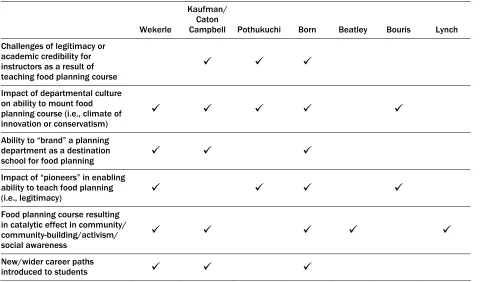
contributors, and allowing themes to emerge that may have been missed in a more empirical approach. Together, the contributions provide a rich set of first-hand insights on a number of benefits and challenges related to teaching emerging planning issues to future planners. The full contributions are provided as an appendix to this article, to provide the full reflections in the authors’ own voices. In this section, we will briefly outline the settings for these seven experiences. This will be followed in the next section by a synthesis and analysis of key themes from the seven contributions.
• Jerome Kaufman, Emeritus Professor, Department of Urban and Regional Planning, University of Wisconsin-Madison; and Marcia Caton Campbell, Milwaukee Program Director, Center for Resilient Cities: Jerome Kaufman’s role12 as a
pioneer in the study of emergent planning issues that took time to become recognized within the field, can be traced back several decades. For Kaufman, his collaboration in 2001 with Marcia Caton Campbell to teach the first class on community food planning in the Department of Urban and Regional Planning, University of Wisconsin-Madison (UWM), marked yet another foray into a topic that was, at the time, “decidedly on the back burner of planning practitioners.” Like Wekerle, Kaufman and Caton Campbell note strong connections between food systems and community-based service initiatives, including student-led community food assessments and other forms of food-related service learning. Reflecting on ten years of food systems plan-ning at UWM, Kaufman and Caton Campbell note the number of students who have
“carried their food planning interests into their