Errors and Correlates in Parental Recall of Child Immunizations:
Effects on Vaccination Coverage Estimates
Lucina Suarez, MS*; Diane M. Simpson, MD, PhD*; and David R. Smith, MD‡
ABSTRACT. Objective. We evaluated the accuracy of parental recall of children’s immunization histories as compared with provider records and examined how er-rors in parental recall correlate with sociodemographic characteristics.
Design. The validation study was part of a popula-tion-based household survey designed to assess immu-nization levels among Texas children under age 2 years. For 72% (n53278), interviewers used vaccination records from the parent to copy dates for the diphtheria and tetanus toxoids and pertussis vaccine (DTP), oral polio vaccine (OPV), and measles, mumps, and rubella (MMR) shots. For parents without shot records (n51216), inter-viewers asked about each vaccine, whether the child had received the shot, how many, and at what age. Of these, 85% (n 5 1029) were validated with health provider records.
Results. Measured against provider records, only 34% of parents accurately recalled the number of DTP shots a child had. More often (42%) parents underestimated the number of DTP shots than overestimated (24%). Agree-ment between parental recall and provider records was high (83%) for the single dose of MMR. Accuracy of parents’ recall did not differ by race/ethnicity, education level, or type of health insurance coverage, but decreased as child’s age increased. Having a vaccination record at home was associated with a higher immunization status. Hispanic, lower educated, and uninsured parents were more likely to have a vaccination record than non-His-panic, higher educated, and privately insured parents.
Discussion. Validity of parental recall of children’s immunization histories depends on the vaccine and the age of the child, which is highly correlated with the number of shots parents must recollect. Results suggest that inclusion of parent recall information from vaccina-tion surveys underestimates DTP:OPV:MMR coverage. This underestimation is consistent across economic and race/ethnic groups. Thus, community surveys based on cards and recall should provide reliable conclusions about which groups need intensive program efforts. For the routine monitoring of vaccination coverage, reason-able estimates can be obtained by combining parent-held record and parent recall data. Caution is required when comparing coverage estimates from different surveys since the source of information and method of derivation will produce widely varying coverage rates. Pediatrics
1997;99(5). URL: http://www.pediatrics.org/cgi/content/
full/99/5/e3; vaccinations, immunization, validity, recall bias, infant.
ABBREVIATIONS. SRS, simple random sample; DTP, diphtheria and tetanus toxoids and pertussis vaccine; OPV, oral polio vac-cine; MMR, measles, mumps, and rubella.
The public health initiative to get 90% of the na-tion’s children adequately immunized before their third birthday1has focused much attention on
mea-surement issues.2Although federal funding to states
for immunizations is tied to the achievement of pre-scribed levels, state and local immunization pro-grams have few options to gauge community vacci-nation coverage. Computerized tracking systems in pediatric clinics are expensive and do not include all children in a community. Retrospective surveys of the school records of children are less costly and are population-based, but their weakness is that esti-mates of coverage are several years out-of-date. Thus, population surveys of immunization coverage may be the best means for assessing needs, setting goals, and measuring progress of immunization ini-tiatives.2 One problem with community
immuniza-tion surveys is that parental responses may be inac-curate. Concern about the validity of parental recall is reasonable since childhood immunization sched-ules are complicated; children routinely receive 9 to 10 different antigens during four or more visits.3
Consequently, verification of parental recall with provider records is desirable, but makes community surveys even more costly and time consuming.
Few studies have evaluated the accuracy of paren-tal recall of their child’s immunization history.4 –11
Most studies are from other countries4 – 8,11 and only
one examined factors related to accuracy.8 Some
studies6,7reported errors of overestimation in
recall-ing measles vaccine; others report that mothers un-derestimated their child’s immunizations8 or that
mothers generally gave accurate assessments.4Two
studies of children presenting to United States emer-gency rooms reported that parental information was too inaccurate for making decisions on whether to immunize.9,10
Using a statewide household survey, we evaluated the degree of accuracy of parental recall of children’s immunization histories as compared with provider records. In addition, we report how errors in paren-tal recall correlate with sociodemographic character-istics. Also, we discuss the effect of errors on vacci-nation coverage estimates and the usefulness of
From the *Associateship for Disease Control and Prevention, Texas Depart-ment of Health, Austin, Texas; and the ‡Office of the Commissioner of Health, Texas Department of Health, Austin, Texas.
Received for publication Mar 4, 1996; accepted May 23, 1996.
information from parent-held vaccination records, parental recall, and provider records.
METHODS Survey
The validation study was part of a population-based household survey designed to assess immunization levels among Texas chil-dren under age 2 years. The statewide survey consisted of samples from 30 counties; 10 counties were preselected because of their population size or race/ethnic composition. To represent the re-mainder of the state, 20 counties were randomly chosen with selection probabilities proportional to the number of births. For all but four counties, we used a three-stage sampling process involv-ing census block groups, blocks, and housinvolv-ing units. In the first stage, a simple random sample (SRS) of 40 census block groups was obtained for each county. In the second stage, a SRS of at least 50% of the blocks was selected from each block group; and in the third stage, a SRS of all housing units up to 20 was chosen from each block. In four sparsely populated counties, we changed the design to reduce costs and increase efficiency by randomly select-ing children from county birth records.
Each selected housing unit was screened to find a child age 2 to 24 months living in the household. At least three attempts were made to contact a member of the selected household. If there was no eligible child in the household, the interviewer asked if an adjacent household had a child 2 to 24 months of age. If there was, an interview was conducted in the adjacent housing unit; if not, a replacement housing unit was randomly drawn. In households with more than one child under 2 years, one child was randomly selected for study.
Trained interviewers used a standardized English- or Spanish-language instrument to solicit information from a parent or legal guardian. The instrument was modeled after the Centers for Dis-ease Control and Prevention State and Local Area Immunization Coverage and Health Survey questionnaire.11 To determine a child’s immunization history, interviewers obtained shot records from the parent and copied dates for each vaccine including diphtheria and tetanus toxoids and pertussis vaccine (DTP), oral polio vaccine (OPV), and measles, mumps, and rubella (MMR) shots. For parents without shot records, interviewers asked about each vaccine, whether the child had received the shot, how many, and at what age.
Over 116 000 households were screened to find children of the appropriate age for inclusion in the survey. A total of 4832 inter-views with parents/guardians was completed during June through November 1994. Respondents were paid $10 for a com-pleted face-to-face interview. There were 311 refusals from house-holds with eligible children and 1038 refusals in which it was unknown whether an eligible child resided in the household. A conservative estimate of the response rate is 78% (4832/48321 10381311).
Consistent with the recommendations of the Advisory Com-mittee on Immunization Practices of the Public Health Service,3we considered children up-to-date if they were: 1) age 3 to 4 months and had received one DTP and one OPV vaccine; 2) age 5 to 6 months and had received two DTP and two OPV vaccines; 3) age 7 to 15 months and had received three DTP and two OPV vaccines; and 4) age 16 to 24 months and had four DTP, three OPV, and one MMR vaccine. For study of vaccination coverage, we restricted the sample to children age 3 to 24 months (n54552).
Validation Study
Among children 3 to 24 months, 72% (n53278) of parents had a vaccination record in the home. Interviewers had to obtain vaccination histories by parental recall for 27% of the respondents (n51216). To validate immunization histories taken by parental recall, interviewers asked where vaccinations were obtained, the health provider name, and health care facility. Parents who said their children had never been vaccinated were not asked for their provider’s name and were excluded from the validation process (n558). Mailed requests for the child’s vaccination records were sent to health providers, after obtaining a signed medical records release from the parent. Written requests were followed up with telephone calls. Providers were located and contacted for 1029 (85%) parents who recalled their child’s immunization histories. In the remaining 187 cases, most could not be located based on information given by the respondent, or in a few instances pro-viders refused requests for information.
Analysis
In this article, we report data on the validity of parental recall when compared with provider records using the 1029 cases in which a provider was successfully contacted. The number of shots for DTP, OPV, and MMR reported by the parent is compared with the number documented in the provider record assumed to be accurate. We measured the degree of accuracy by the percent of parents who were concordant with the number of shots in the provider record. Statistical differences in the proportion who were concordant across race/ethnic, education, and health insurance groups were assessed with ax2test orx2test for trends. For those in the validation sample, we also report the degree of agreement on up-to-date immunization status between recall and provider record. For this purpose, we calculated the positive predictive value as the percentage of children reported as up-to-date that were verified with provider records. Negative predictive value is the percentage of children reported as underimmunized verified as such in the provider records.
Second, to examine the variation in vaccination coverage esti-mates by the source of information, we will refer to three infor-mation groups formed from all survey respondents. First is the “parent-held record” group, or those with vaccination records at home; second is the “recall” group, those without home records who could recall the number of shots; and third, a “don’t know” group, those without home records who were unable to recall whether their child had a shot or the number.
RESULTS Validity of Parental Recall
Table 1 shows the agreement on the number of DTP shots between parental recall and provider records for the 1029 children age 3 to 24 months in the validation study. For 11% (n5 117) of children with no home record, the provider had no vaccina-tion record on the child. In addivaccina-tion, when parents were specifically asked about their child’s DTP shots, 19% of parents did not know if the child had received the shot (6%) or how many (13%). Provider records indicated that 89% of the “don’t know” group had at
TABLE 1. Agreement Between Parental Recall and Provider Record on the Number of DTP Shots, Children Age 3 to 24 Months
Recall Provider Record Total
Number of DTP Shots No Record
0 1 2 3 41
0 2 3 2 3 3 9 22
1 16 43 32 45 18 19 173
2 28 28 46 115 35 29 281
3 6 22 32 115 57 23 255
41 3 3 8 32 48 8 102
Didn’t know 19 26 29 61 32 29 196
least one shot. Excluding those without provider records and responses of “don’t know”, only 34% of parents accurately recalled the number of DTP shots based on provider records. More often (42%) a parent underestimated the number of DTP shots a child had than overestimated (24%). Agreement on the number of OPV shots (not shown) mirrored results on the DTP shot; the two vaccines have similar multidose schedules.
Table 2 shows the agreement between parental recall and provider records for the single MMR shot for children age 16 to 24 months, when the MMR should have been received. Agreement between pa-rental recall and provider records was high (83%). Parents more often overreported than underreported whether the child had received an MMR shot. The proportion of “don’t know” responses was higher (31%) than for the DTP shot.
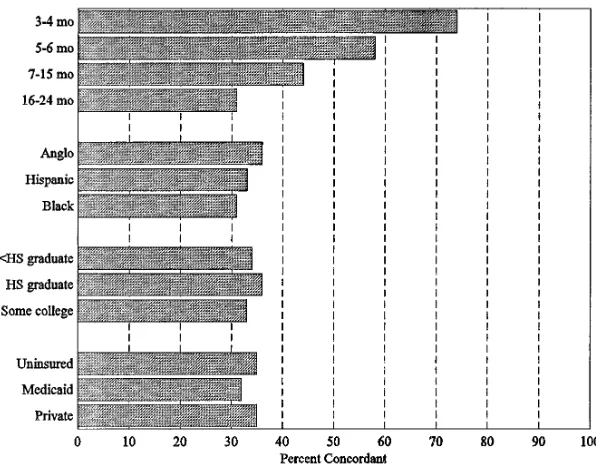
Accuracy of parents’ recall, measured by the con-cordance on the number of DTP shots, did not differ among race/ethnic groups, by education level, or type of health insurance coverage (Fig 1). Accuracy did decrease as the age of the child increased (x2for
linear trend544.1, P,.00001), and this was directly related to the number of shots that parents had to remember.
Table 3 shows the positive and negative predictive value of parental recall. Of greater interest is the comparison of the immunization levels measured by parental recall with levels recorded by the provider. For DTP and OPV, the percent up-to-date is higher when based on provider records. For the single MMR shot, parents overreported whether their child received a dose; thus, parental recall shows a higher level of immunization. For the series, the up-to-date level based on provider records is 20 percentage points higher than what would have been obtained by parental recall.
Vaccination Cards and Immunization Status
Among all survey respondents, the proportion with vaccination records in the home varied with race/ethnicity, education level, and health insurance coverage but not with the child’s age. Eighty percent of Hispanic parents held a vaccination record, far more than Anglos (65%) or African-American par-ents (61%), (x2 5 144.0, df 5 2, P , .000001). The
higher the education level, the less likely the parent had a vaccination record in the home (x2for linear
trend567.8, P,.00001). The uninsured were more likely to have a vaccination record (78%) than
par-ents with private health insurance (66%) or Medicaid (73%), (x2559.3, df52, P,.000001). In multivariate
analysis, these factors (Hispanic ethnicity, education, uninsured status) remained independent and signif-icant predictors of having a vaccination record, with ethnicity as the strongest predictor. Having a vacci-nation record in the home was associated with a higher immunization status (66% up-to-date). Pro-vider record information showed that the parental recall and the “don’t know” group had lower immu-nization levels (53% and 44% up-to-date, respec-tively).
DISCUSSION
The importance of accurate assessments of vacci-nation coverage in meeting vacci-national goals cannot be overemphasized. Under Centers for Disease Control and Prevention monitoring guidelines, state immu-nization programs must obtain annual estimates of vaccination coverage. To this end, states are strongly encouraged to conduct population-based telephone, household, or birth certificate follow-back surveys. These population surveys of vaccination coverage, whether in person or by telephone, will need to rely on vaccination records in the home or parents’ re-ports or both. How data from parent-held records and parental recall are eventually used to calculate coverage estimates will have a great effect on esti-mates obtained. Observations from our study may offer some insight into the validity of immunization coverage estimates from survey information. We can comment on the direction of parental recall bias and the effect of this bias on coverage estimates.
Direction of Bias
We found that the validity of a parent’s recall of their child’s immunization history depended on the vaccine and the age of the child, which is highly correlated with the number of shots parents must recollect. Parents overreported if their child had re-ceived the one recommended dose of MMR, but tended to underestimate the total number of doses of DTP and OPV. This error in recall has been demon-strated in two studies outside the United States.5,8In
a population study of 1171 Costa Rican mothers, accuracy also was related to age of the child; that is, the larger the number of doses, the more the mother underestimated.8A study among children seen at a
New South Wales, Australia, hospital also found that parents recalled fewer doses of DTP or OPV than were recorded in the medical records.5 As in the
Costa Rican study, we were reassured that this bias was nondifferential; that is, the accuracy of parental recall was not related to demographic or economic characteristics of the mother. Thus, surveys based on parental recall will reliably assess the relative immu-nization status of various population groups, an im-portant aspect for targeting community efforts.
Effect of “Don’t Know” Responses on Coverage Estimates
When relying on parental recall, the treatment of the inevitable missing information is an important issue. A study of parents attending a pediatric
emer-TABLE 2. Agreement Between Parental Recall and Provider Record on the Number of MMR Shots, Children Age 16 to 24 Months
Recall Provider Record
Number of MMR Shots No Record Total
0 11
0 18 15 7 40
11 45 169 23 237
Didn’t know 30 73 22 125
gency room showed that the frequency of “don’t know” responses to immunization questions de-pended on the wording.9General questions such as
“has your child received all, some, or none of their immunizations” generated fewer “don’t knows” than specific questions about the number of shots for specific vaccines. We found this to be true in our survey. Asking parents without vaccination records about each vaccine, the number of doses, and age at each dose resulted in missing information for 29%. When asked a general question (has your child re-ceived all shots needed?), 98% of parents gave a definite yes or no answer. But on further examina-tion, we found that this general query was no better in its positive predictive value (65%) than the specific queries (68%). Moreover, parents overreported an up-to-date immunization status (75%) in response to this question when compared with provider records (57%). Within a clinic setting, parental recall is not a satisfactory method of determining if a child present-ing for medical care is up-to-date.
With regard to measuring population coverage, assumptions about the immunization status of the “don’t know” group will have some effect on cover-age estimates. The proportion of missing information
in our survey was not large (8% for DTP:OPV:MMR series) when information from cards and recall was combined. In a previous study,12we calculated DTP:
OPV:MMR coverage rates based on all information collected, including parent-held vaccination records and parental recall. Classifying children whose par-ents cannot recall their immunization history as un-derimmunized resulted in a state coverage estimate of 55%. Our validation data showed that about half of the unknown status group is up-to-date when medical records were examined. If we had excluded this unknown group, the coverage estimate would have been 60%, much closer to the true rate. Thus, in surveys where validation with provider records is not possible, excluding this group from calculation should result in more accurate coverage estimates.
Effect of Source of Information on Coverage Estimates Goldman’s careful study of immunization cover-age in Guatemala showed that vastly different esti-mates could be derived by varying the method of calculation and the source of data.13The use of
vac-cination records alone, discarding responses without a written record, seriously overestimates coverage in the general population.13Our study shows that
hav-ing a vaccination record in the home is related to a higher immunization status and is strongly associ-ated with race/ethnicity, education, and health in-surance. Thus, coverage studies using written records alone would result in biased estimates for subpopulation groups.
Our validity results show that the effect of using parental recall information will be to underestimate DTP:OPV:MMR coverage. But does supplemental provider record information significantly improve the coverage estimate from surveys of parents? In this state survey of vaccination coverage, the addi-tional cost of retrieving provider records for parents who did not have vaccination records in the home was considerable. Replacing parental recall with pro-vider record information increased the estimate from
Fig 1. Concordance on the number of DTP shots by selected demographic factors.
TABLE 3. Percent Up-to-date* (%UTD) on Immunizations: Parental Recall vs Provider Records
Vaccine Parent Recall
Provider Record
PPV† NPV†
%UTD %UTD
DTP (n5745) 44.3 59.6 70.6% 49.2% OPV (n5751) 60.9 78.6 84.7% 31.0% MMR (n5247)‡ 86.6 74.5 79.0% 54.5% DTP:OPV:MMR (n5657) 39.0 59.1 68.4% 46.7%
* In calculating percent up-to-date, children whose parents didn’t know about their shots and children whose provider found no record were excluded.
† PPV 5 positive predictive value of recall, NPV 5 negative predictive value of recall
60% to 62%. The lack of any significant change in the DTP:OPV:MMR coverage estimate is probably due to the high proportion of subjects with written records. Since provider record verification was a costly endeavor, the improvement in accuracy may not have been worth the effort. For the routine mon-itoring of vaccination coverage, we believe that rea-sonable estimates can be obtained by combining par-ent-held record and parent recall data.
In conclusion, our results suggest that inclusion of parent recall information on child vaccinations slightly underestimates DTP:OPV:MMR coverage. This underestimation is consistent across economic and race/ethnic groups. Thus, community surveys based on cards and recall should provide reliable conclusions about which groups need intensive program efforts. Caution is required, however, when comparing coverage estimates from different surveys since the source of information and method of derivation will produce widely varying coverage rates.
ACKNOWLEDGMENTS
We thank James Dyer, PhD, Craig Blakely, PhD, and their staff at the Public Policy Research Institute at Texas A&M University who conducted the survey and provided consultation on the survey design. We also thank, in particular, Radmila Prislin, PhD, who reviewed the manuscript and offered valuable suggestions.
REFERENCES
1. Robinson CA, Sepe SJ, Lin DFY. The president’s child immunization initiative—a summary of the problem and the response. Public Health
Rep. 1993;108:419 – 425
2. Cutts FT, Zell ER, Mason D, Bernier RH, Dini EF, Orenstein WA. Monitoring progress toward US preschool immunization goals. JAMA. 1992;267:1952–1955
3. Centers for Disease Control and Prevention. General recommendations on immunization: recommendations of the Advisory Committee on Immunization Practices (ACIP). MMWR. 1994;43(No. RR-1):1–38 4. Gareaballah ET, Loevinsohn BP. The accuracy of mothers’ reports about
their children’s vaccination status. Bull World Health Organ. 1989;67: 669 – 674
5. Ferson MJ. Immunisation state and its documentation in hospital pa-tients. Arch Dis Child. 1990;65:763–767
6. Hawe P, Wilson A, Fahey P, et al. The validity of parental report of vaccination as a measure of a child’s measles immunisation status. Med
J Aust. 1991;155:681– 686
7. McKinney PA, Alexander FE, Nicholson C, Cartwright RA, Carrette J. Mothers’ reports of childhood vaccinations and infections and their concordance with general practitioner records. J Public Health Med. 1991;13:13–22
8. Valadez JJ, Weld LH. Maternal recall error of child vaccination status in a developing nation. Am J Public Health. 1991;82:120 –122
9. Goldstein KP, Kviz FJ, Daum RS. Accuracy of immunization histories provided by adults accompanying preschool children to a pediatric emergency department. JAMA. 1993;270:2190 –2194
10. Joffe MD, Luberti A. Effect of emergency department immunization on compliance with primary care. Pediatr Emerg Care. 1994;10:317–319 11. Centers for Disease Control and Prevention. State and Local Area
Immu-nization Coverage and Health Survey. SLICHS Questionnaire. Atlanta, GA;
Centers for Disease Control and Prevention; April-June, 1994. Paper version Q2–94 Final
12. Simpson D, Suarez L. The immunization status of Texas children age 3–24 months: results of the 1994 Texas immunization survey. Tex Med. 1996;92:60 – 65
13. Goldman N, Pebley AR. Health cards, maternal reports and the mea-surement of immunization coverage: the example of Guatemala. Soc Sci
DOI: 10.1542/peds.99.5.e3
1997;99;e3
Pediatrics
Lucina Suarez, Diane M. Simpson and David R. Smith
Vaccination Coverage Estimates
Errors and Correlates in Parental Recall of Child Immunizations: Effects on
Services
Updated Information &
http://pediatrics.aappublications.org/content/99/5/e3 including high resolution figures, can be found at:
References
http://pediatrics.aappublications.org/content/99/5/e3#BIBL This article cites 11 articles, 1 of which you can access for free at:
Permissions & Licensing
http://www.aappublications.org/site/misc/Permissions.xhtml in its entirety can be found online at:
Information about reproducing this article in parts (figures, tables) or
Reprints
DOI: 10.1542/peds.99.5.e3
1997;99;e3
Pediatrics
Lucina Suarez, Diane M. Simpson and David R. Smith
Vaccination Coverage Estimates
Errors and Correlates in Parental Recall of Child Immunizations: Effects on
http://pediatrics.aappublications.org/content/99/5/e3
located on the World Wide Web at:
The online version of this article, along with updated information and services, is
by the American Academy of Pediatrics. All rights reserved. Print ISSN: 1073-0397.